





Introduction
The judgment delivered by the Madras High Court in M/s V.V.V. & Sons Edible Oils Ltd. v. M/s Meenakshi Overseas LLC & Connected Matters is an important decision at the intersection of trademark law and civil procedure. The dispute revolved around the well-known “Idhayam” trademark and allegations that goods bearing the mark were being manufactured and exported from India for sale in the United States under arrangements involving entities claiming rights over the mark abroad.
The case raised significant questions regarding:
- The territorial nature of trademark rights
- The effect of foreign trademark registrations
- The maintainability of infringement suits involving export activities
- The limited scope of rejection of plaints under Order VII Rule 11 of the Code of Civil Procedure, 1908
The judgment is particularly relevant for:
- Trademark proprietors
- Exporters
- Manufacturers engaged in international trade
- Intellectual property practitioners
- Litigants facing objections based on res judicata
- Parties alleging suppression of facts
- Cases involving abuse of process
- Disputes relating to non-joinder of parties
The decision reiterates that disputed questions of fact and law ordinarily cannot be decided at the threshold stage by rejecting a plaint and must instead be adjudicated through a full-fledged trial.
Factual and Procedural Background
M/s V.V.V. & Sons Edible Oils Limited is a well-known Indian manufacturer and marketer of sesame oil sold under the trademark “Idhayam.” The company asserted that the mark had been registered in India since 1986 and had acquired considerable goodwill and reputation both domestically and internationally.
According to the plaintiff, M/s Meenakshi Overseas LLC, a company based in the United States, had obtained registration of the mark “Idhayam” in the United States. The plaintiff alleged that this registration had been obtained through misrepresentation and that the foreign entity had also registered trademarks associated with other well-known Indian brands.
The plaintiff further claimed that Indian entities, including Shivaraja Impex Company and Damodar Foods, were affixing the mark “Idhayam” or similar marks on goods in India and exporting them to the United States.
Key Proceedings Arising from the Dispute
| Case Number | Parties Involved | Relief Sought / Issue | Outcome |
|---|---|---|---|
| C.S. No. 726 of 2017 | Meenakshi Overseas LLC, Shivaraja Impex Company, and Damodar Foods | Relief against alleged trademark infringement and export activities | Plaint rejected under Order VII Rule 11 CPC for lack of cause of action and suppression of material facts regarding U.S. proceedings |
| C.S. No. 434 of 2017 | Damodar Foods | Trademark infringement and passing off | Dismissed after full trial; court held suit suffered from non-joinder of Meenakshi Overseas LLC and involved goods intended exclusively for export |
| C.S. No. 987 of 2017 | Related parties | Injunctions and damages | Rejected under Order VII Rule 11 CPC on grounds including res judicata and Order II Rule 2 CPC |
| C.S. No. 235 of 2020 | Related parties | Injunctions and damages | Rejected on similar grounds of res judicata and Order II Rule 2 CPC |
Several proceedings arose from these allegations.
In C.S. No. 726 of 2017, the plaintiff sought relief against Meenakshi Overseas LLC, Shivaraja Impex Company, and Damodar Foods. The plaint was subsequently rejected under Order VII Rule 11 CPC on the ground that it did not disclose a valid cause of action and that the plaintiff had suppressed material facts concerning earlier proceedings in the United States.
In C.S. No. 434 of 2017, Damodar Foods was sued for alleged infringement and passing off. Following a full trial, the suit was dismissed. The Single Judge held that the suit suffered from non-joinder of Meenakshi Overseas LLC, which held the U.S. registration, and further concluded that the goods were intended exclusively for export and that the plaintiff could not restrain such activities in the circumstances of the case.
The plaintiff also instituted C.S. No. 987 of 2017 and C.S. No. 235 of 2020 seeking injunctions and damages. These suits too were rejected under Order VII Rule 11 CPC on the grounds of res judicata and Order II Rule 2 CPC, the courts holding that the plaintiff was attempting to re-litigate matters already adjudicated.
Aggrieved by these orders and judgments, the plaintiff filed a batch of appeals, namely O.S.A. Nos. 63 and 64 of 2019, O.S.A. (CAD) No. 23 of 2022, and O.S.A. Nos. 139 and 140 of 2025 before the Division Bench of the Madras High Court.
Dispute Before the Court
The central issue before the Division Bench was whether the various orders rejecting the plaints and dismissing the suit were legally sustainable.
Plaintiff’s Contentions
The plaintiff argued that:
- Its registered trademark rights under Indian law were independent of any proceedings or registrations in the United States.
- The defendants were affixing the disputed mark in India and exporting goods bearing that mark, thereby committing infringement within India.
- Foreign litigation could not extinguish rights conferred by Indian trademark registrations.
- Each export transaction constituted a fresh cause of action.
Defendants’ Contentions
The defendants, on the other hand, maintained that:
- The plaintiff had already challenged the U.S. registration abroad and failed.
- The Indian proceedings amounted to suppression of material facts.
- The suits constituted re-litigation and abuse of process.
- The claims were barred by res judicata and Order II Rule 2 CPC.
- Meenakshi Overseas LLC was a necessary party to the proceedings.
- Exports undertaken under a valid foreign trademark registration could not be restrained.
Issues for Determination
Thus, the Court was required to determine whether:
- The objections raised by the defendants justified rejection of the plaints at the threshold stage.
- The dismissal of the suit on grounds of non-joinder was legally sustainable.
- The related procedural objections warranted termination of the proceedings without a full trial.
- The disputes involved questions that required adjudication through evidence and detailed examination.
Accordingly, the Division Bench examined whether the plaints disclosed a cause of action and whether the procedural objections relied upon by the defendants could legitimately justify rejection under Order VII Rule 11 CPC or dismissal of the suit without a complete adjudication on merits.
Reasoning and Analysis of the Court
The Division Bench undertook a detailed examination of the principles governing Order VII Rule 11 CPC.
Scope of Order VII Rule 11 CPC
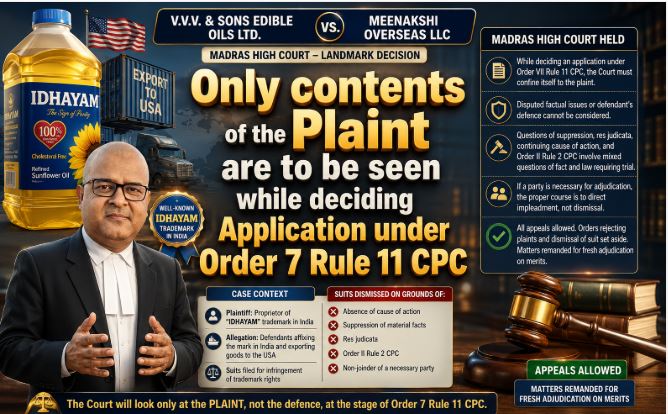
The Court reiterated the settled principle that while considering an application under Order VII Rule 11 CPC, the Court must confine itself to the averments contained in the plaint and the documents relied upon by the plaintiff. The defence set up by the defendant cannot ordinarily be considered at that stage.
Examining the plaint in C.S. No. 726 of 2017, the Court found that it clearly contained material facts constituting a cause of action. The plaintiff had specifically alleged that Indian entities were affixing the impugned trademark within India and exporting goods bearing that mark. These allegations, if proved, could potentially give rise to a valid claim under Indian trademark law.
Consequently, the Court held that rejection of the plaint on the ground of absence of cause of action was unjustified.
Effect of Foreign Proceedings
The Court further observed that the foreign proceedings in the United States were not, by themselves, determinative of the plaintiff’s rights under Indian trademark law.
The suits before the Indian courts were not directed at restraining sales in the United States but were based upon alleged acts of affixation and export occurring within India. Whether those acts amounted to infringement was a matter requiring evidence and trial.
Suppression of Facts and Abuse of Process
The Division Bench also considered the allegations of suppression of material facts and abuse of process.
Referring to the Supreme Court’s decision in K.K. Modi v. K.N. Modi (1998) 3 SCC 573, which deals with abuse of judicial process and re-litigation, the Court held that the precedent could not be mechanically applied.
Whether suppression had occurred and whether it was sufficient to non-suit the plaintiff were issues requiring proper adjudication and could not ordinarily be conclusively determined at the Order VII Rule 11 stage.
Res Judicata and Order II Rule 2 CPC
With respect to the rejection of the plaints in C.S. Nos. 987 of 2017 and 235 of 2020 on grounds of res judicata and Order II Rule 2 CPC, the Court found that the earlier suit relied upon for invoking these bars had not been finally decided when the later suits were instituted.
Since final adjudication is an essential requirement for attracting Section 11 CPC, the bar of res judicata was not apparent from the plaint itself.
The Court referred to Section 10 CPC, which deals with stay of suits where substantially similar issues are pending in an earlier suit.
It noted that questions regarding identity of causes of action, continuing wrongs, and applicability of Order II Rule 2 CPC involved mixed questions of fact and law that could not be decided summarily without evidence.
Non-Joinder of Parties
Another important aspect of the judgment concerned non-joinder of parties.
In C.S. No. 434 of 2017, the suit had been dismissed largely because Meenakshi Overseas LLC had not been impleaded.
The Division Bench referred to Order I Rule 9 CPC and Order I Rule 10(2) CPC and held that even if Meenakshi Overseas LLC was a necessary party, the appropriate course was to direct its impleadment rather than dismiss the suit outright.
Common Trademark Issues Requiring Trial
The Court emphasized that the key issues concerning the effect of foreign trademark registrations, alleged infringement through export activities, and the interpretation of Sections 29(6), 30(2)(b), and 56 of the Trade Marks Act, 1999 were common to all the connected suits.
Since these issues had not been comprehensively adjudicated with participation of all necessary parties, the interests of justice required a fresh and consolidated examination.
Authorities Considered by the Court
The Court also discussed and considered several authorities cited by the parties, including:
- Crompton Greaves Ltd. v. Salzer Electronics Ltd. [2011 (6) CTC 157]
- Mahendra & Mahendra Paper Mills Ltd. v. Mahindra & Mahindra Ltd. [AIR (2002) SC 117]
- Cadila Pharmaceuticals Ltd. v. Madley Laboratories [(2011) SCC OnLine Bom 484]
- Kamala v. K.T. Eshwara Sa
- Alpana Gupta v. APG Towers Pvt. Ltd. [AIR (2008) SC 3174]
- Kum. Geetha v. Nanjundaswamy [AIR (2023) SC 5516]
However, the Court primarily focused on the procedural question of whether the disputes could be terminated at the threshold stage and concluded that a full trial was necessary.
Final Decision of the Court
The Division Bench allowed all the appeals.
- The orders rejecting the plaint in C.S. No. 726 of 2017 were set aside and the suit was restored for fresh consideration on merits.
- The orders rejecting the plaints in C.S. No. 987 of 2017 and C.S. No. 235 of 2020 were also set aside, and those suits were restored to the file of the Single Judge for trial and adjudication on merits.
- The judgment and decree dated 23 August 2021 in C.S. No. 434 of 2017 were likewise set aside and the matter was remanded for fresh adjudication.
- The Court granted liberty to the plaintiff to implead Meenakshi Overseas LLC in the connected suits.
Point of Law Settled
The judgment reinforces several important legal principles:
- A plaint can be rejected under Order VII Rule 11 CPC only when the absence of a cause of action or the legal bar to the suit is apparent from the plaint itself.
- Courts cannot evaluate disputed facts or rely on the defendant’s version while exercising powers under Order VII Rule 11 CPC.
- Questions relating to suppression of facts, abuse of process, res judicata, continuing cause of action, and applicability of Order II Rule 2 CPC often involve mixed questions of fact and law and ordinarily require evidence before they can be conclusively decided.
- Where a court considers a party necessary for effective adjudication, the preferred course is ordinarily to direct impleadment under Order I Rule 10 CPC rather than dismissing the suit altogether.
- The judgment also underscores that disputes concerning alleged trademark infringement through activities occurring within India cannot be summarily dismissed merely because related trademark proceedings or registrations exist in a foreign jurisdiction.
Key Legal Principles at a Glance
| Issue | Principle Laid Down |
|---|---|
| Order VII Rule 11 CPC | Only plaint averments and plaintiff’s documents can be examined. |
| Cause of Action | If material facts disclose a cause of action, the plaint cannot be rejected. |
| Foreign Proceedings | Foreign trademark disputes do not automatically determine rights under Indian law. |
| Res Judicata | Requires final adjudication; cannot be presumed at the threshold stage. |
| Order II Rule 2 CPC | Often involves mixed questions of fact and law requiring evidence. |
| Suppression of Facts | Ordinarily requires adjudication and evidence before a final conclusion. |
| Necessary Parties | Impleadment should generally be directed instead of outright dismissal. |
| Trademark Infringement by Export | Alleged infringing acts occurring within India require proper trial and adjudication. |
Case Details
| Particulars | Details |
|---|---|
| Title of the Case | V.V.V. & Sons Edible Oils Ltd. Vs Meenakshi Overseas LLC & Ors. |
| Date of Judgment/Order | 05 June 2026 |
| Case Number | O.S.A. No. 63 of 2019, O.S.A. No. 64 of 2019, O.S.A. (CAD) No. 23 of 2022, O.S.A. No. 139 of 2025 and O.S.A. No. 140 of 2025 |
| Name of Court | High Court of Judicature at Madras |
| Name of Hon’ble Judges | Hon’ble Mr. Justice P. Velmurugan and Hon’ble Mrs. Justice K. Govindarajan Thilakavadi |

