





U.S.-Iran Understanding, the Strait of Hormuz, and the Shifting Balance of Power: A Legal and Strategic Analysis
Introduction
Few waterways are as strategically significant to the modern world as the Strait of Hormuz. For decades, this narrow maritime passage has served as one of the most critical arteries of global energy trade. Any disruption to navigation through the Strait reverberates instantly across international markets, diplomatic circles, and security establishments.
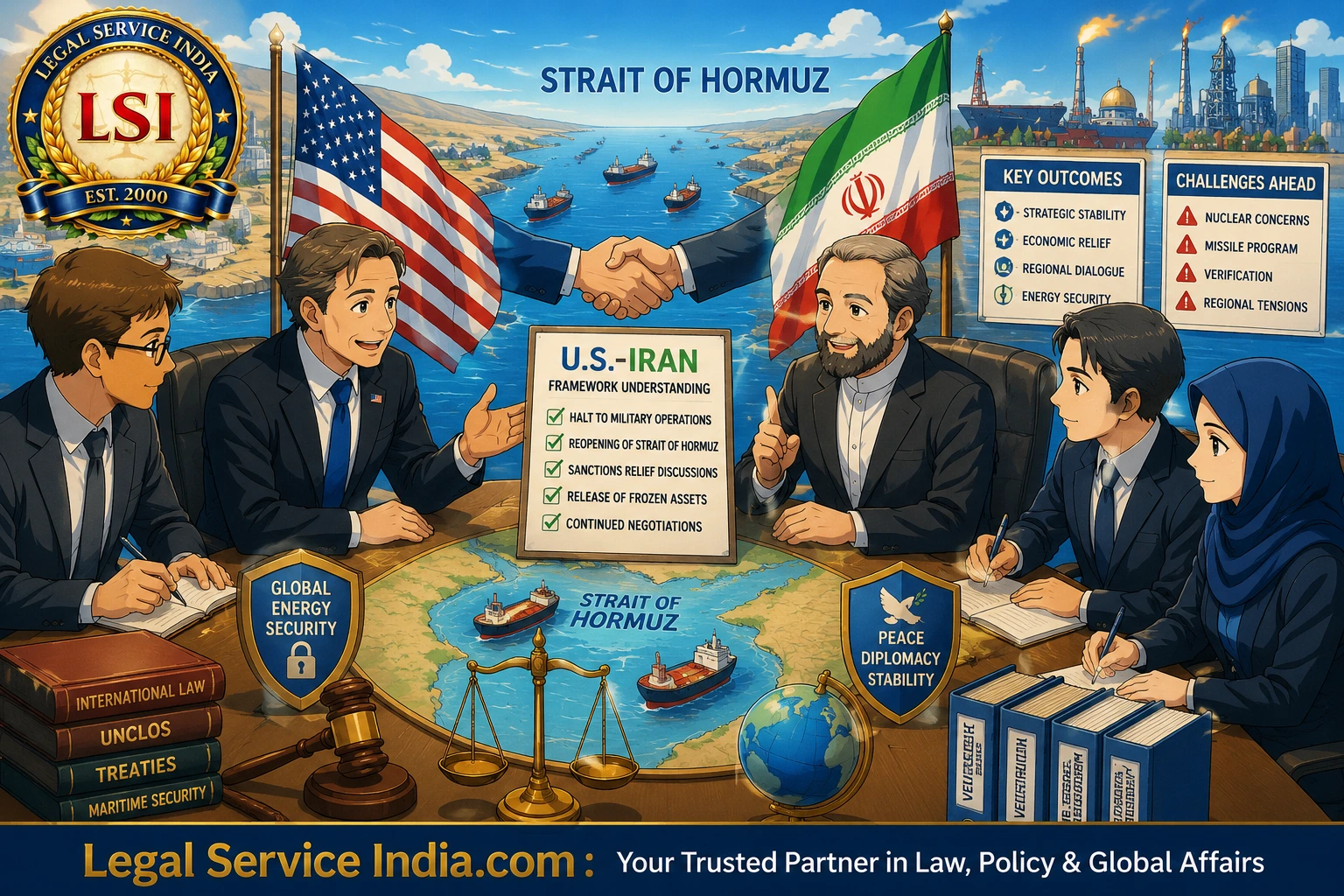
Recent reports and political commentary suggest that a new understanding may be emerging between the United States and Iran following months of heightened tensions, military confrontations, economic pressure, and diplomatic manoeuvring. According to the narrative advanced in the source material, Washington and Tehran have reached a framework arrangement that could fundamentally alter regional dynamics, reopen channels of negotiation, and potentially reshape the geopolitical balance of the Middle East.
As a lawyer who has spent more than twenty-five years studying international disputes, state conduct, treaty obligations, and the legal architecture governing interstate relations, I believe it is essential to separate political rhetoric from legal realities. Nevertheless, even allegations and perceptions surrounding major diplomatic developments deserve careful examination because they often influence policy decisions as much as established facts.
The Central Claim: A U.S.-Iran Framework Understanding
According to news reports, the United States and Iran have reportedly reached a Memorandum of Understanding rather than a comprehensive peace agreement. The distinction is legally important.
A memorandum of understanding generally serves as a framework document outlining future intentions, principles, or negotiating objectives. Unlike a binding treaty, an MoU often leaves substantial details unresolved and anticipates further negotiations before enforceable commitments emerge.
The source claims that the understanding provides for:
- A halt to military operations.
- Reopening of the Strait of Hormuz.
- Discussions regarding sanctions relief.
- Release of certain frozen Iranian assets.
- Continued negotiations concerning broader issues.
If accurate, such an arrangement would represent a significant diplomatic shift from confrontation toward managed engagement.
However, from a legal perspective, the true significance of any MoU depends entirely upon:
- Its precise language.
- Whether obligations are binding.
- Verification mechanisms.
- Enforcement provisions.
- International oversight arrangements.
Without public disclosure of the document, definitive legal conclusions remain impossible.
MoU vs. Treaty: Key Legal Differences
| Aspect | Memorandum of Understanding (MoU) | Treaty |
|---|---|---|
| Legal Status | Often non-binding | Generally legally binding |
| Purpose | Framework for future cooperation | Creates enforceable obligations |
| Negotiation Stage | Preliminary or transitional | Finalized agreement |
| Enforcement | Usually limited | May include formal mechanisms |
| Flexibility | High | Lower due to legal commitments |
The Strait of Hormuz: The Strategic Prize
One of the recurring themes in the source material is that the reopening of the Strait of Hormuz constitutes the most important practical outcome of the alleged understanding.
The Strait is not merely a regional concern. A substantial portion of the world’s oil and liquefied natural gas shipments transit through this maritime corridor. Consequently, any threat to navigation immediately becomes a matter of international concern.
The transcript argues that Iran has emerged with increased leverage over Hormuz and may seek to regulate or manage passage through various forms of monitoring or service fees.
From the standpoint of international maritime law, particularly principles reflected in the United Nations Convention on the Law of the Sea (UNCLOS), international straits generally remain subject to transit passage rights. Any attempt by a coastal state to impose restrictions, tolls, or discriminatory conditions would likely generate substantial legal and diplomatic challenges.
Thus, if future arrangements concerning Hormuz are indeed under discussion, they will have implications extending far beyond the Middle East.
Why the Strait of Hormuz Matters
- Critical route for global oil transportation.
- Essential corridor for liquefied natural gas exports.
- Vital to international energy security.
- Strategically significant for maritime commerce.
- Directly impacts global energy prices and supply chains.
The Nuclear Question: What Is Missing?
Perhaps the most striking aspect of the alleged framework is not what it contains but what it reportedly omits.
The source repeatedly emphasises that:
- Iran’s missile capabilities remain untouched.
- No definitive nuclear dismantlement provisions have been announced.
- Verification arrangements remain uncertain.
- Future discussions are contemplated rather than immediate commitments.
Historically, international concern regarding Iran has centred on nuclear enrichment activities, transparency obligations, and verification by the International Atomic Energy Agency (IAEA).
The 2015 Joint Comprehensive Plan of Action (JCPOA) sought to address these concerns through detailed limitations, inspections, and monitoring procedures. The transcript argues that the alleged new arrangement lacks many of those specific safeguards.
Whether this criticism is justified can only be assessed once authoritative details become available. Nevertheless, from a legal perspective, verification mechanisms are the cornerstone of any credible non-proliferation agreement.
A promise without verification is diplomatically valuable but legally fragile.
Key Nuclear Concerns Highlighted
| Issue | Status According to the Transcript |
|---|---|
| Missile Program | Not addressed |
| Nuclear Dismantlement | No announced commitment |
| Verification Mechanisms | Uncertain |
| IAEA Oversight | Not clearly defined |
| Future Negotiations | Expected to continue |
Economic Relief and Frozen Assets
Another major issue raised concerns sanctions relief and the potential release of frozen Iranian assets.
The transcript refers to:
- Billions of dollars in frozen funds.
- Alleged reconstruction assistance.
- Discussions involving substantially larger compensation or development packages.
Economic sanctions have long been among the most powerful tools employed against Iran. Their gradual removal would signify recognition that diplomacy has become preferable to sustained economic confrontation.
Legally, sanctions relief often requires the following:
- Executive action.
- Regulatory amendments.
- Legislative cooperation in some jurisdictions.
- Compliance reviews.
- International coordination among financial institutions.
Therefore, announcements regarding sanctions relief are only the beginning of a lengthy implementation process.
Sanctions Relief Implementation Process
| Step | Requirement |
|---|---|
| 1 | Executive Action |
| 2 | Regulatory Amendments |
| 3 | Legislative Cooperation |
| 4 | Compliance Verification |
| 5 | International Financial Coordination |
Israel’s Concerns and Regional Security
The transcript portrays Israel as deeply dissatisfied with the reported understanding and suggests that Israeli leaders view the arrangement as strategically unfavourable.
Whether or not one accepts that characterisation, it is undeniable that Israel’s security concerns remain central to any Middle Eastern diplomatic framework.
For many years, Israeli policymakers have argued that the following are true:
- Iran’s regional influence poses a security challenge.
- Ballistic missile development remains a concern.
- Proxy organisations supported by Tehran affect regional stability.
Consequently, any agreement that does not explicitly address these issues would inevitably face scrutiny within Israeli political and security circles.
From an international law perspective, sustainable peace arrangements generally require accommodation of the security interests of all major stakeholders. Excluding key concerns rarely produces durable stability.
Regional Security Issues at a Glance
| Security Issue | Concern Raised |
|---|---|
| Iranian Regional Influence | Strategic balance in the Middle East |
| Ballistic Missile Program | Potential military threat |
| Proxy Organizations | Impact on regional stability |
| Diplomatic Framework | Need for comprehensive security guarantees |
| Long-Term Peace | Inclusion of all stakeholders’ concerns |
The Broader Geopolitical Narrative
The source advances a larger argument: that recent developments symbolise a decline in American influence and the rise of alternative centres of power, particularly Iran and China.
Such claims should be approached cautiously.
Global power transitions are rarely determined by a single negotiation, conflict, or diplomatic compromise. Rather, they emerge through:
- Economic performance.
- Technological innovation.
- Military capability.
- Diplomatic reach.
- Institutional influence.
| Key Driver | Role in Global Power Transitions |
|---|---|
| Economic Performance | Determines long-term national strength and resilience. |
| Technological Innovation | Shapes competitiveness, security, and future growth. |
| Military Capability | Influences deterrence and strategic influence. |
| Diplomatic Reach | Expands international partnerships and alliances. |
| Institutional Influence | Strengthens the ability to shape global norms and policies. |
Even if a negotiated understanding reflects tactical compromises by Washington, it does not automatically establish a broader strategic realignment.
Nevertheless, perceptions matter enormously in international relations. If major regional actors believe power balances are shifting, those perceptions themselves can influence future conduct.
The Legal Difference Between Victory and Settlement
One recurring theme in the transcript is whether the alleged understanding represents a victory for Iran, a defeat for the United States, or a setback for Israel.
Lawyers tend to view such questions differently from political commentators.
International agreements rarely produce absolute winners or losers.
Instead, successful diplomacy often reflects the following:
- Mutual concessions.
- Managed disagreements.
- Deferred disputes.
- Preservation of core interests.
Measuring the Success of Diplomatic Arrangements
The true measure of any arrangement is not who claims victory on signing day but whether the agreement prevents conflict, maintains stability, and creates a workable framework for future engagement.
| Diplomatic Objective | Indicator of Success |
|---|---|
| Conflict Prevention | Reduction in the risk of military confrontation. |
| Regional Stability | Maintenance of peace and security. |
| Future Engagement | Creation of a sustainable framework for dialogue. |
| Protection of Interests | Preservation of essential national objectives. |
Conclusion
If the reported framework between the United States and Iran ultimately proves accurate, it may represent one of the most consequential diplomatic developments in the Middle East in recent years. The alleged reopening of the Strait of Hormuz, discussions concerning sanctions relief, and renewed negotiations over nuclear issues would have implications extending far beyond the region.
Yet caution remains essential. Much of the information currently circulating consists of claims, leaked reports, political interpretations, and competing narratives. Until official texts are released and independently verified, definitive conclusions remain premature.
From the perspective of international law, the ultimate question is not whether one side can claim political triumph. The real test is whether any emerging framework can reduce the risk of war, preserve freedom of navigation, ensure compliance with international obligations, and contribute to a more stable regional order.
International Law Perspective
- Reduce the risk of war.
- Preserve freedom of navigation.
- Ensure compliance with international obligations.
- Contribute to a more stable regional order.
History teaches that durable peace is rarely achieved through rhetoric alone. It is built through transparent commitments, credible verification, and sustained diplomatic engagement.
Pillars of Durable Peace
| Essential Pillar | Purpose |
|---|---|
| Transparent Commitments | Build trust among participating parties. |
| Credible Verification | Ensure compliance and accountability. |
| Sustained Diplomatic Engagement | Maintain long-term stability and cooperation. |
The reported U.S.-Iran framework understanding is said to be a Memorandum of Understanding (MoU) aimed at reducing tensions, reopening the Strait of Hormuz, discussing sanctions relief, and continuing diplomatic negotiations. If confirmed, it could become one of the most significant Middle East diplomatic developments of 2026, affecting regional stability, global energy markets, and international security.
The Strait of Hormuz is one of the world’s most critical maritime chokepoints, carrying a substantial share of global oil and liquefied natural gas (LNG) shipments. Any disruption in the Strait of Hormuz can impact international energy prices, global supply chains, shipping routes, and economic stability across major economies.
Sanctions relief could unlock frozen Iranian assets, improve trade opportunities, increase foreign investment, and strengthen Iran’s economic position. However, implementing sanctions relief typically requires executive actions, regulatory approvals, compliance reviews, and coordination among international financial institutions before meaningful economic benefits can be realised.
According to available reports, the framework understanding does not appear to include detailed nuclear dismantlement commitments or comprehensive verification mechanisms. Experts emphasise that effective nuclear agreements require robust monitoring, transparency measures, and oversight by international bodies such as the International Atomic Energy Agency (IAEA) to ensure long-term compliance.
If successfully implemented, the U.S.-Iran understanding could reduce the risk of military conflict, improve maritime security in the Strait of Hormuz, influence Israel-Iran relations, and reshape the regional balance of power. The agreement’s long-term success will depend on diplomatic engagement, security guarantees, verification mechanisms, and the willingness of all stakeholders to uphold their commitments.
