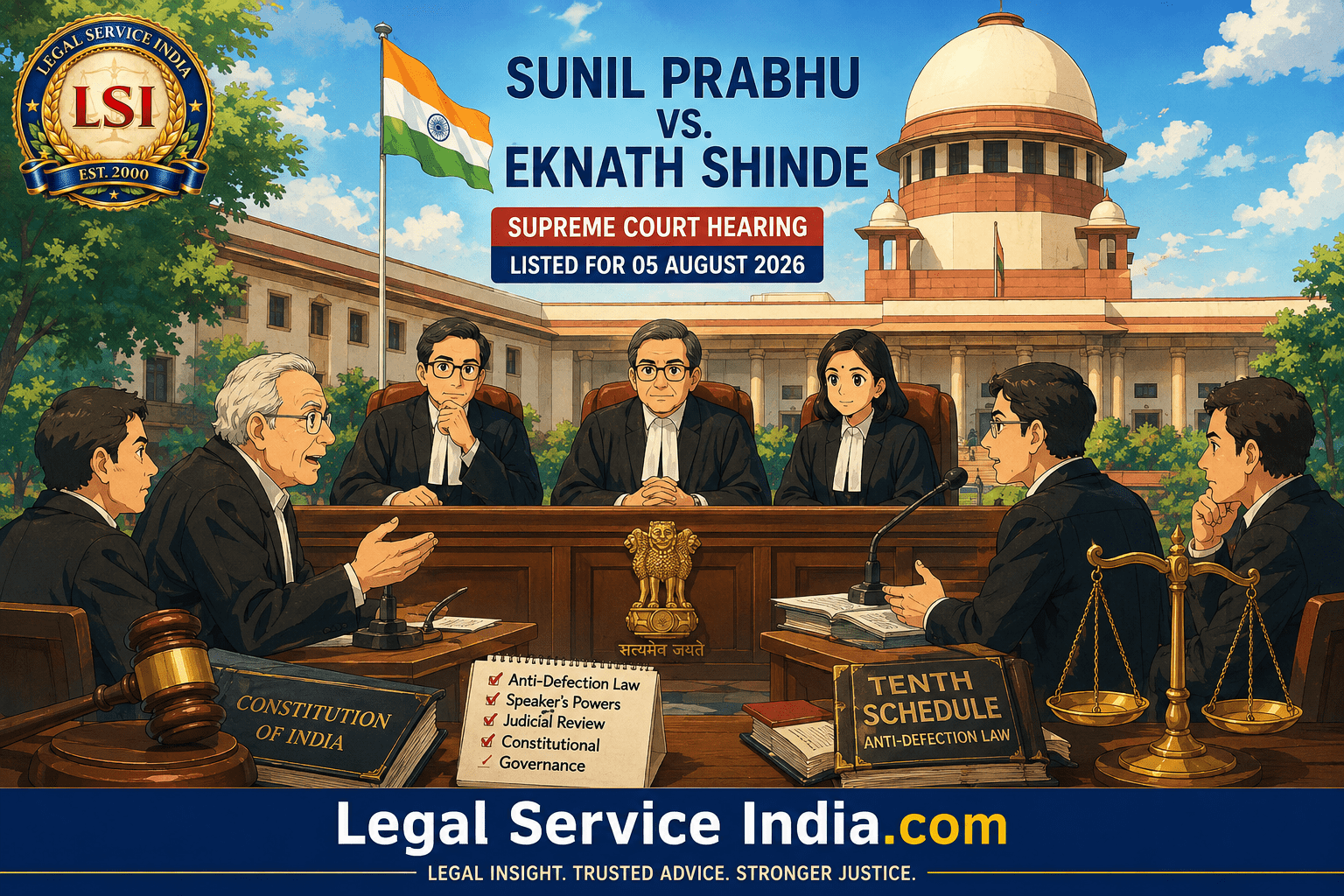
Sunil Prabhu vs. Eknath Shinde: Supreme Court Continues Hearing in Maharashtra Political Crisis
The Sunil Prabhu vs. Eknath Shinde litigation has once again returned to the centre of India’s constitutional discourse. The case is far more than a dispute between rival political factions—it raises profound questions concerning the anti-defection law, the constitutional authority of the Speaker of the Legislative Assembly, the limits of judicial review, party democracy, and the stability of elected governments.
On 4 August 2026, a Bench comprising the Chief Justice of India, Justice Joymalya Bagchi, and Justice V. Mohana heard the matter and, after hearing extensive submissions from senior counsel representing both sides, passed a brief but significant procedural order:
“List tomorrow, i.e., 05.08.2026.”
Although concise, this order underscores the Supreme Court’s continuing engagement with one of the most consequential constitutional disputes in recent Indian political history.
Citation: Sunil Prabhu vs. Eknath Shinde & Ors., SLP (C) Nos. 1644-1662 of 2024 (arising out of the Maharashtra Legislative Assembly Speaker’s decision dated 10 January 2024) with SLP (C) No. 3997 of 2023, Supreme Court of India, Order dated 04 August 2026.
Why the Sunil Prabhu vs. Eknath Shinde Case Is Constitutionally Significant
Few constitutional disputes have attracted as much public attention as the Maharashtra political crisis.
The litigation originated from the dramatic political developments of 2022 when a substantial group of Shiv Sena legislators led by Eknath Shinde revolted against the party leadership. The rebellion ultimately resulted in the fall of the existing government and the formation of a new administration.
The dispute quickly evolved into a constitutional battle involving:
- Interpretation of the Tenth Schedule (Anti-Defection Law)
- Authority of the Speaker
- Internal democracy within political parties
- Recognition of legislative party leadership
- Judicial review of the speaker’s decisions
- Constitutional morality and representative democracy
The Supreme Court had earlier delivered a landmark Constitution Bench judgement laying down broad constitutional principles while leaving several factual questions to be decided by the Speaker of the Maharashtra Legislative Assembly.
Following the Speaker’s decision dated 10 January 2024, multiple Special Leave Petitions were filed before the Supreme Court, leading to the present proceedings.
Background of the Litigation
The controversy revolves around competing claims regarding the legitimate leadership of the Shiv Sena legislative party.
The principal issues include:
- Whether the legislators led by Eknath Shinde incurred disqualification under the Tenth Schedule.
- Whether the Speaker correctly interpreted the Constitution Bench judgment.
- Whether the Speaker exceeded constitutional limits while deciding the disqualification petitions.
- Whether party leadership outside the legislature or the legislative majority should determine political legitimacy under the anti-defection law.
These questions strike at the heart of India’s parliamentary democracy.
Proceedings Before the Supreme Court on 4 August 2026
The matter was listed before:
| Bench Composition | Designation |
|---|---|
| Chief Justice of India | Presiding Judge |
| Justice Joymalya Bagchi | Companion Judge |
| Justice V. Mohana | Companion Judge |
Counsel for the Petitioners
Senior Advocate Kapil Sibal and Senior Advocate Devadatt Kamat appeared for the petitioners.
Counsel for the Respondents
The respondents were represented by several leading constitutional lawyers, including:
- Mukul Rohatgi
- Neeraj Kishan Kaul
- Maninder Singh
- Dhruv Mehta
- Dama Seshadri Naidu
Supreme Court Order Dated 4 August 2026
After hearing submissions, the Court passed the following order:
“List tomorrow, i.e., 05.08.2026.”
The Court has therefore continued hearing the matter without expressing any opinion on the merits.
What Makes This Hearing Important?
Although no substantive ruling has yet been delivered, the continuation of hearings itself carries considerable constitutional significance.
The case involves issues that affect:
| Constitutional Issue | Importance |
|---|---|
| Anti-Defection Law | Stability of elected governments |
| Speaker’s Powers | Neutrality of constitutional offices |
| Party Democracy | Balance between party leadership and legislators |
| Judicial Review | Limits of court interference |
| Constitutional Governance | Preservation of democratic norms |
The eventual judgement is expected to shape Indian constitutional law for decades.
The Central Questions Before the Supreme Court
The Court is expected to examine several constitutional questions, including:
1. Scope of the Speaker’s Authority
Can the Speaker independently assess political party leadership while deciding disqualification petitions?
2. Meaning of Voluntarily Giving Up Membership
Whether conduct alone can establish voluntary abandonment of party membership.
3. Legislative Party vs. Political Party
One of the biggest constitutional controversies is whether a numerical majority within the legislature overrides the organisational structure of the political party.
4. Judicial Review
To what extent can courts interfere with the Speaker’s constitutional decisions?
5. Constitutional Morality
Whether constitutional institutions must preserve democratic accountability over political expediency.
Impact on Future Political Crises
The Supreme Court’s eventual ruling may influence every future instance of political defections across India.
The judgement could determine:
- How speakers decide future disqualification petitions.
- Whether legislators can rely upon numerical strength to avoid disqualification.
- The constitutional relationship between political parties and their elected representatives.
- Judicial standards for reviewing the speaker’s decisions.
Consequently, the case has implications far beyond Maharashtra.
Why the Case Matters for Indian Democracy
India’s anti-defection framework was enacted to prevent political instability caused by opportunistic defections.
However, the present litigation demonstrates the continuing constitutional tension between:
- Representative democracy;
- Party discipline;
- Legislative independence; and
- Constitutional accountability.
The Supreme Court’s final decision may redefine these constitutional boundaries.
Observations on the Procedural Order
The order dated 4 August 2026 is procedural rather than substantive.
Importantly:
- The Court did not uphold the Speaker’s decision.
- The Court did not set aside the Speaker’s decision.
- The Court did not issue interim constitutional directions.
- The Court merely continued the hearing to 5 August 2026.
Accordingly, no legal conclusions should presently be drawn regarding the merits of the rival constitutional claims.
Constitutional Importance Going Forward
The Sunil Prabhu vs. Eknath Shinde proceedings remain among the most consequential constitutional litigations currently pending before the Supreme Court.
The final judgement is expected to clarify:
- Interpretation of the Tenth Schedule;
- Constitutional role of the Speaker;
- Limits of legislative defections;
- Protection of democratic mandates; and
- Constitutional balance between political parties and elected legislators.
Whatever the ultimate outcome, the decision is likely to become one of the leading constitutional precedents governing political defections in India.
Conclusion
The Supreme Court’s order dated 4 August 2026 does not resolve the Maharashtra political crisis but demonstrates that the Court continues to devote careful constitutional scrutiny to the issues arising from the Speaker’s decision.
The continued hearing reflects the enormous constitutional importance of the dispute. As arguments progress, the legal community, constitutional scholars, political parties, and citizens alike await authoritative clarification on the future of India’s anti-defection jurisprudence.
The eventual judgement in Sunil Prabhu vs. Eknath Shinde is expected to become a defining precedent on constitutional governance, legislative accountability, and democratic stability.
Key Takeaways
- Sunil Prabhu vs. Eknath Shinde remains one of India’s most important constitutional cases concerning the Maharashtra political crisis.
- The Supreme Court, by order dated 4 August 2026, continued hearing the case and listed it for 5 August 2026.
- The litigation challenges the Maharashtra Speaker’s 10 January 2024 decision on Shiv Sena disqualification petitions.
- The case raises major constitutional questions on the anti-defection law, the speaker’s powers, judicial review, and constitutional governance.
- No substantive relief or findings were granted on 4 August 2026; the Court merely adjourned the matter for continued hearing.
- The final verdict could redefine how the Tenth Schedule is interpreted across India and significantly influence future political defections and government stability.
Frequently Asked Questions (FAQs)
1. What is the Sunil Prabhu vs. Eknath Shinde case about?
The Sunil Prabhu vs. Eknath Shinde case concerns the Maharashtra political crisis, the Speaker’s decision on Shiv Sena disqualification petitions, and the interpretation of India’s anti-defection law under the Tenth Schedule.
2. What did the Supreme Court order on 4 August 2026 in Sunil Prabhu vs. Eknath Shinde?
The Supreme Court passed a procedural order directing that the matter be listed on 5 August 2026 for further hearing. It did not decide the merits of the dispute.
3. Why is Sunil Prabhu vs. Eknath Shinde important for the anti-defection law?
The case will determine how the Tenth Schedule should be interpreted regarding legislative defections, party leadership, and the constitutional powers of the Speaker, making it a landmark case for India’s anti-defection jurisprudence.
4. What constitutional issues arise in the Sunil Prabhu vs. Eknath Shinde case?
The case involves the Speaker’s powers, judicial review, constitutional governance, legislative party versus political party, constitutional morality, and the stability of elected governments under the anti-defection law.
5. Can the Supreme Court’s final judgement in Sunil Prabhu vs. Eknath Shinde affect future political defections?
Yes. The Supreme Court’s final judgement is expected to become a leading precedent governing future defections, the powers of Speakers, and constitutional governance across all State Legislatures in India.
Need Expert Legal Assistance Before the Supreme Court of India?
If you are planning to file a Special Leave Petition (SLP), Writ Petition, Civil Appeal, Criminal Appeal, Transfer Petition, Review Petition, Curative Petition, or require expert legal advice on any matter before the Supreme Court of India, experienced legal representation can make a significant difference to the outcome of your case.
Adv. Tarun Choudhury
Supreme Court Advocate | 25+ Years of Legal Experience
With extensive experience in constitutional, civil, criminal, commercial, service, election, and public interest litigation matters, Adv. Tarun Choudhury provides strategic legal advice, meticulous drafting, and effective representation before the Supreme Court of India and other courts across the country.
Our Legal Services Include
| Legal Service | Description |
|---|---|
| Special Leave Petitions (SLPs) | Expert drafting and representation before the Supreme Court. |
| Writ Petitions (Articles 32 & 226) | Protection of constitutional and fundamental rights. |
| Civil Appeals & Criminal Appeals | Comprehensive appellate advocacy. |
| Transfer Petitions | Representation in transfer proceedings before the Supreme Court. |
| Review & Curative Petitions | Post-judgement legal remedies before the Supreme Court. |
| Constitutional & Election Law Matters | Expert advice and representation in complex constitutional disputes. |
| Public Interest Litigation (PIL) | Drafting and conducting PIL matters. |
| Legal Opinions & Case Evaluation | Strategic legal advice tailored to your case. |
| Drafting, Settling & Arguing Supreme Court Matters | End-to-end Supreme Court litigation support. |
Contact for a Confidential Consultation
- 📞 Call: 9650499965
- 💬 WhatsApp: 9891244487
Whether you are seeking to challenge a High Court judgement, protect your constitutional rights, or require representation in a complex legal dispute, obtain trusted legal advice from an experienced Supreme Court advocate.
Contact today to discuss your case confidentially and secure experienced legal representation before the Supreme Court of India.
Important Links
- Lawyers in India
- Copyright Registration in India
- Caveat Filing in Supreme Court of India
- Mutual Consent Divorce in Delhi/NCR: WhatsApp 9650499965