Introduction
Cryptocurrency was first promoted as a system of digital anonymity, beyond the reach of traditional surveillance. Early supporters of Bitcoin praised its resistance to censorship and its promise of privacy. But over the past decade, the reality has proven more complex. Cryptocurrencies are not truly anonymous — they are pseudonymous. Every transaction is permanently recorded on a public blockchain, creating a trail that skilled investigators can follow.
By 2026, crypto forensics has become a central part of global financial investigations. Investigators now use blockchain transparency to build courtroom-ready evidence against ransomware operators, money launderers, fraudsters, and sanctions evaders.
Crypto forensics is the structured process of tracing, analysing, and linking cryptocurrency transactions to real-world identities. It combines blockchain data science, network analysis, regulatory compliance, and traditional investigative methods. What once looked like an untouchable digital underworld has now become one of the most traceable financial systems in history — provided investigators have the right tools, legal authority, and analytical discipline.
The Pseudonymous Reality of Blockchain
At its core, a public blockchain is a shared digital ledger that records every transfer of value. Cryptocurrencies like Bitcoin and Ethereum run on transparent ledgers. Wallet addresses appear as long strings of letters and numbers instead of names, which makes them look anonymous. In reality, this anonymity is weak. Once an address is linked to a real person — through an exchange deposit, a known service, or even a public statement — the entire transaction history tied to that address becomes visible.
This visibility is both a weakness for criminals and a strength for investigators. Unlike cash, which leaves no automatic record, or traditional bank wires that can be hidden through complex banking networks, most cryptocurrency movements are permanently stored in a public database. Crypto-forensic investigators use this permanence to trace fund flows, spot behavioural patterns, and ultimately connect activity to specific individuals or organisations.
How Public Blockchains Support Crypto Forensics
| Blockchain Feature | Importance for Crypto Forensics |
|---|---|
| Public Ledger | Every transaction is permanently recorded and can be examined. |
| Pseudonymous Wallets | Wallet addresses hide names but can be linked to real-world identities through investigations. |
| Permanent Transaction History | Investigators can reconstruct historical financial movements. |
| Transparent Fund Flow | Enables tracing of cryptocurrency transfers across multiple wallets. |
Key Points to Understand
- Cryptocurrencies are pseudonymous, not completely anonymous.
- Every blockchain transaction creates a permanent digital record.
- Crypto forensics combines blockchain analytics with traditional investigative techniques.
- Investigators use blockchain transparency to identify criminals and build courtroom-ready evidence.
- Public blockchain records often provide stronger financial trails than cash transactions.
Core Techniques of Crypto Forensics
Modern crypto forensics relies on several connected methods of analysis.
The following table provides an overview of the core techniques used in modern crypto forensic investigations.
| Technique | Primary Purpose |
|---|---|
| Address Clustering | Groups wallet addresses controlled by the same entity. |
| Transaction Graph Analysis | Tracks the movement of digital assets across blockchain networks. |
| Entity Attribution | Links blockchain activity to real individuals or organisations. |
| Cross-Chain and Multi-Layer Tracking | Follows funds across multiple blockchains and DeFi ecosystems. |
| Courtroom Readiness | Ensures blockchain evidence is legally admissible and reliable. |
Address Clustering
Address clustering means grouping wallet addresses that probably belong to the same person or organisation. A common method is the co-spending rule: if two addresses are used together in one transaction, they are likely controlled by the same owner because both private keys must be used at the same time. Other clues include:
- Timing of transactions
- Amounts sent
- Reuse of change addresses
- Repeated dealings with known services
Today, advanced platforms combine these rules with machine learning models trained on past cases to make clustering more accurate.
Transaction Graph Analysis
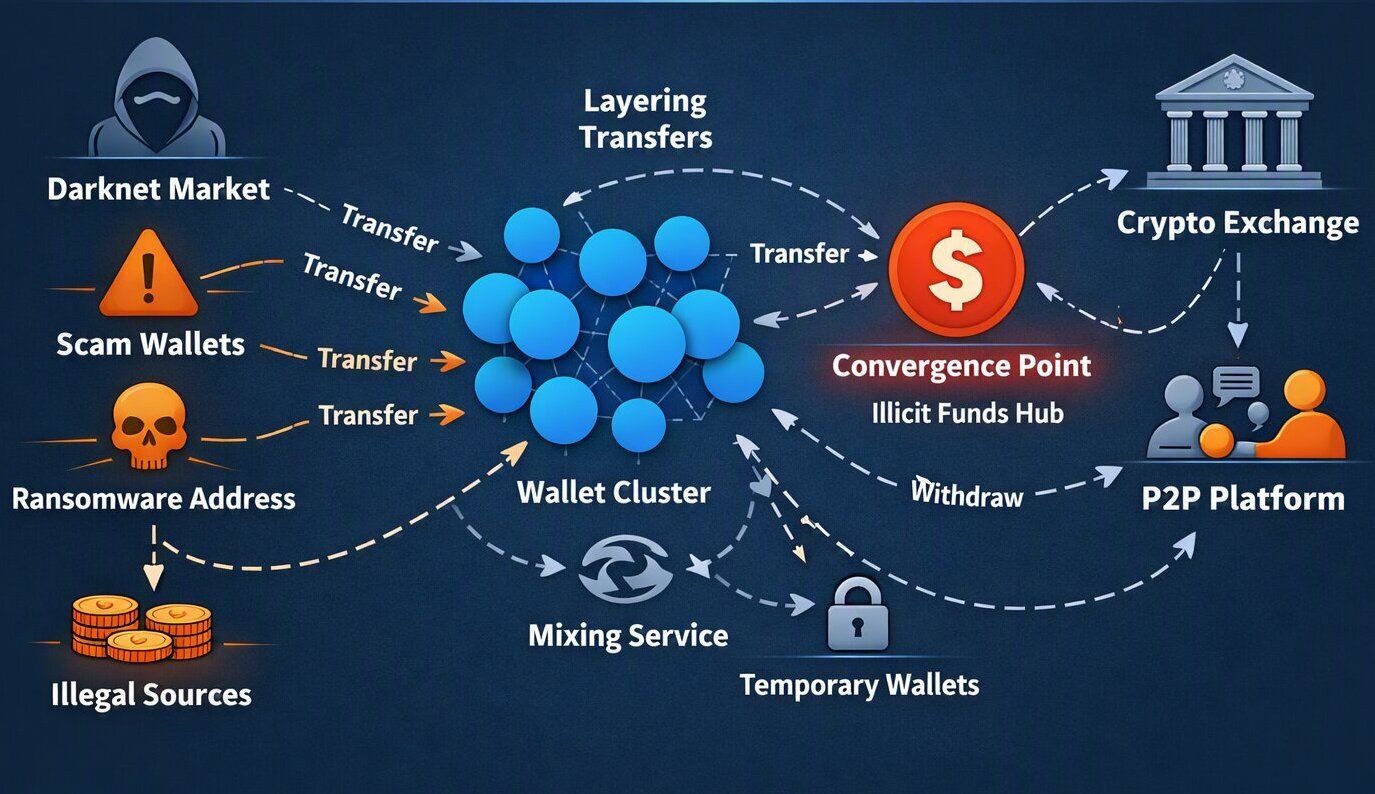
Analysts create graphs where each node represents a wallet address or a group of addresses, and each edge shows a transfer of funds.
By following the flow of money, they can spot money-laundering tricks such as:
- Moving funds through many transfers (layering)
- Using temporary wallets to hide links
- Finally cashing out through exchanges or peer-to-peer platforms
Special focus is given to convergence points — addresses that collect money from many illegal sources or that connect directly to known cash-out services.
Entity Attribution
Entity attribution means linking blockchain activity to real people.
The easiest way is through regulated exchanges and VASPs, which must collect KYC data under anti-money laundering laws. With subpoenas or international cooperation, investigators can match deposits and withdrawals to named individuals.
Another method is heuristic attribution: if an address keeps interacting with darknet markets, ransomware sites, or sanctioned entities, it can be labelled with high confidence even before formal identity confirmation.
Cross-Chain and Multi-Layer Tracking
Criminals often move money across different blockchains like Bitcoin, Ethereum, Tron, Solana, and Layer-2 networks, using tools such as decentralised exchanges, bridges, and wrapped tokens.
Forensic investigators now use advanced tools to follow these complex paths and rebuild multi-step journeys that single-chain analysis would miss.
DeFi protocols make things even harder because smart contracts can automatically split, swap, or lock funds, so investigators must study contract activity as well as simple transfers.
Courtroom Readiness
Forensic reports must be clear and legally reliable.
They should explain:
- The assumptions used in clustering wallet addresses.
- How confident investigators are in linking those addresses to real people.
- The limits of the available data.
If results are exaggerated or limits are hidden, the case can collapse during cross-examination.
That is why skilled investigators carefully record every step and keep digital records similar to a chain of custody, ensuring the evidence can stand up in court.
The Regulatory Scaffolding
Technical skills alone are not enough; strong legal frameworks are needed to force cooperation and set clear rules for the industry.
Two regulations have been especially important.
| Regulation | Key Contribution |
|---|---|
| FATF Travel Rule | Requires crypto service providers to collect and share sender and receiver information. |
| EU MiCA Regulation | Introduces licensing, transparency, consumer protection, and AML compliance for CASPs. |
FATF Travel Rule
This rule requires crypto service providers to collect and share information about the sender and receiver for transactions above certain limits, similar to traditional bank wire rules.
Although implementation has been uneven, it has pushed many exchanges to build compliance systems that identify counterparties and share data.
These extra data points are valuable for forensic investigators.
EU MiCA Regulation
By the mid-2020s, the European Union’s MiCA law created a full licensing system for crypto-asset service providers (CASPs).
It requires:
- Transparency
- Consumer protection
- Strong anti-money laundering controls
Authorised firms must detect suspicious activity and cooperate with regulators.
Together, MiCA and the Travel Rule have turned blockchain analytics from a niche investigative tool into a compliance necessity for serious market participants.
Global Regulatory Trends
Other regions have introduced their own rules.
- The United States relies on the Bank Secrecy Act, OFAC sanctions enforcement, and civil forfeiture.
- Asia-Pacific regulators have aligned with FATF standards while adapting to local markets.
The overall effect is a tightening global net: as more on-ramps and off-ramps become regulated, it becomes harder for criminals to turn crypto into usable cash without leaving identifiable traces.
Landmark Cases That Defined the Field
Several major investigations have shown both the strengths and limits of crypto forensics.
| Case | Key Learning |
|---|---|
| Bitfinex Hack (2016–2022) | Demonstrated blockchain’s permanent transaction history and long-term tracing capability. |
| Colonial Pipeline Ransomware (2021) | Showed how rapid blockchain tracing enabled recovery of ransom payments. |
| Silk Road Marketplace | Illustrated how blockchain evidence complements traditional criminal investigations. |
Bitfinex Hack (2016–2022)
Attackers stole about 120,000 bitcoins.
For years, the funds stayed dormant or were moved through complex mixing chains.
In 2022, the U.S. Department of Justice seized roughly $3.6 billion in bitcoin — the largest financial seizure in its history at the time.
Investigators used blockchain analysis to trace the coins, identify controlled wallets, and link them to two individuals accused of laundering the proceeds.
The case showed both the long memory of the blockchain and the patience needed for attribution.
Colonial Pipeline Ransomware (2021)
After the company paid a multi-million-dollar ransom in bitcoin, U.S. authorities quickly traced the funds and recovered a large portion.
This case highlighted how law enforcement can act fast when payment addresses are known and when criminals use monitored services.
Silk Road Marketplace
Blockchain records played a key role in the prosecution of Ross Ulbricht.
Transaction patterns linked his known addresses to Silk Road wallets, supporting the case that led to his conviction.
Traditional investigative work — undercover operations, server seizures, and device forensics — was essential, but the public ledger provided financial evidence that would have been far harder to collect in a cash-based underground economy.
Key Takeaway from Landmark Cases
Across these cases, one theme stands out: success required collaboration.
- Blockchain analysts
- Traditional investigators
- Prosecutors
- International partners
Pure on-chain analysis was not enough; it had to be combined with off-chain intelligence.
Scale of the Challenge and Global Impact
Illicit use of cryptocurrency remains significant. In 2023, illegal transactions were estimated to be worth tens of billions of dollars. Ransomware groups, darknet markets, investment scams, and sanctions evasion networks continue to rely on digital assets. Yet the same transparency that allows these activities also enables investigators to disrupt them. Major exchanges now regularly freeze suspicious funds flagged by analytics providers, and law-enforcement seizures of crypto assets have become common in advanced jurisdictions.
Key Global Insights
| Area | Current Situation |
|---|---|
| Illegal Crypto Transactions | Estimated to be worth tens of billions of dollars in 2023. |
| Primary Criminal Activities | Ransomware, darknet markets, investment scams, and sanctions evasion. |
| Law Enforcement Response | Crypto exchanges increasingly freeze suspicious funds, while crypto asset seizures have become common in advanced jurisdictions. |
| Blockchain Transparency | Provides investigators with valuable evidence for tracing illicit transactions. |
The strategic message is clear: cryptocurrency is no longer a lawless frontier where criminals can act freely. It has become a space where forensic readiness is both a compliance requirement for legitimate businesses and a critical capability for governments working to protect financial integrity.
Persistent Challenges
Even with progress, big challenges remain. Privacy coins like Monero hide the sender, receiver, and amount by default, making normal tracing methods ineffective. Coins such as Zcash also offer optional privacy features that complicate investigations. Mixers and coin-joining tools deliberately break the links that forensic clustering depends on. Some mixers have been shut down or sanctioned, but others quickly reappear under new names.
DeFi protocols add another layer of complexity. Automated market makers, flash loans, and smart-contract interactions can spread funds across dozens of wallets in seconds. Cross-chain bridges, while useful for legitimate users, create extra steps that investigators must carefully reconstruct.
Jurisdictional differences make things harder. A single transaction might start in one country, move through wallets in another, and end at an exchange licensed in a third. Legal cooperation between countries is often slow, and not all governments treat crypto crime as a priority. Court standards also vary — what counts as reliable forensic evidence in one country may face tougher scrutiny elsewhere.
Finally, the dual-use nature of technology creates tension. The same forensic tools that help recover ransomware payments could, if misused, threaten legitimate privacy. Finding the right balance between investigative power and civil liberties remains a major policy challenge.
Major Challenges at a Glance
| Challenge | Impact on Investigations |
|---|---|
| Privacy Coins | Hide transaction details, making tracing significantly more difficult. |
| Mixers and Coin-Joining Services | Break transaction links used for blockchain forensic analysis. |
| DeFi Ecosystem | Rapid movement of funds across smart contracts complicates transaction reconstruction. |
| Cross-Chain Bridges | Add multiple transaction layers across different blockchain networks. |
| International Jurisdiction | Creates delays due to differing legal systems and regulatory priorities. |
| Privacy vs. Investigation | Requires balancing effective enforcement with protection of civil liberties. |
Looking Ahead
Crypto forensics is becoming more advanced and more widely adopted. Tools like machine learning are already helping detect unusual patterns and automated laundering methods. New techniques such as graph neural networks and behavioural analytics can uncover coordinated activity that human analysts might miss. At the same time, researchers are working on privacy-preserving methods that let investigators query relevant data without exposing entire transaction histories.
International cooperation is also growing stronger. Countries are aligning their travel rule requirements, sharing intelligence, and running joint training programmes for investigators and prosecutors. Education is expanding too: universities, police academies, and professional associations now offer courses in blockchain investigation, ensuring that new practitioners enter the field with both technical skills and legal awareness.
Most importantly, the way people see cryptocurrency is changing. Once viewed mainly as a speculative asset or a tool for crime, it is increasingly treated as just another payment system — one that leaves a very detailed audit trail. Regulators, compliance officers, and investigators who learn to follow that trail will define the next phase of financial crime enforcement.
Future Trends
- Growing use of machine learning for blockchain analysis.
- Graph neural networks identifying sophisticated criminal networks.
- Behavioural analytics detecting coordinated laundering activities.
- Privacy-preserving investigative technologies under development.
- Greater international intelligence sharing and regulatory alignment.
- Expansion of blockchain investigation education and professional training.
- Increasing recognition of cryptocurrency as a traceable financial system.
Conclusion
Crypto forensics has changed the original idea behind digital money. What was once designed to avoid oversight has, in many ways, become more transparent than traditional finance. By using careful blockchain analysis, applying regulatory rules on exchanges, and following strict standards for evidence, investigators have shown again and again that cryptocurrency transactions can be traced, linked to real people, and presented in court.
Of course, crypto forensics is not perfect. Privacy-focused coins, differences in laws across countries, and new laundering tricks still create challenges. But the field has permanently changed the risks for anyone trying to use cryptocurrency for crime.
Looking ahead to 2026 and beyond, the openness of public blockchains will remain both a technical reality and a strategic advantage. When combined with skilled analysis and strong legal frameworks, this openness becomes a powerful tool for accountability. Far from being untraceable, cryptocurrency has proven to be one of the most accessible financial systems for forensic investigation ever created.
Key Takeaways
- Cryptocurrency investigations have become significantly more effective due to blockchain transparency.
- Privacy coins, mixers, DeFi platforms, and cross-chain bridges continue to challenge investigators.
- International cooperation and regulatory compliance are strengthening global enforcement efforts.
- Artificial intelligence, machine learning, and behavioural analytics are shaping the future of crypto forensics.
- Public blockchains provide one of the most comprehensive financial audit trails available for forensic investigations.
Written By: Md.Imran Wahab and Cathryne Smith