- Introduction
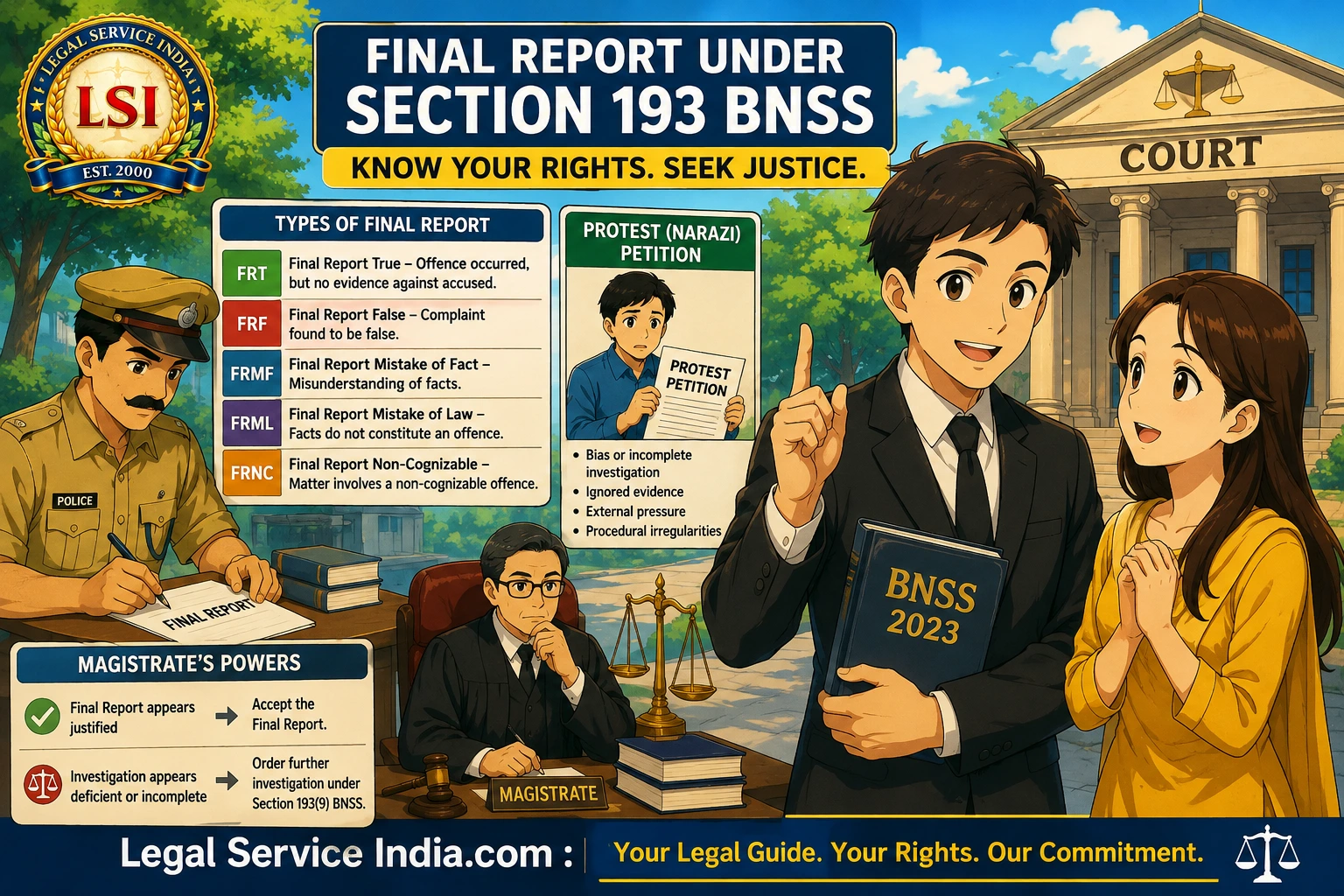
A Final Report (instead of a charge-sheet) is submitted by the police under Section 193 BNSS when the investigation reveals insufficient evidence to prosecute, the complaint is false, it is a mistake of fact or law, or the offence is non-cognizable. The report must explain the facts and reasons for not filing a charge sheet. In West Bengal, classification is also guided by Regulation 275 of the Police Regulations of Bengal, 1943.
- Narazi or Protest Petition
If the complainant is aggrieved by the Final Report, they may file a Protest (Narazi) Petition before the Magistrate, highlighting deficiencies such as bias, incomplete investigation, ignored evidence, external pressure, or irregularities. The magistrate may accept the final report or order further investigation under Section 193(9) BNSS.
- Types of Final Report
Under Regulation 275 of the Police Regulations of Bengal, 1943, final reports submitted by the police are classified into five categories for statistical and administrative purposes:
a) Final Report True (FRT)
A Final Report True (FRT) is filed when the police investigation confirms that the reported incident actually occurred, but finds that the named accused are not responsible or that there is insufficient evidence to prosecute anyone.
Example: In a reported murder case, the investigation establishes that the murder took place, but evidence (such as witness statements, CCTV footage, or alibis) shows the accused were not involved, or the real offender could not be identified.
In such cases, the Investigating Officer submits an FRT stating that the complaint is true, yet no charge sheet can be filed because:
- The accused are not involved;
- The actual perpetrator could not be traced; or
- Evidence is inadequate to support prosecution.
An FRT underscores that a genuine offense occurred, but the investigation could not yield sufficient admissible evidence against any person, highlighting the need for fair and thorough police work.
b) Final Report False (FRF)
A False Final Report (FRF) is submitted when the police investigation reveals that the incident did not occur as alleged in the complaint. After thorough inquiry, the Investigating Officer concludes that no offense, as reported, was committed and the accused are not responsible.
Example: In a case where a murder is alleged at a specific location, investigation may reveal that the death was due to accidental drowning and the accused had no involvement, supported by evidence and alibis.
The FRF records that the complaint was false or unfounded. This protects innocent persons from unwarranted prosecution and ensures police records accurately reflect the true facts of the case.
c) Final Report Mistake of Fact (FRMF)
A Final Report of Mistake of Fact (FRMF) is filed when the investigation reveals that the complaint was based on a misunderstanding or incorrect perception of the facts. The investigating officer concludes that the alleged offense did not occur as reported and the accused are not responsible for any crime.
Example: A complaint alleges kidnapping of a child. Investigation shows the child had willingly gone with a relative (e.g., uncle), with no criminal intent or abduction involved.
In such cases, the police submit an FRMF, recording that the complaint arose from a factual misunderstanding and no offense was committed. This underscores the importance of thorough investigation in uncovering the real facts and protecting innocent persons from prosecution.
d) Final Report Mistake of Law (FRML)
A Final Report of Mistake of Law (FRML) is filed when police conclude that the facts alleged in a case do not amount to an offense under law. Unlike mistakes of fact, this arises from a wrong legal interpretation or misapplication of provisions.
Example: A complaint may allege abduction and rape, but investigation reveals the parties were consenting adults, meaning no offense is made out under the law. In such cases, the Investigating Officer submits an FRML, indicating that the case was registered due to an incorrect legal understanding and that the accused are not liable. This underscores the importance of applying the correct legal provisions to ensure fair investigation outcomes.
e) Final Report Non-cog (FRNC)
A Final Report Non‑Cognizable (FRNC) is filed when investigation confirms that an incident occurred but reveals it amounts only to a non‑cognizable offence—one where police cannot arrest without a warrant and the offence is less serious than a cognizable offence.
Example: A complaint may allege grievous hurt under Section 118(2) BNS, but evidence shows it is only voluntarily causing hurt under Section 115(2) BNS, which is non‑cognizable. In such cases, the Investigating Officer submits an FRNC.
If the magistrate accepts it, the FIR is generally closed unless the complainant files a protest petition. An FRNC ensures proper classification of the case, reflects the true findings of investigation, and applies the correct legal provisions so the accused is dealt with under appropriate law.
- Case Law
As per Bhagwant Singh v. Commissioner of Police (1985) 2 SCC 537, when the police submit a closure report under Section 193 BNSS and the Magistrate proposes to drop proceedings, notice must be given to the informant/complainant, who has a right to be heard through a protest petition. This ensures judicial oversight and prevents arbitrary closure of investigations.
- Conclusion
Final reports such as FRT, FRF, FRMF, FRML, and FRNC classify investigation outcomes for statistical and administrative purposes when a charge sheet is not filed. If the complainant disagrees, they may file a protest petition seeking further investigation. The Magistrate may accept the Final Report or order further investigation under Section 193 BNSS, 2023, but generally cannot direct a fresh or re‑investigation—such powers rest with the High Courts or Supreme Court. Acceptance of a final report usually closes the FIR, unless the court orders otherwise, ensuring that investigations are concluded in line with evidence and law while preserving remedies for the complainant.