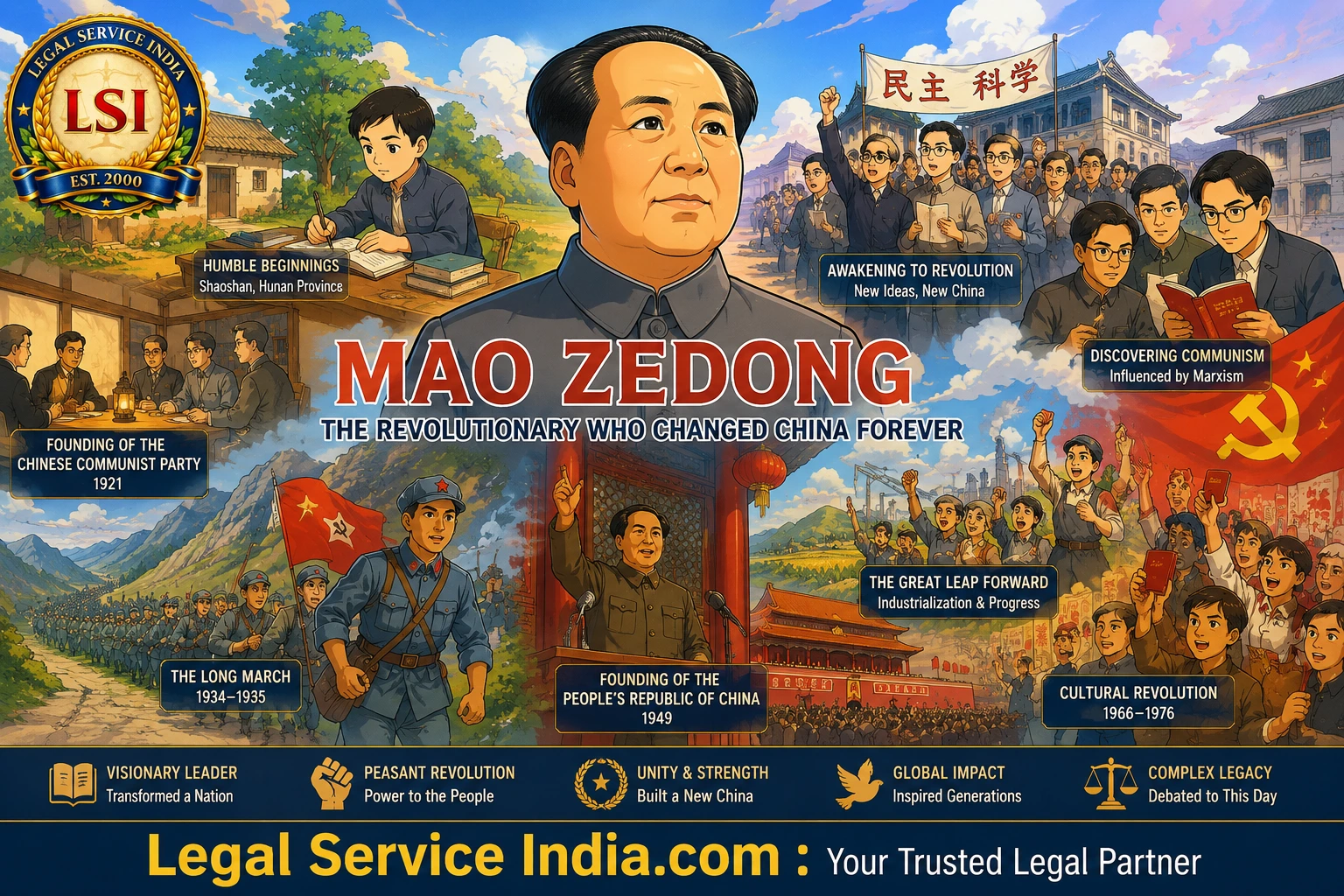
Mao Zedong: The Revolutionary Who Changed China Forever
Few figures in modern history have left a mark as deep, complex, and controversial as Mao Zedong. To some, he was the visionary who transformed a fragmented, impoverished nation into a unified global power. To others, he was responsible for policies that caused immense suffering and millions of deaths. Understanding Mao requires looking beyond slogans and political narratives to examine the extraordinary life of a man whose ideas reshaped China and influenced revolutionary movements around the world.
Humble Beginnings in Rural China
Mao Zedong was born on December 26, 1893, in Shaoshan, a small village in Hunan Province. His father was a prosperous but harsh farmer who demanded discipline and hard work, while his mother was a deeply religious Buddhist known for her kindness and compassion.
Growing up in a household marked by constant conflict, Mao developed an early dislike of authority. He witnessed his mother’s submission to his father’s strict control and gradually came to believe that resistance was often the only path to freedom. These childhood experiences would later shape his revolutionary worldview.
Despite his father’s preference for practical farming, Mao developed a passion for reading. He immersed himself in Chinese history, stories of great rulers and rebels, and accounts of social change. Education became his escape from village life and opened the door to larger ambitions.
Early Life Highlights
| Aspect | Details |
|---|---|
| Birth Date | December 26, 1893 |
| Birthplace | Shaoshan, Hunan Province |
| Father | Prosperous but strict farmer |
| Mother | Compassionate Buddhist |
| Key Interest | Reading and history |
Breaking Away from Tradition
As a teenager, Mao rebelled against many traditional customs. His father arranged a marriage for him at the age of fourteen, but Mao rejected the union and refused to live with his wife. This defiance reflected his growing belief that old social structures were obstacles to progress.
Leaving his village to pursue education, Mao encountered a rapidly changing China. The country was struggling with foreign influence, internal corruption, and the decline of the Qing Dynasty. New ideas about nationalism, democracy, and modernization were spreading among students and intellectuals.
At school, Mao experienced social discrimination due to his rural background, but these experiences sharpened his awareness of class divisions. He became increasingly interested in politics and reform movements aimed at strengthening China.
Key Influences During Youth
- Rejection of traditional customs and arranged marriage.
- Exposure to nationalism and democratic ideas.
- Awareness of social and class inequalities.
- Growing interest in political reform.
Awakening to Revolution
The year 1911 proved decisive. The Xinhai Revolution overthrew China’s imperial system, ending more than two thousand years of dynastic rule. Mao briefly joined the revolutionary army and became deeply involved in political discussions.
During this period, he devoured works by Western thinkers such as Rousseau, Montesquieu, Adam Smith, and Darwin. He also encountered ideas about individual willpower, self-determination, and social transformation.
At teacher-training college, Mao developed a reputation as an energetic activist. He organized student groups, published essays, and participated in debates about China’s future. He became convinced that profound change was necessary and that ordinary people could become agents of history.
Important Intellectual Influences
| Thinker | Area of Influence |
|---|---|
| Rousseau | Political philosophy |
| Montesquieu | Government and law |
| Adam Smith | Economics |
| Darwin | Evolution and social change |
The Road to Communism
A turning point came when Mao moved to Beijing and worked as a library assistant at Peking University. Although his position was humble, it placed him in contact with some of China’s leading intellectuals.
There he encountered the ideas of Karl Marx and the impact of the Russian Revolution. Influential thinkers such as Li Dazhao and Chen Duxiu introduced him to Marxist theory and convinced him that socialism offered a scientific explanation for social inequality.
Mao gradually shifted from nationalism to communism. He became convinced that revolution could transform society and eliminate exploitation. Unlike many Marxists, however, Mao believed that China’s vast peasant population—not industrial workers—would become the driving force of revolution.
Why Mao Embraced Communism
- Exposure to Marxist theory at Peking University.
- Influence of the Russian Revolution.
- Belief that socialism could address inequality.
- Confidence in the revolutionary power of peasants.
Founding the Chinese Communist Party
In 1921, Mao participated in the founding of the Chinese Communist Party. At the time, the party had only a few dozen members and little influence.
Initially, communists cooperated with the nationalist movement led by Sun Yat-sen. However, tensions soon emerged between the two groups.
Mao spent these years organizing workers, educating activists, and studying rural conditions. His experiences convinced him that peasants held revolutionary potential that many communist leaders underestimated.
Early Communist Activities
- Organizing workers.
- Training and educating activists.
- Studying rural social conditions.
- Promoting peasant-based revolution.
Civil War and the Rise of Mao
The alliance between nationalists and communists collapsed violently in 1927 when Chiang Kai-shek launched a brutal crackdown on communists.
Forced into hiding, Mao retreated to remote mountain regions where he began building rural revolutionary bases. There he developed guerrilla warfare strategies that would later become famous worldwide.
Together with military leaders such as Zhu De, Mao established communist-controlled territories, redistributed land to peasants, and gradually expanded his influence.
These years were marked by hardship, constant warfare, and personal tragedy. Mao’s wife Yang Kaihui was executed by nationalist authorities, while his children were separated from him during the conflict.
Major Developments During the Civil War
| Development | Impact |
|---|---|
| Retreat to rural areas | Created revolutionary strongholds |
| Guerrilla warfare tactics | Strengthened communist survival |
| Land redistribution | Won peasant support |
| Partnership with Zhu De | Expanded military capabilities |
The Long March: A Defining Moment
One of the most legendary episodes in communist history was the Long March.
Facing military defeat, communist forces embarked on a massive retreat across thousands of miles of difficult terrain. Most participants perished from battle, disease, hunger, and exhaustion.
The march became a powerful symbol of endurance and sacrifice. More importantly, it elevated Mao to a position of leadership within the Communist Party. His strategic decisions during the crisis strengthened his authority and weakened rivals who favored Soviet-style military tactics.
By the end of the march, Mao had emerged as the dominant figure in the Chinese communist movement.
Why the Long March Mattered
- Demonstrated extraordinary endurance and resilience.
- Strengthened Mao’s leadership position.
- Weakened political rivals within the party.
- Became a defining symbol of communist determination.
- Marked Mao’s emergence as the dominant leader of the Chinese communist movement.
War Against Japan and Consolidation of Power
The Japanese invasion of China created new opportunities for the communists. During the Second Sino-Japanese War, communist forces expanded their influence in rural areas while presenting themselves as defenders of the nation.
Their headquarters in Yan’an became a center of revolutionary activity. Mao refined his political philosophy, developed theories adapted to Chinese conditions, and strengthened his control over the party.
However, this period also saw ideological campaigns aimed at eliminating dissent. Critics were pressured into public confessions, while loyalty to Mao became increasingly important.
Victory and the Birth of a New China
After Japan’s defeat in 1945, civil war resumed between communists and nationalists. Despite facing a larger and better-equipped opponent, communist forces steadily gained momentum.
On October 1, 1949, Mao proclaimed the founding of the People’s Republic of China in Beijing.
For many Chinese, this marked the end of decades of war, foreign intervention, and political instability. Mao became the undisputed leader of the new nation.
Achievements of the Mao Era
Mao’s supporters point to several significant accomplishments during his rule:
- China was politically unified after decades of fragmentation.
- Foreign domination and colonial influence were greatly reduced.
- Literacy rates rose dramatically.
- Public health campaigns improved life expectancy.
- Women’s rights expanded through laws banning forced marriages and promoting legal equality.
- Basic healthcare reached many rural communities for the first time.
- China developed modern industries, scientific programs, and eventually nuclear weapons.
Major Achievements at a Glance
| Area | Achievement |
|---|---|
| Political Unity | China was unified after years of fragmentation. |
| Education | Literacy rates increased significantly. |
| Healthcare | Public health campaigns improved life expectancy. |
| Women’s Rights | Legal reforms expanded rights and equality. |
| Industry | Modern industries and scientific programs were developed. |
| National Defense | China eventually developed nuclear weapons. |
These changes transformed China from a largely agrarian society into a stronger and more modern state.
The Great Leap Forward: A National Disaster
Mao’s most controversial policies emerged during the late 1950s.
The Great Leap Forward aimed to rapidly industrialize China and surpass Western powers. Massive people’s communes were established, private farming was abolished, and millions were mobilized for ambitious production targets.
Unfortunately, unrealistic goals, flawed agricultural policies, and widespread misinformation produced catastrophic results. Local officials exaggerated harvest figures, leading the government to collect grain that did not actually exist.
The consequence was one of the worst famines in human history. Historians continue to debate the exact death toll, but estimates generally range from 20 million to over 40 million people.
Key Causes of the Disaster
| Factor | Impact |
|---|---|
| Unrealistic Goals | Production targets exceeded actual capacity. |
| Flawed Agricultural Policies | Reduced agricultural efficiency and output. |
| False Reporting | Harvest figures were exaggerated by local officials. |
| Excessive Grain Collection | Food shortages worsened across the country. |
The disaster severely damaged Mao’s reputation within the party, although he remained an influential figure.
The Cultural Revolution
In 1966, Mao launched another dramatic campaign: the Cultural Revolution.
Believing that revolutionary ideals were being abandoned, Mao encouraged young people to challenge established authorities. Millions joined the Red Guards, attacking officials, intellectuals, teachers, and cultural institutions.
The movement quickly spiraled into chaos. Historical sites were destroyed, educational systems collapsed, and countless people faced humiliation, imprisonment, or death.
Even senior Communist Party leaders became targets. Entire families were torn apart by political accusations.
Although Mao eventually moved to restore order, the Cultural Revolution left deep social and psychological scars across China.
Effects of the Cultural Revolution
- Destruction of historical and cultural sites.
- Collapse of educational institutions.
- Persecution of intellectuals and officials.
- Widespread social unrest and political violence.
- Long-term psychological and societal consequences.
Final Years and Death
By the early 1970s, Mao’s health was deteriorating. Despite physical decline, he remained a powerful symbol of the Chinese revolution.
One of the most significant developments of his later years was the opening of relations with the United States. His meeting with Richard Nixon in 1972 reshaped global geopolitics and helped counterbalance Soviet influence.
Mao died on September 9, 1976. His death marked the end of an era.
A Legacy That Still Divides Opinion
Assessing Mao Zedong remains one of history’s most difficult tasks.
Supporters credit him with unifying China, improving literacy and healthcare, advancing women’s rights, and restoring national pride after a century of foreign domination.
Critics point to the immense human cost of the Great Leap Forward and Cultural Revolution, arguing that ideological campaigns caused unprecedented suffering.
In 1981, the Chinese Communist Party issued an official assessment describing Mao as “70 percent correct and 30 percent wrong.” The formula reflected an effort to acknowledge mistakes while preserving his role as the founder of modern China.
Supporters vs Critics
| Supporters Credit Mao For | Critics Highlight |
|---|---|
| Unifying China | Human cost of the Great Leap Forward |
| Improving literacy | Famine-related deaths |
| Expanding healthcare | Political persecution |
| Advancing women’s rights | Cultural Revolution chaos |
| Restoring national pride | Suppression of dissent |
Today, Mao’s portrait still overlooks Tiananmen Square. His image appears in museums, textbooks, political discussions, and popular culture. More than four decades after his death, he remains both revered and criticized—a leader whose influence continues to shape China and whose story serves as a reminder of how a single individual can alter the course of history.
Conclusion: Mao Zedong’s Enduring Impact
Mao Zedong’s life was a story of ambition, revolution, triumph, and tragedy. He helped build a new China, yet many of the methods used to achieve that transformation remain deeply contested. Whether viewed as liberator, dictator, visionary, or cautionary tale, his impact on the twentieth century is impossible to ignore.
Key Takeaways: Mao Zedong and His Lasting Impact
Mao Zedong remains one of the most influential and controversial political leaders in modern history. His leadership transformed China, reshaped global politics, and continues to generate debate among historians worldwide.
| No. | Key Takeaway | Main Impact |
|---|---|---|
| 1 | Founder of Modern Communist China | Established the People’s Republic of China in 1949 |
| 2 | Rural Upbringing Influenced His Ideology | Focused on peasant-led revolution |
| 3 | Leader of the Communist Revolution | Brought the Communist Party to power |
| 4 | Long March Strengthened Leadership | Established Mao as the dominant party leader |
| 5 | Unified China | Restored political stability and centralized control |
| 6 | Expanded Education and Healthcare | Improved literacy and public health |
| 7 | Advanced Women’s Rights | Promoted gender equality and legal reforms |
| 8 | Great Leap Forward | Caused widespread famine and economic disruption |
| 9 | Cultural Revolution | Created major social and cultural upheaval |
| 10 | Global Revolutionary Influence | Inspired movements across multiple continents |
| 11 | Foundation for China’s Rise | Contributed to future industrial and scientific growth |
| 12 | Strategic U.S.-China Relations | Helped reshape Cold War diplomacy |
| 13 | Debated Historical Legacy | Mixed views on achievements and human costs |
| 14 | Enduring Global Influence | Remains a major figure in twentieth-century history |
1. Mao Zedong Was the Founder of Modern Communist China
Mao led the Chinese Communist Party to victory in 1949 and established the People’s Republic of China, ending decades of civil war and political instability.
2. His Rural Upbringing Shaped His Revolutionary Vision
Born into a farming family in Hunan Province, Mao’s early experiences with rural life influenced his belief that peasants—not industrial workers—could drive a successful revolution.
3. Mao Played a Central Role in the Chinese Communist Revolution
Through guerrilla warfare, rural mobilization, and political organization, Mao transformed a small communist movement into the ruling force of China.
4. The Long March Cemented Mao’s Leadership
The Long March became a defining moment in Communist Party history, strengthening Mao’s authority and establishing him as the movement’s dominant leader.
5. Mao Successfully Unified China After Years of Conflict
His government restored political unity, reduced foreign influence, and created a stronger centralized state after decades of fragmentation.
6. Major Social Reforms Improved Education and Healthcare
Under Mao’s leadership, literacy rates increased, public health campaigns expanded, life expectancy improved, and basic medical services reached rural populations.
7. Women’s Rights Advanced Significantly During the Mao Era
Legal reforms abolished forced marriages, promoted gender equality, and expanded opportunities for women in Chinese society.
8. The Great Leap Forward Remains One of History’s Most Controversial Policies
Mao’s rapid industrialization campaign resulted in widespread famine and millions of deaths, making it one of the largest human-made disasters of the twentieth century.
9. The Cultural Revolution Created Massive Social Upheaval
Launched in 1966, the Cultural Revolution disrupted education, targeted intellectuals, destroyed cultural heritage, and left lasting social scars across China.
10. Mao Influenced Global Revolutionary Movements
His theories on peasant-based revolution inspired communist and anti-colonial movements throughout Asia, Africa, and Latin America.
11. Mao Helped Transform China into a Global Power
His policies laid the foundations for China’s later industrial growth, scientific development, and emergence as a major world power.
12. Relations with the United States Marked a Strategic Shift
Mao’s 1972 meeting with U.S. President Richard Nixon reshaped international relations and altered Cold War dynamics.
13. Historians Continue to Debate Mao’s Legacy
Supporters praise his role in national unification and modernization, while critics emphasize the human costs of his political campaigns and authoritarian rule.
14. Mao Zedong Remains One of the Most Influential Figures of the 20th Century
Few leaders have had such a profound impact on their nation and the global political landscape, making Mao a subject of ongoing historical debate.
Summary Points
- Founded the People’s Republic of China in 1949.
- Led a peasant-focused communist revolution.
- Strengthened his leadership through the Long March.
- Unified China and reduced foreign influence.
- Expanded literacy, healthcare, and women’s rights.
- Oversaw the Great Leap Forward and Cultural Revolution.
- Influenced revolutionary movements around the world.
- Helped lay the groundwork for China’s future rise.
- Improved relations with the United States during the Cold War.
- Remains a highly debated historical figure.