





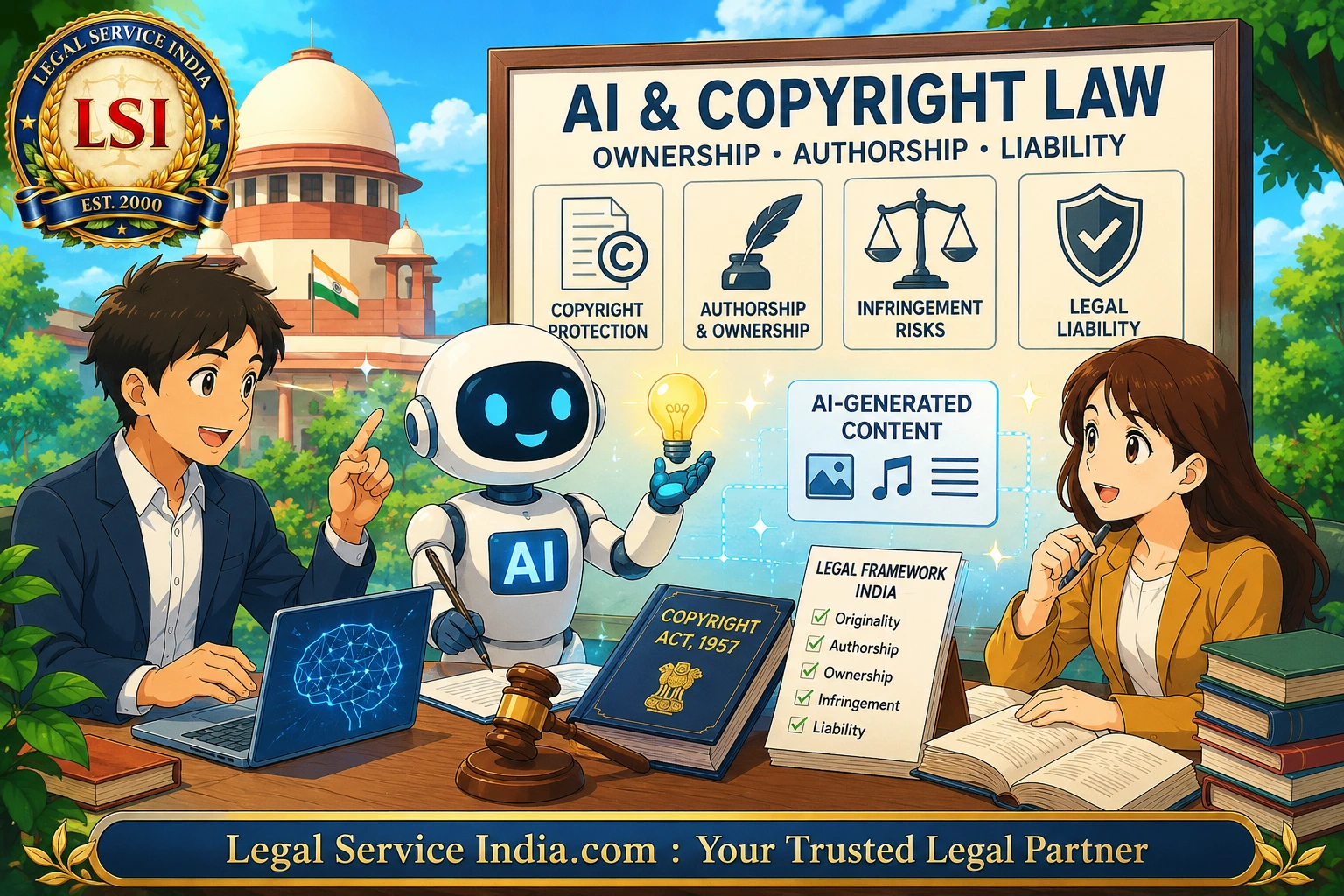
Introduction
Not long ago, creating an article, designing artwork, composing music, or writing computer code required significant human effort, skill, and time. Today, many of these tasks can be performed within seconds through the use of artificial intelligence. With the rise of generative AI tools, individuals can now produce text, images, videos, music, and other forms of content by simply entering a prompt. What was once considered a uniquely human activity is increasingly being shared with machines.
The growing popularity of AI has brought remarkable opportunities. Students use AI to assist with learning, researchers employ it to analyse information, businesses rely on it to improve productivity, and creators use it as a tool to support their creative processes. At the same time, the rapid adoption of AI has generated important legal concerns, particularly in the field of intellectual property law.
Key Legal Questions Raised by Artificial Intelligence
Among the most frequently debated questions are:
- Can AI-generated content be protected by copyright?
- Can an AI system be considered an author?
- If AI produces content that resembles an existing copyrighted work, does copyright infringement occur?
- More importantly, who should bear responsibility when such disputes arise?
Importance of the Debate
These questions are not merely academic. They have significant implications for authors, artists, educators, researchers, software developers, businesses, policymakers, and everyday users of AI technology.
| Stakeholder | Potential Copyright Concern |
|---|---|
| Authors and Artists | Ownership and protection of creative works |
| Researchers and Educators | Use of AI-generated materials and academic integrity |
| Software Developers | Authorship and licensing of AI-generated code |
| Businesses | Commercial use and liability risks |
| Policymakers | Developing appropriate legal frameworks |
| AI Users | Understanding rights, obligations, and infringement risks |
Scope of This Article
This article examines the relationship between artificial intelligence and copyright law by exploring the concepts of authorship, ownership, originality, infringement, and liability.
Copyright Law in Simple Terms
Before examining the relationship between artificial intelligence and copyright, it is important to understand the basic purpose of copyright law. At its core, copyright is a legal mechanism designed to protect original expressions of ideas and to reward human creativity. It grants creators certain exclusive rights over their work, enabling them to control how that work is used, reproduced, distributed, or communicated to the public.
Purpose of Copyright Law
- Protects original expressions of ideas.
- Rewards human creativity and intellectual effort.
- Provides creators with exclusive rights over their work.
- Allows control over reproduction, distribution, and communication of creative works.
A common misconception is that copyright protects ideas themselves. In reality, copyright generally protects the expression of an idea rather than the idea itself. For example, the concept of writing a story about a young wizard or creating a song about heartbreak cannot be monopolized. However, the specific words, characters, musical compositions, artistic expressions, or other original forms in which those ideas are expressed may receive copyright protection.
Idea vs Expression: What Copyright Protects
| Not Protected | May Be Protected |
|---|---|
| The idea of a story about a young wizard | The specific characters, plot, and written expression |
| The idea of a song about heartbreak | The lyrics, composition, and musical arrangement |
| General concepts and themes | Original artistic and literary expression |
Under the Indian copyright framework1, protection extends to a variety of creative works, including literary works, artistic works, musical works, dramatic works, cinematograph films, and sound recordings. Copyright arises automatically upon the creation of an eligible work and does not depend upon the commercial success or popularity of that work. The law seeks to ensure that creators are able to benefit from their intellectual labour while also encouraging the continued production of creative and cultural works.
Works Protected Under Indian Copyright Law
- Literary works
- Artistic works
- Musical works
- Dramatic works
- Cinematograph films
- Sound recordings
Another fundamental concept in copyright law is originality. While different jurisdictions apply different standards, copyright protection generally requires some degree of human skill, judgment, creativity, or intellectual effort2. Mere facts, data, or information are ordinarily not protected. Instead, protection is afforded to the original manner in which those elements are selected, arranged, or expressed.
Importance of Originality in Copyright
- Requires human skill and judgment.
- Requires creativity or intellectual effort.
- Facts and raw data are generally not protected.
- Protection applies to original selection, arrangement, or expression.
Copyright ownership usually vests in the author or creator of a work, although there are exceptions relating to employment, commissioned works, contractual arrangements, and other specific circumstances. Once copyright subsists in a work, the owner is granted a bundle of exclusive rights, including the right to reproduce, publish, distribute, adapt, translate, license, or otherwise exploit the work. Unauthorized use of these protected rights may amount to copyright infringement.
Exclusive Rights of Copyright Owners
- Reproduce the work
- Publish the work
- Distribute copies
- Adapt the work
- Translate the work
- License the work
- Commercially exploit the work
Can AI Own Copyright?
One of the first legal questions raised by generative AI is whether an artificial intelligence system can itself be recognized as an author and, consequently, own copyright in the works it generates. While the question may appear straightforward, it strikes at the very foundation of modern copyright law.
Traditionally, copyright has been linked to human creativity. Copyright systems across the world were developed with the assumption that creative works originate from human intellect, skill, judgment, and labour. As a result, concepts such as authorship, ownership, moral rights, and liability have historically been associated with natural persons or, in some circumstances, legal entities acting through human creators.
Traditional View of Authorship
- Copyright is based on human creativity.
- Creative works are assumed to originate from human intellect and labour.
- Authorship and ownership are traditionally linked to human creators.
- Moral rights and legal responsibility are generally associated with people, not machines.
At present, most jurisdictions do not recognize artificial intelligence as a legal person capable of owning copyright. AI systems cannot enter contracts, hold property in their own name, sue or be sued, or exercise legal rights and obligations in the same manner as human beings. Consequently, the idea of granting copyright directly to an AI system remains largely incompatible with existing legal frameworks.
Why AI Cannot Currently Own Copyright
| Legal Requirement | Position of AI Systems |
|---|---|
| Enter contracts | Cannot independently do so |
| Own property | Cannot hold property in their own name |
| Sue or be sued | Not recognized as legal persons |
| Exercise legal rights and duties | Cannot independently perform these functions |
The position is particularly evident in the United States, where courts and copyright authorities have repeatedly emphasized the requirement of human authorship3. Applications seeking copyright protection for works generated entirely by AI without meaningful human creative input have generally been refused on the ground that copyright law protects human creativity rather than machine-generated output4. Similar reasoning can be observed in several other jurisdictions that continue to treat human involvement as an essential element of authorship.
Human Authorship Requirement
- Human authorship remains a key requirement.
- Purely AI-generated works often face copyright challenges.
- Meaningful human creative input is generally necessary.
- Many jurisdictions continue to prioritize human involvement.
The issue becomes more complicated when AI is used as a tool rather than an independent creator. For instance, if a writer uses AI to generate ideas, draft portions of text, or assist with editing before substantially modifying the final work, it may be argued that the resulting creation reflects sufficient human contribution to justify copyright protection. In such situations, the focus shifts from the capabilities of the AI system to the extent of human creativity involved in producing the final output.
AI as a Tool Versus AI as a Creator
| Scenario | Copyright Consideration |
|---|---|
| Fully autonomous AI-generated work | Copyright protection may be difficult to obtain |
| Human substantially edits AI output | Human authorship may be recognized |
| AI assists with drafting or ideation | Focus shifts to human creative contribution |
The position in India remains relatively unsettled. The Copyright Act, 1957 was enacted long before the emergence of modern generative AI and does not expressly address whether AI-generated works can qualify for authorship or ownership. Nevertheless, the broader structure of Indian copyright law, like that of many other jurisdictions, is built around the notion of human authorship and creative contribution. This suggests that purely autonomous AI-generated works may face significant challenges in obtaining copyright protection under existing legal principles.
Position of AI-Generated Works in India
- The Copyright Act, 1957 does not expressly address generative AI.
- Indian copyright law is built around human authorship.
- Human creative contribution remains central.
- Autonomous AI-generated works may face legal uncertainty.
The more relevant question is not whether AI can be an author, but whether the human being using the AI has contributed enough creativity and judgment to claim authorship over the resulting work. As AI systems become increasingly sophisticated, this distinction is likely to become one of the most contested issues in intellectual property law.
Key Takeaway
The central copyright issue is not whether artificial intelligence can own copyright, but whether the human user has exercised sufficient creativity, judgment, and intellectual effort to qualify as the author of the final work.
Can AI-Generated Content Be Protected?
Even if artificial intelligence cannot itself own copyright, an equally important question remains: can the content generated by AI receive copyright protection at all?
The answer is not always straightforward and largely depends on the degree of human involvement in the creation process. Copyright law is primarily concerned with protecting original creative expression. Therefore, when examining AI-generated content, courts and policymakers often focus on the role played by the human user rather than the capabilities of the AI system.
AI-Generated Works With Minimal Human Input
At one end of the spectrum are works that are generated almost entirely by AI with minimal human input. Consider a situation where a user enters a short prompt and the AI independently produces an article, image, song, or piece of code. In such cases, the human contribution may be limited to issuing a command, while the actual expression is determined by the AI system.
Many legal systems are hesitant to grant copyright protection to such works because doing so may undermine the traditional requirement of human creativity and authorship.
AI as an Assistive Creative Tool
At the other end of the spectrum are situations where AI functions merely as an assistive tool. A writer may use AI to brainstorm ideas, suggest outlines, or refine language before extensively editing and restructuring the final work.
Similarly, an artist may generate multiple AI-created images and then combine, modify, and transform them through substantial personal effort. In these circumstances, the final output may reflect significant human skill, judgment, and creativity, making a stronger case for copyright protection.
The Grey Area of AI-Assisted Creativity
Between these two extremes lies a vast grey area where the legal position remains uncertain. Modern generative AI systems often operate through detailed prompts, iterative instructions, selection among multiple outputs, and repeated revisions by the user.
This raises a fundamental question: at what point does human involvement become sufficient to transform AI-assisted content into a copyrightable work? Different jurisdictions are still grappling with this issue, and no universally accepted standard has yet emerged.
| Level of Human Involvement | Copyright Protection Outlook |
|---|---|
| Minimal input with AI generating the complete work | Protection often uncertain or unlikely |
| Moderate involvement through prompts and revisions | Legal position remains unclear |
| Substantial editing, transformation, and creative contribution | Stronger case for copyright protection |
Can AI Infringe Copyright?
While much of the public discussion surrounding AI focuses on whether AI-generated works can receive copyright protection, an even more pressing concern is whether AI can infringe the copyright of others. This issue lies at the centre of many ongoing legal disputes and has become one of the most controversial aspects of generative AI.
Copyright Concerns During AI Training
To understand the concern, it is important to recognize that modern AI systems are trained using vast quantities of existing data, which may include books, articles, photographs, artworks, music, websites, research papers, and other forms of copyrighted material.
AI developers argue that such training is necessary for the system to learn patterns, language structures, artistic styles, and relationships between different forms of information. Critics, however, contend that the use of copyrighted works during training may amount to unauthorized use of protected content.
Copyright Risks in AI-Generated Outputs
The controversy does not end with the training process. Concerns also arise from the outputs generated by AI systems.
In most cases, AI tools produce new content rather than directly copying existing works. However, there may be situations where an AI-generated output closely resembles a copyrighted work or reproduces substantial portions of it. If such reproduction occurs without authorization, questions of copyright infringement may arise.
Imitation of Artistic Styles
Another issue involves the imitation of artistic styles. Many creators have expressed concern that AI systems can generate content that resembles the distinctive style of particular artists, writers, musicians, or designers.
While copyright law generally protects specific expressions rather than artistic styles themselves, the increasing ability of AI to replicate recognizable creative characteristics has intensified debates about the adequacy of existing intellectual property protections.
Who Is Liable for AI Copyright Infringement?
The question of liability further complicates matters. If infringement occurs, responsibility may potentially be attributed to multiple parties, including:
- The AI developer
- The platform providing the service
- The user generating the content
- A combination of these actors
Determining liability becomes particularly difficult because AI-generated outputs often result from interactions between numerous technological and human factors.
Ongoing Global Legal Disputes
At present, courts around the world are actively examining these issues through a growing number of lawsuits involving authors, artists, publishers, media organizations, and AI companies5. Although definitive legal standards have yet to emerge, these disputes are shaping the future relationship between copyright law and artificial intelligence.
Key Takeaways
- AI-generated content may or may not receive copyright protection depending on the extent of human involvement.
- Human creativity, judgment, and original contribution remain central to copyright eligibility.
- AI training on copyrighted material remains a major area of legal controversy.
- AI-generated outputs can potentially raise copyright infringement concerns if they reproduce protected content.
- Questions regarding liability for infringement remain unresolved in many jurisdictions.
- Ongoing litigation is likely to shape future copyright rules for artificial intelligence.
Who Is Responsible When AI Infringes Copyright?
Determining responsibility for copyright infringement has traditionally been a relatively straightforward exercise. If an individual copies a book without permission, reproduces an artist’s work, or distributes copyrighted material unlawfully, the infringing party can usually be identified and held accountable. Generative AI, however, complicates this framework by introducing multiple actors into the creative process.
When an allegedly infringing AI-generated output is produced, responsibility may potentially involve the developer of the AI system, the platform that provides access to the technology, the user who generated the content, or a combination of these parties. As a result, assigning liability becomes significantly more complex than in traditional copyright disputes.
Potential Parties That May Bear Liability
| Party | Possible Basis of Responsibility |
|---|---|
| AI Developer | Designs, trains, and deploys the AI system. |
| AI Platform Provider | Provides access to the technology and its outputs. |
| User | Creates prompts, requests outputs, and uses the generated content. |
| Multiple Parties | Liability may be shared depending on the circumstances. |
Developer Liability in AI Copyright Disputes
One view is that AI developers should bear responsibility because they design, train, and deploy the systems. If copyrighted works were used during the training process without authorization, or if the system was designed in a manner that makes infringement foreseeable, developers may face legal scrutiny.
Critics argue that companies benefiting commercially from AI technology should also assume responsibility for ensuring that intellectual property rights are respected.
User Liability for AI-Generated Content
Others contend that liability should rest primarily with the user. After all, it is often the user who enters prompts, requests specific outputs, and decides how the generated content will ultimately be used.
If a user intentionally employs an AI system to reproduce copyrighted material or knowingly publishes infringing content, there may be strong grounds for holding that individual accountable.
Current Legal Uncertainty
At present, no universally accepted solution exists. Courts and policymakers across different jurisdictions are still attempting to determine how existing copyright principles should apply to AI-related disputes.
Until clearer legal standards emerge, questions regarding liability are likely to remain highly fact-specific and dependent upon the circumstances of each case.
Importance of Accountability in Copyright Law
What remains clear, however, is that copyright law cannot function effectively without accountability. As artificial intelligence continues to transform the creation and distribution of content, identifying who should bear responsibility for infringement will be essential to ensuring that innovation and the rights of creators remain properly balanced.
India’s Position on AI and Copyright
India, like many other jurisdictions, is currently grappling with the legal challenges posed by artificial intelligence. While the country has witnessed rapid growth in the use of AI across education, business, research, healthcare, media, and creative industries, its copyright framework was developed long before the emergence of modern generative AI systems.
As a result, Indian law does not yet provide a comprehensive answer to many of the questions surrounding AI-generated content and copyright ownership.
The Copyright Act, 1957 and Artificial Intelligence
The Copyright Act, 1957 remains the primary legislation governing copyright protection in India. Although the Act contains provisions relating to authorship, ownership, originality, and infringement, it does not specifically address generative AI or the legal status of works created through advanced machine-learning systems.
Consequently, issues relating to AI-generated content must presently be examined through traditional copyright principles.
Requirement of Originality Under Indian Law
One of the most significant considerations under Indian copyright law is the requirement of originality. Indian courts have generally emphasized the importance of human skill, judgment, and intellectual effort in determining whether a work qualifies for copyright protection.
This approach suggests that purely autonomous AI-generated content may face challenges in obtaining protection if meaningful human creative contribution is absent.
AI as a Creative and Assistive Tool
At the same time, Indian law does not prohibit the use of AI as a creative or assistive tool. Where individuals use AI to support research, drafting, design, content creation, or artistic expression while exercising substantial control over the final output, existing copyright principles may still be capable of recognizing and protecting the resulting work.
The extent of human involvement is therefore likely to play a crucial role in future legal assessments.
Policy Approach Towards Artificial Intelligence
India has also demonstrated a broader policy interest in promoting the responsible development and adoption of artificial intelligence. Policymakers increasingly recognize AI as an important driver of economic growth, innovation, and digital transformation.
However, encouraging technological advancement must be balanced against the legitimate interests of authors, artists, publishers, researchers, and other copyright owners whose works may be affected by AI systems.
Current Legal Position in India
At present, the legal position in India remains largely unsettled. There is no dedicated legislative framework specifically regulating AI-generated works or comprehensively addressing copyright issues arising from generative AI.
As courts, regulators, and policymakers continue to engage with these emerging questions, India will likely draw upon both domestic copyright principles and international developments in shaping its future approach.
Key Takeaways on AI and Copyright in India
- India currently relies on the Copyright Act, 1957 to address AI-related copyright issues.
- The law does not specifically regulate generative AI or AI-generated works.
- Human creativity, skill, and judgment remain central to copyright protection.
- AI can be used as an assistive tool where meaningful human involvement exists.
- Future legislative reforms may provide greater clarity regarding AI-generated content.
For now, the safest conclusion is that Indian copyright law continues to be centred on human creativity and authorship. While existing principles provide a foundation for addressing AI-related disputes, the growing capabilities of generative AI may eventually require clearer legislative guidance to ensure certainty for creators, users, businesses, and technology developers alike.
Future Challenges and Possible Reforms
The rapid advancement of artificial intelligence has exposed several gaps in existing copyright frameworks. Laws that were originally designed to govern human creativity are now being applied to technologies capable of generating text, images, music, videos, and other forms of content with minimal human involvement. As AI systems continue to evolve, courts and policymakers will increasingly be required to address questions that traditional copyright law was never designed to answer.
Challenge of Authorship
One of the most significant challenges concerns the concept of authorship itself. If copyright protection is intended to reward human creativity, how should the law treat works generated largely by machines? Should such works receive copyright protection, should they enter the public domain, or should entirely new categories of rights be created? These questions remain the subject of ongoing debate across jurisdictions.
Copyrighted Material in AI Training
Another challenge relates to the use of copyrighted material in AI training. Technology companies argue that access to large datasets is essential for developing effective AI systems. Creators, on the other hand, contend that their works should not be used without permission, attribution, or compensation. Reconciling innovation with the legitimate interests of copyright owners will likely become one of the defining legal issues of the coming decade.
Transparency and Accountability
Questions of transparency also require attention. Many AI systems operate as “black boxes,” making it difficult to determine what materials were used during training or how a particular output was generated. Greater transparency may help creators understand whether their works have been used and assist courts in resolving copyright disputes more effectively.
Potential Areas of Reform
Future reforms may therefore focus on establishing clearer standards regarding AI-generated content, ownership rights, training data practices, licensing mechanisms, and liability for infringement. Some jurisdictions may choose to amend existing copyright laws, while others may develop entirely new regulatory frameworks tailored specifically to artificial intelligence.
| Area | Possible Reform |
|---|---|
| AI-Generated Content | Clear standards on copyright protection and ownership |
| Training Data | Guidelines on the lawful use of copyrighted works |
| Licensing | New licensing models for AI developers and creators |
| Transparency | Disclosure requirements regarding training datasets |
| Liability | Clarification of responsibility for copyright infringement |
Balancing Innovation and Protection
At the same time, any reform must be approached with caution. Overly restrictive regulations could hinder technological innovation and limit the benefits that AI offers to society. Conversely, insufficient protection may discourage human creativity by weakening the rights of authors, artists, researchers, and other creators. The challenge for lawmakers will be to strike a balance that promotes innovation while preserving the fundamental objectives of copyright law.
- Encourage technological innovation and AI development.
- Protect the rights of authors, artists, researchers, and creators.
- Promote transparency and accountability in AI systems.
- Ensure fair compensation where copyrighted works are utilized.
- Maintain the core objectives of copyright law.
The Road Ahead
The debate surrounding AI and copyright is still in its early stages, and definitive answers remain elusive. What is certain, however, is that artificial intelligence is reshaping the way content is created, distributed, and consumed. As technology continues to advance, copyright law must evolve alongside it to ensure that both innovation and creativity can flourish in the digital age.
Conclusion
Artificial intelligence has rapidly transformed from a technological novelty into a powerful tool capable of influencing how individuals create, learn, work, and communicate. While generative AI offers unprecedented opportunities for innovation and efficiency, it also raises fundamental questions about authorship, ownership, originality, and copyright infringement.
As discussed throughout this article, existing copyright laws were largely built on the assumption that creative works originate from human effort. The emergence of AI-generated content challenges this assumption and has created uncertainty regarding who owns such works, whether they deserve protection, and who should bear responsibility when infringement occurs. Although different jurisdictions are exploring these issues in different ways, a common theme continues to emerge: human creativity remains at the heart of copyright law.
India, like many countries, is still in the process of determining how its legal framework should respond to these developments. Until clearer judicial or legislative guidance emerges, many questions surrounding AI and copyright will continue to be resolved through traditional legal principles applied to new technological realities.
The debate is ultimately not about choosing between technology and creativity. Rather, it is about ensuring that the law evolves in a manner that encourages innovation while continuing to protect the rights and interests of human creators. As artificial intelligence becomes increasingly integrated into everyday life, finding this balance will remain one of the most important challenges for intellectual property law in the years ahead.
Key Takeaways
- AI is challenging traditional concepts of copyright and authorship.
- Ownership of AI-generated content remains legally uncertain in many jurisdictions.
- The use of copyrighted works for AI training is a growing area of legal debate.
- Transparency in AI development may play a crucial role in resolving future disputes.
- Future copyright reforms must balance innovation with the protection of human creativity.
- India and other nations are still developing legal approaches to AI and copyright issues.
Written By: Aman Raj, is an LL.B. graduate with an interest in Intellectual Property Law, technology law, and emerging legal issues arising from artificial intelligence. He is particularly interested in examining the intersection of innovation and legal regulation.

