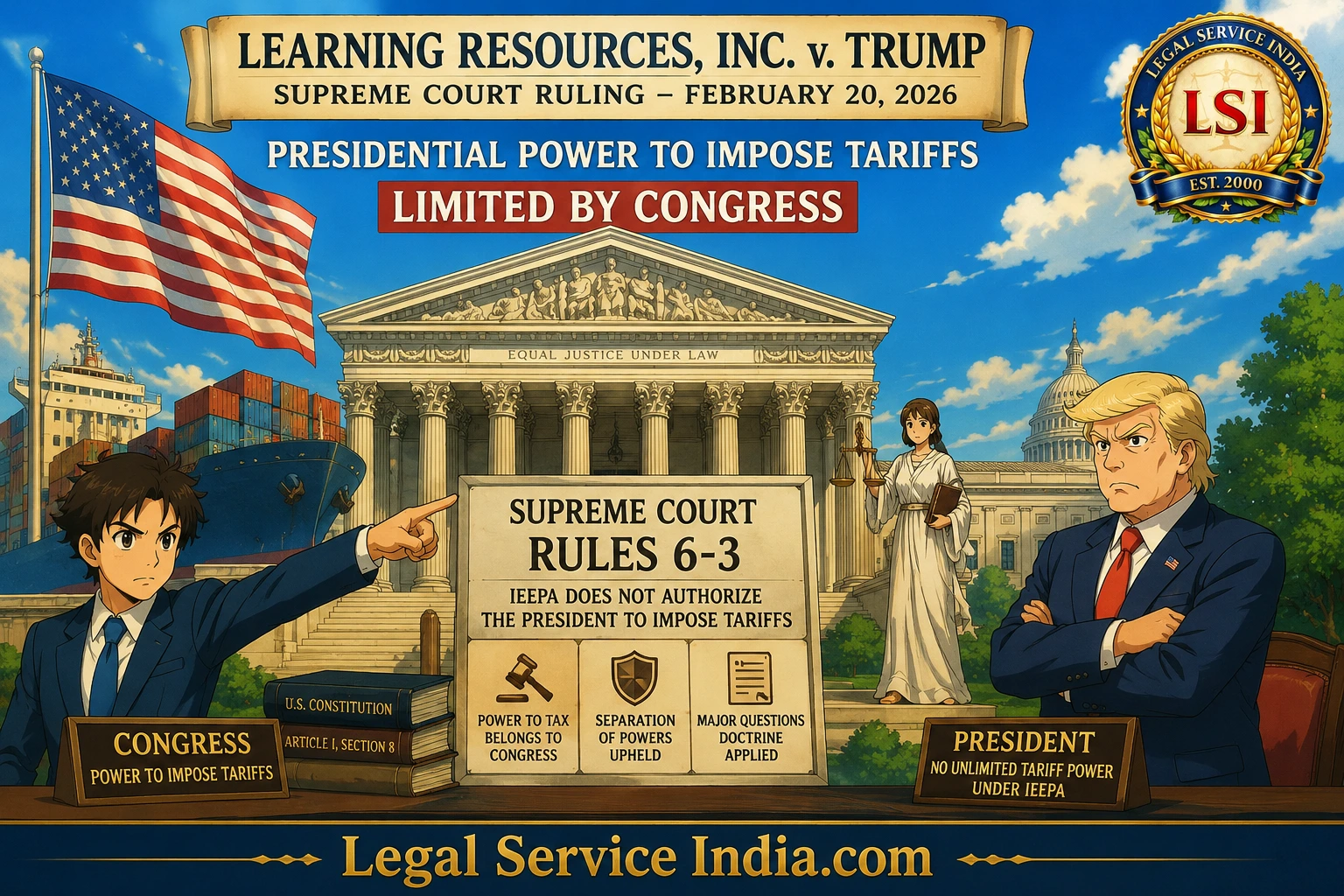
Learning Resources, Inc. v. Trump: Supreme Court Limits Presidential Power to Impose Tariffs Under IEEPA
Citation: Learning Resources, Inc. v. Trump, Nos. 24-1287 & 25-250, 607 U.S. 229 (2026), decided February 20, 2026.
Introduction
The United States Supreme Court’s decision in Learning Resources, Inc. v. Trump, decided on February 20, 2026, is one of the most consequential constitutional and economic judgements of the year.
In a 6–3 judgement, the Supreme Court held that the International Emergency Economic Powers Act (IEEPA) does not authorise the President of the United States to impose tariffs on imported goods.
At first sight, the dispute may appear to concern nothing more than the interpretation of a federal statute. In reality, the case goes to the heart of the American constitutional structure: who possesses the power to impose taxes and duties—the President or Congress?
The Court’s answer was unequivocal. The Constitution places the power to impose duties and tariffs in Congress, and Congress had not clearly delegated that extraordinary power to the President through IEEPA.
The judgement is therefore considerably broader than a dispute over particular tariff schedules. It is a significant statement on separation of powers, congressional control over taxation, presidential emergency powers, statutory delegation and the Major Questions Doctrine.
The case is formally reported as Learning Resources, Inc. v. Trump, Nos. 24-1287 and 25-250, 607 U.S. 229 (2026). The Supreme Court’s official opinions identify February 20, 2026, as the date of decision.
The Core Issue Before the Supreme Court
The central question was deceptively simple:
Does IEEPA authorise the President to impose tariffs?
IEEPA was enacted by Congress in 1977. It gives the President certain economic powers when dealing with unusual and extraordinary threats to the United States that originate substantially outside the country.
President Donald Trump relied upon IEEPA to impose tariffs in response to declared national emergencies involving, among other things, drug trafficking and trade deficits.
The government argued that IEEPA’s authorisation to the President to “regulate” “importation” included the authority to impose tariffs.
The challengers disagreed.
Their argument was that a tariff is effectively a duty imposed upon imported goods and therefore implicates the taxing power expressly assigned by the Constitution to Congress. According to the challengers, IEEPA contained no sufficiently clear authorisation for the President to exercise such an extraordinary power.
The Supreme Court ultimately accepted the challengers’ position.
Constitutional Foundation: The Power to Impose Tariffs Belongs to Congress
The starting point of the Court’s analysis was the Constitution itself.
Article I, Section 8, Clause 1 provides that:
“The Congress shall have Power to lay and collect Taxes, Duties, Imposts and Excises.”
The Court emphasised that tariffs fall within this constitutional allocation of authority.
This was not treated as an incidental detail. Chief Justice Roberts’ opinion placed considerable importance upon the historical understanding of the taxing power and the Framers’ decision to vest it in Congress.
The Court noted that the Framers had lived through the experience of taxation without representation. They consequently designed a constitutional system in which the executive could not simply create a new system of taxation without congressional authorisation.
The constitutional structure is therefore important:
| Constitutional Principle | Significance |
|---|---|
| Article I, Section 8 | Gives Congress power over taxes, duties, imposts and excises |
| Article I, Section 7 | Revenue bills must originate in the House of Representatives. |
| Article II | Establishes presidential executive power but does not independently confer a peacetime tariff power |
| Separation of Powers | Prevents concentration of legislative and executive powers in one branch |
| IEEPA | Provides specified emergency economic powers but does not expressly mention tariffs |
The Supreme Court stressed that the President did not possess an inherent peacetime power to impose tariffs.
Consequently, the government’s case depended entirely upon whether Congress had delegated that power through IEEPA.
What Is IEEPA?
The International Emergency Economic Powers Act, commonly known as IEEPA, was enacted in 1977.
It provides the President with economic tools to respond to certain foreign threats following the declaration of a national emergency.
The statute allows the President, subject to statutory conditions, to regulate certain economic transactions and property interests when dealing with an unusual and extraordinary foreign threat.
The Trump Administration relied particularly upon language authorising the President to:
“regulate … importation”
The government argued that this language was broad enough to encompass tariffs.
The Supreme Court rejected that interpretation.
The Supreme Court’s 6–3 Judgement
The Court held:
The IEEPA does not authorise the President to impose tariffs.
The judgement consisted of a complicated alignment of justices.
Chief Justice Roberts wrote the principal opinion. Justice Gorsuch and Justice Barrett joined the relevant portion concerning the Major Questions Doctrine.
Justices Kagan, Sotomayor and Jackson agreed with the ultimate conclusion but did not join the Major Questions Doctrine portion in the same manner.
Justice Kavanaugh, joined by Justices Thomas and Alito, dissented.
| Judicial Position | Justices | Position |
|---|---|---|
| Principal Opinion | Chief Justice Roberts | IEEPA does not authorise tariffs. |
| Major Questions Doctrine | Justice Gorsuch and Justice Barrett joined the relevant portion. | Clear congressional authorisation was required. |
| Agreed With Result | Justices Kagan, Sotomayor and Jackson | Agreed that the President lacked tariff authority under IEEPA. |
| Dissent | Justice Kavanaugh, joined by Justices Thomas and Alito | Supported the Administration’s interpretation |
Thus, although the Court’s judgement was 6–3, the six Justices supporting the result did not all rely upon precisely the same legal reasoning.
That distinction is important for lawyers because the case is not simply a six-justice endorsement of one unified theory.
Why the Words “Regulate Importation” Were Not Enough
The government’s principal statutory argument rested upon two words:
“regulate” and “importation”.
The administration argued that regulating the importation of foreign goods necessarily included the power to impose tariffs.
The Supreme Court rejected that interpretation.
Chief Justice Roberts explained that the government was effectively asking the court to read the statute as granting the president authority to impose tariffs:
- on virtually any product;
- from virtually any country;
- at virtually any rate; and
- for virtually any duration.
That would represent an extraordinarily broad transfer of congressional authority.
The Court therefore refused to treat the general words “regulate” and “importation” as silently containing such an enormous delegation.
The Court observed that IEEPA does not even use the words “tariff” or “duties”.
That omission became particularly significant in light of the constitutional importance of the power asserted.
The Court’s reasoning was essentially this: when Congress intends to give the President authority to impose tariffs, Congress knows how to say so.
The Major Questions Doctrine
One of the most important aspects of Learning Resources, Inc. v. Trump is its treatment of the Major Questions Doctrine.
The doctrine has become increasingly significant in modern administrative law.
At its core, the doctrine operates on the principle that when an executive agency or the President claims an extraordinary power of enormous economic or political significance, courts generally expect Congress to have provided clear congressional authorisation.
The Supreme Court had previously invoked this principle in cases such as:
- West Virginia v. EPA, 597 U.S. 697 (2022);
- Utility Air Regulatory Group v. EPA, 573 U.S. 302 (2014).
In Learning Resources, the asserted power was particularly extraordinary because it involved the unilateral imposition of tariffs.
The Court therefore concluded that the President needed clear congressional authorisation.
The words “regulate … importation” did not meet that standard.
The Separation-of-Powers Dimension
The significance of the judgement extends beyond tariff law.
It is fundamentally a separation-of-powers case.
The Constitution divides governmental authority among three branches:
- Congress — legislative power;
- President — executive power;
- Federal Judiciary — judicial power.
The tariff controversy presented a question about what happens when executive action begins to resemble the exercise of a legislative power constitutionally assigned to Congress.
The Court’s concern was not simply that tariffs may have economic consequences.
Rather, tariffs are duties imposed upon imported goods, and the constitutional power to impose duties belongs to Congress.
Permitting the President to discover an unlimited tariff power in broad emergency language could substantially alter the constitutional balance.
The Court therefore treated the case as one involving institutional boundaries rather than merely presidential policy.
Congress Cannot Be Treated as Having Delegated Extraordinary Powers by Silence
A particularly important lesson from the judgement is that broad statutory language cannot automatically be converted into unlimited executive authority.
The government’s interpretation would have allowed IEEPA’s general authority to “regulate” imports to become a mechanism for imposing tariffs of potentially unlimited scope and duration.
The Court refused to make that leap.
This is particularly significant because tariff policy can affect:
- consumer prices;
- manufacturers;
- importers;
- exporters;
- international trade;
- foreign relations;
- supply chains;
- domestic employment;
- government revenue.
A power with consequences of this magnitude cannot, according to the majority’s reasoning, be inferred casually from ambiguous statutory language.
The Kagan, Sotomayor and Jackson Position
The judgement is also notable because Justices Kagan, Sotomayor and Jackson agreed that the President lacked tariff authority under IEEPA but did not rely upon the Major Questions Doctrine in the same way as the Chief Justice’s group.
Justice Kagan’s opinion is particularly important.
She considered the statutory text and ordinary principles of statutory interpretation sufficient to resolve the case.
Her position was essentially that there was no need to invoke a special clear-statement principle because ordinary statutory interpretation already demonstrated that IEEPA did not authorise tariffs.
This creates an important doctrinal distinction.
The justices agreed on the result but differed on the path.
That distinction may become significant in future cases concerning the scope and application of the Major Questions Doctrine.
Justice Gorsuch’s Concurrence
Justice Gorsuch provided a strong defence of the constitutional principles underlying the Major Questions Doctrine.
His concurrence emphasised that the Constitution places the nation’s lawmaking authority in Congress.
From this perspective, the Major Questions Doctrine is not merely a technical rule of statutory interpretation.
It functions as a safeguard against executive encroachment upon legislative power.
Justice Gorsuch’s reasoning therefore gives the judgement a broader constitutional significance.
The question is not merely:
“What did Congress mean by this statutory phrase?”
It is also:
“Can the executive branch exercise an extraordinary power that fundamentally affects the public without a clear authorisation from the people’s representatives in Congress?”
Justice Barrett’s Separate Concurrence
Justice Barrett also concurred in the judgement.
She agreed that the most natural reading of IEEPA did not encompass the authority to impose tariffs.
Her separate opinion addressed the debate surrounding the Major Questions Doctrine and its relationship with ordinary statutory interpretation.
Her concurrence is important because it demonstrates that even among the justices who relied upon the major-questions principle, there were differences concerning precisely how that doctrine should be understood and applied.
The Kavanaugh Dissent
Justice Kavanaugh, joined by Justices Thomas and Alito, dissented.
The dissent represents the strongest argument for the administration’s interpretation.
Justice Kavanaugh reasoned that IEEPA’s authority to “regulate … importation” should be understood in light of the historical tools traditionally used to regulate imports.
According to the dissent, tariffs are a conventional method of regulating foreign imports.
The dissent therefore rejected the proposition that IEEPA’s language necessarily excluded tariffs merely because Congress did not expressly use the word “tariff”.
Justice Kavanaugh also emphasised the foreign affairs and national security dimensions of tariff policy.
From the dissent’s perspective, tariffs can function as instruments of:
- foreign policy;
- economic diplomacy;
- national security;
- negotiation;
- trade leverage.
The dissent accordingly viewed the majority’s interpretation as unnecessarily restricting the President’s ability to respond to international emergencies.
The disagreement demonstrates that this was not a case in which the statutory text was considered completely unambiguous by all members of the court.
The Historical Question: Tariffs, Trade and Presidential Power
The case also reveals a longstanding tension in American constitutional law.
Tariffs have historically served two functions.
First: Revenue
Tariffs can raise money for the federal government.
That characteristic brings them squarely within the constitutional concept of duties and the congressional taxing power.
Second: Regulation
Tariffs can also influence international commerce.
They can make foreign products more expensive and thereby affect economic behaviour.
This dual character created the central difficulty in the case.
The government emphasised the regulatory function.
The majority emphasised the constitutional significance of the duty or tax imposed upon imported goods.
The Court ultimately refused to allow the regulatory character of tariffs to erase their constitutional character as duties.
Why the Decision Is Important for the Separation of Powers
The decision may prove to be one of the most significant separation-of-powers judgements of the 2026 term.
The constitutional question can be reduced to a simple proposition:
Can the President exercise a power that the Constitution assigns to Congress merely because Congress has enacted a broadly worded emergency statute?
The Supreme Court’s answer was no.
This principle could extend beyond tariffs.
Future disputes may involve presidential attempts to rely upon broadly worded statutes to exercise powers having major economic or political consequences.
The Court’s reasoning provides litigants with an important constitutional framework for challenging such claims.
Impact on Presidential Emergency Powers
The judgement does not mean that the President has no emergency economic powers.
Nor does it invalidate IEEPA.
IEEPA remains an important federal statute.
What the Court held is narrower but constitutionally significant:
The IEEPA does not authorise the President to impose tariffs.
The distinction matters.
Presidential emergency powers may still exist where Congress has clearly provided them.
But emergency authority cannot automatically be interpreted as an unrestricted substitute for congressional legislation.
The President’s invocation of an emergency therefore does not itself answer the question of what statutory powers Congress actually delegated.
Impact on U.S. Trade Policy
The immediate practical consequences are substantial.
Tariffs can affect almost every part of the economy.
Businesses that import goods may face increased costs when tariffs rise. Those costs can be passed through supply chains and ultimately affect consumers.
Manufacturers may also be affected where imported components are necessary for production.
Consequently, the legal question of who has tariff-setting authority has direct commercial consequences.
The decision potentially requires the Administration to rely upon other statutory authorities where Congress has specifically authorised tariff action, rather than using IEEPA as a broad emergency tariff power.
The case therefore does not end presidential tariff policy.
Rather, it changes the legal routes through which tariff policy may be pursued.
What the Supreme Court Actually Decided
It is important not to overstate the judgement.
The Supreme Court did not hold that:
- All presidential tariffs are unconstitutional;
- The President can never impose tariffs;
- IEEPA is unconstitutional;
- Congress can never delegate tariff authority;
- Tariffs are inherently unconstitutional.
Instead, the Court held that IEEPA does not provide the President with authority to impose the tariffs challenged in these cases.
Congress can authorise tariff powers through legislation.
The constitutional problem arose because the government sought to derive an extraordinary tariff power from statutory language that did not clearly grant it.
That distinction should be maintained when reporting the judgement.
The Procedural Disposition
The Supreme Court consolidated two related matters.
The first was:
Learning Resources, Inc. v. Trump, No. 24-1287
The second was:
Trump v. V.O.S. Selections, Inc., No. 25-250
The Court affirmed the judgement of the United States Court of Appeals for the Federal Circuit in V.O.S. Selections.
With respect to learning resources, the court vacated the District Court’s judgement and remanded with instructions to dismiss for lack of jurisdiction.
The ultimate legal holding, however, was clear:
The IEEPA does not authorise the President to impose tariffs.
Why This Judgement Matters for Constitutional Law
From a constitutional-law perspective, Learning Resources is significant for at least five reasons.
1. It Reinforces Congressional Control Over Taxation
The Constitution expressly gives Congress authority over taxes, duties, imposts and excises.
2. It Places Limits on Presidential Emergency Powers
A declaration of emergency does not automatically confer every economic power that might be useful in responding to the emergency.
3. It Strengthens the Clear-Authorisation Principle
Extraordinary governmental powers require clear congressional authorisation.
4. It Develops the Major Questions Doctrine
The case provides another major application of the doctrine to executive economic action.
5. It Reinforces Separation of Powers
The President cannot transform general statutory language into an unlimited substitute for legislation.
Learning Resources, Inc. v. Trump and the Major Questions Doctrine: A Broader Significance
One of the most interesting features of the case is that the six justices who rejected the tariff authority did not all agree on whether the Major Questions Doctrine was necessary.
That disagreement may become highly relevant in future administrative-law litigation.
There are essentially two approaches:
Two Approaches to the Major Questions Doctrine
Approach One: Ordinary statutory interpretation is enough. If Congress did not authorise tariffs, the inquiry ends there.
Approach Two: Because the President claimed an extraordinary power of immense economic and political significance, the Court should require a clear statement from Congress before recognising that delegation.
The practical result was identical.
The doctrinal implications, however, are different.
This makes learning resources particularly important for lawyers following the continuing development of the Major Questions Doctrine.
Comparison With the Traditional Separation-of-Powers Principle
The judgement can be understood through a simple constitutional equation:
Congress legislates → Executive implements → Judiciary interprets.
The difficulty arises when the Executive claims authority to make a policy decision that resembles legislation itself.
A tariff is not merely an administrative instruction.
Economic Impact of Tariffs
It can determine:
- how much American importers must pay;
- which foreign products become commercially viable;
- which domestic industries receive protection;
- how international trade negotiations proceed;
- How much revenue is collected.
Those are questions of enormous national importance.
The Supreme Court therefore insisted upon a clear congressional foundation before allowing the President to exercise that authority.
Implications for Businesses and Importers
The decision is also highly significant from a commercial perspective.
Businesses engaged in international trade must closely examine the statutory authority underlying any tariff imposed by the federal government.
Businesses and Entities That May Be Affected
The judgement may affect:
- importers;
- manufacturers;
- retailers;
- distributors;
- logistics companies;
- multinational corporations;
- consumers;
- state governments.
It also demonstrates the importance of constitutional litigation in economic disputes.
A tariff dispute may begin as a commercial controversy but quickly become a constitutional question concerning the allocation of federal power.
What the Decision Does Not Mean for Congress
The decision may actually strengthen Congress’s position in trade policy.
If Congress wants the President to have tariff authority in a particular circumstance, Congress can enact legislation expressly granting that authority and defining its limits.
Limits Congress Can Define
Congress can determine:
- when tariffs may be imposed;
- the maximum rate;
- the duration;
- the countries covered;
- the products covered;
- the circumstances triggering presidential authority;
- procedural safeguards;
- reporting requirements.
The Court’s decision therefore does not prevent delegated tariff authority.
It requires that such authority have a sufficiently clear congressional foundation.
A Significant Message About Constitutional Accountability
At a deeper level, Learning Resources, Inc. v. Trump is about accountability.
The Constitution distributes governmental power partly because different institutions have different forms of democratic accountability.
Constitutional Roles of Government Institutions
- Members of Congress vote on legislation.
- The House has the constitutional role in originating revenue bills.
- The President exercises executive authority.
- Federal judges decide cases and controversies.
When a decision involves imposing potentially enormous financial burdens upon citizens and businesses, the constitutional question becomes:
Which institution has been authorised to make that decision?
The Supreme Court’s answer in this case was that the President could not locate that authority in IEEPA.
Conclusion
Learning Resources, Inc. v. Trump, 607 U.S. 229 (2026), is far more than a tariff case.
It is a major constitutional judgement concerning the boundaries of presidential power and the continuing importance of congressional control over taxation and duties.
The Supreme Court held that the International Emergency Economic Powers Act does not authorise the President to impose tariffs. The majority emphasised that the Constitution places the power to impose duties in Congress and that IEEPA’s general language concerning the regulation of imports could not be transformed into an unlimited delegation of tariff-making authority.
The judgement also represents an important development in the Major Questions Doctrine, although the justices differed over whether that doctrine was necessary to reach the result. Justices Kagan, Sotomayor and Jackson considered ordinary statutory interpretation sufficient, while Chief Justice Roberts, joined by Justices Gorsuch and Barrett on the relevant portion, invoked the need for clear congressional authorisation for an extraordinary executive power.
The dissent, led by Justice Kavanaugh and joined by Justices Thomas and Alito, took a markedly different view, emphasising the traditional role of tariffs in regulating imports and the President’s foreign affairs and national security responsibilities.
Ultimately, however, the controlling principle is clear.
A president cannot assume an extraordinary power to impose tariffs merely because a statute gives the executive broad authority to regulate imports during an emergency. When the asserted power implicates one of the Constitution’s most important legislative powers, the source of that authority must be found in clear congressional authorisation.
For students and practitioners of constitutional law, administrative law, international trade law and presidential powers, Learning Resources, Inc. v. Trump is therefore a judgement that deserves close study.
It reinforces a foundational proposition of American constitutional government:
Emergency powers do not erase the separation of powers, and broad executive authority does not automatically become unlimited legislative authority.
FAQs
1. What did the Supreme Court decide in Learning Resources, Inc. v. Trump?
The U.S. Supreme Court held in Learning Resources, Inc. v. Trump, 607 U.S. 229 (2026), that the International Emergency Economic Powers Act (IEEPA) does not authorise the President to impose tariffs. The 6–3 decision emphasised that the constitutional power to impose duties and tariffs belongs to Congress unless Congress clearly delegates that authority.
2. Does the President have the power to impose tariffs under IEEPA?
No. In Learning Resources, Inc. v. Trump, the Supreme Court ruled that IEEPA does not give the President authority to impose tariffs. The Court found that IEEPA’s language allowing the President to regulate imports was not sufficiently clear to constitute a delegation of the extraordinary power to impose tariffs.
3. Why is Learning Resources, Inc. v. Trump important for the separation of powers?
The judgement is significant because it reinforces the separation of powers between Congress and the President. Article I of the U.S. Constitution gives Congress the power to impose taxes, duties and imposts. The Supreme Court held that the President cannot obtain an equivalent tariff-making power from broad statutory language that does not clearly authorise it.
4. How does Learning Resources, Inc. v. Trump relate to the Major Questions Doctrine?
Learning Resources, Inc. v. Trump is an important Major Questions Doctrine case because the President claimed an extraordinary economic power with significant consequences for businesses, consumers and international trade. The Court required clear congressional authorisation before recognising such expansive executive authority under IEEPA.
5. What is the legal significance of Learning Resources, Inc. v. Trump for U.S. tariff policy?
The decision significantly limits the use of IEEPA as a legal basis for presidential tariffs. However, it does not mean that the President can never impose tariffs. Congress may expressly delegate tariff authority through legislation. The judgement instead establishes that extraordinary presidential tariff powers require clear congressional authorisation.
Key Takeaways: Learning Resources, Inc. v. Trump
- Learning Resources, Inc. v. Trump, 607 U.S. 229 (2026), is a landmark U.S. Supreme Court decision on presidential tariff power, IEEPA, separation of powers and the Major Questions Doctrine.
- On February 20, 2026, the U.S. Supreme Court ruled 6–3 that the International Emergency Economic Powers Act (IEEPA) does not authorise the President to impose tariffs.
- The Supreme Court held that the power to impose tariffs and duties belongs primarily to Congress under Article I, Section 8 of the U.S. Constitution.
- The Court rejected the argument that IEEPA’s authority to “regulate” importation provides the President with unlimited power to impose tariffs.
- Learning Resources, Inc. v. Trump reinforces the constitutional principle of separation of powers, preventing the Executive from exercising extraordinary legislative powers without clear congressional authorisation.
- The decision is highly significant for the Major Questions Doctrine, which requires clear congressional authorisation when the Executive claims authority over matters of major economic or political significance.
- The judgement does not prohibit all presidential tariffs. It specifically holds that IEEPA cannot be used as the statutory authority for imposing the challenged tariffs.
- The decision may have major consequences for U.S. trade policy, importers, manufacturers, retailers, consumers and international businesses affected by presidential tariff decisions.
- The ruling confirms that declaring a national emergency does not automatically give the President unlimited economic powers.
- Congress can still authorise presidential tariff powers through clear and specific legislation, subject to constitutional limitations.
- The case is an important precedent concerning presidential emergency powers, congressional delegation, executive authority and constitutional limits on presidential economic power.
Summary
Learning Resources, Inc. v. Trump (2026) is a landmark U.S. Supreme Court ruling holding that IEEPA does not authorise the President to impose tariffs. The 6–3 decision strengthens Congressional control over tariffs and taxation, reinforces separation of powers, and provides important guidance on the Major Questions Doctrine and presidential emergency powers.
Top Lawyers in United States – Search by City
| New York Lawyers | Los Angeles Lawyers | Chicago Lawyers |
| San Diego Lawyers | Boston Lawyers | Houston Lawyers |
| Sacramento Lawyers | Austin Lawyers | San Jose Lawyers |
| Philadelphia Lawyers | San Francisco Lawyers | Add A Listing |