Abstract
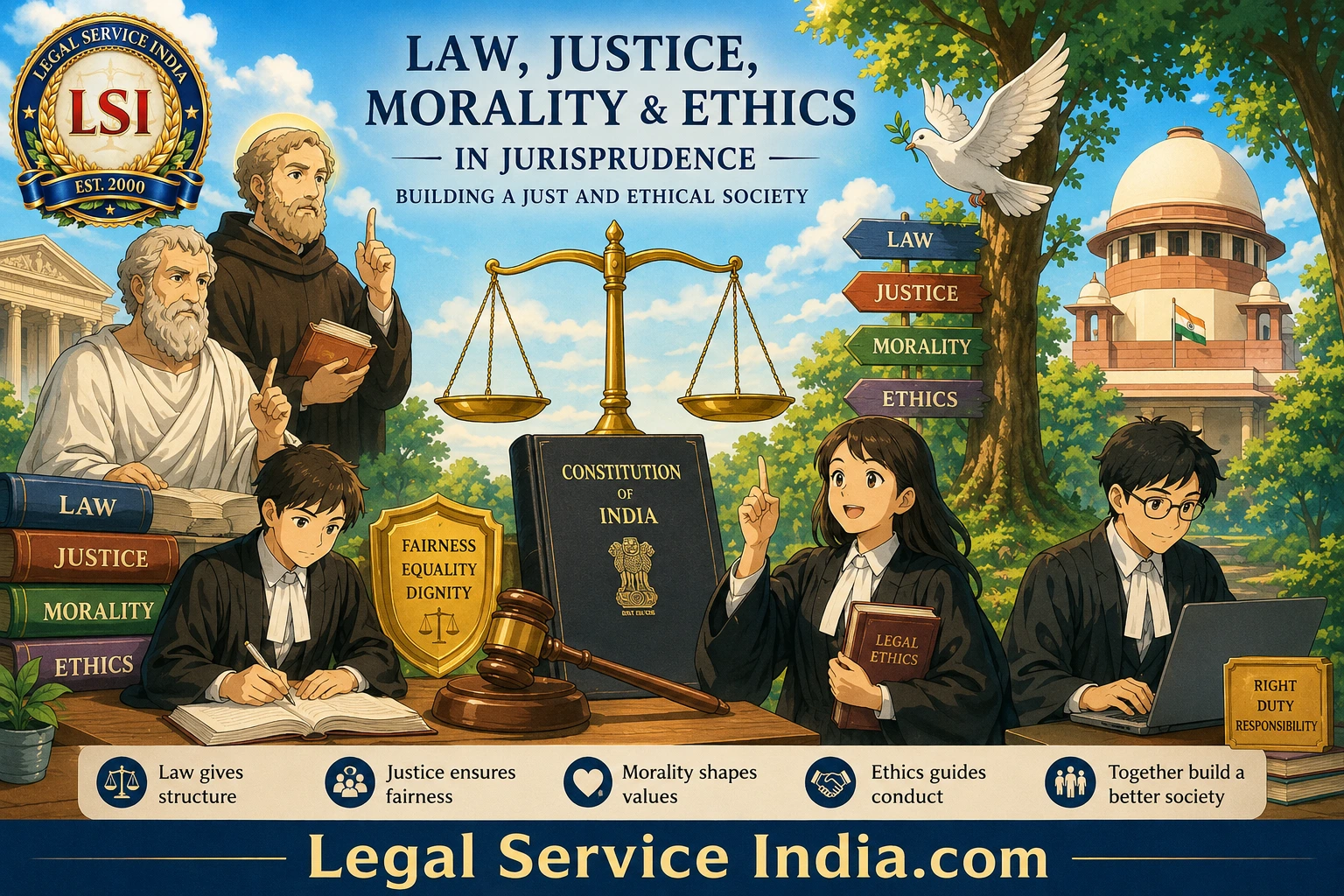
Jurisprudence, often described as the philosophy of law, seeks to examine the nature, purpose, and functioning of law in society. Among the most debated themes within jurisprudence are the concepts of law, justice, morality, and ethics. These concepts are interconnected, yet they are not identical. Law represents the formal system of rules enforced by the State; justice embodies the ideal that law seeks to achieve; morality refers to societal standards of right and wrong; and ethics concerns principles governing individual and professional conduct.
This article critically analyzes these four concepts through the perspectives of classical and modern jurists, including Aristotle, Aquinas, Austin, Bentham, Hart, Fuller, Dworkin, and Indian thinkers. It also examines the relationship between law and morality, the ethical obligations of legal professionals, and the constitutional vision of justice in India. The discussion demonstrates that while law can exist independently of morality, a legal system detached from moral and ethical foundations risks losing legitimacy and public confidence.
1. Introduction
Jurisprudence is the intellectual foundation of legal studies because it explores the meaning, origin, and purpose of law. Every legal system is expected to regulate human behavior, maintain social order, and resolve disputes. However, the mere existence of legal rules does not guarantee justice. Throughout history, societies have questioned whether unjust laws should be obeyed, whether morality should influence legal interpretation, and whether legal professionals must follow ethical standards beyond statutory obligations.
The concepts of law, justice, morality, and ethics have therefore occupied a central position in jurisprudential discourse. Ancient philosophers viewed law as an instrument of justice and moral order, whereas legal positivists argued that law derives its validity from sovereign authority rather than moral content. Modern constitutional democracies attempt to reconcile these competing views by embedding principles of dignity, equality, and fairness within legal frameworks.
The Indian legal system provides a unique example of this interaction. The Constitution not only establishes legal institutions but also reflects moral aspirations such as liberty, equality, fraternity, and justice. Judicial decisions have increasingly relied upon constitutional morality, human rights, and ethical governance to interpret legal provisions. Understanding the relationship among these concepts is therefore essential for students, scholars, and practitioners of law.
Core Concepts at a Glance
| Concept | Meaning | Primary Focus |
|---|---|---|
| Law | Formal system of rules enforced by the state. | Regulation of society and dispute resolution. |
| Justice | The ideal that law seeks to achieve. | Fairness, equality, and rights. |
| Morality | Societal standards of right and wrong. | Social values and moral conduct. |
| Ethics | Principles governing individual and professional conduct. | Personal and professional responsibility. |
Key Takeaways
- Law, justice, morality, and ethics are closely connected but remain distinct jurisprudential concepts.
- Justice is the ultimate objective that legal systems strive to achieve.
- Modern constitutional democracies seek to balance legal authority with moral and ethical principles.
- The Indian Constitution integrates values such as liberty, equality, fraternity, and justice into its legal framework.
- A legal system that is disconnected from morality and ethics risks losing legitimacy and public confidence.
Concept of Law in Jurisprudence
Law may be defined as a body of rules recognised and enforced by the State for regulating human conduct. Different schools of jurisprudence provide different explanations of its nature.
2.1 Analytical or Positivist Perspective
John Austin defined law as “a command of the sovereign backed by sanctions.” According to him, the validity of law depends upon its source rather than its moral quality. A law may be unjust, yet it remains law if issued by the sovereign authority.
H.L.A. Hart criticized Austin’s command theory and introduced the distinction between primary rules and secondary rules. Primary rules impose duties, whereas secondary rules provide procedures for creating, modifying, and adjudicating legal rules. Hart argued that a legal system functions through a “rule of recognition,” which determines the validity of legal norms.
| Jurist | Core Theory | Key Principle |
|---|---|---|
| John Austin | Command Theory | Law is a command of the sovereign backed by sanctions. |
| H.L.A. Hart | Rule-Based Theory | Legal systems operate through primary rules, secondary rules, and the rule of recognition. |
2.2 Natural Law Perspective
Natural law thinkers maintain that law must conform to moral principles. St. Thomas Aquinas argued that an unjust law is not a true law because it violates reason and the common good. According to this view, legal validity cannot be completely separated from morality.
2.3 Sociological Perspective
Roscoe Pound regarded law as a tool of social engineering. He emphasized balancing competing social interests through legal institutions. Law, in this sense, is not merely a command but a mechanism for achieving social welfare and justice.
Thus, jurisprudence reveals that law is both a system of enforceable rules and a social institution influenced by moral, political, and economic factors.
3. Meaning and Nature of Justice
Justice is the ultimate ideal that gives legitimacy to law. Aristotle described justice as “giving each person his due.” He distinguished between distributive justice, which concerns fair allocation of benefits and burdens, and corrective justice, which rectifies wrongs through legal remedies.
Major Dimensions of Justice
Modern jurisprudence identifies several dimensions of justice:
- Legal justice—application of law according to established procedures.
- Social justice – reduction of inequalities and protection of disadvantaged groups.
- Economic justice—equitable distribution of resources and opportunities.
- Political justice—equal participation in democratic processes.
- Procedural justice—fairness in legal processes and decision-making.
| Type of Justice | Meaning |
|---|---|
| Legal Justice | Application of law according to established procedures. |
| Social Justice | Reduction of inequalities and protection of disadvantaged groups. |
| Economic Justice | Equitable distribution of resources and opportunities. |
| Political Justice | Equal participation in democratic processes. |
| Procedural Justice | Fairness in legal processes and decision-making. |
John Rawls developed the theory of “justice as fairness,” arguing that social institutions should be arranged so that they benefit the least advantaged members of society. His “veil of ignorance” thought experiment emphasizes impartiality in designing legal and political systems.
In the Indian context, the Preamble to the Constitution promises justice—social, economic, and political. Fundamental Rights and Directive Principles collectively reflect the constitutional commitment to substantive justice rather than merely formal equality.
4. Morality and Its Jurisprudential Significance
Morality refers to standards of right and wrong accepted by individuals or society. Unlike law, moral rules are generally enforced through social approval or disapproval rather than state coercion.
4.1 Characteristics of Morality
- It originates from conscience, religion, culture, or social values.
- It varies across societies and historical periods.
- It is primarily concerned with the distinction between good and evil.
- Its enforcement depends upon internal conviction and social pressure.
4.2 Law and Morality: The Debate
The relationship between law and morality has produced one of the most significant controversies in jurisprudence.
Natural Law View
Natural law theorists argue that law and morality are inseparable. Aquinas maintained that human laws derive authority from higher moral principles. If a law contradicts natural justice, it lacks moral legitimacy.
Legal Positivist View
Austin and later Hart contended that legal validity is independent of moral evaluation. A law enacted through proper legal procedures remains valid even if morally objectionable.
Fuller’s Internal Morality of Law
Lon L. Fuller attempted a middle path by arguing that law possesses an “internal morality” consisting of principles such as generality, publicity, clarity, consistency and congruence between official action and declared rules. A legal system that disregards these principles fails to function as law in the true sense.
| Theory | Representative Jurist | View on Law and Morality |
|---|---|---|
| Natural Law | St. Thomas Aquinas | Law and morality are inseparable. |
| Legal Positivism | John Austin, H.L.A. Hart | Legal validity is independent of morality. |
| Internal Morality of Law | Lon L. Fuller | Law must satisfy procedural moral principles to function effectively. |
The famous Hart–Fuller debate illustrates the tension between legal certainty and moral responsibility, particularly in cases involving oppressive regimes.
5. Ethics: Concept and Legal Relevance
Ethics concerns principles governing individual and professional conduct. While morality often reflects societal values, ethics provides structured standards for decision-making in specific contexts.
5.1 Types of Ethics
- Personal ethics—individual moral principles.
- Professional ethics—standards applicable to occupations such as law, medicine, and business.
- Judicial ethics—principles governing impartiality, integrity, and independence of judges.
- Legal ethics—duties of advocates towards clients, courts, and society.
5.2 Importance of Ethics in the Legal Profession
The legal profession occupies a position of public trust. Advocates are expected to uphold the rule of law, maintain confidentiality, avoid conflicts of interest, and act with honesty and fairness. The Bar Council of India Rules prescribe ethical standards relating to professional conduct and etiquette.
Judicial ethics are equally important. A judge must not only be impartial but also appear impartial. Public confidence in the judiciary depends upon adherence to ethical values such as integrity, independence, and accountability.
6. Relationship between Law, Justice, Morality, and Ethics
These four concepts may be distinguished yet understood as complementary elements of a civilized legal order.
| Concept | Primary Focus |
|---|---|
| Law | Enforceable rules created by recognized authority |
| Justice | Fairness and rightful treatment |
| Morality | Societal standards of right and wrong |
| Ethics | Principles guiding personal and professional conduct |
Points of Convergence
- All aim to regulate human behavior.
- Justice often requires moral and ethical considerations.
- Ethical values influence the interpretation and application of law.
- Constitutional democracies increasingly incorporate moral principles such as dignity and equality into legal frameworks.
Points of Divergence
- Law is externally enforced; morality is internally accepted.
- Ethics may impose higher standards than those required by law.
- A legally valid rule may be morally questionable.
- Moral values differ across cultures, whereas legal systems require certainty and uniformity.
7. Jurisprudential Schools on the Interrelationship
Each school contributes a different perspective, demonstrating that the relationship among law, justice, morality, and ethics cannot be explained through a single theory.
7.1 Natural Law School
Thinkers such as Aristotle, Cicero, and Aquinas believed that justice and morality are inherent in the concept of law. The purpose of law is to realize the common good and promote virtuous living.
7.2 Analytical School
Austin and Kelsen separated law from morality to preserve legal certainty. Kelsen’s “Pure Theory of Law” sought to study law independently of ethical or political considerations.
7.3 Historical School
Savigny argued that law evolves from the spirit of the people (Volksgeist). Moral and cultural values therefore influence the development of legal norms.
7.4 Sociological School
Pound emphasized the practical role of law in satisfying social needs. Justice is achieved by balancing competing interests rather than merely applying abstract moral principles.
7.5 Realist School
Legal realists focused on judicial behavior and the actual operation of law. They argued that ethical, psychological, and social factors influence judicial decision-making.
Summary of Jurisprudential Schools
| School | Key Thinkers | Core View |
|---|---|---|
| Natural Law School | Aristotle, Cicero, Aquinas | Law should reflect justice and morality. |
| Analytical School | Austin, Kelsen | Law should be studied independently of morality. |
| Historical School | Savigny | Law evolves from the customs and values of society. |
| Sociological School | Pound | Law serves social interests and practical needs. |
| Realist School | Legal Realists | Judicial decisions are influenced by social and psychological factors. |
Key Takeaways
- Ethics provides structured principles governing personal and professional conduct.
- Legal ethics and judicial ethics are essential for maintaining public confidence in the justice system.
- Law, justice, morality, and ethics are distinct concepts but collectively support a civilized legal order.
- Natural Law, Analytical, Historical, Sociological, and Realist Schools each explain the relationship between law and morality from different perspectives.
- No single jurisprudential theory completely explains the interaction between law, justice, morality, and ethics.
6] Indian Constitutional Perspective
The Constitution of India represents a synthesis of legal authority, moral values, and social justice.
8.1 Preamble
The Preamble declares India to be a sovereign, socialist, secular, democratic republic and promises justice, liberty, equality, and fraternity. These ideals provide the moral foundation of the constitutional order.
| Constitutional Ideal | Significance |
|---|---|
| Sovereign | Ensures India’s independent authority and self-governance. |
| Socialist | Promotes social and economic justice. |
| Secular | Guarantees equal respect for all religions. |
| Democratic Republic | Provides representative government and constitutional governance. |
| Justice, Liberty, Equality, and Fraternity | Serve as the moral foundation of the constitutional order. |
8.2 Fundamental Rights
Articles 14, 19, and 21 protect equality, freedom, and life with dignity. Judicial interpretation has expanded these rights to include privacy, education, livelihood, and environmental protection.
- Equality under Article 14.
- Freedom guaranteed under Article 19.
- Right to life and dignity under Article 21.
- Expanded rights include privacy, education, livelihood, and environmental protection.
8.3 Directive Principles of State Policy
Although non-justiciable, the Directive Principles embody ethical and social obligations of the State, including welfare, public health, equal pay, and protection of vulnerable groups.
| Directive Principle | Objective |
|---|---|
| Welfare | Promote social and economic well-being. |
| Public Health | Improve healthcare and public welfare. |
| Equal Pay | Ensure equal remuneration for equal work. |
| Protection of Vulnerable Groups | Safeguard disadvantaged sections of society. |
8.4 Constitutional Morality
The Supreme Court has increasingly invoked constitutional morality to resolve conflicts involving individual rights and social practices. In cases such as Navtej Singh Johar v. Union of India and Indian Young Lawyers Association v. State of Kerala, the Court emphasized that constitutional values must prevail over discriminatory customs.
- Balances individual rights with social practices.
- Prioritises constitutional values over discriminatory customs.
- Strengthens equality, dignity, and constitutional governance.
Contemporary Challenges
The interaction between law, justice, morality, and ethics has become more complex in the twenty-first century.
9.1 Technology and Artificial Intelligence
Questions arise regarding algorithmic bias, data privacy, surveillance, and accountability. Legal regulation must be guided by ethical principles of transparency, fairness, and human dignity.
- Algorithmic bias.
- Data privacy.
- Surveillance.
- Accountability.
- Transparency, fairness, and human dignity.
9.2 Corruption and Governance
Laws against corruption are effective only when supported by ethical public administration and moral commitment to integrity.
9.3 Human Rights
International human rights law increasingly reflects universal moral values, challenging purely positivist conceptions of legal sovereignty.
9.4 Professional Misconduct
Instances of unethical conduct by lawyers, judges, and public officials undermine public confidence in the legal system. Strengthening ethical education and accountability mechanisms has therefore become essential.
| Contemporary Challenge | Key Concern |
|---|---|
| Technology and Artificial Intelligence | Algorithmic bias, privacy, surveillance, and accountability. |
| Corruption and Governance | Ethical public administration and integrity. |
| Human Rights | Universal moral values and legal sovereignty. |
| Professional Misconduct | Ethical education and accountability mechanisms. |
XZ *mc<39h2 id=”critical-evaluation-law-justice-morality-ethics”>Critical Evaluation
A purely positivist legal system may ensure certainty but may fail to prevent grave injustices. Conversely, excessive reliance on subjective morality may create unpredictability and judicial arbitrariness. The challenge is to maintain a balance between legal certainty and moral legitimacy.
Justice as the Bridge Between Law and Morality
Justice serves as the bridge connecting law with morality and ethics. Law provides the institutional framework; morality supplies societal values; ethics guides individual conduct; and justice evaluates whether the legal system fulfills its normative purpose. A democratic constitutional order cannot rely exclusively on coercive legal authority; it must also cultivate ethical citizenship and moral responsibility.
| Concept | Primary Function |
|---|---|
| Law | Provides the institutional framework. |
| Morality | Supplies societal values. |
| Ethics | Guides individual conduct. |
| Justice | Evaluates whether the legal system fulfills its normative purpose. |
Importance for Legal Education
For legal education, this implies that students should not only learn statutes and precedents but also develop critical understanding of justice, constitutional values, and professional ethics. Jurisprudence remains relevant precisely because it encourages reflection on the deeper purposes of law.
- Learn statutes and precedents.
- Develop a critical understanding of justice.
- Understand constitutional values.
- Follow professional ethics.
- Reflect on the deeper purposes of law.
Conclusion
Law, justice, morality, and ethics are distinct yet interdependent concepts within jurisprudence. Law establishes enforceable norms; justice represents the ideal of fairness; morality expresses societal notions of right and wrong; and ethics governs responsible conduct. The historical debate between natural law and legal positivism demonstrates that neither complete separation nor complete fusion of these concepts provides a satisfactory explanation of legal reality.
Balanced Constitutional Approach in India
The Indian constitutional framework illustrates a balanced approach in which legal authority is exercised within a moral and ethical constitutional order committed to dignity, equality, and social justice. Contemporary challenges such as technological regulation, human rights protection, and institutional integrity further highlight the need for ethical and moral reasoning in legal decision-making.
Lasting Legitimacy of the Legal System
Ultimately, a legal system derives lasting legitimacy not merely from the power to enforce rules but from its capacity to promote justice through morally informed and ethically responsible institutions. Jurisprudence therefore continues to remind us that the true purpose of law is not only order but also justice grounded in human values.
| Key Concept | Role in Jurisprudence |
|---|---|
| Law | Establishes enforceable norms. |
| Justice | Represents the ideal of fairness. |
| Morality | Expresses societal notions of right and wrong. |
| Ethics | Governs responsible conduct. |
| Indian Constitutional Framework | Balances legal authority with moral and ethical constitutional values. |
References
- Aristotle. Nicomachean Ethics. Translated by W.D. Ross. Oxford University Press, 2009.
- Austin, John. The Province of Jurisprudence Determined. Cambridge University Press, 1995.
- Bentham, Jeremy. An Introduction to the Principles of Morals and Legislation. Dover Publications, 2007.
- Dias, R.W.M. Jurisprudence. 5th ed., LexisNexis, 2013.
- Dworkin, Ronald. Law’s Empire. Harvard University Press, 1986.
- Finnis, John. Natural Law and Natural Rights. Oxford University Press, 2011.
- Fuller, Lon L. The Morality of Law. Yale University Press, 1969.
- Hart, H.L.A. The Concept of Law. 3rd ed., Oxford University Press, 2012.
- Jain, M.P. Indian Constitutional Law. 8th ed., LexisNexis, 2018.
- Kelsen, Hans. Pure Theory of Law. University of California Press, 1967.
- Lloyd, Dennis. Introduction to Jurisprudence. Sweet & Maxwell, 1979.
- Pound, Roscoe. An Introduction to the Philosophy of Law. Yale University Press, 1922.
- Rawls, John. A Theory of Justice. Harvard University Press, 1971.
- Salmond, John. Jurisprudence. 12th ed., Sweet & Maxwell, 1966.
- Savigny, Friedrich Karl von. Of the Vocation of Our Age for Legislation and Jurisprudence. Littlewood & Co., 1831.
- Seervai, H.M. Constitutional Law of India. Universal Law Publishing, 1996.
- St. Thomas Aquinas. Summa Theologica a. Benziger Brothers, 1947.
- Bar Council of India. Rules on Standards of Professional Conduct and Etiquette, Part VI, Chapter II.
- Constitution of India, 1950.
- iPleaders. “Jurisprudence: Meaning, Nature, Scope, and Relationship between Law and Morality.” https://blog.ipleaders.in/ (analytical reference for conceptual discussions).