





Introduction
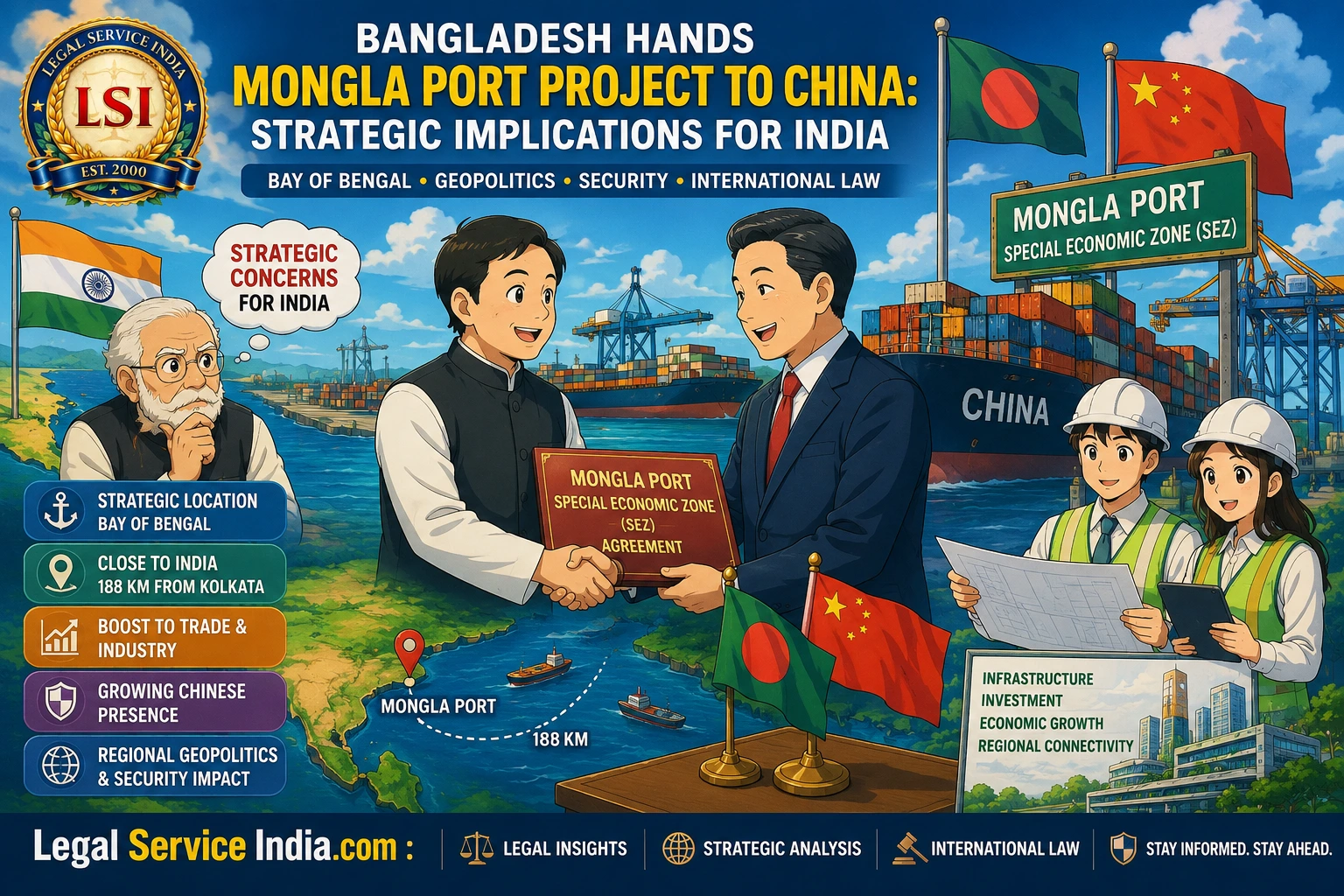
Bangladesh’s decision to involve China in the development of the strategically significant Mongla Port and the adjoining Special Economic Zone (SEZ) has attracted considerable attention across South Asia. The move represents more than a change in infrastructure investment—it reflects the evolving geopolitical landscape of the Bay of Bengal, where economic development, regional diplomacy, maritime security, and great-power competition increasingly intersect.
The project has drawn particular interest in India because the same economic zone had originally been earmarked for Indian development under bilateral agreements signed during the tenure of former Prime Minister Sheikh Hasina. Bangladesh’s subsequent decision to replace India with China has prompted strategic debate regarding the future balance of influence in the Bay of Bengal and the wider Indo-Pacific region.
While Bangladesh maintains that the decision is driven purely by economic considerations, strategic analysts believe the development deserves careful examination because ports have increasingly become instruments of both commercial growth and geopolitical influence.
Background: The India-Bangladesh Agreement
The origins of the Mongla Special Economic Zone project date back to 2015, when Bangladesh and India signed a Memorandum of Understanding (MoU) to establish an Indian-backed Special Economic Zone near Mongla Port.
The initiative formed part of India’s broader Neighbourhood First Policy, aimed at strengthening economic integration with neighbouring countries through trade, infrastructure development, and investment. The proposed SEZ was expected to encourage Indian manufacturing companies to establish industries in Bangladesh while boosting bilateral trade and employment.
In 2018, an Indian company was selected to undertake land development for the project.
In 2022, the Bangladesh Economic Zones Authority (BEZA) executed further agreements to facilitate implementation, indicating continued institutional support.
The project was widely viewed as an important symbol of growing India-Bangladesh economic cooperation under the leadership of Prime Minister Narendra Modi and then Prime Minister Sheikh Hasina.
Key Milestones of the India-Bangladesh Mongla SEZ Project
| Year | Development |
|---|---|
| 2015 | India and Bangladesh signed an MoU to establish an Indian-backed Special Economic Zone near Mongla Port. |
| 2018 | An Indian company was selected for land development. |
| 2022 | BEZA executed additional agreements to facilitate project implementation. |
Political Changes and a Shift in Policy
Bangladesh’s domestic political landscape underwent significant changes following the fall of the Sheikh Hasina government. The interim administration subsequently reviewed several infrastructure and investment projects initiated under the previous government.
According to media reports, the Mongla SEZ project experienced prolonged implementation delays. The interim government ultimately decided to discontinue the Indian-backed proposal and invited fresh investment.
China thereafter proposed developing the same approximately 110-acre Special Economic Zone adjacent to Mongla Port. Bangladesh accepted the proposal, effectively transferring one of its strategically important industrial projects from India to China.
Although Bangladesh has described the decision as an economic one based on investment efficiency and implementation timelines, the shift has inevitably attracted geopolitical attention because of the strategic location of Mongla Port.
Why Mongla Port Is Strategically Important
Mongla Port is Bangladesh’s second-largest seaport after Chattogram and serves as a vital maritime gateway for southwestern Bangladesh.
Its strategic importance arises from several factors:
- It is located on the Bay of Bengal, one of the world’s most important maritime regions.
- It lies approximately 188 kilometres from Kolkata, placing it relatively close to India’s eastern coastline.
- It supports Bangladesh’s growing international trade.
- It serves industries located in southwestern Bangladesh.
- It complements Chattogram Port by diversifying Bangladesh’s maritime logistics network.
Strategic Significance at a Glance
| Strategic Factor | Importance |
|---|---|
| Location | Situated on the Bay of Bengal, a major maritime region. |
| Proximity to India | Approximately 188 kilometres from Kolkata. |
| Trade | Supports Bangladesh’s expanding international trade. |
| Industrial Growth | Serves industries in southwestern Bangladesh. |
| Port Network | Complements Chattogram Port and strengthens maritime logistics. |
The Bay of Bengal has become increasingly important due to rising global trade, expanding energy routes, naval deployments, and regional connectivity projects linking South Asia with Southeast Asia.
Consequently, any significant foreign investment in major ports around the Bay of Bengal naturally receives close attention from regional security planners.
China’s Expanding Presence in the Indian Ocean
The Mongla project must also be understood within the broader context of China’s expanding overseas infrastructure investments under the Belt and Road Initiative (BRI).
Launched in 2013, the BRI seeks to improve connectivity through ports, highways, railways, industrial parks, and logistics corridors across Asia, Africa, Europe, and parts of Latin America.
Chinese companies have participated in the development or financing of several strategically located ports, including:
| Country | Port | Strategic Importance |
|---|---|---|
| Sri Lanka | Hambantota Port | Major shipping route in the Indian Ocean |
| Pakistan | Gwadar Port | Arabian Sea and China-Pakistan Economic Corridor (CPEC) |
| Myanmar | Kyaukpyu Port | Access to the Bay of Bengal and energy corridor to China |
| Bangladesh | Mongla Port | Bay of Bengal connectivity and industrial development |
China maintains that these projects are purely commercial and designed to promote trade, infrastructure, and regional development.
However, some strategic experts in India, the United States, Japan, and other countries have expressed concerns that certain commercial ports could, in the future, possess dual-use capabilities capable of supporting naval logistics or maritime surveillance.
Importantly, no public evidence currently indicates that the Mongla Port project has any military component, and Bangladesh has not announced any defence-related cooperation connected with the project.
India’s Strategic Concerns
India’s concerns stem primarily from geography rather than from any announced military activity.
Several factors contribute to New Delhi’s close monitoring of developments:
1. Proximity to India’s Eastern Coast
Mongla Port lies relatively close to Kolkata and India’s eastern seaboard, making developments there strategically significant.
2. Maritime Security
India has steadily strengthened its maritime posture in the Bay of Bengal to safeguard shipping lanes, offshore assets, and naval operations.
3. Expanding Chinese Regional Influence
China has become Bangladesh’s largest trading partner and a significant source of infrastructure financing.
Increasing Chinese investments across multiple sectors inevitably expand Beijing’s economic influence within Bangladesh.
4. Regional Balance of Power
South Asia has become an increasingly competitive strategic space where India, China, Japan, the United States, and several ASEAN countries seek greater economic and diplomatic engagement.
Infrastructure projects therefore carry implications beyond commercial investment.
Key Factors Behind India’s Concerns
- Strategic proximity of Mongla Port to India’s eastern coastline.
- Protection of maritime security and sea lanes in the Bay of Bengal.
- Growing Chinese economic influence through infrastructure investments.
- Maintaining the regional balance of power in South Asia and the Indo-Pacific.
Bangladesh’s Perspective: Economic Development First
From Bangladesh’s perspective, infrastructure development remains essential for sustaining economic growth.
The government has consistently maintained the following:
- Foreign investment decisions are guided by national economic priorities.
- Modern ports are necessary to support exports and industrialisation.
- Industrial zones generate employment and attract manufacturing investment.
- Bangladesh welcomes investment from multiple international partners.
Bangladesh has repeatedly emphasised that it seeks balanced relations with both India and China while preserving its strategic autonomy.
As a sovereign nation, Bangladesh possesses the right under international law to determine its economic partnerships based on its own developmental priorities.
Bangladesh’s Official Position at a Glance
| Policy Area | Bangladesh’s Position |
|---|---|
| Foreign Investment | Guided by national economic priorities |
| Port Development | Supports exports, trade, and industrialisation. |
| International Partnerships | Open to investment from multiple countries |
| Strategic Policy | Maintains balanced relations with both India and China |
| Sovereign Right | Determines economic partnerships based on national development goals |
The Legal and International Law Perspective
From the standpoint of international law, there is nothing inherently unlawful in Bangladesh awarding infrastructure projects to Chinese entities.
Under the principle of state sovereignty, every nation retains the sovereign right to decide:
- Which foreign investors may participate in domestic infrastructure.
- The terms of investment.
- Industrial development policies.
- Port modernisation strategies.
State Sovereignty and UNCLOS
Similarly, the United Nations Convention on the Law of the Sea (UNCLOS) recognises the sovereign rights of coastal states over the management and development of their ports, territorial waters, and maritime infrastructure, subject to applicable international obligations.
Accordingly, Bangladesh’s decision falls within its sovereign policy-making authority.
The strategic debate surrounding the project therefore concerns geopolitical implications rather than questions of legality.
| International Law Principle | Application to the Mongla Port Project |
|---|---|
| State Sovereignty | Allows Bangladesh to determine its own infrastructure partners and investment policies. |
| UNCLOS | Recognises Bangladesh’s sovereign rights over its ports, maritime infrastructure, and territorial waters. |
| Legal Position | The decision is legally permissible under international law. |
| Strategic Debate | Concerns geopolitical implications rather than legality. |
Implications for India’s “Neighbourhood First” and “Act East” Policies
The development also carries diplomatic significance for India.
For more than a decade, India has pursued its Neighbourhood First Policy, emphasising closer political, economic, and infrastructural cooperation with neighbouring countries.
Simultaneously, India’s Act East Policy seeks deeper engagement with Southeast Asia through enhanced connectivity, trade, and maritime cooperation.
The transfer of the Mongla project to China may prompt India to reassess aspects of its regional infrastructure strategy, including:
- Accelerating implementation of cross-border projects.
- Increasing investment in neighbouring countries.
- Enhancing maritime cooperation in the Bay of Bengal.
- Expanding economic partnerships through faster project execution.
Many analysts view the episode as a reminder that timely implementation is often as important as financial commitment in international development projects.
| India’s Policy | Possible Strategic Response |
|---|---|
| Neighbourhood First Policy | Strengthen regional economic and infrastructure partnerships. |
| Act East Policy | Improve connectivity, trade, and maritime cooperation with Southeast Asia. |
| Infrastructure Strategy | Accelerate project execution and enhance regional investments. |
Economic Significance for Bangladesh
Beyond geopolitics, the project has considerable economic importance.
A modernised Mongla Port and adjoining industrial zone could:
- Increase cargo-handling capacity.
- Attract foreign direct investment.
- Generate employment opportunities.
- Strengthen Bangladesh’s export-orientated manufacturing sector.
- Improve regional logistics and supply chains.
- Support long-term industrial growth.
For Bangladesh, these economic benefits remain central to the rationale behind the project.
| Potential Economic Benefit | Expected Impact |
|---|---|
| Higher Cargo Capacity | Improved efficiency of port operations. |
| Foreign Direct Investment | Greater inflow of international capital. |
| Employment | Creation of new jobs in industry and logistics. |
| Manufacturing Growth | Support for Bangladesh’s export-orientated industries. |
| Regional Logistics | Better connectivity and supply chain efficiency. |
| Industrial Development | Long-term economic expansion. |
Future Scenarios
Scenario 1: Purely Commercial Success
The project functions solely as an industrial and logistics hub, strengthening Bangladesh’s economy without generating significant geopolitical tensions.
Scenario 2: Increased Regional Competition
India and China may intensify infrastructure investments across South Asia as both countries seek greater regional influence through economic cooperation.
Scenario 3: Enhanced Maritime Cooperation
Bangladesh could continue balancing relations with multiple partners—including India, China, Japan, the United States, and ASEAN nations—thereby preserving strategic autonomy while maximising development opportunities.
| Scenario | Possible Outcome |
|---|---|
| Purely Commercial Success | Economic development with limited geopolitical friction. |
| Increased Regional Competition | Greater India-China infrastructure competition across South Asia. |
| Enhanced Maritime Cooperation | Balanced diplomacy with multiple international partners. |
Current Assessment
At present, no evidence conclusively supports predictions of military use, and future developments will depend on regional diplomacy, transparency, and evolving strategic circumstances.
Key Takeaways
| Issue | Significance |
|---|---|
| China replacing India in Mongla SEZ | Strategic shift in regional infrastructure partnerships |
| Bay of Bengal location | Important maritime trade and security region |
| Bangladesh’s decision | Sovereign economic policy choice |
| India’s concern | Maritime security and regional influence |
| China’s position | Commercial infrastructure under the Belt and Road Initiative |
| International law | Bangladesh has the sovereign right to select investment partners |
| Future outlook | Continued geopolitical competition alongside economic cooperation |
Conclusion
Bangladesh’s decision to entrust the Mongla Port Special Economic Zone project to China represents an important development in South Asian geopolitics. Although the project is officially presented as an economic initiative aimed at modernising infrastructure and attracting investment, its strategic location near India’s eastern coastline ensures that it will continue to receive close attention from policymakers and security experts.
From a legal standpoint, Bangladesh is fully entitled to determine its investment partners and infrastructure priorities. The more significant questions arise in the geopolitical domain, where infrastructure increasingly serves not only as an engine of economic growth but also as an instrument of regional influence.
Implications for India
For India, the episode underscores the importance of timely implementation of cross-border projects, sustained diplomatic engagement, and deeper economic partnerships with neighbouring countries under its Neighbourhood First and Act East policies.
Implications for Bangladesh
For Bangladesh, the challenge will be to balance economic development with strategic autonomy while maintaining constructive relations with all major powers.
Future Outlook for Mongla Port
Ultimately, the future significance of the Mongla Port project will depend less on the identity of its developer and more on how the infrastructure is utilised, the transparency of its operations, and the broader trajectory of India–Bangladesh–China relations in an increasingly competitive Indo-Pacific region.
As geopolitical competition intensifies, Mongla Port is likely to remain a focal point in discussions on maritime security, regional connectivity, and the evolving strategic architecture of South Asia.
Summary of Key Findings
- Bangladesh retains the sovereign right to choose its infrastructure and investment partners.
- Mongla Port’s strategic location enhances its importance in the Bay of Bengal and Indo-Pacific region.
- India is likely to strengthen diplomatic and economic engagement under its Neighbourhood First and Act East policies.
- China continues expanding regional infrastructure connectivity through the Belt and Road Initiative.
- The long-term strategic impact will depend on the project’s implementation, operational transparency, and evolving India–Bangladesh–China relations.
