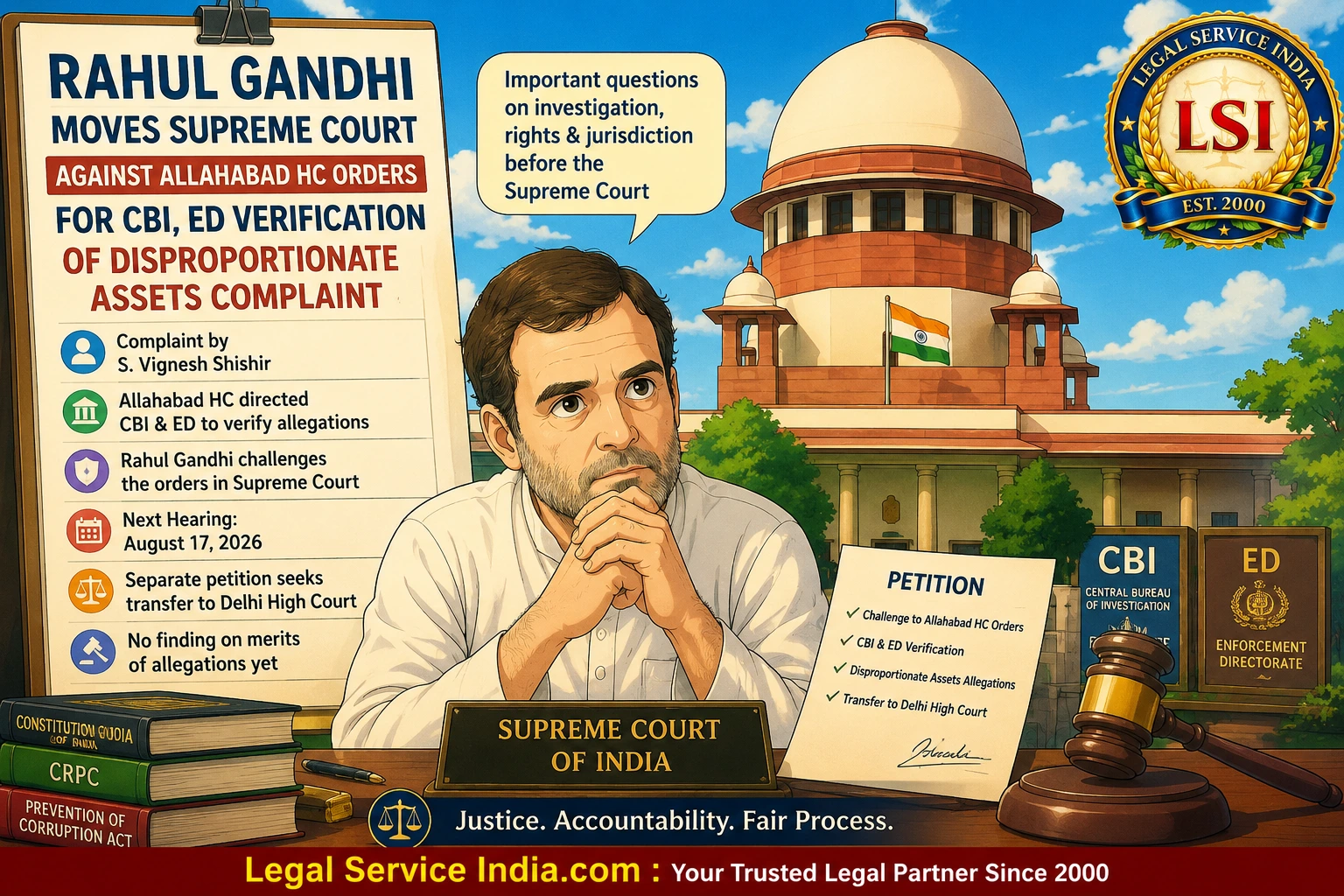
Rahul Gandhi Moves Supreme Court Against Allahabad HC Orders for CBI, ED Verification of Disproportionate Assets Complaint
Introduction
In a significant development carrying substantial legal and political ramifications, Rahul Gandhi has moved the Supreme Court challenging the Allahabad High Court orders concerning a complaint alleging that he possesses assets disproportionate to his known sources of income. The challenge concerns directions issued by the Lucknow Bench of the Allahabad High Court to the Central Bureau of Investigation (CBI) and the Enforcement Directorate (ED) to verify the allegations made by Karnataka-based BJP worker S. Vignesh Shishir.
It is important, at the outset, to clarify that this is not yet a Supreme Court judgment on the merits of the disproportionate-assets allegations. As of August 13, 2026, Rahul Gandhi has filed petitions before the Supreme Court, and the matter is listed for consideration on August 17, 2026, before a bench comprising Chief Justice of India Surya Kant and Justices Joymalya Bagchi and V. Mohana.
The Supreme Court proceedings therefore assume importance not merely because of the identity of the petitioner, but because they raise questions concerning the permissible limits of judicial directions to investigating agencies, the stage at which allegations may be verified, the rights of a person against whom an investigation is sought, and the appropriate jurisdiction in which such proceedings should continue.
Background of the Disproportionate Assets Complaint
The proceedings originate from a complaint filed by S. Vignesh Shishir, a Karnataka-based BJP worker, before the authorities alleging that Rahul Gandhi possessed assets disproportionate to his known sources of income.
The matter subsequently reached the Allahabad High Court, Lucknow Bench, where the petitioner sought investigation by the CBI and ED into the allegations. The proceedings were conducted with considerable caution, including directions concerning the handling of documents and the manner in which the matter was to be heard.
In May 2026, the High Court recorded that the CBI and ED had received the complaint and directed that the allegations could be verified in accordance with law. The Court further stated that the agencies could take appropriate steps permissible under law.
The High Court subsequently sought information regarding the progress made by the investigating agencies.
High Court Proceedings and Agency Verification
The Allahabad High Court later sought a fresh affidavit from the CBI concerning the progress of its inquiry. During the July 20, 2026 proceedings, the Court expressed dissatisfaction with the response filed by the CBI and also indicated that the ED could proceed in accordance with law if relevant material emerged.
The High Court proceedings have therefore remained focused on the status of the allegations and the response of the concerned authorities. They do not, by themselves, establish that Rahul Gandhi has committed any offense or that the allegations concerning disproportionate assets have been proved.
Rahul Gandhi’s Supreme Court Challenge
Rahul Gandhi has now approached the Supreme Court challenging the Allahabad High Court’s directions concerning verification of the allegations by the CBI and ED.
According to reports, the petitions were filed on August 7, 2026. A separate transfer petition has also been filed seeking transfer of the proceedings from the Allahabad High Court to the Delhi High Court.
| Issue | Present Position |
|---|---|
| Allegations | A complaint alleging disproportionate assets has been raised against Rahul Gandhi. |
| High Court | Allahabad High Court directed verification of the allegations in accordance with law. |
| Investigating Agencies | CBI and ED are concerned with the verification and any action permissible under law. |
| Supreme Court | Rahul Gandhi has challenged the High Court orders. |
| Next Listing | August 17, 2026. |
| Important Legal Position | No Supreme Court finding on the merits of the allegations has been made at this stage. |
Separate Transfer Petition
In addition to challenging the High Court’s directions, Rahul Gandhi has filed a separate transfer petition before the Supreme Court. The petition seeks to transfer the proceedings from the Allahabad High Court to the Delhi High Court.
The transfer request adds another important procedural issue to the Supreme Court proceedings. The Court may therefore be required to consider not only the challenge to the directions concerning verification by the CBI and ED but also whether the pending proceedings should continue before the Allahabad High Court.
Why the Supreme Court Hearing Matters
The Supreme Court’s consideration of the petitions could have significance beyond the individual allegations against Rahul Gandhi.
Some of the broader legal questions that may arise include:
- Judicial directions to investigating agencies: The extent to which a constitutional court can direct agencies such as the CBI or ED to verify allegations.
- Stage of verification: The distinction between examining a complaint, verifying allegations, and commencing a formal investigation.
- Protection of legal rights: The safeguards available to a person against whom allegations are made before the allegations are established.
- Jurisdiction: Whether the proceedings should remain before the Allahabad High Court or be transferred to another jurisdiction.
- Role of investigating agencies: The extent to which agencies must independently assess material before taking action.
An Allegation Is Not Proof
A crucial distinction must be maintained between an allegation, verification, investigation, and proof.
The fact that a complaint has been brought before a court or that an investigating agency has been asked to verify allegations does not, by itself, establish criminal liability. Any eventual finding would depend upon the evidence collected and the legal conclusions reached by the competent authorities or courts.
| Stage | Meaning |
|---|---|
| Complaint | A person brings allegations before the competent authority. |
| Verification | The authorities examine whether the allegations require further action. |
| Investigation | Evidence and relevant facts are formally examined under applicable law. |
| Prosecution | Legal proceedings may follow if the statutory requirements are satisfied. |
| Adjudication | A competent court determines the legal consequences on the basis of the evidence and applicable law. |
Supreme Court Hearing on August 17, 2026
The Supreme Court is scheduled to consider Rahul Gandhi’s petitions on August 17, 2026. The bench comprises Chief Justice of India Surya Kant, Justice Joymalya Bagchi, and Justice V. Mohana.
The hearing is expected to clarify the immediate legal position concerning the Allahabad High Court’s directions and the related transfer request. The Supreme Court’s eventual orders will determine the next procedural course of the proceedings.
Current Legal Position
As of August 13, 2026, the legal position can be summarized as follows:
- Rahul Gandhi has challenged the relevant Allahabad High Court orders before the Supreme Court.
- The underlying proceedings arise from allegations made by S. Vignesh Shishir.
- The Allahabad High Court directed that the allegations could be verified in accordance with law.
- The CBI has been asked to provide information concerning the progress of its inquiry.
- The ED may take action permissible under law if relevant material emerges.
- Rahul Gandhi has also sought transfer of the proceedings to the Delhi High Court.
- The Supreme Court is scheduled to consider the petitions on August 17, 2026.
- No final Supreme Court determination on the alleged disproportionate assets has been made at this stage.
Conclusion
Rahul Gandhi’s challenge before the Supreme Court places the Allahabad High Court proceedings under closer judicial scrutiny at the national level. The immediate issue is not whether the allegations of disproportionate assets are ultimately true or false, but whether the High Court’s directions concerning verification by the CBI and ED should stand and where the underlying proceedings should continue.
The Supreme Court hearing on August 17, 2026, is therefore significant from both procedural and constitutional perspectives. The Court’s order may provide important guidance on judicial supervision of investigating agencies, the treatment of allegations at the preliminary stage, and the procedural safeguards applicable when serious allegations are made against a public figure.
What Did the Allahabad High Court Direct?
The May order did not amount to a judicial finding that Rahul Gandhi had acquired disproportionate assets.
Rather, the Court directed the concerned agencies to deal with the allegations in accordance with law and to apprise the Court about the progress of the matter.
The High Court observed that if the complaint had been received, its allegations could be verified according to law and that the CBI or ED could take appropriate steps permissible under the law.
This distinction is legally fundamental.
Verification Is Not Proof of Guilt
A direction to verify an allegation cannot, by itself, be treated as a finding that the allegation is true.
There is a substantial difference between:
- receiving a complaint;
- conducting a preliminary verification or inquiry;
- registering an FIR;
- commencing a statutory investigation;
- collecting documentary and financial evidence;
- filing a charge sheet or prosecution complaint; and
- establishing criminal liability at trial.
At the present stage, the allegations against Rahul Gandhi remain allegations. No conclusion of criminal guilt has been recorded against him in these proceedings merely because the High Court directed verification.
This principle is particularly important when proceedings concern a prominent political figure, because judicial orders should not be converted into findings of guilt through political or media narratives.
The July 20, 2026 Development
The matter developed further on July 20, 2026.
The Allahabad High Court expressed dissatisfaction with the CBI’s affidavit, observing that it did not comply adequately with the court’s earlier directions and did not sufficiently explain the progress concerning the complaint.
The court directed a senior CBI officer to file a fresh affidavit setting out the progress made in the matter.
As regards the ED, the High Court observed that the agency had taken the required steps and indicated that, if information or material suggesting illegality emerged during the inquiry, the ED could proceed in accordance with law.
The High Court fixed August 20 for further consideration of the proceedings.
Rahul Gandhi Approaches the Supreme Court
Against this backdrop, Rahul Gandhi has approached the Supreme Court challenging the Allahabad High Court’s orders.
According to the latest available reports, the petitions were filed on August 7, 2026. Gandhi has also filed a separate transfer petition seeking that the proceedings be transferred from the Allahabad High Court to the Delhi High Court.
The Supreme Court is expected to consider both matters on August 17, 2026.
The precise issues that will ultimately arise for adjudication will depend upon the pleadings, the impugned orders placed before the Supreme Court, and the submissions advanced by the parties.
Why the Supreme Court Proceedings Are Legally Significant
The significance of Rahul Gandhi’s move to Supreme Court against Allahabad HC orders extends beyond the immediate controversy.
The case potentially brings into focus several important principles of criminal and constitutional procedure.
1. Judicial Supervision of Investigative Agencies
High Courts possess broad powers under Article 226 of the Constitution and, in appropriate cases, can issue directions concerning investigation.
However, judicial power over investigation must be exercised within established legal parameters.
Courts ordinarily do not themselves investigate allegations. Investigation remains the statutory responsibility of the competent agency.
The Supreme Court may therefore be required to examine the precise nature and scope of the High Court’s directions in the present case.
2. Difference Between Judicial Scrutiny and Judicial Investigation
There is a delicate distinction between judicially ensuring that a lawful complaint is considered and directing an agency in a manner that effectively predetermines the investigative course.
A constitutional court may intervene where circumstances warrant investigation, transfer, monitoring, or other appropriate relief. But the investigative agency must ordinarily retain the statutory discretion entrusted to it by Parliament.
This separation is important for maintaining both judicial independence and investigative autonomy.
3. Protection Against Premature Criminalization
A person named in a complaint does not become an accused merely because allegations have been published or an inquiry has been ordered.
The criminal justice system requires allegations to pass through legally prescribed stages.
This becomes especially significant where allegations concern financial misconduct, because financial records, ownership structures, tax filings, declarations, transactions, and beneficial interests may require detailed examination before any legal conclusion can properly be drawn.
What Is a Disproportionate Assets Allegation?
In general legal usage, a disproportionate-assets allegation involves a claim that an individual has acquired assets that cannot reasonably be explained by the person’s known or lawful sources of income.
The legal assessment ordinarily requires examination of matters such as
- the person’s known sources of income;
- assets held during the relevant period;
- liabilities and expenditure;
- legitimate financial transactions;
- loans and investments;
- inherited or gifted property;
- jointly held assets;
- tax records;
- corporate interests;
- documentary evidence concerning ownership; and
- the applicable statutory framework.
Consequently, the mere existence of valuable assets does not automatically establish criminal wrongdoing.
The legal question is whether the assets, their acquisition, and the sources from which they were acquired satisfy the requirements of the applicable law.
The Role of the CBI
The CBI is a central investigative agency with jurisdiction governed by the applicable statutory and constitutional framework.
Where a complaint alleging financial irregularity is placed before an investigative agency, the agency must act in accordance with law. Depending on the nature of the allegations and available material, the legal consequences may differ substantially.
The Allahabad High Court’s orders, as presently reported, concern verification and progress rather than a judicial determination that the allegations have been proved.
The Supreme Court’s intervention will therefore be watched closely for what it says about the appropriate judicial threshold before an investigative agency is directed to pursue allegations against an individual.
The Role of the Enforcement Directorate
The ED’s position is legally distinct from that of an ordinary police investigation.
The agency’s jurisdiction arises under specific statutory provisions, particularly the Prevention of Money Laundering Act, 2002 (PMLA), where the statutory prerequisites are satisfied.
Therefore, an allegation of disproportionate assets does not automatically translate into a money-laundering case.
There must be a legally sustainable basis for the exercise of the ED’s jurisdiction.
The Allahabad High Court itself indicated that the ED could take action if, during its inquiry, it received information or documents indicating illegality.
This is significant because it underscores that the agency’s further action must remain tied to the statutory framework.
The Transfer Petition: Why It Matters
Rahul Gandhi has additionally sought transfer of the proceedings from the Allahabad High Court to the Delhi High Court.
A transfer petition is not, by itself, an adjudication on the truth or falsity of the underlying allegations.
The Supreme Court may consider questions such as
- whether the transfer is justified in the circumstances;
- whether the petitioner can demonstrate legally relevant grounds;
- whether continuation before the existing forum would cause prejudice;
- whether the interests of justice require transfer; and
- whether the proceedings can be fairly and effectively dealt with by another court.
Transfer jurisdiction is therefore fundamentally concerned with the interests of justice and fairness, rather than determining the merits of the underlying criminal allegations.
Sealed-Cover Proceedings and Access to the Record
Another unusual feature of the proceedings is the High Court’s decision to keep the case record in sealed cover.
The New Indian Express reported that the High Court directed that the entire case record continue to remain in sealed cover and that the matter was not being conducted as an open-court hearing because of its sensitive nature.
This aspect could also become legally relevant.
Open justice is an important principle of judicial administration. At the same time, courts may, in appropriate circumstances, restrict disclosure of sensitive material where confidentiality, privacy, investigation, or other legally recognized interests require protection.
The balance between open justice and protection of sensitive investigative material is therefore another issue that may warrant attention.
Earlier Proceedings Involving S. Vignesh Shishir
The present dispute should also be understood against the broader litigation initiated by S. Vignesh Shishir concerning Rahul Gandhi.
In earlier proceedings, Shishir had raised issues concerning Gandhi’s citizenship and parliamentary position. In one 2025 proceeding, the Allahabad High Court recorded that the question of Rahul Gandhi’s conviction was already before the Supreme Court and that the conviction and sentence had been stayed. The Court declined to proceed with a quo warranto relief founded on that conviction and disposed of the petition with liberty concerning the citizenship representation.
The later proceedings concerning alleged disproportionate assets constitute a separate legal issue and should not be conflated with the earlier citizenship litigation.
Relevant Case Citation
The reported proceedings concerning the disproportionate-assets complaint are titled:
S. Vignesh Shishir v. Director, Central Bureau of Investigation & Ors.
The Allahabad High Court proceedings were before the Lucknow Bench and involved a Division Bench comprising Justice Rajesh Singh Chauhan and Justice Zafeer Ahmad.
The presently reported Supreme Court proceedings arise from Rahul Gandhi’s challenge to the relevant Allahabad High Court orders. As of August 13, 2026, a final Supreme Court judgment on the challenge has not yet been delivered. The matter is listed for August 17, 2026.
Accordingly, it would be legally inaccurate to describe the present development as a “Supreme Court judgment” determining Rahul Gandhi’s liability in the disproportionate-assets matter.
What Could the Supreme Court Consider?
The Supreme Court could potentially be called upon to consider several questions, depending upon the arguments and reliefs sought.
Whether the High Court’s Direction Was Within Its Jurisdiction
The Court may examine whether the directions requiring verification and progress reports were within the permissible scope of the High Court’s constitutional and supervisory jurisdiction.
Whether the Agencies Were Given Excessive Direction
The Court may examine whether the language and substance of the High Court orders merely required lawful consideration of the complaint or went further into the investigative domain.
Whether Procedural Safeguards Were Adequate
Where allegations can potentially lead to criminal investigation, questions concerning procedural fairness and the rights of the person concerned become important.
Whether the Matter Should Be Transferred
The Supreme Court will also have to consider Rahul Gandhi’s request to transfer the proceedings to the Delhi High Court.
Whether the Proceedings Should Continue in Their Present Form
Depending upon the submissions, the Supreme Court may decide whether the proceedings before the Allahabad High Court should continue, be modified, be transferred, be stayed, or be otherwise dealt with.
Presumption of Innocence Remains Fundamental
One principle must remain clear throughout the controversy: an allegation is not a conviction.
The presumption of innocence is a foundational principle of criminal jurisprudence.
Even when an investigative agency is directed to examine allegations, the legal process must still establish the factual and statutory basis for any subsequent criminal action.
In the present matter, therefore, it would be premature to state that Rahul Gandhi has been found to possess disproportionate assets. The available material establishes that allegations have been made and that the Allahabad High Court directed the competent agencies to verify them in accordance with law.
Political Significance Versus Legal Significance
Because Rahul Gandhi is the leader of the opposition in the Lok Sabha, the proceedings naturally have substantial political significance.
However, courts are required to approach such proceedings through legal principles rather than political considerations.
The same standard must apply whether the person facing allegations is a ruling-party leader, an opposition leader, a private citizen, or a public official.
From a constitutional perspective, that neutrality is essential.
Investigating agencies must act according to law, while constitutional courts must ensure that legal rights and statutory boundaries are respected.
A Lawyer’s Perspective
From the standpoint of constitutional and criminal procedure, the most important aspect of the present litigation is not the political identity of Rahul Gandhi but the institutional relationship between courts and investigative agencies.
A high court unquestionably possesses significant constitutional powers to ensure that serious allegations are not ignored where judicial intervention is legally warranted. At the same time, such powers must be exercised with precision so that the judiciary does not inadvertently assume the investigative functions assigned by statute to executive agencies.
The distinction between ordering lawful consideration of a complaint and directing the manner or outcome of an investigation is therefore critical.
Equally important is the protection of the individual against premature conclusions. Verification of an allegation is one procedural stage; establishment of criminal liability is an entirely different matter.
The Supreme Court’s consideration of Rahul Gandhi’s challenge may therefore become important not merely for the immediate parties but for the broader jurisprudence governing judicial oversight of investigative agencies.
Conclusion
The development reported on August 13, 2026, is significant because Rahul Gandhi moves the Supreme Court against Allahabad HC orders directing the CBI and ED to verify allegations concerning alleged disproportionate assets. The challenge also includes a request to transfer the proceedings from the Allahabad High Court to the Delhi High Court.
The Allahabad High Court has not adjudicated that Rahul Gandhi is guilty of possessing disproportionate assets. Its orders, as presently reported, concern verification of allegations and monitoring of the response of the investigating agencies.
The Supreme Court is scheduled to consider the challenge on August 17, 2026.
The eventual Supreme Court proceedings could have wider implications for the principles governing judicial supervision of CBI and ED investigations, the limits of constitutional court intervention, procedural fairness, transfer of proceedings, and the protection of individuals against premature criminal conclusions.
For the present, the legally correct position is straightforward: the allegations remain allegations, the investigation process remains at an interlocutory stage, and the Supreme Court has yet to rule on Rahul Gandhi’s challenge.
Need Legal Assistance in a Supreme Court Matter?
Consult an Experienced Supreme Court Advocate
Adv. Tarun Choudhury
Supreme Court Advocate | 25+ Years of Legal Experience
For professional legal guidance on Supreme Court matters, constitutional issues, criminal proceedings, CBI/ED investigations, transfer petitions, writ proceedings, and other complex litigation, consult an experienced Supreme Court lawyer.
- 📞 Call: 9650499965
- 💬 WhatsApp: 8851978611
Get professional legal guidance for your matter.
FAQs: Frequently Asked Questions
1. Why Did Rahul Gandhi Move the Supreme Court Against the Allahabad High Court Orders?
Rahul Gandhi moved the Supreme Court challenging the Allahabad High Court orders concerning a complaint alleging disproportionate assets. The High Court had directed the CBI and ED to verify the allegations in accordance with law. Rahul Gandhi has also sought transfer of the proceedings to the Delhi High Court.
2. What Did the Allahabad High Court Order in the Rahul Gandhi Disproportionate Assets Case?
The Allahabad High Court directed the CBI and ED to verify the allegations made in the complaint against Rahul Gandhi and to take appropriate steps in accordance with law. The Court also sought information regarding the progress made by the investigating agencies.
3. Has Rahul Gandhi Been Found Guilty of Possessing Disproportionate Assets?
No. Rahul Gandhi has not been found guilty of possessing disproportionate assets. The proceedings concern allegations and their verification by the investigating agencies. An allegation, preliminary inquiry, or investigation does not by itself establish criminal guilt.
4. Who Filed the Disproportionate Assets Complaint Against Rahul Gandhi?
The complaint concerning alleged disproportionate assets of Rahul Gandhi was filed by S. Vignesh Shishir, a Karnataka-based BJP worker. The matter subsequently came before the Allahabad High Court, which directed the concerned agencies to examine the allegations in accordance with law.
5. When Will the Supreme Court Hear Rahul Gandhi’s Challenge to the Allahabad High Court Orders?
The Supreme Court is scheduled to consider Rahul Gandhi’s challenge on August 17, 2026. The proceedings may address the challenge to the Allahabad High Court orders as well as Rahul Gandhi’s request to transfer the matter to the Delhi High Court.
Key Takeaways
- Rahul Gandhi has moved the Supreme Court against Allahabad High Court orders concerning a complaint alleging possession of disproportionate assets.
- The Allahabad High Court directed the CBI and ED to verify the allegations and take appropriate action in accordance with law.
- The complaint was filed by S. Vignesh Shishir, a Karnataka-based BJP worker, who sought investigation into the alleged disproportionate assets.
- Rahul Gandhi has also sought transfer of the proceedings from the Allahabad High Court to the Delhi High Court, making jurisdiction and procedural fairness important issues before the Supreme Court.
- The CBI and ED have not established Rahul Gandhi’s guilt merely because the allegations are being verified. Investigation and verification must be distinguished from a finding of criminal liability.
- The case raises important legal questions concerning judicial supervision of investigative agencies, particularly the extent to which constitutional courts can direct or monitor investigations by agencies such as the CBI and ED.
- The presumption of innocence remains applicable. Allegations of disproportionate assets must be established through legally admissible evidence and the applicable statutory process.
- The proceedings also highlight the distinction between an allegation, preliminary verification, investigation, prosecution, and conviction under criminal law.
- The Supreme Court’s consideration could have wider implications for judicial oversight of CBI investigations, ED proceedings, transfer petitions, and procedural safeguards.
- As of August 13, 2026, there is no Supreme Court finding that Rahul Gandhi is guilty of possessing disproportionate assets. The matter remains at the litigation and investigative stage.
Summary
Rahul Gandhi has approached the Supreme Court challenging Allahabad High Court orders directing the CBI and ED to verify allegations of disproportionate assets. He has also sought transfer of the proceedings to the Delhi High Court. The Supreme Court is scheduled to consider the matter on August 17, 2026. The allegations have not been judicially established, and the proceedings raise important issues concerning judicial oversight of investigative agencies, procedural fairness, and the limits of court-directed investigations.