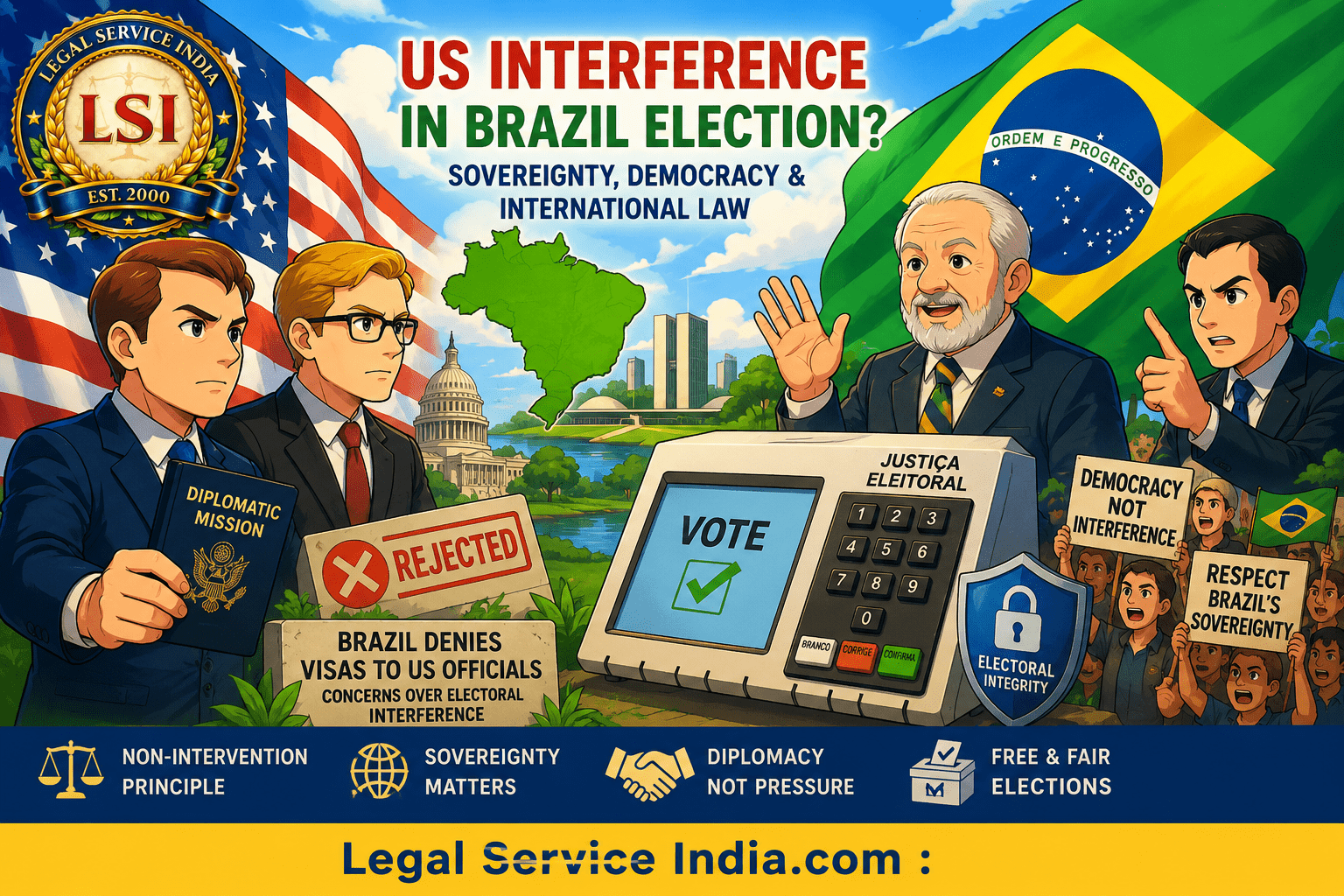
US Interference in Brazil Election: Sovereignty, Electoral Integrity and the New Face of Foreign Election Meddling
Introduction
The allegation of US interference in Brazil’s election has acquired an unusual and potentially significant diplomatic dimension ahead of Brazil’s October 2026 presidential election.
Brazil has reportedly denied visas to two senior U.S. State Department officials whose proposed visit was viewed by Brazilian authorities as an attempt to question or undermine confidence in the country’s electronic voting system. The United States, however, has rejected the allegation and maintained that the proposed engagement was connected with democratic values and related discussions.
The controversy therefore presents a question much larger than the immediate diplomatic dispute:
At what point does legitimate diplomatic engagement become impermissible foreign interference in another sovereign state’s democratic process?
That question is particularly important because Brazil is not a country without established electoral institutions. Its electronic voting system has operated for decades and has been regarded by international observers as orderly and functional, although political criticism of its auditability and integrity has periodically emerged from sections of the Brazilian right. The material supplied for this article similarly records that international observers have generally regarded Brazilian elections as free and fair, while acknowledging continuing political criticism of the electronic voting system.
The present controversy must therefore be examined carefully. An allegation of foreign interference is not, by itself, proof that interference occurred. Equally, foreign interference does not necessarily take the form of hacking voting machines or secretly altering ballots. Modern electoral intervention can occur through political endorsements, economic pressure, diplomatic signalling, funding, information campaigns and attempts to undermine public confidence in electoral institutions.
That distinction is central to understanding the US interference in the Brazil election controversy.
What Exactly Has Happened Between Brazil and the United States?
The immediate controversy emerged in July 2026 when reports indicated that the Trump administration intended to send two State Department officials to Brazil before the October presidential election.
According to Brazilian officials cited by Reuters, the proposed visit was viewed as an attempt to cast doubt upon the integrity of Brazil’s electoral system and potentially influence the election. Brazil consequently denied visa requests for the officials.
The reported officials were Riley M. Barnes, an Assistant Secretary of State, and Samuel Samson, a Deputy Assistant Secretary. According to reporting, they had planned meetings with people involved in Brazil’s electoral process, although the precise intended agenda became a matter of dispute.
The Washington Post reported that Brazilian authorities suspected the delegation could meet electoral-system sceptics and potentially contribute to a report questioning Brazil’s electronic voting arrangements. The U.S. government disputed the characterisation of the mission as an effort to undermine the election.
This distinction is legally important.
There is a substantial difference between:
- observing an election;
- raising legitimate questions about electoral administration;
- expressing a general preference for free and fair elections;
- publicly endorsing a particular candidate;
- providing political or financial assistance to a candidate;
- using economic or diplomatic pressure to influence voters; and
- deliberately attempting to delegitimise an electoral process or manipulate its outcome.
The legal and political consequences of each may be entirely different.
The Brazilian Presidential Election Has Become Highly Polarised
The controversy cannot be separated from Brazil’s intensely polarised political environment.
The supplied source describes the principal contest as being between incumbent President Luiz Inácio Lula da Silva and Senator Flávio Bolsonaro, the son of former President Jair Bolsonaro. It also describes Flávio Bolsonaro as politically aligned with Donald Trump, while noting his attempt to present himself as somewhat more moderate than his father.
This political alignment matters because any overt intervention by a foreign political leader can be perceived not merely as diplomatic speech but as an attempt to influence the electoral balance.
The issue becomes particularly sensitive where the foreign leader has a close political relationship with one of the candidates.
In such circumstances, even an apparently symbolic endorsement can acquire substantial political significance.
The United States Denies Election Interference
The United States has rejected the accusation that it intended to interfere with Brazil’s election.
According to the reporting supplied and independently corroborated by Reuters, U.S. officials characterised the proposed engagement differently from Brazilian authorities. The United States has maintained that it respects the Brazilian people and would work with whichever government emerges from a free and fair election.
This creates two competing narratives.
Brazilian Position
Brazil’s concern is essentially that foreign officials might enter the country, engage with political actors or electoral critics and contribute to a narrative that Brazil’s electoral system cannot be trusted.
U.S. Position
The U.S. position is that diplomatic engagement concerning democracy and elections does not automatically constitute electoral interference.
Both propositions contain an element of legal truth.
A foreign government is not prohibited from discussing democracy with another state. Nor does every diplomatic meeting amount to unlawful intervention.
The critical question is purpose, effect, method and degree of coercion.
Sovereignty Is the Starting Point of the Legal Analysis
From the standpoint of international law, the sovereignty of Brazil cannot be treated as a mere political slogan.
The United Nations Charter is founded upon the principle of the sovereign equality of states. Article 2 also requires States to refrain from conduct inconsistent with the political independence of another State.
The inter-American legal framework is even more directly relevant.
Article 3(e) of the OAS Charter recognises the right of every American state to choose, without external interference, its political, economic and social system. Article 19 goes further by stating that no State has the right to intervene, directly or indirectly, in the internal or external affairs of another State.
Article 20 of the OAS Charter is also significant because it addresses coercive economic or political measures intended to force the sovereign will of another state.
Therefore, the principle of non-intervention is not simply an abstract constitutional value. It forms part of the regional international-law architecture within which Brazil and the United States conduct their relations.
But Is Every Foreign Political Statement “Interference”?
No.
This is where the debate requires legal precision.
A foreign leader saying:
“We hope Brazil conducts a free and fair election.”
would ordinarily be very different from saying:
“Brazilian voters should elect Candidate X.”
The supplied discussion specifically examines this distinction. It notes that a direct endorsement of a foreign candidate can constitute an electoral intervention, whereas a general statement supporting fair elections would ordinarily fall into a different category.
The distinction becomes even sharper when the foreign state uses its economic or diplomatic power.
For example, if a government says:
“If you elect Candidate A, we will withdraw financial assistance.”
The situation is no longer merely one of political expression. It potentially becomes coercive state conduct.
The supplied material refers to historical examples involving threats concerning economic assistance and financial support.
Accordingly, foreign election interference exists on a spectrum.
Foreign Election Interference Does Not Require Hacking a Voting Machine
This is perhaps the most important misconception in the present debate.
Election interference is often imagined as:
- hacking voting machines;
- changing electronic votes;
- stealing voter databases; or
- physically manipulating ballots.
Those are only some possible forms of interference.
Foreign intervention can instead seek to influence the political environment in which voters make their decisions.
It may involve:
- direct endorsements;
- financial support;
- diplomatic pressure;
- economic threats;
- favourable treatment of particular political actors;
- strategic meetings;
- propaganda;
- information operations;
- disinformation;
- attempts to discredit election administrators;
- attempts to create public distrust in voting technology; or
- efforts to delegitimise the result before voting even takes place.
Academic research by Dov H. Levin has examined partisan electoral interventions by major powers and concludes that such interventions have historically been used as foreign-policy instruments. His research also found that overt interventions can have measurable electoral effects.
That scholarship does not establish that the United States is currently interfering in Brazil’s election. It does, however, demonstrate why allegations of foreign electoral intervention deserve serious examination rather than dismissal merely because no voting machine was hacked.
7. A Long Historical Shadow
The present controversy is also significant because the United States has a documented history of attempting to influence foreign electoral politics.
The research discussed in the supplied material refers to Dov Levin’s historical dataset and states that between 1946 and 2014 the United States engaged in numerous partisan electoral interventions. It describes methods ranging from political funding to economic pressure.
Levin’s academic work is broader and more systematic than the television discussion. His research identifies partisan electoral interventions as situations in which a foreign power attempts to influence the result of another country’s election.
This history is important for context but must not be misused.
Historical instances of U.S. intervention do not prove present-day intervention in Brazil.
Likewise, an allegation against the Trump administration cannot automatically be treated as established fact merely because similar conduct occurred historically.
A lawyer must separate:
- historical evidence;
- present allegations;
- official denials;
- independent verification; and
- proved facts.
That is the difference between responsible legal analysis and political commentary.
8. The Trump Era: What Is Different?
According to the analysis contained in the supplied material, the significant distinction of the present period may not necessarily be the existence of foreign electoral intervention but its greater visibility and presidential-level involvement.
The material contrasts earlier interventions, many of which were allegedly conducted through diplomats, officials or covert channels, with a contemporary environment in which presidential political preferences may be expressed openly.
The supplied discussion cites examples of Donald Trump openly endorsing foreign political candidates and describes political pressure involving countries including Hungary, Colombia and Argentina.
The legal significance of such conduct depends upon the circumstances.
An endorsement is political speech.
But when that endorsement is accompanied by:
- threats;
- financial conditionality;
- governmental resources;
- diplomatic pressure;
- covert funding;
- manipulation of electoral institutions; or
- coordinated attempts to undermine confidence in the electoral process,
The issue moves into a substantially more serious legal and diplomatic category.
9. Brazil’s Electronic Voting System Is at the Centre of the Dispute
The Brazilian electoral system has become one of the central battlegrounds in this controversy.
The supplied material records that Brazil has used electronic voting for many years and that international observers have generally regarded its elections as orderly and the electoral system as functional. At the same time, critics have argued that the system is insufficiently auditable.
There is nothing inherently unlawful about questioning an electoral system.
In a democracy, electoral institutions should be capable of scrutiny.
The constitutional principle of electoral integrity is actually strengthened—not weakened—when election administration is transparent, reviewable and capable of independent verification.
The problem arises when legitimate scrutiny is transformed into an unsupported political narrative that the entire electoral process is fraudulent.
Electoral Scrutiny and Democratic Legitimacy
There is a fundamental difference between:
“The electoral system should be independently audited.”
and
“The electoral system is fraudulent, and the election cannot be trusted.”
The first is a demand for institutional accountability.
The second, if unsupported by evidence, can become an instrument for delegitimising democracy itself.
10. Why Brazil’s Decision to Deny Visas Is Legally Significant
From the perspective of sovereignty, Brazil’s refusal to admit foreign officials is an important exercise of sovereign control over entry into its territory.
However, the diplomatic consequences are equally important.
A state cannot reasonably be expected to permit foreign governmental officials to enter its territory if it has credible reasons to believe that their activities would threaten the integrity of its constitutional institutions.
At the same time, a refusal based solely on political disagreement could deepen diplomatic tensions.
The appropriate question is therefore whether Brazil possessed a reasonable and demonstrable basis for believing that the proposed mission was inconsistent with its electoral sovereignty.
The reporting available so far indicates that Brazilian authorities viewed the proposed visit as potentially connected with efforts to undermine confidence in the electoral system, while the U.S. side disputed that interpretation. [ ]
That means the fact of visa denial is established; the alleged underlying intention of the U.S. delegation remains contested.
That distinction should be maintained in any serious legal publication.
11. The OAS Framework Makes the Brazilian Situation Especially Sensitive
Brazil and the United States operate within the inter-American system.
The OAS Charter expressly recognises both:
- representative democracy; and
- the principle of non-intervention.
The OAS framework therefore attempts to balance two potentially competing principles.
Principle One: Democracy Must Be Protected
States have a legitimate interest in encouraging democratic institutions and free and fair elections.
Principle Two: Democracy Must Not Become a Pretext for Intervention
One state cannot simply claim that it is “defending democracy” while actually attempting to dictate the political choice of another sovereign people.
The OAS Charter expressly recognises the right of each state to choose its political system without external interference.
The Inter-American Democratic Charter similarly emphasises representative democracy while retaining respect for non-intervention.
This is the legal tension at the heart of the Brazil controversy.
12. Can a Foreign Country Lawfully Observe an Election?
Yes, subject to the consent and applicable rules of the host state.
There is an important distinction between:
- Election Observation
- Election Intervention
An international observer may examine:
- polling arrangements;
- counting procedures;
- accessibility;
- transparency;
- electoral administration;
- campaign conditions; and
- compliance with established electoral standards.
But an observer should not become a political actor.
The OAS Democratic Charter itself contemplates technical electoral missions in appropriate circumstances, including where free and fair electoral conditions require assistance and with the consent or request of the interested government.
Thus, legitimate international assistance can strengthen democracy.
Uninvited partisan political intervention can weaken it.
13. The Danger of “Delegitimisation Before the Vote”
From a constitutional perspective, one of the most dangerous forms of electoral interference is not changing votes but destroying public confidence in the legitimacy of the result before voting occurs.
Suppose citizens are repeatedly told:
- the voting machines cannot be trusted;
- The electoral authority is corrupt;
- The judiciary is politically controlled;
- the election will be stolen; and
- Therefore, the result should not be accepted.
Even if the voting process itself remains technically secure, democratic stability may be damaged.
The supplied material identifies precisely this concern in relation to Brazil: Brazilian officials reportedly feared that the proposed U.S. mission could fuel suspicions about the Brazilian electoral system.
This is a sophisticated form of electoral vulnerability.
A democracy depends not only upon accurate counting but also upon public acceptance of legitimate constitutional procedures.
14. Foreign Endorsements: Political Speech or State Intervention?
This is one of the most difficult questions.
If a foreign president personally endorses a candidate, one may argue that the statement is merely political speech.
But the identity of the speaker matters.
A private citizen expressing a political preference has one level of influence.
The president of a global superpower speaking publicly about another country’s election has a completely different political weight.
If the statement is accompanied by:
- diplomatic threats;
- trade measures;
- financial incentives;
- government-funded political activities; or
- coordinated official action,
The cumulative conduct may be far more significant than the words of endorsement alone.
Accordingly, the correct legal approach is to examine the entire course of conduct rather than isolate a single statement.
15. Economic Pressure Can Become Electoral Pressure
One of the most serious historical forms of foreign electoral intervention is economic coercion.
A powerful state may possess the ability to influence:
- loans;
- tariffs;
- development assistance;
- trade concessions;
- sanctions;
- investment;
- financial rescue packages; or
- access to international institutions.
If economic measures are expressly conditioned upon the electoral choice of another country, the principle of sovereign self-determination becomes directly implicated.
The OAS Charter specifically states that states may not use or encourage coercive economic or political measures to force the sovereign will of another state.
Therefore, economic diplomacy and electoral coercion should not be confused.
A state is entitled to pursue its economic interests.
It should not, however, use economic power as a mechanism to dictate another nation’s electoral choice.
16. Why the Brazil-US Dispute Could Have Long-Term Consequences
The consequences may extend well beyond the October election.
The supplied analysis points to an important lesson from international relations: governments may remember foreign intervention for generations. It cites the 1953 Iranian coup and the subsequent political consequences as an example of how intervention can shape national perceptions long after the original event.
Whether every historical detail of that analogy is accepted is a matter for historians, but the broader diplomatic principle is sound:
Foreign policy is not judged only by its immediate success.
A government may achieve a short-term political objective and nevertheless suffer long-term damage to:
- diplomatic trust;
- bilateral relations;
- public opinion;
- strategic partnerships;
- regional influence; and
- credibility when it later condemns foreign interference in its own elections.
This is particularly relevant in an era in which accusations of election interference are increasingly made by major powers against one another.
17. The Issue of Reciprocity
There is also an important principle of reciprocity.
If the United States objects to foreign governments attempting to influence American elections, it becomes diplomatically difficult to justify comparable conduct abroad.
Conversely, the United States may argue that its diplomatic engagement does not constitute interference and that criticism of foreign electoral systems is legitimate.
The same standard should apply in both directions.
A sound international legal principle cannot be:
“Foreign interference is wrong when directed against us but acceptable when undertaken by us.”
The stronger principle is:
Electoral sovereignty must be respected regardless of which political party or geopolitical power benefits from the result.
18. The Latest Diplomatic Escalation
The controversy has already moved beyond the initial visa dispute.
Recent reporting indicates that Washington subsequently revoked the visa of Brazil’s ambassador to the United States amid the continuing diplomatic dispute, while Brazil has maintained its position regarding the U.S. diplomatic initiative and the broader disagreement surrounding the election. The Trump administration revokes the visa of Brazil’s ambassador to the US in spite of Lula.
This development is significant because a dispute that began around electoral engagement is now affecting the wider diplomatic relationship.
The danger is that an electoral controversy can become a broader bilateral crisis involving:
- diplomatic appointments;
- visas;
- trade;
- tariffs;
- political alliances;
- judicial disputes; and
- regional strategic competition.
That is why restraint is essential on both sides.
19. What Would Actually Constitute Strong Evidence of Foreign Election Interference?
As a matter of legal and evidentiary analysis, allegations should ideally be tested against objective indicators.
Evidence would become substantially stronger if investigators could establish:
1. Direct Instructions
Evidence showing that foreign officials were instructed to support or defeat a particular candidate.
2. Financial Transfers
Documented funding to political parties, campaign organisations or intermediaries.
3. Coordinated Governmental Action
Evidence connecting diplomatic, economic and political measures to an electoral objective.
4. Information Operations
Evidence demonstrating coordinated dissemination of deliberately false information designed to influence voters.
5. Electoral-System Manipulation
Evidence of attempts to compromise voting infrastructure, election databases or electoral administration.
6. Coercive Economic Conditionality
Evidence that economic assistance, tariffs or other measures were expressly conditioned upon electoral outcomes.
7. Deliberate Delegitimisation
Evidence showing that the objective was to create a predetermined narrative that the election would be fraudulent irrespective of the actual result.
Without such evidence, it is prudent to describe the matter as an allegation of election interference, rather than as an established finding of unlawful intervention.
20. What Should Brazil Do?
Brazil has a legitimate interest in protecting the integrity of its elections.
However, its response should remain firmly grounded in law.
Brazil Should:
- maintain transparency regarding foreign diplomatic missions;
- distinguish legitimate observation from partisan activity;
- provide factual explanations for restrictions on foreign officials;
- protect the independence of its electoral institutions;
- publish credible technical information concerning voting-system security;
- invite legitimate international observation where appropriate;
- investigate concrete allegations rather than political rumours; and
- Avoid allowing foreign political disputes to undermine domestic institutions.
Most importantly, Brazil should ensure that the defence of electoral sovereignty itself does not become politicised.
21. What Should the United States Do?
The United States, as a major global power, also carries a special responsibility.
- respect Brazil’s sovereign electoral institutions;
- avoid conduct that could reasonably be interpreted as partisan intervention;
- distinguish democracy promotion from electoral campaigning;
- avoid economic coercion linked to electoral outcomes;
- respect Brazil’s electoral authorities;
- communicate through established diplomatic channels; and
- accept the outcome of Brazil’s constitutionally conducted election.
If the United States has legitimate concerns about electoral integrity, those concerns can be raised through transparent, evidence-based diplomatic mechanisms.
There is no need to transform election security into a geopolitical contest.
22. What Should Brazil’s Electoral Institutions Do?
Brazil’s electoral authorities occupy the most important position in this debate.
The strongest answer to allegations of foreign interference is not political rhetoric.
It is institutional transparency.
Electoral authorities should ensure that:
- Voting technology is independently scrutinised;
- Testing procedures are transparent;
- Election results can be verified through appropriate mechanisms;
- Observers have reasonable access;
- Complaints are investigated promptly;
- technical information is publicly available; and
- Credible allegations are answered with evidence.
A secure electoral system should not fear scrutiny.
At the same time, scrutiny should not be permitted to become a vehicle for unsupported claims of fraud.
23. The Broader Constitutional Principle
The Brazil controversy illustrates a principle that transcends Brazil, the United States and the personalities involved.
An election belongs to the people who vote in it.
Political parties may compete.
Candidates may persuade.
Foreign governments may conduct diplomacy.
International organisations may promote democratic standards.
But the ultimate political choice must remain with the electorate of the sovereign state.
That principle is the foundation of democratic self-determination.
24. A Warning for Democracies Across the World
The Brazil episode should also concern democracies beyond Latin America.
In the digital age, foreign interference can be extraordinarily difficult to detect.
It may not involve soldiers crossing borders.
It may involve:
- algorithms;
- social media networks;
- anonymous funding;
- political influencers;
- diplomatic pressure;
- artificial intelligence;
- coordinated disinformation;
- cyber operations;
- economic incentives; or
- apparently spontaneous political campaigns.
The battlefield of electoral interference has therefore moved from the polling station to the information environment surrounding the polling station.
This creates a new challenge for constitutional democracies.
The objective should not be to suppress legitimate political disagreement.
The objective should be to ensure that voters make decisions freely, without covert manipulation by foreign state actors.
25. Is the United States Actually Interfering in Brazil’s Election?
Based on the currently available information, the responsible legal answer is:
There are serious and credible allegations of attempted foreign electoral influence, but the publicly available material does not establish every allegation as a proven fact.
The visa denial is an established event.
The Brazilian government’s concern regarding the proposed U.S. delegation is documented.
The United States’ denial of the allegation is also documented.
The historical record of foreign electoral intervention by major powers is well established in academic research.
But whether the proposed U.S. mission constituted an unlawful attempt to manipulate Brazil’s 2026 election requires evidence concerning its actual purpose, activities and intended effect.
A lawyer should therefore resist both extremes:
“There was absolutely no interference.”
and
“The United States has already been proved to be rigging Brazil’s election.”
Neither conclusion follows automatically from the available evidence.
26. Conclusion: Democracy Must Be Decided at Home
The emerging dispute over US interference in Brazil’s election is ultimately a dispute about something much larger than two visas.
It raises fundamental questions concerning:
- sovereignty;
- democratic self-determination;
- international law;
- diplomatic conduct;
- electoral integrity;
- political speech;
- economic coercion; and
- the limits of great-power influence.
The OAS Charter provides an especially relevant legal principle: states have the right to choose their political systems without external interference, while the regional system simultaneously recognises the importance of representative democracy.
The correct balance is therefore neither isolationism nor unrestricted foreign involvement.
Democracies should cooperate.
They should observe.
They should exchange information.
They should assist one another in strengthening electoral institutions.
But the choice of government must ultimately remain with the electorate of the sovereign nation concerned.
The Brazil controversy should consequently be treated as a warning to every democracy.
Foreign interference need not begin with a stolen ballot.
Sometimes it begins with an attempt to influence what voters believe about the ballot.
And when public confidence in an election becomes the target, protecting democracy requires more than securing voting machines. It requires protecting the independence, credibility and legitimacy of the entire electoral process.
Legal Takeaway
From an international-law perspective, the central principle is straightforward:
Foreign states may engage diplomatically with another country, but democratic engagement cannot become a disguised mechanism for determining who that country’s citizens should elect.
The ultimate safeguard remains the same in Brazil as elsewhere:
Free elections, transparent institutions, independent electoral administration and respect for the sovereign choice of the people.
Sources and References
- United Nations Charter, Article 2 — sovereign equality, political independence and principles governing relations among states.
- Charter of the Organization of American States, Articles 3, 19 and 20 — sovereignty, non-intervention and prohibition of coercive political or economic measures.
- Inter-American Democratic Charter — representative democracy and respect for the principle of non-intervention.
- Reuters, July 25, 2026 — reporting on Brazil’s denial of visas to two U.S. officials amid concerns over electoral interference.
- Washington Post, July 25, 2026 — reporting concerning the proposed U.S. delegation and Brazilian concerns over the electronic voting system.
- Dov H. Levin, Partisan Electoral Interventions by the Great Powers — academic research on foreign electoral intervention.
- Source material supplied for this article — BBC Global Story discussion concerning Brazil, U.S. diplomatic activity, electoral intervention and its historical context.
Disclaimer: This article is intended for legal and public-interest analysis. Allegations of foreign electoral interference should not be treated as established facts unless supported by competent evidence or an authoritative finding.
Frequently Asked Questions About US Interference in Brazil Election
1. Is the US interfering in Brazil’s 2026 election?
There are allegations of US interference in Brazil’s 2026 election, particularly concerning a proposed visit by U.S. officials that Brazilian authorities reportedly viewed as potentially undermining confidence in Brazil’s electronic voting system. The United States has denied that it intended to interfere in the Brazilian election. Therefore, the allegation should not be treated as a proven fact without further evidence.
2. Why did Brazil deny visas to US officials before the election?
Brazil reportedly denied visas to two U.S. officials after concerns arose that their proposed diplomatic mission could contribute to doubts about Brazil’s electoral system. The controversy is significant because Brazil’s electronic voting system and electoral integrity have become politically sensitive issues ahead of the 2026 election.
3. What is considered foreign election interference under international law?
Foreign election interference can involve more than hacking voting machines or manipulating ballots. Depending on the circumstances, it may include covert political funding, economic coercion, direct support for a particular candidate, coordinated disinformation, attempts to undermine electoral institutions, or other conduct intended to influence another country’s electoral outcome. The principle of non-intervention in the internal affairs of sovereign states is recognised in the UN Charter and the OAS Charter.
4. Can a foreign president endorse a candidate in another country’s election?
A foreign leader can make political statements, but a foreign endorsement of a candidate can raise concerns about electoral interference, particularly when it is accompanied by government resources, economic pressure, diplomatic threats or coordinated political activity. The legal assessment depends on the nature, purpose, context and consequences of the conduct rather than the endorsement alone.
5. Why is US interference in Brazil’s election a major international law issue?
The US interference in the Brazil election controversy raises fundamental issues of national sovereignty, electoral integrity, democratic self-determination and the international law principle of non-intervention. Brazil has the sovereign right to conduct its elections through its constitutional institutions, while foreign states must avoid using diplomatic, political or economic influence to dictate the electoral choice of the Brazilian people. The controversy therefore has implications beyond Brazil and may influence how democracies address foreign election interference in the future.