





Introduction
Rise of Generative Artificial Intelligence
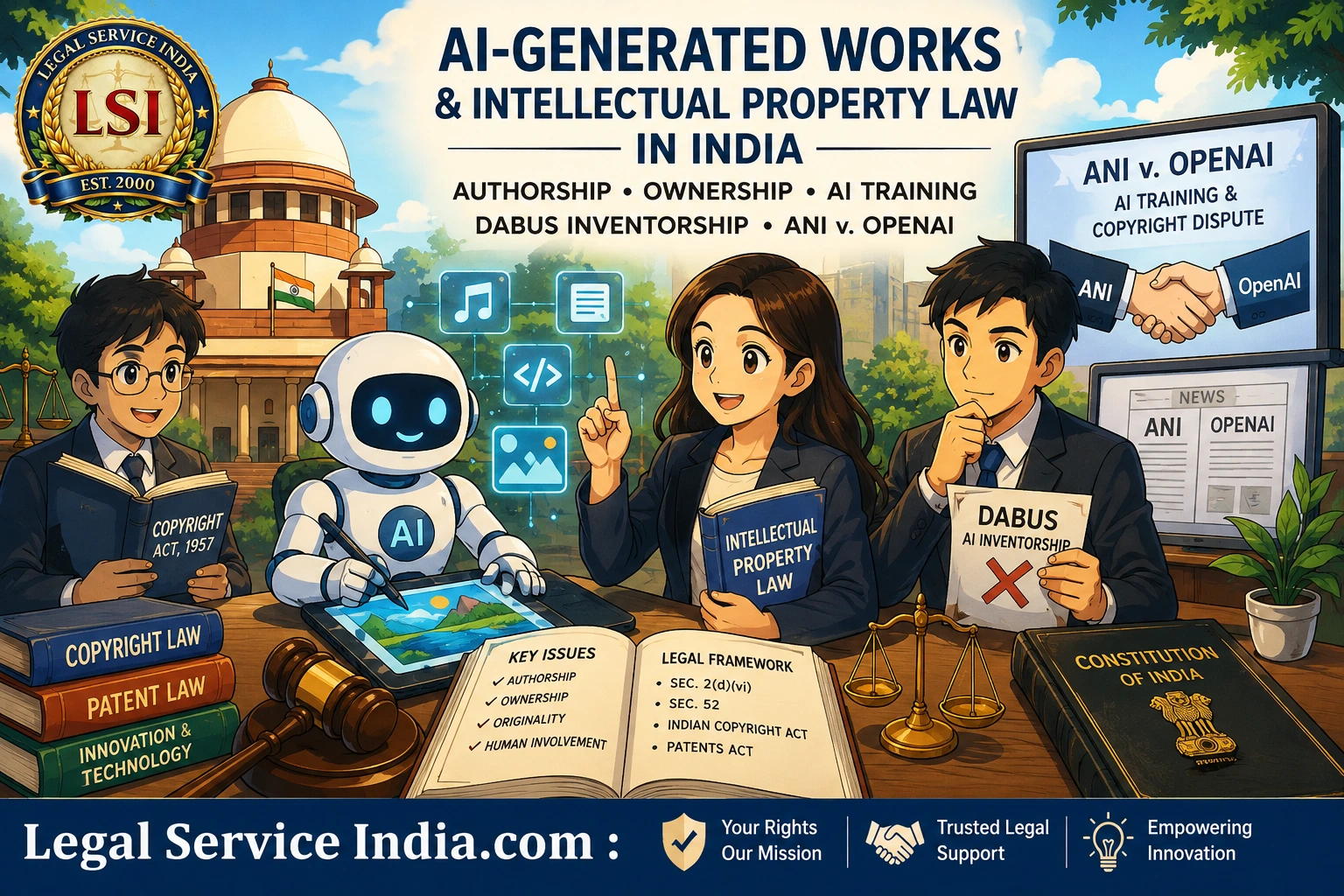
- Rise of Generative Artificial Intelligence: Artificial Intelligence (AI) has rapidly evolved from a technological tool used primarily for automation and data processing into systems capable of generating text, images, music, software and other forms of creative output. Generative AI systems, particularly Large Language Models (LLMs), can produce sophisticated works in response to human instructions or prompts. This development has created a new intersection between technology and Intellectual Property Rights (IPR), particularly concerning the ownership and protection of AI-generated works.
The growing use of AI has consequently challenged traditional assumptions underlying intellectual property law. Copyright law has historically been associated with human creativity and authorship, while patent law has traditionally contemplated a human inventor. AI-generated works therefore raise fundamental questions regarding who should be recognised as the author, who should own the resulting rights, and whether an AI system can itself acquire intellectual property rights.
AI and Intellectual Property
- AI and Intellectual Property: The Indian legal framework contains provisions that are relevant to computer-generated works. Section 2(d)(vi) of the Copyright Act, 1957, specifically provides that, in relation to a literary, dramatic, musical or artistic work which is computer-generated, the “author” is the person who causes the work to be created. This provision provides a starting point for analysing AI-generated works, but the increasing autonomy of generative AI raises questions about how far the concept of a person “causing” a work to be created can extend.
Statement of the Problem and Scope
- Statement of the Problem and Scope: This article therefore examines the legal position concerning AI-generated works, authorship and ownership in India, with particular emphasis on the ANI v. OpenAI dispute. It further considers the emerging dilemma of AI inventorship and the need to balance technological innovation with the legitimate rights of copyright owners and other intellectual property holders.
Understanding AI-Generated Works and Intellectual Property
Meaning of AI-Generated Works
- Meaning of AI-Generated Works: AI-generated works are literary, artistic, musical or other creative outputs produced through artificial intelligence systems. Generative AI can create content with varying degrees of human involvement. A useful distinction is between AI-assisted works, where a human remains substantially involved in directing, selecting, editing or refining the output, and fully AI-generated works, where the system produces the substantive expression with minimal human creative intervention.
Copyright and AI-Generated Works
- Copyright and AI-Generated Works: The principal copyright questions concern originality, authorship and ownership. Where a human uses AI merely as a sophisticated creative tool and contributes meaningful creative choices, the resulting work may more readily be connected to that human creator. However, where an AI system independently determines substantial elements of the final expression, identifying the legally recognised author becomes considerably more difficult. The Indian framework consequently raises an important question: whether the person who develops the AI system, the person who provides the prompt, or another person who exercises creative control should be regarded as the person who “causes” the work to be created.
AI and Patents
- AI and Patents: The problem extends beyond copyright. AI systems are increasingly capable of generating technical solutions and inventions, raising the question of whether an AI can be recognised as an inventor. The recent Indian DABUS decision reinforces the human-centred approach: the Indian Patent Office rejected the designation of DABUS as the inventor, indicating that the existing legal framework does not recognise AI as an inventor. Thus, AI-generated works expose a fundamental tension within IP law: technological systems may increasingly perform creative and inventive functions, while legal rights continue to be structured around human authorship and inventorship.
Key Intellectual Property Issues Raised by AI
| Area | Key Issue |
|---|---|
| Copyright | Originality, authorship and ownership of AI-generated works |
| Computer-Generated Works | Who should be regarded as the person who “causes” the work to be created? |
| Patents | Whether an AI system can be recognised as an inventor |
| Human Creativity | The extent of human involvement in directing, selecting, editing or refining AI output |
| Intellectual Property Rights | Balancing technological innovation with the legitimate rights of copyright owners and other intellectual property holders |
Legal Framework for AI-Generated Works in India
The Copyright Act, 1957
The Copyright Act, 1957, constitutes the principal statutory framework for the protection of literary, dramatic, musical and artistic works in India. Its relevance to artificial intelligence arises particularly from the statutory definition of “author”. Section 2(d)(vi) provides that, in relation to a literary, dramatic, musical or artistic work which is computer-generated, the author is the person who causes the work to be created.
This provision is particularly significant in the context of generative AI because it does not expressly recognise an AI system as an author. Instead, it identifies a human or legal person connected with the creation of the work. The provision therefore provides some basis for protecting computer-generated works while simultaneously leaving unanswered the more complex question of how much human involvement is necessary when an AI system produces the substantive creative expression.
The Copyright Act also becomes relevant to the use of copyrighted material for AI training. Section 52 contains exceptions to copyright infringement, including fair dealing for purposes such as private or personal use, including research, criticism or review, and reporting of current events and current affairs. The provision further states that storing a work in an electronic medium for the specified purposes does not constitute infringement.
The interpretation of these exceptions in the context of large-scale AI training has become a major legal issue, particularly in the ANI v. OpenAI dispute. The case raises the broader question of whether the process by which an AI model learns from copyrighted material can fall within the existing statutory exceptions.
The Patents Act, 1970
The Patents Act, 1970, provides the statutory framework for patents in India and presents a different dimension of the AI debate: inventorship. Section 6 permits a patent application to be made by a person claiming to be the true and first inventor, by an assignee of such person, or by the legal representative of a deceased person entitled to make the application.
Section 2(1)(y) further defines the expression “true and first inventor” and excludes a mere first importer or a person to whom an invention is first communicated from outside India. These provisions operate within a human-centred legal framework and create difficulties when an invention is substantially generated by an autonomous AI system.
The DABUS controversy illustrates this problem. Although AI systems can generate technically innovative solutions, existing patent systems continue to require legally recognised inventorship. Consequently, AI may function as an important tool in the inventive process without necessarily acquiring the legal status of an inventor.
Section 52 and the AI Training Debate
The application of Section 52 to AI training represents one of the most significant emerging questions in Indian copyright law. The central issue is whether the purpose and manner of machine learning can satisfy the statutory concept of research or fair dealing. The answer has implications not only for AI developers but also for publishers, authors, artists and other copyright owners whose works may form part of training datasets.
Absence of an AI-Specific IP Regime
India presently approaches AI-related intellectual property primarily through existing copyright and patent legislation rather than through a comprehensive, AI-specific IP statute. This framework provides important starting points but leaves several questions unresolved, including the degree of human creativity required for AI-assisted works, ownership of substantially autonomous outputs, and the legality of using copyrighted works for training AI models.
The resulting legal uncertainty demonstrates the need to interpret existing legislation carefully while considering whether future reforms should provide greater clarity without unnecessarily restricting technological innovation.
Ownership and Authorship of AI-Generated Works
The Human Authorship Principle
Traditional copyright law is fundamentally structured around the concept of a human creator. Under the Indian Copyright Act, 1957, the ordinary author is the person who creates the work; however, for a computer-generated literary, dramatic, musical or artistic work, Section 2(d)(vi) identifies the author as the “person who causes the work to be created”.
This provision becomes particularly significant with generative AI. Where AI merely assists a person who exercises meaningful creative control, the human contribution may provide a stronger basis for attributing authorship. However, where the AI system independently determines substantial elements of the final expression, it becomes difficult to identify the person who legally “causes” the work to be created. Thus, the increasing autonomy of AI exposes a tension between technologically generated creativity and a copyright framework that continues to attach legal significance to human or legally recognised persons.
Who Should Own AI-Generated Works?
The question of ownership is closely connected with authorship. Several possibilities may be considered:
- the user who provides the prompt,
- the developer or owner of the AI system,
- the person who substantially edits the output, or
- potentially no individual where the output lacks sufficient human creative contribution.
The statutory language provides some support for attributing authorship to the person who causes a computer-generated work to be created, but it does not expressly resolve every situation involving modern generative AI. Therefore, ownership may depend upon the nature and extent of human involvement rather than merely on who technically pressed the “generate” button.
AI-Assisted versus AI-Generated Works
A crucial distinction is between AI-assisted and fully AI-generated works. In an AI-assisted work, a human may determine the concept, provide detailed instructions, select among multiple outputs, modify the result and arrange the final expression. In such circumstances, the AI functions more like a sophisticated creative instrument.
By contrast, a substantially autonomous AI-generated work may involve minimal human creative intervention. The stronger the AI’s independent contribution to the expressive elements of the work, the more difficult it becomes to apply traditional concepts of authorship and ownership.
The Problem of the Prompt
The role of the prompt creates a particularly difficult legal question. A simple instruction such as “create a landscape” may provide very limited creative input. Conversely, a highly detailed sequence of instructions, revisions, selections and modifications may involve substantial human intellectual contribution.
Accordingly, merely using an AI system should not automatically establish authorship. The relevant inquiry should consider the nature, originality and extent of human creative control exercised during the production of the final work. This approach is consistent with the statutory emphasis on the person who causes the computer-generated work to be created.
Can AI Itself Be an Author or Inventor?
Under the present Indian framework, AI cannot straightforwardly be treated as a legal author or inventor. Copyright law identifies a person in relation to computer-generated works, while patent law similarly operates through legally recognised inventorship. The DABUS controversy demonstrates the difficulty of granting independent legal status to an AI system.
Consequently, the immediate legal challenge is not simply whether AI can create sophisticated works, but how intellectual property rights should be allocated when the technological system makes a substantial creative contribution. The ANI v. OpenAI dispute further demonstrates that this problem extends beyond ownership of AI outputs to the use of existing copyrighted works in developing AI systems. “`
The DABUS Case and the AI Inventorship Dilemma
Background Of DABUS
The DABUS controversy is one of the most important international developments concerning artificial intelligence and patent inventorship. DABUS, or Device for the Autonomous Bootstrapping of Unified Sentience, is an AI system developed by Dr Stephen Thaler. Thaler sought patent protection for inventions allegedly generated autonomously by DABUS, including a food-container design. The applications deliberately identified DABUS itself as the inventor, rather than Thaler.
The controversy consequently moved beyond the technical question of whether AI can generate an invention and raised a fundamental legal question: can an AI system be recognised as an inventor under existing patent law?
The Indian Position
The Indian Patent Office has now expressly confronted this question. In its decision concerning Indian Patent Application No. 202017019068, the Patent Office rejected DABUS as the designated inventor. The Controller held that the existing framework of the Patents Act, 1970, requires an inventor to be a natural or legally recognised person capable of holding and transferring rights. Merely owning an AI system, its hardware or its source code does not make its owner the inventor of an invention autonomously generated by that system.
The decision is significant because it represents India’s first substantive determination on whether an AI system can be recognised as an inventor under the Patents Act. It reinforces the present human-centred approach to inventorship in Indian patent law.
International Developments
The DABUS applications have similarly been rejected in several jurisdictions. Courts in the United States and the United Kingdom have maintained that inventorship under existing legislation is confined to human persons. The UK Supreme Court, for instance, held that an inventor must be a person and that DABUS could not be recognised as an inventor under the existing statutory framework.
However, some jurisdictions have explored ways of recognising human contributions to AI-assisted inventions. The German Federal Supreme Court, for example, accepted circumstances in which a natural person who prompted or caused an AI system to generate an invention could be identified as the inventor.
The Legal Dilemma
The DABUS controversy demonstrates a fundamental limitation of traditional patent law. AI may increasingly contribute to or even autonomously generate technically innovative solutions, yet existing legislation connects inventorship with a legally recognised person. This creates uncertainty regarding ownership, entitlement, attribution and responsibility when no human can legitimately claim to have conceived the invention.
The Indian position therefore presently remains clear: AI may assist human inventors, but an AI system itself cannot be designated as the inventor under the existing Patents Act. Any departure from this position would require legislative intervention rather than merely judicial reinterpretation.
ANI Media Pvt. Ltd. v. OpenAI OpCo LLC
The dispute between ANI Media Pvt. Ltd. and OpenAI OpCo LLC represents one of India’s most significant judicial developments concerning copyright and generative artificial intelligence. ANI, a news agency, instituted proceedings before the Delhi High Court alleging that OpenAI had used its copyrighted news content without authorisation for training the Large Language Models (LLMs) underlying ChatGPT. ANI also alleged that ChatGPT could reproduce or attribute fabricated material to ANI in response to user prompts. The case therefore raises fundamental questions regarding the relationship between copyright protection, AI training, fair dealing and technological innovation.
Background and Facts
ANI’s principal grievance concerned the alleged unauthorised storage and use of its copyrighted literary works for training OpenAI’s AI models. According to ANI, its published news content was being used without a licence and could subsequently be reproduced through ChatGPT’s responses. OpenAI disputed these allegations and relied, among other arguments, upon the statutory framework of Section 52 of the Copyright Act, 1957, contending that its use fell within the fair-dealing exception relating to research.
The dispute consequently involved two distinct aspects:
- first, whether storing ANI’s works for training AI models constituted copyright infringement; and
- second, whether outputs generated by ChatGPT amounted to reproduction of ANI’s protected expression.
Issues Before the Court
The Delhi High Court examined several interconnected questions, including whether it possessed territorial jurisdiction, whether Indian copyright law applied to the training claim, whether storage of ANI’s works for AI training amounted to infringement, and whether ChatGPT’s responses substantially reproduced ANI’s copyrighted works.
A further central issue was whether OpenAI’s use qualified as fair dealing under Section 52(1)(a). The Court therefore had to consider not merely the technology involved but how existing copyright principles should operate when copyrighted material is processed by an AI system.
Section 52(1)(a) and the Purpose Test
Section 52(1)(a) provides an exception for fair dealing with a work for purposes including private or personal use and research, subject to the statutory conditions. Its explanation further provides that storage of a work in an electronic medium for the purposes specified in the provision does not itself constitute infringement.
The Meaning of “Research”
The interpretation of the word “research” became particularly important. ANI challenged the application of this provision to OpenAI’s commercial AI operations, while OpenAI argued that the process of training an AI model involves research and technological development.
The Court separately considered whether commercial use automatically excludes protection under Section 52(1)(a)(i), whether the stored material constituted a permissible copy, and whether OpenAI’s use could properly be characterised as research.
The Court’s Interim Findings
On 24 July 2026, Justice Amit Bansal of the Delhi High Court delivered the interim ruling. The Court expressed the prima facie view that OpenAI’s storage of ANI’s original literary works for training the LLMs underlying ChatGPT fell within Section 52(1)(a) and therefore did not amount to infringement under Section 51 at the interim stage.
The Court also considered ChatGPT’s outputs generated through the Retrieval-Augmented Generation (RAG) technique. It found, prima facie, that the outputs were not substantially similar to ANI’s original literary works and that ANI had not established that ChatGPT had memorised and regurgitated its original works through its responses. Consequently, ANI failed to establish a prima facie case warranting an interim injunction.
Importantly, the Court expressly clarified that its observations were made for deciding the interim application and would not determine the final outcome of the suit.
Critical Analysis
The ruling is significant because it represents an important judicial engagement with the application of India’s existing fair-dealing framework to AI training. It suggests that the use of copyrighted works for training an AI model cannot automatically be characterised as infringement merely because the activity is technologically sophisticated or commercially connected.
At the same time, the decision does not mean that all AI training is automatically lawful. The Court’s conclusion was based on the particular facts and the interim stage of the proceedings. Questions concerning the scale and nature of copying, the economic interests of copyright owners, memorisation, reproduction, and the ultimate application of Section 52 remain important.
From the perspective of copyright owners, large-scale ingestion of protected works raises legitimate concerns because AI developers may derive substantial commercial value from datasets containing copyrighted material. Conversely, imposing a licensing requirement for every item used in training could significantly increase the costs of AI research and potentially restrict technological development.
The ANI v. OpenAI dispute therefore demonstrates the central challenge facing Indian IP law: existing statutory concepts such as “fair dealing”, “research”, “copying”, and “reproduction” must be applied to technologies that did not exist when the legislative framework was developed. The case is consequently important not merely for ANI and OpenAI but for the future relationship between copyright protection, AI innovation and access to knowledge in India.
Key Legal Challenges Arising From AI-Generated Works
The rapid development of generative AI has exposed several unresolved questions within India’s existing intellectual property framework. While the Copyright Act, 1957, and the Patents Act, 1970, provide important foundations, they were not designed specifically for highly autonomous AI systems. The resulting uncertainty affects creators, copyright owners, AI developers and users alike.
Uncertainty Regarding Authorship
The first major challenge concerns determining the author of an AI-generated work. Section 2(d)(vi) of the Copyright Act identifies the author of a computer-generated work as the person who causes it to be created. However, modern generative AI can contribute substantially to the final expression, making it difficult to determine whether the user, developer or another person should receive authorship.
The distinction between AI-assisted and substantially autonomous works is therefore crucial.
Ownership and Commercial Exploitation
Authorship directly affects the question of ownership and commercial exploitation. If an AI system cannot itself possess legal rights, the law must determine which human or legal entity should control and commercially exploit its output.
However, existing legislation does not comprehensively address these competing claims. This creates uncertainty for businesses seeking to commercialise AI-generated books, artwork, music, software and other outputs.
Copyright Infringement Through Training Data
A further challenge arises from the use of copyrighted works to train AI models. Generative AI systems may process enormous quantities of existing text, images, music and other protected material. The central legal question is whether such copying constitutes infringement or falls within an applicable statutory exception.
AI Outputs and Substantial Similarity
Another challenge is determining when an AI-generated output becomes sufficiently similar to an existing copyrighted work to constitute infringement. AI may produce outputs that resemble protected works without necessarily reproducing them verbatim. Conversely, an AI system may potentially memorise and reproduce portions of its training data.
Enforcement and Proof
Finally, AI-related IP disputes present considerable evidentiary and enforcement challenges. Copyright owners may find it difficult to establish whether their works were included in a training dataset, how they were processed, or whether a particular output resulted from memorisation.
AI developers, meanwhile, face uncertainty concerning the extent of information they must disclose about training datasets and model development.
Key AI Copyright Challenges
| Legal Challenge | Core Question |
|---|---|
| Authorship | Who should be recognised as the author of an AI-generated work? |
| Ownership | Which human or legal entity should control and commercially exploit AI-generated output? |
| Training Data | Does copying copyrighted material for AI training constitute infringement or fall within a statutory exception? |
| Substantial Similarity | When does an AI-generated output become sufficiently similar to an existing copyrighted work to constitute infringement? |
| Enforcement and Proof | How can copyright owners establish that their works were used in training or reproduced through AI outputs? |
International Comparative Perspective
The challenges posed by AI-generated works are not unique to India. Different jurisdictions have adopted varying approaches to the questions of human authorship, AI-generated output and the use of copyrighted material for AI training. A comparison is useful for identifying possible approaches that India may consider while developing its own legal framework.
United States
- United States: The United States continues to emphasise the requirement of human authorship for copyright protection. In its 2025 report on copyrightability of AI-generated works, the U.S. Copyright Office concluded that existing copyright principles can generally accommodate generative AI. AI-assisted works may receive protection where a human determines sufficient expressive elements, including through creative selection, arrangement or modification. However, purely AI-generated material and material lacking sufficient human control are not protected merely because a person provided prompts.
This approach is particularly relevant to the Indian debate because it distinguishes between AI functioning as a creative tool and AI effectively replacing human creative contribution. It therefore provides a possible framework for analysing whether a person’s involvement in generating an AI output is sufficiently creative to constitute authorship.
United Kingdom
- United Kingdom: The United Kingdom provides an interesting statutory comparison because its copyright framework contains a specific provision dealing with computer-generated works. The approach traditionally attributes authorship to the person undertaking the arrangements necessary for the creation of such a work. This differs from a purely human-authorship model and demonstrates an attempt to accommodate computer-generated material within copyright law.
However, the rapid development of generative AI creates questions about whether a provision designed for earlier forms of computer-generated works can adequately address modern systems capable of producing highly sophisticated creative outputs.
European Union
- European Union: The European Union has taken a more regulatory approach towards AI and copyright. The EU’s framework recognises the importance of copyright compliance and transparency in relation to general-purpose AI (GPAI) models. Providers are required to establish policies for compliance with EU copyright law and to publish a sufficiently detailed summary of the content used to train their models.
This approach is particularly significant because AI models are commonly trained using extremely large datasets that may contain copyright-protected material. The European Parliament has nevertheless noted that significant legal uncertainty remains concerning the application of existing copyright and text-and-data-mining rules to the training of general-purpose AI models.
Lessons for India
Lessons for India: The international experience demonstrates that there is no single settled global approach to AI-generated works. The United States emphasises human creative contribution, while the European Union has additionally developed transparency and copyright-compliance obligations for AI developers. These approaches offer useful lessons for India.
| Jurisdiction | Key Approach | Relevance to India |
|---|---|---|
| United States | Emphasises human creative contribution and human authorship. | Provides a framework for distinguishing AI-assisted works from purely AI-generated material. |
| United Kingdom | Contains a specific statutory provision dealing with computer-generated works. | Demonstrates an alternative approach to authorship of computer-generated material. |
| European Union | Focuses on copyright compliance and transparency for general-purpose AI models. | Offers useful lessons concerning training datasets, transparency and copyright protection. |
For the Indian framework, a balanced approach could preserve the principle of human authorship while providing clearer rules concerning AI-assisted works, training datasets and transparency. The objective should be to protect copyright owners without unnecessarily restricting technological research and innovation. The continuing development of international law also suggests that India’s approach should remain sufficiently flexible to accommodate future advances in AI technology.
The Way Forward: Reforming Indian IP Law for AI
The rapid development of generative AI demonstrates that India’s existing intellectual property framework must evolve without unnecessarily restricting technological innovation. The recent ANI v. OpenAI ruling has provided an important judicial starting point, but the Delhi High Court expressly clarified that its observations were made at the interim stage and would not determine the final outcome of the suit. Consequently, broader legislative and policy questions remain open.
Clarifying AI Authorship
- A clearer framework could recognise copyright where a human exercises meaningful creative control through prompting, selection, arrangement, editing or modification, while avoiding automatic protection for outputs generated with negligible human contribution. Such an approach would preserve the principle of human creativity while accommodating AI as a sophisticated creative tool.
Transparency in AI Training
- AI developers should adopt greater transparency concerning the sources and categories of data used to train their models. This is particularly important where copyrighted literary, artistic or journalistic works are incorporated into training datasets.
Developing a Licensing Framework
- India may also consider structured licensing mechanisms for the use of copyrighted works in AI training. A balanced framework could permit lawful access to large datasets while ensuring appropriate remuneration where commercial exploitation substantially benefits from protected content.
Preserving Human Oversight and Accountability
- AI should presently be understood primarily as a technological tool rather than an independent legal person. Accordingly, responsibility for the use and exploitation of AI-generated works should remain traceable to human users, developers or relevant legal entities.
Balancing Innovation with Creator Rights
- Ultimately, Indian IP policy must achieve a balance between innovation and protection of creators. A framework that completely prohibits the use of copyrighted material for AI development could hinder technological research, while unrestricted use could undermine the economic interests of authors and publishers.
Conclusion
Artificial intelligence is fundamentally transforming the manner in which creative and inventive activities are performed, thereby challenging intellectual property frameworks that have traditionally been based upon human authorship and inventorship. In India, the existing Copyright Act, 1957, provides a limited statutory basis for addressing computer-generated works through Section 2(d)(vi), while patent law continues to operate on the premise of a legally recognised human inventor. The DABUS controversy further demonstrates that, under the present framework, AI cannot independently be recognised as an inventor.
The more immediate copyright challenge concerns the use of existing protected works for developing generative AI systems. The ANI Media Pvt. Ltd. v. OpenAI dispute has brought this issue directly before the Indian judiciary. In its July 2026 interim ruling, the Delhi High Court declined to grant ANI an injunction and held, at the prima facie stage, that OpenAI’s use of ANI’s works for training its LLMs was protected under the fair-dealing framework relating to research. The Court also found that ANI had not established sufficient evidence of memorisation or substantial reproduction of its original works.
Importantly, however, the ruling remains an interim determination, and the final outcome of the suit is still pending. The central lesson is therefore not that AI has displaced intellectual property law, but that existing IP principles must be interpreted and potentially developed to accommodate technological change.
India must balance three competing interests:
- Protecting creators and copyright owners.
- Encouraging AI research and innovation.
- Ensuring legal certainty for technology developers and users.
Ultimately, a sustainable framework should preserve meaningful human authorship and accountability, clarify the treatment of AI-assisted and AI-generated works, and establish greater certainty concerning the use of copyrighted material for AI training. The continuing ANI litigation may prove an important step in determining how Indian IP law responds to one of the most significant technological developments of the modern era.

