Introduction
Fingerprint evidence occupies a unique position at the intersection of forensic science and criminal adjudication. Few forms of identification evidence have enjoyed such a long history of judicial acceptance, yet few have escaped scrutiny over the scientific basis of the conclusions drawn from them. The legal journey of fingerprint evidence therefore presents an important lesson: the evidentiary strength of a fingerprint does not depend merely upon the apparent uniqueness of friction-ridge patterns; it depends upon how the print was discovered, documented, preserved, examined, compared, interpreted, and ultimately presented to the court.
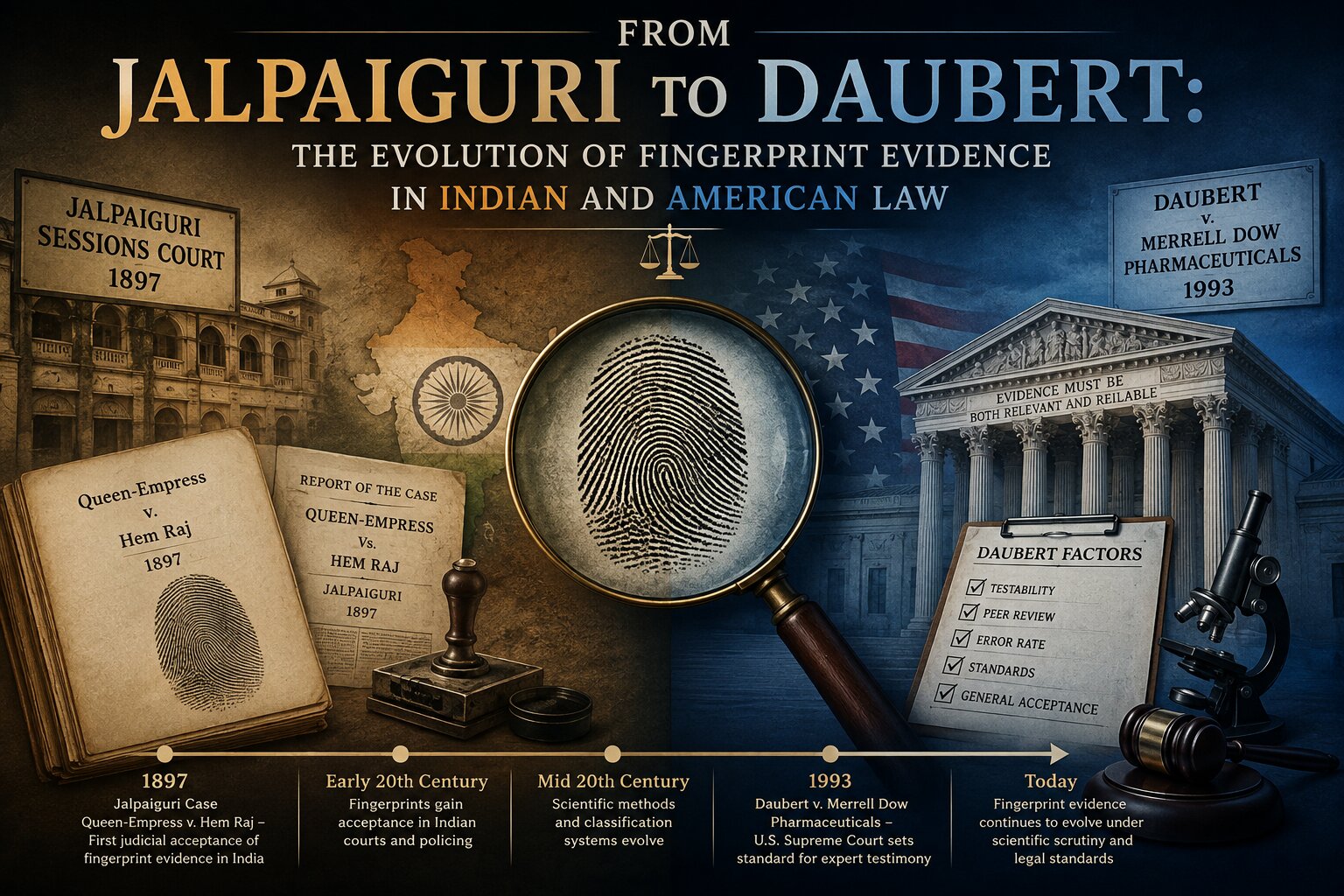
The history is particularly significant in India. The modern forensic development of fingerprint identification owes much to work undertaken in colonial Bengal, including the contributions of Azizul Haque and Hem Chandra Bose to the Henry Classification System. The 1898 Kangali Charan case in Jalpaiguri is commonly identified as one of the earliest—and often the earliest—criminal cases in the British Empire in which fingerprint identification contributed to a murder conviction.
Across the Atlantic, American courts formally embraced fingerprint evidence in People v. Jennings in 1911. Decades later, however, the American legal system moved from broad acceptance to a more demanding inquiry into the reliability of expert evidence through Daubert v. Merrell Dow Pharmaceuticals, Inc. and its subsequent application to fingerprint identification. The resulting jurisprudence demonstrates an important transition: from asking whether fingerprint evidence is generally accepted to asking whether the particular methodology and its application are sufficiently reliable.
India and the United States have consequently developed different—but increasingly convergent—approaches to forensic identification evidence.
The Jalpaiguri Beginning: Kangali Charan and Colonial Bengal
The modern jurisprudence and forensic application of fingerprint identification are deeply rooted in late nineteenth-century Bengal. During this period, colonial officials and local mathematical minds collaborated to transform biometric identification from a speculative administrative concept into a structured forensic science. By 1897, the Calcutta Anthropometric Bureau was formally reconstituted as the world’s first fingerprint bureau under Sir Edward Richard Henry. Central to this monumental achievement were Sub-Inspectors Azizul Haque and Hem Chandra Bose, whose mathematical ingenuity in developing the primary classification, filing, and indexing mechanisms laid the groundwork for what became internationally recognised as the Henry Classification System.
It was against this backdrop of institutional innovation that the celebrated prosecution of Kangali Charan arose in Jalpaiguri in 1898.
The case involved the murder of a tea-garden manager in the Jalpaiguri district. While early investigative enquiries implicated multiple potential suspects, a critical breakthrough occurred when a faint, latent fingerprint was discovered on a blood-stained calendar (or dispatch book) recovered from the crime scene. This latent print was analysed and compared by the newly established Fingerprint Bureau against the recorded impressions of Kangali Charan, a former servant of the deceased who had fallen under suspicion. The positive identification served as the key circumstantial link connecting the accused directly to the scene, ultimately leading to his conviction by the Jalpaiguri Sessions Court. Historical accounts routinely cite this trial as the first murder prosecution in the British Empire—and likely globally—in which fingerprint evidence was successfully introduced to secure a criminal conviction.
The Enduring Significance of Kangali Charan
The enduring significance of Kangali Charan extends beyond its status as a historical curiosity. It established the foundational evidentiary proposition that governs latent prints to this day: an invisible or faint physical impression, when scientifically preserved and matched against a verified exemplar, can establish a definitive spatial link between an individual and a crime scene or instrument.
From a rigorous legal perspective, however, modern scholarship must distinguish the historical record of the Kangali Charan trial from a formally reported appellate precedent. Tried before the Sessions Court at Jalpaiguri, the case was not published in standard contemporary law reports such as the Indian Law Reports (ILR). Instead, its primary documentation survives through administrative reports, contemporary forensic literature, and Sir Edward Henry’s seminal 1900 treatise, Classification and Uses of Finger Prints. Consequently, while the case remains a watershed moment in forensic history, it is best referenced as the Jalpaiguri Sessions Case of Kangali Charan (1898), reflecting its status as an epochal trial rather than a formally indexed appellate authority.
Statutory Recognition: From the Indian Evidence Act to the Bharatiya Sakshya Adhiniyam
The rapid administrative adoption of fingerprint analysis was soon followed by statutory formalisation. When originally enacted, Section 45 of the Indian Evidence Act, 1872 (IEA), recognised expert opinion across science, art, and foreign law but contained no explicit reference to friction-ridge analysis. Recognising the transformative success of the Kangali Charan prosecution and the operationalisation of the Fingerprint Bureau, the imperial legislature passed Act 5 of 1899, amending Section 45 to explicitly include “identity of finger impressions”.
This statutory amendment was pivotal. By categorising fingerprint analysis as an admissible form of expert opinion, the law established that while an examiner’s conclusion was not conclusive proof, it constituted a relevant, scientific aid to judicial decision-making.
Identification of Prisoners Act, 1920
To complement the evidentiary admissibility under the IEA, the procedural power to compel the collection of exemplar prints was enacted through the Identification of Prisoners Act, 1920. The statute’s Statement of Objects and Reasons explicitly acknowledged the operational necessity of creating a systematic database of finger and footprint impressions to aid crime detection.
Criminal Procedure (Identification) Act, 2022
This procedural framework endured for over a century before being modernised by the Criminal Procedure (Identification) Act, 2022. The 2022 legislation expanded the scope of state collection powers beyond traditional rolled inked prints to encompass iris scans, digital biometrics, and physical measurements, reflecting modern advancements in forensic technology.
Bharatiya Sakshya Adhiniyam, 2023
With the overhaul of Indian criminal law and the enforcement of the Bharatiya Sakshya Adhiniyam, 2023 (BSA), on 1 July 2024, the substantive law of evidence underwent structural reorganisation. The core rule governing forensic opinion was transplanted into Section 39 of the BSA, which provides that when a court must form an opinion upon a point of foreign law, science, art, or the identity of handwriting or finger impressions, the opinions of persons specially skilled in such matters are relevant facts.
The Statutory Trajectory of Fingerprint Evidence
| Legal Framework | Relevant Provision / Development | Significance |
|---|---|---|
| Indian Evidence Act, 1872 | Section 45 | Recognised expert opinion, including scientific evidence. |
| Act 5 of 1899 | Amendment to Section 45 | Expressly included the identity of finger impressions. |
| Identification of Prisoners Act, 1920 | Collection of exemplar impressions | Provided procedural support for identification and crime detection. |
| Criminal Procedure (Identification) Act, 2022 | Expanded biometric collection powers | Modernised identification methods beyond traditional fingerprints. |
| Bharatiya Sakshya Adhiniyam, 2023 | Section 39 | Continues recognition of expert opinions concerning science and finger impressions. |
The statutory trajectory demonstrates an unbroken doctrinal lineage:
Section 45, Indian Evidence Act, 1872 ➜ Section 39, Bharatiya Sakshya Adhiniyam, 2023
While procedural tools for biometrics have expanded from manual ink-and-paper rolls to digital databases, the fundamental evidentiary principle remains steadfast: fingerprint expertise is an admissible, non-conclusive opinion designed to assist, rather than supplant, the court’s independent evaluation of facts.
4. The Indian Supreme Court: Acceptance Accompanied by Caution
Indian jurisprudence has never treated expert fingerprint opinion as automatically conclusive. The Supreme Court’s decisions demonstrate that the principal concern is not merely whether fingerprint science is recognised, but whether the particular evidence has been properly collected, preserved, proved, and connected with the accused.
4.1. Shankaria v. State of Rajasthan — 1978
One of the important early Supreme Court decisions is Shankaria v. State of Rajasthan (1978) 3 SCC 435.
The case involved a double murder. A small tin container, or dibbi, recovered from the scene bore fingerprints. The article was seized and sealed before the accused was arrested, and the seals remained intact until examination by the Fingerprint Bureau. A fingerprint on the article was found to correspond with the accused’s specimen fingerprint.
The Supreme Court treated the fingerprint as a significant circumstance pointing towards guilt. Importantly, however, the fingerprint evidence did not exist in isolation: it operated alongside the confession, medical evidence, weapon evidence, and other circumstances.
Shankaria is therefore important for two propositions. First, properly preserved fingerprint evidence can be a powerful incriminating circumstance. Second, the integrity of the physical exhibit and its chain of custody matters. The Court considered the circumstances in which the article had been seized, sealed, stored, and transmitted to the expert.
The case demonstrates an important distinction between the scientific proposition that two prints may correspond and the legal proposition that the print proves participation in a crime. The latter requires the court to consider the circumstances surrounding the presence of the print.
4.2. Mohd. Aman v. State of Rajasthan — 1997
In Mohd. Aman, Babu Khan & Another v. State of Rajasthan, AIR 1997 SC 2960, the Supreme Court considered the legal framework governing the taking of specimen fingerprints.
The decision is significant because it clarified the relationship between fingerprint collection and the Identification of Prisoners Act. The Court held that police authorities were competent, under Section 4 of the 1920 Act, to take specimen fingerprints of an accused in the circumstances contemplated by the statute; obtaining a magistrate’s order was not invariably necessary in such circumstances.
The case is important because fingerprint evidence has two distinct components:
- the questioned or latent impression, and
- the known or specimen impression used for comparison.
A scientifically correct comparison can still become legally vulnerable if the provenance of either print is inadequately established.
Consequently, the collection of specimen fingerprints should be documented with the same seriousness as the collection of the questioned print.
4.3. Musheer Khan v. State of Madhya Pradesh — 2010
The Supreme Court’s decision in Musheer Khan @ Badshah Khan & Anr. v. State of Madhya Pradesh, (2010) 2 SCC 748, represents one of the clearest statements of judicial caution.
The Court expressly observed that fingerprint-expert evidence is not substantive evidence by itself and may be used to corroborate substantive evidence already on record.
The case involved fingerprint impressions allegedly recovered from vehicles. The Supreme Court found serious deficiencies concerning the evidentiary foundation of the fingerprint comparison, including the failure to satisfactorily establish the provenance of the specimen fingerprints. The Court concluded that the fingerprint comparison did not possess sufficient probative force to sustain the conviction in the circumstances of the case.
The significance of Musheer Khan lies in its methodological lesson:
A fingerprint match is not the end of the evidentiary inquiry; it is the beginning of the judicial inquiry into what that match actually proves.
The Court’s approach prevents an examiner’s conclusion from becoming a substitute for proof of the surrounding circumstances.
It would, however, be too broad to describe Indian law as establishing an absolute statutory rule that fingerprint evidence can never sustain a conviction without corroboration. The safer proposition is that the Supreme Court has repeatedly emphasised the non-substantive or corroborative character of expert opinion and has demanded a reliable evidentiary foundation before assigning decisive weight to it.
5. India After the Bharatiya Sakshya Adhiniyam: Continuity with a Modern Forensic Framework
The enactment of the Bharatiya Sakshya Adhiniyam does not fundamentally alter the evidentiary philosophy governing fingerprint expertise.
Section 39 expressly recognises expert opinion concerning the identity of finger impressions as a relevant fact.
But relevance is not the same as conclusiveness.
The court must still consider:
- whether the questioned print was properly located and documented;
- whether the object bearing the print was properly seized;
- whether contamination was possible;
- whether the print was packaged and preserved appropriately;
- whether the chain of custody is demonstrable;
- whether the specimen print genuinely belongs to the accused;
- whether the examiner is properly qualified;
- whether the comparison methodology was correctly applied;
- whether the latent impression contains sufficient information for a meaningful comparison; and
- whether the expert’s conclusion is supported by demonstrable observations rather than merely asserted as an opinion.
This is particularly important in an era of digital photography, AFIS searches, image enhancement, automated candidate generation, and increasingly sophisticated forensic databases.
The existence of an automated fingerprint identification system does not eliminate the need for human examination. AFIS may generate candidates; it does not necessarily establish legal identification by itself.
6. The American Beginning: People v. Jennings
American courts confronted fingerprint evidence somewhat later than colonial India. The landmark decision is People v. Jennings, 252 Ill. 534, 96 N.E. 1077 (1911).
Thomas Jennings was prosecuted for murder after fingerprints were discovered in fresh paint near the scene. On appeal, the defence challenged the admissibility of fingerprint evidence, arguing that it represented an insufficiently established scientific technique.
The Illinois Supreme Court rejected the challenge and recognised fingerprint identification as a science requiring specialised knowledge. It accepted expert testimony because fingerprint classification and identification were beyond ordinary lay experience.
Jennings became the foundational American appellate precedent for fingerprint evidence.
Its significance, however, must be understood in historical context. The court’s reasoning reflected the scientific and legal environment of 1911. It did not conduct the type of empirical reliability inquiry that modern courts associate with Daubert. The decision largely rested on the developing scientific literature, expert testimony, practical experience, and general acceptance of fingerprint identification.
Thus, Jennings represents the acceptance phase of American fingerprint jurisprudence.
7. From Frye to Daubert: The American Reliability Revolution
For much of the twentieth century, scientific evidence in American courts was commonly evaluated through the principle associated with Frye v. United States, 293 F. 1013 (D.C. Cir. 1923).
The Frye approach emphasised general acceptance within the relevant scientific community.
Fingerprint identification benefited enormously from this framework because courts had already accepted the technique for decades. Its widespread forensic use and judicial recognition made general acceptance comparatively easy to establish.
The Supreme Court’s decision in Daubert v. Merrell Dow Pharmaceuticals, Inc., 509 U.S. 579 (1993) changed the federal landscape.
Daubert held that Federal Rule of Evidence 702 requires trial judges to perform a gatekeeping function concerning expert testimony. Relevant considerations include whether the methodology can be tested, whether it has been subjected to peer review and publication, its known or potential error rate, and its degree of acceptance within the relevant scientific community.
The question consequently changed from:
“Is this technique generally accepted?”
to:
“Is this expert testimony based upon reliable principles and methods, and have those principles and methods been reliably applied to the facts of the case?”
The later decision in Kumho Tire Co. v. Carmichael, 526 U.S. 137 (1999), extended the gatekeeping principle beyond narrowly defined scientific testimony to technical and specialised expert knowledge.
The result was a new challenge for fingerprint identification: could a technique historically accepted by courts withstand modern scrutiny concerning testing, error rates, standards, examiner subjectivity, and methodological reliability?
8. United States v. Crisp: Judicial Confidence in Fingerprint Identification
In United States v. Crisp, 324 F.3d 261 (4th Cir. 2003), the Fourth Circuit addressed fingerprint identification in the Daubert environment.
The court recognised the longstanding acceptance of fingerprint identification and declined to require trial courts to conduct an elaborate reliability inquiry every time established fingerprint evidence was introduced. The case is frequently cited for the proposition that courts need not repeatedly re-litigate the basic admissibility of a familiar forensic technique absent a substantial or novel challenge.
Crisp therefore represents a transitional position: Daubert applies, but longstanding judicial experience with fingerprint evidence remains highly relevant.
The decision does not mean that every fingerprint conclusion is immune from challenge. Rather, it recognises the distinction between challenging the general reliability of fingerprint identification and challenging the specific application of the methodology in a particular case.
9. United States v. Mitchell: The Daubert Stress Test
The most important modern American fingerprint decision is arguably United States v. Mitchell, 365 F.3d 215 (3d Cir. 2004).
The Third Circuit considered an extensive Daubert record involving latent fingerprint identification. The case was especially important because the defence directly challenged the scientific reliability of latent fingerprint comparison and the ACE-V methodology—Analysis, Comparison, Evaluation and Verification.
The court ultimately allowed the fingerprint testimony to be admitted, but its reasoning was considerably more nuanced than a simple declaration that fingerprint evidence was infallible.
Indeed, Mitchell acknowledged significant limitations. Latent fingerprints may be partial, distorted, smudged, or otherwise degraded. A clean, full rolled impression is fundamentally different from a fragmentary latent print recovered from a crime scene.
The Third Circuit also rejected an important judicial shortcut: it held that the district court had erred in taking judicial notice of the proposition that human friction-ridge arrangements are unique and permanent even in the broad form in which the proposition had been presented. The error was ultimately considered harmless.
This is a crucial lesson.
Judicial acceptance of fingerprint identification does not justify judicial assumption of every proposition made by a fingerprint examiner.
The examiner must still explain the observations, methodology, limitations, and basis of the conclusion.
10. The Hidden Problem: Examiner Subjectivity
The modern debate has moved beyond the question of whether fingerprints are useful. The more difficult question is:
How reliable is the human process of deciding that two impressions correspond?
This distinction is fundamental.
The physical persistence of friction ridges is one proposition. The proposition that a particular examiner can correctly identify a distorted latent impression as belonging to a particular individual is another.
The latter involves human perception, comparison, interpretation, experience, and judgement.
The Mitchell litigation exposed this difficulty. During the testing associated with the case, not every participating agency reached the same conclusion concerning the disputed latent prints.
Consequently, modern fingerprint jurisprudence should distinguish between:
- (a) Biological Persistence and Distinctiveness;
- (b) Quality and Sufficiency of the Latent Impression;
- (c) Validity of the Comparison Methodology;
- (d) Examiner Competence; and
- (e) Reliability of the Examiner’s Particular Conclusion.
These are related but not identical propositions.
11. The Two Legal Systems Compared
The Indian and American approaches are different in emphasis but increasingly similar in principle.
| Issue | India | United States |
|---|---|---|
| Statutory Recognition | BSA Section 39 recognises expert opinion on finger impressions. | FRE 702 governs federal expert testimony. |
| Historical Foundation | Section 45, Indian Evidence Act; fingerprint reference inserted in 1899 | People v. Jennings (1911) |
| Collection of Specimens | Governed historically by Identification of Prisoners Act; now Criminal Procedure (Identification) Act, 2022 | Governed by criminal procedure and evidentiary rules |
| Expert Opinion | Relevant, but not ordinarily treated as conclusive | Subject to Rule 702 and judicial gatekeeping |
| Major Reliability Framework | Judicial evaluation of evidentiary value and corroboration | Daubert, Kumho Tire, Rule 702 |
| Important Fingerprint Cases | Shankaria, Mohd. Aman, Musheer Khan | Jennings, Crisp, Mitchell |
| Central Concern | Proper collection, proof, corroboration and evidentiary foundation | Reliability, methodology, application and examiner limitations |
The distinction should not, however, be overstated.
Indian courts are not hostile to fingerprint science. American courts are not blind to evidentiary weaknesses. Both systems increasingly recognize that a scientifically plausible technique may nevertheless produce weak evidence when the particular specimen, methodology, documentation, or interpretation is defective.
12. The Chain Of Custody: Where Science Meets Procedure
Perhaps the most important common denominator between Indian and American jurisprudence is the chain of custody.
A fingerprint impression does not reach the courtroom directly from the crime scene. Between discovery and testimony there may be numerous stages:
Crime Scene → Discovery → Photography/Documentation → Lifting or Preservation → Packaging → Sealing → Storage → Transfer → Laboratory Examination → Comparison → Verification → Courtroom Presentation.
Each stage creates an opportunity for error.
A latent fingerprint may be:
- incorrectly attributed to a particular object;
- contaminated;
- damaged during lifting;
- photographed inadequately;
- improperly packaged;
- exposed to unauthorised handling;
- mixed with other impressions;
- digitally enhanced without adequate documentation; or
- compared against an incorrectly obtained specimen.
Therefore, the phrase “the fingerprint matched” is legally incomplete.
The proper question is:
What exactly matched, how was it preserved, who handled it, what methodology was used, what was the quality of the questioned impression, what was the provenance of the known impression, and can every significant step be independently demonstrated?
This is where Shankaria and Musheer Khan are particularly instructive in India, while Daubert and Mitchell illustrate the American insistence upon methodological reliability.
13. The Importance Of Verification And Independent Review
Modern fingerprint examination relies heavily on the ACE-V methodology—an acronym for Analysis, Comparison, Evaluation, and Verification. While the first three stages represent the primary examiner’s interpretive process, the final stage—Verification—serves as the structural quality-control mechanism designed to prevent subjective errors and self-validating conclusions.
However, the scientific validity of verification hinges entirely on its operational independence.
In traditional laboratory practices, “open verification” was common: the verifier knew the primary examiner’s identity, the suspect’s identity, and the initial conclusion of “identification”. Modern cognitive forensic research—most notably highlighted in the post-Daubert era and by reports from the National Academy of Sciences (NAS)—has demonstrated that such open procedures expose the verifier to confirmation bias and domain-irrelevant contextual information. When a verifying examiner is aware that a senior colleague has already declared a match, subconscious cognitive bias can unconsciously sway the verifier’s judgment, particularly when dealing with low-quality, distorted, or partial latent prints.
To mitigate these psychological vulnerabilities, modern forensic science advocates for blind verification or context-managed review. Under a blind protocol, the second examiner is provided the latent and exemplar prints without prior knowledge of:
- The primary examiner’s conclusion;
- The suspect’s criminal background or case narrative; or
- Whether the comparison has already been evaluated by another analyst (often interspersed with decoy prints).
Consequently, the standard of scientific integrity in fingerprint verification must evolve beyond a superficial rubber-stamp process:
In standard verification, Examiner B reviews Examiner A’s identification, creating a potential risk of contextual or confirmation bias. In blind verification, Examiner B independently analyses the evidence without knowledge of Examiner A’s conclusion, allowing any concurrence to be assessed more objectively and providing a scientifically more robust verification process.
Implementing blind or context-limited verification protocols transforms verification from a mere administrative formality into a rigorous scientific safeguard. For trial courts, evidence subjected to blind verification carries significantly higher probative weight, as it demonstrates that the forensic conclusion is reproducible, objective, and resilient against cognitive contamination.
What a Court Should Ask Before Relying on Fingerprint Evidence
A disciplined judicial approach may be organised around ten questions:
- What is the source of the questioned fingerprint?
- Who discovered it and under what circumstances?
- Was the location of the print photographed and documented before lifting?
- Was the item bearing the print properly seized, sealed and preserved?
- Is the chain of custody complete?
- How was the specimen fingerprint of the accused obtained?
- Is the provenance of the specimen independently established?
- What methodology did the examiner employ?
- What limitations arise from the quality, distortion or incompleteness of the latent impression?
- What independent evidence connects the fingerprint with the commission of the offence?
These questions do not undermine fingerprint science. They protect it.
Indeed, rigorous scrutiny can enhance the legitimacy of forensic identification by distinguishing genuine scientific evidence from unsupported claims of certainty.
From “Match” to “Meaning”
The most important conceptual development in fingerprint jurisprudence is the movement away from treating the word “match” as self-explanatory.
A fingerprint may establish that an individual’s friction-ridge detail is consistent with an impression recovered from an object. But the legal significance of that fact depends upon the circumstances.
For example, a fingerprint on:
- a publicly accessible door,
- a common household object,
- a vehicle routinely used by several people,
may have very different evidentiary significance from a fingerprint found:
- inside a sealed container,
- on the trigger or other relevant part of a weapon,
- on an object uniquely associated with the offence,
- or in a location inaccessible to ordinary users.
The fingerprint itself does not narrate the circumstances in which it was deposited.
This is why the forensic conclusion and the legal inference must remain separate.
The examiner answers: “Whose friction-ridge impression is this, insofar as the methodology permits?”
The court answers, “What does the presence of that impression prove in the context of the entire case?”
Confusing these two questions risks converting expert opinion into a substitute for judicial reasoning.
From Jalpaiguri to Daubert: An Evolution, Not a Rejection
The history of fingerprint evidence should therefore not be understood as a movement from “old science” to “new scepticism”. It is better understood as an evolution through three stages.
Stage One: Discovery and Demonstration
The Kangali Charan case and the development of fingerprint classification in Bengal demonstrated the extraordinary practical utility of friction-ridge identification.
Stage Two: Judicial Acceptance
People v. Jennings and subsequent cases established fingerprint identification as a legitimate form of expert evidence. Indian legislation likewise expressly recognised fingerprint expertise through the 1899 amendment to Section 45 of the Indian Evidence Act.
Stage Three: Reliability and Methodological Scrutiny
The Daubert era shifted attention toward testing, error rates, peer review, standards, methodology and application. Crisp and Mitchell demonstrated that longstanding acceptance did not eliminate the judicial responsibility to consider reliability.
India has followed a different doctrinal path, but cases such as Shankaria, Mohd. Aman and Musheer Khan similarly demonstrate that the courtroom must scrutinise the evidentiary foundation rather than simply accept an expert’s conclusion.
Conclusion: From Certainty to Accountability
The journey of fingerprint evidence from Jalpaiguri in 1898 to the Daubert courtroom in America is a story of remarkable scientific success accompanied by an equally important evolution in judicial caution.
Colonial Bengal demonstrated the extraordinary forensic potential of friction-ridge identification. The 1899 amendment to the Indian Evidence Act gave fingerprint expertise express statutory recognition. Shankaria demonstrated the evidentiary significance of a properly preserved fingerprint; Mohd. Aman addressed the lawful acquisition of specimen fingerprints; and Musheer Khan emphasised that an expert fingerprint opinion cannot substitute for substantive evidence and must be evaluated within the complete evidentiary chain.
In the United States, People v. Jennings established early judicial acceptance. Daubert transformed the legal treatment of expert testimony from a relatively broad inquiry into general acceptance toward a structured inquiry into reliability. Kumho Tire extended that gatekeeping responsibility to technical and specialised expertise, while Crisp and Mitchell demonstrated how fingerprint evidence could survive serious reliability challenges without being treated as beyond scrutiny.
The central lesson emerging from both jurisdictions is therefore neither that fingerprint evidence is infallible nor that it is inherently unreliable.
It is this:
A fingerprint is only as persuasive as the scientific and evidentiary process that transforms a ridge impression into a courtroom conclusion.
The future of fingerprint jurisprudence should consequently move from claims of absolute certainty toward demonstrable reliability, transparency and accountability.
Courts should demand not merely a declaration of “identification”, but a clear account of collection, preservation, provenance, methodology, comparison, verification, limitations and evidentiary context.
That approach does not weaken forensic science. It strengthens it.
From the faint impression on a calendar in Jalpaiguri to the rigorous methodological questions raised under Daubert, the history of fingerprint evidence ultimately teaches a broader principle of criminal justice: scientific evidence earns its authority not because courts presume it to be infallible, but because its methods remain open to examination, its limitations are acknowledged, and its conclusions are proved within a reliable chain of evidence.
Authors
| Author | Designation |
|---|---|
| Md. Imran Wahab, IPS | Inspector General of Police, West Bengal, India |
| Christine Loewenhagen | Senior Crime Scene Specialist, City of Mesa Police Department, Arizona, USA |