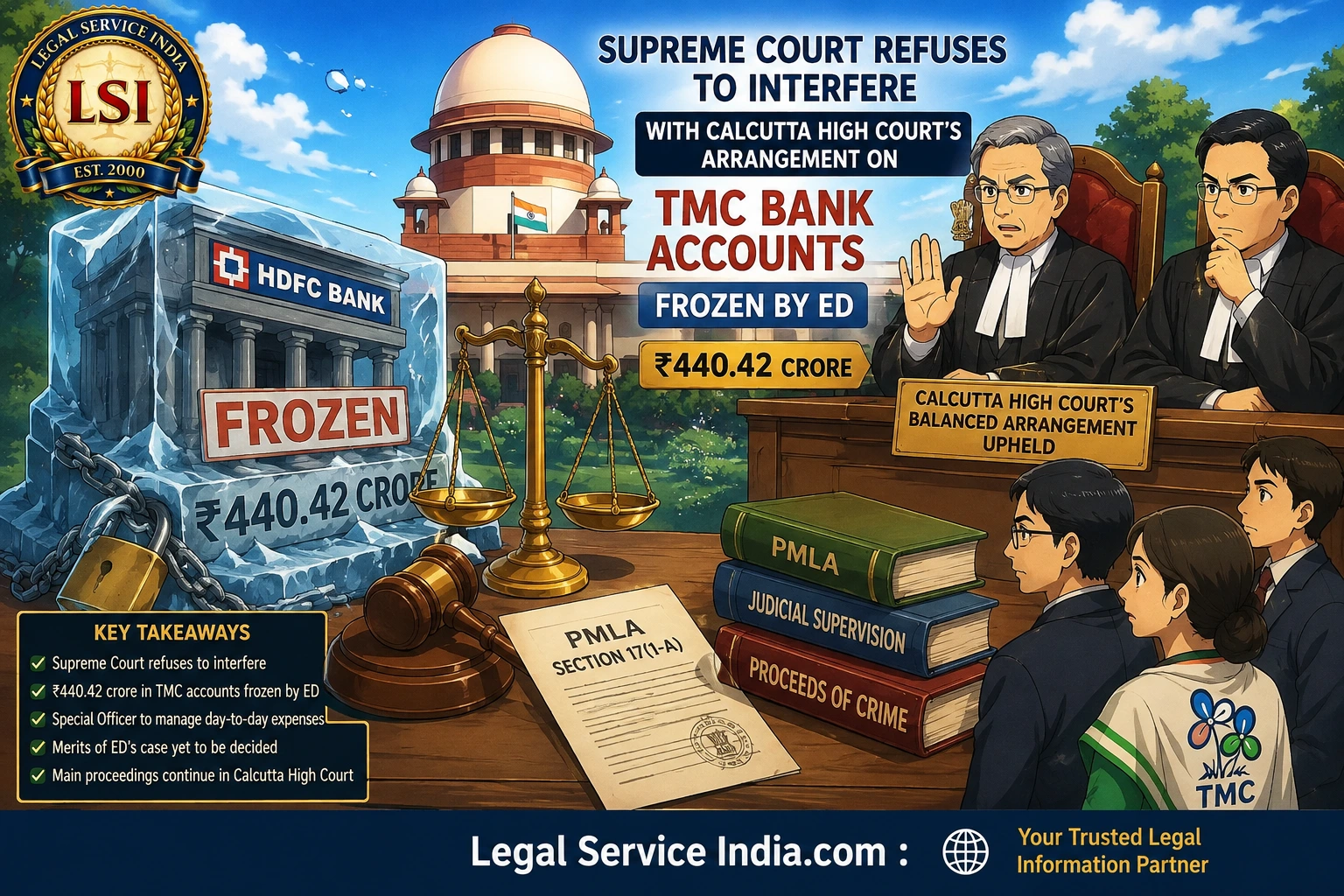
TMC Bank Accounts: Supreme Court Refuses to Interfere With Calcutta High Court’s Interim Arrangement in ED Probe
The Supreme Court has, on 11 August 2026, declined to interfere with the interim arrangement framed by the Calcutta High Court concerning the TMC Bank Accounts frozen by the Enforcement Directorate (ED) in a money-laundering investigation. The Supreme Court has not, however, finally decided the legality of the ED’s freezing action. That distinction is legally important.
A Bench comprising Justice M.M. Sundresh and Justice P.B. Varale disposed of the petitions filed by the All India Trinamool Congress (AITC), holding that the arrangement already put in place by the Calcutta High Court was a “balanced order” and adequately protected the interests of all parties. The Court also permitted the petitioner to place its objections before the Special Officer appointed by the High Court.
The development assumes considerable significance because the ED had frozen approximately ₹440.42 crore in three HDFC Bank accounts of the AITC under Section 17(1-A) of the Prevention of Money Laundering Act, 2002 (PMLA).
The case is therefore not merely about a political party’s bank balance. It raises important questions concerning the freezing of bank accounts under the PMLA, the distinction between alleged proceeds of crime and the total balance in an account, the functioning of a political organisation during an investigation, judicial supervision over frozen funds, and the limits of interim intervention by constitutional courts.
Supreme Court Decision on TMC Bank Accounts: What Happened?
The matter before the Supreme Court arose from proceedings initiated by the AITC against the ED’s action concerning its bank accounts.
The case is reported as
All India Trinamool Congress v. Union of India
| Particulars | Details |
|---|---|
| Case | All India Trinamool Congress v. Union of India |
| Bench | Justice M.M. Sundresh and Justice P.B. Varale |
| Date | 11 August 2026 |
| Proceedings | SLP Nos. 14649/14691 of 2026 |
| Principal Law | Prevention of Money Laundering Act, 2002 (PMLA) |
| Amount Frozen | Approximately ₹440.42 crore |
| Bank Accounts | Three HDFC Bank accounts of the AITC |
The Supreme Court was essentially confronted with an interim controversy.
The AITC wanted relief against the freezing of its accounts and argued that the freezing of such a substantial amount had paralyzed the party’s ordinary functioning.
The ED opposed the plea and maintained that the High Court’s interim arrangement already provided sufficient protection for legitimate day-to-day expenses.
Rather than entering into the merits of the entire money-laundering investigation, the Supreme Court took a restrained approach.
The Court observed that the principal petitions were still pending before the Calcutta High Court and that a detailed examination of the merits at the interlocutory stage could prejudice or affect those proceedings.
That is the central feature of today’s order.
The ₹440.42 Crore TMC Bank Accounts Controversy
The financial magnitude of the case is extraordinary.
According to the ED’s official press release dated 8 July 2026, searches were conducted at five premises connected with the Carewell group of aviation companies.
During those searches, balances aggregating approximately ₹440.42 crore lying in three HDFC Bank accounts of the AITC were frozen under Section 17(1-A) of the PMLA.
The ED stated that its investigation arose from an FIR registered by the Cyber Police Station, Bidhannagar, concerning allegations of dishonest financial dealings, unlawful collection of money and routing of suspected funds through certain bank accounts.
The agency further stated that approximately ₹160 crore had been transferred from AITC bank accounts to Carewell Aviation India Pvt. Ltd. and a related entity, largely between April 2023 and June 2026.
The ED further alleged that funds were subsequently routed towards the acquisition of an aircraft and helicopter and that those aircraft were later rented to the AITC.
Importantly, these are investigative allegations of the Enforcement Directorate and not findings of guilt by the Supreme Court. The investigation remains pending.
Why Did the Supreme Court Refuse to Interfere?
The answer lies in the nature of the proceedings before it.
The Supreme Court was not conducting a final trial of the alleged financial transactions.
Nor was it finally determining:
- whether the money constituted proceeds of crime;
- whether the transactions amounted to money laundering;
- whether the ED’s freezing order would ultimately survive;
- whether any individual associated with the transactions was guilty;
- or whether the AITC had committed any offense.
Those questions remain open.
The Court therefore considered the interim arrangement to be the appropriate mechanism at this stage.
Justice Sundresh emphasized that the orders under consideration were interim orders and that the immediate objective was to ensure that the functioning of the party was not brought to a standstill.
The Supreme Court consequently concluded that the Calcutta High Court had already struck a balance between the competing interests.
What Is the “Balanced Order” of the Calcutta High Court?
This is perhaps the most important practical aspect of the decision.
The Calcutta High Court had appointed a Special Officer/Administrator to facilitate operation of the relevant accounts for legitimate day-to-day and monthly expenditure.
Thus, the arrangement was not simply
“TMC is free to operate the frozen accounts.”
Nor was it:
“Every rupee must remain completely inaccessible.”
Instead, the High Court created a judicially supervised mechanism.
The Supreme Court specifically noted that the accounts would be operated through the court-appointed officer and that the arrangement did not simply place control of the accounts in the hands of either faction of the party.
This distinction is legally significant.
TMC’s Argument: ₹400 Crore Frozen Against an Alleged ₹60 Crore Proceeds-of-Crime Claim
During the Supreme Court hearing, Senior Advocate Kapil Sibal, appearing for the AITC, argued that the ED’s alleged proceeds of crime were approximately ₹60 crore, whereas more than ₹400 crore had effectively been immobilised.
The submission was that freezing the entire amount was disproportionate and had seriously affected the party’s functioning.
The Court was told that the party had approximately 250 employees, with salary liabilities of around ₹53.23 lakh, and operated approximately 17 offices, involving monthly expenditure of about ₹1 crore, apart from other contractual obligations.
The argument raises a broader legal question:
Can the Entire Balance in a Bank Account Be Frozen Merely Because a Part of the Money Is Suspected to Represent Proceeds of Crime?
That question is potentially important in PMLA jurisprudence.
However, the Supreme Court has not answered that question finally in today’s proceedings.
The court deliberately avoided detailed observations that could affect the pending proceedings before the Calcutta High Court.
ED’s Response: TMC Had Other Accounts
The ED disputed the suggestion that the party had been left completely without access to funds.
Additional Solicitor General S.V. Raju informed the Supreme Court that approximately ₹120 crore was available in other accounts and that the High Court had already permitted certain accounts to be operated for day-to-day expenses.
The Calcutta High Court proceedings had also recorded the existence of 36 other accounts in the name of the AITC, in which approximately ₹164 crore was lying.
The existence of other funds was consequently an important factor in assessing whether the interim arrangement adequately protected the party’s immediate functioning.
The Role of the Special Officer
The appointment of a special officer is particularly noteworthy from a judicial-administration perspective.
The Supreme Court pointed out that the High Court’s arrangement contemplated operation of the accounts through the court-appointed administrator/special officer.
Therefore, the question was not simply whether one faction of the TMC should be permitted to withdraw and spend the funds.
The judicial mechanism was intended to ensure that legitimate expenses could be met while preserving safeguards around the disputed funds.
The Supreme Court specifically observed that it was not deciding the factional controversy concerning who was entitled to operate the accounts.
TMC Factional Dispute: Why It Matters
An additional layer of complexity is the internal dispute concerning control and authorization within the party.
A rival faction, represented before the Court, opposed unrestricted operation of the accounts.
It was argued that permitting one faction to control the funds could prejudice competing claims, particularly because the question of who legally represents the TMC was itself pending before the Election Commission.
The Supreme Court consciously declined to decide that political or organizational dispute.
That was a prudent judicial approach.
A court dealing with an interim financial arrangement need not determine the ultimate political leadership of a political party when that issue is separately pending before the competent forum.
The PMLA Dimension: Section 17(1-A)
The freezing action was taken under Section 17(1-A) of the PMLA.
This provision becomes relevant where immediate seizure of property is not practicable. The statutory mechanism permits the authorized officer to freeze the property, preventing it from being transferred or otherwise dealt with without prior permission.
The ED’s official release specifically identifies Section 17(1-A) as the statutory basis for freezing the ₹440.42 crore.
The distinction between seizure and freezing is therefore important.
A bank account cannot ordinarily be treated like a physical object that an investigating officer can simply take away.
A freezing order operates by legally restricting dealings with the property.
The PMLA Rules also provide a procedural framework concerning freezing and the forwarding of relevant material to the Adjudicating Authority.
Seizure vs. Freezing Under the PMLA
| Concept | Legal Effect |
|---|---|
| Seizure | Involves taking control or possession of property in accordance with the statutory process. |
| Freezing | Restricts the person or entity from transferring or otherwise dealing with the property without prior permission. |
The Calcutta High Court’s Earlier Reasoning
The controversy before the Supreme Court must be understood against the backdrop of the Calcutta High Court proceedings.
In its July 20, 2026, order, the High Court considered the challenge to the ED proceedings and the freezing action.
The petitioners argued that the freezing of the accounts had been arbitrary and that specific proceeds of crime had not been identified or segregated.
The ED, on the other hand, relied upon transactions identified during its investigation and maintained that substantial funds had been transferred to various entities.
The High Court ultimately refused interim relief in that proceeding, while leaving the substantive questions open for further adjudication.
It directed the respondents to file affidavits and listed the matter for further consideration.
Thus, the litigation remains alive.
What Exactly Has the Supreme Court Decided?
It is important not to overstate today’s decision.
The Supreme Court Has Not Held That:
- The ED’s investigation is illegal;
- The ₹440.42 crore is untainted money;
- The TMC committed money laundering
- The ED has proved its allegations;
- The entire ₹440.42 crore constitutes proceeds of crime;
- or the freezing order has been finally upheld on merits.
What the Supreme Court Has Held at This Stage Is:
- The Calcutta High Court’s interim arrangement is adequate.
- The High Court has passed a balanced order.
- The Supreme Court should not enter into a detailed merits examination while the principal proceedings remain pending before the High Court.
- The Special Officer’s mechanism adequately protects the interests of the parties.
- The petitioner may place its objections before the Special Officer.
- The Supreme Court therefore disposed of the petitions rather than retaining the matter for further interim adjudication.
This distinction should be kept firmly in mind while reporting the judgment.
Why This Order Is Legally Significant
The significance of the TMC Bank Accounts decision extends beyond the immediate political controversy.
1. Judicial Restraint in an Interlocutory Proceeding
The Supreme Court demonstrated considerable restraint.
Where the principal writ proceedings remain pending before the High Court, an appellate constitutional court must be careful not to make observations that effectively prejudge the final controversy.
This is especially important in complex PMLA investigations involving large volumes of financial transactions.
2. Protection of Legitimate Functioning Without Frustrating Investigation
The order demonstrates a possible middle path.
The Court did not have to choose between two extreme positions:
complete freezing versus unrestricted operation.
A court-supervised mechanism can sometimes preserve both objectives:
- preventing dissipation of potentially disputed funds; and
- permitting legitimate and necessary expenses.
This is precisely why the Special Officer mechanism assumes significance.
3. Political Parties and Financial Regulation
The case also raises an important constitutional-policy question.
Political parties are not above financial laws merely because they are political organizations.
At the same time, investigative powers affecting the financial resources of a political party can have consequences extending beyond an ordinary commercial entity.
The freezing of hundreds of crores can affect:
- employees;
- offices;
- legal expenses;
- administrative operations;
- organizational activities;
- compliance obligations;
- and the party’s ability to function as a political institution.
That makes judicial proportionality particularly relevant.
Proceeds of Crime vs. Total Account Balance
One of the most important legal questions arising from the controversy is the distinction between suspected proceeds of crime and the total balance in a bank account.
The petitioner’s argument, as recorded in the proceedings, was essentially that the alleged proceeds of crime were substantially lower than the amount frozen.
That argument deserves serious legal examination.
The PMLA is concerned with property connected with the proceeds of crime and the activity of money laundering. The mere fact that a large amount is present in an account does not, by itself, answer the legal question of whether every rupee represents proceeds of crime.
But the converse proposition is equally important: at the investigation stage, authorities may need to preserve property while tracing transactions and determining its character.
This creates the delicate judicial balance between:
investigative necessity and property rights/business or organizational functioning.
Today’s Supreme Court order deliberately leaves that substantive question open.
Relevance of Vijay Madanlal Choudhary
The larger PMLA jurisprudence cannot be discussed without reference to Vijay Madanlal Choudhary & Ors. v. Union of India, reported in (2023) 12 SCC 1.
The case remains one of the foundational Supreme Court decisions concerning the constitutional and statutory framework of the PMLA.
The Calcutta High Court proceedings themselves recorded reliance upon Vijay Madanlal Choudhary in the arguments concerning proceeds of crime and the statutory framework.
However, today’s Supreme Court order should not be understood as creating a new final rule overriding that jurisprudence.
The Bench expressly avoided a detailed examination of the merits because the principal proceedings remain pending before the High Court.
The Importance of State of Maharashtra v. Tapas D. Neogy
Another significant authority discussed in the proceedings was
State of Maharashtra v. Tapas D. Neogy, (1999) 7 SCC 685.
The ED relied upon this line of authority in addressing the power of investigating agencies concerning bank accounts. The issue was also considered by the Calcutta High Court in the context of the freezing of accounts and the statutory powers available to investigating agencies.
The interaction between ordinary criminal-investigation powers and the special statutory regime under the PMLA is likely to remain an important issue as the proceedings progress.
Does Today’s Order Mean TMC Has Lost Its Case?
No.
This is perhaps the most important clarification.
The Supreme Court has not finally decided the TMC’s challenge to the ED proceedings.
The main proceedings before the Calcutta High Court remain pending.
Today’s order concerns the interim arrangement.
Consequently, the AITC retains the opportunity to contest the legality of the ED action and the underlying allegations in the appropriate proceedings.
The Supreme Court itself noted that detailed consideration at this stage could affect the pending proceedings before the High Court.
Does the Order Mean the ED Has Proved Money Laundering?
Again, no.
An investigation, a freezing order, an adjudication proceeding, and a criminal finding of guilt are legally distinct stages.
The ED has put forward allegations concerning the movement of funds and transactions involving Carewell Aviation and related entities.
Those allegations remain subject to legal scrutiny.
The ED’s own press release states that further investigation is in progress.
Therefore, the Supreme Court’s refusal to interfere with an interim arrangement cannot legitimately be described as a judicial declaration that the alleged money laundering has been established.
The Broader Constitutional Question
The case ultimately illustrates a recurring problem in constitutional adjudication:
How Should Courts Balance Investigative Powers With the Right of an Institution to Continue Functioning?
The answer cannot always be found by adopting an absolute position.
On one side is the state’s legitimate interest in preventing suspected proceeds of crime from being dissipated.
On the other side is the affected party’s right to challenge coercive action and, where appropriate, continue legitimate activities.
The High Court’s appointment of a special officer represents an attempt to reconcile these competing considerations.
The Supreme Court’s decision to leave that arrangement intact indicates that, at the interim stage, it considered this balance appropriate.
What Happens Next?
The substantive litigation before the Calcutta High Court will continue.
The important questions likely to remain before the courts include
- whether the ECIR and underlying proceedings can legally continue;
- whether the freezing order satisfies the statutory requirements of the PMLA;
- whether the requisite reasons to believe and supporting material existed;
- whether the frozen funds can legally be connected with proceeds of crime;
- whether the freezing of the entire balance was legally justified;
- what material supports the alleged transactions; and
- What relief, if any, should ultimately be granted to the AITC.
The Supreme Court has deliberately left these questions open.
My Legal Analysis: The Real Significance of the Supreme Court’s Order
In my considered view, the most important aspect of today’s decision is not that the Supreme Court has sided with the ED or against the TMC.
That would be an oversimplification.
The real significance lies in the Court’s decision to preserve the institutional balance between investigation and judicial scrutiny.
The Supreme Court has essentially said that when the High Court is already seized of the substantive controversy and has created a workable interim mechanism, the Supreme Court should not unnecessarily duplicate the adjudicatory process.
This approach has considerable merit.
The Court has protected the integrity of the pending High Court proceedings while simultaneously ensuring that the political party is not completely paralyzed.
At the same time, the Special Officer mechanism ensures that access to the disputed funds remains under judicial supervision rather than becoming unrestricted access by either faction.
From the standpoint of constitutional adjudication, this is a classic example of judicial restraint coupled with interim protection.
TMC Bank Accounts Case: Key Takeaways
| Issue | Position After Supreme Court Order |
|---|---|
| Amount Involved | Approximately ₹440.42 crore |
| Accounts | Three HDFC Bank accounts |
| Investigating Agency | Enforcement Directorate |
| Statutory Provision | Section 17(1-A), PMLA |
| Supreme Court Bench | Justice M.M. Sundresh and Justice P.B. Varale |
| Date | 11 August 2026 |
| Case | All India Trinamool Congress v. Union of India |
| Supreme Court Approach | Declined to interfere with interim arrangement |
| High Court Arrangement | Court-appointed Special Officer/Administrator |
| Final Legality of Freezing | Not decided by the Supreme Court today |
| Merits of Money-Laundering Allegations | Not finally adjudicated |
| Main Proceedings | Continue before the Calcutta High Court. |
| Objections | May be placed before Special Officer |
The underlying facts concerning the ₹440.42 crore freeze are based on the ED’s official release, while the description of today’s Supreme Court proceedings is based on the reported order and hearing record.
Conclusion
The Supreme Court’s latest order concerning the TMC Bank Accounts is a significant development in Indian PMLA jurisprudence, but its significance lies in its limited and carefully calibrated character.
The Court has not finally determined the legality of the ED’s investigation. It has not declared that the ₹440.42 crore constitutes proceeds of crime. Equally, it has not declared the ED’s freezing action unlawful.
Instead, the Supreme Court has chosen to preserve the Calcutta High Court’s supervised interim arrangement, describing it as a balanced mechanism that adequately protects the interests of all parties.
For the moment, therefore, the legal position is one of controlled access rather than unrestricted access, continued investigation rather than final adjudication, and judicial supervision rather than unilateral control.
The ultimate legal battle over the TMC Bank Accounts, the ED’s freezing action, the alleged transactions and the underlying money-laundering proceedings is still to be decided.
And that is precisely why today’s order should be read not as the end of the controversy, but as an important interim chapter in a much larger PMLA litigation.
Important Authorities
- All India Trinamool Congress v. Union of India, SLP Nos. 14649/14691 of 2026, Supreme Court of India, order dated 11 August 2026.
- All India Trinamool Congress & Anr. v. Union of India & Ors., WPA No. 16258 of 2026, Calcutta High Court, order dated 20 July 2026.
- Vijay Madanlal Choudhary & Ors. v. Union of India & Ors., (2023) 12 SCC 1.
- State of Maharashtra v. Tapas D. Neogy, (1999) 7 SCC 685.
- Prevention of Money Laundering Act, 2002, particularly Section 17.
- Prevention of Money-Laundering (Search and Seizure or Freezing and the Manner of Forwarding the Reasons and Material to the Adjudicating Authority, Impounding and Custody of Records) Rules, 2005.
Editorial Note
Because the Supreme Court order is an interim/procedural disposal while the substantive proceedings remain pending, headlines suggesting that the Supreme Court has finally upheld the ED’s ₹440.42-crore freeze would be legally broader than what today’s order actually decides.
FAQs
1. Why Were the TMC Bank Accounts Frozen by the ED?
The TMC bank accounts were frozen by the Enforcement Directorate (ED) under Section 17(1-A) of the Prevention of Money Laundering Act (PMLA). The ED stated that approximately ₹440.42 crore in three HDFC Bank accounts of the All India Trinamool Congress (AITC) was frozen during an investigation involving alleged financial transactions connected with Carewell Aviation and related entities.
2. What Did the Supreme Court Decide About the TMC Bank Accounts?
The Supreme Court refused to interfere with the Calcutta High Court’s interim arrangement concerning the TMC bank accounts. The Bench of Justice M.M. Sundresh and Justice P.B. Varale considered the High Court’s arrangement to be balanced and allowed the existing judicially supervised mechanism to continue.
3. Has the Supreme Court Upheld the ED’s ₹440.42 Crore Freeze on TMC Bank Accounts?
No. The Supreme Court did not finally decide the legality of the ₹440.42 crore freeze on TMC bank accounts. The court only declined to interfere with the interim arrangement made by the Calcutta High Court. The substantive challenge to the ED proceedings remains pending.
4. Can TMC Operate Its Frozen Bank Accounts After the Supreme Court Order?
The TMC bank accounts can be operated subject to the Calcutta High Court’s judicially supervised arrangement. A special officer/administrator has been appointed to facilitate legitimate day-to-day expenditure while maintaining safeguards over the disputed funds. The Supreme Court did not grant unrestricted access to the frozen accounts.
5. What Happens Next in the TMC Bank Accounts and ED Case?
The TMC bank accounts and ED money-laundering proceedings will continue before the Calcutta High Court. The Court will ultimately examine the legality of the freezing action, the alleged transactions, the connection of the funds with proceeds of crime, and other substantive issues. The Supreme Court has left these questions open.
Key Takeaways: TMC Bank Accounts & Supreme Court ED Case
- Supreme Court Refuses to Interfere With TMC Bank Accounts Arrangement: The Supreme Court declined to disturb the Calcutta High Court’s interim arrangement concerning the bank accounts of the All India Trinamool Congress (AITC) frozen by the Enforcement Directorate (ED).
- ₹440.42 Crore TMC Bank Accounts Frozen by ED: The ED had frozen approximately ₹440.42 crore in three HDFC Bank accounts of TMC under Section 17(1-A) of the Prevention of Money Laundering Act (PMLA).
- Supreme Court Calls High Court Arrangement Balanced: The Supreme Court considered the Calcutta High Court’s mechanism, including supervision through a Special Officer/Administrator, to be a balanced arrangement protecting the interests of the parties.
- No Final Ruling on Legality of ED Freezing: The Supreme Court has not finally upheld or rejected the ED’s freezing action. The substantive legal challenge remains pending before the Calcutta High Court.
- TMC Can Meet Legitimate Operational Expenses: The judicially supervised arrangement allows access to funds for legitimate day-to-day expenses, including organisational and administrative requirements, while maintaining safeguards over the disputed money.
- Money-Laundering Allegations Remain Unproven: The ED’s allegations concerning alleged financial transactions and proceeds of crime have not been finally adjudicated. The Supreme Court’s interim order should not be interpreted as a finding of guilt or proof of money laundering.
- Important PMLA Issue Remains Open: The case raises a significant legal question concerning whether the entire balance of a bank account can be frozen when only a portion is alleged to represent proceeds of crime. The Supreme Court has not finally decided this issue.
- Political Party Functioning Versus ED Powers: The case highlights the difficult balance between the ED’s power to preserve suspected proceeds of crime and the need to ensure that a political organisation can continue its legitimate activities.
- Special Officer Plays a Crucial Role: The Special Officer provides a mechanism for judicial supervision of the TMC bank accounts, reducing the possibility of unrestricted withdrawal or unilateral control over the disputed funds.
- order,Calcutta High Court Proceedings Will Continue: The substantive proceedings concerning the TMC bank accounts, ED investigation, freezing order and alleged proceeds of crime remain pending before the Calcutta High Court.
Summary
In short: The Supreme Court has refused to interfere with the Calcutta High Court’s balanced interim arrangement concerning ₹440.42 crore frozen in TMC bank accounts by the ED. The Court has not finally ruled on the legality of the ED’s freezing action or the money-laundering allegations. The accounts remain subject to judicial supervision while the substantive PMLA proceedings continue before the Calcutta High Court.