





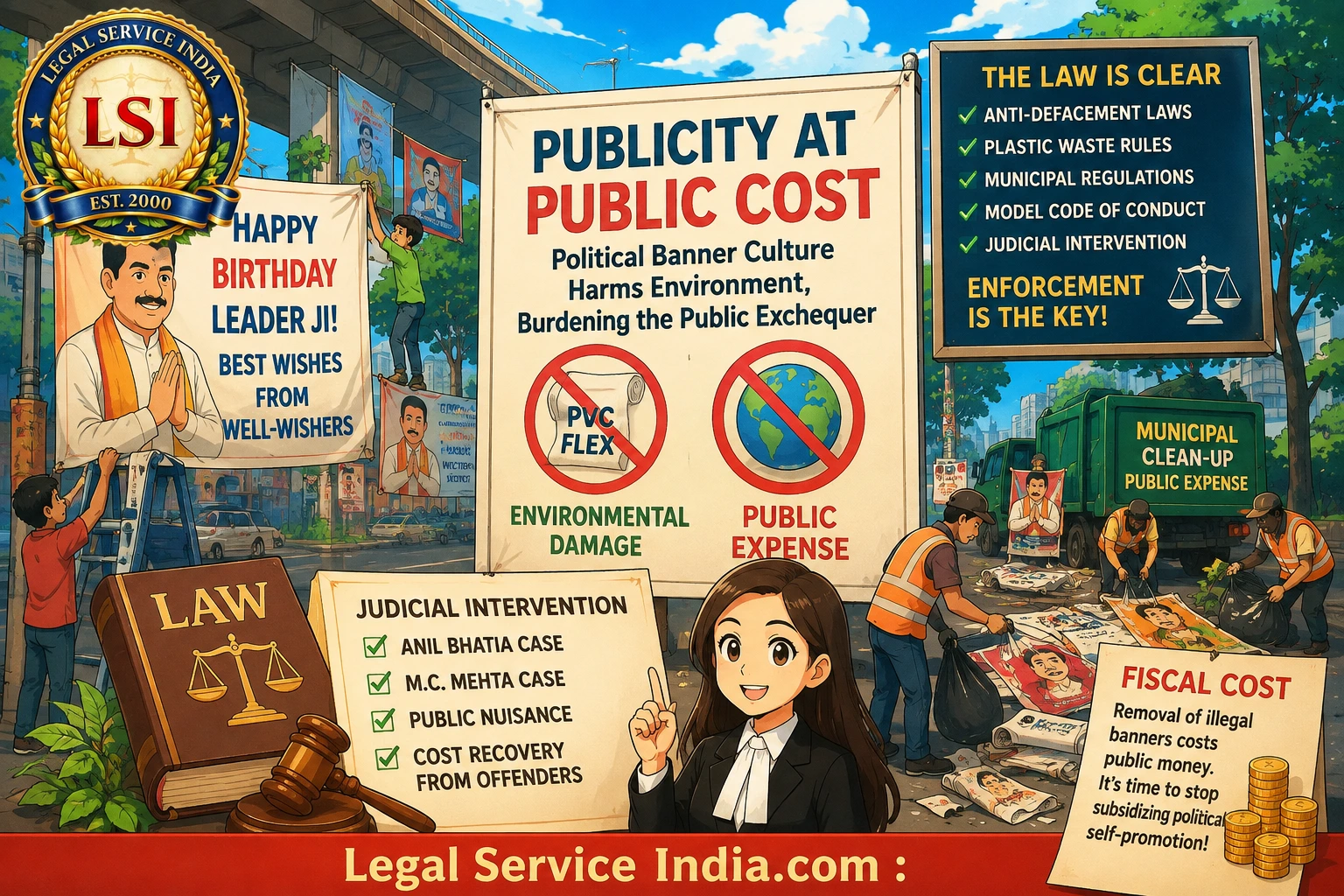
Publicity at Public Cost: The Environmental and Legal Implications of Political Banner Culture
Abstract
India’s streetscapes are frequently turned into canvases of political self-promotion, birthday greetings to leaders, felicitations of party workers and campaign messaging inscribed on flex and PVC banners. This practice, tolerated as a facet of participatory democracy, generates significant environmental costs through non-biodegradable waste and an unaccounted fiscal burden on municipal bodies tasked with removal. This article explores the legal regime that governs banner culture in India, including anti-defacement laws, plastic waste regulation, and judicial intervention, and argues that the problem is not the lack of law, but the lack of enforcement.
Introduction
In India, during election season, festivals and even regular local politics, streets, flyovers and public walls are covered with banners bearing the faces of politicians, greetings on behalf of “well-wishers” and congratulatory messages timed to a leader’s birthday or electoral victory. That’s banner culture, a form of political marketing that is at the same time a vernacular expression of loyalty and patronage, and a major drain on public money and ecological resources.
Although often dismissed as a minor civic inconvenience, its cumulative environmental footprint and the legal questions it raises about the misuse of public space merit sustained scholarly attention.
The Environmental Cost
Most of the political banners in India are made out of flex. Flex is a composite material composed mostly of polyvinyl chloride (PVC). PVC does not break down biologically and when burned (as dumped banners often are) releases dioxins and furans, toxins that can cause serious health problems and environmental damage. Acknowledging this, the Ministry of Environment, Forest and Climate Change has progressively banned such materials through the Plastic Waste Management Rules, 2016 and subsequent amendments. The 2021 amendment specifically bans plastic or PVC banners below 100 microns in thickness with effect from July 2022. Several states like Andhra Pradesh, Tamil Nadu and Himachal Pradesh have gone further and banned flex banners outright under the Environment (Protection) Act, 1986.
Political Banners and Enforcement
In practice, however, the major exception to the rule are political banners, especially those put up around election times or for the felicitations of leaders: they are generally temporary, poorly regulated at the time of their installation and seldom monitored for their subsequent disposal, leading to their accumulation as roadside litter or their disposal in landfills and waterways.
The Fiscal Cost to the Public Exchequer
Besides ecological damage, the other invisible but no less serious cost is the cost of removal of unauthorized banners by municipal corporations. Various Indian states have anti-defacement statutes, such as the Maharashtra Prevention of Defacement of Property Act, 1995 and the Delhi Prevention of Defacement of Property Act, 2007, that allow local authorities to wipe offending material off the face of the earth, or to remove it, and to recover the cost of removal from the offender.
But in practice enforcement is seldom on a scale to match the problem, especially when one considers the sheer volume of banners put up by political workers who often act without the knowledge or explicit sanction of the leaders they are meant to felicitate.
The cost of clean-up, largely borne by ratepayers through municipal budgets, is a subsidy from the public exchequer for what is in fact private political self-promotion.
The Legal Framework
The legal edifice that governs banner culture in India rests on three overlapping pillars.
Anti-Defacement Laws
Firstly, anti-defacement laws, the Prevention of Defacement of Property Acts (state-specific) and provisions like Sections 268 and 278 of the erstwhile Indian Penal Code (related to public nuisance), criminalise the unauthorised marking, writing or affixing of material on property visible to the public.
Municipal Corporation Laws
Second, municipal corporation laws require local bodies to license and regulate outdoor advertising, to which political material is in principle subject.
Model Code of Conduct
Third, the Model Code of Conduct enforced by the Election Commission of India during periods of election restricts the use of public spaces for campaign material, and mandates the removal of unauthorised hoardings within prescribed timelines.
However, this framework is operational only during notified election periods, and a regulatory vacuum remains for banner culture the rest of the year.
Judicial Intervention
In fact, Indian courts have repeatedly dismissed constitutional challenges to anti-defacement laws on the grounds of freedom of speech and expression under Article 19(1)(a).
Anil Bhatia v. Government of NCT of Delhi
In Anil Bhatia v. Government of NCT of Delhi, the Delhi High Court held that the unchecked erection of posters, banners and hoardings, even on private property, amounts to a public nuisance and an eyesore where it is visible to the public and that the requirement of prior permission is a reasonable restriction permissible under Article 19(2).
The court referred to the reasoning of the Supreme Court in the Noise Pollution case and in Novva Ads which already held that outdoor advertising, whether in public or private property, is subject to licensing when it affects public view.
M.C. Mehta v. Union of India
In M.C. Mehta v. Union of India, the Supreme Court identified four different types of defacement, namely:
- posters,
- banners,
- wall-writing and
- illegal hoardings or flexes.
This indicates the judicial recognition of banner culture as a separate regulatory problem and not an incidental one.
More recent interventions, such as the directions of the National Green Tribunal and the orders of the Delhi High Court regarding a campus election disputes, have reinforced the principle that the cost of removing unauthorised material can fairly be recovered from those responsible, and that failure to do so allows the practice to continue unchecked.
Recent Developments: The Tamil Nadu Precedent
A recent and significant departure from the enforcement of judicial and statutory law came from within party politics itself.
Tamilaga Vettri Kazhagam (TVK) leader and Tamil Nadu Chief Minister C. Joseph Vijay instructed party workers in May 2026 to stop displaying banners, posters, flex boards and giant cutouts in public places and said that action will be taken against the violators even if they are from the party itself.
The order followed years of interventions by the Madras High Court against illegal hoardings and increasing public complaints in Chennai over footpath obstruction, traffic hazards and flex boards falling onto vehicles and power lines during storms, hazards long associated with Tamil Nadu’s cutout-driven political culture.
Unlike statutory cost-recovery mechanisms, which depend upon municipal bodies to prosecute violators after the fact, this intervention sought to prevent installation altogether through the enforcement of discipline via the party’s own organizational hierarchy.
An earlier example of the rapidity with which banner removal can take place when there is institutional will was witnessed in the enforcement of the Model Code of Conduct in the 2026 Tamil Nadu Assembly election, when civic bodies in Chennai and other districts systematically removed banners, posters and wall advertisements as soon as the code came into effect in March 2026.
Conclusion
The legal tools to curb political banner culture exist in reasonably comprehensive form already:
- Anti-defacement statutes provide for penalty and cost recovery;
- Plastic waste rules restrict the material itself; and
- Courts have repeatedly affirmed that regulation of public visual space is a constitutionally permissible restriction on expression.
What is missing is consistent enforcement—especially the political will of local bodies to prosecute offenders from the same party structures that control municipal governance.
Unless cost-recovery provisions are routinely enforced and biodegradable alternatives are mandated, not just advised, the public will continue to subsidize, financially and environmentally, a form of publicity from which it derives no benefit.

