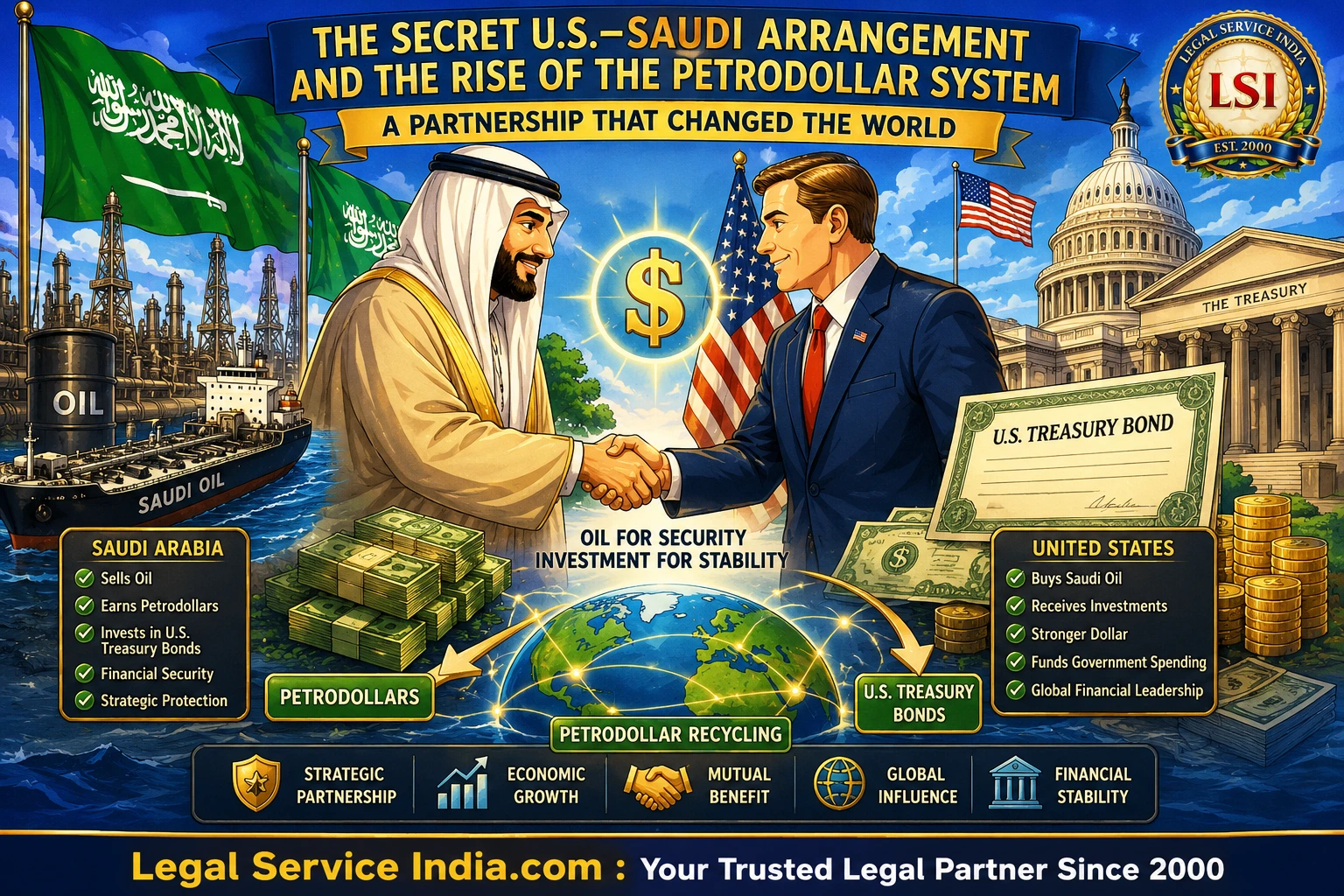
The Secret U.S.–Saudi Arrangement and the Rise of the Petrodollar System
By mid-1974, both the United States and Saudi Arabia faced challenges that, while very different, created an opportunity for a mutually beneficial partnership.
The United States needed a way to restore global confidence in the dollar after abandoning the gold standard. Saudi Arabia, meanwhile, had accumulated enormous oil revenues and required a secure, reliable destination for its growing financial reserves.
The agreement that gradually emerged between the two countries would become one of the most influential financial arrangements of the twentieth century. Although much of it remained hidden from public view for decades, its impact extended across global trade, finance, and geopolitics.
A Strategic Partnership Takes Shape
The framework negotiated during William Simon’s visit to Saudi Arabia was relatively straightforward, even if its long-term consequences were extraordinary.
Under the arrangement, the United States would continue purchasing Saudi oil while strengthening its military and security relationship with the kingdom. Washington would provide Saudi Arabia with defence assistance, advanced weaponry, and strategic protection.
In return, Saudi Arabia agreed to invest a substantial portion of its oil revenues in U.S. government securities, particularly U.S. Treasury bonds.
This arrangement benefited both nations.
Benefits for Saudi Arabia
- U.S. Treasury securities offered one of the safest investment opportunities in the world.
- They also provided one of the most liquid destinations for Saudi Arabia’s growing financial reserves.
Benefits for the United States
- Saudi investments helped finance federal spending.
- They reinforced international demand for the U.S. dollar.
Key Elements of the Arrangement
| United States | Saudi Arabia |
|---|---|
| Continued purchasing Saudi oil. | Invested a substantial portion of oil revenues in U.S. Treasury bonds. |
| Strengthened military and security cooperation. | Provided long-term financial support through investments. |
| Provided defence assistance, advanced weaponry, and strategic protection. | Helped reinforce international demand for the U.S. dollar. |
Petrodollar Recycling Process
Rather than allowing billions of petrodollars to remain idle, the money was effectively recycled into the American financial system.
This process later became widely known as petrodollar recycling.
The Kingdom’s Demand for Secrecy
Although negotiations progressed successfully, Saudi Arabia insisted on one important condition.
According to diplomatic records later uncovered in the U.S. National Archives, King Faisal bin Abdulaziz Al Saud required that the kingdom’s purchases of U.S. government debt remain strictly confidential.
The United States agreed.
To honour this request, the U.S. Treasury established an unusual mechanism that allowed Saudi Arabia to purchase Treasury securities outside the normal public auction process.
Ordinarily, foreign governments acquiring U.S. Treasury bonds participated in competitive auctions, and their holdings were eventually disclosed through official reporting.
Saudi Arabia, however, received special treatment.
- Its purchases were made through a mechanism known as “add-ons”.
- This allowed investments to be placed outside the standard auction process.
- As a result, the scale of Saudi holdings remained largely hidden from public scrutiny.
Four Decades of Confidentiality
The secrecy surrounding Saudi investments continued for more than forty years.
Unlike many other foreign governments, Saudi Arabia’s Treasury holdings were not reported separately. Instead, they were grouped under a broad category labelled “Oil Exporters”, alongside countries such as Kuwait and the United Arab Emirates.
As a result, neither financial markets nor the general public could accurately determine the extent of Saudi Arabia’s investments in U.S. government debt.
This secrecy remained intact until 2016, when Bloomberg News obtained information through a Freedom of Information Act (FOIA) request.
For the first time, the U.S. Treasury publicly disclosed Saudi Arabia’s holdings, revealing that the kingdom owned approximately US$117 billion in U.S. Treasury securities.
Some former U.S. officials suggested that the actual figure may have been considerably higher because additional investments could have been held through offshore financial centres and intermediary institutions.
Gerald Parsky, who had accompanied William Simon during the original negotiations, later remarked that he was surprised the secrecy had been maintained for so many years and believed it could have been lifted much earlier.
Summary of Saudi Treasury Secrecy
| Aspect | Details |
|---|---|
| Confidentiality Request | King Faisal requested complete secrecy for Saudi purchases of U.S. Treasury securities. |
| U.S. Response | The U.S. Treasury created a special “add-ons” mechanism outside normal auctions. |
| Reporting Method | Saudi holdings were grouped under “Oil Exporters” instead of being reported separately. |
| Public Disclosure | Holdings were officially disclosed in 2016 following a FOIA request. |
| Reported Holdings | Approximately US$117 billion in U.S. Treasury securities. |
Separating Historical Fact from Popular Myth
The petrodollar system has generated numerous myths and conspiracy theories over the years.
One of the most common claims is that, in 1974, the United States and Saudi Arabia signed a secret treaty requiring Saudi Arabia to sell all of its oil exclusively in U.S. dollars. According to this popular narrative, the agreement supposedly remained in force for fifty years before expiring in 2024.
Although widely repeated online, this version of events is not supported by the historical evidence.
The documented history is more nuanced—and arguably more interesting.
Common Myth vs Historical Evidence
| Popular Claim | Historical Record |
|---|---|
| A secret 1974 treaty required Saudi Arabia to sell all oil exclusively in U.S. dollars. | The historical evidence does not support this claim. |
| The agreement remained valid for fifty years and expired in 2024. | No documented evidence confirms such an agreement or expiry date. |
What the Historical Record Actually Shows
Long before 1974, international oil was already being priced predominantly in U.S. dollars.
This practice had developed naturally during the Bretton Woods era, when the dollar served as the world’s principal reserve currency.
A genuine agreement was signed on 8 June 1974, establishing the U.S.-Saudi Joint Commission on Economic Cooperation.
However, the published text of that agreement focused on:
- Economic collaboration
- Technological development
- Military cooperation
It did not contain any clause requiring Saudi Arabia to price all of its oil exclusively in U.S. dollars.
Historical evidence also shows that Saudi Arabia continued accepting other currencies for certain oil transactions after the agreement was signed.
For example, the kingdom continued to accept British pounds sterling for some oil sales before gradually shifting almost entirely toward dollar-based transactions later in 1974.
Key Historical Points
| Historical Event | What the Record Shows |
|---|---|
| Before 1974 | International oil was already priced predominantly in U.S. dollars. |
| 8 June 1974 Agreement | Created the U.S.-Saudi Joint Commission on Economic Cooperation. |
| Main Focus | Economic collaboration, technological development, and military cooperation. |
| Dollar Pricing Clause | No clause required Saudi Arabia to sell all oil exclusively in U.S. dollars. |
| Oil Transactions | Saudi Arabia continued accepting British pounds sterling for certain oil sales before later shifting almost entirely to dollar-based transactions. |
The Petrodollar Was Built Through Incentives, Not One Contract
Researchers who have examined archival records—including historians associated with Project Energy History—have noted that several developments occurred almost simultaneously:
- Saudi Arabia continued selling most of its oil in U.S. dollars.
- The kingdom increasingly invested its oil revenues in American financial assets.
- The United States expanded military cooperation and security commitments to Saudi Arabia.
- Bilateral economic relations deepened significantly.
These developments strongly suggest coordinated diplomacy and shared strategic interests.
However, there is no evidence of a single secret treaty that legally compelled Saudi Arabia to sell oil exclusively in dollars for fifty years.
Instead, the petrodollar system evolved gradually through a network of mutually reinforcing arrangements.
Key Factors Behind the Evolution of the Petrodollar System
These included:
- Security guarantees provided by the United States.
- Large-scale American arms sales.
- Saudi investment in U.S. Treasury securities.
- Continued economic cooperation.
- The existing international preference for conducting oil trade in U.S. dollars.
Together, these factors created powerful economic incentives that naturally reinforced the dollar’s dominant role in global energy markets.
Summary of the Petrodollar System’s Foundation
| Strategic Element | Contribution to the Petrodollar System |
|---|---|
| Oil Sales in U.S. Dollars | Strengthened global demand for the U.S. dollar. |
| Saudi Investment in U.S. Assets | Supported American financial markets and Treasury securities. |
| Military and Security Cooperation | Deepened long-term strategic ties between both nations. |
| Economic Cooperation | Expanded bilateral trade and financial integration. |
| Global Preference for Dollar-Based Oil Trade | Reinforced the dollar’s international reserve currency status. |
Why This Distinction Matters
Understanding the difference between documented history and popular myth is essential.
The simplified conspiracy narrative suggests that a single secret agreement created the entire petrodollar system.
The historical evidence points to something more sophisticated.
The system emerged through overlapping political, military, financial, and economic relationships that gradually strengthened one another over time.
Rather than being created by one dramatic treaty, the petrodollar became the product of numerous interconnected decisions that collectively reshaped the international monetary system.
Ironically, this documented version of events reveals a deeper reality about how global power often operates.
Major shifts in international finance rarely result from a single agreement. More often, they evolve through a series of strategic decisions, institutional arrangements, and mutually beneficial incentives that become increasingly difficult to reverse once they are firmly established.
Documented History vs. Popular Myth
| Popular Myth | Historical Evidence |
|---|---|
| A single secret treaty created the petrodollar system. | The system evolved through multiple political, economic, financial, and military arrangements. |
| One agreement permanently established dollar dominance. | Dollar dominance developed gradually through mutually reinforcing incentives. |
| The system was created instantly. | The system strengthened over time through interconnected strategic decisions. |
The “Exorbitant Privilege”
The consequences of this new system soon became apparent.
French policymakers had long criticised what they called America’s “exorbitant privilege”. The petrodollar arrangement reinforced that advantage on an unprecedented scale.
Because oil—the world’s most essential industrial commodity—was overwhelmingly traded in U.S. dollars, virtually every country that imported energy needed to maintain substantial dollar reserves.
Whether located in Africa, Asia, Europe, or Latin America, nations had to acquire dollars simply to purchase the fuel required to operate factories, transportation networks, power plants, and modern economies.
The dollar was no longer merely America’s national currency.
It had become the indispensable currency of global commerce.
This generated a permanent and structural demand for U.S. dollars that was largely independent of the relative performance of the American economy.
Why the Dollar Gained Global Demand
- Oil was primarily traded in U.S. dollars.
- Energy-importing countries needed large dollar reserves.
- Global trade increasingly relied on dollar-denominated transactions.
- The U.S. dollar became the dominant currency for international commerce.
Financing American Power
The petrodollar system also delivered a major financial advantage to the United States.
Since governments, central banks, and international investors continually needed dollar-denominated assets, demand for U.S. Treasury securities remained exceptionally strong.
This allowed the United States to borrow money more easily and at lower interest rates than almost any other country.
As a result, Washington could finance large budget deficits over extended periods without facing the immediate financing pressures that many other governments would encounter.
International investors continued purchasing Treasury securities, effectively funding American public spending while reinforcing the dollar’s global dominance.
In practical terms, the United States gained an extraordinary ability to finance military operations, social programmes, and overseas commitments because the rest of the world continued holding and investing in dollars.
The dollar’s central role in global oil trade had become one of the hidden foundations of American economic and geopolitical influence.
Financial Benefits of the Petrodollar System
| Benefit | Impact |
|---|---|
| Strong Demand for U.S. Treasury Securities | Enabled the United States to borrow at relatively low interest rates. |
| Global Dollar Reserves | Created continuous international demand for dollar-denominated assets. |
| Budget Financing | Allowed Washington to sustain large fiscal deficits over long periods. |
| Military and Overseas Commitments | Supported funding for defence, social programmes, and international engagements. |
| Global Economic Influence | Strengthened America’s financial and geopolitical position worldwide. |
Petrodollar Recycling, the Latin American Debt Crisis, and the Hidden Cost of Dollar Dominance
The petrodollar system did far more than strengthen the U.S. dollar. It also transformed the way international capital moved across the world.
While the United States gained an enduring financial advantage, the same system produced devastating consequences for many developing economies. The mechanism that helped sustain American economic influence also contributed to one of the worst debt crises of the twentieth century.
To understand why, it is necessary to follow the journey of the petrodollars after they left the oil-producing nations.
The Rise of Petrodollar Recycling
Following the 1973 oil crisis, Saudi Arabia and other Gulf oil exporters accumulated enormous dollar surpluses. Their domestic economies were simply too small to absorb the vast revenues generated by soaring oil prices.
These countries therefore deposited much of their wealth in major commercial banks based in New York and London.
Leading financial institutions, including Citibank and Chase Manhattan Bank, suddenly found themselves managing unprecedented volumes of deposits.
While these inflows strengthened the banking system, they also created a new challenge.
Banks make profits by lending money, not by allowing deposits to remain idle. With billions of dollars flowing into their balance sheets, they needed borrowers capable of absorbing these funds.
The developed economies of North America and Western Europe already had mature financial markets and comparatively limited demand for additional borrowing.
As a result, international banks increasingly turned their attention to the developing world.
Developing Nations Become Major Borrowers
Many developing countries were eager to borrow.
Throughout the 1970s, governments across Latin America, including Mexico, Brazil, Argentina, and Peru, sought large amounts of foreign capital to finance infrastructure projects, industrial development, and the rapidly rising cost of imported oil.
Western banks readily supplied the funds.
This lending process became known as petrodollar recycling.
How the Petrodollar Recycling Cycle Worked
The cycle operated in a relatively simple manner:
- Oil-importing nations paid billions of dollars for expensive crude oil.
- Those dollars accumulated in the treasuries of Gulf oil exporters.
- Gulf states deposited their surplus funds in major Western commercial banks.
- The banks then lent those dollars to developing countries.
Petrodollar Recycling Process Summary
| Stage | What Happened |
|---|---|
| 1 | Oil-importing nations paid billions of dollars for crude oil. |
| 2 | Oil-exporting Gulf countries accumulated large dollar surpluses. |
| 3 | Surplus dollars were deposited in major commercial banks in New York and London. |
| 4 | Western banks recycled these funds by lending them to developing countries. |
Initial Benefits for All Parties
Initially, the arrangement appeared beneficial for all parties involved.
- Oil exporters earned substantial returns on their surplus wealth.
- Commercial banks generated significant lending profits.
- Developing countries gained access to the capital needed to support economic growth.
At first glance, it seemed like an efficient redistribution of global financial resources.
Why the Loans Appeared Safe
During the 1970s, international interest rates remained relatively low.
Most loans extended to developing countries carried floating interest rates, meaning the borrowing cost would rise or fall according to prevailing global market conditions.
At the time, this structure attracted little concern.
Interest rates had remained comparatively stable for years, leading many borrowers to assume they would continue doing so.
Consequently, governments across Latin America borrowed heavily.
Between 1975 and 1983, the region’s external debt increased dramatically—from approximately US$75 billion to more than US$315 billion.
Key Reasons Borrowing Was Considered Safe
- International interest rates remained relatively low.
- Floating interest rates had been stable for several years.
- Borrowers expected interest rates to remain stable.
- Latin American governments expanded external borrowing.
- International bankers believed sovereign governments carried minimal credit risk.
Latin America’s Rising External Debt
| Period | External Debt | Observation |
|---|---|---|
| 1975 | Approximately US$75 billion | Beginning of rapid borrowing |
| 1983 | More than US$315 billion | Sharp increase in external debt |
Many international bankers believed sovereign governments presented little credit risk.
A widely quoted phrase in financial circles captured this confidence:
“Countries do not go bankrupt.”
That assumption would soon prove dangerously mistaken.
Paul Volcker Returns
One individual would dramatically alter the course of the global economy.
Earlier in this story, Paul Volcker appeared as one of the advisers present when President Nixon closed the gold window in 1971.
By the end of the decade, Volcker had become chairman of the U.S. Federal Reserve.
He inherited an American economy suffering from severe inflation.
Years of expansionary monetary policy, combined with the oil shocks of the 1970s, had pushed inflation to levels that threatened long-term economic stability.
Volcker concluded that inflation had to be defeated, regardless of the short-term economic pain.
Economic Challenges Facing the United States
- Severe inflation.
- Years of expansionary monetary policy.
- Oil shocks during the 1970s.
- Growing risks to long-term economic stability.
The Volcker Shock
To restore price stability, the Federal Reserve embarked on one of the most aggressive monetary tightening campaigns in modern history.
Interest rates were increased repeatedly until the Federal Funds Rate approached 20 per cent during the early 1980s.
The policy succeeded in bringing inflation under control.
However, its consequences extended far beyond the United States.
Because so much international borrowing had been denominated in U.S. dollars, higher American interest rates immediately increased borrowing costs for countries across the developing world.
This marked the beginning of what economists often refer to as the Volcker Shock.
Impact of the Volcker Shock
| Policy Action | Immediate Effect | Global Impact |
|---|---|---|
| Sharp increase in U.S. interest rates | Higher borrowing costs | Developing countries faced rising debt-servicing expenses |
| The federal funds rate approached 20% | Inflation declined | Global financial pressures intensified |
| Monetary tightening | Price stability improved | Beginning of the Volcker Shock |
The Debt Trap Closes
For many Latin American countries, the impact was devastating.
Most of their international loans had two defining characteristics:
- They were denominated in U.S. dollars.
- They carried floating interest rates.
As the Federal Reserve sharply increased interest rates, debt servicing costs rose almost overnight.
Governments suddenly found themselves paying dramatically higher interest on loans they had considered affordable only a few years earlier.
The situation became even worse because these countries could not simply create additional U.S. dollars to meet their obligations.
Unlike the United States, they had no control over the currency in which their debts were denominated.
A Triple Economic Blow
The crisis intensified through several interconnected developments.
First, higher U.S. interest rates substantially increased debt repayments.
Second, the aggressive tightening of American monetary policy strengthened the U.S. dollar against many other currencies.
As the dollar appreciated, repaying dollar-denominated debt became even more expensive in local currency terms.
Third, the global recession triggered by high interest rates reduced international demand for many of the commodities exported by developing countries.
Commodity prices weakened, reducing export earnings precisely when governments needed more dollars to service their debts.
Many analysts have described this combination as a quadruple shock:
- Rising interest payments.
- A stronger U.S. dollar.
- Falling export revenues.
- Global economic recession.
Summary of the Quadruple Shock
| Economic Shock | Impact on Developing Countries |
|---|---|
| Rising interest payments | Debt servicing costs increased significantly. |
| Stronger U.S. dollar | Dollar-denominated debt became more expensive in local currency. |
| Falling export revenues | Commodity price declines reduced foreign exchange earnings. |
| Global economic recession | Lower global demand weakened economic growth. |
Together, these forces overwhelmed many developing economies.
Mexico Triggers a Global Financial Crisis
The breaking point arrived in August 1982.
Mexico’s Finance Minister, Jesús Silva Herzog, informed the U.S. Treasury, the Federal Reserve, and the International Monetary Fund (IMF) that Mexico could no longer meet its debt obligations.
At that time, the country’s external debt had reached approximately US$80 billion.
The announcement sent shockwaves through the international financial system.
Investors quickly realised that Mexico was unlikely to be the only country facing insolvency.
Their fears proved justified.
Soon afterward, Brazil, Argentina, Peru, and numerous other Latin American nations also encountered severe debt crises.
What had initially appeared to be a successful system of petrodollar recycling had evolved into a continent-wide financial disaster.
Major Countries Affected
| Country | Key Development |
|---|---|
| Mexico | Announced inability to meet debt obligations in August 1982. |
| Brazil | Encountered a severe debt crisis soon afterward. |
| Argentina | Faced major debt repayment difficulties. |
| Peru | Experienced a serious external debt crisis. |
| Other Latin American nations | Also suffered widespread financial distress. |
Latin America’s “Lost Decade”
The economic consequences were severe.
Throughout much of the 1980s, Latin America experienced what economists now describe as the Lost Decade.
Major Economic Consequences
- Economic growth stagnated.
- Real incomes declined.
- Unemployment rose sharply.
In many urban areas, workers’ real wages fell by 20 to 40 per cent over the course of the decade.
Governments diverted scarce public resources away from schools, hospitals, and infrastructure in order to service foreign debt.
Between 1982 and 1985 alone, Latin American countries repaid more than US$180 billion to international creditors.
At the same time, millions of people were pushed into extreme poverty as economic conditions deteriorated.
Key Economic Statistics
| Indicator | Figure |
|---|---|
| Mexico’s external debt (1982) | Approximately US$80 billion |
| Workers’ real wage decline | 20 to 40 percent |
| Debt repaid by Latin American countries (1982–1985) | More than US$180 billion |
IMF Intervention and the Washington Consensus
Countries seeking emergency financial assistance found that rescue packages came with significant conditions.
The International Monetary Fund (IMF) required borrowing governments to implement extensive economic reforms before receiving support.
These programmes generally included:
- Reductions in public spending.
- Fiscal austerity measures.
- Privatisation of state-owned enterprises.
- Trade liberalisation.
- Financial market reforms.
- Greater openness to foreign investment.
Collectively, these policy prescriptions later became known as the Washington Consensus.
Supporters and Critics of the Washington Consensus
Supporters argued that such reforms were necessary to restore economic stability and investor confidence.
Critics, however, contended that they imposed severe social costs and transferred much of the adjustment burden onto ordinary citizens rather than international lenders.
The debate over the long-term impact of these policies continues among economists and policymakers today.
Understanding the Real “Trap”
Viewed as a whole, the sequence of events reveals the deeper significance of the petrodollar system.
- The oil crisis generated enormous dollar surpluses.
- Those surpluses flowed into Western commercial banks.
- The banks recycled the funds as dollar-denominated loans to developing countries.
- When the United States later increased interest rates to solve its own inflation problem, the financial burden on those borrowers escalated dramatically.
- The affected countries had virtually no influence over the policies that determined their borrowing costs.
- Nor could they create the dollars needed to repay their debts.
Why Developing Countries Faced Structural Dependence
In that sense, the “trap” extended far beyond America’s dependence on the dollar.
Many developing nations became structurally dependent on a foreign currency and on monetary decisions made by institutions over which they had little or no control.
| Key Factor | Impact on Developing Countries |
|---|---|
| Dollar-denominated borrowing | Created dependence on a currency they could not issue. |
| Higher U.S. interest rates | Increased debt servicing costs significantly. |
| Limited policy influence | Borrowing nations had little control over monetary decisions affecting their debt. |
| Dollar shortages | Made debt repayment increasingly difficult. |
A Pattern That Repeated Itself
The Latin American debt crisis was not an isolated event.
The same underlying mechanism reappeared repeatedly over subsequent decades.
Emerging economies continued borrowing heavily in U.S. dollars while remaining exposed to changes in American monetary policy.
Variations of this pattern contributed to later crises, including the Mexican peso crisis of the mid-1990s and the Asian financial crisis of 1997.
Although each episode had its own unique circumstances, they shared a common vulnerability.
Common Vulnerability Across Financial Crises
- Countries borrowed in a currency they could not issue.
- They remained exposed to financial conditions determined largely by the United States Federal Reserve.
- Changes in U.S. monetary policy directly affected borrowing costs.
- External financial shocks became difficult to manage.
The experience demonstrated that while the petrodollar system strengthened the global position of the U.S. dollar, it also created systemic risks for nations operating on the periphery of the international financial system.
Winners, Losers, the Petrodollar Debate, and the Rise of Financial Power
By the 1980s, the petrodollar system had become deeply embedded in the global economy. What began as a pragmatic response to the collapse of the gold standard had evolved into a financial structure that influenced international trade, government borrowing, banking, and geopolitics.
The system generated immense benefits for some countries and institutions while imposing significant costs on others. It also gave rise to one of the most controversial debates in modern international relations: did the United States use military power to preserve the dollar’s dominance?
To answer that question responsibly, it is essential to distinguish between verifiable historical evidence and speculation.
Who Benefited from the Petrodollar System?
The beneficiaries of the petrodollar system are relatively easy to identify.
| Beneficiary | Primary Advantage |
|---|---|
| United States Government | Strong global demand for U.S. dollars and Treasury securities |
| Wall Street and International Banks | Profits from recycling petrodollars and global finance |
| Defence Industries | Large-scale arms sales to Gulf nations |
| Gulf Monarchies | Security guarantees, investments, and financial stability |
United States Government
Perhaps the greatest advantage accrued to the United States itself.
Because countries around the world needed U.S. dollars to purchase oil and conduct international trade, there was constant global demand for dollar-denominated assets, particularly U.S. Treasury securities.
This allowed Washington to borrow vast sums at relatively low interest rates.
Unlike most countries, which must carefully balance government borrowing against investor confidence, the United States enjoyed an extraordinary financial privilege. Investors, central banks, and sovereign wealth funds continued purchasing Treasury bonds because they required dollar assets regardless of short-term fluctuations in the American economy.
This enabled successive U.S. governments to finance military operations, infrastructure, social programmes, and budget deficits on a scale that would have been far more difficult for most other nations.
French policymakers had earlier described this unique position as America’s “exorbitant privilege”.
The petrodollar system reinforced that privilege for decades.
Wall Street and International Banks
Major financial institutions also benefited enormously.
Commercial banks in New York and London became central intermediaries in recycling petrodollar revenues into global financial markets.
These institutions earned substantial profits by managing Gulf state investments, arranging sovereign loans, underwriting debt, and facilitating international capital flows.
The movement of petrodollars generated business opportunities across the following:
- Investment banking
- Foreign exchange markets
- Asset management
- International finance
In many respects, the expansion of modern global banking was closely linked to the rise of the petrodollar system.
Defence Industries
American defence manufacturers emerged as another significant beneficiary.
The strategic partnership between Washington and Gulf monarchies included large-scale arms sales.
Military aircraft, missile defence systems, naval equipment, surveillance technology, and other advanced weaponry became central elements of U.S.–Saudi security cooperation.
These defence contracts generated tens of billions of dollars while further strengthening political and military ties between the two countries.
Gulf Monarchies
Saudi Arabia and several neighbouring Gulf states also gained considerable advantages.
Their governments received:
- Strong American security guarantees
- Access to sophisticated military technology
- Secure investment opportunities for growing financial reserves
Investing heavily in U.S. financial markets also helped preserve the value and liquidity of their oil revenues.
Some analysts, however, argue that this close financial integration gradually aligned Gulf strategic interests more closely with American foreign policy, creating a long-term relationship of mutual dependence.
Who Bore the Costs?
While governments, financial institutions, and investors often prospered, the burden of adjustment frequently fell upon ordinary citizens in developing countries.
The debt crises of the 1980s left lasting economic scars across Latin America and other regions.
Millions experienced:
- Declining living standards
- Rising unemployment
- Reduced public services
- Prolonged periods of economic stagnation
In many countries, the costs of servicing foreign debt limited government spending on the following:
- Healthcare
- Education
- Infrastructure
- Poverty reduction
The economic consequences were often felt for an entire generation.
Some economists also argue that persistent expansion of the U.S. money supply—made possible in part by sustained global demand for dollars—has gradually reduced the currency’s purchasing power over time.
Measured against gold, the dollar has lost a substantial portion of its value since the United States abandoned the gold standard in 1971.
The Most Controversial Question: The “Petrodollar War” Theory
No discussion of the petrodollar system is complete without addressing one of its most disputed aspects.
A popular theory suggests that whenever an oil-producing country attempts to sell its oil in a currency other than the U.S. dollar, it inevitably becomes a target of American military or political intervention.
Supporters of this argument often point to several historical events that appear, at least superficially, to follow a similar pattern.
However, appearances alone do not establish causation.
The evidence deserves careful examination.
Iraq and the Euro
One frequently cited example concerns Iraq.
In 2000, Iraqi President Saddam Hussein announced that Iraq would price its oil exports under the United Nations Oil-for-Food Programme in euros rather than U.S. dollars.
Three years later, in 2003, the United States led a coalition that invaded Iraq and removed Saddam Hussein from power.
Following the invasion, Iraqi oil transactions returned to being largely denominated in U.S. dollars.
These events are historical facts.
What remains disputed is whether Iraq’s decision to adopt the euro played any meaningful role in the decision to invade.
Most historians argue that multiple factors influenced the Bush administration’s policy, including:
- The belief—later shown to be incorrect—that Iraq possessed weapons of mass destruction.
- Iraq’s repeated violations of United Nations resolutions.
- Concerns regarding regional security.
- The broader post-9/11 strategy of regime change.
Key Factors Cited by Historians in the Iraq Invasion
| Factor | Description |
|---|---|
| Weapons of Mass Destruction | The belief—later shown to be incorrect—that Iraq possessed weapons of mass destruction. |
| United Nations Resolutions | Iraq’s repeated violations of United Nations resolutions. |
| Regional Security | Concerns regarding regional security. |
| Post-9/11 Strategy | The broader post-9/11 strategy of regime change. |
While Iraq’s shift to euro pricing may have been viewed unfavourably in Washington, there is no conclusive historical evidence establishing it as the principal cause of the invasion.
At most, it may have been one consideration among many.
Libya and the Gold Dinar Proposal
A similar debate surrounds Libya.
Libyan leader Muammar Gaddafi promoted the idea of introducing a gold-backed African currency, often referred to as the gold dinar, which could eventually facilitate trade—including oil transactions—across Africa.
In 2011, NATO intervened in Libya’s civil war, and Gaddafi was ultimately overthrown and killed.
Supporters of the petrodollar war theory frequently cite these events as further evidence that challenges to dollar dominance invite military intervention.
Again, however, the available evidence is far from definitive.
Most historical research identifies several other factors behind NATO’s intervention, including:
- The Libyan civil war.
- Humanitarian concerns raised by the international community.
- The political leadership of France and other NATO members.
- United Nations Security Council authorisation for civilian protection.
Key Factors Cited by Historians in the Libya Intervention
| Factor | Description |
|---|---|
| Libyan Civil War | The Libyan civil war. |
| Humanitarian Concerns | Humanitarian concerns raised by the international community. |
| Political Leadership | The political leadership of France and other NATO members. |
| United Nations Security Council Authorisation | United Nations Security Council authorisation for civilian protection. |
Historical Assessment of the Petrodollar War Theory
Moreover, historians note that Libya had never transitioned significant oil exports away from dollar-based pricing before the intervention.
Consequently, while Gaddafi’s monetary proposals are historically documented, there is insufficient evidence to conclude that they directly triggered military action.
Iran and Venezuela
Other countries, including Iran and Venezuela, have also sought to reduce their reliance on the U.S. dollar in international trade.
Both have faced extensive American economic sanctions.
This has further fuelled arguments that the United States seeks to preserve dollar dominance through political and economic pressure.
There is no dispute that sanctions have been imposed.
The more difficult question is whether efforts to reduce dollar usage were the principal reason for those sanctions.
Most scholars conclude that sanctions have generally reflected a combination of geopolitical, security, nuclear proliferation, and foreign policy considerations rather than currency issues alone.
Separating Evidence from Speculation
The available historical evidence supports several important conclusions.
It is well documented that:
- Saddam Hussein switched Iraq’s oil sales under the Oil-for-Food Programme from dollars to euros.
- Muammar Gaddafi advocated a gold-backed African currency.
- Iran and Venezuela have promoted alternatives to dollar-denominated trade.
These events are matters of historical record.
Historical Events and Their Significance
| Country / Leader | Monetary Initiative | Historical Status |
|---|---|---|
| Iraq (Saddam Hussein) | Switched Oil-for-Food Programme oil sales from U.S. dollars to euros. | Well documented. |
| Libya (Muammar Gaddafi) | Advocated a gold-backed African currency. | Well documented. |
| Iran | Promoted alternatives to dollar-denominated trade. | Well documented. |
| Venezuela | Promoted alternatives to dollar-denominated trade. | Well documented. |
What has not been conclusively established is that these monetary initiatives directly caused subsequent military interventions or sanctions.
Most professional historians and economists caution against reducing complex geopolitical decisions to a single explanation.
Wars, particularly those involving major powers, are rarely driven by one factor alone.
Instead, they typically result from multiple political, military, economic, diplomatic, and strategic considerations.
Balanced Assessment
Accordingly, the most balanced assessment is that while currency issues may have formed part of broader strategic calculations, there is insufficient evidence to conclude that protecting the petrodollar was the decisive motive behind these conflicts.
| Claim | Current Historical Assessment |
|---|---|
| Countries attempted to reduce reliance on the U.S. dollar. | Supported by historical evidence. |
| Military interventions or sanctions were directly caused by those monetary initiatives. | Not conclusively established. |
| Geopolitical decisions involve multiple factors. | Widely accepted by historians and economists. |
The Dollar’s Most Powerful Weapon: Financial Sanctions
Although the evidence for the so-called “petrodollar war” theory remains contested, there is one aspect of dollar dominance that is firmly established.
The United States possesses extraordinary influence over the international financial system.
Because so much global trade, banking, and cross-border finance continues to operate through dollar-denominated payment networks and American financial institutions, Washington can impose sanctions with remarkable effectiveness.
Countries, banks, companies, and individuals cut off from the U.S. financial system often find themselves excluded from a large portion of global commerce.
How Financial Sanctions Operate
Access to dollar clearing, international banking relationships, foreign exchange markets, and overseas reserves can be restricted or frozen.
Unlike military intervention, these measures operate through financial infrastructure rather than armed force.
| Financial Measure | Potential Impact |
|---|---|
| Restriction of dollar clearing | Limits international financial transactions. |
| Loss of banking relationships | Reduces access to global banking services. |
| Restrictions on foreign exchange markets | Impairs international trade and currency conversion. |
| Freezing of overseas reserves | Limits access to national financial assets. |
Over the past two decades, the United States has exercised this authority against countries including Iran, Russia, and Venezuela, demonstrating how financial influence has become one of its most significant instruments of foreign policy.
For many governments, these developments have highlighted an uncomfortable reality.
Dependence on the dollar creates not only economic benefits but also strategic vulnerabilities.
That recognition has increasingly encouraged countries to explore alternatives to the existing international monetary order.
Key Takeaways
- Iran and Venezuela have sought alternatives to dollar-denominated trade.
- Historical evidence confirms several monetary initiatives by Iraq, Libya, Iran, and Venezuela.
- No conclusive evidence establishes that these initiatives directly caused military interventions or sanctions.
- Most experts view geopolitical conflicts as the result of multiple strategic, political, economic, and security factors.
- The United States continues to exercise significant global influence through financial sanctions and the international role of the U.S. dollar.
Is the Petrodollar Era Coming to an End? De-Dollarisation, China, and the Future of the Global Financial System
After dominating international finance for nearly half a century, the petrodollar system is facing its most significant challenge since its emergence in the 1970s.
In recent years, discussions about “de-dollarisation” have moved from academic circles into mainstream economic and geopolitical debate. Governments, central banks, and financial institutions are increasingly asking whether the world will continue relying on the U.S. dollar as its primary reserve and trading currency—or whether a more diversified monetary system is gradually taking shape.
Before answering that question, it is important to separate fact from fiction.
The Myth of the “Expired” 2024 Petrodollar Agreement
In June 2024, social media and several financial websites were flooded with claims that a 50-year petrodollar agreement between the United States and Saudi Arabia had expired and that Saudi Arabia had refused to renew it.
Many commentators portrayed this as the beginning of the end for the U.S. dollar.
However, this claim was incorrect.
As discussed earlier, historical evidence does not support the existence of a single 50-year treaty requiring Saudi Arabia to sell oil exclusively in U.S. dollars.
The 1974 U.S.–Saudi Joint Commission on Economic Cooperation focused on economic and security cooperation. It did not contain any provision mandating exclusive dollar pricing for Saudi oil exports, nor was there a 50-year contract scheduled to expire in 2024.
Consequently, there was no agreement whose expiry could automatically dismantle the petrodollar system.
The viral narrative was based on a misunderstanding of history rather than documented facts.
Key Facts About the 2024 Petrodollar Claim
| Claim | Fact |
|---|---|
| A 50-year petrodollar agreement expired in 2024. | No documented 50-year treaty requiring Saudi Arabia to sell oil only in U.S. dollars existed. |
| Saudi Arabia refused to renew the agreement. | There was no agreement requiring renewal in 2024. |
| The expiry ended the petrodollar system. | No expiry occurred that could automatically dismantle the petrodollar system. |
The Underlying Trend Is Real
Although the viral story was inaccurate, it should not obscure an important reality.
A genuine long-term shift is taking place within the international monetary system.
The change is gradual rather than dramatic, but the evidence is increasingly difficult to ignore.
The U.S. dollar remains the world’s dominant reserve currency, yet its relative share of global reserves has been slowly declining for more than two decades.
According to International Monetary Fund (IMF) data, the dollar accounted for approximately 72 per cent of global foreign exchange reserves in 2001.
Today, that figure has fallen to below 57 per cent, representing its lowest share in roughly thirty years.
This does not indicate that the dollar is collapsing.
It still remains, by a considerable margin, the world’s most important international currency.
The U.S. dollar continues to appear on one side of nearly 90 per cent of all foreign exchange transactions, while approximately 80 per cent of global oil trade is still settled in dollars.
Nevertheless, the long-term trend points toward gradual diversification rather than increasing concentration.
Key Statistics on the U.S. Dollar
| Indicator | Figure |
|---|---|
| Share of global foreign exchange reserves (2001) | Approximately 72% |
| Current share of global foreign exchange reserves | Below 57% |
| Share of global foreign exchange transactions involving the U.S. dollar | Nearly 90% |
| Approximate share of global oil trade settled in US dollars | Around 80% |
Main Takeaways
- The viral claim about a 2024 petrodollar agreement expiry was historically inaccurate.
- No documented 50-year treaty required Saudi Arabia to sell oil exclusively in U.S. dollars.
- The U.S. dollar remains the world’s leading reserve and trading currency.
- The dollar’s share of global reserves has gradually declined over the past two decades.
- The broader trend indicates increasing diversification in the international monetary system rather than a sudden collapse of the dollar.
Why Are Countries Seeking Alternatives?
Several structural developments are encouraging governments to reduce their dependence on the dollar.
Key Drivers Behind the Shift Away from the Dollar
- The Growing Use of Financial Sanctions
- China’s Expanding Financial Influence
- Central Banks Are Buying More Gold
- Saudi Arabia’s Changing Strategic Position
1. The Growing Use of Financial Sanctions
One major factor is the increasing use of the dollar as a foreign policy instrument.
When the United States and its allies imposed extensive financial sanctions on Russia following its invasion of Ukraine, Russian foreign exchange reserves held abroad were frozen, and access to parts of the international financial system was severely restricted.
The episode prompted many governments to reassess their own financial security.
If foreign exchange reserves held in dollars can be frozen during geopolitical disputes, then complete reliance on dollar-denominated assets may expose countries to strategic risks.
As a result, several central banks have begun exploring ways to diversify their reserve portfolios.
Key Takeaways
- Financial sanctions have highlighted strategic risks associated with excessive dependence on the U.S. dollar.
- Countries are reassessing the security of their foreign exchange reserves.
- Many central banks are diversifying reserve portfolios.
2. China’s Expanding Financial Influence
Another important driver is China.
As the world’s largest importer of crude oil, China has long viewed its dependence on the U.S. dollar as a strategic vulnerability.
To reduce that dependence, Beijing has pursued several initiatives, including:
- Expanding the use of the Chinese yuan (renminbi) in international trade.
- Establishing alternative cross-border payment systems.
- Launching yuan-denominated oil futures.
- Negotiating bilateral trade agreements using local currencies instead of the U.S. dollar.
These developments have led analysts to increasingly discuss the possibility of a “petroyuan”, although the concept remains in its early stages.
Despite this progress, the yuan still faces significant structural limitations.
China maintains strict capital controls that restrict the free movement of money across its borders.
Until the yuan becomes fully convertible and international investors enjoy unrestricted access to Chinese financial markets, it is unlikely to replace the dollar as the world’s principal reserve currency.
Summary of China’s Initiatives
| Initiative | Purpose |
|---|---|
| Expanding yuan use in international trade | Reduce dependence on the US dollar |
| Alternative cross-border payment systems | Provide payment channels outside traditional systems |
| Yuan-denominated oil futures | Increase the international role of the yuan |
| Bilateral trade in local currencies | Reduce reliance on dollar-based settlements |
3. Central Banks Are Buying More Gold
Another notable trend is the renewed importance of gold.
Over the past several years, central banks have purchased more than one thousand tonnes of gold annually, representing one of the strongest periods of official gold accumulation in decades.
This reflects a broader effort to diversify reserve assets away from excessive dependence on paper currencies.
For the first time in many years, several central banks have increased their gold holdings more rapidly than their purchases of U.S. Treasury securities.
While gold cannot replace the dollar as a transaction currency, it continues to serve as an important reserve asset during periods of geopolitical uncertainty.
Why Gold Remains Important
- Supports reserve diversification.
- Acts as a store of value during geopolitical uncertainty.
- Reduces excessive dependence on paper currencies.
- Continues to play an important role in central bank reserves.
Saudi Arabia’s Changing Strategic Position
Perhaps the most symbolic development involves Saudi Arabia itself.
The kingdom that played a central role in establishing the petrodollar system has gradually diversified its international relationships.
China has become Saudi Arabia’s largest oil customer.
The kingdom has also strengthened economic ties with emerging economies and expressed openness to accepting currencies other than the U.S. dollar for certain international transactions.
At the same time, Saudi Arabia has deepened its engagement with the BRICS grouping and other multilateral initiatives seeking greater diversity in global financial arrangements.
These developments reflect changing geopolitical realities.
In 1974, the United States relied heavily on imported Saudi oil.
Today, following the American shale revolution, the United States has become one of the world’s largest oil producers and is significantly less dependent on Saudi crude than it was five decades ago.
The strategic circumstances that originally brought Washington and Riyadh together have evolved considerably.
How Saudi Arabia’s Position Has Changed
| Earlier Situation | Current Situation |
|---|---|
| Central role in establishing the petrodollar system. | Diversifying international relationships. |
| Strong dependence on U.S.-Saudi strategic partnership. | Stronger engagement with China, BRICS, and emerging economies. |
| The United States is heavily dependent on Saudi oil imports. | The United States is one of the world’s largest oil producers after the shale revolution. |
| The dollar dominated oil transactions. | Greater openness to accepting currencies other than the U.S. dollar for certain international transactions. |
Does This Mean the Petrodollar Is Finished?
Despite growing discussions about de-dollarisation, the available evidence suggests that the answer is no.
The U.S. dollar retains several advantages that are extremely difficult for any competing currency to replicate.
Key Advantages of the U.S. Dollar
These include:
- Deep and highly liquid financial markets.
- Strong legal and regulatory institutions.
- A vast supply of safe government securities.
- Well-established global banking infrastructure.
- Decades of international trust and familiarity.
- Network effects created by widespread worldwide use.
Why the Dollar Remains Dominant
These advantages reinforce one another.
Businesses continue using dollars because suppliers accept them.
Banks continue holding dollars because customers demand them.
Governments continue maintaining dollar reserves because international trade remains heavily dollar-based.
Replacing such a deeply entrenched system would require not only an alternative currency but also an equally comprehensive financial infrastructure.
At present, no competing currency fully satisfies those conditions.
| Factor | Why It Matters |
|---|---|
| Financial Markets | Provide deep liquidity for global transactions. |
| Legal Institutions | Promote investor confidence and stability. |
| Government Securities | Offer safe assets for central banks and investors. |
| Banking Infrastructure | Supports international payments efficiently. |
| Global Trust | Encourages continued worldwide acceptance. |
| Network Effects | Increase adoption because others already use the dollar. |
A Multipolar Monetary Future
Most economists therefore anticipate gradual evolution rather than sudden collapse.
Instead of one dominant reserve currency being replaced overnight, the international monetary system is likely to become increasingly multipolar.
What a Multipolar System Could Look Like
In such a system:
- The U.S. dollar would remain the leading reserve currency.
- The euro would continue serving as an important international currency.
- The Chinese yuan would play a growing regional and global role.
- Gold would regain greater significance as a reserve asset.
- Bilateral trade settlements in local currencies would become more common.
| Reserve Asset | Expected Role |
|---|---|
| U.S. Dollar | Leading global reserve currency. |
| Euro | Major international trading and reserve currency. |
| Chinese Yuan | Growing regional and international influence. |
| Gold | Increasing importance as a reserve asset. |
| Local Currencies | Greater use in bilateral trade settlements. |
Rather than disappearing, the dollar’s dominance may gradually become less absolute.
Its “exorbitant privilege” may diminish over time without being completely eliminated.
Conclusion
The story of the petrodollar is ultimately about far more than oil.
It illustrates how economic necessity, geopolitical strategy, financial innovation, and international diplomacy combined to reshape the modern global order.
Following the collapse of the Bretton Woods system in 1971, the United States faced the possibility of losing confidence in its currency.
Instead, through a combination of strategic diplomacy, security partnerships, and the growing centrality of oil in international commerce, the dollar became more influential than ever before.
For decades, this arrangement enabled the United States to finance persistent budget deficits, support a global military presence, and exercise extraordinary influence through international financial markets and sanctions.
At the same time, the system also exposed many developing countries to recurring debt crises and made much of the world dependent on monetary decisions made in Washington.
Today, that financial architecture is slowly evolving.
Countries are diversifying their reserves, exploring alternative payment systems, increasing their gold holdings, and expanding trade in local currencies.
None of these developments signals the immediate collapse of the dollar, but together they suggest that the international monetary system is becoming more balanced and less centred on a single currency.
Key Takeaways
- The U.S. dollar remains the world’s leading reserve currency.
- No alternative currency currently matches the dollar’s complete financial ecosystem.
- Countries are gradually diversifying reserves and payment systems.
- The future is likely to be increasingly multipolar rather than dominated by a single reserve currency.
- The petrodollar system continues to influence global economics, finance, and geopolitics.
Whether the coming decades produce a genuinely multipolar monetary order remains uncertain.
What is clear, however, is that the petrodollar system has profoundly shaped global politics, economics, and finance for more than fifty years.
Understanding its origins, evolution, strengths, and limitations provides valuable insight into one of the most important forces behind the modern international economy.
The barrel of oil resting on a Persian Gulf dock is still, in most cases, bought and sold in U.S. dollars.
Yet for the first time in generations, governments and financial institutions are seriously considering whether that must always remain the case.
The answer to that question may influence not only the future of international finance but also the broader balance of global economic and geopolitical power in the decades ahead.