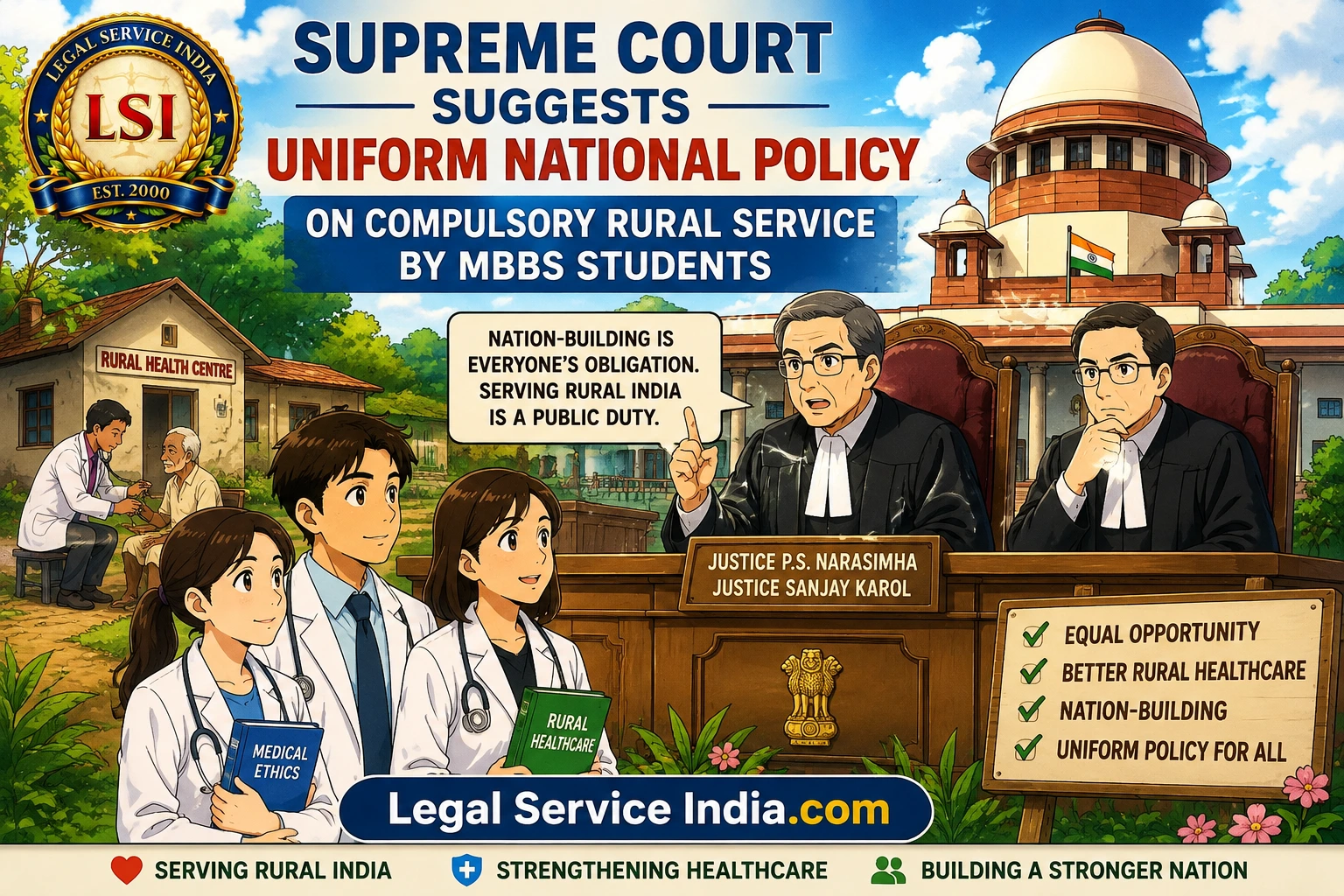
MBBS: Supreme Court Suggests Uniform National Policy on Compulsory Rural Service by Medical Students
A Step Towards Equitable Healthcare and Uniform Medical Education Across India
Introduction
India’s healthcare system has long struggled with an acute shortage of doctors in rural and remote regions despite producing one of the world’s largest numbers of medical graduates annually. This imbalance has prompted several states to impose compulsory rural service obligations on MBBS graduates.
However, the absence of a uniform national framework has resulted in inconsistent laws, varying service periods, different bond conditions, and frequent litigation.
In a significant development, the Supreme Court of India has suggested that the Union Government should formulate a uniform national policy governing compulsory rural service by MBBS students across the country.
The observations came while the Court was hearing challenges relating to Karnataka’s compulsory rural service requirements for medical graduates. The Bench emphasized that medical education serves a larger public purpose and that rural healthcare cannot remain neglected merely because different states follow different policies.
The court’s observations could become an important milestone in shaping India’s future public health policy.
Citation
| Case | In Re: Challenge to Karnataka’s Compulsory Rural Service Requirement for MBBS Students |
|---|---|
| Court | Supreme Court of India |
| Bench | Justice P.S. Narasimha and Justice Sanjay Karol |
| Proceedings | The order passed in August 2026 during proceedings concerning the compulsory rural service policy. |
Background of the Dispute
The litigation arose from a challenge to Karnataka Government notifications requiring MBBS students to complete compulsory public rural service before becoming eligible for permanent registration.
The petitioners, largely students from private medical colleges, questioned the constitutional validity of the compulsory rural service requirement and argued that compelling them to work in rural areas violated their rights.
During the hearing, however, the Supreme Court appeared unconvinced by the argument that students from private institutions should receive exemptions merely because they had financed their education independently.
Key Observation by Justice P.S. Narasimha
Nation-building is everyone’s obligation, and merely studying in a private medical college cannot automatically justify exemption from serving rural India.
Key Highlights
- The Supreme Court suggested a uniform national policy on compulsory rural service for MBBS students.
- The observations were made while hearing challenges to Karnataka’s compulsory rural service policy.
- The Bench emphasized that medical education serves a larger public purpose.
- The Court noted that differing state policies have resulted in inconsistency and repeated litigation.
- The observations may influence the future framework for rural healthcare and medical education in India.
Why the Supreme Court Suggested a Uniform National Policy
The Court noted that India presently has multiple and often conflicting systems governing compulsory rural service.
Different states presently prescribe:
- Different durations of rural service
- Different bond amounts
- Different exemptions
- Different penalties
- Different registration requirements
This lack of consistency creates:
- Legal uncertainty;
- Unequal treatment of similarly placed students;
- Migration of students towards states having relaxed policies; and
- Repeated constitutional challenges before high courts and the Supreme Court.
The Bench therefore suggested that the Union Government consider framing a uniform national policy that would apply consistently throughout India.
The Constitutional Questions
The dispute raises several important constitutional questions.
Article 14 – Equality Before Law
One major issue is whether medical graduates from different states can be subjected to vastly different compulsory service obligations.
The absence of uniformity arguably results in unequal treatment despite identical professional qualifications.
Article 19(1)(g)
Students contend that compulsory rural service interferes with their freedom to practice their chosen profession.
The counter-argument is that reasonable regulatory conditions attached to professional education are constitutionally permissible.
Article 21
The right to life includes access to healthcare.
The State, therefore, has a constitutional obligation to ensure availability of doctors in underserved rural areas.
Compulsory service is viewed by many as one mechanism for fulfilling that obligation.
Directive Principles of State Policy
Articles 38, 39, 41, and 47 and related Directive Principles obligate governments to improve public health and reduce inequalities.
The Supreme Court’s observations reflect these constitutional commitments.
Medical Education as a Public Resource
Perhaps the most significant aspect of the Court’s observations is its broader philosophy regarding medical education.
The bench indicated that:
- Medical education is not merely a private investment;
- Doctors perform an essential public function;
- Society invests substantial resources in medical education;
- Rural populations deserve access to qualified healthcare.
Accordingly, reasonable public service obligations cannot automatically be viewed as unconstitutional.
Existing Position Across States
India presently follows no single national model.
Different states prescribe:
| State Practice | Position |
|---|---|
| Rural service duration | Varies |
| Bond amount | Varies considerably |
| Penalty for default | Different in each state |
| Registration conditions | Not uniform |
| Exemptions | State-specific |
This fragmented approach has produced significant litigation over the years.
Earlier Supreme Court Approach
The latest observations are consistent with earlier judicial thinking.
In previous decisions concerning compulsory service bonds for postgraduate medical education, the Supreme Court upheld such bonds as reasonable conditions attached to admission and public medical education.
The Court had also previously encouraged the Union Government to evolve a broader policy regarding compulsory rural service.
The present proceedings revive that larger question in the context of MBBS graduates.
Why Rural Healthcare Needs Attention
India continues to face a significant imbalance between urban and rural healthcare infrastructure.
Many primary health centers struggle because of:
- shortage of doctors;
- specialist vacancies;
- poor retention of medical professionals;
- lack of incentives for rural postings.
A carefully designed national policy could substantially strengthen healthcare delivery in underserved regions.
| Major Rural Healthcare Challenges | Impact on Healthcare Delivery |
|---|---|
| Shortage of doctors | Limited access to timely medical care |
| Specialist vacancies | Reduced availability of advanced treatment |
| Poor retention of medical professionals | Frequent disruption of healthcare services |
| Lack of incentives for rural postings | Difficulty attracting qualified doctors |
Arguments Supporting Compulsory Rural Service
Supporters contend that compulsory rural service:
- improves access to healthcare;
- benefits economically weaker populations;
- exposes young doctors to diverse clinical conditions;
- promotes equitable distribution of medical professionals;
- fulfils constitutional obligations relating to public health.
| Key Benefits | Expected Outcome |
|---|---|
| Improves access to healthcare | Better medical services in underserved regions |
| Benefits economically weaker populations | Greater healthcare equity |
| Exposure to diverse clinical conditions | Enhanced practical experience for doctors |
| Equitable distribution of medical professionals | Reduced urban-rural healthcare gap |
| Fulfils constitutional obligations relating to public health | Supports broader public welfare objectives |
Concerns Raised by Medical Students
Opponents raise several concerns.
These include:
- inadequate rural infrastructure;
- poor accommodation;
- safety concerns;
- inconsistent salaries;
- lack of specialist supervision;
- differing policies among states.
Many argue that unless rural working conditions improve, compulsory postings alone cannot solve India’s healthcare challenges.
| Concern | Potential Effect |
|---|---|
| Inadequate rural infrastructure | Limits effective patient care |
| Poor accommodation | Discourages long-term rural service |
| Safety concerns | Reduces willingness to accept postings |
| Inconsistent salaries | Creates dissatisfaction among doctors |
| Lack of specialist supervision | Restricts professional growth |
| Differing policies among states | Creates uncertainty and legal disputes |
What Could a Uniform National Policy Include?
If the Union Government accepts the Supreme Court’s suggestion, a national framework may include:
- standardized duration of rural service;
- uniform bond conditions;
- common exemptions;
- fixed remuneration;
- transparent posting mechanisms;
- nationwide certification procedures;
- grievance redressal mechanisms;
- incentives for voluntary rural service beyond mandatory periods.
Such uniformity would likely reduce litigation while ensuring predictability for students and governments alike.
| Proposed Policy Feature | Purpose |
|---|---|
| Standardized duration of rural service | Ensures consistency nationwide |
| Uniform bond conditions | Reduces legal uncertainty |
| Common exemptions | Promotes fairness |
| Fixed remuneration | Ensures equal compensation |
| Transparent posting mechanisms | Minimizes arbitrary allocation |
| Nationwide certification procedures | Creates uniform compliance standards |
| Grievance redressal mechanisms | Provides administrative remedies |
| Incentives for voluntary rural service beyond mandatory periods | Encourages continued rural healthcare service |
Legal Significance of the Supreme Court’s Observations
Although the Court has not yet delivered a final judgment directing implementation of a nationwide scheme, its observations carry considerable persuasive value.
Historically, several important legislative and policy reforms have followed similar judicial suggestions where the Court identified systemic inconsistencies requiring national attention.
The observations may therefore encourage:
- the Union Government;
- the National Medical Commission;
- State Governments; and
- public health authorities
to collectively examine a harmonized framework for rural medical service.
| Stakeholder | Possible Role |
|---|---|
| Union Government | Develop a nationwide policy framework. |
| National Medical Commission | Frame regulatory standards. |
| State Governments | Implement and coordinate rural service policies. |
| Public health authorities | Strengthen healthcare delivery systems. |
Author’s Analysis
From a constitutional perspective, the Supreme Court has rightly shifted the debate beyond the individual interests of medical graduates toward the broader public interest.
Healthcare is a constitutional necessity, not merely a market service. Rural India continues to bear a disproportionate burden of doctor shortages despite producing thousands of MBBS graduates annually.
Nevertheless, compulsory service should not become punitive. Any national framework must balance the interests of young doctors with the healthcare needs of rural communities. Adequate infrastructure, fair remuneration, secure working conditions, professional mentoring, and transparent posting policies are indispensable if such a policy is to withstand constitutional scrutiny.
A well-designed uniform national policy would minimize arbitrary differences between states, reduce avoidable litigation, and promote greater equity in access to healthcare. The Supreme Court’s observations therefore represent an important opportunity to reimagine India’s approach to rural medical service through a constitutionally balanced and nationally consistent framework.
Key Takeaways
- India continues to face a significant urban-rural healthcare imbalance.
- Supporters believe compulsory rural service can improve healthcare access and promote equitable distribution of doctors.
- Medical students highlight infrastructure, safety, accommodation, and remuneration concerns.
- A uniform national policy could standardize rural service obligations across states.
- The Supreme Court’s observations may encourage comprehensive reforms in rural healthcare policy.
- Any future framework must balance constitutional obligations with the rights and welfare of young medical professionals.
Conclusion
The Supreme Court’s suggestion for a uniform national policy on compulsory rural service by MBBS students reflects an attempt to reconcile two equally important constitutional objectives—protecting the rights of medical graduates while ensuring equitable healthcare for India’s rural population.
Whether the Union Government ultimately formulates such a policy remains to be seen. However, the Court has unmistakably highlighted that the existing patchwork of state-specific regulations is neither ideal for students nor conducive to a coherent national healthcare strategy.
If implemented with fairness, adequate safeguards, and proper infrastructure, a uniform policy could become one of the most significant reforms in India’s medical education and public health landscape in recent years.
FAQs: Supreme Court Compulsory Rural Service for MBBS Students
| Question | Quick Answer |
|---|---|
| What did the Supreme Court say? | It suggested a uniform national policy on compulsory rural service for MBBS students. |
| Is rural service mandatory across India? | No. Different states currently follow different rules. |
| Why was a national policy suggested? | To ensure uniformity, reduce litigation, and strengthen rural healthcare. |
| Are private medical college students exempt? | The Supreme Court questioned automatic exemption merely because students studied in private colleges. |
| How will the policy benefit healthcare? | It may improve doctor availability, standardize service conditions, and reduce disparities. |
1. What Did the Supreme Court Say About Compulsory Rural Service for MBBS Students?
The Supreme Court suggested that the Union Government consider framing a uniform national policy on compulsory rural service for MBBS students. The Court observed that different states currently follow varying rules regarding mandatory rural service, bond amounts, and penalties, leading to inconsistency and repeated litigation. A nationwide policy could ensure equal treatment of medical graduates while strengthening rural healthcare.
2. Is Compulsory Rural Service Mandatory for MBBS Students in India?
At present, compulsory rural service for MBBS students is not governed by a single national law. Instead, individual states have their own regulations, with varying service periods, bond conditions, and exemptions. The Supreme Court’s recent observations may pave the way for a uniform national policy on compulsory rural service by medical students across India.
3. Why Did the Supreme Court Recommend a Uniform National Policy on Compulsory Rural Service for MBBS Students?
The Supreme Court recommended a uniform national policy on compulsory rural service for MBBS students to eliminate disparities between States, reduce legal disputes, and ensure that rural and underserved areas receive adequate medical professionals. The Court emphasized that medical education carries a public responsibility and that a standardized framework would promote fairness and improve access to healthcare.
4. Can MBBS Students Studying in Private Medical Colleges Be Exempted from Compulsory Rural Service?
During the hearing, the Supreme Court questioned the argument that students from private medical colleges should automatically be exempt from compulsory rural service merely because they funded their education privately. The Court observed that all doctors have a role in nation-building, and attending a private institution alone may not justify exemption from rural healthcare obligations.
5. How Could a Uniform Compulsory Rural Service Policy Benefit India’s Healthcare System?
A uniform compulsory rural service policy for MBBS students could significantly improve healthcare delivery by ensuring an equitable distribution of doctors across rural and urban areas. It may also standardize bond conditions, service duration, remuneration, and exemptions, reduce litigation, strengthen primary healthcare services, and help bridge the gap in medical facilities available to rural populations.
Key Takeaways
- Supreme Court suggests a uniform national policy on compulsory rural service for MBBS students to eliminate inconsistencies in State-level regulations and strengthen rural healthcare across India.
- The Court observed that different States currently follow varying rules on compulsory rural service, bond amounts, penalties, and exemptions, leading to unequal treatment of medical graduates and frequent litigation.
- The Supreme Court questioned whether MBBS students from private medical colleges should be exempt from compulsory rural service, emphasizing that medical professionals have a broader responsibility towards nation-building and public health.
- A uniform compulsory rural service policy for MBBS students could ensure equal opportunities, standardized service conditions, and greater legal certainty while improving access to healthcare in underserved rural areas.
- The Court highlighted the need to balance the constitutional rights of MBBS graduates with the State’s obligation to provide accessible healthcare, particularly in rural and remote regions.
- A nationwide framework may include:
- Uniform rural service duration
- Standardized bond conditions
- Transparent posting mechanisms
- Fair remuneration
- Common exemption criteria for all medical graduates
- The observations reinforce the constitutional vision under Articles 14 and 21, along with the Directive Principles of State Policy, which encourage equitable access to quality healthcare for every citizen.
- The proposed policy could reduce litigation over compulsory rural service by MBBS students, create a predictable regulatory framework, and promote consistency in medical education and public health administration.
- The National Medical Commission (NMC) and the Union Government may play a crucial role in developing a comprehensive national policy that balances the interests of medical students with India’s growing healthcare needs.
- If implemented, the Supreme Court’s recommendation on compulsory rural service for MBBS students could become a landmark reform in India’s medical education system, ensuring better doctor availability in rural areas while promoting healthcare equity nationwide.
Need Expert Legal Advice on Supreme Court or Constitutional Matters?
If you are facing a legal issue involving medical education, compulsory rural service, constitutional law, education policy, Supreme Court litigation, or any other important legal matter, obtain trusted legal guidance from an experienced Supreme Court advocate.
Consult Adv. Tarun Choudhury.
Supreme Court Advocate | 25+ Years of Legal Experience
- ✔ Supreme Court Litigation
- ✔ Constitutional & Writ Petitions
- ✔ Medical Education & Regulatory Matters
- ✔ Public Interest Litigation (PIL)
- ✔ Civil, Criminal & Corporate Legal Advisory
📞 Call: 9650499965
💬 WhatsApp: 9891244487
Get professional legal assistance from an experienced Supreme Court advocate. Schedule your consultation today for reliable legal advice and effective representation.