1. Introduction
In legal dramas and, at times, even in courtroom arguments, the phrase “touch DNA” is presented as if it were a definitive forensic fact: “The defendant touched the object—their DNA was recovered from it.” Such a statement may sound compelling, but it can convey far more certainty than the underlying science supports.
The central problem is not that DNA recovered from an object is necessarily unreliable. Rather, the problem lies in assuming how, when, and by whom the DNA was deposited merely because a person’s DNA profile was detected.
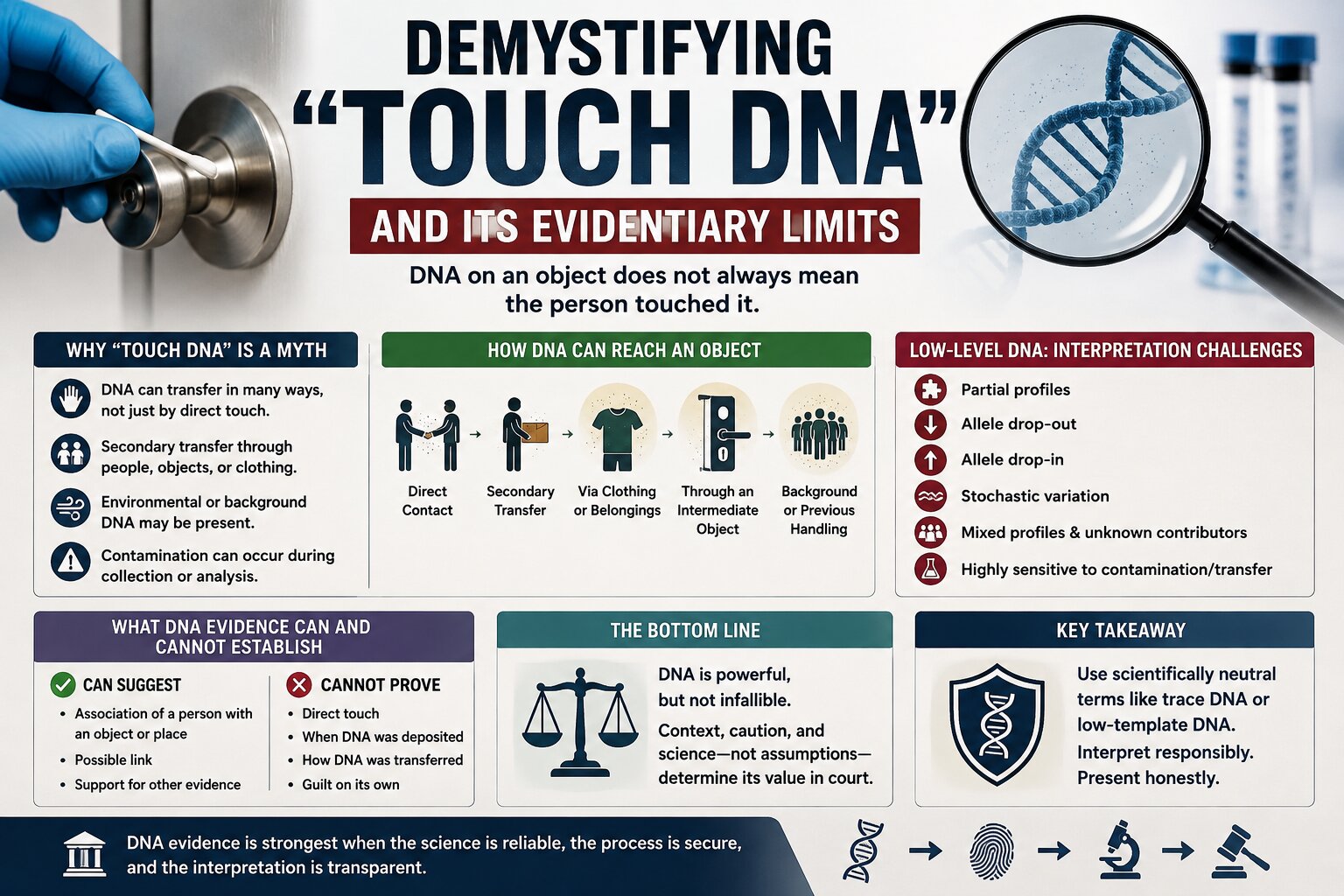
Modern forensic genetics recognises that minute quantities of DNA can reach an object through a variety of mechanisms, including direct contact, secondary or indirect transfer, background DNA, and, in some circumstances, contamination. Consequently, the presence of a person’s DNA on an object does not, by itself, establish that the person recently touched it, nor does it establish when the DNA was deposited.
Thus, the expression “touch DNA” is potentially misleading when used as if it describes a scientifically established mode of deposition. More neutral terminology—such as trace DNA, low-template DNA, or, where scientifically appropriate, low-copy-number DNA—better reflects the evidentiary limitations.
2. The Problem with the Term “Touch DNA”
The expression “touch DNA” suggests a simple causal sequence:
Person → Touched Object → DNA Recovered → Person Was Therefore Recently in Contact With the Object.
Forensic interpretation is considerably more complicated.
DNA may reach a surface through:
- direct contact;
- secondary transfer from another person or object;
- transfer through clothing, tools, or other intermediaries;
- previously deposited background DNA;
- airborne or environmental transfer of cellular material; or
- contamination introduced during collection, handling, packaging, or laboratory processing.
Accordingly, finding a DNA profile on an object does not automatically identify the mechanism of deposition.
The distinction is particularly important when the recovered material is extremely small in quantity. Low-level samples may produce partial or mixed DNA profiles and may be more susceptible to stochastic effects such as allele drop-out, as well as interpretation difficulties associated with mixtures and potential contamination.
The evidentiary question should therefore not simply be:
“Whose DNA is this?”
It should also include:
“How could the DNA have arrived here, when might it have been deposited, and what competing explanations are reasonably possible?”
3. The More Precise Terminology: Trace DNA and Low-Template DNA
The term “trace DNA” is generally preferable when referring to small quantities of DNA recovered from an evidentiary item without presuming the mechanism by which it was deposited.
Similarly, “low-template DNA (LtDNA)” describes a sample in which the quantity of DNA available for analysis is particularly limited. “Low-copy-number (LCN) DNA” has also been used in forensic literature, although terminology and technical definitions vary among laboratories and jurisdictions.
These terms are preferable because they do not automatically imply that the DNA resulted from touching.
Importantly, “trace DNA” is not synonymous with “unreliable DNA”. A trace sample may provide valuable evidence. Its probative value, however, depends upon the quality of the sample, the analytical method used, the possibility of transfer or contamination, the statistical interpretation, and the circumstances of the case.
The scientific principle is therefore one of caution rather than categorical rejection.
4. Transfer and Contamination: Why Context Matters
DNA is transferable biological material. A person’s DNA can potentially move from one surface to another without that person directly touching the second surface.
For example, DNA may be transferred:
- from one person to another during physical contact;
- from a person’s clothing or personal belongings to another object;
- through an intermediary object or tool;
- through repeated handling of a commonly used surface; or
- during evidence collection or laboratory processing if appropriate safeguards are not followed.
This phenomenon is particularly important in cases involving objects that have been handled by numerous people.
The presence of DNA can therefore establish an association, but the strength and meaning of that association must be evaluated in light of the circumstances.
5. Quantity Does Not Automatically Establish Meaning
The amount of DNA recovered can be relevant to interpretation, but there is no universal quantity threshold at which DNA suddenly becomes “touch DNA” or becomes automatically unreliable.
Very small samples can present analytical challenges, including:
- partial profiles;
- allele drop-out;
- allele drop-in;
- increased stochastic variation;
- mixed profiles;
- difficulties in determining the number of contributors; and
- increased sensitivity to contamination and transfer considerations.
Consequently, a statement such as “only 78 picograms were recovered; therefore, the evidence is inadmissible” would be too simplistic.
The scientifically defensible approach is to examine the entire evidentiary and analytical context, rather than relying on an arbitrary numerical threshold.
6. What Should Be Said in Court?
Instead of saying:
“The defendant’s touch DNA was found on the gun.”
A more scientifically cautious formulation would be:
“A low-level trace DNA profile consistent with the defendant was detected on the grip of the firearm. The DNA findings, by themselves, do not establish the mechanism or timing of deposition.”
Where the laboratory has reliable quantitative information, the report may additionally state the quantity, analytical method, mixture interpretation, statistical assessment, and relevant limitations.
This formulation separates what the laboratory observed from what investigators or lawyers might infer from it.
That distinction is fundamental to sound forensic evidence.
7. Lessons from Real-World Cases
7.1 Amanda Knox Investigation
The Amanda Knox case is frequently cited in discussions concerning low-level DNA evidence and forensic interpretation. The case illustrates how the interpretation of very small or mixed DNA samples can become highly contentious when the quantity of DNA is limited and the circumstances of collection and transfer are disputed.
However, it is important not to oversimplify the litigation by stating that a particular quantity of DNA was itself the sole reason for the eventual outcome. The case involved numerous evidentiary, procedural, and interpretative issues.
The broader lesson is that a DNA association must be evaluated within its complete forensic context.
7.2 The “Phantom of Heilbronn”
The so-called “Phantom of Heilbronn” investigation provides an even more striking illustration of contamination risk.
Between 1993 and 2009, the same female DNA profile appeared in evidence associated with numerous criminal investigations across Europe. The investigation eventually revealed that the apparent common perpetrator was not a serial offender at all. The DNA profile had originated from contamination associated with the cotton swabs used to collect evidence.
The case demonstrates a fundamental forensic principle:
A DNA profile is only as meaningful as the integrity of the process through which it was obtained.
8. DNA Evidence and Indian Law
In India, DNA evidence is generally presented through scientific or expert evidence and must be assessed alongside the circumstances in which the biological material was collected, preserved, transported, examined, and reported.
Under Section 39 of the Bharatiya Sakshya Adhiniyam, 2023, opinions of experts on matters requiring specialised knowledge may be relevant. Expert DNA evidence, however, does not automatically determine the ultimate issue before the court.
The court must consider the reliability of the underlying scientific analysis, the chain of custody, the possibility of contamination or transfer, the quality of the sample, and the totality of the evidence.
8.1 Important Judicial Caution
Indian courts have repeatedly emphasised that DNA evidence cannot be considered in isolation from the circumstances surrounding its collection and preservation.
In Manoj v. State of Madhya Pradesh (2022), the Supreme Court considered the possibility of contamination where biological material was recovered from an open area. The decision illustrates the importance of examining the circumstances in which biological evidence was recovered rather than treating a laboratory match as conclusive by itself.
Similarly, questions concerning delays in transportation, preservation, documentation, sealing, and chain of custody can materially affect the evidentiary weight attributed to biological evidence.
The appropriate legal principle is therefore not:
“DNA Match = Guilt.”
It is:
“DNA Finding + Reliable Collection + Secure Preservation + Scientifically Valid Analysis + Appropriate Interpretation + Corroborating Circumstances = Potentially Powerful Evidence.”
9. The Importance of Chain of Custody
DNA evidence is exceptionally sensitive to contamination and transfer. Consequently, every stage of its journey may matter:
Collection → Packaging → Sealing → Storage → Transportation → Laboratory Receipt → Analysis → Reporting
Any unexplained gap or procedural deficiency may raise legitimate questions about the integrity of the evidence.
This does not necessarily mean that every procedural irregularity automatically makes DNA evidence inadmissible. Rather, the court must determine what effect the particular irregularity has on reliability and evidentiary weight.
Forensic science and forensic procedure are therefore inseparable.
10. The American Experience With Low-Level DNA Evidence
American courts have also confronted challenges involving low-level DNA, complex mixtures, probabilistic genotyping, and the scientific validation of particular analytical methods.
The lesson from this jurisprudence is not that low-level DNA is inherently inadmissible. Rather, courts may scrutinise whether the specific methodology, statistical model, laboratory procedures, and expert conclusions are sufficiently reliable and properly supported.
Thus, it is preferable to avoid broad claims that all LCN or trace DNA evidence is scientifically invalid. The admissibility and weight of such evidence depend on the methodology and jurisdiction involved.
11. What Forensic Experts Should Avoid
Experts should be cautious about converting an analytical finding into an unsupported reconstruction of events.
For example:
| Approach | Statement |
|---|---|
| Overstated | “The defendant touched the firearm.” |
| More Scientifically Appropriate | “The defendant’s DNA profile is consistent with the DNA detected on the firearm. The DNA result alone does not establish when, how, or by what mechanism the DNA was deposited.” |
The second statement preserves the distinction between scientific observation and investigative inference.
That distinction is essential because courts decide facts; forensic scientists provide scientifically grounded observations, interpretations, and probabilities within the limits of their expertise.
12. The Bottom Line
The phrase “touch DNA” should be used with considerable caution.
It is not accurate to treat every low-level DNA finding as proof that a person directly touched an object. DNA may be transferred through multiple pathways, and a laboratory match generally cannot, by itself, establish the timing, mechanism, or circumstances of deposition.
The better approach is to use scientifically neutral terminology such as trace DNA or low-template DNA, where appropriate, and to explain clearly the limitations of the finding.
The objective of forensic science is not to produce the most dramatic explanation. It is to provide the most scientifically defensible explanation.
In court, therefore, the question should not be:
“Whose touch DNA is this?”
It should be:
“What does the DNA finding actually establish, what does it not establish, and what alternative explanations are scientifically plausible?”
That is the difference between forensic evidence and forensic storytelling.
The law does not need DNA evidence to be dramatic. It needs DNA evidence to be reliable, transparent, and honestly interpreted.
13. Conclusion: From “Touch DNA” to Scientifically Defensible Evidence
The term “touch DNA” should be used with caution because the presence of a DNA profile on an object does not, by itself, prove direct contact, timing, or the manner of deposition. Trace DNA may result from direct or secondary transfer, background DNA, or contamination, and its interpretation depends on the quality of the sample, analytical method, statistical evaluation, and chain of custody. Therefore, forensic experts should use neutral terminology such as trace DNA or low-template DNA and clearly distinguish scientific findings from investigative assumptions. Ultimately, DNA evidence is most powerful when it is scientifically reliable, procedurally secure, and interpreted within the complete circumstances of the case.