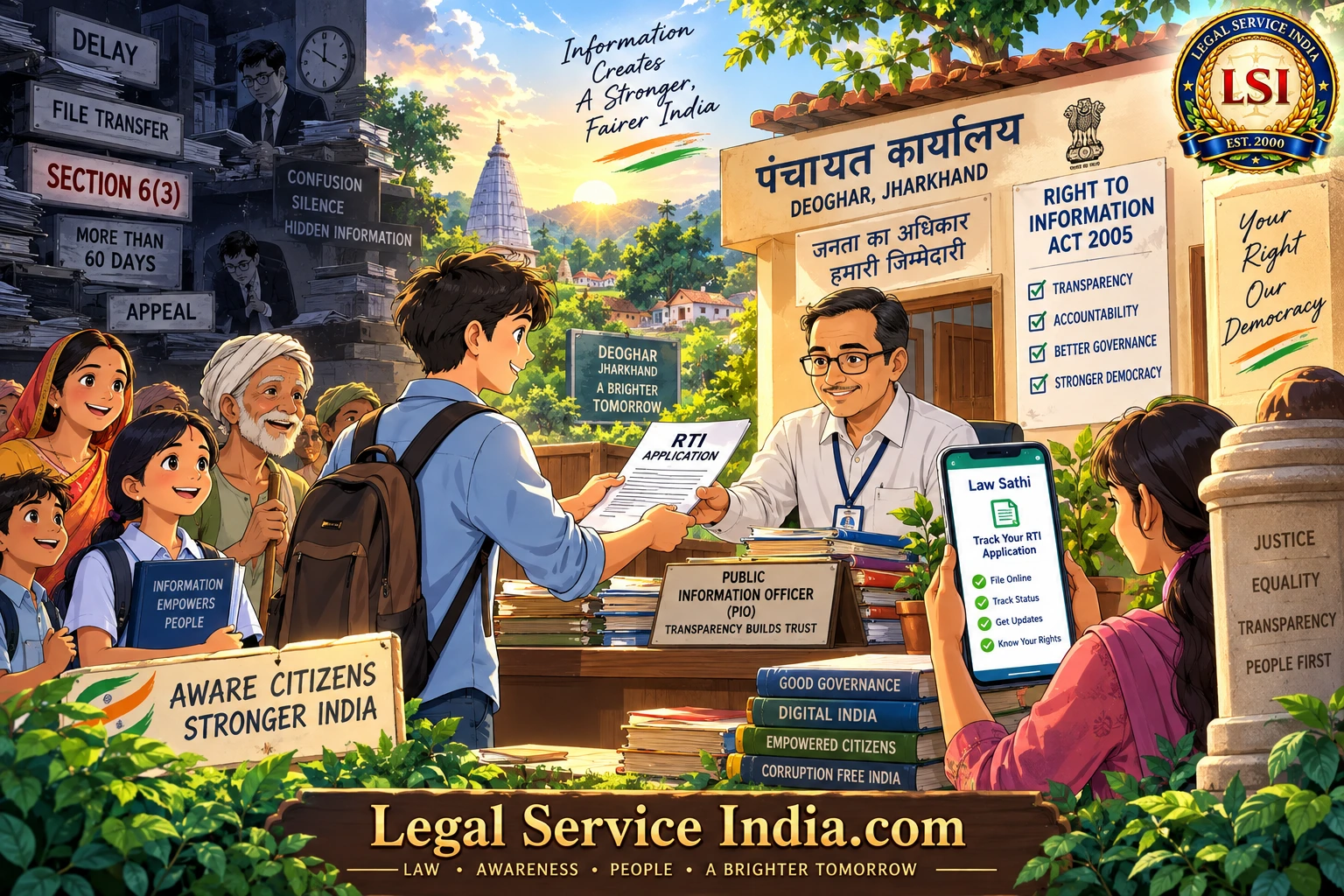
The Right to Information Act, 2005, is a law that gives power to common people to ask questions of the government. The main goal of this law is to stop corruption and make government work clear and honest. However, even after many years, it is very difficult to use this law in villages and small towns. This research paper shows the real situation of RTI in the Deoghar district of Jharkhand.
For this study, the researcher filed RTI applications in different government offices like the Panchayati Raj and the Education Department. The researcher used practical experience and official letters like Memo No. 90 and Memo Number 788 to show how much struggle a common man has to do to get simple information.
The research shows that government clerks and officers often try to hide information. The biggest problem is with Section 6(3) of the law. This section is about moving an application from one office to another, but officers take a lot of time to do this. While the law says that the answer should come in 30 days, in reality it takes more than 60 days.
The data shows that almost 45% of people have to file a first appeal because they do not get the right answer the first time. To fix this problem, a digital model of the Lawthe Law Sathi application is suggested to help people. In the end, this paper says that until we use a digital system and train the staff properly, the dream of RTI will not be complete.
Keywords
RTI Act 2005
Corruption
Deoghar District
Panchayati Raj
Education Department
Section 6(3)
First Appeal
Law Sathi
Introduction
The Basic Idea of RTI
In a country like India, the government works for the people. But for a long time, there was a big problem: the common man did not know how the government was spending money or making decisions. To fix this, the Right to Information Act was started in 2005. It is a powerful tool that allows any citizen to open the doors of government offices and see the records.
The main goal of this law is to stop corruption and make every officer responsible for their work. If the government is doing something for the public, the public has the right to know about it.
The Gap Between Law and Reality
When we read the RTI law in books, it looks very simple and perfect. It says that any person can write a letter, pay 10 rupees, and get the answer in 30 days. But when we go to the real ground, especially in places like the Deoghar district of Jharkhand, the story is very difficult.
For a poor person living in the village, filing an RTI is not easy. Many times, the officers do not want to give information because they are afraid of being caught for their mistakes. This creates a wall of silence between the government and the citizens.
This research is about this exact struggle: how a good law fails because of slow-moving files and the wrong attitude of staff. staff.
Reason for Choosing Deoghar District
Deoghar was chosen for the field study because it represents the heart of rural Jharkhand. Here, people depend on the government for everything from school meals, midday meals, village roads, and panchayat funds.
During the research, the researcher practically visited the offices and filed RTI applications. The researcher wanted to observe what happens when a student asks a question and receives official replies like Memo Number 90 from the Panchayati Raj office and Memo Number 788 from the Education Department. These documents proved that the system is not working as fast as the law says in many cases.
The staff tried to confuse the applicant or moved the file from one room to another just to waste time.
The Problem of Section 6(3) and Delays
One major issue observed is related to Section 6(3) of the RTI Act. This section says that if you send an RTI to the wrong department, they must send it to the right one within 5 days.
But in reality, offices use this as the excuse to delay the process. They keep the file for weeks and then say it belongs to another office. Because of this, a process that should take one month ends up taking 3 or 4 months.
This is very frustrating for a common man. The collected data shows that nearly half of the people in our area have to file a first appeal because the first office did not do their job properly.
Key Observations From the Field Study
Issue Observed
Situation Described in the Study
Access to RTI
It is difficult for people in villages and small towns to use the RTI system.
Delay in Information
Information that should be received within 30 days may take more than 60 days.
Section 6(3)
Applications transferred between offices can face significant delays.
First Appeal
Almost 45% of people have to file a first appeal because they do not receive the right answer the first time.
Administrative Attitude
Clerks and officers may try to hide information or move files between offices.
Digital Solution
A digital model of the Law Sathi application is suggested to help people.
Conclusion of the Introduction
The reason why this study is important is that it talks about real problems of real people. If a law student who understands the rules has to struggle so much, what will happen to the farmers who do not know their rights?
This paper will show with a chart and data how much time is actually taken in Deoghar, compared to what the laws say. My goal is not just to complain about the struggle. Better ways, like using a digital system or a helper like Law Sathi, can help so that the RTI Act can truly help the people of Jharkhand.
We need a system where information flows freely and no officer can handle behind all files anymore.
Historical Background
The Root of Secrecy
To understand why the Right to Information (RTI) is so important today, we must look at how things were in the past. For a very long time, the Indian government worked under a curtain of secrecy. This started during the British rule in 1923.
The British passed a law called the Official Secrets Act. The main goal of this law was to keep everything hidden from the public. Government officers were told that they should never share any information with the citizen.
Even after India became independent in 1947, this old habit of keeping secrets continued. If a common man went to a government office to ask how his tax money was being spent, the officer would simply say, “This is a secret. We can’t tell you.”
The Struggle of the Common Man (MKSS Movement)
The real change did not come from the Parliament first. It came from the poor people living in the villages.
In the 1990s, in the state of Rajasthan, a group called Majdur Kisan Shakti Sangathan (MKSS) started a big movement. These were simply labourers who were not getting their full wages for work like building roads or dams.
When they asked the local officer for the Master Roll (attendance and payment records), the officer refused. These villagers then started a famous protest with a simple slogan: “Hamara Paisa Hamara Hisab”—our money, our account.
This was the first time that common people stood up and said that since it is public money, the public has the right to see the records.
This moment proved that information is not just for rich people in the cities. It is a matter of survival for the poor in villages.
The Role of the Supreme Court
While the people were fighting on the streets, the Supreme Court of India was also helping. The judges understood that, without the right to know, the right to speak under Article 19 is useless.
One of the most famous cases was S.P. Gupta vs. Union of India (1982). In this case, the Supreme Court said that in a democracy, the people are the masters and they must know what the government is doing.
The Court said that an open government is the only way to stop corruption.
This judgement was used as a victory. It shifted the power from the government’s hand to the citizens’ hand. It sent a clear message that keeping secrets should be the exception and sharing information should be the rule.
The Birth of the 2005 Act
After years of protest by activists and many orders from the court, the Parliament finally passed the Right to Information Act in 2005. This was the revolutionary movement.
It replaced the old right of secrecy with the new right to know. For the first time, a law was made that set a fixed time limit of 30 days for giving information.
It also created a system of Information Commissions where people could complain if they did not get an answer.
This law was designed to be simple so that anyone, even someone who can’t read well, could use it.
Conclusion of the History
Studying the history of RTI shows us that this right was not a gift from the government. It was earned through the hard work of villagers and the wisdom of our courts.
When observing the situation in Deoghar today, it is clear that we have the law, but we are slowly forgetting the struggle behind it.
Officers in departments like the Panchayati Raj or Education still behave like they are living in the 1920s. Officers still follow the British secret rules.
By remembering this history, we realise that when we file an RTI today and track records like Memo Number 634, we are actually continuing a long fight for justice and honesty in our country.
Relevant
Important Sections of the RTI Act
To understand the RTI Act, we must look at the main sections that give us power.
RTI Provision
Importance
Section 6
Allows any citizen to ask for information.
Section 6(3)
If any officer gets an RTI that belongs to another department, he must transfer it within 5 days.
Section 7
Sets the 30-day limit for providing information.
Section 19
Gives the right to file an appeal if the citizen is not satisfied.
Section 6 is the most relevant because it allows any citizen to ask for information.
Another very important part is Section 6(3). This law says that if any officer gets an RTI that belongs to another department, he must transfer it within 5 days.
But during the study, it was found the officers use this section to waste time.
Section 7 sets the 30-day limit, and Section 19 gives us the right to file an appeal if we are not satisfied.
Chart 1: The RTI Legal Process
Step
Authority / Action
Step 1
File the RTI application before the Public Information Officer (PIO).
Step 2
If the citizen is not satisfied or does not receive information, file the first appeal.
Step 3
If the matter remains unresolved, approach the State Information Commission.
Analysis of Chart 1
This flowchart shows the legal path an application must take. It starts with the PIO (Public Information Officer).
If he fails, the citizen goes to the first appeal and then to the State Information Commission.
This chart is relevant because it shows that the law has a step-by-step safety net for citizens.
Chart 2: Success Rate of Appeals
Level
Percentage
Cases solved at the first level
40%
People who have to use the first appeal
45%
Analysis of Chart 2
This chart is relevant to the legal study because it shows that only 40% of cases are solved at the first level.
A huge 45% of the people have to use the first appeal law to get their work done.
This proves that the first level of the RTI law is not working strongly enough, and citizens are forced to go to senior officers for justice.
Judicial Decisions
The courts have always protected the RTI. In the case of S.P. Gupta vs. Union of India, the Supreme Court said that the people have a right to know.
They said that in a democracy, nothing should be a secret unless it is about national security.
Another case is Aditya Bandhopadhyay, where the court said that RTI should be used to bring transparency, not harass the officers.
These decisions are very relevant because they guide how the law should be used in districts like Deoghar.
Recent Trends
The Current Situation in Deoghar
In this section, I will discuss what is actually happening on the ground in the Deoghar district of Jharkhand.
While the law says one thing, the reality in offices like the Panchayati Raj and the Education Department is different.
Recently, several RTI applications were filed to see how the system works for a student.
It was found that most officers do not take the 30-day deadline seriously.
The experience with Memo No. 90 and Memo No. 788 shows that files move very slowly from one desk to another.
Chart 3: Response Time Reality in Deoghar
Response Time
Percentage
People getting a reply on time
30%
People waiting for more than two months
43%
Analysis of Chart 3
This chart shows the time taken by departments to give an answer. According to the law, information should be given within 30 days.
But, as you can see, only 30% of the people get a reply on time.
Most people, 43%, have to wait for more than two months.
The recent trend shows that the government staff is either too busy or doesn’t want to follow the rules of the RTI Act.
Chart 4: Quality of Information
Quality of Information
Percentage
Complete and honest answer
25%
Incomplete information
45%
Analysis of Chart 4
This chart shows whether the information given was useful or not.
Only 25% of the people get a complete and honest answer. The biggest problem is 45% incomplete information.
This matches the experience with Memo No. 788. The department give half answers to hide their mistakes.
This trend proves that even if you get a reply, it is often not the full truth.
Field Observation
During the fieldwork, it was noticed that rural people are afraid to ask questions.
They feel that if they file an RTI, the officers will get angry.
Also, there is a big digital divide. Most people in the world don’t know how to use the online RTI portal.
So, they still depend on paper applications, which are easy for officers to ignore or lose.
Conclusion
The Right to Information (RTI) Act, 2005, was created to bring light into the dark corners of government offices. After studying the situation in Deoghar and looking at all field data, it is clear that the law is strong, but implementation is very weak.
The culture of secrecy from the British time is still present in our local offices. When a common man asks for a simple record, he is treated like an enemy. The research shows that the 30-day time limit under Section 7 is just a number on paper. As shown in the charts, most people have to wait for months or file appeals to get any answer.
Implementation and Transparency Problems
The problem is not just about delaying information; it is about the quality of honesty. In cases like Memo Number 90 and Memo Number 788, we saw that officers tried to hide behind technical rules like Section 6(3). Instead of helping the citizen, they use the law to move files from one desk to another.
This discourages the poor people of Jharkhand from asking questions. If the government is spending public money on schools and roads, every villager should know where every rupee is going.
RTI in Rural Jharkhand: A Struggle Rather Than a Right
In conclusion, RTI in rural Jharkhand is currently a struggle rather than a right. The gap between the urban and rural users shows that we are failing to reach the people who need this law.
A democracy cannot work if the government is afraid of the truth. We need to move from a system of hiding files to a system of sharing facts. Only then will the people of Deoghar truly feel that they are the masters of their own democracy.
Suggestions To Improve The RTI System
Based on the research and the data analysis, the following steps are suggested to improve the RTI system.
S. No.
Suggested Step
Proposed Improvement
1
Digital Transparency Model
We need a simple, mobile-friendly system where a villager can track their RTI status. It should be as easy as tracking a mobile recharge or a courier.
2
Strict Penalties
The State Information Commission should strictly use Section 20 to fine officers who delay applications without a good reason. Fear of losing money will make them work faster.
3
Staff Training for Lower-Level Staff, Clerks, and PIOs
New regular training should be provided. They should be taught that giving information is their legal duty, not a personal favour. favour.
4
Local Language Help Desk
Every block office should have a help desk that assists people in writing applications in simple Hindi or local languages.
Four Key RTI Reforms Suggested By The Research
Digital Transparency Model: Create a simple, mobile-friendly RTI status-tracking system for villagers.
Strict Penalties: The State Information Commission should strictly use Section 20 against officers who delay applications without a good reason.
Staff Training: Regular training should be provided to lower-level staff, clerks, and Public Information Officers (PIOs).
Local Language Help Desk: Every block office should provide assistance for writing RTI applications in simple Hindi or local languages.
🎖️ Recognition · LSI Author
📚
1
Published Articles
👨⚖️ Satyam Kumar – BA LLB Student & Legal Researcher
🎓 BA LLB (Semester V) Student | Jharkhand Rai University, Ranchi
📚 Legal Research | RTI Act, 2005 | Constitutional Law | Empirical Research
🔎I am Satyam Kumar, a BA LLB (Semester V) student at Jharkhand Rai University, Ranchi, with a strong interest in legal research, constitutional law, transparency, public accountability, and the Right to Information (RTI) Act, 2005.