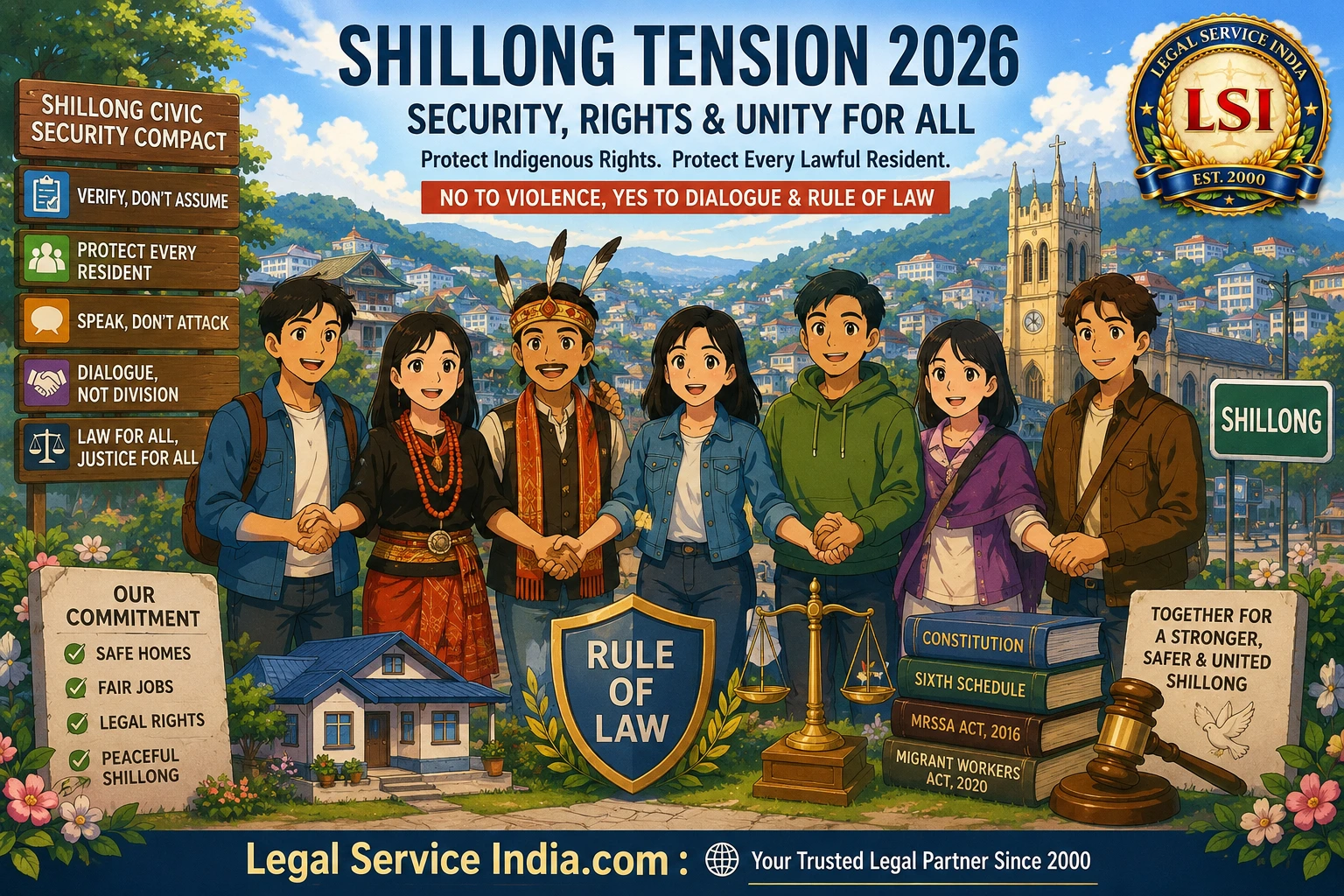
Shillong Tension 2026: Indigenous Rights, Migration, Violence and the Rule of Law — A Legal Roadmap for Peace
“A Peaceful Meghalaya Does Not Have To Choose Between Protecting Its Indigenous Identity And Protecting Its People. True Leadership Begins When We Defend Constitutional Rights, Reject Violence, And Ensure That Every Lawful Resident Can Live Without Fear. The Answer To Fear Is Not Another Confrontation—It Is A Stronger Rule Of Law.”
Adv. Tarun Choudhury — Legal Perspective
Supreme Court Advocate | 25+ Years Of Legal Experience
Introduction: Shillong Has Reached a Critical Constitutional Moment
The latest Shillong tension is not merely another political protest that turned violent.
What happened in Shillong on August 19, 2026, during a black-flag motorcycle rally organised by the Khasi Students’ Union (KSU), should concern every person who believes in democracy, indigenous rights and the rule of law.
The rally, organised amid an ongoing agitation over migration, recruitment, indigenous protection and other issues, reportedly descended into violence, with vehicles damaged or torched, public property vandalised and statues of Swami Vivekananda and Netaji Subhas Chandra Bose allegedly damaged.
The situation moved into a more serious legal phase when Meghalaya Police arrested three senior KSU leaders — President Raymond Kharjana, General Secretary Reuben Najiar and Vice-President Pynkmenlang Sanmiet — in connection with the violence.
But there is a danger in reducing the entire episode to a simple headline:
“KSU Protest Becomes Violent.”
That is only one part of the story.
The deeper question is:
How can Meghalaya protect the constitutional and cultural interests of its indigenous people while simultaneously guaranteeing that every law-abiding resident is safe from violence, intimidation and forced displacement?
After more than 25 years of legal practice, I believe this distinction is fundamental.
The solution cannot be found in choosing one community over another.
It must be found in law, evidence, institutional accountability and equal protection against violence.
The research underlying this article reaches a similar conclusion: Shillong does not need a system that chooses between indigenous Khasi interests and non-tribal residents; it needs a system that separates rights, responsibilities and enforcement mechanisms.
What Exactly Is Behind the Current Shillong Tension?
It is important not to misunderstand the present agitation.
The current KSU campaign has reportedly involved demands concerning:
- implementation of the Meghalaya Residents Safety and Security Act;
- migrant-worker regulation;
- recruitment and employment policies;
- recruitment at NEIGRIHMS;
- the Inner Line Permit issue;
- environmental and mining concerns;
- the Shree Cement public hearing;
- protection of indigenous interests.
The agitation, therefore, cannot responsibly be described as being about only one issue or one community.
This distinction matters enormously.
If every demand is described merely as an “ethnic demand”, legitimate questions about jobs, migration, environmental governance and administrative accountability may be ignored.
But if every indigenous-security concern is dismissed as “communal politics”, the genuine anxieties of Meghalaya’s indigenous population will also remain unaddressed.
Both approaches are dangerous.
The August 19 Violence: Protest Is a Democratic Right, Violence Is Not
The right to protest is an essential part of democratic society.
Citizens, students, unions and civil-society organisations have every right to criticise a government, oppose policies, submit demands and organise peaceful demonstrations subject to law.
But constitutional democracy contains an equally important principle:
The Right to Protest Does Not Include a Right to Assault Another Person, Destroy Property, Burn Vehicles or Intimidate Civilians.
The latest reports indicate that the August 19 rally was followed by attacks on vehicles and damage to public property, while statues of Swami Vivekananda and Netaji Subhas Chandra Bose were allegedly vandalised.
These allegations must be investigated individually.
At the same time, we should avoid collective blame.
It would be legally and socially irresponsible to say that the actions of particular individuals represent the Khasi community as a whole.
Equally, violence should not be minimised simply because it occurred during a political demonstration.
The correct legal approach is:
Identify the Individual Act, Identify the Evidence, Identify the Offender and Apply the Law.
That is how a constitutional democracy operates.
The Arrest of Three KSU Leaders: What Does It Mean Legally?
The arrest of three senior KSU leaders is an important development, but an arrest is not a conviction.
This principle must be remembered.
The criminal justice process requires investigation, evidence, due process and, where appropriate, trial.
The legal system must therefore avoid two opposite mistakes.
First Mistake: Treating Arrest as Proof of Guilt
An arrested person remains entitled to due process and all legal safeguards available under law.
Second Mistake: Treating Political Status as Immunity
A person’s position as a student leader, political activist or influential community representative does not provide immunity from criminal law.
The correct principle is simple:
Political Influence Cannot Create Criminal Immunity, and Political Disagreement Cannot Justify Selective Prosecution.
If the investigation establishes offences, the law must take its course.
If evidence does not establish an offence against a particular individual, the law must equally protect that person.
That neutrality is essential for public confidence.
The Constitutional Background Cannot Be Ignored
The Shillong debate cannot be understood without understanding Meghalaya’s special constitutional position.
The Sixth Schedule to the Constitution of India provides a distinctive governance framework for tribal areas in the Northeast, including autonomous institutions and protections concerning matters such as customary practices and land.
Therefore, Meghalaya cannot simply be treated like any other Indian state without considering its constitutional history and institutional structure.
Similarly, Meghalaya has statutory protections concerning tribal land.
The Meghalaya Transfer of Land (Regulation) Act, 1971, exists to regulate land transfers and protect the interests of Scheduled Tribes.
These protections have constitutional and historical significance.
They should not be casually dismantled in the name of creating a superficially “uniform” system.
But the existence of special constitutional protection leads to another equally important question:
Can Indigenous Protection Become a Justification for Intimidating a Law-Abiding Non-Tribal Resident?
The answer must be no.
Indigenous Rights and Equal Protection Are Not Opposing Principles
This is perhaps the most important legal point in the entire debate.
There is a tendency to construct the issue as:
Indigenous Rights Versus Non-Tribal Rights.
That is the wrong framework.
The correct framework is:
Indigenous Constitutional Protection
Plus
Equal Protection of Law
These principles can coexist.
For example, the State may lawfully protect tribal land through special legislation.
That does not mean an individual can lawfully assault someone because the victim is non-tribal.
The State may regulate migration.
That does not mean a lawful Indian citizen can be forcibly removed from a residence merely because of identity.
The government may impose lawful employment or recruitment conditions.
That does not mean a private group can threaten a worker.
The government may verify documentation.
That does not mean verification should become a street-level system of ethnic intimidation.
This distinction should become the foundation of Meghalaya’s response.
The Dangerous Confusion: “Non-Tribal” Does Not Mean “Illegal”
One of the most dangerous developments in any identity-based conflict is the collapse of different legal categories into one.
| Category | Why the Legal Distinction Matters |
|---|---|
| Non-tribal Indian citizen | Does not automatically mean an illegal migrant. |
| Migrant worker from another Indian state | Does not automatically mean a foreign national. |
| Person speaking Bengali, Hindi, Nepali or another language | Does not automatically mean an illegal entrant. |
| Businessman belonging to a non-tribal community | Does not automatically mean an unlawful resident. |
| Undocumented person | Cannot be declared illegal merely because of ethnicity. |
Consider the following:
A non-tribal Indian citizen who has lived in Shillong for decades is not automatically an illegal migrant.
A migrant worker from another Indian state is not automatically a foreign national.
A person speaking Bengali, Hindi, Nepali or another language is not automatically an illegal entrant.
A businessman belonging to a non-tribal community is not automatically an unlawful resident.
And an undocumented person cannot be declared illegal merely because of ethnicity.
The legal question must always be:
What Is the Person’s Legal Status?
Not:
What Community Does the Person Belong To?
The supplied research correctly identifies this distinction as central to any workable solution.
Meghalaya Already Has Laws — The Bigger Problem Is Implementation
Another important finding is that Meghalaya does not necessarily suffer from a complete absence of legal mechanisms.
Existing Legal Mechanisms
It already has:
- the Sixth Schedule framework;
- tribal land protections;
- MRSSA;
- migrant-worker registration legislation;
- administrative machinery;
- police institutions;
- digital registration systems.
MRSSA provides mechanisms relating to tenant information, verification, District Task Forces and facilitation centres.
The migrant-worker framework also combines registration with protection against intimidation, harassment, discrimination, forced removal and economic boycott.
The Real Difficulty: Implementation, Confidence and Accountability
The real difficulty is therefore increasingly one of:
Implementation + confidence + consistency + accountability.
The supplied research notes that the East Khasi Hills administration acknowledged inconsistencies in MRSSA implementation at the locality level, including discrepancies between physical records and digital data.
That kind of administrative gap creates fear on both sides.
The indigenous resident may think:
“The government is not controlling migration.”
The lawful non-tribal resident may think:
“The government cannot protect me.”
Both perceptions weaken the State.
My Proposal: The Shillong Civic Security Compact
Instead of immediately creating another large law, I would recommend a practical pilot based on existing constitutional and statutory mechanisms.
I call it:
The Shillong Civic Security Compact
It would be based on one fundamental principle:
Protect Meghalaya’s indigenous character without making any law-abiding resident unsafe.
The model would have five principal components.
1. A Lawful Resident Status Framework
The administration should distinguish between different legal situations without creating an ethnic register.
For administrative purposes, there could be:
Category A — Indigenous Resident
A person covered by applicable constitutional, statutory and customary protections.
Category B — Established Lawful Resident
A non-tribal Indian citizen who can establish lawful residence, employment, business or other recognised legal status.
Category C — Temporary/Migrant Worker
A person coming into Meghalaya primarily for employment and covered by applicable migrant-worker legislation.
Category D — Uncertain Or Unlawful Status
A person whose residence, employment or entry raises an evidence-based legal issue.
The fourth category must never mean:
“Non-tribal.”
It must mean:
There is an identifiable legal/documentary issue requiring verification.
That distinction could prevent enormous social damage.
2. The Two-Way Protection Guarantee
This is the heart of my proposal.
The Meghalaya government should publicly announce two simultaneous guarantees.
Guarantee One: Indigenous Protection
The State will protect:
- tribal land;
- constitutional safeguards;
- indigenous cultural institutions;
- lawful recruitment and reservation policies;
- regulation of migrant workers;
- environmental protections;
- lawful action against illegal immigration.
Guarantee Two: Resident Protection
At the same time:
No law-abiding resident — tribal or non-tribal — should be assaulted, threatened, forcibly evicted, economically boycotted or prevented from carrying on lawful employment because of identity.
This should be communicated clearly in Khasi and English.
The message should be:
“Protect Meghalaya’s indigenous identity. Keep Shillong safe for every lawful resident.”
That is a much stronger political and legal message than telling either side to surrender its legitimate concerns.
3. Establish a Shillong Resident Protection Cell
A small professional unit can be created under the district administration and police leadership.
It could include:
- a senior administrative officer;
- police liaison officer;
- legal officer;
- labour officer;
- mediation/social officer;
- digital case manager;
- recognised community representatives.
Its most important feature would be neutrality.
It should receive complaints from both sides.
Example
A Khasi resident reports:
“Undocumented workers have entered our locality.”
The cell verifies the allegation.
If the persons are unlawfully present, the appropriate authority acts.
If they are lawful residents or workers, the matter ends there.
Now consider the opposite situation.
A non-tribal shopkeeper reports:
“I am being threatened because I am an outsider.”
The cell investigates.
If intimidation occurred, the criminal law applies.
If there is a separate documentation issue, that is investigated separately.
The two issues must never be mixed.
4. A 72-Hour Protection Protocol
Every serious complaint involving:
- physical threats;
- mob intimidation;
- forced eviction;
- property attacks;
- economic boycott;
- communal intimidation;
- serious harassment;
should receive a case number.
The administration should establish measurable response standards.
| Timeframe | Required Response |
|---|---|
| 0–6 hours | Initial safety assessment. |
| 6–24 hours | Police verification and immediate protection where necessary. |
| 24–72 hours | Preliminary action and classification. |
| Within 7 days | Status communication to the complainant. |
| Within 30 days | Reasoned administrative decision or referral to the ordinary criminal/legal process. |
The promise should not be:
“Every case will be solved within 72 hours.”
That would be unrealistic.
The promise should be:
“Every serious security complaint will receive a documented institutional response within 72 hours.”
That is achievable.
5. Community Peace Panels — But No Parallel Courts
Community involvement is necessary in a sensitive society like Meghalaya.
But traditional or community panels must never become parallel criminal courts.
A local peace panel could include:
- a Khasi/local community representative;
- non-tribal resident representative;
- women representative;
- youth representative;
- police representative;
- neutral legal/civil-society representative.
The panel could:
- address rumours;
- mediate minor disputes;
- explain legal procedures;
- identify emerging tensions;
- recommend preventive measures.
But it must not determine criminal guilt.
Serious offences remain matters for the police and courts.
This distinction protects both community participation and the rule of law.
The “No Ethnic Shortcut” Rule
I would make this a fundamental operating principle.
A government complaint system should not classify complaints as:
- Khasi complaint;
- Bengali complaint;
- tribal complaint;
- non-tribal complaint.
Instead, classify them according to the legal issue:
| No. | Legal Issue |
|---|---|
| 1 | Illegal entry |
| 2 | Illegal employment |
| 3 | Documentation dispute |
| 4 | Land dispute |
| 5 | Threat/intimidation |
| 6 | Physical violence |
| 7 | Forced eviction |
| 8 | Economic boycott |
| 9 | Recruitment dispute |
| 10 | Environmental/public-hearing dispute |
This produces a crucial transformation:
An identity conflict becomes a rule-of-law problem.
And rule-of-law problems can be investigated, measured and adjudicated.
What About The Inner Line Permit Demand?
The ILP demand cannot simply be dismissed.
Nor should it be treated as a magic solution to every problem.
An entry-control mechanism may address migration and documentation concerns.
But it does not answer a completely different question:
What happens to a non-tribal Indian citizen who has lawfully lived and worked in Shillong for 20 or 30 years and is threatened?
Entry regulation and resident protection are separate legal problems.
A comprehensive policy must therefore address both.
The research also warns against simply recreating an ILP-type mechanism through administrative rules without proper legal scrutiny, particularly given the statutory and constitutional questions involved.
Employment Is The Hidden Engine Of The Conflict
Migration debates are rarely only about migration.
Behind them is often a much more immediate question:
Who gets the jobs?
If young Khasi people believe that outsiders are taking employment opportunities, simply telling them not to discriminate will not solve the underlying anxiety.
The government therefore needs a transparent employment system.
For major government projects and large private projects, publish:
- number of jobs;
- qualification requirements;
- number of applicants;
- number of local applicants;
- number selected;
- applicable reservation category;
- apprenticeships;
- identified skill shortages.
Then the political argument changes.
Instead of:
“Outsiders are taking all the jobs.”
The administration can say:
“Here are the numbers. Here are the rules. Here is who applied. Here is who was selected and why.”
Transparency is a powerful antidote to rumours.
A “Local First, Not Local Only” Employment Strategy
Where constitutionally and legally permissible, I would suggest a four-stage approach.
| Stage | Approach |
|---|---|
| Stage 1 | Train local youth. |
| Stage 2 | Provide transparent opportunities to qualified local candidates under applicable law. |
| Stage 3 | Where specialised skills are unavailable locally, recruit externally. |
| Stage 4 | Require major employers to develop local apprenticeship and skill-development programmes. |
This approach recognises the legitimate economic aspirations of Meghalaya’s youth without pretending that employment policy can operate outside India’s constitutional and statutory framework.
Public Hearings Must Become More Transparent
The Shree Cement controversy illustrates another problem: public confidence in administrative processes.
The KSU has raised allegations concerning the July 31 public hearing. Those allegations must be independently verified and should not automatically be treated as established facts.
But regardless of who is right, the solution is obvious.
Major environmental public hearings should have:
- pre-published rules;
- online registration;
- video recording;
- attendance records;
- speaking lists;
- written objections;
- independent observers;
- complete video archives;
- reasons for exclusion;
- post-hearing response matrices.
When the process is transparent, it becomes much harder for any side to later claim:
“We were deliberately silenced.”
The Vivekananda And Netaji Statues: A Serious Constitutional And Social Issue
The alleged vandalism of statues of Swami Vivekananda and Netaji Subhas Chandra Bose is particularly disturbing.
But caution is necessary.
The fact of alleged vandalism must be investigated.
The identity and motive of the perpetrators must be established through evidence.
It would be irresponsible to attribute the conduct automatically to an entire community or to declare a particular ideological motive without investigation.
At the same time, the incident should not be trivialised.
If investigation establishes deliberate ideological or identity-based targeting, the appropriate criminal and legal consequences should follow.
The principle should be:
Political disagreement is protected. Vandalism is not.
And:
National figures and public property are not legitimate targets of political anger.
The Government Must Not Reward Escalation
There is another institutional problem that deserves attention.
If the political system operates according to:
Protest → pressure → violence → negotiation → concession,
Then, unintentionally, escalation becomes politically valuable.
A healthier model is:
Demand → evidence → consultation → decision → legal remedy.
The administration should therefore create formal channels through which legitimate demands receive a documented response.
This does not mean the government must accept every demand.
It means every serious demand should receive a reasoned institutional response.
That is how democratic pressure should work.
What Should Happen in the Next 30 Days?
I would recommend ten immediate steps.
1. Joint Peace Statement
The Chief Secretary, DGP, East Khasi Hills administration and political leadership should condemn violence against any person or community.
2. Launch the Shillong Civic Security Pilot
Begin with Shillong/East Khasi Hills rather than attempting statewide implementation.
3. Audit MRSSA Implementation
Compare locality-level physical records with the digital database.
4. Create One Complaint Channel
One telephone number and one digital case system for serious resident-security complaints.
5. Establish the 72-Hour Protocol
Make the response measurable.
6. Separate Legal Categories
Distinguish:
- Illegal entrant ≠ migrant worker ≠ established non-tribal resident ≠ indigenous resident.
7. Stop Ethnic Shortcuts
Documentation and lawful status must be determined by evidence.
8. Publish an Anonymised Dashboard
Citizens should know how many complaints were received, acknowledged, investigated and resolved.
9. Create Local Peace Panels
Use them for prevention and mediation, not criminal adjudication.
10. Begin Structured Khasi–Non-Tribal Dialogue
But do not conduct a symbolic “peace meeting” merely for photographs.
Discuss concrete issues:
- land;
- jobs;
- migration;
- safety;
- recruitment;
- environmental governance;
- public hearings;
- documentation.
The Pilot Should Run for Six Months
I would not recommend immediately creating a large new statewide bureaucracy.
Start in Shillong/East Khasi Hills.
The pilot could cover approximately 10–15 sensitive localities.
Use existing:
- Deputy Commissioner’s office;
- police stations;
- MRSSA infrastructure;
- Labour Department;
- legal-services institutions;
- community organisations.
The supplied research estimates an incremental pilot cost of approximately ₹30–50 lakh for six months, although this is only a planning estimate and could be reduced substantially by using existing personnel and infrastructure.
An even cheaper pilot could begin with:
One telephone number + one case register + one weekly review meeting + one public dashboard.
Sometimes institutional discipline matters more than technology.
Do Not Create a “Non-Tribal Register”
I would strongly advise against this.
The State should not create a database whose principal purpose is to identify people according to ethnicity.
That could deepen the very division the government is trying to solve.
The better question is:
“What is the legal basis for this person’s residence or employment?”
Not:
“What ethnic group does this person belong to?”
This is not merely a philosophical distinction.
It is a legal safeguard.
Data Protection Must Be Built Into the System
Any resident-verification mechanism should follow data-minimisation principles.
There should be:
- no public personal database;
- no unnecessary Aadhaar aggregation;
- no facial-recognition system;
- no unnecessary ethnicity database;
- restricted access;
- audit logs;
- clear retention rules.
The objective is public safety, not mass surveillance.
What Should Success Look Like?
A six-month pilot should not be judged by political speeches.
It should be judged by measurable outcomes.
Security
- Have violent incidents decreased?
- Have threats decreased?
- Have forced evictions decreased?
- Have property attacks decreased?
Administration
- How many complaints were acknowledged within 24 hours?
- How many received preliminary action within 72 hours?
- How many were resolved or referred within 30 days?
Migration Governance
- How accurate are locality-level records?
- How many registration discrepancies were corrected?
- How many verification cases remain pending?
Community Confidence
Ask both indigenous and non-tribal residents:
“Do you feel safe reporting a problem to the police and administration?”
The objective is not to permanently classify communities.
The objective is to measure whether trust is increasing.
My Proposed “Shillong Civic Trust Index”
I would introduce one additional measurement:
Shillong Civic Trust Index
It could measure:
- perception of safety;
- confidence in police;
- confidence in administration;
- perception of fairness;
- complaint-resolution experience;
- inter-community trust;
- fear of violence.
This produces a very important test.
If indigenous confidence rises while non-tribal confidence collapses, the policy is failing.
If non-tribal confidence rises while indigenous confidence collapses, the policy is also failing.
The objective must be:
Security for one community must not require insecurity for another.
Ten Legal Principles That Should Guide the Government
The current crisis can be reduced to ten principles.
Principle 1
Indigenous constitutional protections must be respected.
Principle 2
Violence must never be justified by political objectives.
Principle 3
Lawful residents must receive protection irrespective of ethnicity.
Principle 4
Illegal migration and non-tribal citizenship must never be treated as identical concepts.
Principle 5
Documentation must be established through evidence.
Principle 6
Community identity cannot substitute for criminal investigation.
Principle 7
Political leaders and protest leaders remain subject to ordinary law.
Principle 8
Arrest is not conviction; political influence is not immunity.
Principle 9
Government decisions must become more transparent where public trust is low.
Principle 10
Disputes should move from the street to accountable institutions.
My Legal Assessment: What Meghalaya Should Not Do
I would advise against four extreme approaches.
First — Do Not Respond Only With Force
Police deployment is necessary when violence occurs.
But policing alone cannot resolve migration, employment and identity concerns.
Second — Do Not Surrender Constitutional Safeguards
Removing legitimate tribal protections would not produce peace.
It could produce greater insecurity.
Third — Do Not Allow Mob Pressure to Replace Law
No community should acquire a veto over another person’s legal rights through intimidation.
Fourth — Do Not Create Ethnic Surveillance
A system designed to protect identity should not institutionalise permanent suspicion of another identity.
The Deeper Problem: Two Communities Can Become Trapped in Two Different Fears
This is, in my view, the most important insight.
An indigenous resident may fear:
“Our land, culture, employment opportunities and demographic identity are gradually being weakened.”
A non-tribal resident may fear:
“Even if I am legally present, I can be targeted because of who I am.”
These fears reinforce each other.
The cycle becomes:
Fear → suspicion → rumours → mobilisation → confrontation → violence → greater fear.
A successful policy must break the cycle from both ends.
That is why I believe a two-way protection guarantee is more promising than a one-sided law-and-order response.
The Constitutional Formula I Would Recommend
After looking at the problem as a lawyer rather than merely as a political commentator, I would reduce the solution to one sentence:
Different constitutional protections where the Constitution permits them + equal protection against violence and intimidation for everyone.
That is the constitutional balance Meghalaya needs.
It recognises that equality does not necessarily mean identical treatment in every circumstance.
The Constitution itself recognises special protections for historically vulnerable communities.
But special protection does not mean private individuals acquire the power to punish another person.
That power belongs to the State and must be exercised according to law.
What I Would Tell the Meghalaya Government Today
If I were advising the Government of Meghalaya at this moment, my advice would be straightforward.
- Do not announce another grand slogan.
- Do not reduce the entire problem to “outsiders”.
- Do not reduce the entire problem to “communalism”.
- Do not assume that police action alone will solve the underlying problem.
Instead announce:
The Shillong Two-Way Security Pilot
With five clear promises:
- Protect indigenous land, culture and constitutional safeguards.
- Protect every law-abiding resident from violence, intimidation and forced eviction.
- Verify migration and residence through evidence, not ethnicity.
- Separate illegal immigration from ordinary non-tribal citizenship and lawful residence.
- Make government performance measurable and publicly accountable.
The Final Test of Leadership
The true test of political leadership during a crisis is not whether a government can silence a protest.
It is whether the government can address legitimate grievances without allowing violence to become the language of politics.
Similarly, the test of a protest movement is not merely whether it can mobilise thousands of people.
It is whether it can maintain discipline when emotions are high.
A democratic movement becomes stronger, not weaker, when it rejects violence.
Conclusion: Shillong Needs Security Without Fear
Shillong does not need to choose between:
- indigenous rights and rule of law.
It needs both.
Meghalaya’s indigenous character must be protected.
Tribal land protections must be respected.
Legitimate concerns about migration, employment and demographic security must receive serious institutional attention.
But equally:
- A law-abiding non-tribal resident must not live in fear.
- A migrant worker must not be assaulted merely because he or she came from another state.
- A person with a documentation problem must face the law — not a mob.
- A political leader must be accountable for criminal conduct if evidence establishes it.
- And a protest must remain a protest, not become a licence for violence.
The latest Shillong violence is therefore more than a law-and-order episode.
It is a warning.
If the state responds only after every escalation, the cycle will continue.
The better strategy is to build an institutional system in which grievances are verified, heard, investigated, decided and remedied before they become street confrontations.
The formula I would recommend is simple:
Protect Meghalaya’s indigenous character. Protect every lawful resident. Control illegal migration through evidence. Punish violence regardless of who commits it. And move disputes from the street to transparent institutions.
That, in my considered view, offers Shillong the best chance of breaking the cycle of fear and confrontation.
And perhaps the most powerful message Meghalaya can send today is:
“Meghalaya for its indigenous people. Shillong safe for every lawful resident.”
That is not a compromise between two sides.
It is the rule of law.
Important Legal Sources and References
| Legal Source / Reference | Relevance |
|---|---|
| Constitution of India — Sixth Schedule | constitutional framework governing autonomous tribal areas and institutions in Meghalaya. |
| Meghalaya Residents Safety and Security Act, 2016 (MRSSA) | provides the statutory framework concerning resident/tenant information, verification and District Task Forces. |
| Meghalaya Identification, Registration (Safety & Security) of Migrant Workers Act, 2020 | provides for migrant-worker registration while also recognising protections against intimidation, harassment and unlawful coercion. |
| Meghalaya Transfer of Land (Regulation) Act, 1971 | an important statutory instrument for protecting Scheduled Tribe interests in land. |
| Current August 2026 reporting | The August 19 KSU black-flag rally turned violent, with reports of vehicle damage, arson and vandalism. |
| Latest development | Meghalaya Police arrested three senior KSU leaders in connection with the violence. |
| KSU’s broader agitation | The current campaign involves multiple demands concerning migration, recruitment, indigenous protection and environmental/public-hearing issues, rather than a single issue. |
About the Author
Adv. Tarun Choudhury
Supreme Court Advocate | 25+ Years of Legal Experience
For legal consultation relating to constitutional rights, criminal law, public law, administrative action, property disputes, civil liberties or matters involving governmental authorities:
- 📞 Call: 9891244487
- 💬 WhatsApp: 9891244487
Legal Perspective
This article is an independent legal and policy analysis based on publicly reported developments and the research materials supplied for this article. Allegations relating to individual acts, motives or criminal conduct should be treated as allegations unless established through investigation or judicial proceedings.