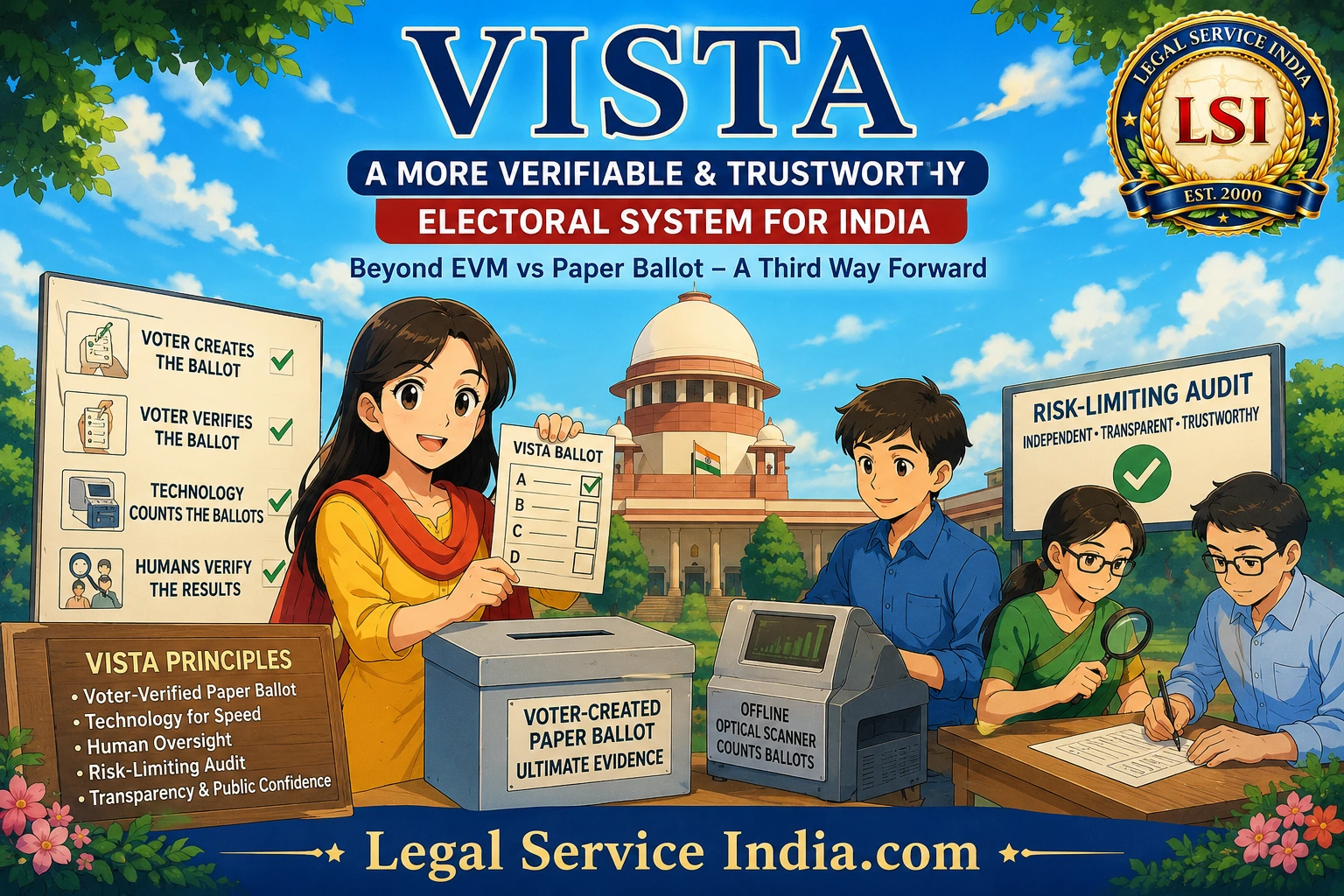
VISTA: My Proposal for a More Verifiable and Trustworthy Electoral System in India
Why India Should Move Beyond the EVM-Versus- Paper-Ballot Debate and Build an Electoral System in Which the Voters Paper Ballot Remains the Ultimate Evidence
By Adv. Tarun Choudhury
Supreme Court Advocate
LegalServiceIndia.com
Introduction
As a lawyer practising before the Supreme Court, I have always believed that institutions become stronger not when we refuse to question them, but when we subject them to reasoned scrutiny and ask whether they can be made better.
India’s electoral system deserves precisely that kind of examination.
The debate over electronic voting machines (VVPAT) and paper ballots has, unfortunately, become heavily polarized. One side often argues that EVMs are the future and that questioning them amounts to questioning the electoral process itself. The other side demands a return to paper ballots, sometimes as though the paper-ballot system of the past had no serious weaknesses.
I do not subscribe to either extreme.
My concern is not to establish that Indian EVMs are fraudulent. The Supreme Court has not made such a finding, and I would be legally and intellectually irresponsible if I made such a claim without evidence.
My question is different:
Can we design an electoral system in which the voter-created physical ballot remains the ultimate legal evidence of the vote, while technology is used to make counting faster and statistical auditing stronger?
I believe we can.
After examining the strengths and weaknesses of electronic voting, traditional paper ballots, VVPAT, election auditing, chain-of-custody safeguards, and international approaches, I would propose that India seriously study a third model.
I call that model:
VISTA—Verifiable India Secure Tabulation & Audit
This is my proposed architecture for discussion and testing, not an assertion that the system is already ready for nationwide implementation.
Its philosophy can be expressed in one sentence:
The computer may count the ballots, but the computer should never own the ballots.
The physical ballot created by the voter should remain the ultimate evidence.
1. Why I Am Not Advocating a Simple Return to Paper Ballots
Let me make my position clear at the outset.
If the question is
Should India simply go back to the old paper-ballot system?
My answer would be no.
I say this not because paper ballots are inherently unreliable, but because India’s experience with traditional paper elections demonstrated that paper alone does not guarantee electoral integrity.
Historically, paper elections were vulnerable to problems such as
- booth capturing
- ballot-box stuffing;
- pre-marked ballots;
- invalid ballots;
- incorrect marking;
- manual counting errors; and
- lengthy counting processes.
Technology was introduced into the electoral process for reasons.
Therefore, if we are going to discuss replacing or substantially modifying the existing system, I would not recommend going backwards.
I would recommend going forward.
What I have in mind is neither the old paper ballot nor an EVM-centric system.
It is a modern paper-first electoral architecture.
2. The Real Question Is Not Whether EVMs Are “Good” or “Bad”
I believe the public debate has been framed incorrectly.
We repeatedly hear:
EVM versus ballot paper.
But that is not the question that lawyers, election administrators, and constitutional policymakers should be asking.
The more important question is
What electoral architecture provides the best combination of secrecy, accuracy, accessibility, speed, transparency, auditability, and public confidence?
That is a much more meaningful question.
The Supreme Court’s 26 April 2024 judgment dealing with EVMs and VVPAT did not find evidence establishing that Indian EVMs were being manipulated. The Court upheld the existing framework and rejected demands for a wholesale return to paper ballots and for 100% VVPAT verification.
That judgment must be acknowledged honestly.
I would therefore never build my argument around the proposition:
“The Supreme Court has found EVMs fraudulent.”
It has not.
Nor would I argue that EVMs have been proved to be incapable of conducting free and fair elections.
That proposition has not been established either.
My argument is much more modest—and, in my view, much more constructive:
Even where an existing system is constitutionally acceptable, India is entitled to examine whether an even more independently verifiable system can be developed for the future.
That is the reform conversation I am proposing.
3. My Basic Idea: Create a Third Way
In my considered view, India should examine a third electoral model built around four simple propositions.
First
The voter should create a physical ballot.
Second
The voter should be able to see and verify that ballot.
Third
Technology should be used to count the ballots quickly.
Fourth
Technology should never be the final authority because the physical ballots should remain available for independent statistical and human verification.
In other words:
Paper provides the evidence. Technology provides the speed. Statistics provide the audit. Human counting provides the ultimate safeguard.
That, in essence, is VISTA.
4. What Would VISTA Actually Look Like?
Let me explain the proposal in practical terms.
A voter would receive a standardized paper ballot.
The ballot would contain:
- candidate number;
- candidate name;
- party symbol;
- clearly defined marking areas; and
- appropriate accessibility instructions.
The voter would physically mark the ballot.
The crucial point is that the voter’s physical act creates the primary electoral record.
There would be no need to treat an electronic record as the original expression of the voter’s choice.
The physical ballot would be the primary evidence.
This is the fundamental departure from an EVM-centric architecture.
5. The Voter Must Be Able to See the Vote
I consider this principle extremely important.
Before the ballot is deposited, the voter should have an opportunity to examine the completed paper.
The voter should be able to satisfy himself or herself:
“This is the vote I have cast.”
That is fundamentally different from asking a voter to trust that an electronic system has internally recorded the intended choice.
The voter-created ballot becomes an independently preserved physical record.
And this is precisely where I see a conceptual strength in a paper-first system.
The ballot does not have to be generated by the machine.
The voter creates it.
6. Then Why Use a Machine at All?
This is the obvious question.
If I am advocating a paper-first system, why introduce a scanner?
Because I am not advocating a return to nineteenth-century election administration.
India needs speed.
India needs accuracy.
India needs scalable election administration.
India cannot realistically require election officials to manually count hundreds of millions of ballots before a result can be declared.
Therefore, I would use an offline optical scanner.
But—and this is the critical qualification—the scanner would not become the ultimate authority.
Its job would principally be
to count quickly.
Not:
to own the election result.
7. The Scanner Should Have a Limited Function
The scanner could determine whether:
- The ballot is readable
- One candidate has been marked;
- multiple candidates appear to have been marked; or
- The ballot contains an ambiguous marking.
It could communicate something as simple as
Accepted
or
Please Review Ballot
The system should not unnecessarily disclose the voter’s selection.
That would help preserve secrecy.
More importantly, the scanner’s interpretation would remain subject to subsequent audit.
This is the distinction I consider central to VISTA:
The machine produces a preliminary count. The paper remains the independent evidence.
8. What If Somebody Manipulates the Scanner?
This is where I believe the proposed architecture becomes particularly interesting.
Let us assume, for argument’s sake, that a scanner has been compromised.
Suppose the scanner reports:
Candidate A—40,000
Candidate B—60,000
But the physical ballots actually show:
Candidate A—55,000
Candidate B—45,000
The electronic preliminary result would obviously be wrong.
But the election itself would not become incapable of verification.
Why?
Because the physical ballots remain.
The discrepancy can be detected through auditing.
The system can then escalate to a larger audit or a complete manual count.
This is an important change in security philosophy.
I am not proposing that we build a machine that can never fail.
I am proposing that we build an election system in which a failure of the machine cannot silently become the final electoral truth.
9. This Is Where Risk-Limiting Audits Become Important
In my view, the most important technical component of VISTA is the risk-limiting audit, commonly known as an RLA.
I would make such auditing a mandatory part of the electoral architecture rather than an exceptional procedure.
The principle is straightforward.
| Candidate | Votes | Nature of Result |
|---|---|---|
| A | 600,000 | Substantial Margin |
| B | 400,000 | Substantial Margin |
There is a substantial margin.
A statistical audit may therefore require examination of a relatively limited number of ballots.
Now imagine:
| Candidate | Votes | Nature of Result |
|---|---|---|
| A | 501,200 | Extremely Narrow Margin |
| B | 498,800 | Extremely Narrow Margin |
The margin is extremely small.
The audit should therefore examine substantially more ballots.
If the evidence remains uncertain, the audit should expand.
Ultimately, if necessary:
Full Manual Count.
I regard that not as a failure of the system, but as the system doing exactly what it was designed to do.
10. I Would Introduce Three Audit Levels
I would propose three broad levels of verification.
Level One — Statistical Audit
A predetermined statistical algorithm would randomly select ballots or batches for manual examination.
The statistical risk limit should be determined in advance and independently validated.
For discussion, a risk limit of 1% or lower could be considered, although the precise figure should be settled only after proper statistical modelling and testing.
The important principle is that the rules must be known before the election, not invented after seeing the result.
Level Two — Expanded Audit
The audit would automatically expand where there are objectively defined warning signs.
These could include:
- Scanner/manual discrepancies;
- Ballot-accounting discrepancies;
- Chain-of-custody irregularities;
- Equipment malfunction;
- Legally defined anomalies;
- Significant candidate objections; or
- An exceptionally narrow margin.
The process should not depend entirely upon political pressure.
Level Three — Full Manual Count
A full hand count should be triggered where:
- The statistical audit cannot confirm the result;
- Material discrepancies remain unexplained;
- Chain of custody has been materially compromised; or
- A statutory threshold is crossed.
The key principle would be
When the evidence is insufficient, the system should count more ballots—not ask citizens to trust the machine more.
11. My Proposal for Close Elections
I would go one step further.
Where the winning margin is exceptionally narrow, I would consider making an enhanced audit automatic.
For example, suppose the result is
| Candidate | Votes |
|---|---|
| Winner | 500,800 |
| Runner-up | 499,200 |
| Difference | 1,600 Votes |
The difference is only 1,600 votes.
Under a predefined close-election rule, the system could automatically move to a higher audit level.
No allegation of fraud would be necessary.
No political party would have to demand a recount.
No candidate would need to approach the court simply to ask whether the closeness of the contest justifies additional verification.
The rule would operate automatically.
The exact threshold—for example, 0.5%—would require proper statistical and legislative examination.
But I strongly favor the principle of automatic escalation based on objectively predetermined conditions.
12. Why Should a Candidate Have to Ask for a Recount?
This is a question I believe deserves greater attention.
A close election should not necessarily become a political dispute.
If the system itself knows that a result falls within a predetermined statistical danger zone, why should a candidate have to make an allegation before additional verification takes place?
Why not simply build the safeguard into the system?
That is the philosophy behind VISTA.
Instead of:
“I Don’t Trust the Result.”
We should have:
“The Result Has Triggered the Statutory Audit Rule. Let Us Follow the Rule.”
That is a much healthier democratic mechanism.
13. The Ballot Must Never Become Traceable to the Voter
As a lawyer, I would regard this as an absolute requirement.
There must never be a system capable of creating:
Voter Identity → Ballot Identity → Candidate Choice.
That would undermine the secrecy of the ballot.
Instead, ballots could be organized into sealed batches.
For example:
Batch 742—200 Ballots
The audit system could identify the batch.
It should not be capable of identifying the individual voter who cast a particular ballot.
The distinction between voter identity and ballot choice must remain structurally protected.
14. Chain of Custody Must Become Much More Transparent
A paper-based system creates another important responsibility: securing the physical ballots.
Every ballot container should have:
- A unique container identifier;
- Tamper-evident seals;
- Recorded seal numbers;
- Two-person custody;
- Documented handovers;
- Timestamps;
- Originating polling station; and
- Destination counting center.
Every transfer should be recorded.
But again, the record should identify the movement of the ballot container, not the identity of individual voters.
The purpose is to answer a simple question:
Can we demonstrate that the ballots counted are the same ballots that left the polling station?
That is a chain-of-custody question.
15. I Would Keep the Voting Equipment Offline
I would not make internet connectivity part of the core voting architecture.
The polling-station scanner should ideally have no unnecessary:
- Wi-Fi;
- Bluetooth;
- Cellular connection;
- Cloud connection; or
- Remote administration.
Why create a network vulnerability where none is necessary?
The machine should perform a limited local task.
The election result should be subject to controlled verification procedures after polling closes.
In election security, simplicity can itself be a security feature.
16. Technology Should Be Used for Speed, Not Blind Trust
This distinction lies at the heart of my proposal.
I am not anti-technology.
On the contrary, I want to use technology intelligently.
I would divide responsibilities as follows:
| Component | Primary Responsibility |
|---|---|
| Machine | Speed |
| Physical Ballot | Evidence |
| Statistical Audit | Verification |
| Human Counting | Final Safeguard |
That is a much more balanced architecture than placing excessive evidentiary dependence upon a single technological process.
17. India Should Not Manually Count Every Ballot Immediately
I can already anticipate the criticism:
“India has an enormous electorate. How can millions of ballots be manually audited?”
That is precisely why I am not proposing a universal immediate manual count.
The answer lies in statistical sampling.
We do not need to count every ballot at the first stage if a scientifically designed audit can determine whether the reported result is supported by sufficient evidence.
Where the result is clear and the audit is clean, the process can remain efficient.
Where the contest is close or the system detects discrepancies, the audit expands.
Where necessary, we count everything.
This is the point at which statistical science becomes extremely useful to election law.
18. I Would Make Counting Centers More Transparent
The counting center should not be treated as a place where the public simply waits for officials to emerge with a result.
The process should be observable.
Appropriate observers, political-party representatives, and accredited media should be able to observe:
- opening of ballot containers;
- reconciliation procedures;
- audit selection;
- manual counting;
- recounts;
- relevant documentation; and
- security procedures.
CCTV could cover storage and counting areas subject to appropriate safeguards.
But I would strongly oppose any surveillance inside the voting booth.
Election transparency must never become voter surveillance.
19. A National Election Stress Test
One of the ideas I would particularly like to see examined is what I would call a
National Election Stress Test
Before an election, randomly selected scanners should be subjected to controlled and adversarial testing.
The exercise should be observable by:
- political parties;
- election experts;
- universities;
- cybersecurity researchers;
- civil society; and
- accredited observers.
The equipment should be tested using difficult but realistic ballot conditions:
- faint marks;
- smudges;
- multiple markings;
- damaged paper;
- unusual permissible marking instruments;
- ambiguous markings; and
- other deliberately challenging conditions.
Then compare:
Human interpretation versus machine interpretation.
The results should be published.
I would much rather see the weaknesses of a system exposed before an election than discover them during a political controversy after an election.
20. Accessibility Cannot Be an Afterthought
There is a legitimate difficulty with a purely paper-based system.
What about voters who cannot independently mark a conventional paper ballot?
The answer is not to abandon paper.
The answer is to build accessibility into the system.
Possible mechanisms could include:
- tactile ballot guides;
- Braille identifiers;
- accessible ballot-marking devices producing physical paper ballots;
- audio instructions; and
- appropriate assisted-voting safeguards.
The important principle remains:
The final legally controlling record should remain the physical ballot.
Technology can assist a voter.
It should not silently replace the independent physical record.
21. What About Invalid Votes?
This is another area where I would not recommend simply reproducing the old ballot paper.
A modern optical-mark ballot could use clearly defined marking areas.
If the voter accidentally marks more than one candidate or makes an ambiguous mark, the system could provide an opportunity for correction before the ballot is finally deposited, subject to carefully drafted legal safeguards.
The rules concerning voter intent must be published in advance.
And where a disputed ballot requires human determination, the final decision should be governed by transparent legal rules.
I would be extremely reluctant to give an opaque algorithm the final authority to determine what a voter intended.
22. The Legal Problem Cannot Be Ignored
This proposal must be approached with constitutional and statutory discipline.
Section 61A of the Representation of the People Act, 1951, provides the statutory basis for voting machines, while the Conduct of Elections Rules contain provisions relating to voting machines and VVPAT.
Therefore, an immediate administrative instruction to abandon EVMs would not be the proper route.
Nor would it be appropriate to suggest that the Election Commission could simply replace the existing system nationwide without considering the statutory framework.
If Parliament and the country seriously wish to explore an alternative architecture, the appropriate approach would be
Legislative authority → regulations → technical standards → pilots → independent evaluation → evidence-based decision.
That is the legally responsible route.
23. I Would Begin With a Pilot, Not a Lok Sabha Election
If VISTA were to be seriously considered, I would strongly oppose testing it for the first time in a nationwide Lok Sabha election.
That would be reckless.
I would begin with approximately 10–20 carefully selected constituencies representing India’s diversity.
For example:
- urban;
- rural;
- tribal;
- mountainous;
- coastal;
- multilingual;
- high-density;
- high turnout; and
- constituencies with many candidates.
The purpose would be to test whether the system works under India’s actual conditions.
24. The Best Experiment Would Compare Three Systems
I would go further.
Where legally and administratively possible, the pilot should enable comparison between:
System A
Existing EVM/VVPAT architecture.
System B
Traditional paper ballot.
System C
VISTA.
Then measure:
- accuracy;
- counting speed;
- cost;
- voter experience;
- accessibility;
- staff workload;
- ballot reconciliation;
- discrepancies;
- audit effectiveness; and
- public understanding.
This would move the debate from television studios and political speeches into the realm of evidence.
25. The Pilot Must Be Allowed to Fail
This is perhaps the most important condition I would impose.
If 20 scanners are tested and three fail, publish it.
If an audit detects a counting discrepancy, publish it.
If ballot reconciliation fails at a polling station, publish it.
If voters find the ballot confusing, publish it.
I do not believe that a new electoral system should be protected from criticism in order to preserve public confidence.
Quite the opposite.
A system becomes credible when it demonstrates:
It can detect its own weaknesses and correct them.
That is much stronger than simply telling citizens to trust it.
26. What About Blockchain?
I would not make blockchain the centerpiece of this reform.
There is a tendency in every technological debate to propose blockchain as though immutability solves every problem.
It does not.
A blockchain could potentially make an electronic record difficult to alter.
But it cannot answer the fundamental question:
Was the original vote correctly captured?
An immutable record of an incorrect vote is still an incorrect vote.
That is why I would focus on the physical voter-created ballot rather than introducing blockchain merely for technological fashion.
27. What About Artificial Intelligence?
AI will undoubtedly have useful roles in future election administration.
It may assist with:
- logistics;
- staffing;
- equipment maintenance;
- anomaly detection;
- ballot-image quality assessment; and
- administrative reconciliation.
But I would draw a clear legal and ethical line:
AI should assist election administration, not become the final judge of voter intention.
If a ballot is ambiguous, the law should decide how it is treated.
A trained human may resolve it under transparent rules.
AI may flag it.
But AI should not become the final sovereign over a citizen’s vote.
28. What Would VISTA Cost?
I would be cautious about quoting a precise national cost before engineering specifications exist.
A serious cost study would need to examine:
- number of polling locations;
- scanners;
- ballot boxes;
- secure paper;
- printing;
- transportation;
- storage;
- staff;
- training;
- accessibility equipment;
- maintenance;
- auditing; and
- replacement cycles.
It is entirely possible that the initial capital expenditure would be substantial.
But that should be compared against the full lifecycle cost of the existing EVM/VVPAT architecture.
Election technology should be evaluated on its total cost over several election cycles, not merely its acquisition price.
29. The Strongest Objections to My Proposal
A proposal of this nature should not be presented without confronting its weaknesses.
| Objection | Response |
|---|---|
| Objection 1: Paper ballots can be stuffed. | Yes. That is why ballot accounting, security, seals, observers, and chain-of-custody safeguards are necessary. |
| Objection 2: Scanners can be manipulated. | Potentially. That is precisely why the scanner cannot be the final authority. |
| Objection 3: Human counters can make mistakes. | Of course. That is why statistical auditing, multiple observers, prescribed counting rules, and escalation mechanisms are required. |
| Objection 4: Counting could become slower. | It could, particularly where an audit escalates. But preliminary electronic counting preserves speed in ordinary circumstances. |
| Objection 5: Paper creates environmental costs. | Yes. That cost must be measured and addressed through responsible paper procurement and recycling. |
| Objection 6: Ballot transportation creates risks. | Yes. That is why chain-of-custody should be treated as a central component of the architecture rather than an administrative afterthought. |
| Objection 7: Why change a system the Supreme Court has accepted? | This is perhaps the strongest objection. My answer is simple: I am not suggesting that the Supreme Court has invalidated EVMs. I am suggesting that India should scientifically examine whether an even more independently auditable system can be developed. |
There is no contradiction between respecting the existing judicial position and researching future electoral improvements.
30. The Fundamental Difference Between My Proposal and the Demand to “Bring Back Ballot Papers”
There is an important distinction that I want to emphasize.
I am not proposing a nostalgic return to the old ballot box.
I am proposing:
A 21st-Century Paper Election.
The difference is substantial.
The old model essentially depended upon:
Paper → human counting → result.
My proposed model would be
Voter → paper ballot → voter verification → secure ballot box → offline optical count → preliminary result → statistical audit → automatic escalation → human count where required.
That is not a return to the past.
It is a redesigned electoral architecture.
31. The Election Commission Should Publish an Election Integrity Report
I would also recommend a substantial improvement in post-election transparency.
After every election, the Election Commission could publish a constituency-wise Election Integrity Report.
It could include:
- ballots issued;
- ballots cast;
- spoiled ballots;
- counted ballots;
- preliminary scanner result;
- audit sample;
- manual audit result;
- discrepancies;
- chain-of-custody exceptions;
- final certified result;
- whether an enhanced audit was triggered; and
- whether a full recount occurred.
Over several elections, this would create an extraordinarily valuable public dataset.
It would allow researchers and constitutional institutions to ask:
- Where do errors occur?
- How often do audits escalate?
- How often do scanners disagree with humans?
- Which safeguards are effective?
- What should be changed?
That is what evidence-based electoral reform looks like.
32. Political Parties Should Have Strong Observation Rights
Political parties must be part of the transparency architecture.
They should be permitted to observe:
- ballot printing;
- transportation;
- sealing;
- scanner testing;
- ballot-box custody;
- counting;
- random audit selection;
- manual audits; and
- recounts.
But there is an important distinction between observation and control.
Political parties should not control the election machinery.
They should be able to observe, document, and challenge according to predetermined legal procedures.
The constitutional authority of the Election Commission must remain protected.
33. My 0–30 Day Reform Plan
If I were asked to initiate this project, I would begin by establishing an independent National Paper Election Architecture Committee.
It should include:
- election administrators;
- constitutional lawyers;
- statisticians;
- cybersecurity experts;
- printing specialists;
- accessibility experts;
- logistics experts;
- political-party representatives;
- academics; and
- civil-society representatives.
The first task should not be procurement.
It should be architecture.
We should first determine:
What exactly are we trying to build?
Only then should we discuss machines.
34. Days 31–90: Build and Attack
The next stage should involve prototypes.
The system should be subjected to deliberate attack.
Try to manipulate:
- scanners;
- ballot accounting;
- chain of custody;
- audit selection;
- ballot interpretation;
- data transfer; and
- counting procedures.
The objective should be to identify weaknesses before the system reaches an actual election.
I would rather discover a vulnerability in a laboratory than in a polling station.
35. Six to Twelve Months: Controlled Elections
The system should then be tested in controlled electoral environments.
The results should be independently evaluated.
And I would insist on one principle:
Do not hide the failures.
If the new system fails, we should know.
If it succeeds, we should know why.
If it performs better than EVM/VVPAT in some respects but worse in others, that too should be reported honestly.
Electoral reform should be based upon evidence rather than predetermined conclusions.
36. The Larger Constitutional Idea
Ultimately, this debate is not really about machines.
It is about constitutional trust.
The vote belongs to the citizen.
The electoral authority counts it.
The state certifies the result.
The courts provide constitutional oversight.
The political parties participate in the democratic process.
Technology is merely an instrument.
It should never become more important than the underlying democratic act.
That is why I believe the physical ballot has a special significance.
It is a tangible piece of evidence created by the voter.
It can be preserved.
It can be inspected.
It can be counted.
It can be recounted.
It can be independently audited.
And where necessary, it can be produced to resolve a dispute.
37. My Final Position
Let me state my position clearly.
I am not arguing that Indian EVMs have been proved fraudulent.
I am not suggesting that the Supreme Court has ordered or recommended a return to paper ballots.
I am not suggesting that VISTA is already a proven nationwide electoral technology.
I am proposing something more practical.
I am suggesting that India should research, develop, attack, test, and independently evaluate a paper-first, audit-first electoral architecture before deciding whether such a system has any place in future elections.
If it fails rigorous testing, we should reject it.
If it succeeds, we should have the intellectual honesty to consider it.
That is how serious institutional reform should happen.
Conclusion: My Vision for the Future of Indian Elections
In my considered view, India should not remain trapped in the question:
EVM or ballot paper?
That is yesterday’s debate.
The question for tomorrow should be:
How do we combine the transparency of a voter-created paper ballot, the speed of technology, the mathematical strength of statistical auditing, and the safeguard of human verification?
My answer is the architecture I have proposed as VISTA—Verifiable India Secure Tabulation & Audit.
Its core structure is simple:
Voter-created paper ballot
↓
Voter verification
↓
Secure ballot box
↓
Offline optical counting
↓
Preliminary result
↓
Mandatory risk-limiting audit
↓
Automatic escalation where necessary
↓
Human count as the ultimate safeguard.
The philosophy behind it is even simpler:
Trust the voter-created evidence. Use machines for speed. Use statistics for verification. Use human beings for the final safeguard.
As a lawyer, I believe that is the direction in which the discussion should move.
We should not design elections around the assumption that any machine is infallible.
Nor should we design elections around the assumption that human beings are infallible.
We should design them around a more realistic constitutional principle:
Errors may occur. Manipulation may be attempted. But the system must make such errors or manipulation difficult to conceal, capable of detection, capable of proof, and capable of correction.
That, in my view, is the real meaning of an auditable election.
And if India ever chooses to develop a new generation of electoral technology, I would put forward one principle above all others:
The Computer May Count the Ballot, but the Computer Must Never Become the Owner of the Vote.
Have a legal question about electoral reform, election law, or constitutional issues?
Adv. Tarun Choudhury
Supreme Court Advocate | 25+ Years of Legal Experience
If you need professional legal guidance concerning election law, electoral disputes, constitutional matters, voting systems, or democratic reforms, you may contact Adv. Tarun Choudhury for legal consultation.
- 📞 Call: 9891244487
- 💬 WhatsApp: 9891244487
Legal Perspective. Constitutional Experience. Practical Legal Guidance.
Author’s Note: VISTA is a policy and electoral-system proposal put forward for research, debate, pilot testing, and independent evaluation. It is not presented as an existing Election Commission system or as a claim that India should immediately replace its present voting mechanism. The proposal should be subjected to constitutional, statutory, statistical, cybersecurity, accessibility, logistical, and empirical scrutiny before any consideration of implementation.