Introduction
A person who has lost a case in the High Court will quite naturally ask the next question: Can the High Court judgement be challenged before the Supreme Court?
In many cases, the answer is yes. But that answer needs an important qualification.
The Supreme Court is not a routine third forum where every unsuccessful litigant can ask for the entire case to be heard afresh. The principal constitutional provision is Article 136 of the Constitution of India, which gives the Supreme Court a discretionary power to grant special leave to appeal.
That distinction between a right of appeal and a discretionary power to grant special leave is at the heart of the matter.
An SLP is therefore not simply another appeal drafted in a different format. The Supreme Court expects the petitioner to demonstrate why the case deserves the exercise of its extraordinary jurisdiction.
This is why, when advising a client after an adverse High Court judgement, I would not begin with the question:
“What did the High Court get wrong?”
I would begin with a more fundamental question:
“What is wrong with the High Court judgement in a manner that calls for the intervention of the Supreme Court under Article 136?”
That difference may appear subtle. In practice, it is often decisive.
Also Read: Can I File an SLP Against a High Court Judgement? Article 136 Explained
Article 136: The Constitutional Foundation
Article 136(1) provides that the Supreme Court may, in its discretion, grant special leave to appeal from any judgement, decree, determination, sentence or order passed or made by any court or tribunal in India.
The language of the Constitution is significant.
It does not say that an aggrieved party shall have an appeal to the Supreme Court. It says that the Supreme Court may, in its discretion, grant special leave.
Article 136 is therefore an extraordinary and residuary appellate jurisdiction.
There is also an express constitutional limitation. Article 136(2) excludes judgements, determinations, sentences and orders of courts or tribunals constituted under laws relating to the Armed Forces.
Article 141 is equally important in this context. It provides that the law declared by the Supreme Court is binding on all courts in India.
Thus, where a High Court merely distinguishes a Supreme Court judgement because of different facts, one issue arises. Where the High Court disregards a legal proposition actually declared by the Supreme Court, an entirely different issue arises.
The distinction must be demonstrated carefully in the SLP. Merely stating that the High Court “has not followed Supreme Court judgements” is not enough.
An SLP Is Not an Automatic Further Appeal
The Supreme Court explained the structure of Article 136 with considerable clarity in Kunhayammed v. State of Kerala, (2000) 6 SCC 359.
The Court explained that Article 136 operates in two stages.
- The first is the stage at which the Supreme Court considers whether special leave should be granted.
- The second begins only after leave has been granted. At that stage, the matter enters the appellate jurisdiction of the Supreme Court.
This distinction is not academic.
At the SLP stage, the petitioner is asking the Supreme Court to exercise its discretion and permit the matter to enter its appellate jurisdiction. There is no automatic entitlement to that permission.
This is also why an SLP should not simply reproduce the appeal that was already argued before the High Court.
The petition must identify the exceptional feature of the case.
The Principle Goes Back to the Early Years of the Supreme Court
The leading starting point is Pritam Singh v. The State, 1950 SCR 453: AIR 1950 SC 169.
The judgement remains important because it explained the extraordinary character of Article 136 at a very early stage of the Supreme Court’s constitutional history.
The Court made it clear that the power should be exercised sparingly and in exceptional cases. It referred to exceptional and special circumstances, substantial and grave injustice, and circumstances of sufficient gravity to justify intervention.
The Court also rejected the idea that Article 136 should turn the Supreme Court into another ordinary court of facts.
That principle remains highly relevant today.
Every SLP begins with a litigant who believes that the High Court has made an error. That, by itself, cannot be the test.
If disagreement with a High Court judgement were sufficient, Article 136 would effectively become an unrestricted third appeal.
It is not.
So, When Does the Supreme Court Interfere With a High Court Judgement?
There is no exhaustive statutory list of circumstances in which the Supreme Court must or may interfere.
That is partly because Article 136 is deliberately broad.
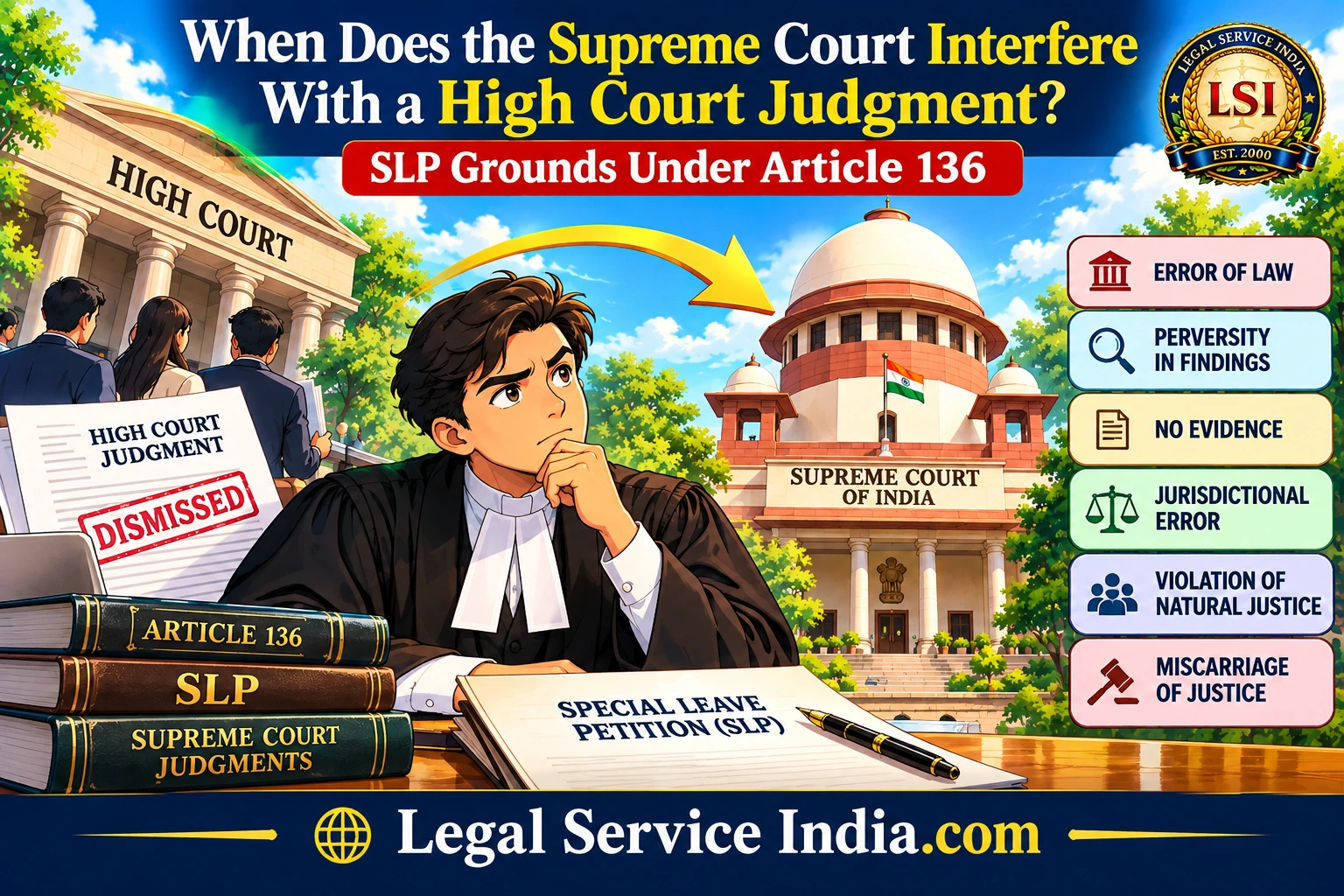
Over the years, however, certain recurring categories have emerged. They include cases involving:
- a manifest error of law;
- perversity in findings;
- findings based on no evidence;
- material evidence being ignored;
- jurisdictional error;
- failure to exercise jurisdiction;
- exercise of jurisdiction where none exists;
- disregard of binding Supreme Court precedent;
- serious procedural illegality;
- violation of natural justice;
- arbitrary or legally unsustainable exercise of discretion; and
- serious miscarriage of justice.
These expressions should not be treated as interchangeable.
Each describes a different kind of defect.
A Wrong Judgement Is Not Necessarily a Perverse Judgement
This is one of the most important distinctions in Article 136 jurisprudence.
A litigant may genuinely believe that the High Court has reached the wrong conclusion.
That does not automatically mean that the conclusion is perverse.
Suppose the evidence permits two reasonably possible interpretations. The High Court accepts one of them.
The unsuccessful party may strongly believe that the other interpretation is preferable.
That disagreement alone does not necessarily justify Supreme Court interference.
A perverse finding is something more serious.
It may arise where the conclusion has no reasonable evidentiary foundation, where material evidence has been ignored, where the finding is fundamentally inconsistent with the record, or where the conclusion is one that a reasonable court could not have reached on the material before it.
In other words:
A finding is not perverse merely because it is adverse.
That distinction should be kept firmly in mind while drafting an SLP.
Error of Law and Manifest Error of Law
There is a similar distinction between an ordinary error of law and a manifest error of law.
An error of law may arise because the court has misunderstood a statutory provision or applied an incorrect legal principle.
But not every arguable question of statutory interpretation becomes an Article 136 case.
A stronger case arises where the High Court’s legal approach is plainly inconsistent with:
- the statutory language;
- a mandatory statutory requirement;
- a binding Supreme Court decision; or
- the basic legal framework governing the dispute.
For example, if the High Court applies a legal test that the Supreme Court has already rejected, and that legal error determines the outcome, the case presents a substantially different problem from a situation in which two interpretations of an uncertain statutory provision are reasonably possible.
The SLP should therefore identify the precise legal proposition involved.
A collection of authorities is not a substitute for a clearly demonstrated error.
Findings Based on No Evidence
A finding based on no evidence occupies a particularly important place in appellate scrutiny.
There is a difference between:
- “There was not enough evidence.”
- “There was no evidence capable of supporting the finding.”
The first may involve appreciation of evidence.
The second can raise a much more fundamental question.
Counsel alleging that a finding is based on no evidence should therefore identify:
- the precise finding;
- the evidence relied upon by the High Court;
- the material actually available on record;
- why that material cannot support the conclusion; and
- how the conclusion affected the final judgement.
Simply describing a finding as “perverse” or “unsupported by evidence” without demonstrating the defect does little to assist the Court.
Ignoring Material Evidence
A judgement does not become legally vulnerable merely because the judge has not discussed every document placed before the court.
A judicial judgement is not required to become an inventory of every page of the record.
The question is whether material evidence relevant to the determination of the dispute was ignored.
If, for example, an important admission, registered document, expert report or other crucial piece of evidence could materially affect the result and the judgement proceeds without considering it, the omission may assume significance.
The correct approach in an SLP is to identify that material specifically.
A pleading that merely says:
“The High Court failed to appreciate the evidence correctly.”
is generally weaker than one that identifies the particular evidence ignored and demonstrates why that evidence mattered.
Jurisdictional Error: When the High Court Crosses the Legal Boundary
Jurisdictional errors are another important category.
A High Court may commit a jurisdictional error where it:
- exercises a power that the law does not confer;
- refuses to exercise jurisdiction that the law requires it to exercise;
- proceeds under the wrong jurisdictional provision;
- travels beyond the limits of the proceeding; or
- fundamentally misunderstands the nature and extent of the jurisdiction being exercised.
But an important caution is necessary.
An error committed while exercising jurisdiction is not automatically a jurisdictional error.
If the High Court unquestionably has jurisdiction over the matter but allegedly reaches the wrong conclusion, the petitioner must identify the substantive legal defect rather than simply describing it as “jurisdictional”.
Precision in terminology matters before the Supreme Court.
Violation of Natural Justice and Procedural Fairness
There are cases where the problem lies not in the substantive conclusion but in the manner in which the decision was reached.
Natural justice generally requires a meaningful opportunity of hearing and an impartial adjudicatory process.
A serious case may arise where a party:
- was denied a real opportunity to present its case;
- was confronted with material on which the decision was based without an appropriate opportunity to respond;
- was denied consideration of a material submission in circumstances causing real prejudice; or
- was affected by legally relevant bias.
But every procedural irregularity does not automatically invalidate a judgment.
The Court is concerned with substantive fairness and prejudice, not merely procedural technicalities.
What About Concurrent Findings of Fact?
This is an area where many SLPs go wrong.
Suppose the trial court reaches a factual conclusion and the High Court agrees with it.
The unsuccessful party then approaches the Supreme Court and asks it to reconsider the same evidence.
That is not ordinarily enough.
The Supreme Court has repeatedly exercised restraint where concurrent findings are supported by the record and represent a possible view of the evidence.
But concurrent findings are not immune from Supreme Court scrutiny.
If the findings are:
- perverse;
- based on no evidence;
- reached by ignoring material evidence;
- founded on a serious error of law; or
- otherwise affected by a defect warranting extraordinary intervention,
the fact that both courts below reached the same conclusion does not prevent the Supreme Court from examining the matter.
The question is not simply whether the findings are concurrent.
The question is whether the findings can legally and reasonably stand.
A Recent Illustration: State of Uttar Pradesh v. A.K. Gaba
A useful recent illustration is State of Uttar Pradesh v. A.K. Gaba & Ors., Criminal Appeals Nos. 3383–3385 of 2025, 2026 INSC 568, decided on 27 May 2026 by Justices Pankaj Mithal and Prasanna B. Varale.
The matter arose from a corruption prosecution in which the Allahabad High Court, Lucknow Bench, had acquitted the accused.
The Supreme Court examined the High Court’s appreciation of the evidence and the principles governing interference with acquittal.
The Court referred to earlier authorities including Chandrappa v. State of Karnataka, (2007) 4 SCC 415 and Hakeem Khan v. State of M.P., (2017) 5 SCC 719.
The important point was not simply that the High Court had acquitted the accused.
The Supreme Court examined how the High Court had arrived at that conclusion.
At paragraph 34, the Court described the High Court’s view as a “plausible and possible view.”
Paragraph 35 reiterated the principle that the Supreme Court does not ordinarily interfere with an acquittal under Article 136 unless the findings are manifestly illegal, perverse or result in miscarriage of justice.
The Supreme Court found no such exceptional circumstance and dismissed the appeals.
The significance of the judgment lies in its practical demonstration of judicial restraint.
The Court did not say that a High Court can never be wrong.
It said, in substance, that where the High Court has examined the evidence and arrived at a plausible and possible conclusion, Article 136 is not a mechanism for simply replacing that conclusion with another view.
That distinction is fundamental.
Challenging a High Court Acquittal
An appeal against acquittal deserves particular care.
Once an accused has been acquitted, the presumption of innocence receives additional reinforcement.
That does not eliminate the appellate jurisdiction of the Supreme Court.
But it affects the manner in which that jurisdiction is exercised.
The Supreme Court has repeatedly recognised that where two reasonable conclusions are possible on the evidence, the acquittal should ordinarily not be displaced merely because another view can be taken.
Therefore, an SLP challenging an acquittal should ordinarily identify something more substantial than disagreement with the prosecution evidence.
The petition should demonstrate, for example, that the High Court:
- ignored material evidence;
- adopted a legally impermissible approach;
- reached a conclusion unsupported by the record;
- misunderstood a material legal principle; or
- arrived at a manifestly illegal or perverse conclusion resulting in serious injustice.
That is a much more exacting exercise than simply rearguing the prosecution case.
Challenging a High Court Conviction
The position is not identical when the High Court has convicted an accused.
The reinforced presumption of innocence applicable to an acquittal is obviously not operating in the same manner against a conviction.
After leave is granted, the Supreme Court can examine the conviction within its appellate jurisdiction.
Potential grounds may include:
- an incorrect interpretation of the ingredients of the offence;
- reliance on inadmissible material;
- failure to consider material defence evidence;
- a legally impermissible burden of proof;
- a finding unsupported by the record;
- perversity in appreciation of evidence; or
- serious violation of procedural safeguards.
But the same Article 136 discipline remains relevant at the threshold.
The petition must still explain why the matter warrants the Supreme Court’s intervention.
Bail Orders: When Will the Supreme Court Interfere?
Bail is another area where the distinction between disagreement and legal error becomes particularly important.
A High Court exercises judicial discretion when deciding whether bail should be granted or refused.
The Supreme Court does not ordinarily interfere merely because it might have exercised that discretion differently.
The question is whether the High Court exercised its discretion properly and with due application of mind.
In Mahipal v. Rajesh Kumar, (2020) 2 SCC 118, the Supreme Court explained that interference with a High Court order granting bail is not an ordinary exercise. Intervention becomes justified where the discretion has been exercised without due application of mind or contrary to the directions of the Supreme Court.
A recent example is Usman Ali v. State of Uttar Pradesh, 2026 INSC 98.
The Supreme Court granted leave to examine the challenge, but ultimately dismissed the appeal and did not disturb the bail granted by the Allahabad High Court.
That is itself an important lesson:
- Grant of leave does not mean that the appellant will ultimately succeed.
A contrasting example is Mohseen v. State of Uttar Pradesh, 2026 INSC 526.
There, the Supreme Court interfered with the High Court’s bail order because the High Court had failed to properly engage with an earlier Supreme Court order cancelling bail and had overlooked material circumstances, including the accused’s abscondence and the distinct role attributed to him.
Taken together, the cases illustrate the principle more clearly than either case in isolation.
The Supreme Court will respect judicial discretion where it has been properly exercised.
It will intervene where the exercise of that discretion is legally defective.
Key Principles on Supreme Court Intervention
| Issue | Important Consideration |
|---|---|
| Jurisdictional Error | The High Court must have acted beyond, refused to exercise, or fundamentally misunderstood its lawful jurisdiction. |
| Natural Justice | The focus is on meaningful hearing, procedural fairness, legally relevant bias and actual prejudice. |
| Concurrent Findings | Concurrent findings are not ordinarily reconsidered merely because another view of the evidence is possible. |
| Acquittal | Intervention requires more than disagreement with the evidence; exceptional circumstances such as perversity or manifest illegality may justify scrutiny. |
| Conviction | Potential grounds may include errors of law, inadmissible material, ignored defence evidence, perversity and procedural violations. |
| Bail | The Supreme Court does not ordinarily substitute its discretion merely because it might have reached a different conclusion. |
Articles 226 and 227: The Nature of the High Court’s Jurisdiction Matters
High Court orders passed under Articles 226 and 227 also frequently reach the Supreme Court.
But Articles 226 and 227 should not be treated as though they confer identical jurisdiction.
Article 226 concerns the High Court’s writ jurisdiction.
Article 227 concerns its power of superintendence over subordinate courts and tribunals.
An SLP challenging an Article 227 order therefore has to take account of the supervisory nature of that jurisdiction.
A useful recent example is Vinay Raghunath Deshmukh v. Natwarlal Shamji Gada, 2026 INSC 416.
The case concerned an amendment of pleadings and the High Court’s exercise of supervisory jurisdiction under Article 227.
The Supreme Court’s intervention was directed to the limits of that supervisory jurisdiction. The case should not, however, be presented as establishing a general Article 136 formula. Its significance is narrower: the High Court exercising Article 227 jurisdiction does not simply become an appellate court re-examining the merits of a discretionary order allowing amendment.
That distinction is important when challenging an Article 227 judgment.
Civil, Service, Tax and Commercial Matters
Article 136 applies across a wide range of litigation.
The underlying constitutional standard remains the same, although the nature of the error will vary according to the case.
In a civil dispute, the issue may concern:
- interpretation of a document;
- limitation;
- jurisdiction;
- perversity of factual findings; or
- application of a statutory provision.
In a service matter, the central issue may be statutory interpretation, jurisdiction or violation of service rules.
In taxation, questions of statutory construction and jurisdiction frequently assume importance.
In commercial litigation, the Court may be dealing with contractual interpretation, arbitration, limitation or discretionary interim relief.
The fact that a case belongs to a particular legal category does not by itself determine whether Article 136 intervention is warranted.
What matters is the nature and seriousness of the error.
Discretionary Orders: Another Area of Judicial Restraint
The Supreme Court generally exercises caution when dealing with discretionary orders.
This includes matters such as:
- condonation of delay;
- amendment of pleadings;
- interim injunctions;
- procedural directions; and
- other interlocutory matters.
But judicial discretion is not beyond appellate scrutiny.
In Shivamma (Dead) by LRs v. Karnataka Housing Board, 2025 INSC 1104, the Supreme Court dealt with condonation of an extraordinary delay of 3966 days.
The case illustrates an important principle: discretion must still be exercised according to law.
A discretionary power does not mean an unrestricted power.
At the same time, an SLP cannot succeed merely by demonstrating that the Supreme Court might have exercised the discretion differently.
The petitioner must identify the legal defect in the exercise of discretion.
The Difference Between SLP Dismissal and Dismissal After Leave
This distinction is often misunderstood by litigants.
The sequence is:
- SLP filed
- Supreme Court considers whether to grant leave
- Either:
- Leave refused
- or
- Leave granted
- Appeal proceeds
In Kunhayammed, the Supreme Court explained the consequences of these different stages.
If an SLP is dismissed without grant of leave, the High Court judgment does not ordinarily merge into the Supreme Court’s order.
A non-speaking dismissal of an SLP is also not, by itself, a declaration of law under Article 141.
Once leave has been granted and the Supreme Court decides the appeal on merits, the legal consequences are different and the doctrine of merger becomes relevant.
This distinction is not merely technical.
A lawyer advising a client that “the Supreme Court has upheld the High Court judgment” simply because an SLP was dismissed at the threshold may be conveying an inaccurate legal position.
What Should a Lawyer Examine Before Filing an SLP?
Before drafting an SLP, I would first put the client’s grievance aside and read the High Court judgment carefully.
The first question is:
What exactly has the High Court decided?
Then:
What findings actually support that decision?
After that:
Is the error factual, legal, jurisdictional or procedural?
The record should then be tested against the findings.
If material evidence was ignored, where is that evidence?
If the finding is said to be perverse, why?
If a Supreme Court precedent has allegedly been violated, what exact proposition was declared by that precedent?
If jurisdiction is challenged, what provision defines the jurisdiction?
If natural justice is invoked, what was the actual prejudice?
These are not drafting formalities.
They are the questions that determine whether the SLP has a real Article 136 foundation.
The Most Important Drafting Lesson
There is a substantial difference between saying:
“The High Court has wrongly appreciated the evidence.”
and saying:
“The High Court’s conclusion rests upon a finding for which the record contains no supporting evidence, while the material admission contained in the record has not been considered; that omission directly affects the finding on which the impugned judgment rests.”
The second formulation gives the Court something capable of examination.
The same principle applies to a question of law.
Instead of writing:
“The High Court has ignored the judgments of the Supreme Court.”
the petition should identify:
“The High Court has adopted a legal test inconsistent with the proposition declared by the Supreme Court in the governing authority, and that legal error forms the basis of the impugned conclusion.”
That is how an SLP moves from a statement of grievance to a properly articulated ground of intervention.
What the Supreme Court Will Not Ordinarily Do
There are certain things an Article 136 petition should not expect the Supreme Court to do routinely.
The Court will not ordinarily:
- conduct a fresh trial;
- reweigh every piece of evidence;
- replace one plausible factual view with another merely because it prefers it;
- interfere with a properly exercised judicial discretion merely because another outcome was possible;
- treat every legal error as an exceptional constitutional case; or
- interfere simply because the losing party remains dissatisfied with the High Court’s conclusion.
This is why adjectives are not enough.
Calling a judgment “perverse”, “illegal” or “arbitrary” does not make it so.
The defect has to be demonstrated from the judgment, the record and the applicable law.
A Practical Article 136 Decision Tree
High Court Judgment
↓
Is there a maintainable route to the Supreme Court?
Also check the constitutional limitation under Article 136(2).
↓
Is there an exceptional legal, constitutional, jurisdictional or factual defect?
If not, ask whether the proposed challenge is merely disagreement with the result.
↓
Is the finding perverse, unsupported by evidence or manifestly illegal?
If yes, identify the exact finding and the material demonstrating the defect.
↓
Has binding Supreme Court law been ignored or misapplied?
Identify the exact proposition and the conflict.
↓
Has there been serious procedural unfairness, jurisdictional failure or miscarriage of justice?
Demonstrate the prejudice and effect on the result.
↓
Is the petition ultimately asking the Supreme Court only to take another view of evidence on which the High Court has already taken a plausible view?
If yes, the case faces the central restraint governing Article 136.
This is a practical framework, not a statutory checklist. The Supreme Court’s jurisdiction remains discretionary.
Recent Supreme Court Authorities: What They Actually Show
The recent cases are useful when placed in their proper context.
- State of U.P. v. A.K. Gaba, 2026 INSC 568 illustrates restraint in an appeal against acquittal where the High Court’s view was found to be plausible and possible.
- Usman Ali v. State of U.P., 2026 INSC 98 demonstrates that even after leave is granted, the Supreme Court may ultimately decline to interfere with a High Court bail order.
- Mohseen v. State of U.P., 2026 INSC 526 demonstrates the opposite situation, where the High Court’s bail order suffered from a serious defect because material circumstances and an earlier Supreme Court order were not properly considered.
- Chennai Metropolitan Development Authority v. Dr. Kamala Selvaraj, 2025 INSC 1200 illustrates restraint concerning concurrent factual findings that were supported by the record and free from perversity.
- Shivamma, 2025 INSC 1104 concerns judicial discretion in condonation of delay and demonstrates that discretionary orders remain subject to legal scrutiny.
- Vinay Raghunath Deshmukh, 2026 INSC 416 belongs principally to the Article 227 and amendment context and should not be overstated as a general Article 136 authority.
None of these decisions replaces the foundational principles laid down in Pritam Singh and Kunhayammed.
They demonstrate how those principles operate in different factual and procedural settings.
Conclusion
The question “When Does the Supreme Court Interfere With a High Court Judgment?” cannot be answered simply by preparing a list of grounds.
Article 136 is deliberately broad, but its exercise is exceptional.
The Supreme Court may intervene where the High Court judgment suffers from a serious legal or jurisdictional defect, where findings are perverse or unsupported by evidence, where material evidence has been ignored, where binding Supreme Court law has been disregarded, where there has been serious procedural unfairness, or where allowing the judgment to stand would result in a grave miscarriage of justice.
But a litigant must understand the other side of the principle as well.
A High Court judgment does not become vulnerable merely because another view is possible.
Where the High Court has considered the evidence, applied the relevant law and arrived at a plausible conclusion, the Supreme Court ordinarily does not convert Article 136 into another round of factual litigation.
The recent decision in State of Uttar Pradesh v. A.K. Gaba is a good illustration. The Supreme Court examined the High Court’s reasoning and found its conclusion to be a plausible and possible view. In the absence of the kind of perversity, manifest illegality or miscarriage of justice contemplated by the jurisprudence, the Court declined to interfere.
For a litigant considering an SLP, therefore, the more useful question is not merely:
“Why do I believe the High Court is wrong?”
It is:
“What is the exceptional legal reason why the Supreme Court should exercise its jurisdiction under Article 136?”
That is the question around which a serious SLP must be built.
And, in my experience, the strongest petitions are not necessarily those containing the greatest number of grounds. They are those that identify the one or two fundamental defects in the High Court judgment that can be demonstrated clearly from the record and the law.
That is ultimately what gives an Article 136 petition its legal force.
Need Legal Advice on Challenging a High Court Judgment?
A High Court judgment can have serious consequences, and deciding whether to approach the Supreme Court through a Special Leave Petition (SLP) requires careful assessment of the facts, legal grounds, limitation and the scope of Article 136 of the Constitution.
Do not leave the decision to guesswork. If you are considering challenging a High Court judgment, order or decision before the Supreme Court, obtain a professional assessment of your case before taking the next step.
Adv. Tarun Choudhury
Supreme Court Advocate | 25+ Years of Legal Experience
Whether your matter involves a High Court judgment, SLP, civil dispute, criminal matter, bail order, service dispute, constitutional issue or other substantial question of law, your case should be examined on its individual facts and applicable law.
- 📞 Call for a consultation: 9650499965
- 💬 WhatsApp: 8851978611
- ✉️ Email: [email protected]
Your next legal step should be based on a careful assessment of the judgment—not assumptions.
Discuss your High Court judgment and possible Supreme Court remedy with an experienced Supreme Court Advocate.
Frequently Asked Questions
Can Every High Court Judgment Be Challenged Before the Supreme Court?
A Special Leave Petition may be maintainable in many cases, subject to constitutional and statutory limitations. However, Article 136 does not confer an automatic right to appeal. The Supreme Court decides whether special leave should be granted.
Is an SLP the Same Thing as an Appeal?
No. The SLP is the request for special leave. If leave is granted, the matter enters the appellate stage. This distinction was explained comprehensively in Kunhayammed v. State of Kerala.
Can the Supreme Court Interfere With Findings of Fact?
Yes, but ordinarily not merely because it would have appreciated the evidence differently. Exceptional circumstances such as perversity, no evidence, ignored material evidence or serious legal error may justify intervention.
Can the Supreme Court Interfere With Concurrent Findings of Fact?
Yes, in an appropriate case. Concurrent findings are entitled to substantial respect, but they are not immune if they are perverse, unsupported by evidence or affected by a serious error of law.
When Does the Supreme Court Interfere With a High Court Acquittal?
The Supreme Court exercises considerable restraint. In State of U.P. v. A.K. Gaba, the Court reiterated that interference under Article 136 with an acquittal is ordinarily unwarranted unless the findings are manifestly illegal, perverse or result in miscarriage of justice.
Can the Supreme Court Interfere With a High Court Bail Order?
Yes. But ordinary disagreement with the High Court’s discretion is generally insufficient. Interference may be justified where the discretion has been exercised without due application of mind or contrary to binding Supreme Court directions.
Does Dismissal of an SLP Mean That the Supreme Court Has Upheld the High Court Judgment?
Not necessarily. The legal consequences depend upon whether leave was granted and whether the Supreme Court subsequently decided the appeal on merits. A non-speaking dismissal of an SLP before grant of leave does not ordinarily result in merger or constitute a declaration of law under Article 141.
What Is the Strongest Ground in an SLP Against a High Court Judgment?
There is no universal “strongest” ground. The strength of an SLP depends on the record. A clearly demonstrated jurisdictional error, manifest legal error, perversity, disregard of binding precedent or serious miscarriage of justice may provide a basis for Article 136 intervention.
Important Authorities
| Case | Citation | Principal Relevance |
|---|---|---|
| Pritam Singh v. The State | 1950 SCR 453 : AIR 1950 SC 169 | Exceptional nature of Article 136; substantial and grave injustice; restraint regarding factual findings |
| Kunhayammed v. State of Kerala | (2000) 6 SCC 359 | Two stages of Article 136; SLP dismissal, leave, appeal and merger |
| Chandrappa v. State of Karnataka | (2007) 4 SCC 415 | Principles governing appeals against acquittal |
| Hakeem Khan v. State of M.P. | (2017) 5 SCC 719 | Distinction between a possible view and a view merely considered wrong |
| Mahipal v. Rajesh Kumar | (2020) 2 SCC 118 | Judicial scrutiny of High Court bail orders |
| Chennai Metropolitan Development Authority v. Dr. Kamala Selvaraj | 2025 INSC 1200 | Concurrent findings and restraint under Article 136 |
| Shivamma (Dead) by LRs v. Karnataka Housing Board | 2025 INSC 1104 | Judicial discretion and condonation of delay |
| Vinay Raghunath Deshmukh v. Natwarlal Shamji Gada | 2026 INSC 416 | Article 227 supervision and amendment proceedings |
| Mohseen v. State of Uttar Pradesh | 2026 INSC 526 | Interference with defective High Court bail order |
| State of Uttar Pradesh v. A.K. Gaba | 2026 INSC 568 | Recent illustration of restraint in interference with High Court acquittal |
| Usman Ali v. State of Uttar Pradesh | 2026 INSC 98 | Recent illustration of Supreme Court declining to disturb High Court bail order |
Key Takeaways
- The Supreme Court does not treat Article 136 as an ordinary third appeal. The power to grant Special Leave Petition (SLP) is discretionary and is exercised in exceptional cases involving serious legal or factual defects.
- The Supreme Court may interfere with a High Court judgment when there is manifest illegality, perversity, jurisdictional error, serious procedural unfairness, disregard of binding Supreme Court law, or a miscarriage of justice.
- A mere disagreement with the High Court’s appreciation of evidence is generally not enough. Article 136 is not intended to provide another routine opportunity to reargue the facts.
- Perversity is more than an incorrect finding. A finding may become vulnerable where it cannot reasonably be sustained on the evidence, is based on no evidence, ignores material evidence, or proceeds on an irrational or legally unsustainable basis.
- Concurrent findings of fact receive substantial judicial restraint. However, concurrent findings are not immune from Supreme Court interference where they are perverse, unsupported by evidence, legally erroneous, or result in serious injustice.
- A High Court judgment contrary to binding Supreme Court precedent may justify intervention. The SLP should identify the specific Supreme Court ruling, the legal proposition actually declared, and the precise manner in which the High Court departed from it.
- High Court acquittals receive particularly careful scrutiny. In State of Uttar Pradesh v. A.K. Gaba, 2026 INSC 568, the Supreme Court reiterated that interference with an acquittal under Article 136 is ordinarily not warranted unless the findings are manifestly illegal, perverse, or result in miscarriage of justice.
- High Court bail orders are also subject to restraint. The Supreme Court does not normally interfere merely because it might have exercised discretion differently. Intervention may be justified where the High Court exercised discretion without due application of mind or contrary to Supreme Court directions.
- Recent bail decisions illustrate both sides of the Article 136 jurisdiction. Usman Ali v. State of Uttar Pradesh, 2026 INSC 98, demonstrates restraint, while Mohseen v. State of Uttar Pradesh, 2026 INSC 526, illustrates interference where material circumstances and an earlier Supreme Court order were not properly considered.
- An SLP and an appeal are not the same thing. Under Kunhayammed v. State of Kerala, (2000) 6 SCC 359, Article 136 operates in two stages: first, the Supreme Court decides whether to grant leave; only after leave is granted does the matter enter the appellate stage.
- Dismissal of an SLP without reasons does not ordinarily amount to a declaration of law under Article 141. Nor does merger ordinarily take place merely because an SLP has been dismissed at the leave stage.
- The strongest SLP grounds identify the exceptional defect rather than merely repeating the arguments rejected by the High Court. The petition should explain precisely what the High Court got legally or factually wrong and why that error warrants extraordinary Supreme Court intervention.
- The central question in an SLP is not simply whether the High Court was wrong. The more important question is whether the High Court judgment contains an exceptional defect serious enough to justify the Supreme Court exercising its discretionary jurisdiction under Article 136.
In Simple Terms
The Supreme Court may interfere with a High Court judgment when the decision is manifestly illegal, perverse, jurisdictionally defective, contrary to binding Supreme Court law, procedurally unfair, or results in a serious miscarriage of justice. It ordinarily will not interfere merely because another view of the evidence is possible.
Summary: When Does the Supreme Court Interfere With a High Court Judgment?
Article 136 | SLP Against High Court Judgment | Supreme Court Interference | Special Leave Petition | Grounds for SLP