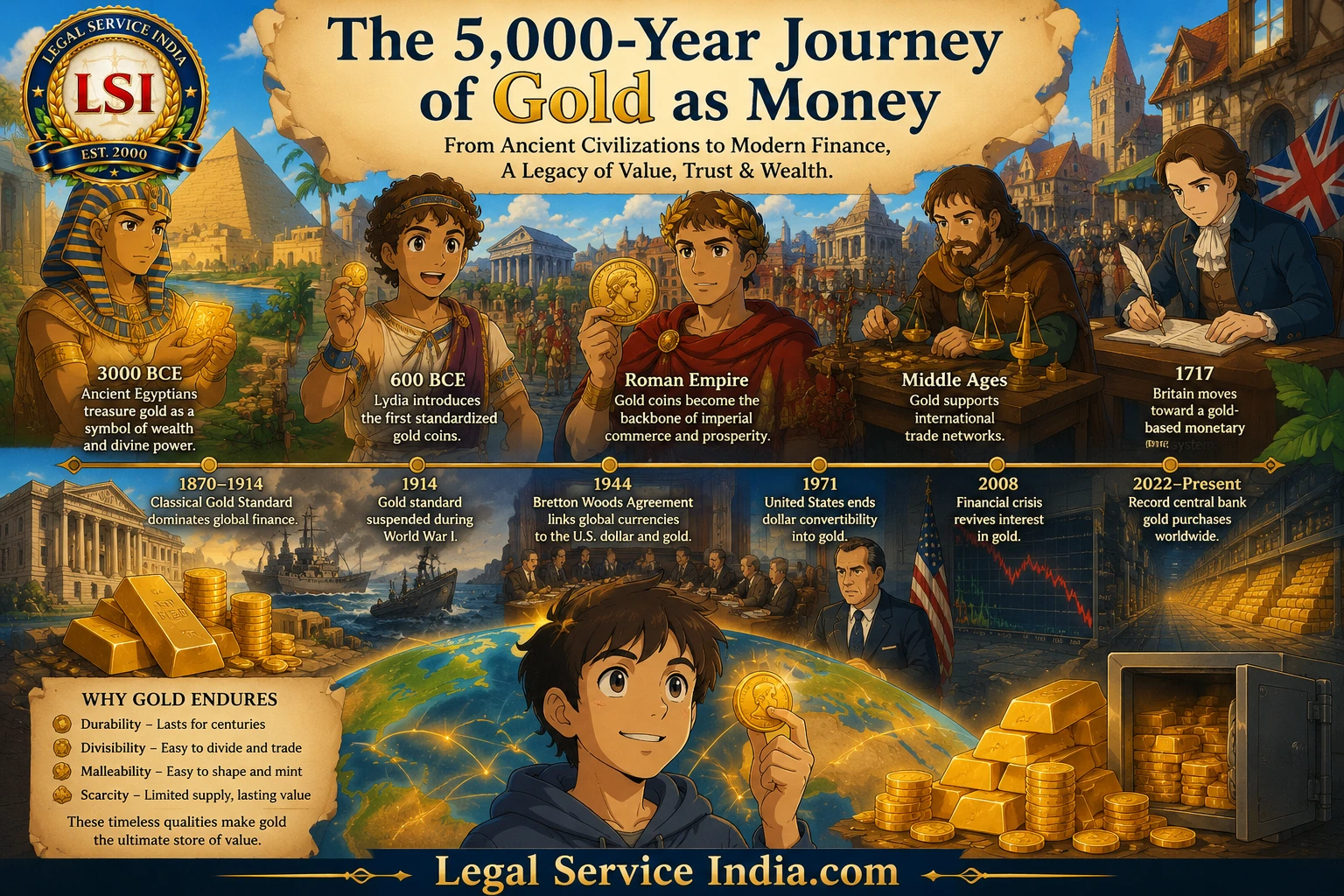
Part 1: The 5,000-Year Journey of Gold as Money
Introduction
Throughout human history, few substances have captivated civilisations as profoundly as gold. Empires have risen in pursuit of it, wars have been fought over it, and entire monetary systems have been built upon it. Across thousands of years and countless cultures, humanity repeatedly arrived at the same conclusion: gold represented wealth, security, and money.
Ancient Egyptians treasured it. Roman emperors minted it into coins. Chinese dynasties accumulated it as a symbol of prosperity. European kingdoms measured their fortunes by it. Even in today’s digital age, when money exists largely as electronic entries on banking systems, gold continues to command respect from governments, investors, and central banks.
What makes this extraordinary is that gold’s monetary role emerged long before economists, central banks, and modern financial institutions existed. Civilisations separated by oceans, languages, religions, and political systems independently recognised gold’s unique qualities.
In recent years, renewed interest in gold has emerged due to inflation concerns, geopolitical tensions, mounting government debt, and questions about the long-term stability of fiat currencies. Understanding gold’s history is therefore not merely an academic exercise—it provides valuable insights into how money evolved and why gold continues to influence financial markets today.
This article explores the remarkable 5,000-year history of gold, examines why humanity chose it over countless other materials, and explains how it became one of the most enduring stores of value ever known.
A Brief Timeline of Gold’s Monetary History
Before exploring the details, it is useful to understand the broad historical journey of gold.
| Period | Major Development |
|---|---|
| 3000 BCE | Ancient Egyptians use gold as a symbol of wealth and divine power |
| 1200 BCE | Gold widely used in trade and royal treasuries |
| 600 BCE | The first standardised gold coins introduced in Lydia |
| Roman Empire | Gold coins become a cornerstone of imperial commerce |
| Middle Ages | Gold supports international trade networks |
| 1717 | Britain effectively moves toward a gold-based monetary system |
| 1870–1914 | The classical gold standard dominates global finance |
| 1914 | Gold standard suspended during World War I |
| 1944 | Bretton Woods Agreement links global currencies to the U.S. dollar and gold |
| 1971 | United States ends dollar convertibility into gold |
| 2008 | Financial crisis revives interest in gold |
| 2022–Present | Record central bank gold purchases worldwide |
This timeline demonstrates that gold’s monetary role spans far longer than any modern currency system.
Why Humanity Chose Gold
One of the most fascinating questions in economic history is why gold became money at all.
After all, nature provides hundreds of materials that humans could theoretically have used for exchange. Throughout history, societies experimented with shells, salt, livestock, copper, silver, beads, tobacco, and numerous other commodities.
Yet gold ultimately emerged as the most universally accepted monetary metal.
The answer lies in a combination of unique physical and economic characteristics.
The Four Characteristics That Made Gold Ideal Money
1. Durability
Money must survive the passage of time.
- Food spoils.
- Livestock dies.
- Iron rusts.
- Paper deteriorates.
Gold is different.
Gold does not corrode, rust, tarnish, or decay under normal conditions. Archaeologists have recovered gold artefacts from ancient tombs and shipwrecks that remain remarkably intact after centuries or even millennia.
This durability allows wealth to be preserved across generations.
A gold coin buried centuries ago retains much of its original form today.
Few other materials can make the same claim.
2. Divisibility
An effective monetary system requires flexibility.
A medium of exchange must be capable of facilitating both large and small transactions.
Gold excels in this regard.
It can be:
- Melted
- Refined
- Divided
- Recast
- Minted
without losing its essential value.
A large gold bar can be transformed into smaller coins, and each portion retains proportional worth.
This divisibility made gold particularly useful in trade.
3. Malleability
Gold is among the most malleable metals known to humanity.
A single ounce can be hammered into an extraordinarily thin sheet covering a surprisingly large area.
It can also be drawn into fine wires thinner than a human hair.
This property made gold easy to work with and ideal for coin production.
Ancient civilisations lacking modern technology could still shape gold into practical forms suitable for commerce.
4. Scarcity
Perhaps gold’s most important attribute is scarcity.
Unlike paper money, gold cannot be created through political decisions.
Unlike digital currency, it cannot be produced with a keystroke.
Gold must be discovered, mined, refined, and transported.
This process requires:
- Time
- Labor
- Capital
- Technology
As a result, new gold enters the market slowly and predictably.
Scarcity creates trust.
People accept gold because they know its supply cannot be expanded overnight.
The Astonishing Scarcity of Gold
One of the most surprising facts about gold is how little of it exists.
Despite thousands of years of mining activity, the total quantity of gold ever extracted remains relatively small.
Industry estimates suggest that all the gold mined throughout human history could fit into a cube occupying roughly three and a half Olympic-sized swimming pools.
This means that every gold coin, central bank reserve, wedding ring, bullion bar, and industrial gold component ever produced would occupy a surprisingly modest physical space.
When viewed from this perspective, gold’s scarcity becomes easier to understand.
More than eight billion people inhabit the planet, yet the total stock of gold remains remarkably limited.
This scarcity helps explain why gold has retained value for thousands of years.
Gold in Ancient Egypt: The First Great Gold Civilization
Ancient Egypt is perhaps the civilisation most closely associated with gold.
Egyptians regarded gold as the flesh of the gods and believed it possessed divine qualities.
Gold adorned:
- Temples
- Royal palaces
- Religious artifacts
- Funeral treasures
The famous tomb of Tutankhamun contained extraordinary quantities of gold, demonstrating its importance within Egyptian society.
Egypt’s control over rich gold deposits contributed significantly to its wealth and influence.
Although gold did not function as everyday currency in the modern sense, it served as a powerful store of wealth and a symbol of political authority.
Gold in Ancient Greece and Lydia
The first standardised gold coins are generally credited to the ancient Kingdom of Lydia, located in present-day Turkey, around the seventh century BCE.
These coins revolutionised commerce.
For the first time, merchants could exchange standardised pieces of precious metal carrying an official guarantee of weight and purity.
This innovation spread rapidly throughout the Greek world.
Coinage simplified trade, reduced transaction costs, and accelerated economic activity.
The concept remains fundamental to modern money.
Gold and the Roman Empire
No discussion of monetary history would be complete without examining Rome.
The Roman Empire built one of history’s most sophisticated monetary systems.
Gold coins such as the Aureus became trusted instruments throughout the empire.
Roman soldiers, merchants, and government officials relied upon gold-based currency to conduct transactions across vast territories stretching from Britain to the Middle East.
Gold played a crucial role in supporting imperial administration and long-distance trade.
Its acceptance throughout the empire demonstrated one of gold’s greatest strengths: universality.
People trusted it regardless of language, ethnicity, or local customs.
Key Takeaways
- Gold has served as a store of value and symbol of wealth for more than 5,000 years.
- Its monetary role emerged independently across multiple civilisations.
- Durability, divisibility, malleability, and scarcity made gold uniquely suited for use as money.
- The first standardised gold coins originated in Lydia around the seventh century BCE.
- Ancient Egypt, Greece, and Rome all played major roles in establishing gold’s monetary significance.
- Gold remains influential in modern financial markets despite the rise of fiat currencies and digital banking systems.
The Roman Centurion and Purchasing Power Across 2,000 Years
One of the most frequently cited examples of gold’s ability to preserve value involves Roman soldiers.
Historical evidence suggests that a Roman centurion—a respected professional military officer—earned approximately one ounce of gold per month.
What Could That Ounce Purchase?
It could buy high-quality clothing, footwear, and equipment suitable for a respected member of society.
Remarkably, an ounce of gold today can still purchase a high-quality suit, premium shoes, and related accessories.
The precise comparison is not perfect, but the broader lesson is significant.
Gold has demonstrated an extraordinary ability to preserve purchasing power over long periods.
This characteristic distinguishes it from many paper currencies that have lost substantial value over time.
| Period | Approximate Purchasing Power of One Ounce of Gold |
|---|---|
| Roman Era | High-quality clothing, footwear, and equipment for a respected individual |
| Modern Era | High-quality suit, premium shoes, and related accessories |
Gold During the Middle Ages
Following the fall of Rome, gold remained central to international commerce.
- Islamic caliphates issued gold dinars.
- European kingdoms minted gold florins and ducats.
- Merchants travelling along trade routes connecting Europe, Asia, Africa, and the Middle East frequently relied on gold because it was widely recognised and accepted.
In a world lacking modern banking systems, gold provided trust.
A merchant might not recognise a foreign ruler’s authority, but he recognised the value of gold.
This universal acceptance strengthened its role as international money.
The Rise of Britain and the Modern Gold System
By the eighteenth century, Britain emerged as a dominant commercial power.
In 1717, Isaac Newton, while serving as Master of the Royal Mint, established a gold valuation that effectively pushed Britain toward a gold-based monetary system.
Over time, gold became increasingly central to British finance.
As the British Empire expanded, its monetary influence spread globally.
This laid the foundation for what would eventually become the Classical Gold Standard.
The Classical Gold Standard: The Golden Age of Monetary Stability
Between approximately 1870 and 1914, much of the world operated under what economists call the Classical Gold Standard.
How the Classical Gold Standard Worked
- National currencies were linked to fixed quantities of gold.
- Governments agreed to exchange currency for gold on demand.
- Exchange rates between countries remained relatively stable.
The system offered several advantages.
Benefits
- Stable exchange rates
- Greater confidence in currencies
- Lower long-term inflation
- Enhanced international trade
For many historians, this period represented one of the most stable monetary environments in modern history.
However, the system was not perfect.
Limitations
- Governments had limited flexibility during crises.
- Economic downturns could become more severe.
- Deflation sometimes emerged when economic growth exceeded gold supply growth.
| Benefits | Limitations |
|---|---|
| Stable exchange rates | Limited government flexibility during crises |
| Greater confidence in currencies | Economic downturns could become more severe |
| Lower long-term inflation | Deflation could emerge when growth exceeded gold supply growth |
| Enhanced international trade | Constraints on monetary policy |
These weaknesses would eventually become apparent during periods of global conflict.
The Beginning of the End
The outbreak of World War I in 1914 placed enormous financial pressure on governments.
Countries needed unprecedented amounts of money to finance military operations.
Maintaining full gold convertibility became increasingly difficult.
As a result, many nations suspended aspects of the gold standard.
The relationship between governments and money would never be quite the same again.
The stage was set for a series of monetary experiments that would ultimately transform the global financial system.
Those developments—including the Bretton Woods system, the rise of the U.S. dollar, and the historic decision that ended the gold standard in 1971—would reshape the modern economy and fundamentally change how money operates today.
Coming Next: Part 2
Key Takeaways
- Gold has served as money for over 5,000 years, becoming a symbol of wealth and security across civilisations.
- Humanity chose gold due to its durability, divisibility, malleability, and scarcity, setting it apart from other materials.
- The first standardised gold coins appeared in Lydia around the seventh century BCE, revolutionising commerce.
- The Classical Gold Standard from 1870 to 1914 brought monetary stability, but limitations arose during crises and conflicts.
- The onset of World War I marked the beginning of the end for the gold standard, leading to significant changes in the global financial system.