Student Protest Violence: Supreme Court Hearing Live Updates – A Constitutional Balancing Act Between the Right to Protest and the Rule of Law
Introduction
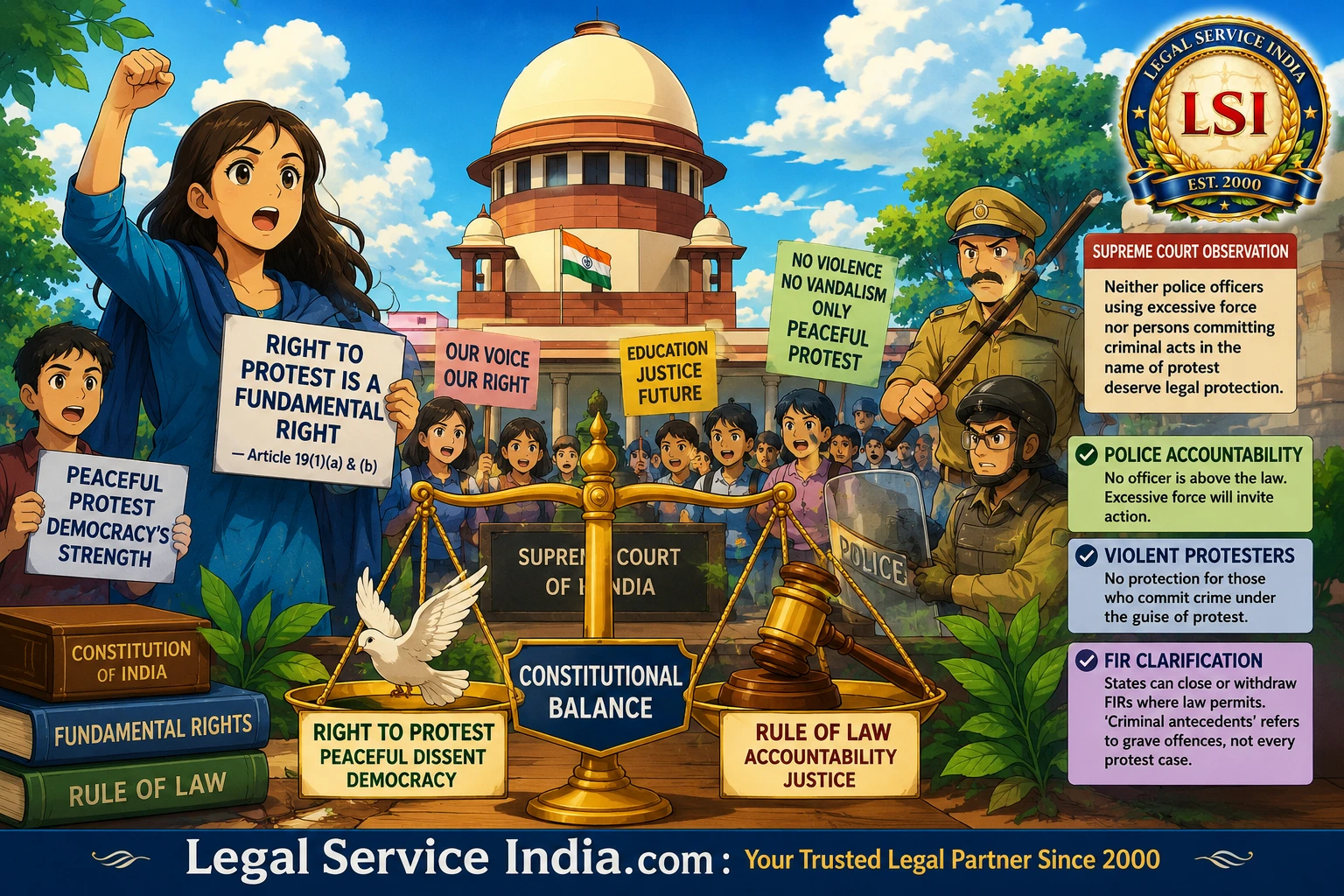
The Supreme Court of India’s hearing on the Student Protest Violence: Live Updates From Supreme Court Hearing has emerged as one of the most significant constitutional proceedings of 2026. The matter is not merely about allegations of police excesses or violence committed during student demonstrations. Rather, it concerns a deeper constitutional question: How should a democratic nation protect the fundamental right to peaceful protest while simultaneously preserving public order and ensuring accountability for unlawful acts?
The petitions arise from widespread student demonstrations that were followed by allegations of excessive police force, arbitrary arrests, injuries to students and police personnel, and the registration of numerous criminal cases. During the hearing, the Supreme Court made a significant observation that has already become the defining principle of the case:
Neither police officers using excessive force nor persons committing criminal acts in the name of protest deserve legal protection.
From a constitutional lawyer’s perspective, this statement perfectly encapsulates the balance that constitutional courts are expected to maintain.
Citation: In Re: Student Protest Violence Cases (Supreme Court of India, proceedings dated 3 August 2026) (Live proceedings; final judgement awaited).
Background of the Case
The present proceedings involve several petitions placed before the Supreme Court concerning the student protests and the violence that allegedly followed.
Broadly, the petitions seek:
- Investigation into allegations of excessive police force.
- Accountability of officers responsible for illegal use of force, if proved.
- Protection of genuine student protesters exercising constitutional rights.
- Consideration of cases where police officials themselves suffered injuries.
- Clarification regarding FIRs registered against students.
- Formulation of guidelines governing future protest management.
The Court is therefore dealing with multiple competing constitutional interests rather than deciding a conventional criminal dispute.
Issues Before the Supreme Court
The hearing raises several constitutional and legal questions.
1. Can Peaceful Protesters Be Criminalised?
The first issue concerns the scope of Article 19(1)(a) and Article 19(1)(b) of the Constitution, guaranteeing:
- Freedom of speech and expression.
- Right to assemble peacefully.
The Court has consistently held that peaceful dissent forms part of democratic governance.
However, constitutional protection does not extend to:
- Arson
- Stone pelting
- Assault
- Destruction of public property
- Obstruction of emergency services
Accordingly, the Court has distinguished peaceful protest from criminal misconduct.
2. Can Police Use Force Merely Because There Is a Protest?
This issue has become central.
Earlier hearings had already indicated that:
Mere agitation cannot automatically justify a lathi charge or excessive police action.
The Court is examining whether force used during the protests was:
- necessary,
- proportionate,
- lawful, and
- consistent with constitutional safeguards.
3. Accountability of Police Officials
One category of petitions seeks action against police officers alleged to have exceeded lawful authority.
The Supreme Court indicated that no officer enjoys immunity merely because he acted in uniform.
If excessive force is established through evidence, appropriate legal consequences must follow.
4. Accountability of Violent Protesters
Equally important is the Court’s refusal to romanticise violence committed under the guise of protest.
The Bench observed that:
- Genuine protesters deserve constitutional protection
- But those committing criminal acts cannot escape prosecution merely by calling themselves protesters.
This balanced approach is likely to become an important constitutional precedent.
Supreme Court’s Significant Observation
The most important takeaway from the hearing is the court’s observation:
Neither officers using excessive force nor criminal protesters should be protected.
This single sentence reflects several constitutional doctrines.
It rejects:
- police impunity,
- mob violence,
- political partisanship, and
- selective accountability.
Instead, it insists upon equal application of the rule of law.
Clarification Regarding FIRs Against Student Protesters
During the proceedings, another important clarification emerged.
The Supreme Court explained that state governments retain the legal authority to close or withdraw FIRs against student protesters where the law permits. The Court also clarified that the expression “criminal antecedents” should be understood as referring to persons involved in grave or heinous offences, rather than being mechanically applied to every student facing a protest-related case.
This clarification may have significant implications for many students facing relatively minor allegations.
Constitutional Principles Involved
The case engages multiple constitutional provisions.
| Constitutional Provision | Key Protection |
|---|---|
| Article 19 | Free speech, peaceful assembly, and democratic dissent. |
| Article 21 | Life, liberty, dignity, and protection against arbitrary state action. |
| Article 14 | Equal treatment before the law and equal protection of laws. |
Police officers violating the law cannot receive special protection merely because they represent the State.
Likewise, protesters cannot seek immunity solely because they claim constitutional rights.
Previous Supreme Court Jurisprudence
The present hearing builds upon established constitutional principles laid down in several landmark decisions.
| Case | Legal Principle |
|---|---|
| Mazdoor Kisan Shakti Sangathan v. Union of India (2018) | The Court recognised peaceful protest as an essential democratic right while permitting reasonable regulation. |
| Amit Sahni v. Commissioner of Police (Shaheen Bagh Case) | The Court held that protests cannot indefinitely occupy public spaces and inconvenience the public. |
| Ramlila Maidan Incident v. Home Secretary, Union of India (2012) | The Court ruled that the police force must always satisfy the tests of legality, necessity and proportionality. |
These decisions collectively recognise that both citizens and the state remain bound by constitutional limitations.
Why This Hearing Is Constitutionally Significant
This hearing is important because it addresses recurring questions in modern constitutional governance:
- What constitutes peaceful protest?
- When may police legitimately use force?
- Should protesters accused of minor offences be treated differently from those involved in serious violence?
- How should courts balance civil liberties with public order?
- Can governments reconsider or withdraw protest-related prosecutions in appropriate cases?
The answers may influence future handling of demonstrations across India.
Possible Outcomes
Although the Court has not yet delivered its final judgement, several possibilities emerge from the hearing:
- Comprehensive guidelines for police management of protests.
- Independent investigation into allegations of excessive force where warranted.
- Protection for peaceful protesters.
- Continued prosecution of those involved in serious criminal offences.
- Greater judicial scrutiny of police conduct.
- Clear standards for the withdrawal or continuation of protest-related FIRs.
Any final directions are likely to shape constitutional law concerning public demonstrations for years to come.
Legal Analysis
From the standpoint of constitutional jurisprudence, the Supreme Court has wisely avoided adopting an absolutist approach.
Courts must guard against two extremes.
- The first is treating every protest as a threat to public order.
- The second is assuming that every act committed during a protest deserves constitutional protection.
The Constitution protects peaceful dissent, not lawlessness.
Similarly, it empowers the State to maintain order, but not through disproportionate or arbitrary force.
The Court’s insistence that both unlawful police action and criminal conduct by protesters must be investigated impartially reinforces the principle that the rule of law applies equally to all.
If this balanced approach is reflected in the final judgement, it is likely to become one of the leading constitutional precedents governing protest rights and police accountability in India.
Conclusion
The Student Protest Violence: Live Updates From the Supreme Court hearing, it represents far more than litigation arising out of one episode of public unrest. It is a constitutional examination of the limits of state power and the scope of democratic freedoms.
The Supreme Court’s observations underscore that democracy is strengthened not by shielding any particular group, but by ensuring that constitutional rights are respected, public order is maintained, and accountability is imposed wherever the law has been violated. As the proceedings continue, the legal community will closely watch the final judgement, which is expected to provide enduring guidance on the relationship between the citizen’s right to protest and the state’s duty to preserve order.
Key Takeaways
| Topic | Key Takeaway |
|---|---|
| Constitutional Balance | The Supreme Court examines the constitutional balance between the right to peaceful protest and the state’s duty to maintain public order, making this one of the most significant constitutional hearings of 2026. |
| Right to Peaceful Protest | Peaceful protest remains a protected fundamental right under Articles 19(1)(a) and 19(1)(b) of the Constitution, but violence, arson, stone-pelting, assault, and destruction of public property do not receive constitutional protection. |
| Police Accountability | The Court emphasised that police officers accused of using excessive force are not immune from legal accountability, reinforcing that law enforcement must act within constitutional limits. |
| Rule of Law | The Bench also made it clear that individuals committing criminal acts during protests cannot avoid prosecution by claiming to be peaceful protesters, reaffirming the rule of law. |
| Withdrawal of FIRs | A significant clarification during the hearing stated that state governments may close or withdraw FIRs against student protesters where legally permissible, depending on the facts and applicable law. |
| Criminal Antecedents | The Supreme Court further observed that the expression “criminal antecedents” should primarily refer to involvement in grave or heinous offences, rather than being automatically applied to students facing minor protest-related cases. |
| Constitutional Safeguards | The hearing revisits key constitutional safeguards under Articles 14, 19, and 21, highlighting the principles of equality before law, freedom of speech and peaceful assembly, and protection against arbitrary state action. |
| Landmark Precedents | The proceedings build upon landmark judgments including Mazdoor Kisan Shakti Sangathan v. Union of India (2018), Amit Sahni v. Commissioner of Police (Shaheen Bagh Case), and Ramlila Maidan Incident v. Home Secretary (2012), all of which shape India’s jurisprudence on protests and police powers. |
| Future Guidelines | The Court is expected to consider future guidelines on police management of protests, standards governing the use of force, and judicial oversight of protest-related investigations. |
| Constitutional Precedent | The final judgement could become a landmark precedent on protest rights, police accountability, constitutional freedoms, and public order, influencing how demonstrations are regulated across India for years to come. |
| Democratic Principles | The case reinforces the principle that constitutional democracy protects peaceful dissent while ensuring equal accountability for unlawful conduct by both protesters and public authorities. |
| Why This Case Matters | Student Protest Violence: Supreme Court Hearing Live Updates is a crucial constitutional case for lawyers, students, policymakers, civil rights advocates, and citizens seeking clarity on the legal boundaries of protests, policing, and democratic freedoms in India. |
Quick Summary
- The Supreme Court seeks to balance constitutional freedoms with public order.
- Peaceful protests remain protected under the Constitution.
- Violent acts committed during protests receive no constitutional protection.
- Police officers may face legal consequences for excessive use of force.
- Violent protesters remain liable for criminal prosecution.
- State governments may withdraw protest-related FIRs where legally justified.
- Articles 14, 19, and 21 remain central to the Court’s constitutional analysis.
- The final judgement may establish new nationwide guidelines on protest management and police accountability.
Important Links
Important Links:
- Lawyers in India
- Copyright Registration in India
- Caveat Filing in Supreme Court of India
- Mutual Consent Divorce in Delhi NCR: WhatsApp 9650499965