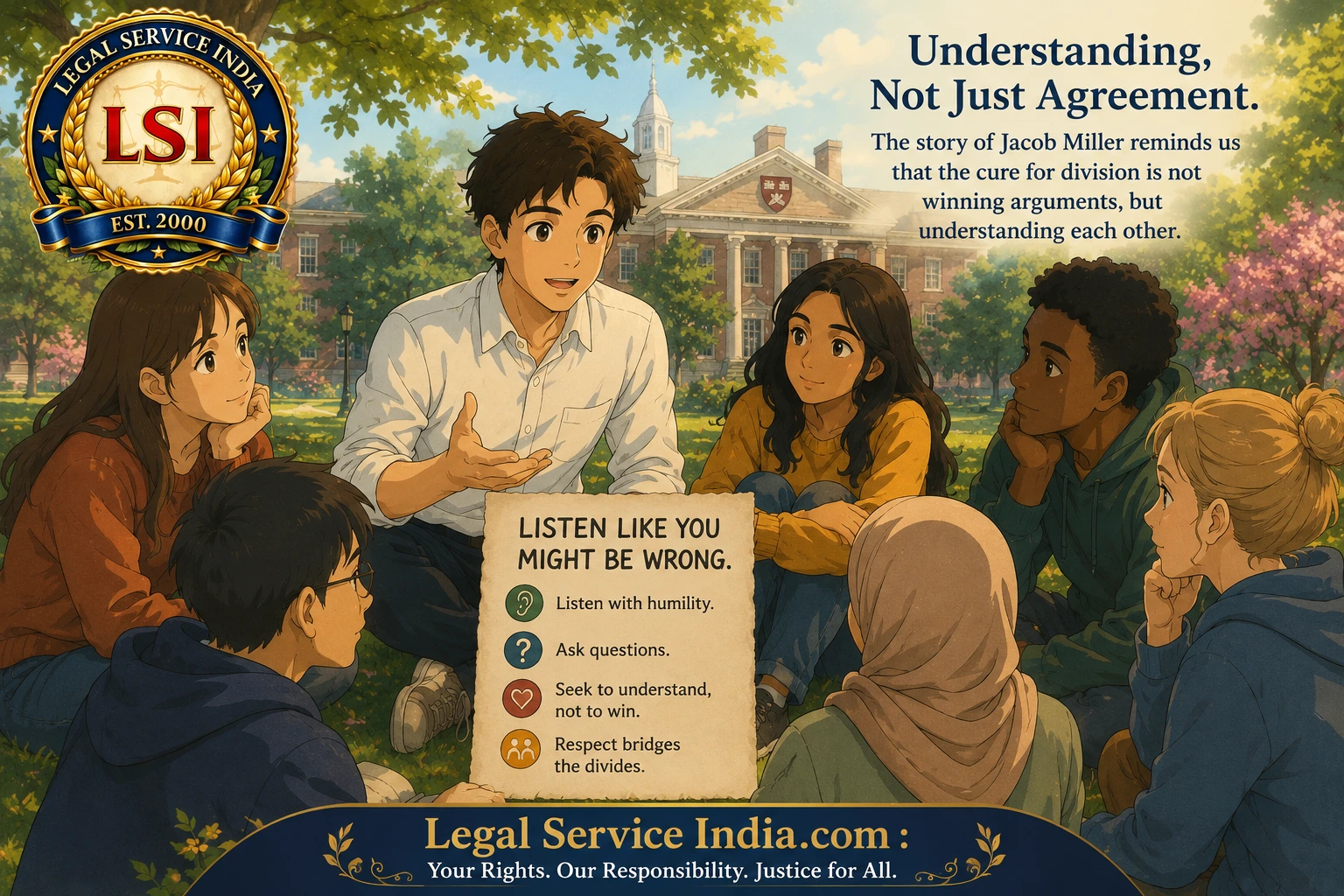
Listen Like You Might Be Wrong: Noah Eckstein’s Powerful Lesson for a Divided World
In a world where everyone seems eager to speak, few people are willing to listen.
That simple truth is what made Harvard graduate Noah Eckstein’s commencement speech, “Listen Like You Might Be Wrong”, resonate with millions of people across the globe. At a time when political divisions, cultural conflicts, and social media arguments dominate everyday life, Miller offered a message that felt both refreshing and desperately needed.
His speech was not about politics. It was not about winning an argument or proving someone wrong. Instead, it was about something much more challenging: understanding people who think differently from us.
A Story That Begins Like a Joke
Noah Eckstein opened his speech with a line that immediately captured attention:
“A Christian, a Muslim, and a Jew walk into a bar.”
But this wasn’t a joke.
It was the story of his own family.
Miller explained that his Christian grandmother, Muslim grandfather, Jewish grandfather, and parents created a family that crossed religious, cultural, and historical boundaries. Growing up, he witnessed something that many people today rarely experience: individuals with deeply different beliefs treating one another with genuine respect.
His family members did not agree on everything. In fact, they disagreed on many important issues. Yet those disagreements never prevented them from caring for one another.
That experience taught him a lesson that would later become the heart of his speech: the opposite of division is not agreement—it is understanding.
Key Message From His Family
- People can hold different beliefs and still respect one another.
- Disagreement does not have to create division.
- Understanding is often more important than agreement.
- Human connection can survive ideological differences.
The Modern Obsession With Choosing Sides
Today’s society often reduces complex issues into simple choices.
Every debate is framed as a battle between two camps. Every discussion demands allegiance. Whether the subject is politics, religion, economics, international relations, or social issues, people are constantly pressured to pick a side.
Once they do, the conversation often ends.
- Instead of listening, people defend.
- Instead of questioning, people accuse.
- Instead of understanding, people assume.
Social media has amplified this tendency. Platforms reward outrage, certainty, and confrontation. The loudest voices receive the most attention, while thoughtful dialogue is pushed aside.
As a result, many conversations become competitions rather than opportunities to learn.
Effects of Polarization
| Constructive Dialogue | Polarized Dialogue |
|---|---|
| Listening | Defending |
| Learning | Winning |
| Curiosity | Certainty |
| Understanding | Judgment |
When People Become Labels
One of the most powerful ideas in Miller’s speech is that modern society increasingly sees people as categories rather than human beings.
Someone becomes a political identity instead of a person.
Someone becomes a religion instead of a neighbour.
Someone becomes an ideology instead of an individual.
Once that happens, empathy begins to disappear.
The person sitting across from us is no longer someone with experiences, fears, dreams, and struggles. They become an obstacle, an opponent, or even an enemy.
This mindset makes meaningful dialogue nearly impossible.
Yet Miller’s own family history demonstrated a different path. His grandparents came from vastly different backgrounds and carried very different perspectives. Despite this, they remained connected through conversation, mutual respect, and curiosity about one another’s lives.
Their disagreements became points of discussion rather than reasons for separation.
People Are More Than Labels
- A political view does not define an entire person.
- A religious identity does not reveal someone’s full story.
- An opinion is only one part of an individual’s life experience.
- Understanding begins when labels end.
Understanding Is Not the Same as Agreement
Many people fear that trying to understand someone means abandoning their own beliefs.
Noah Eckstein challenged that assumption.
Understanding does not require surrendering your principles. It does not mean accepting harmful behaviour or excusing injustice. Rather, it means making an honest effort to understand how another person arrived at their beliefs.
Important Questions to Ask
- Why do they think the way they do?
- What experiences shaped their worldview?
- What fears, hopes, or circumstances influenced their conclusions?
These questions do not weaken our convictions. They strengthen our understanding of the world.
A person can firmly disagree with another viewpoint while still making the effort to understand it.
In fact, true understanding often requires more courage than disagreement.
The Crisis of Listening
One of the greatest challenges facing society today is not a lack of information but a lack of listening.
People enter discussions already convinced they are right.
They listen only long enough to prepare a response.
They argue not to learn but to win.
Miller urged his audience to resist this temptation.
Real listening requires humility. It requires accepting the possibility that we may not have all the answers. It demands curiosity instead of certainty.
That is why his most memorable advice was so powerful:
“Listen like you might be wrong.”
At first glance, the statement seems simple. Yet it challenges one of the deepest human instincts—the desire to always be right.
Traits of a Good Listener
- Humility
- Curiosity
- Patience
- Empathy
- Open-mindedness
Why Understanding Matters
Many young people dream of changing the world.
They want to solve problems, fight injustice, and create positive change. These ambitions are admirable, but Miller reminded his audience that meaningful change begins with understanding.
- You cannot persuade people if you refuse to hear them.
- You cannot bridge divides if you refuse to cross them.
- You cannot improve a society that you do not fully understand.
Lasting peace is not built on universal agreement. Human beings will always have different opinions, beliefs, and values.
What creates stability is the willingness to engage with those differences respectfully.
Agreement may be temporary.
Understanding has the power to endure.
A Lesson for Our Time
Perhaps the most remarkable aspect of Noah Eckstein’s speech is its relevance beyond the walls of Harvard.
His message applies to families divided by politics, friends separated by disagreement, communities struggling with polarisation, and nations facing conflict.
The challenge he presented is simple but difficult:
- Stand up for what you believe.
- Defend your values.
- Speak your truth.
- But also listen.
- Ask questions.
- Seek understanding.
- Try to see the world through another person’s eyes before judging their conclusions.
In an era where countless voices are telling us to choose a side, Noah Eckstein offered a different path—one built not on surrendering our beliefs, but on expanding our understanding.
His speech reminds us that disagreement does not have to lead to division. People can hold different convictions and still recognise each other’s humanity.
That lesson may be one of the most important lessons our generation needs to hear.
Conclusion: Listen Like You Might Be Wrong
Because in a fractured world, healing rarely begins with agreement.
More often, it begins with a conversation.
And sometimes, it begins by listening like you might be wrong.
Key Takeaways
- Noah Eckstein’s speech, ‘Listen Like You Might Be Wrong’, emphasises the importance of understanding over agreement in a divided world.
- His family experiences showed that people can respect one another despite differing beliefs.
- Miller critiques the modern tendency to choose sides, which hinders true dialogue and understanding.
- He argues that meaningful change starts with listening and engaging with those who hold different views.
- The core message is clear: healing begins with conversation, not consensus.