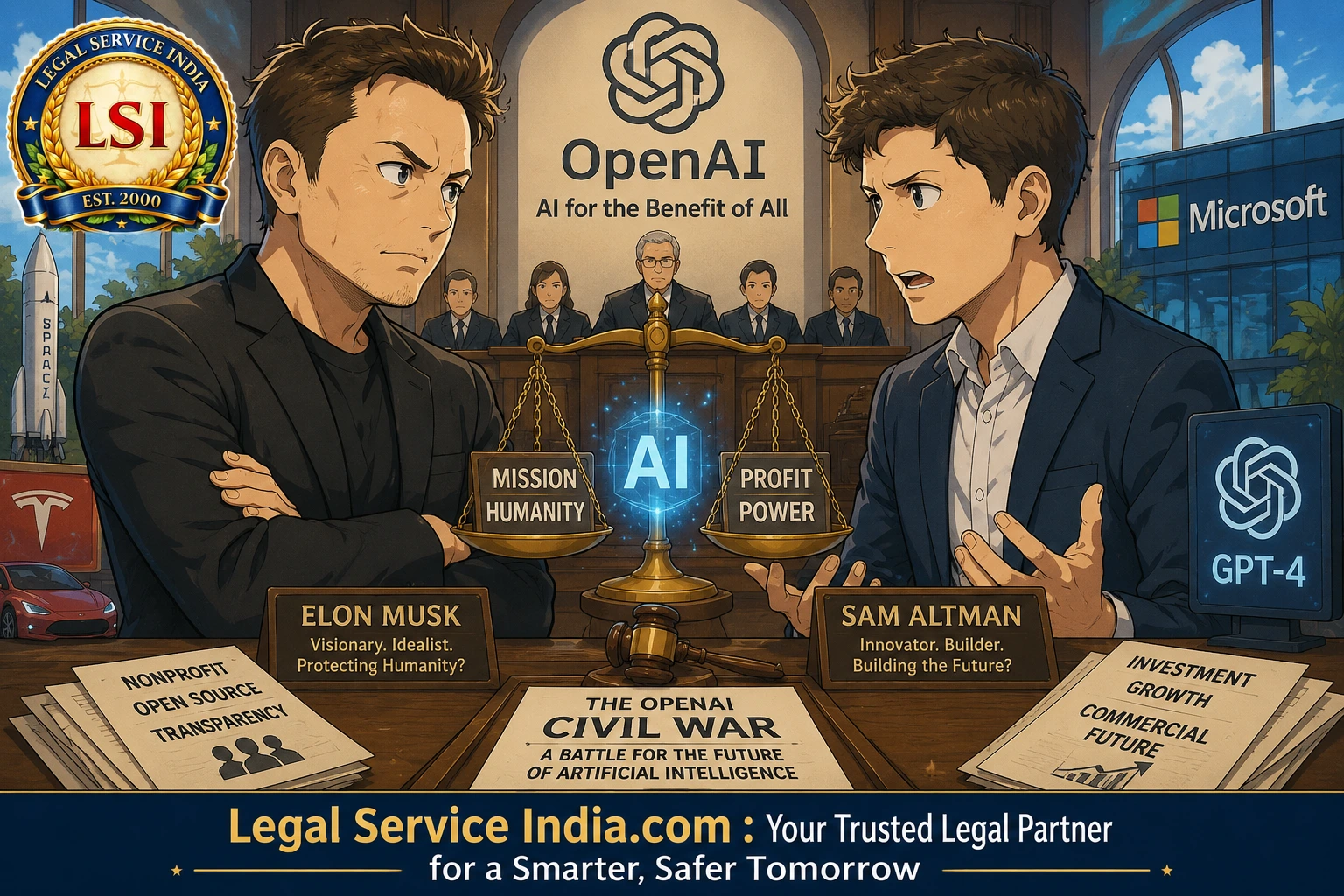
The OpenAI Civil War: How Elon Musk and Sam Altman Turned a Shared Dream into Silicon Valley’s Biggest Betrayal Story
Two Men, One Mission, and a Billion-Dollar Fallout
History is filled with stories of revolutionaries who began as allies and ended as enemies.
- Steve Jobs and John Sculley.
- Thomas Jefferson and Alexander Hamilton.
- Mark Zuckerberg and the Winklevoss twins.
Now add another chapter to that list: Elon Musk and Sam Altman.
What started as a partnership to save humanity from the dangers of artificial intelligence evolved into one of the most extraordinary legal battles in modern corporate history.
At stake was not merely money, power, or prestige. The dispute raised a much larger question:
Who owns the future of artificial intelligence?
Is AI a public good meant to benefit humanity, or is it a commercial product destined to enrich a handful of corporations and investors?
The courtroom clash between Musk and Altman became the latest battlefield in that debate.
Ironically, both men claim to be protecting humanity.
- Both claim to care about AI safety.
- Both warn about the existential dangers of artificial intelligence.
- Both continue to build ever more powerful AI systems.
The contradiction lies at the heart of the story.
The Beginning: A Noble Experiment
To understand the conflict, one must return to 2015.
The technology world had just witnessed Google’s acquisition of DeepMind, one of the world’s leading AI research laboratories.
Many influential figures worried that artificial intelligence was becoming concentrated inside a small number of corporate giants.
Among those concerned were Elon Musk and Sam Altman.
Their solution was ambitious.
Create an organisation dedicated not to shareholders, but to humanity.
Thus, OpenAI was born.
The organisation was launched as a nonprofit research laboratory with an almost utopian mission:
Develop artificial intelligence safely and openly for the benefit of all mankind.
The message resonated.
- It promised openness.
- It promised transparency.
- It promised safety.
- It promised that AI would not become another technology monopolised by a few powerful companies.
At the time, Musk was among the world’s most admired entrepreneurs.
- Tesla was revolutionising electric vehicles.
- SpaceX was redefining private space exploration.
His reputation carried enormous weight.
According to later court filings, Musk contributed not only money but also credibility. He helped recruit researchers, attract attention, and convince people that OpenAI was a serious undertaking.
In many ways, OpenAI’s early success rested on the reputations of both Musk and Altman.
Neither man could have imagined how dramatically their relationship would deteriorate.
Cracks Begin to Appear
Grand ideals are easy.
Building advanced artificial intelligence is not.
Developing frontier AI systems requires vast computational resources, elite engineering talent, and billions of dollars in investment.
OpenAI soon faced a brutal reality.
Good intentions do not pay cloud-computing bills.
According to Musk’s account, this is where the organisation’s mission began to drift.
Altman increasingly argued that OpenAI needed a structure capable of generating enormous amounts of capital.
Musk viewed this as a dangerous departure from OpenAI’s founding purpose.
Emails later produced in court revealed growing tensions.
- The exchanges became sharper.
- The disagreements became personal.
- The trust began to evaporate.
What started as a philosophical disagreement evolved into a struggle over the organisation’s identity.
Nonprofit vs Commercial Future
Would OpenAI remain a nonprofit dedicated to humanity?
Or would it become another technology company competing for profits and market dominance?
The answer would ultimately define the future of the organisation.
Microsoft’s Arrival Changes Everything
Every great corporate drama has a turning point.
For OpenAI, that turning point was Microsoft.
As Microsoft’s involvement deepened, OpenAI gained access to vast resources that no nonprofit could easily obtain on its own.
The partnership transformed OpenAI’s trajectory.
What Microsoft Brought to OpenAI
| Contribution | Impact on OpenAI |
|---|---|
| Massive cloud infrastructure | Enabled large-scale AI training |
| Strategic support | Strengthened long-term growth |
| Financial investment | Provided capital for expansion |
| Global distribution capabilities | Expanded worldwide reach |
Supporters viewed the relationship as essential.
Critics viewed it as a takeover in slow motion.
Musk belonged firmly in the second camp.
Court filings revealed his discomfort with Microsoft’s growing influence years before the current controversy erupted.
What troubled him was not merely the investment.
It was the possibility that OpenAI’s mission was gradually being subordinated to commercial interests.
Whether that concern was justified remains one of the central questions of the entire dispute.
From Open Source Idealism to Corporate Secrecy
One of the most symbolic transformations involved transparency.
OpenAI originally built its reputation on openness.
- Researchers published papers.
- Methods were shared.
- Knowledge flowed freely.
The organisation’s name itself contained the word “Open”.
Then came a shift.
As AI systems became more powerful—and more valuable—OpenAI began revealing less.
GPT-4 and the Transparency Debate
The release of GPT-4 became a defining moment.
Unlike previous generations, OpenAI withheld substantial technical information regarding its development.
The decision reflected a new philosophy.
OpenAI argued that advanced AI capabilities carried significant safety risks.
Critics argued that secrecy conveniently aligned with commercial interests.
Either way, the organisation had clearly moved away from the radical openness that characterised its early years.
- For Musk, this was evidence that OpenAI had abandoned its founding principles.
- For Altman, it was evidence that OpenAI had matured.
The disagreement reflected fundamentally different visions of responsibility.
The Boardroom Coup That Shocked Silicon Valley
Then came an episode that seemed almost too dramatic to be real.
In November 2023, OpenAI’s board abruptly fired Sam Altman.
The technology industry was stunned.
The company’s own board claimed it had lost confidence in its CEO.
Questions emerged regarding transparency, governance, and conflicts of interest.
Former board members later suggested that Altman had not always been forthcoming regarding important matters.
Some alleged that information had been withheld.
Others claimed the board itself was often left uninformed.
The episode exposed a remarkable reality.
The company developing humanity’s most influential AI system appeared unable to govern itself.
But the drama was only beginning.
Employee Revolt and Power Struggle
Employees revolted.
Investors panicked.
Microsoft intervened.
Within days, the pressure became overwhelming.
Altman returned.
The board effectively surrendered.
The attempted coup collapsed.
Many observers concluded that OpenAI’s actual centre of power no longer resided with its board.
It resided with Altman himself.
That perception would become highly relevant in Musk’s later lawsuit.
The Safety Revolt
The governance controversy was soon followed by another crisis.
Several senior AI safety researchers resigned.
Their public statements were deeply troubling.
Some argued that OpenAI’s safety culture had weakened.
Others suggested that commercial pressures were overtaking ethical considerations.
The criticism struck at the heart of OpenAI’s original identity.
After all, safety had always been one of the organisation’s defining promises.
The departures fuelled concerns that the race for market dominance was beginning to overshadow caution.
Whether those fears are justified remains heavily debated.
But they provided Musk with powerful ammunition.
Key Concerns Raised by Safety Researchers
- Weakening AI safety culture.
- Growing commercial influence over ethical priorities.
- Reduced transparency in decision-making.
- Concerns regarding long-term AI governance.
- Pressure to accelerate development and deployment.
The Lawsuit That Put OpenAI on Trial
By 2024, Musk had seen enough.
He filed suit against Sam Altman, OpenAI, and Microsoft.
His accusation was simple but explosive.
OpenAI, he argued, had taken charitable donations, built a nonprofit reputation, attracted public trust, and then transformed itself into something entirely different.
According to Musk, OpenAI’s leadership effectively converted a mission-driven organisation into a profit-generating enterprise.
In his view, the organisation had betrayed the very promises upon which it was founded.
He repeatedly characterised the transformation as the theft of a charity.
The phrase became a recurring theme throughout the litigation.
A Case About More Than Money
The lawsuit was never merely about financial damages.
It became a referendum on the future of AI governance.
Musk sought extraordinary remedies.
He wanted structural changes.
Leadership changes.
Financial disgorgement.
He even sought to disrupt OpenAI’s relationship with Microsoft.
These requests were highly unusual.
American courts rarely attempt to redesign entire corporations.
Yet Musk argued that extraordinary circumstances demanded extraordinary solutions.
The court ultimately allowed several important claims to proceed.
The case moved toward trial.
Public attention intensified.
The stakes appeared enormous.
Major Remedies Sought by Musk
| Requested Remedy | Objective |
|---|---|
| Structural Changes | Alter OpenAI’s governance framework |
| Leadership Changes | Modify executive control and oversight |
| Financial Disgorgement | Recover alleged improper gains |
| Microsoft Relationship Review | Challenge OpenAI’s strategic partnership |
The Twist Nobody Expected
Yet after years of allegations, testimony, emails, and headlines, the case ultimately turned on something surprisingly mundane.
Time.
Specifically, the statute of limitations.
OpenAI argued that Musk had waited too long.
Even if every allegation were true, the company contended, the law required him to act sooner.
The jury agreed.
After only a short period of deliberation, jurors concluded that Musk either knew—or should have known—about the alleged problems years earlier.
That finding effectively ended the case.
Judge Yvonne Gonzalez Rogers agreed.
The lawsuit was dismissed.
Not because the jury necessarily decided OpenAI was innocent.
Not because Musk proved his allegations.
But because the legal clock had already run out.
One of the most consequential technology cases of the decade ended not with a dramatic verdict on AI ethics but with a procedural rule.
Why the Case Ended
- OpenAI argued the claims were filed too late.
- The jury found Musk knew or should have known about the issues earlier.
- The statute of limitations became the decisive legal factor.
- The court dismissed the case on procedural grounds.
The Bigger Question Remains Unanswered
Legally, OpenAI won.
Politically, culturally, and philosophically, the debate continues.
The trial exposed uncomfortable truths about modern technology.
It revealed how difficult it is for nonprofit organisations to resist commercial pressures.
It demonstrated the immense influence wielded by major technology corporations.
It highlighted persistent concerns regarding transparency, accountability, and AI safety.
Most importantly, it forced society to confront an unsettling possibility.
Perhaps the battle between Musk and Altman was never really about Musk or Altman.
Perhaps it was about the inevitable tension between idealism and capitalism.
OpenAI’s Transformation and the Future of AI
OpenAI began as a dream.
A dream that artificial intelligence could be developed openly, ethically, and for the benefit of humanity.
Today it stands at the centre of a global industry worth hundreds of billions of dollars.
Whether that transformation represents progress or betrayal depends largely on whom you ask.
What is beyond dispute is that the lawsuit exposed one of the defining struggles of our age.
The future of artificial intelligence will not be decided solely by engineers.
It will also be shaped by courts, regulators, investors, corporations, and public trust.
Stakeholders Shaping the Future of AI
- Courts and judicial institutions.
- National and international regulators.
- Technology companies.
- Investors and shareholders.
- Researchers and engineers.
- The broader public.
Conclusion: The Battle for the Soul of AI
The Musk-Altman war may be over.
The battle for the soul of AI has only just begun.
Key Takeaways
- The OpenAI Civil War highlights the conflict between Elon Musk and Sam Altman over the direction of AI development.
- Initially, they aimed to create a nonprofit organization to benefit humanity, but differing views led to tension over commercial interests.
- Musk filed a lawsuit claiming OpenAI betrayed its mission, but procedural issues led to its dismissal.
- The case exposed the struggle between ethical principles and commercial pressures in the tech industry.
- The lawsuit centered more on the future of AI governance than on financial damages, revealing society’s concerns about transparency and accountability.