





I. Introduction
The commodification of the human body stands as one of the most disturbing manifestations of economic inequality and institutional failure in modern society. Organ trafficking — the illicit buying, selling, or brokering of human organs for transplantation — represents a severe violation of human rights, human dignity, and the foundational ethical norms that govern medical practice.
India, with a population exceeding 1.4 billion and a persistent organ shortage crisis, occupies a particularly complex position in the global discourse on organ trafficking. The country grapples simultaneously with:
- The desperate medical needs of patients awaiting life-saving transplants.
- The exploitation of economically destitute individuals coerced into selling their organs.
- The systemic inadequacies of a legal framework that has struggled to keep pace with the sophistication of organised criminal networks.
Global and Indian Organ Trafficking Crisis
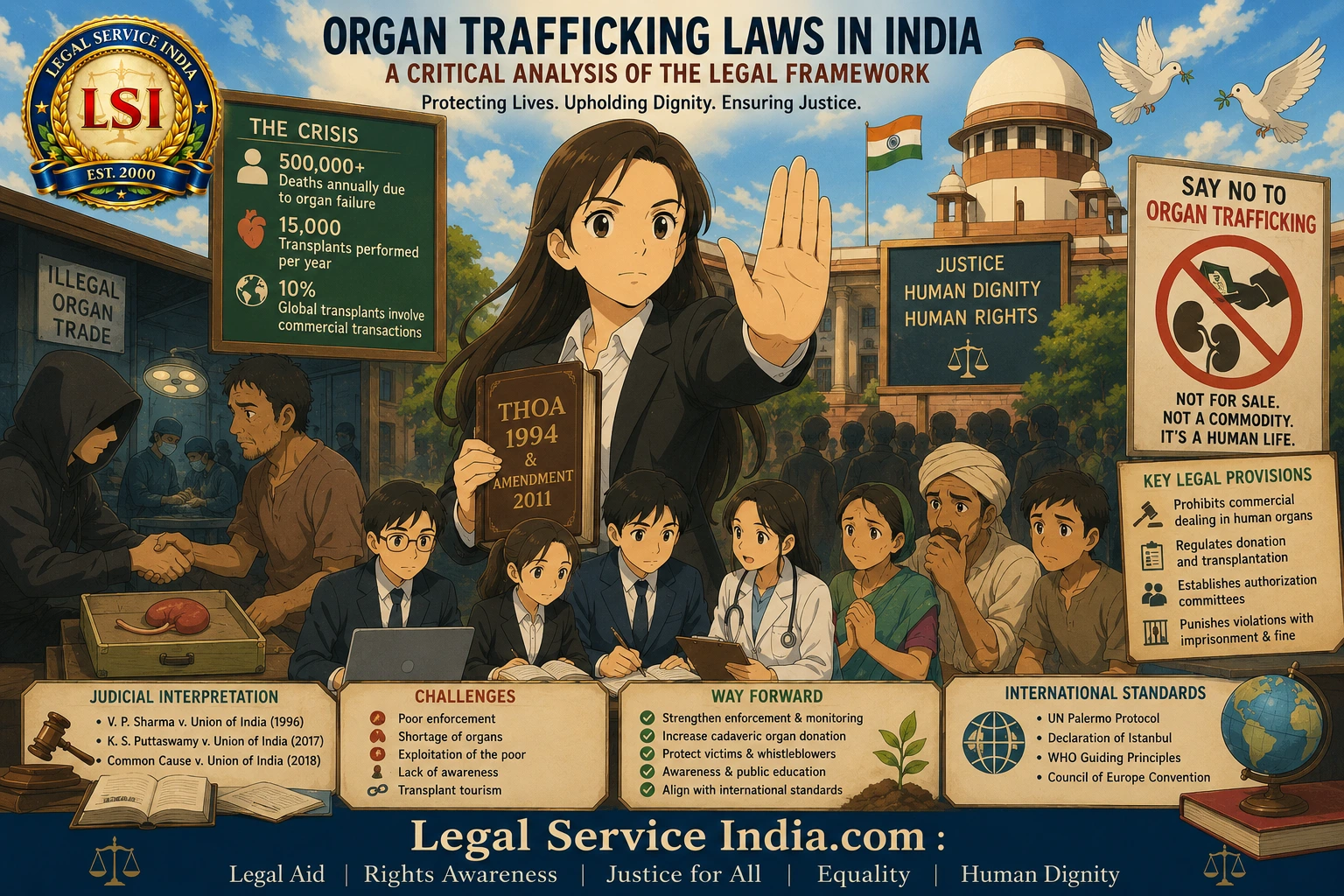
According to the World Health Organization, approximately 10% of all organ transplants conducted globally involve some form of commercial transaction, implicating the criminal exploitation of vulnerable donors.1
In India, the demand-supply gap for transplantable organs is staggering. The country records over 500,000 deaths annually attributable to organ failure yet performs only approximately 15,000 transplants per year.2 This colossal deficit creates fertile ground for illegal organ trade networks that exploit the poor, the uneducated, and the socially marginalised.
Key Organ Transplant Statistics in India
| Indicator | Approximate Figure |
|---|---|
| Population | 1.4+ Billion |
| Annual Deaths Due to Organ Failure | 500,000+ |
| Transplants Performed Annually | 15,000 |
| Estimated Global Transplants Involving Commercial Transactions | 10% |
Legislative Response to Organ Trafficking
The primary legislative response to this crisis has been the Transplantation of Human Organs Act, 1994 (hereinafter ‘THOA 1994’), which was further amended by the Transplantation of Human Organs and Tissues Act, 2011.
These legislative instruments represent the backbone of India’s regulatory approach to organ donation and transplantation, prohibiting commercial transactions in human organs while establishing a framework for regulated donation.
However, widespread evidence from judicial pronouncements, investigative journalism, and academic scholarship suggests that these laws have been systematically circumvented, inadequately enforced, and structurally limited in their capacity to address the full dimensions of the organ trafficking crisis.
Scope and Structure of the Study
This paper adopts a critical evaluative approach to examine the efficacy of India’s legal framework in regulating organ trafficking.
The analysis is structured to move through the following stages:
- Definitional clarity.
- Legislative history.
- Statutory analysis.
- Judicial interpretation.
- Institutional assessment.
- Comparative international standards.
The paper ultimately argues that while India possesses a foundational legal architecture to combat organ trafficking, fundamental reforms in enforcement mechanisms, institutional capacity, victim protection, and cadaveric donation infrastructure are urgently required to transform legal provisions from aspirational text into effective practice.
Research Methodology
The research methodology is doctrinal, supplemented by empirical data drawn from secondary sources, including:
- Judicial decisions.
- Government reports.
- World Health Organization publications.
- Peer-reviewed academic scholarship.
The paper proceeds on the recognition that organ trafficking is not merely a criminal justice concern but also a matter of the following:
- Social justice.
- Public health policy.
- International human rights obligation.
II. Understanding Organ Trafficking: Conceptual And Definitional Framework
Before undertaking a legal analysis, it is essential to establish a precise conceptual understanding of organ trafficking, as the definitional scope directly determines the ambit of any regulatory framework. The term ‘organ trafficking’ is often used interchangeably with ‘organ trade’ or ‘transplant tourism’, but these concepts carry distinct legal and ethical implications that must be carefully delineated.
A. Defining Organ Trafficking
The most authoritative international definition of organ trafficking is contained in the United Nations Protocol to Prevent, Suppress and Punish Trafficking in Persons, Especially Women and Children (Palermo Protocol, 2000), which supplements the United Nations Convention Against Transnational Organised Crime. Article 3 of the Palermo Protocol defines trafficking in persons to include the recruitment, transfer, harbouring, or receipt of persons for the purpose of exploitation, with exploitation explicitly including ‘the removal of organs’.organs’.organs’. ‘3 This definition captures three essential elements: the act (recruitment, transfer, etc.); the means (coercion, deception, abuse of power); and the purpose (exploitation, including organ removal).
| Essential Element | Description |
|---|---|
| Act | Recruitment, transfer, harbouring, receipt of persons |
| Means | Coercion, deception, abuse of power |
| Purpose | Exploitation, including organ removal |
The Declaration of Istanbul on Organ Trafficking and Transplant Tourism (2008), adopted by the International Summit on Transplant Tourism and Organ Trafficking, provides more operationally specific definitions. It distinguishes between ‘organ trafficking’ (the recruitment, transport, transfer, harbouring or receipt of living or deceased persons or their organs by means of threat or use of force or other forms of coercion) and ‘transplant commercialism’ (a policy or practice in which an organ is treated as a commodity). 4 This distinction is significant because it separates criminal trafficking conduct from broader commercial practices, each requiring distinct legal responses.
B. The Spectrum Of Organ Trafficking
Organ trafficking operates across a spectrum ranging from straightforward commercial transactions between willing sellers and buyers to elaborate criminal networks involving coercion, deception, and exploitation.
- At one end lies the desperate sale of a kidney by an impoverished individual facing debt bondage — technically voluntary but substantively coerced by circumstance.
- At the other extreme lies the forcible removal of organs from trafficked persons, prisoners, or cadavers without consent — conduct squarely within the ambit of violent crime. 5
Transplant tourism constitutes a related but distinct phenomenon, wherein patients travel from organ-scarce high-income countries to organ-abundant low-income countries to obtain transplants, often facilitated by criminal networks. India has historically been a destination for such tourism, attracting patients from wealthy nations who could pay above-market rates for organs procured from Indian donors of limited means. 6 The interdependence of international organ tourism and domestic organ trafficking networks complicates regulatory responses and demands transnational legal coordination.
C. The Organ Shortage Paradigm
Any critical evaluation of anti-trafficking law must acknowledge the structural context in which organ trafficking thrives. The chronic global shortage of transplantable organs, driven by low rates of cadaveric donation and growing incidence of organ failure attributable to lifestyle diseases, diabetes, and hypertension, creates an environment of desperation.
- Patients facing terminal organ failure are willing to pay extraordinary sums.
- Impoverished individuals are willing to accept them.
- The imbalance fuels illegal organ markets and trafficking networks.
As Professor Francis Delmonico of Harvard Medical School has observed, the organ shortage is the primary enabler of organ trafficking; without addressing the shortage, legal prohibitions alone are insufficient. 7 This insight fundamentally shapes the normative dimension of this paper’s analysis.
III. Historical Evolution Of Organ Transplantation Law In India
Understanding the current legal framework requires an appreciation of the historical trajectory through which organ transplantation regulation evolved in India. The legislative response has been reactive rather than proactive, responding to scandals and crises rather than anticipating them.
A. The Pre-Legislative Era: Absence Of Regulation
Prior to 1994, India lacked any legislation specifically governing organ transplantation. The practice of organ donation and transplantation was regulated only by general principles of medical ethics and the Indian Medical Council Act, 1956, which granted broad regulatory authority to the Medical Council of India over medical practice but did not specifically address organ transactions. This regulatory vacuum was exploited extensively.
The 1980s witnessed the rise of a thriving kidney bazaar in India, particularly in Chennai, Mumbai, and parts of Andhra Pradesh. Investigative reports documented entire villages where a significant proportion of residents had sold kidneys, driven by poverty, indebtedness, and the predatory practices of organ brokers. 8 The kidney market was openly organised, with brokers advertising their services and hospitals conducting transplants without meaningful scrutiny of donor-recipient relationships. The scale of commercial organ trading attracted international condemnation and placed India in the global spotlight as a major hub of organ commodification.
| Period | Regulatory Position | Key Issues |
|---|---|---|
| Pre-1994 | No dedicated organ transplantation law | Kidney bazaars, broker exploitation, weak oversight |
| 1980s | Medical ethics and IMC Act only | Commercial organ trade expanded rapidly |
B. The Krishnan Committee And Legislative Impetus
The immediate legislative impetus for organ trafficking regulation came from the recommendations of the Health Ministry’s Expert Committee, popularly known as the Krishnan Committee, which submitted its report in 1993 following extensive examination of the organ trade problem. The Committee documented the systematic exploitation of poor donors, recommended strict prohibition of commercial transactions in organs, and advocated for the creation of a regulated donation system based on altruistic principles. 9
- Documented exploitation of economically vulnerable donors.
- Recommended prohibition of commercial organ transactions.
- Advocated a regulated altruistic donation framework.
The committee’s findings prompted sustained advocacy from medical professionals, human rights organisations, and the judiciary. The Supreme Court of India, in several obiter observations during the early 1990s, expressed concern about the absence of legal regulation of organ transplantation and called upon the Parliament to legislate. 10 This combination of expert recommendation and judicial pressure catalysed the enactment of the Transplantation of Human Organs Act, 1994.
C. Post-1994 Developments And Persistent Scandals
The enactment of THOA 1994 did not eliminate the organ trade. A series of high-profile scandals in subsequent years demonstrated that the legal prohibition, while significant, was being systematically evaded.
The Amit Kumar kidney scandal of 2008, one of the largest organ trafficking operations ever exposed in India, revealed a sophisticated network that had allegedly conducted over 600 illegal kidney transplants over several years, preying on migrant labourers and impoverished individuals. 11 The scandal exposed critical failures in hospital accreditation, authorisation committee oversight, and police coordination.
| Event | Significance |
|---|---|
| Amit Kumar Kidney Scandal (2008) | Exposed large-scale illegal transplant network |
| Hospital Oversight Failures | Weak accreditation and authorization mechanisms |
| Legislative Review | Led to reforms culminating in the 2011 Amendment |
The response to the 2008 scandal and similar incidents prompted a comprehensive review of THOA 1994 and ultimately led to the Transplantation of Human Organs and Tissues Act, 2011, which sought to address the legislative gaps exposed by enforcement experience. However, as will be argued below, the 2011 Amendment, while improving upon the original Act, was itself incomplete in addressing the structural dimensions of the problem.
IV. The Transplantation Of Human Organs Act, 1994: A Critical Analysis
The Transplantation of Human Organs Act, 1994, constitutes the foundational legislation governing organ donation and transplantation in India. It represents a watershed moment in Indian medical law, establishing for the first time a comprehensive statutory framework that simultaneously enabled altruistic organ donation and prohibited commercial organ transactions. A critical analysis reveals both its achievements and its significant shortcomings.
A. Key Provisions And Structural Architecture
THOA 1994 operates on a dual framework:
- It legalises and regulates organ donation from both living donors and deceased donors (brain death).
- It categorically prohibits the sale and purchase of human organs.
Section 9 of the original Act permitted living donation only between close relatives, defined to include parents, children, siblings, and spouses. For unrelated donations, the Act required approval from a state-level authorisation committee, which was empowered to verify that the donation was motivated by affection and attachment rather than commercial considerations.
Section 19 of the Act created penal offences for commercial organ transactions, prescribing imprisonment of two to seven years and fines. Section 18 created liability for hospitals conducting transplants without registration. The Act also introduced the concept of brain death into Indian law for the first time, enabling the retrieval of organs from brain-dead patients, which was essential to developing a cadaveric donation programme. 12
Major Features Of THOA 1994
| Feature | Description |
|---|---|
| Living Donation | Permitted primarily between close relatives |
| Unrelated Donation | Requires Authorization Committee approval |
| Commercial Transactions | Strictly prohibited |
| Hospital Regulation | Mandatory registration for transplant facilities |
| Brain Death Recognition | Introduced legal recognition of brain death |
B. Critical Assessment: Definitional Inadequacies
The first major criticism of THOA 1994 concerns its definitional framework. The Act defined ‘near relative’ in a restrictive manner that created both under-inclusion and over-inclusion problems.
Under-Inclusion Problem
The under-inclusion problem arose because the definition excluded individuals with genuine emotional relationships — such as long-term companions or extended family members in Indian social contexts — forcing them into the authorisation committee process, which was cumbersome and susceptible to bribery.
Over-Inclusion Problem
The over-inclusion problem arose because the near-relative exception was exploited by traffickers who arranged false documentation claiming familial relationships between paid donors and unrelated recipients. 13
The definitional treatment of ‘commercial purpose’ was similarly inadequate. The Act did not define what constituted payment beyond the organ itself, creating ambiguity about whether reimbursement of lost wages, post-operative care costs, or compensation for pain and suffering constituted prohibited commercial transactions. This ambiguity was exploited by transplant networks that structured payments as legitimate reimbursements to circumvent the prohibition. 14
C. Critical Assessment: Authorization Committee Failures
The Authorisation Committee mechanism established under THOA 1994 has been widely identified as the single greatest institutional failure in the implementation of the Act.
Authorisation committees, constituted at the state level with varying compositions, were tasked with verifying the bona fides of unrelated living donations. In practice, these committees became notorious for:
- Corruption
- Inadequate verification
- Rubber-stamp approval of manifestly commercial transactions
The Law Commission of India’s 201st Report (2006) documented systematic failures in authorisation committee functioning, noting that many committees lacked medical expertise, conducted cursory examinations, and approved applications without adequate documentation verification. 15
The committees were overwhelmed by case volumes in high-transplant states and inadequately resourced to conduct independent verification. Organ brokers adapted by coaching donors to present convincing narratives of emotional attachment and by forging supporting documentation.
D. Critical Assessment: Cadaveric Donation Neglect
Perhaps the most consequential structural weakness of THOA 1994 was its failure to adequately develop the infrastructure for cadaveric organ donation.
The Act introduced brain death as a legal concept but failed to create the institutional architecture — hospital protocols, public awareness campaigns, donor registries, and retrieval networks — necessary to translate legislative permission into actual practice.
Cadaveric Donation Rates Comparison
| Country | Donors Per Million Population |
|---|---|
| Spain | 36.88 |
| United States | 36.10 |
| Sri Lanka | 4.3 |
| India | 0.52 |
As a result, India’s cadaveric donation rate remained dismally low, estimated at approximately 0.52 donors per million peoplepeoplepeople in 2020 compared to 36.88 in Spain, 36.10 in the United States, and 4.3 in neighbouring Sri Lanka. 16
This failure of cadaveric donation development left living donation as the primary source of transplantable organs, sustaining the conditions that enable organ trafficking. A robust cadaveric programme could significantly reduce demand for living donor organs and thereby undermine the economic rationale for illegal organ trade.
E. Critical Assessment: Transplant Tourism Blindspot
THOA 1994 did not address the phenomenon of transplant tourism — the arrival of foreign nationals in India to receive organ transplants in commercial transactions.
This omission was exploited extensively in the decade following enactment, with Indian hospitals and brokers openly soliciting foreign patients.
The silence of the law on transplant tourism effectively created a legal loophole that facilitated the most egregious form of organ commodification while nominally prohibiting domestic commercial transactions. 17
V. The 2011 Amendment: Reforms And Residual Deficiencies
The Transplantation of Human Organs and Tissues Act, 2011 (hereinafter ‘the 2011 Act’) represented a significant legislative effort to address the deficiencies exposed by seventeen years of THOA 1994’s operation.
The amendments incorporated responses to judicial criticism, recommendations from expert committees, and lessons drawn from international best practices. However, a critical evaluation reveals that the reforms, while substantial, remain incomplete.
A. Significant Reforms Introduced
The 2011 Act introduced several materially important reforms.
Key Legislative Reforms
- Expanded the category of permissible donors to include grandparents and grandchildren within the ‘near relative’ definition.
- Permitted swap donations between compatible pairs.
- Strengthened penal provisions for commercial organ transactions.
- Created specific offences for hospitals, transplant coordinators, and medical professionals.
- Addressed transplant tourism through restrictions involving foreign nationals.
- Mandated establishment of NOTTO.
First, it expanded the category of permissible donors to include grandparents and grandchildren within the ‘near relative’ definition, better reflecting Indian family structures.
Second, it permitted swap donations between compatible pairs, enabling patients whose living donors were biologically incompatible to exchange donors with another such pair — a medically significant development that increased the pool of viable living donations without requiring commercial transactions. 18
Third, the Act significantly strengthened penal provisions. The maximum imprisonment for commercial organ transactions was enhanced, and the Act created specific offences for hospitals, transplant coordinators, and medical professionals involved in illegal transactions. The inclusion of hospitals as potential accused parties was particularly significant, creating institutional accountability rather than limiting liability to individual actors.
Fourth, the 2011 Act explicitly prohibited the removal of organs from foreign nationals except in cases where the recipient was also a foreign national or a person of Indian origin — a direct response to the transplant tourism problem identified above. This provision was a significant step toward closing the loophole exploited by international organ trafficking networks.
Fifth, the Act mandated the establishment of the National Organ and Tissue Transplant Organization (NOTTO) as a central coordinating body for organ procurement and distribution, with the objective of creating a national registry and streamlining organ allocation on the basis of medical urgency rather than financial capacity. 19
B. Residual Deficiencies
Despite these improvements, the 2011 Act retains critical deficiencies that limit its effectiveness.
Continuing Challenges
- Persistent weaknesses in authorisation committees.
- Lack of independent verification mechanisms.
- Insufficient victim protection measures.
- Absence of comprehensive anti-organ trafficking provisions.
- Failure to address digital and online trafficking networks adequately.
The authorisation committee structure, though marginally reformed, continues to suffer from the same systemic vulnerabilities documented under THOA 1994. The Act did not fundamentally restructure the committees, introduce independent verification mechanisms, or create robust penalties for committee members who approve fraudulent applications.
The Act’s approach to victim protection is inadequate. Persons who are trafficked for organ removal are simultaneously victims of trafficking and, under certain readings of the law, potentially accomplices to illegal organ transactions. The Act contains no specific provisions for witness protection, victim restitution, or rehabilitation – critical lacunae,lacunae,lacunae, given the power asymmetry between trafficking networks and their victims. 20
The absence of a comprehensive anti-trafficking provision specifically addressing organ trafficking within the THOA framework creates a regulatory gap. While organ trafficking may be prosecuted under the Immoral Traffic (Prevention) Act, 1956, or under the general provisions of the Indian Penal Code, 1860, these instruments are ill-suited to the specific dynamics of organ trafficking and often fail to capture the full criminal enterprise involved.
Furthermore, the 2011 Act does not adequately address the digital dimensions of organ trafficking. The proliferation of online platforms, social media, and encrypted communication tools has enabled trafficking networks to operate with greater efficiency and reduced visibility. The Act contains no provisions addressing cyberspace-facilitated organ trafficking, a gap that has grown increasingly significant in the decade since enactment. 21
VI. Judicial Interpretation And Case Law
The judiciary has played a significant role in shaping the interpretation and application of organ transplantation law in India. A review of key judicial decisions reveals both the courts’ engagement with the ethical dimensions of organ trafficking and the limitations of adjudication in addressing systemic regulatory failures.
A. Landmark Judicial Pronouncements
The Supreme Court of India addressed organ transplantation regulation in several significant decisions. In Kuldeep Singh v. Union of India (1996), the Supreme Court upheld the constitutional validity of THOA 1994, rejecting challenges to the prohibition of commercial organ transactions on grounds that it violated the right to trade and profession under Article 19(1)(g) of the Constitution. 22 The court held that the prohibition was a reasonable restriction in the public interest, recognising the exploitative potential of an unregulated organ market.
In Suchita Srivastava v. Chandigarh Administration (2009), while addressing a distinct issue of reproductive rights, the Supreme Court articulated a broad principle of bodily autonomy under Article 21 that has been invoked in subsequent organ trafficking cases to argue that individuals cannot be treated as mere repositories of transplantable organs. 23 The principle of bodily integrity as a constitutional value has become increasingly central to arguments for enhanced legal protection of organ trafficking victims.
In State of Andhra Pradesh v. Manna Jaideep (2004), the High Court of Andhra Pradesh dealt directly with a case involving an alleged commercial kidney transaction facilitated by false documentation of a near-relative relationship. The court’s judgement emphasised the investigative obligations of authorisation committees and the need for independent verification of claimed relationships, presaging the legislative reforms ultimately introduced in 2011. 24
Key Principles Emerging From Case Law
- Constitutional validity of the prohibition on commercial organ trade.
- Recognition of bodily autonomy and bodily integrity under Article 21.
- Enhanced scrutiny of authorisation committee procedures.
- Need for independent verification of donor-recipient relationships.
- Protection of vulnerable individuals from organ trafficking and exploitation.
B. Post-2008 Judicial Response
The Amit Kumar scandal of 2008 generated significant judicial activity. The Allahabad High Court took suo motu cognisance of the matter and issued extensive directions for investigation, directing state authorities to audit registered transplant hospitals, verify authorisation committee records, and compile data on organ trafficking complaints. 25 The Supreme Court’s monitoring of the subsequent investigation reinforced the judiciary’s role as a supervisory authority over the executive’s implementation of organ trafficking regulation.
Multiple high courtshigh courtshigh courts have addressed the evidentiary dimensions of organ trafficking prosecutions, developing jurisprudence on the admissibility of medical records, the evidentiary weight of authorisation committee approvals subsequently challenged as fraudulent, and the standards of proof applicable to prosecutions involving organised criminal networks. The courts have generally applied a strict evidentiary standard that, while appropriate from a due process perspective, has made successful prosecution of organ trafficking networks difficult.
Judicial Interventions After The Amit Kumar Scandal
| Area | Judicial Focus |
|---|---|
| Hospital Audits | Verification of transplant procedures and records |
| Authorization Committees | Review of approvals and relationship verification |
| Evidence Assessment | Scrutiny of medical records and donor documentation |
| Executive Oversight | Monitoring of investigations and enforcement actions |
C. Critical Appraisal Of Judicial Approach
The judicial approach to organ trafficking regulation has been characterised by a tension between rights protection and regulatory effectiveness. Courts have appropriately emphasised constitutional rights, due process, and the presumption of innocence, but these principles sometimes operate to the detriment of effective prosecution of sophisticated criminal networks that deliberately exploit procedural protections. The absence of specialised tribunals or dedicated courts for organ trafficking cases means that prosecutions are handled by general criminal courts without specialised expertise in medical law, forensic medicine, or the specific dynamics of organ trafficking networks. 26
Moreover, Indian courts have been reluctant to impose significant sentences in organ trafficking cases, with many convictions resulting in minimal custodial sentences or fines. This lenient sentencing pattern undermines deterrence and contradicts the legislative intent of THOA 1994 and its amendment. A more consistent and robust sentencing approach, guided by Supreme Court direction, would significantly strengthen the deterrent function of the legal framework.
Major Challenges In Judicial Enforcement
- Difficulty in prosecuting organised trafficking networks.
- Strict evidentiary requirements affecting conviction rates.
- Lack of specialised courts for medical and transplant-related offences.
- Limited judicial expertise in forensic medicine and transplant law.
- Relatively lenient sentencing patterns reducing deterrence.
VII. Institutional Mechanisms: NOTTO And State Authorities
The effective regulation of organ trafficking depends not only on the text of the law but also on the institutional infrastructure created to implement it. An assessment of India’s key regulatory institutions reveals significant capacity deficits that undermine the efficacy of the legal framework.
A. National Organ And Tissue Transplant Organisation (NOTTO)
NOTTO was established under the 2011 Act as the apex body for the coordination of organ and tissue donation and transplantation in India. Its mandate includes maintaining a national registry of donors and recipients, coordinating organ allocation on the basis of objective medical criteria, overseeing the functioning of State Organ and Tissue Transplant Organisations (SOTTOs), and promoting deceased donor transplantation. 27
In practice, NOTTO’s functioning has been hampered by inadequate resources, understaffing, and limited inter-agency coordination. The national registry, while established, is not uniformly updated by all registered hospitals, compromising its utility as a surveillance and allocation tool. The organ allocation algorithms, intended to depoliticise and de-commercialise organ distribution, have been criticised for lack of transparency and inconsistent application across states. 28
NOTTO’s capacity to investigate and respond to organ trafficking allegations is particularly limited. The organisation lacks investigative powers, enforcement authority, or the ability to conduct independent audits of registered hospitals. Its role is largely administrative, limiting its utility as a front-line anti-trafficking institution.
Core Functions Of NOTTO
| Function | Purpose |
|---|---|
| National Registry | Maintain donor and recipient databases |
| Organ Allocation | Coordinate allocation based on medical criteria |
| SOTTO Oversight | Monitor state-level transplant organisations. |
| Public Awareness | Promote deceased organ donation |
Institutional Limitations Of NOTTO
- Inadequate staffing and resources.
- Incomplete and inconsistent hospital reporting.
- Limited transparency in allocation mechanisms.
- No independent investigative authority.
- Lack of enforcement and audit powers.
B. State Authorization Committees
State authorisations committeesauthorisations committeesauthorisations committees remain the most operationally significant institutions in the regulatory architecture of organ transplantation. These committees function as gatekeepers for unrelated living donations, tasked with distinguishing altruistic from commercial donations. Their effectiveness is therefore central to the Act’s anti-trafficking function.
Research by Shroff et al. (2012) documented significant variation in authorisation committee practices across states, with some committees conducting rigorous psychological evaluations, financial assessments, and independent donor interviews, while others relied primarily on documentary submissions that could be fabricated. 29 The lack of standardised protocols, training requirements for committee members, and performance accountability mechanisms perpetuates this variation and creates regulatory arbitrage opportunities for trafficking networks.
The absence of independence from hospital management in many committee compositions represents a structural conflict of interest. Hospitals have financial incentives to approve transplants; authorisation committees composed of hospital-affiliated personnel may be subject to institutional pressure to approve applications that a truly independent body would reject. 30 The 2011 Act’s provisions for committee composition should be revised to mandate independent medical and legal expertise, with members appointed by the state government rather than the hospital management.
Issues Affecting State Authorization Committees
- Variation in evaluation and verification practices.
- Lack of standardised operating procedures.
- Insufficient training and accountability mechanisms.
- Risk of fabricated documentation.
- Potential conflicts of interest due to hospital affiliation.
C. Law Enforcement And Prosecution Agencies
The investigation and prosecution of organ trafficking offences involve multiple agencies, including state police, the Central Bureau of Investigation, and state health regulators. The absence of specialised anti-organ trafficking units within law enforcement agencies means that investigations are typically conducted by general crime investigation departments lacking the forensic medical expertise, financial investigation capabilities, and cross-border intelligence coordination necessary for effective prosecution of organised trafficking networks. 31
Coordination between health regulatory authorities and criminal justice agencies is particularly weak. Information gathered by health regulators during hospital inspections rarely flows systematically to law enforcement; conversely, intelligence developed by law enforcement on trafficking networks is not routinely shared with health regulatory bodies. This siloed approach enables trafficking networks to evade detection across institutional boundaries.
Institutional Coordination Challenges
| Institution | Key Limitation |
|---|---|
| State Police | Lack of specialized medical and financial investigation expertise |
| CBI | Limited involvement except in major cases |
| Health Regulators | Weak intelligence-sharing mechanisms |
| Prosecution Agencies | Challenges in proving organized trafficking networks |
Key Enforcement Gaps
- Absence of specialised anti-organ trafficking units.
- Weak inter-agency coordination.
- Limited forensic and financial investigation capacity.
- Insufficient intelligence-sharing mechanisms.
- Institutional silos that hinder detection and prosecution.
VIII. International Legal Framework And Comparative Analysis
India’s domestic legal framework does not operate in isolation. It exists within a broader international normative framework and can be evaluated against comparative regulatory models that offer instructive lessons for reform.
A. The International Legal Framework
At the international level, organ trafficking is addressed through the Palermo Protocol (2000), which obliges signatory states — including India — to criminalise trafficking in persons for organ removal, protect and assist trafficking victims, and cooperate internationally to prevent and prosecute trafficking. 32. India ratified the United Nations Convention against Transnational Organised Crime in 2011, which incorporates the obligations of the Palermo Protocol.
The Council of Europe Convention Against Trafficking in Human Organs (Lanzarote Convention, 2015), while not directly binding on India, represents the most comprehensive international instrument specifically addressing organ trafficking and provides a normative benchmark for legislative evaluation. The Convention requires criminalisation of the removal of organs from living or deceased persons without free, informed consent; criminalisation of organ trafficking facilitation; and protection of victims, including rehabilitation and compensation measures. 33
The World Health Assembly’s Guiding Principles on Human Cell, Tissue and Organ Transplantation (2010) provide authoritative guidance on national regulatory frameworks, emphasising that cells, tissues, and organs should only be donated freely and without financial gain; that national bodies should be established to oversee transplantation activities; and that allocation should be guided by medical criteria without discrimination on financial grounds. 34
| International Instrument | Key Focus |
|---|---|
| Palermo Protocol (2000) | Criminalization of trafficking for organ removal and victim protection |
| UN Convention Against Transnational Organized Crime | International cooperation against organized crime and trafficking |
| Council of Europe Convention Against Trafficking in Human Organs (2015) | Comprehensive framework against organ trafficking |
| World Health Assembly Guiding Principles (2010) | Ethical organ donation and transplantation governance |
B. Comparative Analysis: Spain
Spain is consistently identified as the global leader in cadaveric organ donation, with a donation rate exceeding 40 donors per million population. The Spanish success is attributable to a combination of presumed consent legislation (the Ley de Trasplantes, 1979, subsequently amended), a robust national transplant organisation (Organización Nacional de Trasplantes — ONT) with significant operational capacity, a hospital-based transplant coordinator system, and sustained public education campaigns. 35
India’s regulatory model could adopt the Spanish approach in two critical respects.
- First, the introduction of an opt-out (presumed consent) system for deceased donation — wherein all adults are presumed to consent to organ donation unless they have explicitly registered an objection — could dramatically increase the supply of cadaveric organs.
- Second, the ONT model of a well-resourced, independent national transplant authority with genuine operational powers offers a blueprint for NOTTO reform.
Several Indian states have debated such legislation, though concerns about its compatibility with diverse religious and cultural practices require careful consideration.
C. Comparative Analysis: Philippines
The Philippines offers a cautionary comparison. Historically one of the world’s most active organ-selling markets, the Philippines enacted the Organ Donation Act in 1991 and banned transplant tourism in 2008.
The ban on foreigner organ recipients dramatically reduced the volume of commercial transplants but also exposed the lack of infrastructure for domestic altruistic donation that had been concealed by the commercial market. The Philippine experience illustrates that prohibition alone, without concurrent investment in altruistic donation systems, is insufficient and may actually worsen the organ shortage for domestic patients. 36
D. Comparative Analysis: Israel
Israel’s Organ Transplant Law (2008) introduced an innovative ‘priority system’ that gives registered organ donors priority access to donated organs when they themselves require transplantation.
This system creates a reciprocal incentive for registration without commercialising organ donation, addressing the free-rider problem wherein individuals benefit from donated organs without registering as donors. The Israeli model suggests a creative approach to increasing donation rates that India might consider adapting to its own cultural and demographic context. 37
| Country | Key Regulatory Feature | Lesson For India |
|---|---|---|
| Spain | Presumed consent and strong national authority | Increase cadaveric donation and strengthen NOTTO |
| Philippines | Ban on transplant tourism | Prohibition must be supported by donation infrastructure |
| Israel | Priority system for registered donors | Create incentives for donor registration |
IX. Socioeconomic Dimensions And Structural Vulnerabilities
A legally sophisticated critique of organ trafficking regulation must attend to the socioeconomic structures that both drive organ trafficking and systematically undermine the effectiveness of legal responses. Law alone cannot solve a problem rooted in extreme economic inequality, healthcare access disparities, and institutional corruption.
A. Poverty As The Primary Enabler
The empirical literature consistently identifies poverty as the primary driver of organ selling in India. Studies conducted in Tamil Nadu, Maharashtra, and Telangana — historically the most active organ market states — document that organ sellers are overwhelmingly from low-income backgrounds, motivated by debt repayment, medical expenses for family members, or the inability to meet basic subsistence needs. 38
A seminal study by Goyal et al. (2002), published in the Journal of the American Medical Association, examined 305 individuals who had sold kidneys in Chennai, India. The study found that 96% had sold an organ to repay debt; after selling, their economic situation had generally worsened rather than improved due to post-operative health decline, inability to return to physically demanding labour, and the short-term nature of the financial benefit. 39
This finding has profound regulatory implications:
- The harm to organ sellers is not merely the immediate violation of bodily integrity.
- It also involves a long-term deterioration in well-being.
- This deterioration constitutes a form of chronic exploitation.
Any effective regulatory response must therefore address the socioeconomic vulnerabilities that render individuals susceptible to organ selling. This requires coordination between health regulation, social welfare, and anti-poverty policy — a cross-sectoral approach that the THOA framework, focused exclusively on the medical transaction, does not facilitate.
B. The Role Of The Medical Profession
The medical profession occupies an ambiguous position in the organ trafficking ecosystem. Medical professionals — surgeons, anaesthesiologists, pathologists, and nursing staff — are indispensable to the conduct of organ transplantation, legal or otherwise.
The complicity of medical professionals in commercial organ transactions represents both an ethical crisis within the profession and a critical enforcement failure.
The Medical Council of India’s response to documented medical professional involvement in organ trafficking has been widely criticised as inadequate. Deregistration proceedings against implicated doctors have been slow, vulnerable to legal challenge, and insufficiently deterrent.
The absence of mandatory reporting obligations requiring medical professionals to report suspected organ trafficking to law enforcement creates a zone of professional discretion within which trafficking can operate with reduced risk of exposure. 40
C. Gender Dimensions
Organ trafficking in India has significant gender dimensions that are underaddressed in the existing legal framework.
- Women represent a disproportionate share of organ sellers.
- Women are vulnerable to direct coercion to sell their own organs.
- Women may face removal of organs without meaningful consent during medical procedures.
The intersection of gender inequality with economic vulnerability creates conditions in which women’s bodily autonomy is particularly susceptible to violation. 41
The National Human Rights Commission of India has noted in several reports that women from marginalised communities — Dalit women, migrant women, andwomen, andwomen, and women in debt bondage — are particularly targeted by organ trafficking networks. 42
The THOA framework contains no gender-sensitive provisions and does not address the specific vulnerability of women to organ trafficking, a significant normative gap given India’s constitutional commitment to gender equality under Articles 14 and 15.
D. Healthcare System Deficiencies
The inadequacy of India’s public healthcare system contributes to organ trafficking in two distinct ways.
- The high cost of private healthcare and the inaccessibility of public healthcare for chronic organ failure patients drive desperate patients to seek organs through any available means, including illegal commercial channels.
- The absence of a universal health insurance system means that patients with potentially transplantable organs are disincentivised to register as deceased donors because they cannot afford the medical care that would be necessary to diagnose and manage brain death in a hospital setting – thesetting – thesetting – the prerequisite for deceased donation. 43
X. Recommendations And Reform Proposals
Based on the foregoing analysis, this paper proposes a comprehensive set of reforms directed at strengthening India’s legal framework for the regulation of organ trafficking. The proposals address legislative gaps, institutional capacity, enforcement mechanisms, victim protection, and the demand-side challenge of organ shortage.
Key Reform Areas Overview
| Reform Area | Primary Focus |
|---|---|
| Legislative Reforms | Strengthening legal provisions and closing loopholes |
| Institutional Reforms | Enhancing governance and oversight mechanisms |
| Enforcement Reforms | Improving investigation, prosecution, and deterrence |
| Victim Protection | Supporting and rehabilitating trafficking victims |
| International Cooperation | Strengthening cross-border collaboration |
A. Legislative Reforms
First, India should enact a comprehensive Anti-Organ Trafficking Act as a standalone instrument, distinct from the THOA framework, that specifically criminalises organ trafficking as a form of organised crime, provides for victim identification and protection, mandates inter-agency coordination, and establishes specialised prosecution mechanisms. This approach, modelled on the Prevention of Trafficking Act in the United States (Trafficking Victims Protection Act, 2000), would provide a more targeted and operationally comprehensive response than the current provisions scattered across multiple statutes.
Second, the definition of prohibited commercial transactions should be clarified and expanded to close identified loopholes. The distinction between legitimate reimbursement of donor expenses and prohibited payment should be codified with specific criteria, eliminating the ambiguity currently exploited by trafficking networks. The prohibition should be extended to include indirect payments routed through third parties, broker commissions, and any form of financial benefit conferred as an inducement to donate.
Third, presumed consent legislation for deceased donation should be considered. While this is a sensitive issue requiring extensive public consultation and accommodation of religious and cultural objections, the potential to dramatically increase cadaveric donation rates — and thereby reduce living donor demand — justifies serious policy consideration. A soft opt-out system, allowing individuals to register objections, would balance increased donation rates with respect for individual autonomy.
Fourth, digital offences relating to organ trafficking should be explicitly criminalised. The use of online platforms, social media, and encrypted communications to facilitate organ trafficking should be addressed through amendments to the Information Technology Act, 2000, and through specific provisions in a revised THOA framework.
Legislative Reform Highlights
- Comprehensive Anti-Organ Trafficking Act
- Expanded definition of prohibited commercial transactions
- Consideration of presumed consent legislation
- Criminalization of digital organ trafficking offences
B. Institutional Reforms
NOTTO should be restructured as a genuinely independent statutory authority with adequate financial resources, operational autonomy, investigative powers, and authority to conduct compliance audits of registered transplant hospitals. Its governance structure should include independent medical experts, legal experts, and civil society representatives, insulated from political and commercial influence.
Authorisation committees should be fundamentally reconstituted to ensure independence from hospital management, inclusion of independent legal and social welfare expertise, standardised verification protocols across all states, mandatory use of biometric identification systems to prevent documentation fraud, and accountability mechanisms including regular external audits and performance reporting to NOTTO.
A dedicated cadaveric donation infrastructure should be established at all government medical colleges and major public hospitals, with trained transplant coordinators, hospital-based brain death protocols, and systematic engagement with families of potential deceased donors. This infrastructure investment is essential to reducing reliance on living donation and thereby undermining the commercial organ market.
Institutional Reform Priorities
- Independent and empowered NOTTO
- Reconstituted Authorization Committees
- Biometric verification systems
- Expanded cadaveric donation infrastructure
C. Enforcement Reforms
Specialised anti-organ trafficking units should be established within the Central Bureau of Investigation and in high-incidence states’ police departments, with personnel trained in forensic medicine, financial crime investigation, and cybercrime investigation. These units should have dedicated prosecutorial support and should be formally integrated into the multi-agency anti-trafficking coordination framework established under the Anti-Human Trafficking Unit programme of the Ministry of Home Affairs.
Mandatory reporting obligations should be imposed on medical professionals, hospitals, and insurance companies who encounter evidence of potential organ trafficking in the course of their professional activities. These obligations should be coupled with whistleblower protection provisions to encourage reporting without fear of professional or legal reprisal.
Sentencing guidelines for organ trafficking offences should be issued by the Supreme Court or incorporated in legislation, establishing presumptive minimum sentences for commercial organ transactions and enhanced sentences for organised trafficking enterprises, use of coercion, and trafficking of vulnerable persons. The current pattern of lenient sentencing provides insufficient deterrence for profitable criminal enterprises.
Enforcement Reform Measures
- Specialised anti-organ trafficking units
- Mandatory reporting obligations
- Whistleblower protection mechanisms
- Enhanced sentencing guidelines
D. Victim Protection
A comprehensive victim protection framework should be established, including:
- identification protocols for organ trafficking victims in healthcare settings;
- legal aid provision for victims in criminal proceedings;
- rehabilitation services addressing both physical health consequences of organ removal and economic vulnerability;
- compensation funds for organ trafficking victims, funded by penalties imposed on convicted traffickers and negligent institutions; and
- witness protection for victims providing evidence against trafficking networks. 44
E. International Cooperation
India should ratify the Lanzarote Convention, which, while a Council of Europe instrument, is open to accession by non-member states committed to its principles. Ratification would strengthen India’s international commitments and provide a framework for enhanced cooperation with European states that are destinations for transplant tourism facilitated by Indian trafficking networks. Bilateral mutual legal assistance treaties with key source and destination countries should be negotiated and operationalised to enable cross-border investigation and prosecution of transnational organ trafficking enterprises.
International Cooperation Priorities
- Ratification of the Lanzarote Convention
- Enhanced international commitments
- Cross-border investigations
- Bilateral mutual legal assistance treaties
- Prosecution of transnational organ trafficking networks
XI. Conclusion
Organ trafficking in India represents a crisis at the intersection of economic inequality, medical need, institutional failure, and criminal exploitation. The legal framework developed through THOA 1994 and its 2011 amendment represents a genuine legislative commitment to combating organ trafficking and establishing an ethical transplantation system. However, the gap between legislative aspiration and regulatory reality is substantial and consequential.
Key Findings of the Study
This paper has demonstrated that India’s legal framework suffers from definitional inadequacies that create exploitable loopholes; institutional weaknesses that permit the systematic corruption of gatekeeping mechanisms; enforcement deficits that allow sophisticated trafficking networks to operate with limited risk of effective prosecution; victim protection failures that leave organ trafficking survivors without adequate legal support or rehabilitation; and structural neglect of cadaveric donation that perpetuates the organ shortage driving commercial demand.
| Issue Area | Impact on Organ Trafficking Regulation |
|---|---|
| Definitional Inadequacies | Create exploitable legal loopholes. |
| Institutional Weaknesses | Permit systematic corruption of gatekeeping mechanisms. |
| Enforcement Deficits | Allow trafficking networks to operate with limited risk of effective prosecution. |
| Victim Protection Failures | Leave survivors without adequate legal support or rehabilitation. |
| Neglect of Cadaveric Donation | Perpetuates organ shortages and fuels commercial demand. |
Comparative Lessons and Reform Imperatives
The reforms proposed in this paper are neither novel in conception nor impossible in implementation. The comparative analysis with Spain, Israel, and the Philippines demonstrates that effective regulatory frameworks can be constructed, that cadaveric donation can be substantially increased through appropriate policy interventions, and that the organ trafficking problem is not culturally or structurally inevitable.
What is required includes:
- Sustained political will.
- Adequate institutional investment.
- A recognition that organ trafficking is not merely a law enforcement problem but a human rights emergency demanding a comprehensive social response.
The Ultimate Objective of Organ Trafficking Regulation
The ultimate objective of organ trafficking regulation is not merely to punish offenders but to construct a world in which no one is compelled by poverty or coercion to sell their body’s constituent parts, in which every person in organ failure has access to a transplant based on medical need rather than financial capacity, and in which the human body is treated as the repository of dignity and autonomy that constitutional and moral principles demand.
The Way Forward for India
India’s existing legal framework is an important, but insufficient, step toward that objective. The reforms advocated in this paper are offered in the spirit of moving that step forward.
Bibliography
A. Primary Sources
Statutes
- Transplantation of Human Organs Act, 1994 (Act No. 42 of 1994).
- Transplantation of Human Organs and Tissues Act, 2011 (Act No. 42 of 1994, as amended by Act No. 16 of 2014).
- Indian Penal Code, 1860 (Act No. 45 of 1860).
- Prevention of Immoral Traffic Act, 1956 (Act No. 104 of 1956).
- Information Technology Act, 2000 (Act No. 21 of 2000).
- Indian Medical Council Act, 1956 (Act No. 102 of 1956).
International Instruments
- United Nations Protocol to Prevent, Suppress and Punish Trafficking in Persons, Especially Women and Children (Palermo Protocol), 2000, supplementing the United Nations Convention Against Transnational Organised Crime.
- Council of Europe Convention Against Trafficking in Human Organs (Lanzarote Convention), 2015, CETS No. 216.
- World Health Assembly, Guiding Principles on Human Cell, Tissue and Organ Transplantation, Resolution WHA63.22 (2010).
- Declaration of Istanbul on Organ Trafficking and Transplant Tourism, Clinical Journal of the American Society of Nephrology (2008).
Case Law
- Kuldeep Singh v Union of India, (1996) 2 SCC 182.
- Suchita Srivastava v Chandigarh Administration, AIR 2010 SC 235.
- State of Andhra Pradesh v Manna Jaideep, (2004) Cri LJ 3943 (AP).
- In re: Amit Kumar Organ Trafficking Case, Writ Petition (Criminal) No. 130 of 2008 (Allahabad High Court).
B. Secondary Sources
Books
- Amita Dhanda and Archana Parashar (eds), Deconstructing Sexuality in South Asia: Challenges and New Paradigms (Routledge 2016).
- Sunita Reddy and Imrana Qadeer, Medical Tourism in India: Progress or Predicament? (Orient Blackswan 2010).
- P.K. Dave, Guidelines for Cadaveric Organ Transplantation in India (Indian Society of Organ Transplantation 2000).
- Francis Delmonico (ed.), A Report of the Amsterdam Forum On the Care of the Live Kidney Donor (Transplantation 2005).
Journal Articles
- M.M. Goyal et al., ‘Economic and Health Consequences of Selling a Kidney in India’ (2002) 288(13) JAMA 1589.
- Shroff S et al., ‘The History of Organ Donation and Transplantation in India’ in Progress in Transplantation (2012).
- Ingrid Schneider, ‘Organ Trafficking as a Challenge for Medical Ethics and Law’ (2005) 12 European Journal of Health Law 163.
- Debra Budiani-Saberi and Francis Delmonico, ‘Organ Trafficking and Transplant Tourism: A Commentary on the Global Realities’ (2008) 8(5) American Journal of Transplantation 925.
- Sanjay Kumar, ‘Middlemen Drive India’s Organ Trade’ (2003) 362 The Lancet 45.
- R. Ravichandran, ‘Organ Trafficking in India: A Critique of the Legal Safeguards’ (2018) 60(2) Journal of the Indian Law Institute 142.
- Yosuke Shimazono, ‘The State of the International Organ Trade: A Provisional Picture Based on Integration of Available Information’ (2007) 85(12) Bulletin of the World Health Organization 955.
Reports and Official Documents
- Law Commission of India, ‘201st Report on Need for Legislation to Regulate Assisted Reproductive Technology Clinics as well as Rights and Obligations of Parties to a Surrogacy’ (2009).
- National Organ and Tissue Transplant Organisation (NOTTO), Annual Report 2020-21 (Ministry of Health and Family Welfare, Government of India, 2021).
- National Human Rights Commission of India, Report on Trafficking in Persons — India (NHRC 2016).
- World Health Organization, Global Report on Trafficking in Persons 2020 (UNODC 2021).
- United Nations Office on Drugs and Crime, Trafficking in Persons for the Purpose of Organ Removal: Assessment Toolkit (UNODC 2015).
- Global Observatory on Donation and Transplantation, ‘International Data on Organ Donation and Transplantation 2020’ (Council of Europe/WHO 2021).
Endnotes:
- World Health Organization, ‘Organ Trafficking and Transplant Tourism’ (WHO Fact Sheet, 2021).
- NOTTO, Annual Report 2020-21 (Ministry of Health and Family Welfare, Government of India 2021) 12.
- UN Protocol to Prevent, Suppress and Punish Trafficking in Persons (Palermo Protocol) 2000, Art 3(a).
- Declaration of Istanbul on Organ Trafficking and Transplant Tourism, Clinical Journal of the American Society of Nephrology (2008).
- Debra Budiani-Saberi and Francis Delmonico, ‘Organ Trafficking and Transplant Tourism: A Commentary on the Global Realities’ (2008) 8(5) American Journal of Transplantation 925, 926.
- Sanjay Kumar, ‘Middlemen Drive India’s Organ Trade’ (2003) 362 The Lancet 45.
- Francis Delmonico (ed.), A Report of the Amsterdam Forum On the Care of the Live Kidney Donor (Transplantation 2005) 7.
- Sunita Reddy and Imrana Qadeer, Medical Tourism in India: Progress or Predicament? (Orient Blackswan 2010) 143.
- P.K. Dave, Guidelines for Cadaveric Organ Transplantation in India (Indian Society of Organ Transplantation 2000) 3-5.
- See generally, Law Commission of India, 201st Report (2009).
- ‘India’s Organ Trafficking Kingpin Arrested’ BBC News (8 February 2008).
- Transplantation of Human Organs Act 1994, s 2(e) (defining ‘brain stem death’).
- R. Ravichandran, ‘Organ Trafficking in India: A Critique of the Legal Safeguards’ (2018) 60(2) Journal of the Indian Law Institute 142, 148.
- ibid 150.
- Law Commission of India, 201st Report (2009) 45-48.
- Global Observatory on Donation and Transplantation, International Data on Organ Donation and Transplantation 2020 (2021), Table 1.
- Yosuke Shimazono, ‘The State of the International Organ Trade’ (2007) 85(12) Bulletin of the World Health Organization 955, 959.
- Transplantation of Human Organs and Tissues Act 2011 (as amended), s 9(3).
- ibid., s. 13A.
- National Human Rights Commission of India, Report on Trafficking in Persons — India (NHRC 2016) 67.
- UNODC, Trafficking in Persons for the Purpose of Organ Removal: Assessment Toolkit (UNODC 2015) 22.
- Kuldeep Singh v Union of India (1996) 2 SCC 182, para 14.
- Suchita Srivastava v Chandigarh Administration AIR 2010 SC 235, para 11.
- State of Andhra Pradesh v Manna Jaideep (2004) Cri LJ 3943 (AP).
- In re Amit Kumar Organ Trafficking Case, Writ Petition (Criminal) No. 130 of 2008 (Allahabad HC).
- Ingrid Schneider, ‘Organ Trafficking as a Challenge for Medical Ethics and Law’ (2005) 12 European Journal of Health Law 163, 171.
- NOTTO, Annual Report 2020-21 (n 2) 4-6.
- ibid., 18.
- Shroff S et al., ‘The History of Organ Donation and Transplantation in India’, in Progress in Transplantation (2012) 23.
- Ravichandran (n 13) 155.
- UNODC Assessment Toolkit (n 21) 31.
- Palermo Protocol (n 3), Arts 5, 6, 9, 10.
- Council of Europe Convention Against Trafficking in Human Organs 2015, CETS No. 216, Arts. 4-9.
- WHA Guiding Principles on Human Cell, Tissue and Organ Transplantation, Resolution WHA63.22 (2010) Principle 5.
- Rafael Matesanz, ‘A Decade of Continuous Improvement in Cadaveric Organ Donation: The Spanish Model’ (2001) 1 Journal of Nephrology 22.
- Budiani-Saberi and Delmonico (n 5) 928.
- Tamar Ashkenazi et al., ‘Israeli Organ Transplant Law: New Aspects in Allocating Scarce Organs’ (2015) Transplantation Proceedings.
- M. Goyal et al., ‘Economic and Health Consequences of Selling a Kidney in India’ (2002) 288(13) JAMA 1589, 1592.
- ibid 1591-1592.
- Ravichandran (n 13) 158-159.
- NHRC Report (n 20): 72.
- ibid., 74.
- NOTTO Annual Report (no. 2) 21.
- UNODC Assessment Toolkit (n 21) 35-38.
Written By: Bedika Amar – Amity University Madhya Pradesh

