





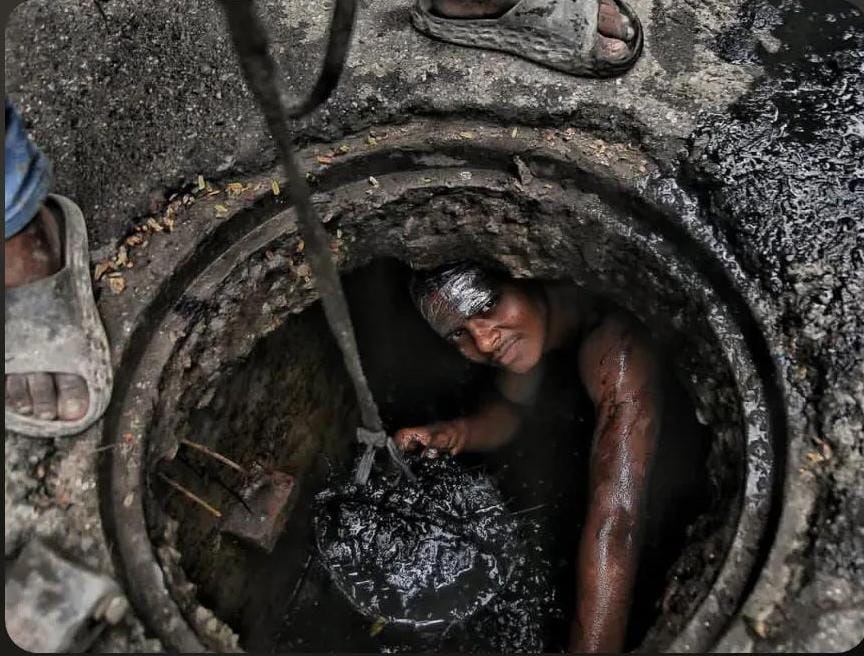
Manual Scavenging?
In the age of artificial intelligence (AI), manual scavengers are individuals who engage in the undignified work of manual scavenging for a livelihood. The government has taken several initiatives to eliminate the practice of manual scavenging. Employment of Manual Scavengers and Construction of Dry Latrines (Prohibition) Act, 1993. It is the first Indian law that banned manual scavenging in the country.
Manual Scavenging Continues in India
Manual scavenging is still going on in India. Do you think practices like untouchability and caste discrimination are out of the picture yet?
Dr. B.R. Ambedkar describes the caste system as a division of laborers. Even today, the caste system still exists in the country. Manual scavenging is performed by a specific caste that has existed since civilization.
Division of laborers means the choice of occupation associated with the particular caste. According to this caste system, the occupation of cleaning is associated with the lower caste (scheduled caste). If a person doesn’t have the right to change his occupation, it would be impossible for him to earn his livelihood.
It is a violation of Article 19 (1) (g): the right to practice any profession or to carry on any occupation, trade, or business.
What Is Manual Scavenging?
Manual scavenging is defined as manually cleaning, carrying, disposing of, or handling human excreta from dry insanitary latrines, drains, and other sanitation systems.
Manual scavenging encompasses all forms of direct interface with fecal matter during work.
Forms of Manual Scavenging
- Cleaning human excreta from dry insanitary latrines.
- Cleaning fecal matter on railway lines and disposing of it.
- Getting into choked nallas or deep drainages filled with filthy waste and human waste for cleaning and repairing them.
- Getting into septic tanks, manholes, and chambers of sea waste treatment plants for repairing them.
The riskiest one is getting into septic tanks, manholes, and chambers of sea waste treatment plants for repairing them.
Constitutional Rights and Human Dignity
Health is human beings’ greatest wealth. The Indian Constitution provides certain essential, basic, and inalienable fundamental rights to individuals.
The right to live with dignity is a human right that is covered under Article 21 of the Indian Constitution. Article 21 also includes the right to health as a fundamental right.
The inhuman practice of manual scavenging is expressly a violation of the human rights or fundamental rights of people who are employed in such work.
Constitutional Provisions Related to Manual Scavenging
| Constitutional Provision | Relevance |
|---|---|
| Article 19 (1) (g) | Guarantees the right to practice any profession or to carry on any occupation, trade, or business. |
| Article 21 | Protects the right to life, the right to live with dignity, and the right to health. |
Impact of the Caste System
This article puts forward the view that the existence of manual scavenging is a violation of Article 21 for the right to live with dignity and also represents how the caste system still exploits a particular group of society.
It emphasizes the need for structural changes and the invention of new technologies to eradicate such work of manual scavenging.
Key Highlights
- Manual scavenging remains a continuing social and human rights issue in India.
- The Employment of Manual Scavengers and Construction of Dry Latrines (Prohibition) Act, 1993 was the first law banning manual scavenging.
- The practice is closely linked to caste-based occupational discrimination.
- Manual scavenging includes cleaning dry latrines, railway tracks, drains, septic tanks, manholes, and sewage treatment chambers.
- The practice raises serious concerns under Article 19(1)(g) and Article 21 of the Constitution of India.
- Structural reforms and technological innovation are essential for eliminating manual scavenging.
6]YR2′.
Efforts of the Indian Government to End Manual Scavenging
The Employment of Manual Scavengers and Construction of Dry Latrines (Prohibition) Act, 1993. It is an act to provide for the prohibition of employment of manual scavengers as well as the construction of dry latrines. The states adopt this act under Article 252 (1) of the Indian Constitution.
Employment of Manual Scavengers and Construction of Dry Latrines (Prohibition) Act, 1993
Sec 3 of the abovementioned Act prohibits the engagement or employment of a person by any other person for manually carrying human excreta, constructing or maintaining a dry latrine.
However, the above-said provisions of Sec 3 do not take effect immediately. Sec 3 empowers the state government to issue such a notification, making the Act applicable in a specified area.
Under Sec 3, the govt only issues a notification upon the fulfillment of 3 conditions:
- It must give 90 days’ notice of its intention to do so.
- Only when adequate facilities for the use of water-sealed latrines in that area exist.
- Only if the ban is essential for the protection and improvement of the environment or public health in that area.
| Requirement Under Sec 3 | Condition |
|---|---|
| Notice Period | 90 days’ prior notice |
| Infrastructure | Adequate water-sealed latrine facilities must exist |
| Purpose | Protection and improvement of environment or public health |
Critical Analysis of Section 3
The provision of Sec3 (2) (II) prompts essential questions. Can the absence of sanitary infrastructure ever justify the continuation of manual scavenging?
The inhuman practice of manual scavenging constitutes a grave violation of human rights and the right to live with human dignity. The prohibition of this inhuman practice should not depend on the availability of adequate facilities and infrastructure.
Also, the principle laid down in sec 3(2)(lll) is fundamentally flawed. Manual scavenging consistently endangers life and constitutes a violation of the right to health. This is not an environmental issue; it is a social issue. This practice requires complete annihilation.
Limitations of the 1993 Act
The above-mentioned law has substantial limitations and loopholes that make it ineffective.
- There is no provision for the rehabilitation of manual scavengers that exists in the 1993 Act.
- It was therefore replaced with the Prohibition of Employment as Manual Scavengers and their Rehabilitation Rules, 2013.
Prohibition of Employment as Manual Scavengers and Their Rehabilitation Rules, 2013
This Act is not only for the prohibition of employment as scavengers but also provides provisions related to the rehabilitation of manual scavengers and their families. It extends to the whole of India.
The PEMSR ACT 2013 expanded the concept of manual scavenging to encompass the definition of hazardous cleaning.
The Act defines hazardous cleaning as the manual cleaning of sewer and septic tanks by an employee without protective gear and other safety devices.
It is an obligation for employers to provide safety gear and cleaning devices to employees.
Sec 5 of the Act prohibits insanitary latrines and the employment and engagement of any person as a manual scavenger directly or indirectly by a person, agency, or any local authority.
Insanitary latrines shall be converted into sanitary latrines. It also provides provisions to convert insanitary latrines into sanitary latrines.
The Act penalizes the work of manual scavenging and hazardous cleaning and makes it punishable with imprisonment for a maximum of 1 year or a fine of 50 thousand or both.
The Act requires the identification of manual scavengers in urban areas by municipalities and in rural areas by panchayats and offers them skill development and alternative opportunities and provides help in loans for financial support.
Key Features of the PEMSR Act, 2013
| Provision | Details |
|---|---|
| Coverage | Extends to the whole of India |
| Definition | Includes hazardous cleaning |
| Employer Obligation | Provide safety gear and cleaning devices |
| Sec 5 | Prohibits insanitary latrines and employment of manual scavengers |
| Punishment | Maximum 1 year imprisonment or ₹50,000 fine or both |
| Rehabilitation | Skill development, alternative employment and financial assistance through loans |
Exception Under the Act
The Act also provides an exception to the definition of manual scavengers.
If a person is engaged or employed in cleaning human excreta by using protective gear and cleaning devices as notified by the central government, they shall not be covered under the definition of manual scavengers.
This exception is inherently vague and susceptible to misuse. It does not define safety devices and protective gears. The absence of effective enforcement and accountability of the officials of the Act.
National Commission for Safai Karmacharis (NCSK)
It is the commission that monitors various related schemes, demolition of dry latrines, conversion of dry latrines into water-sealed latrines, and relief and rehabilitation of manual scavengers.
NCSK is operating under the Ministry of Social Justice and Empowerment.
According to the NCSK annual report 2021–2022, after the enactment of the PEMSR ACT 2013, 14,505 manual scavengers were identified in the country in 2013. iv.
In the survey conducted March–September 2018, 42,303 manual scavengers were identified by the commission.
Furthermore, the survey suffered significant limitations, as 18 states were selected for the survey. The survey was carried out in 178 districts, out of 718. vi
Functions of the NCSK
The NCSK has the investigating grievance:
- Taking Suo moto notice of problems of manual scavenging.
- Investigating complaints related to violation of rights of Safai Karmacharis.
- Non-payment of minimum wages.
- Harassment.
- Loans.
- Non-payment of sewer death compensation.
- Not providing safety gear.
- Other related grievances.
Manual Scavenging: Health and Safety Risks
Manual scavengers encounter occupational health and safety hazards, including physical injuries, respiratory problems, and limited access to sanitation facilities and clean water.
People who engage in the above-said activity die of asphyxiation.
Inhalation of gases like methane, hydrogen sulfide, and ammonia in manholes leads to instant death.
Without life, rights don’t matter.
Despite the statutory prohibition on manual scavenging, according to the annual report 2021-2022 of NCSK, a total of 988 people have died who were engaged in or employed in hazardous cleaning (sewer deaths). vii
| NCSK Statistics | Figures |
|---|---|
| Manual scavengers identified in 2013 | 14,505 |
| Manual scavengers identified in 2018 survey | 42,303 |
| States surveyed | 18 |
| Districts surveyed | 178 out of 718 |
| Reported sewer deaths (Annual Report 2021–2022) | 988 |
Limitations of the NCSK
The National Commission for Safai Karmacharis is a non-statutory body.
NCSK lacks independent legal backing. As an advisory body, it cannot compel compliance with its recommendations or take punitive action against defaulting authorities.
The government can dissolve it at any time via executive order.
It cannot legally summon officials, mandate production of documents, or enforce the attendance of witnesses during investigation.
Government Rehabilitation Schemes
The Government of India also introduced some rehabilitation schemes, such as NAMASTE (the National Action for Mechanized Sanitation Ecosystem) and SRMS (self-employment scheme for rehabilitation of manual scavengers).
| Scheme | Objective |
|---|---|
| NAMASTE | National Action for Mechanized Sanitation Ecosystem |
| SRMS | Self-employment scheme for rehabilitation of manual scavengers |
What Is the Right to Live with Dignity?
Every human being has the right to live in dignity. Living in dignity is something that every state must make sure of: the person is not only surviving, but he has the right to food, he has the right to adequate housing, and he has the right to good health. Article 21 of the Indian Constitution guarantees the “protection of life and personal liberty” for all individuals.
Article 21: Right to Life and Personal Liberty
In the practice of manual scavenging, women gather human excreta from dry latrines across India’s towns and villages. They carry the waste on their head over a distance to dispose of it. Men use their bare hands to clean and scoop out filth from choked sewers, open drains, and manholes.
These practices are explicit fundamental violations of Article 21 of the Constitution of India (right to live with dignity). The Supreme Court of India declared in its landmark judgment, French Caroline Mullin versus The Administrator, Union Territory of Delhi. Article 21 of the Constitution is not just about mere physical survival or animal existence. viii. The right encompasses the right to live with human dignity.
It is a recognized right by the Universal Declaration of Human Rights.
Impact of Manual Scavenging on Human Dignity
People engaged in manual scavenging have limited access to medical care facilities and housing facilities. They are just surviving.
80 years after independence, the inhuman practice of manual scavenging continues in India.
- Manual scavenging is caste-based violence.
- Manual scavenging is also a violation of Article 17 of the Indian Constitution.
- Article 17 of the Indian Constitution abolishes “untouchability” in all forms and forbids its practice.
- Article 23 states the prohibition of forced labor.
Constitutional Values of Fraternity and Human Dignity
The term “fraternity” enshrined in the preamble of the Indian Constitution is the foundation that guarantees human dignity by ensuring the people treat others with respect, without discrimination.
Article 47: Duty of the State
Article 47 in the Constitution of India: Duty of the State to raise the level of nutrition and the standard of living and to improve public health: The State shall regard the raising of the level of nutrition and the standard of living of its people and the improvement of public health as among its primary duties.
Constitutional Provisions Related to Human Dignity
| Constitutional Provision | Protection Provided |
|---|---|
| Article 21 | Protection of life and personal liberty, including the right to live with dignity. |
| Article 17 | Abolishes untouchability in all forms and forbids its practice. |
| Article 23 | Prohibits forced labor. |
| Preamble | Fraternity ensures dignity of the individual and promotes equality and respect. |
| Article 47 | Directs the State to improve nutrition, the standard of living, and public health. |
Continuing Challenge of Manual Scavenging
Even though the Constitution of India provides several provisions, the dehumanizing practice of manual scavenging is continued in several parts of the country.
Judicial Safeguards for the Dignity of Manual Scavengers
The Indian judiciary has been instrumental in safeguarding the rights and dignity of manual scavengers. Many deaths happen every year due to gas poisoning.
The significant judicial cases are:
Delhi Jal Board v. National Campaign for Dignity and Rights of Scavengers (2011)
In the above-mentioned case, the apex court pronounced a milestone decision. The court emphasized the constitutional responsibilities of the agencies for workers’ safety and their rehabilitation. Sewer workers are entitled to free medical treatment. There were many other recommendations given by the court for the rehabilitation of workers.
Safai Karmachari Andolan v. Union of India (2014)x
In this judgment, the apex court recognized the practice of manual scavenging as an inhuman and dishonorable occupation. The court acknowledged manual scavenging as an infringement of fundamental rights, i.e., Articles 14, 17, 21 and 23 of the Indian Constitution.
The court has given, inter alia, the following directions:
- The apex court requires the identification of the families of all persons who have died in sewerage work (manholes, septic tanks) since 1993.
- Award compensation of Rs. 10 lakhs for each such death to the family members depending on them.
- The NCSK monitors the implementation of these directions issued by the apex court in the 2014 case.
- The case emphasized rehabilitation of manual scavengers.
Balram Singh v. Union of India and Ors.xi
Dr. Balram Singh filed a PIL on 31 January 2023. The case emphasized the complete elimination of manual scavenging and hazardous cleaning.
The apex court gave directions for the proper enactment of the provisions of the PEMSR Act 2013 and to adopt mechanized methods for sewer cleaning and eradicating manual scavenging.
The Court made an excellent decision by increasing compensation for deaths caused by hazardous sewer and septic tank cleaning from 10 lakh to ₹30 lakh.
| Case | Year | Key Judicial Contribution |
|---|---|---|
| Delhi Jal Board v. National Campaign for Dignity and Rights of Scavengers | 2011 | Emphasized worker safety, rehabilitation, and free medical treatment. |
| Safai Karmachari Andolan v. Union of India | 2014 | Recognized manual scavenging as unconstitutional and ordered compensation and rehabilitation. |
| Balram Singh v. Union of India and Ors. | 2023 | Directed mechanization of sewer cleaning and enhanced compensation to ₹30 lakh. |
Towards the Complete Eradication of Manual Scavenging
Although the Government of India has taken several initiatives to prohibit or ban manual scavenging, such as legal or policy reforms, it is still carried out in India. However, several countries have effectively ended the practice of manual scavenging through the use of technology and stringent legislation. Modern technologies can save the lives of manual scavengers and end manual scavenging.
Several Asian countries like Singapore, Japan, Malaysia, etc. have effectively solved the manual scavenging issue. The state government of Nagaland stated that there was no incident of employment of manual scavengers in the state.xii
India should adopt these measures for the eradication of manual scavenging. Other states of India should adopt the principles followed by Nagaland.
The Government of India should ensure:
- Time-bound rehabilitation with adequate financial assistance.
- Skill development programs (entrepreneurial skills).
- Guaranteed alternative employment to manual scavengers or their families.
- Proper training for Safai Karmacharis.
The limitation of 03 months given in section 10 of the PEMSR Act 2013 for filing complaints seems insufficient. Hence, it may be enhanced to at least one year.
Robot Bandicoot Technologyxiii to Eliminate Manual Scavenging
The world’s first robotic scavenger (BANDICOOT) is designed and developed by Genrobotics, a national startup, for cleaning confined spaces like sewer manholes and provides a safer workspace for people engaged or employed in manual scavenging.
It was initiated and supported at the national level by the Ministry of Housing and Urban Affairs through the Swachh Bharat Mission.
The sewage cleaners should be given jobs to operate these machines. So, they don’t lose their jobs.
India needs to use these robots and AI to replace jobs like manual scavenging. The Indian government needs to allocate more budget to science and research for our New India.
The Government of India makes efforts for mechanized cleaning of sewers and to eradicate human intervention in such cleaning. Strict compliance with the PEMSR Act 2013.
| Recommended Measures | Expected Outcome |
|---|---|
| Mechanized sewer cleaning | Reduction in hazardous human intervention |
| Bandicoot robotic technology | Safer sewer maintenance and elimination of manual scavenging |
| Skill development and rehabilitation | Alternative employment opportunities |
| Financial assistance | Economic rehabilitation of affected families |
| Strict compliance with the PEMSR Act 2013 | Effective implementation of the prohibition law |
Conclusion
Manual scavenging is not merely an issue of sanitation or labor; it is an issue of the human dignity of people engaged in such work and the protection of their human rights, which are inalienable. It is the responsibility of both the legislature and the judiciary.
This issue is related to the caste system. India needs to annihilate the caste system to eradicate this issue.
Even though the act of manual scavenging is banned in India under the PEMSCR Act 2013, these activities continue because of a lack of awareness. People engaged in such work do not know about their rights.
The government must increase awareness. nd-Notes
- Article 19 in the Constitution of India
Protection of certain rights regarding freedom of speech, etc. - Consumer Education & Research Centre vs. Union of India & Others, decided on 27 January.
URL: https://indiankanoon.org/doc/1657323/ - The Employment of Manual Scavengers and Construction of Dry Latrines (Prohibition) Act, 1993, Section 3 – Prohibition of employment of manual scavengers, etc.
URL: https://www.indiacode.nic.in/bitstream/123456789/1581/1/A1993-46.pdf - The National Commission for Safai Karmacharis (NCSK), Annual Report 2021–2022, Page 9.
URL: https://ncsk.nic.in/annual-report - The National Commission for Safai Karmacharis (NCSK), Annual Report 2021–2022, Page 9.
URL: https://ncsk.nic.in/annual-report - The National Commission for Safai Karmacharis (NCSK), Annual Report 2021–2022, Page 9.
URL: https://ncsk.nic.in/annual-report - The National Commission for Safai Karmacharis (NCSK), Annual Report 2021–2022, Page 50, Heading 5.5.1 (Table).
URL: https://ncsk.nic.in/annual-report - Francis Coralie Mullin vs. The Administrator, Union Territory of Delhi, decided on 13 January 1981.
URL: https://indiankanoon.org/doc/78536/ - Delhi Jal Board v. National Campaign for Dignity and Rights of Sewerage and Allied Workers, (2011) 8 SCC 568.
- (2014) 11 SCC 224 : (2014) 3 SCC (L&S) 814.
- Dr. Balram Singh v. Union of India & Others.
URL: https://clpr.org.in/litigation/dr-balram-singh-v-union-of-india-ors/ - The National Commission for Safai Karmacharis (NCSK), Annual Report 2021–2022, Page 44.
URL: https://ncsk.nic.in/annual-report - Press Information Bureau (PIB) Press Release.
URL: https://www.pib.gov.in/PressReleaseIframePage.aspx? PRID=1947053®=48&lang=2
Written By: Shailesh Chahar – BA.LLB

