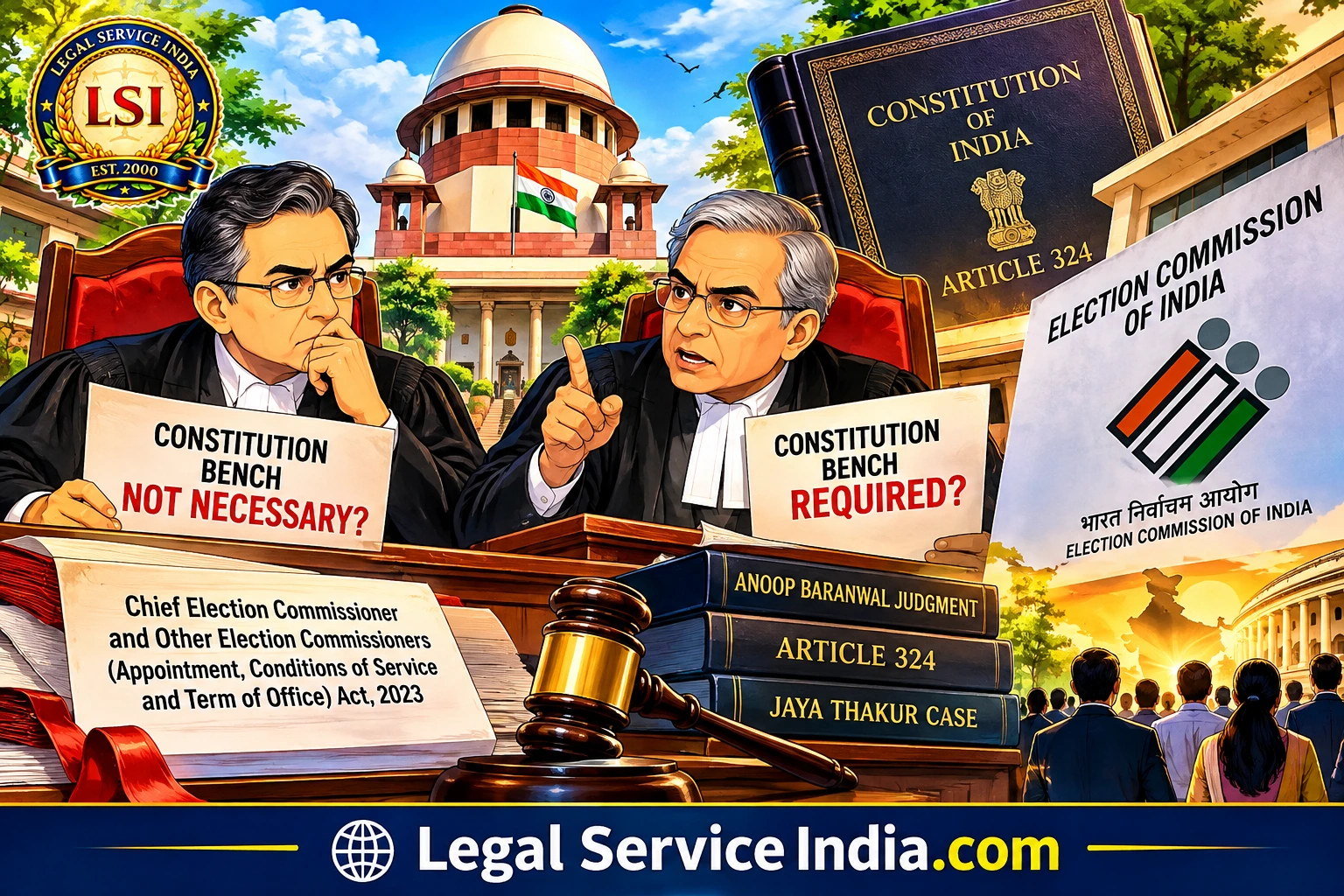
Election Commissioner Appointment Act 2023: Supreme Court Split Verdict Puts ECI Appointment Law Before Chief Justice
Introduction
The Supreme Court has not struck down the law governing the appointment of India’s Chief Election Commissioner and Election Commissioners.
But on 23 September 2026, the Court’s two-judge bench reached a significant disagreement over a more fundamental question: does the constitutional challenge to the 2023 appointment law require consideration by a Constitution Bench?
Justice Dipankar Datta took the view that a Constitution Bench reference was not necessary because the constitutional principles governing the independence of the Election Commission had already been settled in Anoop Baranwal v. Union of India. Justice Satish Chandra Sharma took the opposite view, holding that the constitutional validity of the new statutory framework raises a substantial question requiring consideration by at least five judges.
Because the Bench differed, the papers have been placed before the Chief Justice for consideration of an appropriate Constitution Bench.
That distinction matters.
The Supreme Court has not yet decided whether the Chief Election Commissioner and Other Election Commissioners (Appointment, Conditions of Service and Term of Office) Act, 2023, is constitutionally valid.
- The Act continues to operate.
- The appointments made under it continue to stand.
- And the central constitutional question—whether Parliament’s new appointment mechanism sufficiently protects the institutional independence of the Election Commission—remains open.
This is the legal position as of 24 September 2026.
Also Read: TMC Name-Symbol Freeze: Can the Election Commission Freeze a Political Party’s Identity?
The Constitutional Question Behind the Dispute
The starting point is Article 324 of the Constitution.
Article 324(2) provides that the Chief Election Commissioner and other Election Commissioners are appointed by the President, subject to the provisions of any law made by Parliament.
For decades, Parliament did not enact a comprehensive law prescribing the appointment mechanism.
That changed after the Supreme Court’s Constitution Bench judgement in Anoop Baranwal v. Union of India in 2023.
The Court was concerned not merely with who formally appoints Election Commissioners, but with the institutional independence of the Election Commission itself.
The underlying constitutional concern was straightforward: an institution responsible for administering elections must be sufficiently independent from the executive whose political fortunes may be affected by its decisions.
What the Supreme Court Held in Anoop Baranwal
In Anoop Baranwal, a five-judge Constitution Bench dealt with the absence of parliamentary legislation governing appointments.
The Court recognised free and fair elections as a constitutional requirement connected with the basic structure of the Constitution.
Until Parliament enacted a law, the Court directed that appointments should be made on the recommendation of a committee comprising:
- the Prime Minister;
- the Leader of the Opposition in the Lok Sabha; and
- the Chief Justice of India.
But there is an important qualification.
The Court’s arrangement was expressly intended to operate until Parliament made a law.
That qualification has become central to the present dispute.
Justice Datta’s reasoning in the 2026 case rests substantially on this distinction.
According to that view, the judicially prescribed committee in Anoop Baranwal was an interim arrangement fashioned to fill a legislative vacuum. Once Parliament enacted the 2023 legislation, that interim arrangement ceased to operate.
The question then becomes different:
Did Parliament merely replace a temporary judicial arrangement, or did it enact a framework that fails the constitutional requirement of an independent Election Commission?
That is the real constitutional controversy now awaiting determination.
Parliament’s 2023 Law
Parliament enacted the Chief Election Commissioner and Other Election Commissioners (Appointment, Conditions of Service and Term of Office) Act, 2023.
The legislation came into force in February 2024.
The Act created a statutory mechanism involving both a Search Committee and a Selection Committee.
The Search Committee
Section 6 establishes a Search Committee headed by the Union Minister of Law and Justice.
The Search Committee prepares a panel of five persons.
The Selection Committee
Section 7 provides that the Chief Election Commissioner and other Election Commissioners are appointed by the President on the recommendation of a Selection Committee consisting of:
- the Prime Minister — Chairperson;
- the Leader of Opposition in the Lok Sabha — Member; and
- a Union Cabinet Minister nominated by the Prime Minister — Member.
The statutory composition is therefore materially different from the interim arrangement prescribed in Anoop Baranwal.
- The Chief Justice of India is no longer a member of the Selection Committee.
- The third member is a Union Cabinet Minister nominated by the Prime Minister.
Section 8 Adds Another Important Feature
The Selection Committee may regulate its own procedure in a transparent manner.
More importantly, it may consider a person who was not included in the panel prepared by the Search Committee.
That provision has become part of the constitutional challenge.
The Difference in One Table
| Issue | Anoop Baranwal Interim Arrangement | 2023 Act |
|---|---|---|
| Prime Minister | Member | Chairperson |
| Leader of Opposition | Member | Member |
| Third member | Chief Justice of India | Union Cabinet Minister nominated by PM |
| Executive-aligned members | 1 of 3 | 2 of 3 |
| Search Committee | No comparable statutory mechanism | Yes, under Section 6 |
| Can the Selection Committee consider persons outside the Search Committee panel? | Not applicable | Yes, under Section 8 |
The structural change is therefore significant.
The Prime Minister and Leader of Opposition remain part of the process.
The major change is the replacement of the Chief Justice of India with a Union Cabinet Minister nominated by the Prime Minister.
Whether that change is constitutionally permissible is the question now pending.
The Challenge Before the Supreme Court
Several petitions challenged provisions of the 2023 Act.
The principal challenge concerns the composition of the Selection Committee, particularly Section 7.
The petitioners’ argument is that the new arrangement places the appointment process under effective executive dominance.
Their concern is not simply numerical.
They argue that the Prime Minister and the Cabinet Minister nominated by the Prime Minister constitute two members of a three-member committee.
The Leader of Opposition can therefore be outvoted.
The petitioners contend that such a structure undermines both the actual independence of the Election Commission and public confidence in that independence.
The challenge also extends to the Search Committee mechanism and Section 8, which permits the Selection Committee to consider persons outside the Search Committee’s panel.
What the Supreme Court Decided on 23 September 2026
This is where precision is essential.
The two-judge bench did not decide the constitutional validity of the 2023 Act.
The immediate issue before the Court was whether the challenge raised a substantial question of law as to the interpretation of the Constitution requiring a Constitution Bench under Article 145(3).
Justice Dipankar Datta and Justice Satish Chandra Sharma disagreed.
Justice Dipankar Datta: No Constitution Bench Reference Necessary
Justice Datta’s approach was that Anoop Baranwal had already established the relevant constitutional principles.
Those principles include the importance of free and fair elections and the need to protect the Election Commission from exclusive executive control.
In his view, the three-member committee prescribed in Anoop Baranwal was an interim arrangement under Article 142.
It was not a permanent constitutional command under Article 141 requiring Parliament to retain the Chief Justice of India on every future selection committee.
Once Parliament enacted legislation under Article 324(2), the interim judicial arrangement ceased to operate.
The remaining question, therefore, was whether the statutory arrangement complied with the constitutional principles already established.
On that reasoning, Justice Datta did not consider a Constitution Bench reference necessary.
But Justice Datta Also Raised Serious Prima Facie Concerns
This part of the judgement deserves careful treatment.
Although Justice Datta did not consider a reference necessary, his opinion contained significant observations about the structure created by the 2023 Act.
He questioned whether a Cabinet Minister nominated by the Prime Minister could provide a genuinely independent counterweight within a three-member committee.
The concern was connected with the constitutional principle that institutional independence must not merely exist in theory but must also be capable of being perceived by the public.
In other words, the issue is not simply:
- Is the Election Commission legally independent?
- It can also be: Does the method by which its members are selected inspire reasonable confidence in that independence?
Those observations are important.
But they must not be misunderstood.
They are not a declaration that the 2023 Act is unconstitutional.
The constitutional validity of the Act remains undecided.
Justice Satish Chandra Sharma: Constitution Bench Reference Required
Justice Sharma took a different approach.
For him, the central question was not simply whether the principles in Anoop Baranwal were settled.
The 2023 Act itself had never been tested by the Supreme Court for constitutional validity.
The question of whether Parliament could replace the Chief Justice of India with a Union Cabinet Minister nominated by the Prime Minister raised a fresh constitutional issue.
That, according to Justice Sharma, was precisely the kind of question contemplated by Article 145(3).
Article 145(3) requires that a case involving a substantial question of law as to the interpretation of the Constitution be heard by a Bench of at least five judges.
His reasoning therefore focused on the distinction between:
- applying an existing constitutional rule
- and determining whether new legislation complies with the Constitution.
For Justice Sharma, the latter question remained unresolved.
The Article 145(3) Question
The significance of the judgement extends beyond the Election Commission.
It also concerns the circumstances in which the Supreme Court should constitute a Constitution Bench.
Article 145(3) establishes a minimum five-judge bench where a substantial question of law concerning constitutional interpretation arises.
The disagreement between the judges therefore raises an institutional question:
When Parliament legislates after a Supreme Court judgement, is a subsequent constitutional challenge merely an application of the earlier judgement, or can the new legislation itself create a fresh constitutional question requiring a larger bench?
That issue could have implications well beyond election law.
Article 141 and Article 142: The Hidden Constitutional Issue
One of the most important legal distinctions in the case concerns Articles 141 and 142.
Article 141 provides that the law declared by the Supreme Court is binding on all courts in India.
Article 142 empowers the Supreme Court to make orders necessary to do complete justice.
Justice Datta’s approach places particular emphasis on the character of the directions issued in Anoop Baranwal.
If the committee prescribed there was an Article 142 arrangement designed to operate only until Parliament legislated, then Parliament was constitutionally entitled to create a different statutory mechanism—subject, of course, to the Constitution.
That does not mean Parliament can legislate anything it wishes.
It means that the question shifts from:
- Must Parliament retain the Anoop Baranwal committee?
- to:
- Does Parliament’s replacement mechanism satisfy the Constitution?
That distinction may ultimately be central to the Constitution Bench’s analysis.
The NJAC Analogy
Justice Sharma also drew attention to the Supreme Court’s decision concerning the National Judicial Appointments Commission.
The NJAC judgement dealt with judicial independence and the participation of the executive in judicial appointments.
The present case concerns appointments to the Election Commission, not appointments to the judiciary.
Therefore, the analogy cannot simply be transplanted without further constitutional analysis.
The larger question is whether principles developed to protect judicial independence necessarily operate in precisely the same way when the institution concerned is the Election Commission.
That is one of the issues a Constitution Bench may eventually have to examine.
Why the Search Committee and Section 8 Matter
The debate is not confined to Section 7.
Section 6 creates the Search Committee.
But Section 8 allows the Selection Committee to consider persons who were not included in the Search Committee’s panel.
This raises an important institutional question.
If the Search Committee is intended to function as an initial filter, how much constitutional significance does that filter have if the final Selection Committee is free to look beyond it?
The answer is not self-evident.
The Union can argue that the provision gives the Selection Committee flexibility and prevents a preliminary administrative panel from unnecessarily restricting the final choice.
The petitioners can argue that it weakens the independent screening mechanism.
The constitutional question is ultimately whether the overall structure sufficiently protects the independence and credibility of the Election Commission.
The Removal Question
There is another issue that deserves greater attention in discussions about institutional independence: removal protection.
The Chief Election Commissioner enjoys protection broadly comparable to that of a Supreme Court judge.
The other Election Commissioners do not enjoy identical removal protection.
That difference matters because institutional independence does not end on the day an appointment is made.
There are two distinct questions:
- Who selects an election commissioner?
- How secure is that commissioner after appointment?
A constitutional analysis of institutional independence may therefore have to consider both.
The SIR Judgement Is Related—but Legally Different
The appointment case is also being discussed alongside the Supreme Court’s May 2026 judgement concerning the Special Intensive Revision of electoral rolls.
That connection needs to be handled carefully.
In Association for Democratic Reforms v. Election Commission of India, the Supreme Court examined the ECI’s authority to conduct the Special Intensive Revision of electoral rolls in Bihar.
The Court upheld the exercise while addressing questions concerning Article 324, Section 21 of the Representation of the People Act, 1950, proportionality and the Commission’s role in relation to citizenship-related electoral-roll enquiries.
But that case concerned the powers exercised by the Election Commission.
The Jaya Thakur litigation concerns the constitutional validity of the mechanism used to appoint the Election Commissioners.
These are different legal questions.
The distinction is important because one can accept that the Election Commission possesses statutory and constitutional authority to conduct a particular electoral exercise while separately questioning whether the institutional appointment mechanism adequately protects its independence.
The two questions should therefore not be collapsed into one.
The Arguments on Both Sides
The Case in Defence of the 2023 Act
The Union’s position can be understood through Article 324(2).
The Constitution expressly contemplates parliamentary legislation governing appointments.
The Anoop Baranwal committee was expressly designed to operate only until Parliament made a law.
Parliament subsequently enacted the 2023 Act.
The Government can therefore argue that the constitutional scheme does not require the Chief Justice of India to remain part of the Selection Committee.
It can also point to the presence of the Leader of Opposition as an institutional check.
The Search Committee provides another layer of scrutiny.
From this perspective, the Constitution requires an adequate and lawful appointment mechanism but does not necessarily prescribe one particular composition.
The Petitioners’ Constitutional Objection
The petitioners approach the issue differently.
Their argument is that Parliament’s power under Article 324(2) is not unlimited.
Legislation governing appointments to a constitutional body must remain consistent with constitutional requirements, including the basic-structure principle of free and fair elections.
Their central concern is structural.
If two out of three members of the Selection Committee are aligned with the Union executive, the opposition member can be outvoted on every appointment.
The question is therefore whether the presence of one opposition member is sufficient to provide meaningful institutional balance.
The petitioners also challenge the effectiveness of the Search Committee because the final Selection Committee is not confined to its panel.
These arguments will now have to be examined at the appropriate judicial level.
What Is Settled—and What Is Still Open?
| Settled as of 24 September 2026 | Still Open |
|---|---|
| The 2023 Act remains operative. | Constitutional validity of the challenged provisions |
| No stay has struck down or suspended the Act | Whether Sections 6, 7 and 8 satisfy Articles 14 and 324 |
| Appointments made under the Act have not been set aside. | Whether the appointment structure adequately protects ECI independence |
| Anoop Baranwal remains an important authority on ECI independence. | The precise continuing legal significance of its interim committee |
| The May 2026 SIR judgment concerns ECI electoral-roll powers | Whether and how the SIR judgement interacts with the institutional-independence debate |
| The two-judge Bench disagreed on the need for a Constitution Bench | Whether the Chief Justice constitutes a five-judge or larger Bench and when it will hear the matter |
What Happens Next?
The immediate procedural step is before the Chief Justice.
Because the two judges differed on the reference question, the papers have been placed before the Chief Justice for consideration of an appropriate Constitution Bench.
The Court has also drawn attention to the problem of delays in Constitution Bench matters and considered whether a more permanent mechanism for deciding pure constitutional questions would be desirable.
That observation may have significance beyond this particular litigation.
Constitutional questions involving major institutions cannot remain unresolved indefinitely while the statutory framework continues to operate.
At the same time, the existence of a constitutional challenge does not itself suspend a parliamentary enactment.
That is the position here.
The Real Constitutional Question
The most important question arising from this litigation is not simply whether the Chief Justice of India should sit on the Selection Committee.
The deeper question is this:
How should the Constitution protect the independence of an institution that administers elections while leaving Parliament sufficient democratic authority to design its appointment mechanism?
There are competing constitutional principles at work.
- Article 324(2) gives Parliament legislative space.
- The basic structure doctrine places constitutional limits on legislative power.
- The independence of the Election Commission is connected with the constitutional requirement of free and fair elections.
- And the judiciary must decide how these principles fit together without converting an interim judicial arrangement into a permanent constitutional formula—or, conversely, allowing legislation to dilute a constitutional safeguard merely because Parliament has acted.
That is the question that ultimately matters.
Current Legal Position as of 24 September 2026
The position can therefore be stated quite simply.
| Legal Issue | Current Position |
|---|---|
| Election Commissioner Appointment Act, 2023 | The Election Commissioner Appointment Act, 2023 remains in force. |
| Constitutional Validity | The Supreme Court has not struck it down. |
| Appointments Made Under the Act | The appointments made under the Act have not been invalidated. |
| Justice Datta | Justice Datta did not consider a Constitution Bench reference necessary. |
| Justice Sharma | Justice Sharma considered such a reference necessary. |
| Present Position of the Matter | Because of that difference of opinion, the papers have gone before the Chief Justice for consideration of an appropriate Constitution Bench. |
The constitutional validity of the appointment mechanism remains undecided.
And until a larger Bench rules, the Anoop Baranwal judgment continues to provide the constitutional principles concerning the independence of the Election Commission, while the specific committee prescribed in that judgment cannot simply be treated as the permanent statutory appointment mechanism after Parliament enacted the 2023 law.
Conclusion
The 23 September 2026 judgement is important precisely because it did not settle the ultimate question.
It has moved the dispute to the next constitutional stage.
The Supreme Court must eventually confront a difficult balance: Parliament has the constitutional authority to legislate on the appointment of Election Commissioners, but that legislative power exists within a constitutional structure that treats free and fair elections as fundamental.
The Institutional Design Questions
The controversy is therefore not merely about three names on a Selection Committee.
It is about institutional design.
- Who should have the power to select the people who administer elections?
- How much executive influence is constitutionally permissible?
- Does the presence of the Leader of Opposition provide sufficient institutional balance?
- Does the Search Committee provide a meaningful independent filter?
- Can a selection process be legally valid while still failing the constitutional requirement that the Election Commission must be—and appear to be—independent?
- And, perhaps most importantly, where should the line be drawn between Parliament’s power to legislate and the Constitution’s demand for institutional independence?
The Supreme Court has not answered those questions yet.
What it has decided is that the dispute has reached a point where the constitutional architecture of India’s Election Commission itself is under examination.
The next authoritative answer will come from the Bench constituted to decide it.
Frequently Asked Questions
Has the Supreme Court struck down the Election Commissioner Appointment Act, 2023?
No. The Act remains operative, and its constitutional validity has not yet been finally decided.
What did the Supreme Court decide on 23 September 2026?
The two-judge bench differed on whether the constitutional challenge required a constitution bench. Justice Datta said a reference was unnecessary, while Justice Sharma favoured a reference. The papers were consequently placed before the Chief Justice.
Who appoints the Chief Election Commissioner under the 2023 Act?
The President makes the appointment on the recommendation of the Selection Committee constituted under Section 7 of the 2023 Act.
Who is on the Selection Committee?
The Selection Committee consists of the Prime Minister, the Leader of Opposition in the Lok Sabha and a Union Cabinet Minister nominated by the Prime Minister.
What did Anoop Baranwal decide?
Among other matters, the Constitution Bench addressed the absence of legislation governing Election Commissioner appointments and prescribed an interim committee consisting of the Prime Minister, Leader of Opposition and Chief Justice of India until Parliament enacted a law.
Does Anoop Baranwal permanently require the Chief Justice of India to be on the Selection Committee?
That is disputed in the present litigation. Justice Datta treated the Anoop Baranwal committee as an interim Article 142 arrangement that ceased to operate once Parliament legislated. The constitutional implications of the 2023 Act remain for determination.
Is the present Chief Election Commissioner’s appointment invalid?
No court has set aside the appointment. The 2023 Act remains operative, and the constitutional challenge to the appointment framework remains pending.
What is the connection between the SIR case and the appointment case?
Both concern the Election Commission, but they address different legal questions. The SIR case concerned the Commission’s power and procedure in revising electoral rolls. The Jaya Thakur litigation concerns the constitutional validity of the mechanism used to appoint Election Commissioners.
What happens next?
The Chief Justice will consider the appropriate bench for hearing the constitutional challenge. The eventual Constitution Bench, if constituted, will have to determine the constitutional validity of the challenged provisions.
Can the Supreme Court ultimately uphold the 2023 Act?
That remains an open question. Neither judge’s 23 September 2026 decision constitutes a final ruling on the constitutional validity of the Act.
Need Legal Assistance on Election Law, Constitutional Matters or Supreme Court Litigation?
When a constitutional issue involves the Election Commission, Article 324, election laws, appointment of constitutional authorities, electoral disputes or fundamental constitutional questions, the legal strategy can matter as much as the law itself.
Whether you are an individual, political organisation, company, institution or public-interest petitioner, complex constitutional litigation requires careful examination of the facts, applicable statutes, Supreme Court precedents and the appropriate legal remedy.
If your matter involves the Supreme Court of India, constitutional interpretation, election law, public law or a high-stakes legal dispute, obtaining advice from an experienced Supreme Court Advocate at the right stage can help you understand your legal position and available remedies before important decisions are made.
Speak With an Experienced Supreme Court Advocate
Adv. Tarun Choudhury
Supreme Court Advocate | 25+ Years of Legal Experience
- 📞 Call: 9650499965
- 💬 WhatsApp: 8851978611
- 📧 Email: [email protected]
Confidential Legal Consultation | Supreme Court & Constitutional Matters
If your matter requires constitutional litigation, election law advice, Supreme Court representation, drafting of petitions, legal notices, or strategic legal consultation, contact Adv. Tarun Choudhury to discuss your case and understand the appropriate legal course.
Your legal issue may have constitutional consequences. Get the right legal advice before the next step.
Key Takeaways: Election Commissioner Appointment Act 2023 & Supreme Court Split Verdict
- The Supreme Court has not struck down the Chief Election Commissioner and Other Election Commissioners (Appointment, Conditions of Service and Term of Office) Act, 2023. The Act remains in force as of 24 September 2026.
- On 23 September 2026, a two-judge Supreme Court Bench delivered a split view on whether the constitutional challenge to the 2023 Election Commissioner appointment law requires consideration by a Constitution Bench under Article 145(3).
- Justice Dipankar Datta held that a Constitution Bench reference was not necessary because the constitutional principles concerning Election Commission independence had already been addressed in Anoop Baranwal v. Union of India.
- Justice Satish Chandra Sharma took the contrary view, holding that the validity of the 2023 statutory appointment mechanism raises a novel and substantial constitutional question requiring a bench of at least five judges.
- Because of the difference of opinion, the matter has been placed before the Chief Justice of India for consideration of an appropriate Constitution Bench.
- The central constitutional controversy concerns Section 7 of the 2023 Act, under which the Selection Committee comprises the Prime Minister, the Leader of Opposition in the Lok Sabha and a Union Cabinet Minister nominated by the Prime Minister.
- The 2023 statutory mechanism differs significantly from the interim arrangement prescribed in Anoop Baranwal, where the committee consisted of the Prime Minister, Leader of Opposition and Chief Justice of India.
- A major constitutional issue is whether replacing the Chief Justice of India with a Union Cabinet Minister gives the executive excessive influence over the appointment of Election Commissioners and affects the institutional independence of the Election Commission.
- Section 6 creates a Search Committee headed by the Union Minister of Law and Justice, while Section 8 permits the Selection Committee to consider persons outside the panel prepared by the Search Committee.
- Justice Datta’s concerns regarding executive influence and the “perception test” were expressed on a prima facie basis. They should not be treated as a final judicial declaration that the 2023 Act is unconstitutional.
- The constitutional significance of Anoop Baranwal v. Union of India remains central. An important unresolved issue is whether its appointment committee was merely an interim Article 142 arrangement or whether its underlying requirements continue to constrain Parliament after enactment of a statutory framework.
- The article also highlights the removal-protection distinction between the Chief Election Commissioner and the other Election Commissioners, raising a separate question concerning institutional independence after appointment.
- The May 2026 Special Intensive Revision (SIR) judgement is legally distinct from the appointment litigation. The SIR case concerned the Election Commission’s authority over electoral-roll revision, whereas the present litigation concerns the constitutional validity of the Election Commissioner appointment mechanism.
- The Supreme Court has not decided whether the 2023 Election Commissioner appointment mechanism is constitutional. The ultimate questions concerning Sections 6, 7 and 8, Article 324(2), institutional independence and the basic structure remain pending.
Summary
The Supreme Court’s 23 September 2026 split verdict has not invalidated India’s Election Commissioner Appointment Act, 2023. Justice Dipankar Datta considered the existing constitutional principles sufficient to decide the matter without a Constitution Bench, while Justice Satish Chandra Sharma considered the validity of the 2023 appointment mechanism a substantial constitutional question requiring a larger bench. The matter is now before the Chief Justice, and the constitutional validity of the Selection Committee comprising the Prime Minister, Leader of Opposition and Prime Minister-nominated Cabinet Minister remains unresolved.
Important Links
- Lawyers in India
- Copyright Registration in India
- Caveat Filing in Supreme Court of India
- Mutual Consent Divorce in Delhi NCR: WhatsApp 9650499965