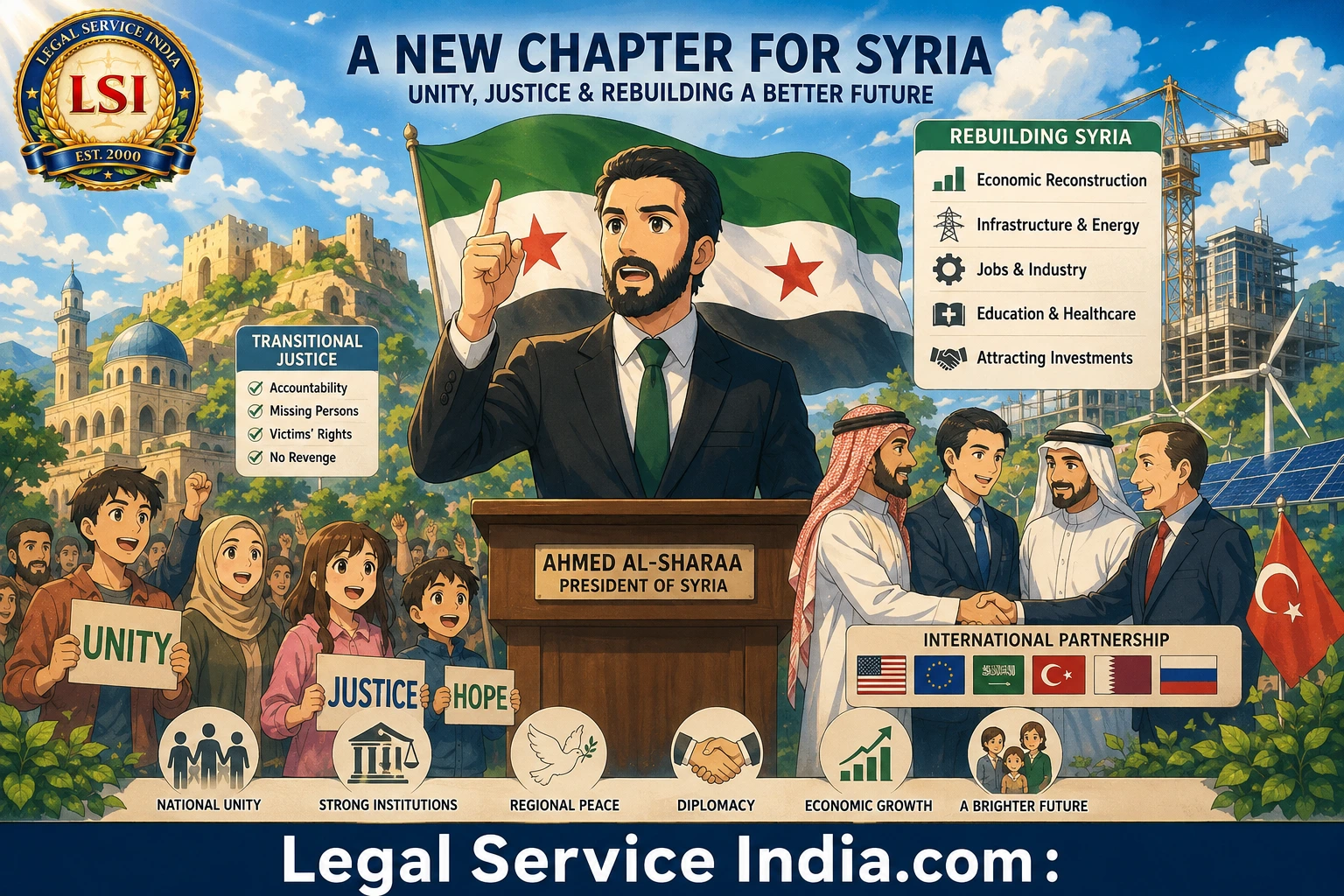
Syria After Assad: Ahmed Al-Sharaa’s Vision for a New Syria, Regional Peace and Economic Reconstruction
Part 1: From the Fall of Damascus to the Rise of Ahmed Al-Sharaa
Syria has entered one of the most consequential and uncertain chapters in its modern history.
On December 8, 2024, armed opposition forces announced that Damascus had been liberated, bringing an end to more than five decades of family rule. The change did not come through a conventional political transition. It followed an intense eleven-day military offensive in which opposition forces advanced rapidly, capturing city after city before reaching the Syrian capital.
Several armed groups participated in the offensive. Yet, within weeks, the leader of the group that had taken Damascus emerged as the country’s new leader: Ahmed Al-Sharaa.
His emergence created a striking paradox.
A man who had risen through an armed revolutionary movement was now confronted with the far more difficult task of governing an exhausted country. Syria was not simply a state that needed a change of government. It was a country facing the enormous consequences of war, economic isolation, institutional collapse, displacement, unresolved disappearances, competing armed groups and deep political and sectarian divisions.
The central question was therefore no longer simply who had won the war.
It was:
Could the new leadership turn military victory into a functioning state?
That question forms the backdrop to Al-Sharaa’s vision of Syria’s future.
Part 2: The Battle to End Syria’s International Isolation
One of the earliest and most significant challenges confronting the new Syrian government was the country’s international isolation.
For decades, Syria had faced severe economic restrictions. Among the most important measures was the Caesar Act, which imposed extensive sanctions on Syria.
Al-Sharaa argued that these sanctions had originally been imposed because of crimes committed by the former regime, including allegations involving chemical weapons, mass killings and other serious abuses.
His argument was straightforward.
If the sanctions were imposed because of the conduct of the former government, why should ordinary Syrians continue to bear their consequences after that government had fallen?
In his view, the Syrian people had already suffered enormously from the conflict. Continuing to impose economic restrictions on them would only prolong the consequences of the previous regime’s actions.
This became an important diplomatic argument for the new government.
According to Al-Sharaa, Saudi Arabia played an important role in the diplomatic efforts to secure sanctions relief. Turkey also became involved, with President Recep Tayyip Erdoğan reportedly intervening with the United States and President Donald Trump.
The objective was not merely to remove individual economic restrictions.
The broader ambition was to bring Syria back into the international economic and political system.
The State Sponsor of Terrorism Designation
There was, however, another major obstacle.
Syria had been designated a state sponsor of terrorism since 1979.
Al-Sharaa maintained that lifting the Caesar Act sanctions alone would not be enough. Syria also needed to overcome this longstanding terrorism designation if it was to fully reconnect with the international economy.
According to the account presented in the interview, the process involved the American legal and political system, including a period during which Congress could potentially object.
Al-Sharaa said that his government had already held extensive discussions with members of Congress, particularly lawmakers involved in foreign affairs.
He believed there was growing interest in removing the remaining restrictions.
For Damascus, this was about much more than diplomatic symbolism.
Sanctions relief could potentially open the door to:
- International investment
- Reconstruction financing
- Greater trade
- Economic cooperation
- Infrastructure development
- Energy investment
- Banking-sector reform
- Broader diplomatic normalisation
In other words, Syria’s international reintegration was being presented as a necessary foundation for rebuilding the country itself.
Part 3: A New Relationship With Washington
The interview also described a significant change in the relationship between Syria and the United States.
Al-Sharaa characterised his reception in Washington as positive and viewed the lifting of sanctions as evidence that a new phase in Syrian-American relations was beginning.
This represented a dramatic transformation.
For years, Syria had been treated as an isolated and heavily sanctioned state. The new government was now attempting to present itself as a government with which other countries could conduct normal diplomatic and economic relations.
But normalisation would not depend solely on Washington.
Syria also had to deal with its relationships with Turkey, Saudi Arabia, Qatar, the Gulf states, Russia, Iraq, Lebanon and Israel.
That meant the new Syrian leadership faced an extraordinary diplomatic balancing act.
It needed international partnerships without becoming dependent upon any single foreign power.
It needed investment without surrendering sovereignty.
And it needed regional cooperation while avoiding the armed conflicts that had devastated the country for more than a decade.
Part 4: Transitional Justice — Can Syria Deliver Justice Without Creating New Injustice?
Perhaps the most emotionally difficult challenge facing post-war Syria is transitional justice.
The destruction caused by the conflict cannot be measured merely in buildings and infrastructure.
Thousands of people remain missing.
Families continue to search for relatives.
Victims want answers.
Survivors want accountability.
And many Syrians want those responsible for serious crimes committed under the former regime to face punishment.
The new authorities say that they have established mechanisms for investigating missing persons and documenting abuses.
According to the source material, these efforts involve legal procedures, forensic investigations and cooperation with countries possessing advanced expertise in investigating mass atrocities and disappearances.
But the sheer scale of the problem makes the task extraordinarily difficult.
Al-Sharaa acknowledged that the extent of the suffering and alleged crimes under the former regime was enormous — potentially much greater than many people outside Syria could understand.
That creates a fundamental dilemma.
How can a new government satisfy the victims’ demand for justice while preventing justice from becoming another source of violence?
Justice Is Not Revenge
Al-Sharaa’s answer was based on a distinction between justice and revenge.
Those who have suffered injustice have the right to demand answers.
They have the right to ask where their loved ones are.
They have the right to demand accountability.
They have the right to speak about their suffering.
But, in his formulation, they do not have the right to commit a new injustice against someone else.
That distinction may become one of the defining principles of Syria’s transition.
A post-conflict society cannot rebuild itself if every victim becomes part of a new cycle of retaliation.
The objective, therefore, is not to forget the past.
It is to establish a legal process through which the past can be confronted without allowing it to destroy the future.
Part 5: The Kurdish Question—Beyond the Politics of Armed Groups
Syria’s future also depends upon how it handles its ethnic, religious and sectarian diversity.
The Kurdish population represents an important part of Syrian society and is distributed across different regions of the country.
Al-Sharaa emphasised that the Kurdish question should not automatically be equated with the question of armed organisations.
This distinction is politically significant.
According to the source material, some Kurdish Syrians had historically been denied full citizenship rights under the former regime.
The new government said it had taken steps to address this problem, including measures relating to citizenship, nationality and cultural recognition.
For Kurdish communities, such measures could represent a major departure from the policies of the past.
The source also describes recognition of Kurdish cultural identity and national celebrations within Syria’s official framework.
The broader message was that Kurdish citizens should be treated as part of the Syrian national community rather than as an inherently separate political problem.
Part 6: The SDF — A Different Problem From the Kurdish Question
The situation involving the Syrian Democratic Forces (SDF) was presented as a separate issue.
The SDF emerged under particular circumstances during the war against ISIS in northeastern Syria, with the involvement of the international coalition.
Consequently, the new Syrian government faced a complicated question:
How could armed formations that had developed during the war eventually be integrated into a unified Syrian state?
According to Al-Sharaa, earlier agreements had sometimes failed to produce full implementation.
Eventually, negotiations combined with military pressure resulted in another agreement.
He described the development as positive, although implementation remained slow.
The government’s stated objective was to find a solution that minimised casualties and destruction.
That reflects a broader principle running throughout Al-Sharaa’s vision:
Syria cannot afford another war while trying to rebuild itself.
Part 7: Syria Must Remain One Country
The question of territorial unity is inseparable from the future of Syria’s armed groups.
The country inherited a complex situation after years of conflict.
Some individuals had become involved in drug trafficking.
Others wanted to retain weapons.
Some communities sought security through ethnic or sectarian identities.
These different motivations could overlap and produce dangerous combinations.
Al-Sharaa’s stated position was nevertheless clear:
Syria must remain one country.
The state must ultimately control weapons.
The government must enforce the law throughout Syrian territory.
And no permanent arrangement should allow competing armed authorities to replace the state.
According to the interview, Al-Sharaa believed that this principle was broadly supported by countries including the United States, Turkey, Iraq and the Gulf states.
The logic is simple.
A country cannot easily establish stable institutions if different territories are governed by different armed authorities.
Nor can investors confidently enter a country where the state does not have effective control over security.
For Syria, therefore, territorial unity and state authority are not merely constitutional questions.
They are also economic and developmental necessities.
Part 8: What Does the New Syria Actually Stand For?
Perhaps the most fundamental question posed during the interview was:
What is the identity of the new Syria?
The question is particularly important because the new leadership emerged from an Islamic political background while Syria itself is an extraordinarily diverse society.
Would the new state be primarily defined by religion?
Would it be defined by sect?
Would it adopt a rigid ideological identity?
Al-Sharaa’s answer was strikingly simple:
Syria should be Syria.
The country’s identity, he argued, should arise from its history, civilisation and future aspirations.
Rather than imposing excessive ideological labels, the objective should be to develop a Syrian identity capable of bringing different communities together.
This approach attempts to move the national conversation away from the question of which community owns Syria.
The alternative proposition is that Syria belongs to all Syrians.
That is an ambitious idea in a country whose recent history has been shaped by political repression, sectarian tensions, foreign intervention and armed conflict.
Its success, however, will depend not merely on words but on how these principles are translated into institutions and law.
Part 9: Syria’s Return to the Regional Stage
Syria’s geography makes isolation difficult to sustain indefinitely.
The country occupies a strategic position at the crossroads of the Middle East.
It has historical connections with the Mediterranean, the Levant, Iraq, Turkey and the Gulf region.
It also possesses significant human resources and a long history of political and commercial influence.
Al-Sharaa argued that Syria’s isolation was therefore abnormal.
The new government’s ambition is to restore Syria to what he described as its natural regional and international role.
The source material says that Syria’s new approach had received positive responses from several European countries, including France, Germany, Britain, Spain and Italy.
At the same time, Damascus was seeking constructive relations with Russia and China.
The strategy appears to be one of broad diplomatic engagement.
Rather than choosing one geopolitical camp, Syria would attempt to establish working relationships with multiple powers based on its own interests.
That is easier said than done.
But for a country emerging from years of war and foreign involvement, strategic flexibility could become an important diplomatic asset.
Part 10: Syria and Russia — From Alliance to a Relationship Between States
Russia occupies a particularly sensitive position in Syria’s post-war future.
During the conflict, Russia was one of the most important foreign supporters of the previous government.
Russia also maintains military facilities in Syria, including its presence at Hmeimim and Tartus.
The Future of the Syria-Russia Relationship
According to Al-Sharaa, communication with Moscow began even before the previous government had completely fallen.
The two sides subsequently discussed the future of Russian military facilities.
But the new leadership appears to be trying to redefine the relationship.
The argument is that Syria and Russia have a relationship extending beyond any individual Syrian government.
There are historical economic, agricultural, energy and military connections.
Syrian military equipment, for example, has long been associated with the former Soviet Union and Russia.
Consequently, Al-Sharaa’s position was not that every connection with Russia should disappear.
Instead, the objective was to preserve relationships beneficial to Syria while transforming them into a more conventional relationship between two sovereign states.
That would mean mutual respect, recognition of sovereignty and adherence to agreements.
According to the interview, Russia appeared to understand the political transformation and was prepared to open a new chapter.
Part 11: What Does the West Want From Syria?
The new Syrian government also sees significant potential for cooperation with Europe and the United States.
According to Al-Sharaa, the relationship could involve:
- Trade
- Investment
- Economic cooperation
- Strategic cooperation
- Security
- Technology and expertise
- Reconstruction
The Syrian Diaspora and Reconstruction
There is also a powerful human connection.
Millions of Syrians have lived outside Syria because of the conflict. Germany alone has a very large Syrian population.
Many Syrians who moved to Europe have established careers, businesses, families and communities.
This creates a unique bridge between Syria and Europe.
The Syrian diaspora can potentially become more than a humanitarian issue.
It could become an economic and intellectual resource for reconstruction.
Syrians who acquired education, professional experience and business knowledge abroad may eventually contribute to rebuilding the country.
Part 12: Lebanon, Hezbollah and the Question of State Authority
Syria’s relationship with Lebanon is unavoidable.
The two countries share a border, deep social connections and a complicated political history.
The fourteen years of Syrian conflict also had significant consequences for Lebanon.
Syria’s Strategic Interest in Lebanon
Al-Sharaa therefore emphasised that Syria has a strong strategic interest in preventing Lebanon from descending into another major conflict.
He described Lebanon as facing serious dangers, including the possibility of Israeli occupation or internal civil war.
His government, according to the interview, wanted to cooperate with the Lebanese government in finding practical solutions.
State Authority, Weapons and National Security
A central principle was the authority of the state.
Al-Sharaa argued that armed organisations operating outside state authority create long-term instability.
His broader position was that the state should have exclusive authority over:
- Weapons
- Law enforcement
- War and peace
- National security
He also criticised Hezbollah’s involvement in the Syrian conflict, alleging that the organisation had participated in the former regime’s war and contributed to displacement and deaths.
Nevertheless, the proposed solution was not another war.
The objective was to find a practical security arrangement capable of reducing violence and restoring state authority.
Part 13: Supporting Lebanon Without Military Intervention
Syria, according to Al-Sharaa, did not want to intervene militarily in Lebanon.
Instead, Damascus could use diplomatic and political tools to support the Lebanese state.
The Taif Agreement and State Authority
One important reference was the Taif Agreement, which serves as a fundamental constitutional reference for Lebanon.
The agreement contains principles concerning state authority and the concentration of weapons under state control.
Syria’s proposed role was therefore supportive rather than militaristic.
The Lebanese authorities would ultimately determine how those tools were used.
This approach reflects the wider philosophy presented in the interview:
Syria wants regional influence without returning to the pattern of military intervention.
Part 14: Syria, Israel and the Search for a Security Arrangement
The interview distinguished between the Lebanon-Israel track and Syria-Israel discussions.
Al-Sharaa expressed caution about the possibility of a rapid agreement.
There remained numerous unresolved issues.
He warned that without durable understandings, the region could again experience escalation.
Syria-Israel Diplomatic Efforts
At the same time, Syria was reportedly pursuing diplomatic efforts aimed at achieving a security agreement with Israel.
The objective was to avoid unnecessary confrontation while protecting Syrian interests.
If a security agreement could be reached and both sides respected their commitments, Al-Sharaa suggested that a second stage could potentially involve discussions about a broader peace.
The Golan Heights and the Palestinian State
But there were important red lines.
Syria would not abandon its claim to the occupied Golan Heights.
It also continued to support the establishment of a Palestinian state and the broader Arab position on the Palestinian issue.
Thus, diplomatic engagement with Israel was not being presented as abandonment of Syria’s longstanding territorial or political positions.
Part 15: The Iran-US-Israel Conflict and the Risk of a Wider War
The wider confrontation involving Iran, Israel and the United States creates another major challenge for Syria.
Al-Sharaa expressed concern about the possibility of regional escalation.
Iran, Syria and Regional Escalation
Because Iran had been deeply involved in Syria during the previous conflict, the Syrian leadership had gained substantial insight into Iranian military and political thinking.
He also expressed concern about Iranian ambitions in the Gulf.
At the same time, he acknowledged the difficulties in communication and diplomacy between Iran and the United States.
The possibility of a broader regional war therefore remained a serious concern.
Syria’s Diplomatic Approach
Syria’s preferred approach was diplomatic.
Al-Sharaa argued that Arab countries needed to play an active role rather than allowing the Middle East to become merely a battlefield for competing external or regional powers.
Syria, because of its historical relationships with the Gulf states, could potentially contribute to a collective Arab response.
Part 16: The Middle East Needs an Independent Regional Strategy
One of the broader themes of Al-Sharaa’s vision is that Middle Eastern countries should develop their own strategic identity.
For centuries, the region has been the object of competition among external powers.
Today, competing interests remain visible across the Gulf, Iraq, Yemen and the Levant.
Strategic Independence in the Middle East
Al-Sharaa argued that the region should not permanently become an arena for competition between larger powers.
The Middle East, in his view, needs policies based on the interests of its own peoples and states.
That does not necessarily mean rejecting international partnerships.
Rather, it means ensuring that those partnerships do not erase the strategic independence of regional countries.
For Syria, this could become an important principle of its foreign policy.
Part 17: Syria and Iraq — Rebuilding a Historic Relationship
Syria and Iraq share deep connections.
Their relationship is not merely diplomatic.
The two countries share:
- Historical ties
- Tribal connections
- Social relationships
- Economic interests
- Geographic proximity
- Cultural links
Syria-Iraq Border and Regional Cooperation
Despite political tensions between their governments in the past, their populations remain closely connected.
Al-Sharaa described relations between Syria and Iraq as improving.
At the same time, Syria remained concerned about armed factions operating outside state authority, particularly near the Syrian-Iraqi border.
During the conflict, communication between the Syrian and Iraqi authorities was used to prevent misunderstandings and discourage actions that could negatively affect Syria or Lebanon.
According to the interview, those messages were received positively.
The broader objective is to turn the Syrian-Iraqi border from a security vulnerability into a channel for economic and political cooperation.
Part 18: Why Choose Reconciliation Instead of Revenge?
One of the most interesting features of Al-Sharaa’s foreign-policy message is his emphasis on reconciliation.
Syria’s new leadership could have chosen a different path.
It could have demanded revenge against countries and organisations that had supported the previous government.
Instead, the interview presented a different philosophy:
Countries cannot be built through revenge.
Reconciliation and Reconstruction
The reasoning is practical as much as moral.
Revenge may satisfy political emotions temporarily.
But it does not build roads.
It does not create jobs.
It does not restore electricity.
It does not rebuild hospitals.
It does not attract investment.
It does not establish functioning institutions.
For Al-Sharaa, Syria’s priorities were therefore:
Construction. Stability. Development.
Diplomatic Credibility and Transparency
This also explains the emphasis on diplomatic credibility.
He said that the government wanted to be honest with other countries.
If Syria could fulfil a commitment, it would do so.
If it could not, it would say so.
Such transparency, in his view, was essential to establishing confidence with foreign governments.
Part 19: Gulf States — The New Economic Partners
The Gulf states occupy a particularly important position in Syria’s reconstruction strategy.
Qatar’s Emir, Sheikh Tamim bin Hamad Al Thani, was described as one of the first leaders to visit Damascus.
Saudi Crown Prince Mohammed bin Salman was credited with an important role in the diplomatic effort surrounding sanctions relief and communication with President Trump.
The United Arab Emirates had also developed close relations with the new Syrian government.
Syria and the Gulf States
Al-Sharaa described relations with Saudi Arabia, Qatar, the UAE, Kuwait and other Gulf countries as generally positive.
The logic behind this cooperation is geographical as well as economic.
Syria, Jordan, Iraq and the Gulf states form an interconnected regional environment.
Borders cannot eliminate common economic interests.
The Gulf states therefore have both an interest and an opportunity in Syria’s recovery.
Part 20: Gulf Investment and the Rebuilding of Syria
Investment was already being discussed across several sectors.
However, Al-Sharaa cautioned against assuming that major strategic investments could appear overnight.
Large projects require:
- Feasibility studies
- Financial planning
- Legal certainty
- Proper institutional structures
- Long-term commitments
The Syrian government was particularly concerned that new investments should succeed.
A failed major investment could discourage future investors.
Potential areas of investment included:
- Energy
- Electricity generation
- Airports
- Real estate
- Tourism
- Infrastructure
- Oil refining
The source material refers to Saudi investment in one airport and Qatari-Turkish investment in another.
Major real estate developments were being considered in Damascus, Aleppo and other important cities.
Tourism projects were also being discussed in places including Palmyra, Latakia, Tartus and areas surrounding Damascus.
For Syria, these projects represent more than construction.
They could become symbols of the country’s transition from a war economy to a reconstruction economy.
Part 21: Reforming Syria’s Economic Foundations
Foreign investors, particularly from the Gulf, are interested not simply in opportunities but in the conditions under which those opportunities exist.
They want:
- Infrastructure
- Transparency
- Legal certainty
- Reliable banking
- Good governance
- Predictable regulations
Al-Sharaa said that his government was therefore working on investment laws, the legal system and the banking sector.
But he also made an interesting point.
The greatest investment may not always be money.
It may be knowledge.
Syria can learn from countries that have already undergone rapid transformation.
It can study what worked elsewhere.
It can also study what failed elsewhere and avoid repeating those mistakes.
That accumulated knowledge could be as valuable as billions of dollars in investment.
Part 22: Energy — The Backbone of Reconstruction
Energy is one of Syria’s most urgent economic challenges.
The interview described discussions involving pipelines capable of transporting Iraqi oil through Syria and potentially connecting the system with Lebanon.
Other proposals involved:
- Oil refining
- Petroleum products
- Domestic pipeline networks
- Rehabilitation of oil fields
- Energy infrastructure
These projects could generate revenue while simultaneously strengthening the country’s basic infrastructure.
A functioning energy sector would also have wider consequences.
Factories need electricity.
Hospitals need electricity.
Businesses need reliable power.
Homes need affordable energy.
Therefore, energy reconstruction is not simply an industrial policy.
It is one of the foundations upon which social recovery depends.
Part 23: The Syrian Economy — Growth Beyond the Numbers
The interviewer raised reports suggesting that Syria’s government budget had increased dramatically.
Al-Sharaa responded by emphasising the importance of context.
A large statistical increase does not automatically mean that the population has become substantially wealthier.
Sometimes a dramatic increase simply reflects the reopening of sectors that had previously collapsed.
The more meaningful question is whether the overall trajectory is improving.
Is production increasing?
Are services returning?
Are businesses reopening?
Are jobs being created?
Is infrastructure being rebuilt?
Are public institutions functioning?
These are more important measures of genuine recovery.
According to Al-Sharaa, Syria remained in a stage of filling enormous economic gaps created by years of destruction.
Nevertheless, he believed the overall direction was positive.
Part 24: Jobs, Industry and the Return of Production
Economic recovery ultimately has to reach ordinary people.
That means jobs.
Electricity had improved, according to the source, although costs had also increased.
Unemployment and the lack of employment opportunities remained serious problems.
Factories had closed.
Production had fallen.
Energy services had deteriorated.
The previous system had also suffered from corruption and structural weaknesses.
But there were signs of industrial recovery.
According to the interview, thousands of new production lines had begun operating since 2025.
The expectation was that industrial expansion would continue.
At the same time, the government was investing in:
- Roads
- Hospitals
- Infrastructure
- Reconstruction
- Villages
- Towns
- Energy projects
- Oil-field rehabilitation
If these efforts succeed, the result could eventually be a virtuous cycle:
Investment → Production → Employment → Higher incomes → Greater demand → Further investment.
That is the economic trajectory the new Syrian leadership hopes to create.
Part 25: The Idlib Experience — A Smaller Model for a Larger State
An intriguing part of the interview concerned Idlib.
Al-Sharaa acknowledged that the administration developed in Idlib had provided important governing experience.
Around four million people had lived there under extremely difficult conditions, with limited resources and weak infrastructure.
Yet the administration had undertaken projects involving:
- Roads
- Industrial zones
- Residential development
- Markets
- Commercial facilities
An economic system developed on a smaller scale.
The experience therefore became something of a practical laboratory for the new leadership.
The challenge now is fundamentally different.
Running a smaller territory under wartime conditions is not the same as governing an entire country.
Nevertheless, the lessons learned in Idlib could potentially influence the reconstruction of national institutions.
Part 26: Rebuilding the Syrian State
Perhaps the greatest challenge of all is institutional reconstruction.
War does not merely destroy buildings.
It damages the machinery of government.
Administrative systems deteriorate.
Public services disappear.
Institutions lose expertise.
Corruption becomes entrenched.
Citizens lose confidence.
Al-Sharaa acknowledged that rebuilding institutions could take considerable time.
In some cases, repairing a damaged institution can be more difficult than creating a new one.
The government was therefore attempting to reform institutions from the earliest stages.
The proposed reforms include:
- Digital transformation
- Electronic government services
- Modern public administration
- Training government employees
- Improving citizen services
- Prioritising essential public services
The philosophy is pragmatic.
Syria cannot solve every problem simultaneously.
The country must identify its most urgent needs, divide the challenges into manageable areas and address them systematically.
Part 27: Democracy and Syria’s Future Political System
The political future of Syria remains one of the most important unanswered questions.
The interviewer raised the issue of democracy and recalled how democratic reform had once been a central demand during the Arab Spring.
Al-Sharaa said that Syria was moving toward greater public participation.
People should have a voice in selecting leaders and determining the laws under which they live.
The People’s Assembly was presented as part of that process, with its initial sessions already underway.
But Al-Sharaa also rejected the idea that Syria should simply copy another country’s political system.
The country can learn from other nations.
It can study their political institutions.
It can adopt successful economic practices.
But ultimately, the Syrian political model must reflect Syrian circumstances.
That means taking into account the country’s history, social structure, ethnic and religious diversity and political experience.
Part 28: The Syrian People Are the Greatest Reconstruction Asset
Syria’s greatest resource may not be oil, gas or geography.
It may be its people.
Al-Sharaa emphasised that Syrians had demonstrated their capabilities around the world.
Wherever Syrians settled, they built businesses, professions and communities.
Many younger Syrians obtained education from leading universities around the world.
If Syria becomes stable, a significant portion of this human capital could potentially return.
The returning diaspora could bring:
- Professional expertise
- Entrepreneurship
- Education
- Investment
- Technology
- International connections
- Management experience
In that sense, rebuilding Syria is not merely about reconstructing physical infrastructure.
It is also about reconnecting Syria with the human capital that war dispersed across the world.
Part 29: Will Syrians Return Home?
Millions of Syrians have been displaced by the conflict.
The source describes large numbers of Syrians returning or visiting the country.
But Al-Sharaa acknowledged that return is complicated.
A person who has spent years abroad may have built an entirely new life.
They may have:
- A job
- A business
- A home
- Children
- Financial obligations
- A new social environment
Returning home is therefore not simply an emotional decision.
It is also an economic calculation.
The key to encouraging sustainable return is creating conditions under which people can realistically rebuild their lives.
That means security, employment, education, healthcare, housing and economic opportunity.
If those conditions improve, the expectation is that more Syrians will gradually return. “`
Part 30: Transitional Justice — The Test That Could Define the New Government
The question of accountability returns to the centre of Syria’s transformation.
Victims want answers.
Families want to know what happened to missing relatives.
Those accused of serious crimes may eventually face prosecution.
The government says it has created mechanisms for investigating missing persons and is using international standards and forensic expertise.
But transitional justice is never simply a legal exercise.
It is also a test of whether the new state can establish legitimacy.
If justice is perceived as selective, political or retaliatory, the process could deepen divisions.
If victims believe that their suffering has been ignored, reconciliation may become impossible.
But if the government can establish credible institutions capable of investigating crimes fairly, identifying victims and prosecuting those responsible according to law, transitional justice could become one of the foundations of national reconciliation.
The principle repeatedly emphasised by Al-Sharaa is therefore significant:
Justice must restore rights without creating new victims.
Part 31: Syria’s Minorities and the Challenge of National Unity
The future of Syria will also depend upon the treatment of minorities.
Syria is multi-ethnic, multi-religious and multi-sectarian.
Any attempt to impose a narrow national identity could therefore create new tensions.
Al-Sharaa argued that every choice capable of preventing confrontation and war should be preferred.
The situation in Suwayda was specifically mentioned as an area where tensions needed to be prevented from escalating.
The government inherited a complicated environment.
Some individuals were involved in drug trafficking.
Some wanted to retain weapons.
Others sought security through ethnic or sectarian identities.
These issues could overlap and make local conflicts more dangerous.
The government’s stated answer is institutional:
Preserve Syria’s territorial unity and place weapons ultimately under state control.
Part 32: A Long Road Ahead—Twenty to Twenty-Five Years?
One of the most realistic parts of the interview concerned the time required for national transformation.
The question was straightforward:
How long will it take Syria to become a successful, modern and prosperous country?
Al-Sharaa rejected the idea that transformation could happen overnight.
Countries that successfully rebuilt themselves did not do so in a few years.
He referred to examples including Singapore, Rwanda, Turkey and the Gulf states.
Their transformation required sustained effort over decades.
The full results, he suggested, could take approximately twenty to twenty-five years to become visible.
But there is an important distinction.
Syrians do not necessarily have to wait twenty-five years before seeing improvement.
The key is maintaining an upward trajectory.
Every month should produce progress.
Every few months should bring another visible improvement.
One improvement builds upon another.
A functioning electricity system enables factories.
Factories create employment.
Employment generates income.
Income stimulates consumption.
Consumption attracts investment.
Investment creates more production.
Over time, these individual gains can accumulate into national transformation.
Part 33: The Larger Vision — A New Chapter for Syria
The vision presented in the interview is ultimately about much more than changing a government.
It is about attempting to change the direction of an entire country.
The proposed Syria would be:
- United rather than fragmented
- Governed by institutions rather than competing armed groups
- Open to international relations
- Attractive to investment
- Focused on economic reconstruction
- Committed to justice without revenge
- Respectful of ethnic, religious and cultural diversity
- Protective of state sovereignty
- Engaged with its regional neighbours
- Connected with Europe, Russia, China, the United States and the Gulf
- Capable of rebuilding its economy
- Focused on restoring employment and public services
- Gradually returning to its historical regional role
That is an extraordinarily ambitious agenda.
But Syria’s problems are equally extraordinary.
Part 34: The Real Test Begins After the Revolution
The fall of an old regime can happen quickly.
Building a new state cannot.
A military offensive may capture a capital in days.
Institutional reform may require years.
Ending sanctions may require diplomacy.
Rebuilding hospitals requires money.
Rebuilding trust requires time.
Finding missing people requires painstaking investigation.
Creating jobs requires investment.
Reintegrating armed groups requires political compromise.
Rebuilding a national identity requires patience.
And achieving reconciliation requires both justice and restraint.
That is why the real test of Syria’s transformation will not simply be whether the new leadership can maintain political power.
The deeper test will be whether it can build institutions that survive beyond individual leaders.
Part 35: What the Future Could Mean for Syria
The Syria described by Ahmed Al-Sharaa is a country attempting to move from conflict toward reconstruction.
Its success will depend upon several interconnected factors.
1. Political Stability
Without political stability, investment and reconstruction will remain fragile.
2. State Authority
The government must establish effective authority across the country while avoiding unnecessary confrontation.
3. Transitional Justice
Victims must receive answers, and accountability must be pursued through credible legal mechanisms.
4. National Unity
Ethnic, religious and sectarian differences must not become permanent political divisions.
5. Economic Reform
Investment laws, banking, taxation, public administration and commercial institutions must become more predictable.
6. International Engagement
Syria must maintain constructive relationships with multiple international and regional powers.
7. Infrastructure
Energy, roads, airports, hospitals and communications must be rebuilt.
8. Employment
Economic recovery will ultimately be judged by whether ordinary Syrians can find productive work.
9. Return of Human Capital
The Syrian diaspora could become a major force in reconstruction if conditions allow people to return.
10. Long-Term Vision
Perhaps most importantly, Syria needs to think beyond the immediate aftermath of war.
The transformation of a country is a generational project.
Conclusion: Can Syria Become a New Syria?
Syria’s story has entered a new chapter, but the hardest pages may still be ahead.
The fall of the previous regime ended one political era. It did not automatically solve Syria’s problems.
The new leadership now faces the enormous task of converting political change into lasting institutions, economic recovery and national reconciliation.
Ahmed Al-Sharaa’s message, as presented in the interview, is built around several central ideas:
- Unity instead of fragmentation.
- Justice instead of revenge.
- State authority instead of competing armed groups.
- Diplomacy instead of endless war.
- Investment instead of isolation.
- Reconstruction instead of destruction.
- A Syrian identity instead of divisive ideological labels.
And perhaps most importantly:
Progress does not have to happen overnight, but it must continue moving forward.
Syria’s transformation could take decades.
But a country does not become prosperous in one dramatic moment. It becomes prosperous through thousands of smaller improvements — a functioning hospital, a reopened factory, a new road, a reliable electricity supply, a new business, a returning professional, a functioning court, a trustworthy public institution and a generation that begins to believe that its future can be better than its past.
That is ultimately the challenge facing the new Syria.
The question is no longer simply whether the old order has ended.
The real question is whether a stable, united, prosperous and internationally connected Syrian state can emerge from its ruins.
The answer will not be determined by speeches alone.
It will be determined by what happens next.
FAQs: Ahmed Al-Sharaa and the Future of Syria
1. Who is Ahmed Al-Sharaa, and what is his vision for the new Syria?
Ahmed Al-Sharaa emerged as Syria’s new leader following the fall of the previous regime. His stated vision focuses on Syrian national unity, strong state institutions, economic reconstruction, transitional justice, international relations and regional stability. He has emphasised creating a Syria that is united, sovereign and capable of rebuilding its economy.
2. What is Ahmed Al-Sharaa’s position on transitional justice in Syria?
Ahmed Al-Sharaa has emphasised that transitional justice in Syria must deliver accountability without turning into revenge. The new authorities are described as working to investigate missing persons, document crimes and pursue accountability through legal procedures, forensic investigations and international expertise. The objective is to restore victims’ rights while preventing another cycle of violence.
3. How does the new Syrian government plan to rebuild Syria’s economy?
The proposed economic reconstruction of Syria includes attracting foreign investment, reforming investment and banking laws, rebuilding infrastructure, expanding energy production, restoring industries and creating employment. Potential investment areas include energy, electricity, airports, tourism, real estate, infrastructure and oil refining.
4. What is Syria’s foreign policy under Ahmed Al-Sharaa?
Ahmed Al-Sharaa has presented a foreign policy based on diplomacy, sovereignty and constructive relations with multiple countries. Syria is seeking improved relations with the United States, Russia, European countries, Turkey, Saudi Arabia, Qatar, the UAE, Iraq and other regional partners. The broader objective is to end Syria’s isolation and restore its regional and international role.
5. How long will it take for Syria to become a stable and prosperous country?
According to the vision presented in the interview, Syria’s reconstruction and economic transformation could take decades, with successful examples such as Singapore, Rwanda, Turkey and Gulf states requiring roughly 20–25 years to show their full results. However, Syrians would not necessarily have to wait decades to see improvements. The emphasis is on maintaining a continuous upward trajectory through economic growth, institutional reform, infrastructure development, job creation and national stability.
Key Takeaways
- Ahmed Al-Sharaa’s vision for Syria focuses on national unity, political stability, strong state institutions, economic reconstruction and a return to Syria’s regional and international role.
- Syria’s transition after the fall of the previous regime presents major challenges, including rebuilding institutions, restoring public services, addressing displacement and preventing renewed internal conflict.
- Transitional justice in Syria is a central priority. The new authorities aim to investigate missing persons and serious crimes while ensuring that accountability does not turn into revenge or create new injustices.
- Syria’s Kurdish question is being approached separately from the issue of armed organisations such as the SDF, with emphasis on citizenship, cultural identity and integration within a unified Syrian state.
- State control over weapons and territory is a key element of the new Syrian government’s vision. The stated objective is to prevent competing armed groups from creating permanent fragmentation or another cycle of war.
- Syria’s foreign policy is shifting toward diplomatic engagement, with efforts to build constructive relations with the United States, Russia, Turkey, European countries, Iraq and the Gulf states.
- Syria’s relationship with Lebanon and Hezbollah is linked to the broader question of state sovereignty. The vision presented emphasises strengthening the Lebanese state while avoiding another military conflict.
- Syria-Israel relations remain complicated by unresolved security issues and the status of the occupied Golan Heights, while Syria continues to support Palestinian statehood and a broader political solution.
- Economic reconstruction is at the heart of Syria’s recovery strategy, with potential investment in energy, electricity, airports, tourism, real estate, infrastructure, oil refining and industrial production.
- Gulf investment could play an important role in rebuilding Syria, particularly through infrastructure and energy projects, while legal certainty, transparency and banking reforms will be important for attracting long-term investors.
- The Syrian diaspora represents an important reconstruction resource. Syrians living abroad could contribute capital, professional expertise, education, entrepreneurship and international connections to the country’s recovery.
- Syria’s economic transformation will take time. The article highlights the possibility that meaningful national transformation could require 20–25 years, although improvements in employment, infrastructure, public services and economic activity could occur much sooner.
- The central challenge for the new Syria is turning political change into lasting institutions. Long-term stability will depend on justice, national unity, economic development, state authority and sustained institutional reform.
Summary
Ahmed Al-Sharaa’s vision for a new Syria centres on rebuilding a united and sovereign state after years of conflict. The priorities include transitional justice without revenge, Kurdish rights, state control over armed groups, diplomatic normalisation, economic reconstruction, foreign investment, institutional reform and regional stability. Syria’s recovery is expected to be a long-term process, potentially requiring decades of sustained economic and political development.
Important Links
- Lawyers in India
- Copyright Registration in India
- Caveat Filing in Supreme Court of India
- Mutual Consent Divorce in Delhi NCR: WhatsApp 9650499965