





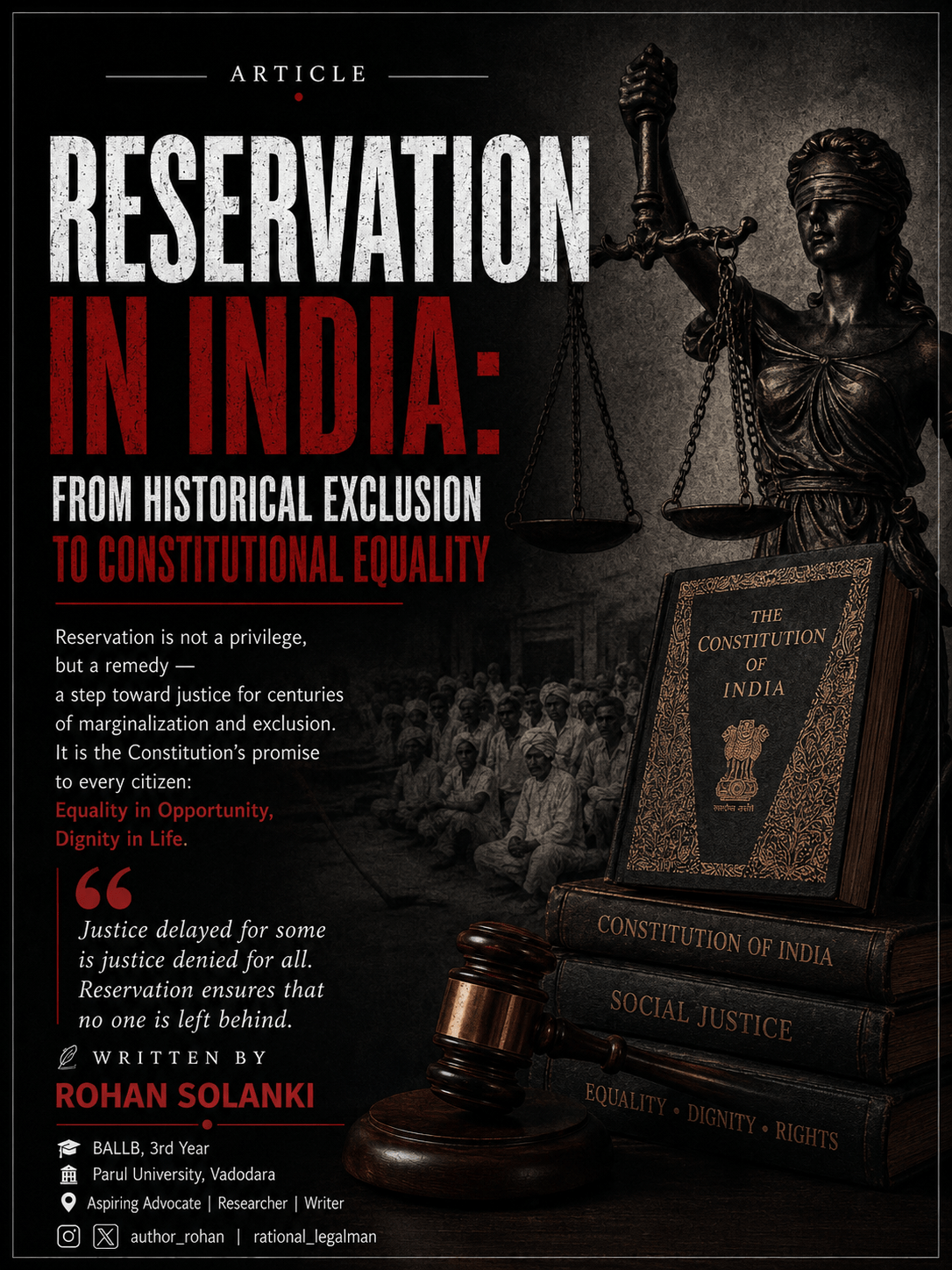
Reservation in India: Representation, Equality and the Reality of Caste
Introduction
First of all, there are four Varnas mentioned in Hindu scriptures:
- Brahmin
- Kshatriya
- Vaishya
- Shudra
Those who were not considered within these four Varnas were treated as “untouchables” and placed outside the Varna system. Today, many of the communities historically subjected to untouchability are constitutionally recognised as Scheduled Castes.
So, the question arises: how are they Hindus?
Was Hinduism imposed upon the Dalits of this country by the biggest leaders of the country for their own political and electoral purposes? If these communities were historically excluded from the Varna system itself, then why should their identity automatically be treated as part of that system?
This question is important when we discuss reservation.
The reservation was not created out of pity. It was created for the representation of those Depressed Classes who had been suppressed and excluded from society for generations. Their exclusion was not merely economic; it was social, educational and political.
For nearly 2,000 years, or at least across many centuries of deeply entrenched caste hierarchy, access to education and other opportunities was controlled by the caste system, while communities placed at the bottom of this hierarchy were denied equal access to them. This historical exclusion created a gap that cannot simply be erased by declaring everyone formally equal today.
Therefore, reservation can be understood as a bridge to fill this historical gap—a constitutional mechanism intended to bring representation and opportunity to communities that were systematically excluded from them.
The Poona Pact of 1932
The Poona Pact was a landmark agreement reached on 24 September 1932 concerning the political representation of the Depressed Classes. Dr B.R. Ambedkar was one of the principal representatives of the Depressed Classes involved in the negotiations.
The background to the Pact was the Communal Award, announced in August 1932 by British Prime Minister Ramsay MacDonald. The award provided separate electorates for several communities, including Muslims, Sikhs and the Depressed Classes.
Dr B.R. Ambedkar initially supported separate electorates for the Depressed Classes because he believed that separate political representation was necessary to ensure genuine political empowerment and an independent Dalit voice.
Mahatma Gandhi strongly opposed separate electorates for the Depressed Classes. He believed that separate electorates would permanently divide Hindu society. Gandhi subsequently began a fast unto death while imprisoned in Yerwada Central Jail in Pune.
The situation resulted in intense negotiations between Ambedkar, Gandhi and other representatives. Eventually, a compromise was reached.
Joint Electorates and Reserved Seats
The most important feature of the Poona Pact was the replacement of separate electorates with joint electorates along with reserved seats for the Depressed Classes. This meant that members of the Depressed Classes would contest from seats reserved for them, but the elections would take place within a joint electorate rather than through a completely separate electorate.
The Pact also increased the number of reserved seats for the Depressed Classes in the provincial legislatures. The number was increased from the 71 seats provided under the Communal Award to 148 seats under the Poona Pact. (Ministry of External Affairs)
The agreement was reached on 24 September 1932, bringing an end to Gandhi’s fast.
The significance of the Poona Pact goes beyond the immediate political circumstances of 1932. It represents an important moment in the history of political representation of the Depressed Classes in India. It demonstrated that the question was not simply about providing economic assistance to oppressed communities; it was fundamentally about political representation and participation in institutions of power. (Constitution of India)
At the same time, the Pact remains a subject of debate. While some view it as an important compromise that expanded representation and prevented a permanent division within Hindu society, others argue that replacing separate electorates with joint electorates reduced the independent political power and autonomy that Ambedkar had sought for the Depressed Classes.
This history is important because it shows that the roots of reservation for historically oppressed communities cannot simply be reduced to poverty or economic backwardness. The question has always been closely connected with representation, social exclusion and political power.
Constitutional Framework of Reservation
The idea of reservation did not end with the Poona Pact. After independence, the Constitution of India gave the principle of representation a constitutional foundation.
The Constitution promises equality to every citizen, but it also recognises that identical treatment cannot always produce genuine equality.
Constitutional Provisions on Equality and Reservation
Article 14 guarantees equality before the law and equal protection of the laws. At the same time, Article 15(4) permits the State to make special provisions for the advancement of socially and educationally backward classes and for Scheduled Castes and Scheduled Tribes. Article 16(4) recognises the question of adequate representation in public employment. Article 17 abolishes untouchability, while Article 46 directs the State to promote the educational and economic interests of weaker sections, particularly Scheduled Castes and Scheduled Tribes. (National Commission for Scheduled Castes)
The Constitution also recognises representation in political institutions. Articles 330 and 332 provide for reservation of seats for Scheduled Castes and Scheduled Tribes in the Lok Sabha and State Legislative Assemblies, respectively. (Election Commission of India)
This makes one thing clear: reservation is not merely an economic welfare scheme. The constitutional framework connects reservation with social disadvantage, equality and, importantly, representation.
The Supreme Court has also developed extensive jurisprudence on reservation. In Indra Sawhney v. Union of India, the Court examined the constitutional basis and limits of reservation under Articles 15(4) and 16(4). The judgement remains one of the central authorities in Indian reservation jurisprudence. (Press Information Bureau)
But the Constitution’s approach to equality cannot be understood simply as “everyone must be treated exactly the same.” The constitutional scheme recognises that historical disadvantage may require special measures to achieve meaningful equality.
This brings us back to the fundamental question of this article:
If caste-based exclusion created unequal conditions, can merely declaring everyone equal erase those conditions?
The answer, in my view, is no.
Reservation is therefore not a constitutional rejection of equality. It is one of the constitutional instruments through which India attempts to make equality real.
And this principle can be traced back to the political struggle that preceded the Constitution itself. The Poona Pact provided 148 reserved provincial seats for the Depressed Classes and expressly dealt with their representation through joint electorates. (Constitution of India)
Therefore, from the Poona Pact to the Constitution, the central issue has remained remarkably consistent:
Representation for communities that had historically been denied representation.
Caste in the 21st Century
Now, let us come back to the present times.
We are living in the 21st century, yet there are still people among the Savarna communities who believe that they are superior and that others are below them. This mentality has not disappeared. Casteism still exists, and I call this “Jatankwad”, just as we use the word “Aatankwad” for terrorism.
Dalits are still humiliated because of their caste. There are still instances where Dalits are prevented from entering temples, treated differently in villages and subjected to violence because they attempt to exercise the same social rights as everyone else.
In some places, even the simple act of a Dalit groom riding a horse during his wedding procession has resulted in hostility and violence. Why should a person’s caste determine whether he can ride a horse during his own baraat? Why should anyone have the authority to decide which temple another human being can enter?
Isn’t this wrong?
The problem is not merely about individual incidents. It is about the mentality behind them—the belief that one’s birth gives one a higher social position than another human being.
Even today, caste pride is openly displayed. Surnames, caste titles and caste identities are sometimes displayed on cars and in public spaces as symbols of superiority. Brahmin, Thakur, Kshatriya and other caste identities are proudly displayed as if birth itself were an achievement.
But what exactly is there to be proud of in something that was never a choice?
Your birth is accidental.
You did not choose the family into which you were born. You did not choose your caste. You did not choose your religion.
If you had been born in another country, you might have been born into an entirely different religious and cultural environment. A person born in the United States may be raised as a Christian, while a person born in Pakistan may be raised as a Muslim. The same person, born into a different family and society, could have inherited an entirely different identity.
Then how can birth be treated as proof of superiority?
How can something that was never chosen by an individual become a reason to consider another human being inferior?
If one’s caste is merely an accident of birth, then caste pride cannot be a measure of a person’s worth.
And if someone believes that their God has created a particular caste hierarchy to make one human being superior to another, then another question must be asked: why would the same divine power create billions of human beings belonging to different religions and cultures?
These questions are uncomfortable, but they need to be asked.
Because if caste discrimination still exists in the 21st century, then the argument that reservation is no longer necessary simply because India has formally abolished untouchability becomes difficult to sustain.
The Constitution may have abolished untouchability. But has society completely abolished the mentality behind it?
Equality: Same Treatment or Real Equality?
If the Constitution promises equality to everyone, then why does it itself permit reservation?
At first glance, reservation may appear to contradict the principle of equality. If every citizen is equal before the law, then why should one person receive a benefit or opportunity based on the caste to which they belong?
The answer lies in understanding the difference between formal equality and substantive equality.
Formal Equality
Formal equality means treating everyone equally. It says that the law should not discriminate between people and that everyone should have the same legal rights and opportunities.
But the problem is that society does not begin from a position of equality.
Imagine two people being asked to run the same race. One person has been given proper shoes, training, food and education throughout their life, while the other person has been denied these basic opportunities because of the caste into which they were born. If both are simply told, “Now you are equal, so run,” are they actually starting from the same position?
Equality on paper does not necessarily create equality in reality.
Substantive Equality
This is where substantive equality becomes important.
Substantive equality recognises existing social and historical inequalities and allows the State to take special measures to remove those inequalities. The purpose is not to create permanent inequality but to create conditions in which people who have historically been excluded can genuinely participate on equal terms.
This is also why the Constitution itself does not treat equality as merely identical treatment.
Article 14 guarantees equality before the law and equal protection of the laws. At the same time, Article 15 permits the State to make special provisions for socially and educationally backward classes and for Scheduled Castes and Scheduled Tribes. Article 16(4) further permits reservation in public employment where a backward class of citizens is not adequately represented in the services of the State. (National Commission for Scheduled Castes)
Therefore, reservation is not an exception created against the Constitution. It is a part of the constitutional approach towards achieving substantive equality.
The Constitution recognises that simply removing legal discrimination is not enough when historical discrimination has already created unequal social conditions.
If a community has been denied education, social dignity, political representation and access to public institutions for generations, then merely saying “everyone is equal now” does not automatically erase the consequences of that exclusion.
Reservation, therefore, should not be understood as giving someone an unfair advantage.
It can instead be understood as an attempt to correct an unequal starting point.
The ultimate objective is not to make one caste superior to another. It is to create a society where a person’s caste no longer determines their access to education, employment, dignity or representation.
And perhaps this is the most important point:
Equality does not always mean treating unequals equally. Sometimes, achieving real equality requires treating historically unequal situations differently.
As long as casteism exists, reservation must remain.
I believe reservation has to remain even after decades of constitutional reservation because the fundamental problem for which reservation was introduced has not completely disappeared.
In India, caste pride is still too deeply rooted in society. Even if a person from an SC community becomes an IAS officer, achieves a high position, becomes financially successful and earns respect through their own hard work, there are still people who will identify that person by their caste first.
That is the reality of India.
A person’s achievement does not always erase the caste identity imposed upon them by society.
Therefore, my question is simple: if casteism still exists, why should reservation be treated as if its purpose has already been fulfilled?
As long as caste continues to determine how people are treated, reservation continues to have a purpose. Reservation should not be seen as a permanent reward for a particular caste. It should be understood as a mechanism of representation and social correction for communities that continue to face caste-based exclusion.
And the reality of caste discrimination can be seen not only in history but also in cases reported in contemporary India.
Contemporary Examples of Caste Discrimination
- In Sikar, Rajasthan, in 2025, a young Dalit man was reportedly abducted, stripped, beaten and subjected to sexual violence by men from an upper-caste community.
- In Jalore, Rajasthan, in 2022, a nine-year-old Dalit boy, Indra Meghwal, died after being assaulted by his teacher following an incident involving a drinking-water pot.
- The Hathras case of 2020, involving the death of a young Dalit woman after a brutal assault, also exposed serious questions about caste, violence and the protection of vulnerable communities.
- There have also been incidents reported from Gujarat involving attacks on Dalits over matters that should never determine a person’s dignity—such as clothing, social customs or eating with members of another caste.
- In Udaipur, Rajasthan, in 2025, reports also emerged of a Dalit journalist being assaulted and subjected to caste-based abuse while carrying out his work.
These incidents are not being mentioned to claim that every person belonging to an upper caste is a casteist. That would itself be an unfair generalisation. They are being mentioned to demonstrate something much more fundamental:
Caste-based discrimination has not disappeared.
If caste discrimination continues to affect a person’s dignity, safety, social participation and opportunities, then it is difficult to argue that the constitutional response to caste-based exclusion has become completely unnecessary.
The reservation may certainly be debated, reviewed and reformed. But abolishing reservation while caste discrimination continues to exist would mean removing a constitutional safeguard before removing the social condition that made the safeguard necessary.
As long as casteism exists, the question of representation cannot simply be declared finished.
Conclusion
Reservation in India is not a matter of pity, charity or an economic scheme. It is a question of representation, dignity and substantive equality.
For centuries, caste-based discrimination created a society in which a person’s birth could determine their education, occupation, social status and even their basic human dignity. The Constitution attempted to break this structure by guaranteeing equality and simultaneously providing special measures for communities that had historically been excluded.
The history of the Poona Pact shows that the demand for representation was not something created recently for electoral politics. It was a political demand raised by Dr. B.R. Ambedkar for communities that had been denied an effective voice in the institutions of society.
And even today, casteism has not disappeared. A person may become an IAS officer, a lawyer, a professor or a successful entrepreneur, but society can still reduce that person to their caste. Incidents of caste-based humiliation and violence continue to remind us that legal equality has not automatically produced social equality.
Therefore, before asking “Why does reservation still exist?”, we should ask a more fundamental question:
“Has the society that made reservation necessary actually changed?”
If caste discrimination continues, the demand for representation cannot simply be declared unnecessary.
Reservations may certainly be discussed, criticised, reviewed and reformed. No public policy should be beyond debate. But reforming reservation and abolishing reservation are two completely different questions.
The ultimate goal should be a society where reservation is no longer necessary because caste itself no longer determines a person’s opportunities, dignity or social position.
Until that day comes, reservation remains not a privilege but a constitutional bridge between the promise of equality and the reality of inequality.
Because equality cannot merely exist on paper.
It must be visible in society.
