





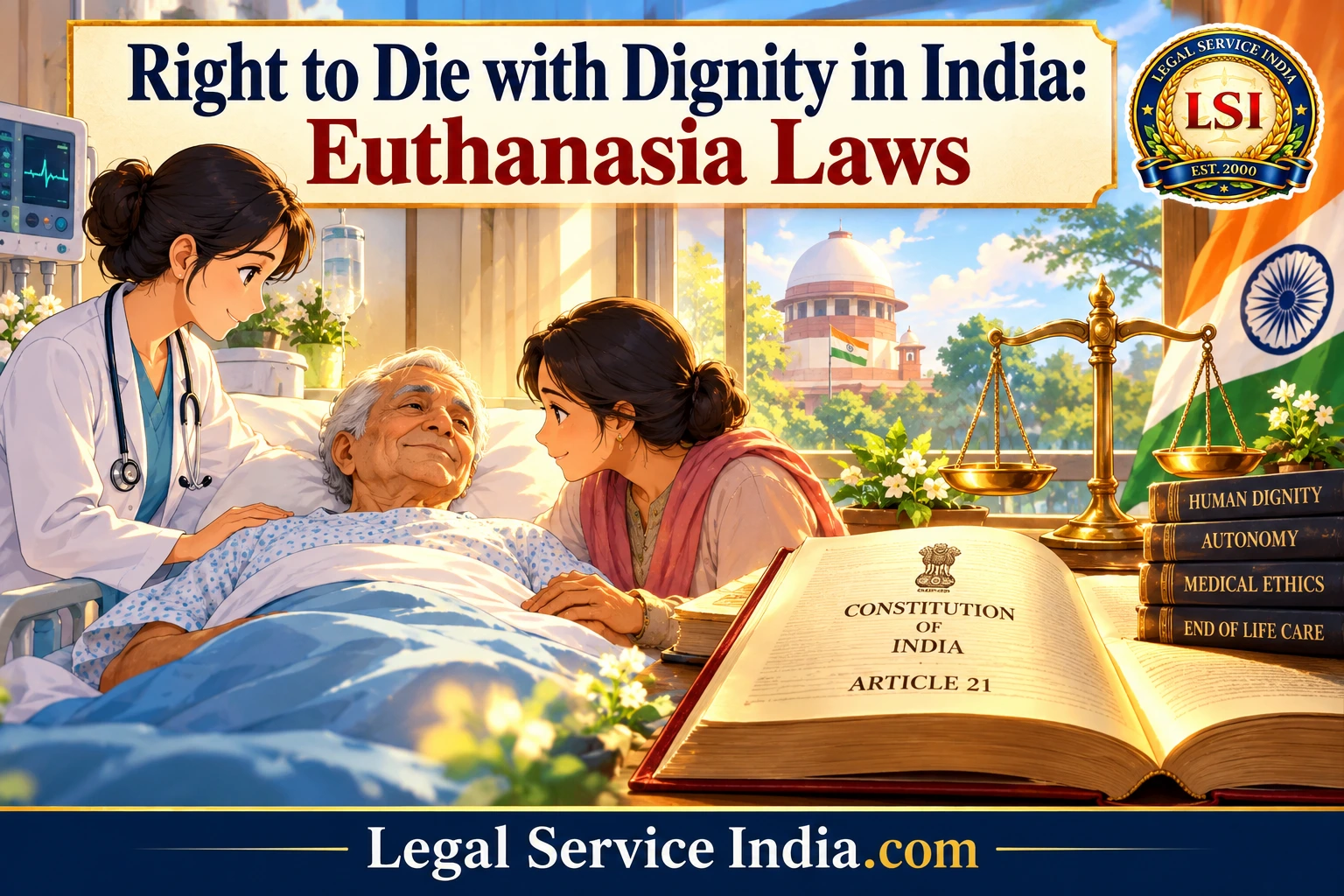
Abstract: Euthanasia and the Right to Die with Dignity in India
Euthanasia and right to die with dignity in the context of constitutional governance and state accountability. Article 21 of the Indian Constitution gives the right to life which is defined very broadly through judicial interpretation. This interpretation has raised a legal issue as whether dignity, under certain exceptional conditions, can be a part of the right to die with dignity. Euthanasia raises various issues including individual autonomy, human dignity, personal liberty, safeguarding of vulnerable persons and duties of the state.
The paper focuses on the legal and constitutional dimensions of euthanasia and the right to die with dignity in India. It provides a discussion of the development of law in relation to the issue of euthanasia and the right to die with dignity through the analysis of judicial decisions.
This paper takes a doctrinal and comparative approach to analysing the constitutional provisions, laws, judicial precedents and legal frameworks in relation to the issue of euthanasia in India and highly regulated jurisdiction like Canada and the Netherlands.
It is argued that the right to die with dignity requires procedural safeguards, medical supervision and accountability to prevent coercion and exploitation of vulnerable persons. The paper discuss the difficulties involved in implementing this right under the current legal framework in India.
It indicates that constitutional governance requires a proper balance between the protection of life, human dignity, individual autonomy and the state’s duty to protect vulnerable persons. Clear and effective legal mechanism is needed to ensure that end-of-life decisions are taken lawfully and constitutionally.
Introduction: Right to Die with Dignity Under Article 21
The right to life is one of the most important fundamental rights guaranteed under Article 21 of the Constitution of India. Article 21 provides that no person shall be deprived of life or personal liberty except according to procedure established by law. Judicial interpretation has gradually given Article 21 a broader meaning, extending it beyond mere physical existence to include dignity, autonomy and conditions necessary for a meaningful life.
Euthanasia involves a difficult intersection of the right to life, personal liberty, individual autonomy, medical ethics and the State’s responsibility to protect life. Active euthanasia, involving a positive act intended to cause death, must be distinguished from withholding or withdrawing life-sustaining medical treatment in legally permissible circumstances. In Harish Rana v Union of India, the Supreme Court reaffirmed that active euthanasia remains impermissible in India, while withholding or withdrawing medical treatment may be permitted under the constitutional framework developed in Common Cause.
The constitutional position has developed through important judicial decisions. In Gian Kaur v State of Punjab, the Supreme Court rejected a general right to die under Article 21, while recognising the significance of dignity in the natural process of dying. In Aruna Ramachandra Shanbaug v Union of India, the Court permitted withholding or withdrawal of life-sustaining treatment in appropriate circumstances subject to safeguards. The Constitution Bench in Common Cause (A Registered Society) v Union of India subsequently recognised the right to die with dignity as part of Article 21 and recognised Advance Medical Directives. In 2023, the Court modified the procedure relating to Advance Medical Directives to make the framework more workable.
The recent decision in Harish Rana v Union of India further clarified that clinically assisted nutrition and hydration can constitute medical treatment capable of being withdrawn in appropriate circumstances. The Court permitted withdrawal after medical evaluation and directed appropriate palliative and end-of-life care.
The issue is therefore not simply whether an individual possesses a right to die. It concerns how constitutional governance can protect dignity and autonomy at the end of life while preventing coercion, exploitation and arbitrary decision-making. The State has a dual responsibility to respect legally protected autonomy and dignity while protecting vulnerable persons and ensuring accountability in medical decision-making. This paper examines these issues and considers comparative lessons from Canada and the Netherlands.
Constitutional Provisions and Judicial Authorities
- Constitution of India, 1950, Article 21.
- Harish Rana v Union of India (Supreme Court of India, 2026) [full citation to be verified].
- Gian Kaur v State of Punjab (1996) 2 SCC 648.
- Aruna Ramachandra Shanbaug v Union of India (2011) 4 SCC 454.
- Common Cause (A Registered Society) v Union of India (2018) 5 SCC 1.
- Common Cause v Union of India (Misc Application No 1699 of 2019 in WP (Civil) No 215 of 2005, Supreme Court of India, 24 January 2023) [date and reference to be verified].
- Harish Rana (n 2).
1. Research Problem and Research Questions
The principal research problem is the absence of a comprehensive Indian statute specifically governing end-of-life decision-making. Although the Supreme Court has recognised a limited constitutional right to die with dignity, the existing framework depends substantially upon judicially developed safeguards and medical procedures.
Central Research Question
The central research question is:
Does the recognition of the right to die with dignity under Article 21 adequately balance individual autonomy and human dignity with the State’s obligation to protect life and vulnerable persons?
Additional Research Questions
The study also examines:
- Whether the right to die with dignity can constitutionally be understood as an aspect of Article 21;
- The present legal position concerning withholding or withdrawal of life-sustaining treatment and Advance Medical Directives;
- Safeguards that may be identified from Canada and the Netherlands; and
- Whether India requires a clearer statutory framework governing end-of-life decisions.
2. Objectives of the Study
The research traces the development of the right to die with dignity under Article 21 through legislation and judicial decisions. It evaluates safeguards governing end-of-life decisions, particularly medical supervision and protection of vulnerable persons. It also examines the regulatory approaches of Canada and the Netherlands to identify safeguards relevant to India and proposes reforms for clearer allocation of responsibility among Parliament, medical institutions, the executive and the judiciary.
3. Research Methodology
This is primarily a doctrinal legal research study. It examines authoritative legal sources to identify and analyse the existing law. Primary sources include the Constitution of India, relevant legislation, judicial decisions and applicable legal guidelines. Secondary sources include Law Commission reports, academic literature and scholarly commentary on autonomy, dignity and end-of-life decision-making.
A limited comparative component examines Canada and the Netherlands. The comparison is functional and focuses on safeguards, medical assessment, consent, reporting and institutional review. The study does not rely on empirical data and does not examine the theological or medical merits of euthanasia.
4. Main Discussion and Legal Analysis
4.1 Dignity, Autonomy and Article 21
The constitutional meaning of Article 21 developed substantially in Maneka Gandhi v Union of India, where the Supreme Court held that a procedure depriving a person of life or personal liberty must be fair, just and reasonable.
In Francis Coralie Mullin v Administrator, Union Territory of Delhi, the Court held that the right to life includes the right to live with human dignity. The relationship between dignity, privacy and autonomy was further strengthened in Justice KS Puttaswamy (Retd) v Union of India, where individual autonomy was recognised as an important aspect of constitutional liberty.
These principles provide a constitutional basis for examining end-of-life decisions. A competent person may have a legitimate interest in refusing medical treatment, particularly where continued treatment is unwanted or medically futile.
Recognition of dignity at the end of life, however, does not create a general right to intentionally cause death. It supports the principle that a person should not necessarily be compelled to undergo life-sustaining treatment where refusal or withdrawal is legally protected.
The philosophical debate also reflects this tension. John Stuart Mill’s conception of liberty supports personal autonomy, while Ronald Dworkin’s analysis of end-of-life decisions emphasises an individual’s critical interests and conception of the value of life.
- Maneka Gandhi v Union of India (1978) 1 SCC 248.
- Francis Coralie Mullin v Administrator, Union Territory of Delhi (1981) 1 SCC 608.
- Justice KS Puttaswamy (Retd) v Union of India (2017) 10 SCC 1.
Kantian ethics, in contrast, places emphasis on the inherent worth of human life. These perspectives demonstrate the need to balance autonomy with protection of life.
4.2 Vulnerability and the Limits of Autonomy
Autonomy requires an informed and voluntary decision. In end-of-life situations, however, consent may be affected by financial difficulties, inadequate medical facilities, family pressure, psychological distress or lack of access to palliative care.
The State must therefore ensure that an individual’s decision is genuinely voluntary and informed.
This is particularly significant in India because unequal access to healthcare may affect the practical meaning of choice. A person should not choose withdrawal of treatment merely because appropriate treatment, pain management or palliative care is inaccessible.
Protection of autonomy therefore requires access to appropriate healthcare, palliative services and support.
4.3 Constitutional Governance and State Accountability
Constitutional governance requires State action to remain lawful, reasoned and accountable. In the context of end-of-life decisions, three duties are particularly important.
- The State must protect life and regulate practices that intentionally cause death.
- It must respect legally protected autonomy and should not unnecessarily compel a competent person to undergo unwanted medical treatment.
- It must create institutional mechanisms through which decisions are medically evaluated, recorded, reviewed and subjected to legal scrutiny.
The Indian framework has developed substantially through judicial decisions, but responsibility remains distributed among hospitals, medical boards, magistrates and courts.
The absence of comprehensive legislation may create uncertainty for patients, families and medical professionals. Constitutional recognition of a right is therefore insufficient unless institutions can implement that right consistently and transparently.
4.4 Comparative Perspective: Canada
Canada demonstrates how constitutional litigation can lead to detailed legislative regulation. In Carter v Canada (Attorney General), the Supreme Court of Canada held that the prohibition on physician-assisted dying unjustifiably infringed section 7 of the Canadian Charter in specified circumstances involving competent adults experiencing grievous and irremediable medical conditions and intolerable suffering.
Parliament subsequently enacted legislation in 2016 establishing the medical assistance in dying (MAID) framework.
The Canadian regime has subsequently evolved through legislative amendments. The 2021 framework removed the requirement that natural death be reasonably foreseeable and established different procedural safeguards depending upon the circumstances of the request.
Persons whose sole underlying medical condition is a mental illness remain temporarily excluded from MAID eligibility until 17 March 2027.
The Canadian system requires informed and voluntary consent and provides monitoring and reporting mechanisms. For India, the relevant lesson is that constitutional rights require clear legislative procedures, eligibility requirements, independent assessment and institutional monitoring.
Canada’s continuing legislative review also demonstrates that safeguards must evolve with medical and social developments.
4.5 Comparative Perspective: The Netherlands
The Netherlands offers another regulatory model. Under the Termination of Life on Request and Assisted Suicide (Review Procedures) Act 2001, euthanasia and assisted suicide remain offences under the Dutch Criminal Code, but a physician may avoid criminal liability where statutory due-care requirements are satisfied.
The principal requirements include:
- A voluntary and well-considered request.
- Unbearable suffering without prospect of improvement.
- Adequate information.
- The absence of a reasonable alternative.
- Consultation with an independent physician.
- Due medical care.
The system also provides post-decision review through regional euthanasia review committees, with possible referral to prosecutorial or regulatory authorities where requirements have not been satisfied.
The Dutch model demonstrates the value of statutory criteria, independent medical consultation, reporting and institutional review. India should not simply copy this model but may consider its accountability mechanisms while developing a framework suited to Indian constitutional and healthcare conditions.
- Carter v Canada (Attorney General) 2015 SCC 5, [2015] 1 SCR 331.
- An Act to amend the Criminal Code (medical assistance in dying) SC 2021, c 2; Criminal Code RSC 1985, c C-46, s 241.2.
- Termination of Life on Request and Assisted Suicide (Review Procedures) Act 2001 (Netherlands); Criminal Code (Netherlands) arts 293, 294.
5. Relevant Statutory and Judicial Analysis
5.1 Statutory Framework
India does not presently have a comprehensive statute expressly regulating euthanasia and all aspects of end-of-life decision-making. Active intentional killing continues to attract criminal-law consequences.
The Bharatiya Nyaya Sanhita 2023 replaced the Indian Penal Code from 1 July 2024. Relevant provisions include the following:
| Legal provision | Subject |
|---|---|
| Section 100, Bharatiya Nyaya Sanhita 2023 | Culpable homicide |
| Section 101, Bharatiya Nyaya Sanhita 2023 | Murder |
| Section 103, Bharatiya Nyaya Sanhita 2023 | Punishment for murder |
| Section 105, Bharatiya Nyaya Sanhita 2023 | Culpable homicide not amounting to murder |
| Section 108, Bharatiya Nyaya Sanhita 2023 | Abetment of suicide |
| Section 226, Bharatiya Nyaya Sanhita 2023 | Attempts to commit suicide with the intention of compelling or restraining a public servant from exercising lawful powers |
| Section 115, Mental Healthcare Act 2017 | Rehabilitative approach to attempted suicide |
The general offence of attempt to suicide under section 309 IPC has not been retained in the same form. Section 226 BNS concerns attempts to commit suicide with the intention of compelling or restraining a public servant from exercising lawful powers.
The Mental Healthcare Act 2017 also adopts a rehabilitative approach to attempted suicide through section 115.
These criminal-law provisions do not constitute a comprehensive framework for withholding or withdrawing life-sustaining treatment. That area has therefore developed principally through constitutional adjudication.
The Law Commission of India addressed the issue in its 196th Report concerning medical treatment of terminally ill patients and again in its 241st Report, Passive Euthanasia – A Relook.
Both reports considered legal protection and safeguards relating to withdrawal of life-sustaining treatment and proposed legislative approaches. Despite these recommendations, comprehensive legislation has not been enacted.
- Bharatiya Nyaya Sanhita 2023 (Act 45 of 2023), sections 100, 101, 103, 105 and 108.
- Bharatiya Nyaya Sanhita 2023, section 226.
- Law Commission of India, Medical Treatment of Terminally Ill Patients (Right to Die with Dignity) (Report No. 196, 2006).
- Law Commission of India, Passive Euthanasia – A Relook (Report No. 241, 2012).
5.2 Judicial Development
The judicial development began with P Rathinam v Union of India, where a two-judge Bench held section 309 IPC unconstitutional and treated the right not to live as falling within Article 21.
This approach was overruled by the Constitution Bench in Gian Kaur v State of Punjab, which upheld sections 306 and 309 IPC and rejected a general constitutional right to die.
The Court nevertheless recognised the distinction between a general right to die and the dignity associated with the natural process of dying.
In Aruna Ramachandra Shanbaug v Union of India, the Supreme Court considered withdrawal of life-sustaining treatment from a person in a persistent vegetative state.
While rejecting active euthanasia, the Court accepted that withholding or withdrawing life-sustaining treatment could be permissible in appropriate cases, subject to safeguards.
The constitutional position was substantially developed in Common Cause (A Registered Society) v Union of India. The Constitution Bench recognised the right to die with dignity as part of Article 21 and upheld Advance Medical Directives.
It also recognised withholding or withdrawal of life-sustaining treatment, subject to procedural safeguards.
In 2023, the Supreme Court modified the Common Cause procedure to simplify formalities relating to Advance Medical Directives and the functioning of medical boards, thereby making implementation more practical.
The position was further clarified in Harish Rana v Union of India (2026). The Court held that clinically assisted nutrition and hydration can constitute medical treatment and may, in appropriate circumstances, be withdrawn.
The Court considered the patient’s best interests and medical evidence and directed appropriate palliative and end-of-life care.
The judgment is significant because withdrawal of treatment is not equivalent to abandonment. A patient whose treatment is withdrawn remains entitled to appropriate palliative care and dignity.
The case also demonstrates the continuing importance of legislation because the present framework remains substantially dependent on judicially developed safeguards.
- P Rathinam v Union of India (1994) 3 SCC 394.
- Gian Kaur v State of Punjab.
- Aruna Ramachandra Shanbaug v Union of India.
- Common Cause (A Registered Society) v Union of India.
5.3 Gaps in the Present Framework
Three principal gaps emerge.
First: A Judge-Developed Legal Framework
The framework remains substantially judge-developed. Judicial guidelines provide constitutional protection but do not offer the comprehensive institutional clarity that legislation can provide.
Second: Limits of the Recognised Right to Die
India does not recognise a general right to active euthanasia or physician-assisted suicide. The recognised right to die with dignity primarily concerns refusal, withholding or withdrawal of life-sustaining treatment under legally defined circumstances.
Third: Fragmented Institutional Accountability
Institutional accountability remains fragmented. Medical boards, hospitals, magistrates and courts perform different functions, but there is no comprehensive statutory mechanism responsible for monitoring the entire end-of-life framework, collecting national data and auditing compliance.
Findings and Observations
The study produces six principal findings.
1. Article 21 and the Right to Die with Dignity
First, Article 21 recognises a limited right to die with dignity, principally concerning legally permissible refusal, withholding or withdrawal of life-sustaining treatment. It does not establish a general constitutional right to active euthanasia.
2. Judicial Development of the Legal Framework
Secondly, the present framework is substantially judge-developed through Common Cause, its subsequent procedural modification and Harish Rana. This provides constitutional protection but creates uncertainty in implementation.
3. Medical Safeguards and Institutional Implementation
Thirdly, safeguards such as Advance Medical Directives, medical boards and medical evaluation are important, but their effectiveness depends upon consistent institutional implementation.
4. Protecting Vulnerable Persons and Voluntary Decisions
Fourthly, protection of vulnerable persons requires more than procedural safeguards. Access to palliative care, medical treatment, mental-health support and social assistance is necessary to ensure that end-of-life decisions are genuinely voluntary.
5. Comparative Legal Frameworks: Canada and the Netherlands
Fifthly, Canada and the Netherlands demonstrate the usefulness of clear statutory eligibility criteria, independent medical assessment, reporting and review mechanisms. Their experience also shows the need for continuing legislative scrutiny.
6. Accountability and Legal Certainty in India
Sixthly, accountability in India remains dispersed among several institutions. A clearer statutory framework could define responsibilities, improve transparency and provide greater legal certainty for patients, families and healthcare professionals.
Conclusion and Suggestions
Indian constitutional law has moved from rejecting a general right to die towards recognising a limited right to die with dignity. The development from Gian Kaur to Aruna Shanbaug, Common Cause and Harish Rana demonstrates an attempt to reconcile the protection of life with dignity, autonomy and the right to refuse or withdraw unwanted life-sustaining treatment.
The principal difficulty is now effective governance. A right that depends substantially upon judicial guidelines and fragmented institutional procedures may not be implemented consistently. India therefore requires a framework combining constitutional principles with clear statutory responsibilities and effective safeguards.
Bibliography
Cases
- Aruna Ramachandra Shanbaug v Union of India (2011) 4 SCC 454
- Carter v Canada (Attorney General) 2015 SCC 5, [2015] 1 SCR 331
- Common Cause (A Registered Society) v Union of India (2018) 5 SCC 1
- Common Cause v Union of India (Misc Application No 1699 of 2019 in WP (Civil) No 215 of 2005, Supreme Court of India, 24 January 2023)
- Francis Coralie Mullin v Administrator, Union Territory of Delhi (1981) 1 SCC 608
- Gian Kaur v State of Punjab (1996) 2 SCC 648
- Harish Rana v Union of India (Supreme Court of India, 2026) [to be verified]
- Justice KS Puttaswamy (Retd) v Union of India (2017) 10 SCC 1
- Maneka Gandhi v Union of India (1978) 1 SCC 248
- P Rathinam v Union of India (1994) 3 SCC 394
Legislation
India
- Bharatiya Nyaya Sanhita 2023 (Act 45 of 2023)
- Constitution of India 1950
- Indian Penal Code 1860
- Mental Healthcare Act 2017
Canada
- An Act to amend the Criminal Code (medical assistance in dying) SC 2021, c 2
- Criminal Code RSC 1985, c C-46
Netherlands
- Criminal Code (Wetboek van Strafrecht) arts 293, 294
- Termination of Life on Request and Assisted Suicide (Review Procedures) Act 2001
Reports
- Law Commission of India, Medical Treatment of Terminally Ill Patients (Right to Die with Dignity) (Report No 196, 2006)
- Law Commission of India, Passive Euthanasia – A Relook (Report No 241, 2012)

