





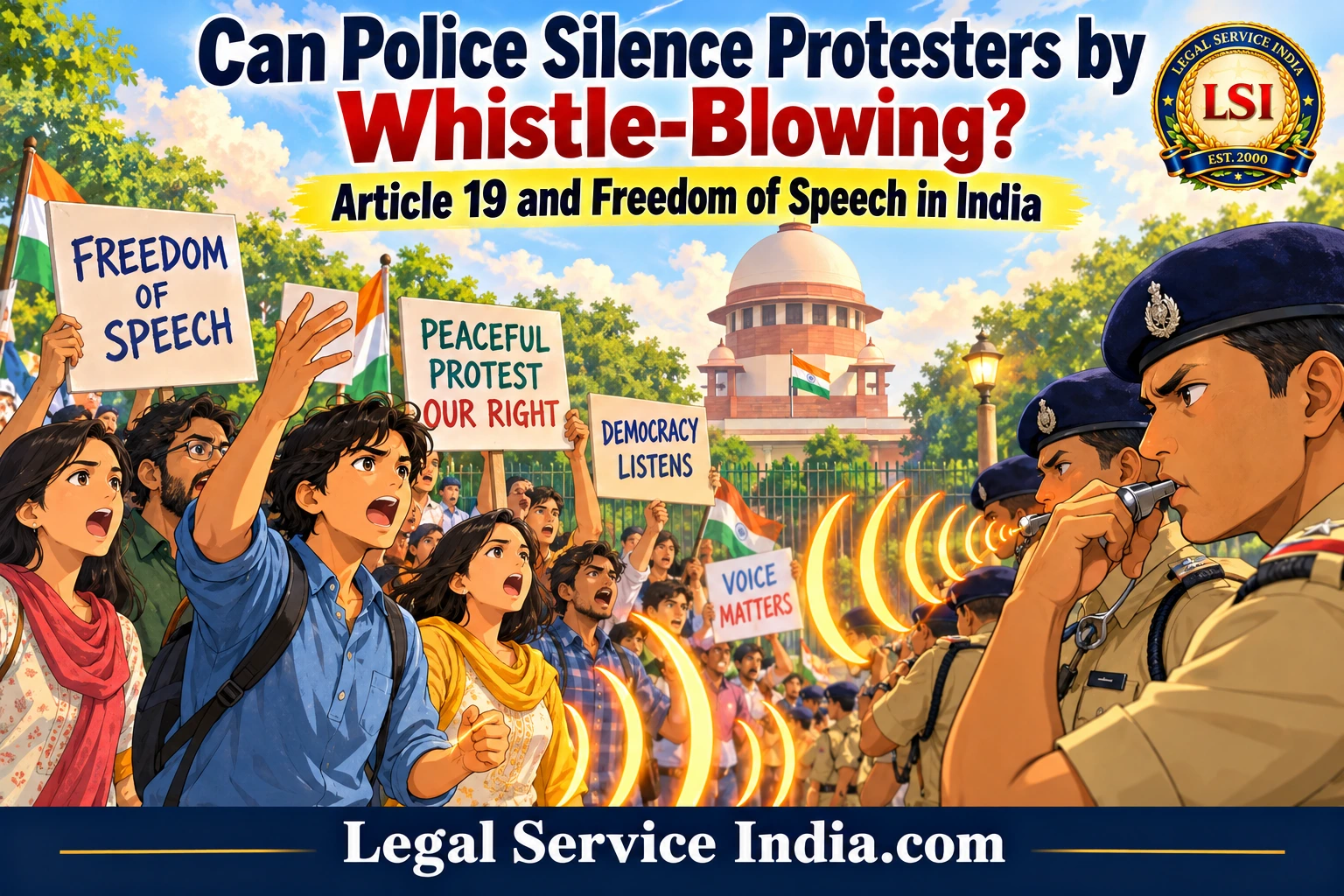
Would a Government Whistle Order to Silence Protesters Violate Article 19? Freedom of Speech and Fundamental Rights
By Adv. Tarun Choudhury | Supreme Court Advocate | 25+ Years of Legal Experience
Introduction: When Crowd Control Becomes a Question of Free Speech
A police whistle is ordinarily a tool of law enforcement. It can help officers direct crowds, coordinate movement, maintain order and respond to an unfolding situation. There is nothing inherently unconstitutional about its use.
But the legal position changes if whistles are deliberately used to prevent peaceful protesters from being heard.
The distinction is important. Police officers have a legitimate duty to maintain public order. At the same time, citizens do not lose their fundamental rights merely because they assemble to express political disagreement with the government.
A report by Newslaundry, based on ground reporting by journalist Samarth Grover during the protests in Delhi on October 10, 2026, described police personnel allegedly blowing whistles continuously so that protesters’ words could not be heard. The account also referred to detentions, with media personnel reportedly being directed aside while the police action was underway.
These allegations raise a serious constitutional question: if police personnel are instructed to use whistles specifically to drown out peaceful political speech, would that amount to an unlawful restriction on the fundamental right to freedom of speech and expression?
In my view, if such an instruction were established by credible evidence, it would require close constitutional scrutiny under Article 19 of the Constitution of India.
However, one distinction must be maintained from the outset. A report describing the conduct of police personnel does not, by itself, establish that a government or senior police official issued a specific order to silence protesters. That question requires independent verification.
The constitutional principle, nevertheless, is clear: maintaining public order is a legitimate state responsibility, but suppressing peaceful dissent cannot automatically be justified in the name of maintaining order.
1. Article 19(1)(a): The Right to Speak Must Have Practical Meaning
Article 19(1)(a) of the Constitution guarantees citizens the fundamental right to freedom of speech and expression.
This right protects more than the private act of forming an opinion. It also protects the ability to communicate that opinion, criticise public authorities and participate in political discussion.
Peaceful protest is an important part of that process. Citizens may wish to challenge government decisions, question the conduct of public officials or draw attention to matters they believe affect democracy and public accountability.
The freedom of speech during protests in India must therefore be understood in practical terms. A person may technically be allowed to stand in a public place, yet be prevented from communicating effectively if official action deliberately makes that person’s speech inaudible.
Example: When Police Whistles Drown Out Protesters
Consider a simple example.
A group of citizens gathers peacefully to oppose a government policy. They raise slogans, explain their concerns to journalists and attempt to communicate their position to the wider public. Police officers then repeatedly blow loud whistles, not to manage the crowd or prevent a safety risk, but specifically to drown out what the protesters are saying.
In such circumstances, the question would not be merely whether whistles are lawful police equipment. It would be whether the manner and purpose of their use amount to an interference with the protesters’ constitutionally protected expression.
A restriction on speech must be assessed by its actual purpose and effect, not merely by the label attached to the action.
This does not mean that every loud whistle, police instruction or disruption of a protest violates Article 19(1)(a). The surrounding circumstances matter. Officers may need to use whistles to coordinate operations, manage dangerous crowd movements or communicate urgent instructions.
The constitutional concern arises when the evidence suggests that the purpose of the noise was to prevent citizens from expressing a political opinion or communicating it to others.
2. Article 19(2): Public Order Is Not a Blank Cheque
The right to freedom of speech is not absolute.
Article 19(2) permits the State to impose reasonable restrictions on freedom of speech and expression on specified constitutional grounds, including public order, subject to the requirements of the Constitution.
Police authorities may therefore regulate public gatherings where there is a genuine concern about violence, obstruction, public safety or disruption. Depending on the circumstances and the applicable law, they may impose lawful conditions on the location, timing and manner of a protest.
But there is a fundamental difference between regulating a protest and deliberately preventing its message from being heard.
A public-order justification cannot simply be asserted whenever an action affects political expression. The restriction must have a lawful basis and satisfy the applicable constitutional standards.
The question becomes particularly serious where the police action appears directed not at violence, obstruction or another identifiable public-order concern, but at the content or audibility of the protesters’ message.
The Importance of Proportionality
Constitutional scrutiny should examine whether the action was justified by a legitimate objective and whether the means used were proportionate to that objective.
Several questions would arise:
- Was there a genuine and identifiable public-order concern?
- Was the use of whistles connected to that concern?
- Was the objective to coordinate police operations or to prevent protesters from being heard?
- Could the same legitimate objective have been achieved through less restrictive measures?
- Was the interference limited to what was reasonably necessary in the circumstances?
For example, if officers needed to direct a crowd away from a dangerous area, using whistles to communicate instructions might be entirely justified.
However, if officers deliberately used sustained noise to drown out peaceful political speech when no corresponding operational necessity existed, the constitutional justification would be far more difficult to sustain.
The State may regulate the manner in which a fundamental right is exercised, but it cannot treat the right itself as an inconvenience to be eliminated.
The precise legal conclusion would depend on the evidence, the purpose of the action and the applicable constitutional standards. Nevertheless, an instruction specifically designed to silence peaceful dissent would raise a substantial question about whether the restriction was lawful and proportionate.
3. What Does the Supreme Court Say About Police Action Against Peaceful Protesters?
The Supreme Court has repeatedly examined the relationship between public order, police powers and fundamental rights. Although the Court has not, in the judgments discussed below, laid down a specific rule about using whistles to drown out protesters, its broader constitutional principles are relevant.
A. Ramlila Maidan Incident, In Re (2012)
In Ramlila Maidan Incident, In Re, (2012) 5 SCC 1, the Supreme Court examined police action against people assembled at Ramlila Maidan in Delhi.
The judgment considered the rights of those assembled, the circumstances surrounding the police action and whether the response was proportionate and consistent with constitutional guarantees.
The case is important because it demonstrates that police powers to maintain order do not place police action beyond judicial scrutiny.
Authorities may have legitimate reasons to regulate or disperse a gathering. But the legality of their conduct must still be examined in light of the rights affected and the manner in which those powers were exercised.
Applied to the present issue, the relevant question would be whether the use of whistles served a legitimate operational purpose or was intended to frustrate the exercise of a fundamental right.
The judgment does not directly decide the legality of whistle-blowing to suppress speech. Its relevance lies in the broader principle that police action affecting peaceful assemblies must be constitutionally justified.
B. Mazdoor Kisan Shakti Sangathan v. Union of India (2018)
In Mazdoor Kisan Shakti Sangathan v. Union of India, (2018) 17 SCC 324, the Supreme Court considered issues concerning demonstrations in public spaces and the competing interests involved in regulating such gatherings.
The decision recognises that the right to protest must be considered alongside the rights of other people and the need to maintain public order.
This is an important balance. Fundamental rights do not give protesters an unrestricted entitlement to occupy every public place, at any time, without reasonable regulation.
Equally, the existence of a power to regulate protests does not mean that authorities may impose arbitrary or excessive restrictions.
The law must accommodate legitimate public interests without unnecessarily extinguishing the constitutional space available for peaceful dissent.
If an official instruction were shown to have been designed specifically to make peaceful protesters inaudible, the question would be whether that measure represented a legitimate and proportionate form of regulation or an unjustified interference with their expression.
C. Himat Lal K. Shah v. Commissioner of Police, Ahmedabad (1973)
In Himat Lal K. Shah v. Commissioner of Police, Ahmedabad, (1973) 1 SCC 227, the Supreme Court considered the right to hold public meetings and the authority of the State to regulate their use of public places.
The judgment establishes an important distinction between regulation and arbitrary denial.
The State may regulate public meetings through lawful and reasonable measures. However, public authorities cannot exercise their powers in a manner that effectively destroys the constitutional right they are supposed to regulate.
This principle is directly relevant to the broader issue of freedom of speech during protests in India.
If the police are controlling a crowd for a legitimate purpose, the action may be lawful. If the real objective is to prevent a peaceful political message from reaching its intended audience, the constitutional analysis changes significantly.
The decisive issue is not simply whether police intervention occurred, but whether it was lawful, reasonable and consistent with fundamental rights.
D. Shreya Singhal v. Union of India (2015)
In Shreya Singhal v. Union of India, (2015) 5 SCC 1, the Supreme Court examined restrictions on online expression and struck down Section 66A of the Information Technology Act, 2000.
The Court distinguished discussion and advocacy from incitement in its analysis of constitutionally protected speech and emphasised the need for restrictions on expression to remain within constitutional limits.
The case did not concern police whistles or physical protests. It is relevant here as part of the broader constitutional framework governing restrictions on expression.
The underlying lesson is that the State cannot justify restrictions on speech merely because the expression is unwelcome, critical or politically inconvenient.
Where the facts suggest that police action was intended to prevent peaceful political criticism from being heard, the justification for that action would require careful examination.
A further concern is the potential chilling effect. If citizens believe that expressing criticism in a public gathering will lead to deliberate suppression of their voices, they may hesitate to participate in future demonstrations.
That possibility does not, by itself, establish a constitutional violation. But it reinforces the importance of examining whether state action unnecessarily interferes with legitimate expression.
E. Anuradha Bhasin v. Union of India (2020)
In Anuradha Bhasin v. Union of India, (2020) 3 SCC 637, the Supreme Court examined restrictions on communication services in Jammu and Kashmir and addressed the relationship between freedom of expression, proportionality and restrictions imposed by the State.
The case arose in a different factual and legal context. It should not be presented as a direct precedent on the use of whistles during protests.
Its broader relevance lies in the need to examine restrictions on communication through constitutional standards, including proportionality and the requirement that restrictions be justified rather than arbitrary.
The practical ability to communicate matters. A right that exists formally but is rendered ineffective through unjustified state action raises a legitimate constitutional concern.
If evidence showed that an official instruction was intended to prevent peaceful protesters from communicating their views, the proportionality of that instruction would need to be assessed carefully.
F. Secretary, Ministry of Information and Broadcasting v. Cricket Association of Bengal (1995)
In Secretary, Ministry of Information and Broadcasting v. Cricket Association of Bengal, (1995) 2 SCC 161, the Supreme Court considered freedom of speech and expression in the context of broadcasting and the communication of information.
The judgment recognised the importance of communication and the dissemination of ideas within the constitutional framework.
Although it did not concern street protests, it provides useful background for understanding why freedom of expression involves more than the formal permission to speak. The ability to communicate information and ideas is an important part of the constitutional guarantee.
Taken together, these judgments provide a framework for examining whether police action affecting protesters’ speech is lawful, proportionate and consistent with fundamental rights. None, however, should be described as directly deciding the legality of a whistle order intended to drown out protest speech.
4. Two Separate Constitutional Questions: Protesters’ Speech and Press Freedom
The reported incident raises two related but distinct concerns.
The first concerns the protesters themselves. Were they able to express their views, raise slogans and communicate their objections without unjustified interference?
The second concerns the journalists covering the protest. Were media personnel prevented from observing police action, speaking to demonstrators or reporting what was happening?
These questions should not be conflated.
Interference with Protesters’ Speech
If whistles were deliberately used to drown out peaceful political expression, the principal question would concern the protesters’ rights under Article 19(1)(a), subject to the applicable constitutional restrictions.
The answer would depend on the purpose, circumstances and effect of the police action.
Interference with Journalists
Article 19(1)(a) also protects the freedom of the press, although the Constitution does not create a separate fundamental right for the press independent of the freedom of speech and expression.
Journalists play an important role in informing the public about protests, detentions and the conduct of public authorities.
If journalists were deliberately obstructed from observing or reporting police action without lawful justification, that conduct could raise an additional constitutional concern.
However, the reported use of whistles to drown out protesters does not automatically prove that the press was unlawfully obstructed. The allegation that media personnel were directed aside must be assessed separately, with attention to what happened, why it happened and whether the restriction was justified.
The public interest is substantial. When police action takes place during a political demonstration, reliable reporting can help citizens understand whether public authorities acted lawfully and proportionately.
5. Can Police Silence Protesters Because the Demonstration Was Not Authorised?
The question of permission is relevant, but it does not end the constitutional analysis.
Police authorities may impose lawful restrictions on public gatherings. Depending on the applicable law and circumstances, a gathering held without the required permission may justify directions, regulation or other lawful action.
A protest may also create genuine concerns about traffic, access, safety or public order.
But the absence of permission does not automatically mean that every action taken against the protesters is lawful.
The legality of a particular police measure must be assessed on its own facts. The authority to regulate a gathering does not, by itself, establish an unrestricted power to suppress the political message being expressed.
For example, directing protesters to a lawful location or requiring them to clear an emergency access route may be justified by a legitimate public purpose.
Deliberately drowning out their speech simply because they are criticising the government would present a very different question.
The constitutional issue is therefore not whether the police have any power to regulate a protest. They do. The issue is whether that power has been exercised for a lawful purpose and in a proportionate manner.
6. What Evidence Is Needed to Establish Whether There Was a Whistle Order?
The reported conduct deserves scrutiny, but a responsible legal assessment must distinguish between what has been reported, what has been independently corroborated and what remains unproven.
A contemporaneous ground report can be important evidence of what a journalist observed. It does not, without more, establish the existence of a formal government order or a coordinated policy across Delhi.
To determine whether whistles were used deliberately to silence protesters, several questions need to be answered.
First, What Do the Original Recordings Show?
Unedited video and audio from multiple independent sources could help establish whether the whistles were continuous, when they were used, how close the officers were to the protesters and whether the noise made their speech inaudible.
Second, What Was Happening at the Time?
The recordings should be examined alongside the sequence of events, including detentions, police instructions, crowd movements and any identifiable safety or operational concerns.
Third, Was There an Instruction from a Senior Officer?
Relevant material might include operational orders, police wireless communications, duty instructions, incident reports or other records that lawfully document the decision-making process.
Fourth, Was the Practice Consistent with an Established Operational Protocol?
If whistles were used under a general crowd-control procedure, that would be relevant. But the existence of such a procedure would not automatically resolve the question. Its actual purpose and application would still need to be examined.
Fifth, What Explanation Did the Police Give?
An official explanation identifying a specific operational necessity would be relevant to the assessment. It would need to be considered alongside the available footage and other evidence.
Finally, Who Issued the Instruction?
Finally, did the conduct reflect an individual officer’s decision, an instruction from a supervising officer or a formal government direction? These are materially different possibilities and should not be treated as interchangeable.
The distinction matters because the legal assessment of an officer’s conduct and the claim that a government ordered the suppression of speech are not identical.
At present, the reported account provides a basis for asking questions. It should not be treated as conclusive proof of a government directive unless further evidence establishes that connection.
7. What Legal Remedies May Be Available?
If credible evidence establishes that police action unlawfully interfered with fundamental rights, affected persons may consider appropriate legal remedies.
The correct course would depend on the facts, the nature of the alleged instruction, the available evidence and the relief sought.
Possible steps include:
- Preserving evidence: Retain original video recordings, photographs, timestamps, witness accounts and other relevant material. Avoid editing or altering the original files.
- Submitting a documented complaint: Affected persons may place the facts before the appropriate police supervisory authority or other competent body and request an inquiry.
- Seeking relevant records: Where legally available, relevant operational documents or other records may help establish the basis and purpose of the police action.
- Approaching the High Court: Article 226 provides the High Courts with broad writ jurisdiction, including the power to examine alleged violations of fundamental rights, subject to the applicable legal requirements.
- Approaching the Supreme Court: Article 32 provides a constitutional remedy for the enforcement of fundamental rights, subject to the Court’s jurisdiction and applicable procedural requirements.
A legal challenge would be stronger if it identifies the specific conduct complained of, explains how that conduct affected protected rights and supports the allegations with reliable evidence.
Where the complaint concerns an alleged official instruction, evidence connecting the conduct on the ground to the person or authority responsible for the instruction would be particularly important.
The objective should not be to reach a conclusion before the facts are established. It should be to ensure that potentially unlawful interference with fundamental rights is investigated and, where proved, addressed through the appropriate legal process.
8. The Constitutional Principle: Public Order Must Not Become a Pretext for Suppressing Dissent
A democratic government has both the authority and the responsibility to maintain public order. Police officers must be able to respond to genuine threats, manage crowds and enforce lawful restrictions.
But the rule of law requires those powers to be exercised within constitutional limits.
Peaceful political criticism can be uncomfortable for those in authority. That is precisely why freedom of speech and expression matters. Fundamental rights are not reserved for opinions that the government agrees with or messages that cause no political inconvenience.
If whistles were used for ordinary crowd management, the conduct should be judged in that context.
If, however, credible evidence establishes that police personnel were instructed to blow whistles specifically to drown out peaceful protesters and prevent their political message from being heard, the matter would raise a serious question under Article 19(1)(a). Depending on the circumstances, it could also affect the right to assemble peacefully under Article 19(1)(b).
The constitutional analysis would have to consider the legal basis for the instruction, its purpose, the public-order justification offered and whether the interference was proportionate. A deliberate attempt to silence peaceful dissent cannot be justified merely by describing it as crowd control.
The original footage, corroborating accounts and relevant police operational records would be central to determining what actually happened and whether any official instruction was issued.
Conclusion: Freedom of Speech During Protests in India Must Be Protected in Practice
The reported use of continuous whistles during the Delhi protests on October 10, 2026, raises a legitimate question about the limits of police power and the protection of political expression.
The issue is not whether police officers may use whistles. They plainly may use them for legitimate operational purposes. The issue is whether a tool ordinarily used to maintain order was allegedly employed to prevent peaceful protesters from being heard.
If an instruction designed to suppress peaceful dissent is established by evidence, its constitutionality must be examined under Article 19 and the principles governing lawful restrictions on fundamental rights.
The available reporting provides a reason to investigate the allegation. It does not, on its own, establish that a government directive was issued. Unedited recordings from multiple sources, operational records and a clear account of the circumstances remain important to determining the facts.
The larger principle, however, should not be in doubt. The police are empowered to maintain public order, not to decide which peaceful political opinions deserve to be heard.
In a constitutional democracy, public order and freedom of speech must coexist. The State may regulate the exercise of fundamental rights within the law, but it must not use its authority to extinguish those rights.
The protection of freedom of speech during protests in India ultimately depends on whether constitutional guarantees remain meaningful when citizens use them to question those in power.
Facing Unlawful Police Action? Protect Your Fundamental Rights.
Your fundamental rights deserve to be protected. Know your legal options before taking your next step.
If you or someone you know has faced unlawful police restrictions, interference with peaceful protest, suppression of free speech, arbitrary detention, or other action that may violate constitutional rights, obtaining timely legal advice can help you understand the remedies available under Indian law.
Whether you need advice on Article 19(1)(a), freedom of speech and expression, the right to peaceful protest, police accountability, or a possible constitutional remedy before the High Court or Supreme Court, the right legal guidance can make a meaningful difference.
Do not leave important legal questions unanswered. Discuss the facts of your case, understand your rights, and explore the legal options available to you.
Consult an Experienced Supreme Court Advocate
Adv. Tarun Choudhury
Supreme Court Advocate | 25+ Years of Legal Experience
- 📞 Call: 9650499965
- 💬 WhatsApp: 8851978611
- ✉️ Email: [email protected]
Take the first step towards understanding and protecting your constitutional rights. Contact us for a legal consultation.
All legal remedies depend on the specific facts, available evidence, and applicable law.
Frequently Asked Questions (FAQs)
1. Does Article 19(1)(a) Protect Freedom of Speech During Protests in India?
Yes. Article 19(1)(a) of the Constitution of India guarantees citizens the fundamental right to freedom of speech and expression. This protection extends to peaceful political expression, including expressing disagreement with government policies. However, the right is subject to reasonable restrictions under Article 19(2). Whether a particular police action violates this right depends on its purpose, legal basis and circumstances.
2. Can Police Use Whistles to Silence Peaceful Protesters in India?
Police officers may use whistles for legitimate operational purposes, such as crowd management, coordination and public safety. However, if evidence establishes that whistles were deliberately used to drown out peaceful political speech, the action could raise serious constitutional questions under Article 19(1)(a). The legality would depend on the facts, the purpose of the action and whether the interference was legally justified and proportionate.
3. Would a Government Order to Silence Protesters Violate Article 19 of the Constitution?
An order specifically intended to prevent peaceful protesters from expressing their political views could raise serious concerns under Article 19(1)(a). Depending on the circumstances, it could also affect the right to assemble peacefully under Article 19(1)(b). The government would need to establish a lawful constitutional basis for the restriction. Whether a violation has occurred depends on the evidence and applicable legal standards.
4. What Is the Difference Between Lawful Crowd Control and Suppression of Freedom of Speech?
Lawful crowd control aims to address legitimate concerns such as public safety, traffic obstruction, violence or the orderly management of a gathering. Suppression of freedom of speech occurs when state action unjustifiably interferes with the communication of protected expression. For example, using whistles to coordinate police movement differs significantly from deliberately using sustained noise to prevent peaceful protesters from being heard.
5. Can Police Stop a Protest Because the Organisers Did Not Obtain Permission?
Police authorities may regulate public gatherings under applicable laws and impose lawful restrictions in appropriate circumstances. An unauthorised protest may justify certain enforcement measures, depending on the facts and governing law. However, the absence of permission does not automatically make every police action lawful. Restrictions must have a legal basis and remain consistent with constitutional protections.
6. Which Supreme Court Judgments Protect the Right to Peaceful Protest and Freedom of Expression?
Several Supreme Court judgments provide relevant constitutional principles. These include Ramlila Maidan Incident, In Re, (2012) 5 SCC 1; Mazdoor Kisan Shakti Sangathan v. Union of India, (2018) 17 SCC 324; Himat Lal K. Shah v. Commissioner of Police, Ahmedabad, (1973) 1 SCC 227; Shreya Singhal v. Union of India, (2015) 5 SCC 1; and Anuradha Bhasin v. Union of India, (2020) 3 SCC 637. These decisions address related principles concerning police powers, public assemblies, freedom of expression and constitutional restrictions, although none directly decides the specific question of using whistles to drown out protest speech.
7. Can Deliberately Drowning Out Protesters’ Voices Violate Freedom of Speech?
Potentially, yes. If credible evidence establishes that authorities deliberately used noise to prevent peaceful protesters from communicating their views, the conduct could raise questions under Article 19(1)(a). The court would need to consider the purpose, circumstances, legal authority and proportionality of the action. Ordinary operational use of whistles, without evidence of an intention to suppress speech, would not automatically amount to a constitutional violation.
8. What Evidence Is Needed to Prove That Police Were Ordered to Silence Protesters?
Relevant evidence may include unedited video and audio recordings, footage from independent sources, eyewitness accounts, police operational orders, wireless communications, duty instructions and incident reports. Such material may help establish what happened, why whistles were used and whether the conduct resulted from an official instruction. A report describing events on the ground may justify further investigation, but it does not by itself prove that a government or senior police official issued an order to suppress speech.
9. What Legal Remedies Are Available If Police Violate Fundamental Rights During a Peaceful Protest?
Depending on the facts, affected persons may submit a complaint to the appropriate police supervisory authority, preserve evidence and seek legal advice on further remedies. A petition under Article 226 may be filed before the appropriate High Court, while Article 32 provides a remedy before the Supreme Court for enforcement of fundamental rights, subject to applicable legal requirements. The appropriate course depends on the nature of the alleged violation, the evidence available and the relief sought.
Key Takeaways: Freedom of Speech During Protests in India
- Article 19(1)(a) protects freedom of speech and expression: Indian citizens have a fundamental right to express political opinions, criticise government policies and communicate their views through peaceful protest, subject to constitutionally valid restrictions.
- Can police use whistles to silence protesters? Police may use whistles for legitimate crowd-control and public-safety purposes. However, deliberately using whistles to drown out peaceful political speech could raise serious constitutional concerns under Article 19(1)(a).
- A government order to suppress peaceful dissent requires constitutional scrutiny: If credible evidence establishes that authorities instructed police personnel to prevent peaceful protesters from being heard, the legality of that instruction would need to be examined under Article 19 and the applicable constitutional standards.
- Public order does not justify every restriction on free speech: Article 19(2) permits reasonable restrictions on freedom of speech and expression on specified grounds. Any restriction must have a lawful basis and satisfy the applicable constitutional requirements.
- Proportionality is an important consideration: Courts may examine the purpose of police action, its connection to a legitimate objective, its impact on fundamental rights and whether less restrictive measures could reasonably have achieved the same objective.
- The right to peaceful protest is constitutionally protected: Article 19(1)(b) guarantees citizens the right to assemble peaceably and without arms, subject to the reasonable restrictions permitted by the Constitution.
- Supreme Court judgments provide relevant legal principles: Decisions including Ramlila Maidan Incident, In Re (2012), Mazdoor Kisan Shakti Sangathan v. Union of India (2018), Himat Lal K. Shah v. Commissioner of Police, Ahmedabad (1973), Shreya Singhal v. Union of India (2015) and Anuradha Bhasin v. Union of India (2020) offer relevant guidance on police powers, peaceful assemblies, freedom of expression and constitutional restrictions. None directly decides the specific question of using whistles to drown out protesters’ speech.
- Freedom of the press raises a separate constitutional issue: Alleged obstruction of journalists covering a protest must be assessed independently. Interference with protesters’ speech does not automatically establish unlawful interference with journalists.
- Evidence is essential to establish an alleged whistle order: Unedited recordings, independent eyewitness accounts, police operational instructions, wireless communications and incident reports may help determine whether whistles were used for ordinary crowd control or to suppress peaceful expression.
- An unauthorised protest does not make every police action lawful: Police may enforce valid restrictions under applicable law, but each measure must still be assessed for legality, necessity and consistency with fundamental rights.
- Legal remedies may be available for violations of fundamental rights: Depending on the facts, affected persons may submit complaints to the appropriate authorities or seek constitutional remedies before the High Court under Article 226 or the Supreme Court under Article 32, subject to applicable legal requirements.
- The central constitutional principle is clear: Police have the authority to maintain public order, but that authority must be exercised within the law. If evidence establishes that police were instructed to deliberately drown out peaceful political speech, the instruction would raise serious questions about freedom of speech during protests in India.
