





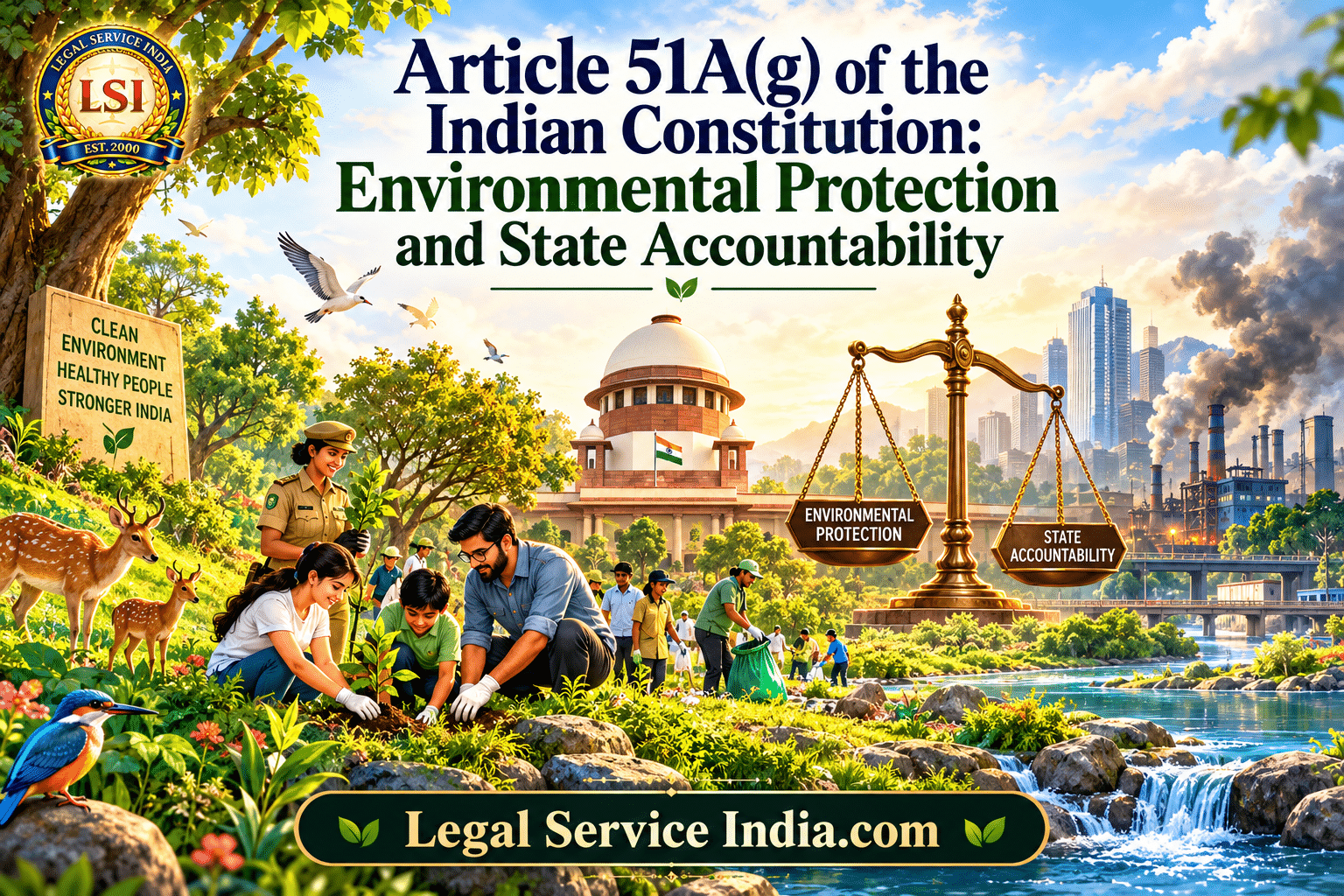
Abstract: Article 51A(g) and Environmental Protection in India
Article 51A(g) of the Indian Constitution places a duty on every citizen to protect and improve the natural environment. Courts in India have used this duty, along with the Directive Principles of State Policy, to build a strong body of environmental law. Yet this duty is still often treated as a moral guideline rather than a binding obligation, raising questions about how far the State itself is accountable for enforcing it.
Despite this recognition, environmental degradation continues due to weak enforcement and unclear accountability between citizens and the State, creating a gap between the constitutional promise and its real-world implementation.
This paper aims to study the scope of Article 51A(g), examine how courts have connected this duty to State accountability through doctrines such as the Public Trust Doctrine and Sustainable Development, and identify the main gaps in enforcement by State authorities. The study follows a doctrinal method based on constitutional provisions, judicial decisions, legislation and academic writings.
The paper argues that judicial intervention has played an important role in enforcing environmental duties, while weaknesses in administrative action and implementation continue to create difficulties. It suggests that environmental protection should move beyond being viewed merely as a citizen’s duty and become a clear standard for State accountability, supported by effective institutional monitoring and stronger regulatory enforcement.
The study concludes that meaningful environmental governance in India requires the State to treat Article 51A(g), read with Article 48A and Article 21, as part of a wider constitutional framework for environmental protection against which its own conduct can be assessed.
Introduction
Importance of Environmental Protection
The environment is essential for the survival of human beings and other living creatures. Clean air, safe drinking water, forests, rivers and wildlife are not luxuries; they are necessary for a healthy life. However, increasing pollution, deforestation, improper waste disposal and the excessive use of natural resources have created serious environmental problems in India. These problems affect not only the present generation but also the lives of people who will come after us.
Environmental protection is therefore not simply a matter of personal choice. It is connected with public health, social justice, economic development and the responsibility of the State towards its citizens.
Constitutional Provisions for Environmental Protection
The Constitution of India recognises the importance of environmental protection through different provisions. Article 21 protects the right to life, which the Supreme Court has interpreted to include the right to live in a healthy environment. Article 48A directs the State to protect and improve the environment and safeguard forests and wildlife. Article 51A(g), on the other hand, places a fundamental duty on every citizen to protect and improve the natural environment, including forests, lakes, rivers and wildlife, and to show compassion for living creatures.
Articles 48A and 51A(g) were introduced by the Constitution (Forty-second Amendment) Act, 1976. Their inclusion reflected the growing recognition that environmental protection requires cooperation between the government and the public.
Citizens’ Duty and State Accountability
Although Article 51A(g) specifically refers to the duty of citizens, environmental protection cannot be achieved if the government fails to perform its own responsibilities. Citizens may be expected to avoid littering, conserve water and protect trees, but they cannot independently regulate industrial pollution, maintain sewage treatment systems or ensure compliance with environmental clearance conditions. These responsibilities require effective public institutions and proper enforcement of the law.
The Constitutional Question of State Environmental Responsibility
This raises an important constitutional question: if citizens have a fundamental duty to protect the environment, what happens when the State fails to protect it or permits environmental damage through its own decisions?
Judicial Interpretation and Environmental Law Principles
Indian courts have addressed this concern through constitutional interpretation and environmental principles such as sustainable development, the precautionary principle, the polluter pays principle and the Public Trust Doctrine. These principles help explain why environmental protection is not merely a personal responsibility but also an essential duty of public administration.
Scope of the Article
This article examines Article 51A(g), its relationship with other constitutional provisions, the role of the judiciary and the problems that continue to affect environmental governance in India.
Research Problem and Research Questions
1.1 Research Problem
India has a constitutional framework and several laws intended to protect the environment. Nevertheless, pollution, damage to forests, contamination of water bodies and unlawful use of natural resources continue to occur.
One major concern is the difference between recognising environmental protection as a constitutional responsibility and actually ensuring compliance with that responsibility. Fundamental duties are often discussed as obligations of citizens, while insufficient attention may be given to the responsibility of government authorities to protect natural resources and enforce environmental laws.
Article 51A(g) does not independently establish a complete enforcement mechanism or prescribe a penalty for every breach of environmental responsibility. Its effectiveness therefore depends on its interpretation alongside other constitutional provisions, legislation and judicial decisions.
The central research problem is to understand whether the existing legal framework provides adequate accountability for environmental harm and how the State’s constitutional responsibilities can be made more effective.
1.2 Research Questions
This study addresses the following questions:
- What is the constitutional scope and significance of Article 51A(g)?
- How have Indian courts used Article 51A(g) to strengthen environmental protection?
- How do the Public Trust Doctrine and Sustainable Development contribute to State accountability?
- What are the main weaknesses in the implementation of environmental laws in India?
- What legal and administrative measures can improve environmental governance?
Objectives of the Study
The main objectives of this research are:
- To examine the meaning and constitutional importance of Article 51A(g).
- To study its relationship with Articles 21 and 48A of the Constitution.
- To analyse important judicial decisions concerning environmental protection.
- To understand the role of environmental principles in determining State accountability.
- To identify difficulties in implementing environmental laws.
- To suggest measures for improving environmental protection and the accountability of public authorities.
Research Methodology
This research follows the doctrinal method of legal research. It is based on the study and interpretation of existing legal materials rather than surveys or interviews.
The primary sources include the Constitution of India, environmental legislation and judgments of the Supreme Court of India. Important decisions relating to Article 51A(g), the right to a healthy environment, sustainable development and the Public Trust Doctrine have been examined to understand how environmental responsibilities have developed through judicial interpretation.
Secondary sources include legal commentaries, academic writings and research publications relating to constitutional and environmental law.
The research is analytical in nature. It examines both the strengths and the limitations of the existing legal framework, with particular attention to the difference between constitutional recognition and practical enforcement.
Constitutional Framework for Environmental Protection
4.1 Article 51A(g): A Fundamental Duty of Citizens
Article 51A(g) forms part of Part IVA of the Constitution, which deals with Fundamental Duties. It requires every citizen of India to protect and improve the natural environment, including forests, lakes, rivers and wildlife, and to have compassion for living creatures.
The provision has two important aspects. First, it requires citizens to protect the existing environment. Secondly, it calls upon them to improve it. This means that environmental responsibility should not be limited to avoiding harmful activities. It should also include reasonable efforts to conserve natural resources and reduce environmental damage.
For example, a citizen who avoids throwing plastic waste into a lake fulfils part of this responsibility. A community that participates in restoring a local water body also contributes to environmental improvement.
However, the scope of Article 51A(g) is wider than individual behaviour. It promotes the idea that environmental protection is a shared responsibility and that citizens should develop respect for nature.
At the same time, Article 51A(g) must be understood correctly. Fundamental Duties are not generally directly enforceable in the same way as Fundamental Rights under Part III. A breach of Article 51A(g), by itself, does not automatically result in a criminal penalty. Legal consequences may arise where the conduct also violates an applicable statute or another enforceable legal obligation.
Nevertheless, courts can use Fundamental Duties to interpret constitutional provisions and environmental legislation. Article 51A(g) therefore has legal significance even though it does not independently prescribe a penalty for every failure to protect the environment.
4.2 Article 48A: Responsibility of the State
Article 48A is part of the Directive Principles of State Policy. It directs the State to endeavour to protect and improve the environment and safeguard forests and wildlife.
Unlike Article 51A(g), which addresses citizens, Article 48A expressly concerns the State. Although Directive Principles are not directly enforceable by courts under Article 37, they are fundamental in the governance of the country and must guide the making of laws.
The relationship between Articles 48A and 51A(g) is important. Article 48A places environmental protection within the responsibilities of the State, while Article 51A(g) encourages citizens to participate in the same objective.
These provisions should not be treated as alternatives to each other. Citizens cannot be expected to compensate for failures by environmental authorities, just as government action alone cannot eliminate every form of environmental harm.
For instance, citizens may be responsible for disposing of household waste properly, but municipal authorities must arrange effective collection, transportation and treatment. If waste continues to enter a river because a sewage treatment plant is not functioning, the problem cannot fairly be described as a failure of citizens alone.
Therefore, Article 51A(g) becomes more meaningful when read alongside Article 48A and the enforceable right to life under Article 21.
4.3 Article 21 and the Right to a Healthy Environment
Article 21 states that no person shall be deprived of life or personal liberty except according to procedure established by law. Through judicial interpretation, the right to life has developed beyond the mere physical existence of a person.
The Supreme Court has recognised that serious environmental pollution can affect the right to life because clean air, safe water and a healthy environment are necessary for human survival and dignity.
In Subhash Kumar v State of Bihar, the Court recognised that the right to life includes the right to enjoy pollution-free water and air for the full enjoyment of life.¹
This approach is important because it provides a legal basis for challenging environmental harm. Unlike Article 51A(g), which is a Fundamental Duty, Article 21 is an enforceable Fundamental Right. Where environmental damage violates the right to life, an affected person may seek appropriate constitutional remedies, subject to the applicable legal requirements.
Together, Articles 21, 48A and 51A(g) create a constitutional framework in which the State has responsibilities, citizens have duties and courts can intervene where enforceable rights are violated.
Judicial Interpretation of Article 51A(g)
The judiciary has played a significant role in developing environmental law in India. Through public interest litigation and constitutional interpretation, the Supreme Court has connected environmental protection with the right to life, State responsibility and the duties of citizens.
6.1 Municipal Council, Ratlam v Vardichand
In Municipal Council, Ratlam v Vardichand, residents approached the courts because of serious sanitation problems, including open drains and unhealthy living conditions. The municipal authority faced difficulties in carrying out the necessary improvements and relied on financial constraints.
The Supreme Court rejected the idea that a public authority could avoid its statutory responsibilities merely because performing them involved expenditure.²
Although the decision was delivered before Article 51A(g) was introduced, it remains important to environmental governance. It demonstrates that public authorities must perform their legal duties and cannot treat public health and sanitation as optional responsibilities.
The judgment also illustrates a central point relevant to State accountability: environmental protection requires practical action, not merely the recognition of a problem.
6.2 M.C. Mehta v Kamal Nath
The case of M.C. Mehta v Kamal Nath is a landmark decision concerning the Public Trust Doctrine.
The dispute involved a private motel that interfered with the natural course of the River Beas. The Supreme Court examined the government’s responsibility to protect natural resources and held that the Public Trust Doctrine forms part of Indian law.³
Under this doctrine, the State holds certain natural resources, such as rivers, forests and other ecologically important areas, in trust for the public. These resources are not simply assets that the government may use without considering the interests of the community.
The State has a responsibility to protect such resources and prevent their improper exploitation for private commercial benefit.
The decision is directly relevant to State accountability. If a government authority permits activities that seriously damage a river or allows public resources to be diverted for an improper private purpose, its conduct may be examined against its legal and constitutional responsibilities.
The doctrine also makes it clear that the government’s role is not limited to responding after environmental damage has occurred. It must exercise its powers carefully and protect resources for present and future generations.
6.3 Vellore Citizens Welfare Forum v Union of India
In Vellore Citizens Welfare Forum v Union of India, the Supreme Court considered environmental pollution caused by tanneries in Tamil Nadu. The discharge of untreated industrial waste had seriously affected agricultural land and water resources.
The Court recognised the precautionary principle and the polluter pays principle as essential features of environmental law in India.⁴
The precautionary principle requires appropriate preventive measures where an activity presents a risk of serious environmental harm, even when scientific certainty about the extent of that harm is incomplete.
The polluter pays principle means that those responsible for pollution may be required to bear the cost of preventing and remedying the damage they cause.
These principles are significant for State accountability because environmental authorities must not wait until serious damage becomes irreversible before taking appropriate action. They must also ensure that polluters do not escape responsibility while the public bears the consequences.
The judgment further supports the idea that economic activity must be carried out in a manner consistent with environmental protection.
6.4 Indian Council for Enviro-Legal Action v Union of India
In Indian Council for Enviro-Legal Action v Union of India, the Supreme Court dealt with serious environmental damage caused by chemical industries in Rajasthan. Industrial waste had contaminated the surrounding environment and created significant difficulties for local communities.
The Court emphasised the responsibility of polluting industries to bear the cost of remedying environmental damage.⁵
The decision is important because it demonstrates that environmental protection requires more than stopping the harmful activity. Where damage has already occurred, appropriate restoration and compensation may also be necessary.
It also highlights the importance of effective regulatory supervision. Environmental authorities must identify violations, take action against those responsible and ensure compliance with applicable legal requirements.
The case therefore connects environmental responsibility with accountability for actual harm rather than treating environmental protection as a general statement of good intentions.
6.5 T.N. Godavarman Thirumulpad v Union of India
The litigation in T.N. Godavarman Thirumulpad v Union of India became an important part of the Supreme Court’s work on forest conservation.
Through continuing judicial proceedings and directions, the Court addressed the protection and management of forests and the implementation of forest-related legal requirements.⁶
The case demonstrates that environmental protection sometimes requires sustained supervision rather than a single judicial order. Forest conservation involves several authorities, long-term planning and continuing compliance.
It also illustrates a limitation of relying heavily on courts. Judicial directions may establish clear obligations, but their success ultimately depends on implementation by the executive and the relevant authorities.
Courts can require lawful action and examine administrative failures, but they cannot independently carry out every aspect of environmental management across the country.
6.6 What These Decisions Establish
Taken together, these decisions show that Indian environmental law has developed through the interaction of constitutional provisions, legislation and judicial interpretation.
The courts have recognised the importance of preventing pollution, protecting natural resources, restoring damaged environments and ensuring that public authorities fulfil their legal responsibilities.
However, these judgments do not mean that Article 51A(g) has become an independently enforceable provision in every situation. Its importance lies in the way it supports the broader constitutional framework for environmental protection.
The main challenge is to ensure that the principles recognised by the courts are consistently applied by administrative authorities and other institutions responsible for environmental governance.
Environmental Principles and State Accountability
7.1 The Public Trust Doctrine
The Public Trust Doctrine is based on the idea that certain natural resources are held by the State for the benefit of the public.
Rivers, forests, lakes and other ecologically important resources support the lives and livelihoods of large sections of society. Their protection cannot be left entirely to private ownership or commercial interests.
Under this doctrine, the State must act as a responsible trustee of natural resources. Its decisions concerning the use of such resources should consider the public interest and the need to preserve the environment.
For example, if a public authority permits construction that unlawfully blocks a river or damages an ecologically sensitive area, the decision may be challenged under the applicable law. The authority’s conduct can be examined to determine whether it has fulfilled its responsibilities.
The doctrine is especially relevant where environmental harm results from government decisions, permissions or failures to act. It shifts attention from the behaviour of individual citizens to the State’s responsibility for protecting resources that belong to the public in a broader sense.
However, the doctrine does not prohibit every development project or commercial use of natural resources. It requires public authorities to exercise their powers lawfully, consider environmental consequences and avoid decisions that improperly sacrifice public resources for private gain.
7.2 Sustainable Development
Sustainable development means meeting the needs of the present without compromising the ability of future generations to meet their own needs.
Environmental protection and economic development are sometimes presented as competing objectives. In reality, development that destroys essential natural resources may create greater social and economic problems in the long run.
For instance, an industrial project may generate employment, but its benefits may be outweighed by the contamination of drinking water, destruction of agricultural land or serious health problems if environmental safeguards are ignored.
The Supreme Court discussed sustainable development in Vellore Citizens Welfare Forum v Union of India and recognised its importance in Indian environmental law.⁷
The principle requires decision-makers to consider environmental consequences while planning and approving development activities. It does not demand that all development stop. Instead, it requires development to take place within appropriate environmental limits.
For State accountability, sustainable development means that government authorities should be able to explain how environmental risks were assessed, what safeguards were imposed and how compliance will be monitored.
A development decision should not be considered satisfactory simply because it promises economic benefits. It must also meet applicable environmental requirements and consider the long-term interests of the public.
7.3 The Precautionary Principle
Environmental damage can sometimes be difficult or impossible to reverse. The destruction of a forest, contamination of groundwater or extinction of a species may have consequences that continue for decades.
The precautionary principle recognises the importance of taking preventive action where there is a credible risk of serious environmental harm.
It is particularly relevant when scientific evidence is incomplete but the possible consequences are significant.
For example, where a proposed activity presents a serious risk of groundwater contamination, the relevant authority should properly examine that risk before allowing the activity to proceed. It should not automatically disregard the danger merely because the full extent of future damage cannot be predicted with certainty.
This principle strengthens State accountability by requiring environmental risks to be considered before harm occurs. It also encourages proper scientific assessment and reasoned decision-making.
7.4 The Polluter Pays Principle
The polluter pays principle places responsibility for pollution-related costs on those who cause environmental harm.
Without this principle, the public may be forced to bear the costs of cleaning polluted rivers, restoring damaged land or dealing with other consequences of industrial activity.
In Indian Council for Enviro-Legal Action v Union of India, the Supreme Court emphasised the responsibility of polluters to bear the costs associated with remedying the damage they caused.⁸
The principle also has implications for government authorities. Effective accountability requires the State to investigate violations, identify responsible parties and use the remedies available under the law.
At the same time, the principle should not be understood as allowing every form of pollution in exchange for payment. Compensation does not automatically make an unlawful activity acceptable, nor does it remove the need for prevention, compliance and environmental restoration.
Legislative Framework and Enforcement Mechanisms
Article 51A(g) provides constitutional guidance, but environmental protection also depends on legislation that creates specific duties, regulatory powers and enforcement mechanisms.
8.1 Environment (Protection) Act, 1986
The Environment (Protection) Act, 1986 is an important law dealing with the protection and improvement of the environment. It provides a framework for the Central Government to take measures for environmental protection and to address environmental pollution.⁹
The Act supports the implementation of environmental standards and regulatory measures. It is important because constitutional principles need practical legal mechanisms to control activities that may harm the environment.
However, the existence of legislation is not sufficient by itself. Its effectiveness depends on the proper use of regulatory powers, monitoring of compliance and timely action against violations.
8.2 Air and Water Pollution Laws
The Water (Prevention and Control of Pollution) Act, 1974 and the Air (Prevention and Control of Pollution) Act, 1981 establish legal frameworks for addressing water and air pollution.
These laws provide for pollution control institutions and mechanisms intended to prevent and control pollution.
Their proper implementation is essential because pollution frequently affects people who have little control over the activities causing it. Residents living near industrial areas, for example, may suffer from contaminated water or polluted air even when they have not contributed to the problem.
Effective enforcement therefore requires regulatory authorities to carry out their statutory responsibilities and respond appropriately to violations.
8.3 National Green Tribunal Act, 2010
The National Green Tribunal Act, 2010 established the National Green Tribunal to deal with specified environmental disputes and provide relief, compensation and other remedies in matters falling within its jurisdiction.¹⁰
The Tribunal provides a specialised forum for environmental disputes and can contribute to the enforcement of environmental rights and legal obligations.
Its importance lies in the fact that environmental disputes often involve scientific questions, technical evidence and complex questions of law.
Nevertheless, specialised adjudication cannot replace routine environmental administration. Pollution control boards, local authorities and government departments must continue to perform their functions effectively.
The Tribunal’s role is most useful when supported by reliable environmental information, competent institutions and compliance with its orders.
Major Challenges in Implementing Environmental Duties
Despite constitutional provisions and environmental legislation, several difficulties affect the implementation of environmental responsibilities in India.
9.1 Weak Enforcement of Environmental Laws
One of the major problems is the gap between the existence of environmental laws and their practical enforcement.
Rules may prescribe standards for industrial emissions or waste disposal, but their purpose is defeated if violations are not detected or addressed in time.
Environmental protection requires regular inspections, reliable testing, proper record-keeping and timely legal action. If these processes are weak, harmful activities may continue even when the applicable law is clear.
9.2 Limited Institutional Capacity
Environmental authorities often have to monitor a large number of industries, construction projects, waste facilities and other activities.
Effective supervision requires trained personnel, scientific equipment, sufficient funding and access to accurate information. Where these resources are inadequate, monitoring may become irregular and violations may remain undetected.
Improving institutional capacity is therefore an important part of environmental accountability.
9.3 Conflict Between Development and Environmental Protection
Governments must consider employment, infrastructure, industrial growth and other economic needs. However, environmental concerns should not be ignored simply because a project promises economic benefits.
The real challenge is to ensure that development decisions follow the law and properly consider environmental risks.
Environmental impact assessments, appropriate public consultation and compliance with clearance conditions can help decision-makers understand the likely consequences of proposed projects.
9.4 Unclear Accountability Between Authorities
Environmental governance involves several institutions, including central and state departments, pollution control boards, municipal bodies and other regulatory authorities.
When their responsibilities overlap or coordination is poor, it may become difficult to determine which authority must take action.
For example, a polluted water body may be affected by industrial discharge, untreated sewage and improper waste disposal. Different authorities may be responsible for different sources of pollution.
Without clear coordination and responsibility, corrective action may be delayed.
9.5 Limited Public Awareness and Participation
Article 51A(g) expects citizens to participate in environmental protection. However, many people may not know how to report environmental violations, access relevant information or approach the appropriate authority.
Public participation becomes more meaningful when people receive accurate information and have accessible ways to raise concerns.
At the same time, public awareness should not be used to transfer the government’s regulatory responsibilities onto citizens. Awareness and State accountability must work together.
9.6 Difficulties in Monitoring Compliance
Environmental orders and directions are effective only when they are properly implemented.
A court or tribunal may order the closure of an unlawful activity, the installation of pollution-control equipment or the restoration of a damaged site. However, if compliance is not verified, the same problem may continue.
Environmental monitoring should therefore include follow-up inspections, transparent reporting and appropriate action where directions are ignored.
These challenges demonstrate that the central issue is not simply the absence of constitutional recognition. It is the need to ensure that existing responsibilities are carried out consistently.
Findings of the Study
The study leads to the following findings.
- First, Article 51A(g) provides an important constitutional basis for citizen responsibility towards the environment. It encourages individuals to protect natural resources and develop respect for living creatures.
- Secondly, Article 51A(g) cannot be examined in isolation. Its relationship with Article 48A and Article 21 is essential to understanding environmental protection as a constitutional concern involving both citizens and the State.
- Thirdly, judicial decisions have played a significant role in developing environmental principles. The Public Trust Doctrine, sustainable development, the precautionary principle and the polluter pays principle have strengthened the legal framework for addressing environmental harm.
- Fourthly, environmental legislation provides important enforcement mechanisms, but the effectiveness of these mechanisms depends on the performance of the institutions responsible for implementing them.
- Fifthly, environmental accountability must apply not only to private individuals and industries but also to public authorities. Government decisions, regulatory failures and the improper use of natural resources may have serious environmental consequences.
- Finally, the study finds that the gap between legal recognition and practical implementation remains a major concern. Improving environmental governance requires more effective monitoring, transparent decision-making and consistent enforcement of existing laws.
These findings suggest that environmental protection must be treated as a continuing constitutional responsibility rather than an objective that can be fulfilled through legislation or judicial decisions alone.
Suggestions and Recommendations
11.1 Strengthen Environmental Monitoring
Environmental authorities should carry out regular inspections and ensure that industries and other regulated activities comply with applicable standards.
Monitoring systems should be supported by reliable scientific data and appropriate follow-up action. Serious violations should be addressed promptly under the relevant law.
11.2 Improve Accountability of Public Authorities
Government departments and regulatory bodies should have clearly defined responsibilities for environmental protection.
Where environmental damage occurs, the relevant authority should examine its cause, determine whether legal requirements were followed and take corrective action within its powers.
Public authorities should also provide clear explanations for important environmental decisions, particularly where those decisions affect public resources.
11.3 Ensure Compliance with Judicial and Regulatory Orders
Orders passed by courts, tribunals and competent regulatory authorities should be monitored until the required action is completed.
Where an order is ignored, the authorities should use the enforcement mechanisms available under the law. Environmental restoration should not remain limited to promises or paperwork.
11.4 Encourage Public Participation
Citizens should have access to environmental information and practical ways to report pollution and other violations.
Public consultation should be meaningful, particularly in projects that may affect local communities, forests, water resources or ecologically sensitive areas.
Public participation can improve decision-making by bringing local knowledge and concerns to the attention of authorities.
11.5 Improve Coordination Between Institutions
Environmental protection often requires the cooperation of several departments and regulatory bodies.
Clear coordination mechanisms can reduce delays and prevent authorities from shifting responsibility to one another. Where different agencies are involved, their respective roles and responsibilities should be clearly identified.
11.6 Promote Environmental Education
Environmental education should explain not only the duties of citizens but also the legal responsibilities of government institutions and industries.
Schools, colleges and universities can help students understand Article 51A(g), environmental legislation and the practical consequences of pollution.
Such education should encourage responsible behaviour while also helping citizens understand lawful ways to seek action against environmental violations.
11.7 Balance Development with Environmental Protection
Development projects should be assessed according to their environmental consequences and compliance with the applicable legal framework.
Authorities should ensure that required assessments are conducted properly, environmental safeguards are meaningful and clearance conditions are monitored.
Economic growth should not become a reason to disregard the long-term interests of communities or future generations.
These measures would help translate constitutional principles into practical standards for environmental governance.
Conclusion
Article 51A(g) reflects the constitutional expectation that every citizen should take responsibility for protecting and improving the natural environment. It recognises that environmental protection is not merely the responsibility of government institutions but also a duty shared by society.
However, the meaning of this provision becomes clearer when it is read alongside Article 48A and Article 21. Article 51A(g) establishes a fundamental duty of citizens, Article 48A directs the State to protect and improve the environment, and Article 21 provides an enforceable constitutional basis for challenging environmental harm that violates the right to life.
The Supreme Court has played an important role in connecting these provisions with practical environmental principles. Decisions such as M.C. Mehta v Kamal Nath, Vellore Citizens Welfare Forum v Union of India and Indian Council for Enviro-Legal Action v Union of India demonstrate the importance of protecting natural resources, preventing pollution and holding those responsible for environmental damage accountable.
Nevertheless, judicial recognition alone cannot guarantee effective environmental protection. The implementation of court orders and environmental laws depends on the regular functioning of administrative authorities, proper monitoring and timely corrective action.
The State must therefore be assessed not only on the environmental laws it adopts but also on how effectively those laws are implemented. Where public authorities fail to perform their legal duties, the consequences may extend beyond environmental damage to the health, livelihood and constitutional rights of affected communities.
The Public Trust Doctrine reinforces this responsibility by recognising that natural resources must be protected for the benefit of the public. Sustainable development further requires that present economic needs be considered alongside the interests of future generations.
Ultimately, Article 51A(g) should not be viewed as a responsibility that citizens must fulfil while the State remains free from scrutiny. Citizens and public authorities have different but complementary roles in environmental protection. The State must provide the legal framework, institutions and enforcement mechanisms needed to make environmental responsibility effective.
Meaningful environmental governance in India requires a shift from formal recognition to consistent implementation. Stronger monitoring, transparent decision-making, institutional coordination and accountability for environmental harm can help bridge the gap between constitutional principles and everyday reality.
The protection of the environment is therefore not simply a moral expectation. It is an essential part of constitutional governance, public welfare and the responsibility to preserve natural resources for generations to come.
Footnotes
- Subhash Kumar v State of Bihar (1991) 1 SCC 598.
- Municipal Council, Ratlam v Vardichand (1980) 4 SCC 162.
- M.C. Mehta v Kamal Nath (1997) 1 SCC 388.
- Vellore Citizens Welfare Forum v Union of India (1996) 5 SCC 647.
- Indian Council for Enviro-Legal Action v Union of India (1996) 3 SCC 212.
- T.N. Godavarman Thirumulpad v Union of India (1997) 2 SCC 267.
- Vellore Citizens Welfare Forum v Union of India (1996) 5 SCC 647.
- Indian Council for Enviro-Legal Action v Union of India (1996) 3 SCC 212.
- Environment (Protection) Act 1986.
- National Green Tribunal Act 2010.
Bibliography
A. Constitutional Provisions
- Constitution of India, art 21.
- Constitution of India, art 37.
- Constitution of India, art 48A.
- Constitution of India, art 51A(g).
B. Legislation
- Air (Prevention and Control of Pollution) Act 1981.
- Environment (Protection) Act 1986.
- National Green Tribunal Act 2010.
- Water (Prevention and Control of Pollution) Act 1974.
C. Cases
- Indian Council for Enviro-Legal Action v Union of India (1996) 3 SCC 212.
- M.C. Mehta v Kamal Nath (1997) 1 SCC 388.
- Municipal Council, Ratlam v Vardichand (1980) 4 SCC 162.
- Subhash Kumar v State of Bihar (1991) 1 SCC 598.
- T.N. Godavarman Thirumulpad v Union of India (1997) 2 SCC 267.
- Vellore Citizens Welfare Forum v Union of India (1996) 5 SCC 647.
Written By: Atharv Sen, B.A. LL.B. – University: University College of Law, Mohanlal Sukhadia University (MLSU), Udaipur

