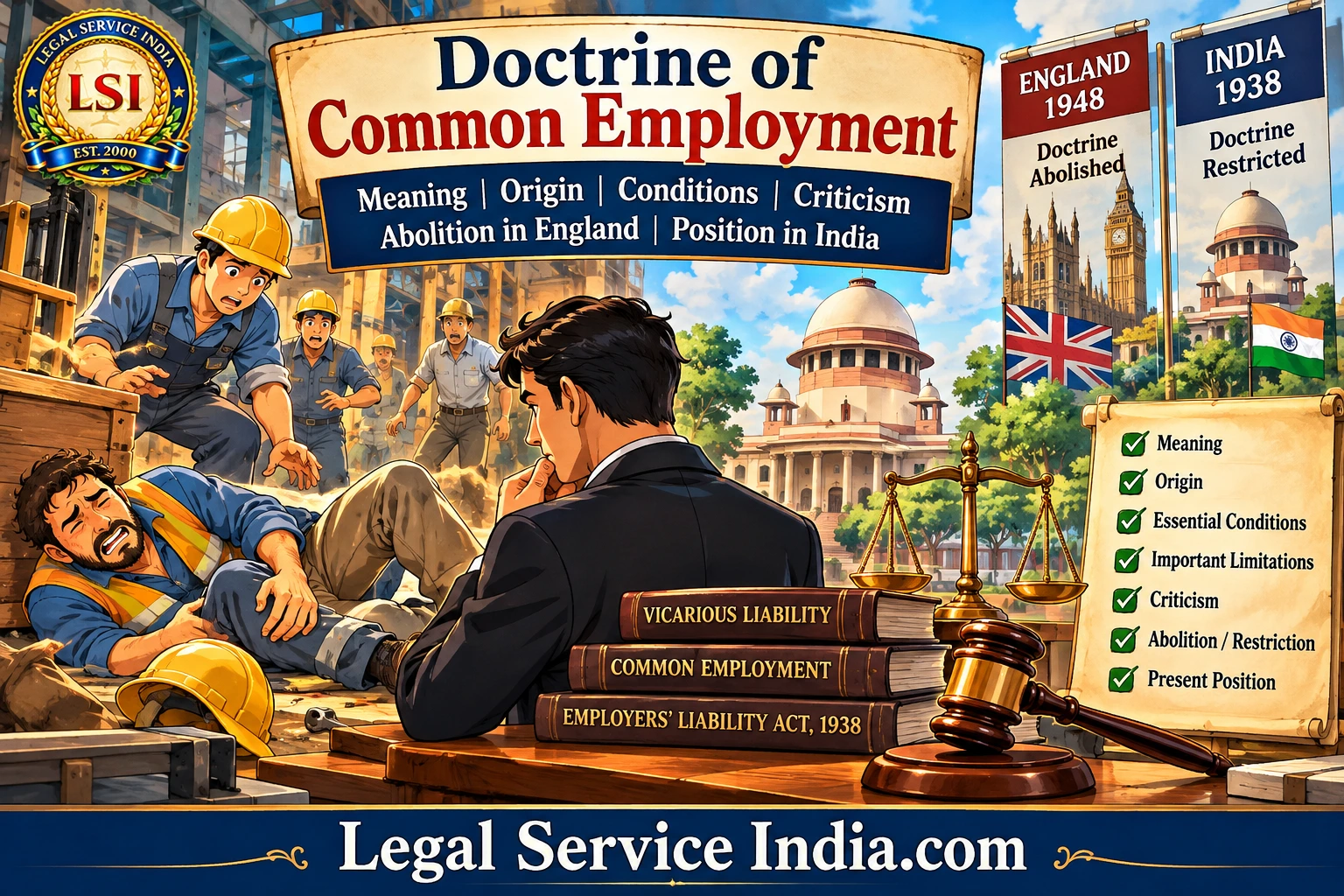
Doctrine of Common Employment: Meaning, Origin, Conditions, Criticism and Present Position
Introduction
The Doctrine of Common Employment, also known as the Fellow-Servant Rule, was an old exception to the general principle of vicarious liability. Under the ordinary rule, an employer is liable for the wrongful act or negligence of an employee when it is committed in the course of employment.
However, under the traditional doctrine of common employment, an employer was not liable for an injury caused to one employee by the negligence of another employee if both were engaged in the same or common employment. In other words, an employee was generally expected to bear the risk of negligence committed by a fellow employee working in the same undertaking.
The doctrine was developed in nineteenth-century English law but was later criticised as unfair to employees. Its scope was gradually restricted by courts and legislation, and it was eventually abolished in England. In India, the Employers’ Liability Act, 1938, significantly restricted its operation.
Origin
The rule began with the English case Priestley v. Fowler (1837). A butcher’s servant was injured when an overloaded van broke down. The court refused to hold the employer liable. Later cases (including American and English decisions) developed the idea that a worker accepted the ordinary risk of fellow-workers’ negligence.
Why It Existed: Historical Justifications
- Workers were said to assume the risk of working with others.
- Employees were thought to know the workplace better than outsiders.
- It limited employers’ liability for every accident between workers.
These reasons later came to be seen as unfair: ordinary workers had little real control over who was hired or how the workplace was run.
Essential Conditions
For the defence to apply, two things had to be shown:
- Both the injured person and the negligent person were employees of the same employer.
- They were engaged in a common employment (the same undertaking) at the time of the accident.
Important Limitations
Even while the doctrine existed, it could not protect an employer from his own negligence. An employer still had personal duties to provide:
- competent staff,
- proper equipment and machinery,
- a safe system of work, and
- effective supervision.
This was firmly stated by the House of Lords in Wilson & Clyde Coal Co. Ltd. v. English (1937). If the real cause of injury was the employer’s failure in these duties, the defence of common employment did not apply.
Criticism of the Doctrine of Common Employment
The Doctrine of Common Employment was widely criticised for being harsh and unfair to employees. It was based on the assumption that a worker accepted the risk of negligence by fellow employees, but in reality, an employee usually had little or no control over the selection, training, supervision or conduct of co-workers. The doctrine also placed the burden of workplace accidents on the injured employee, even though the employer was generally in a better position to prevent such accidents through proper supervision, safety measures and working systems.
Further, the distinction between the employer’s own negligence and the negligence of a fellow employee often created difficulties in obtaining compensation. With the growth of industrial employment and greater recognition of workers’ rights, the doctrine came to be regarded as outdated and inconsistent with the modern principle that employers should take reasonable care to provide a safe working environment. These criticisms ultimately led to its restriction and abolition in various jurisdictions.
Abolition / Restriction of the Doctrine
The doctrine of common employment was gradually considered harsh and unfair to employees because it prevented an injured worker from holding the employer liable for the negligence of a fellow employee. As a result, its operation was restricted and, in some jurisdictions, completely abolished.
England
The doctrine was completely abolished by the Law Reform (Personal Injuries) Act, 1948. An employee could therefore no longer be denied a claim against the employer merely because the injury was caused by the negligence of a fellow employee.
India
The doctrine was substantially restricted by the Employers’ Liability Act, 1938. The Act did not abolish the doctrine in every situation, but it prevented an employer from relying on it in several important circumstances.
Section 3 bars the defence of common employment in specified cases, including injuries resulting from the failure to maintain safe ways, works, machinery or plant, negligence of a person entrusted with superintendence, and negligence of a person whose orders or directions the injured employee was bound to follow, among other situations.
Section 3-A prevents an employer from using a contractual term or agreement to exclude or limit liability for personal injuries caused in circumstances covered by the Act.
The Privy Council in Governor-General in Council v. Constance Zena Wells (1949) clarified that the Employers’ Liability Act, 1938, restricted the doctrine rather than completely abolishing it in all cases. Thus, the defence could still operate in situations not covered by the statutory exceptions.
Present Position
The doctrine is now mainly of historical interest. Modern Indian law (through the 1938 Act and later labour and social-security legislation) has greatly reduced its practical importance. An employer cannot escape responsibility for failing to provide a safe workplace merely by pointing to the negligence of a fellow employee.
Quick Comparison
| Vicarious Liability | Common Employment (Traditional) |
|---|---|
| Employer liable for employee’s tort in course of employment | Defence that prevented liability when one employee injured another |
| General rule | Exception to that rule |
| Still fundamental in modern law | Abolished in England; heavily restricted in India |
In short, the doctrine once allowed employers to avoid liability for injuries caused by one worker to another. Courts and legislatures gradually limited and then largely removed it because it was unfair to workers and inconsistent with the employer’s own duty to provide a safe system of work.
Conclusion
The Doctrine of Common Employment was once an important exception to vicarious liability, allowing an employer to escape responsibility when one employee was injured by the negligence of another engaged in the same work. Originating in nineteenth-century English cases such as Priestley v. Fowler, it rested on the idea that workers accepted the ordinary risks created by their fellow servants.
Over time this reasoning was recognised as unfair and unrealistic, especially because ordinary employees had little control over workplace conditions or the conduct of their colleagues. English law abolished the defence completely in 1948, while India substantially restricted it through the Employers’ Liability Act, 1938. The lasting lesson of the doctrine is that an employer’s own duty to provide competent staff, proper equipment and a safe system of work remains distinct from the negligence of any individual employee, and modern law rightly places the primary responsibility for workplace safety on the employer rather than on the injured worker.