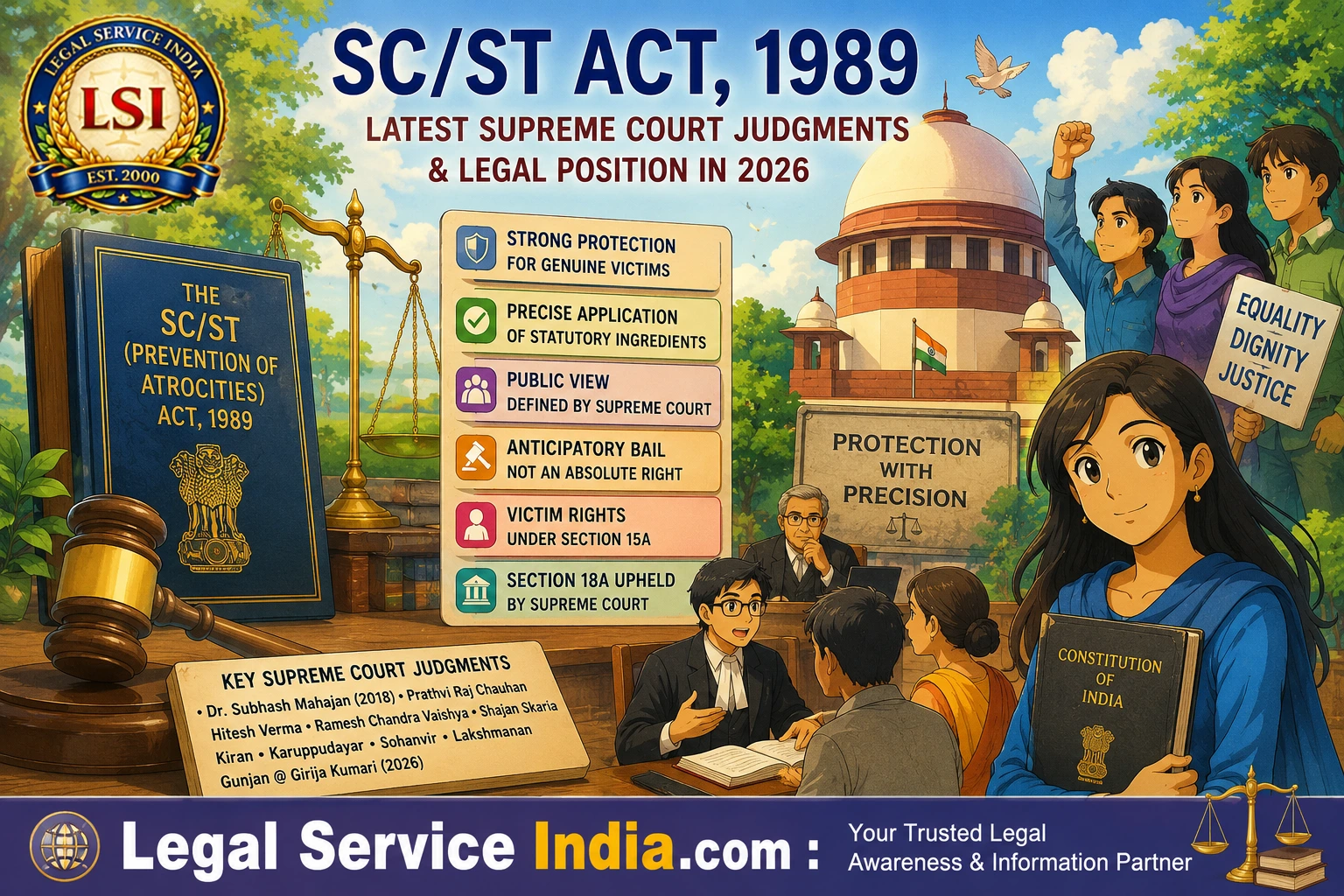
SC/ST (Prevention of Atrocities) Act, 1989: Latest Supreme Court Judgments, Legal Position, and What Has Changed in 2026
Can a stringent protective law also guarantee fair procedure?
Can a law enacted to protect some of India’s most vulnerable citizens be so strict that ordinary criminal-law safeguards disappear?
And can concerns about false cases become a reason to weaken protection against caste-based atrocities?
The Supreme Court’s jurisprudence over the last several years suggests that neither extreme is correct.
The Scheduled Castes and the Scheduled Tribes (Prevention of Atrocities) Act, 1989—commonly known as the SC/ST Act—remains one of India’s strongest protective criminal statutes. It was enacted in response to a deeply rooted social reality of caste-based discrimination, humiliation, violence, exclusion, and exploitation.
But the modern legal question is no longer simply whether the Act should be “strict” or “lenient.”
The more important question is
When do the facts actually satisfy the statutory ingredients of an offense under the Act?
That question has produced a significant body of Supreme Court jurisprudence.
From Dr. Subhash Kashinath Mahajan in 2018, through Prathvi Raj Chauhan, Hitesh Verma, Ramesh Chandra Vaishya, Shajan Skaria, Kiran, Karuppudayar, Sohanvir, Lakshmanan, and finally Gunjan @ Girija Kumari in 2026, the law has evolved considerably.
The emerging position is best described as
Strong protection for genuine victims, but precise application of the statutory ingredients.
The Act has not been rendered ineffective. At the same time, the Supreme Court has repeatedly made clear that the mere fact that a complainant belongs to an SC/ST community does not automatically convert every personal quarrel, property dispute, insult, or criminal allegation into an offense under the special statute.
That distinction is at the heart of the law as it stands in September 2026.
What Has Changed Since the Older Version of This Article?
The earlier version of this article was written in a very different legal environment.
Since then, several important developments have taken place.
| Earlier understanding | Position in 2026 |
|---|---|
| The 2018 Supreme Court safeguards were central to the debate. | Parliament enacted Section 18A, and the Supreme Court later upheld its constitutional validity. |
| Preliminary inquiry was discussed as a safeguard before FIR. | There is no general requirement of preliminary inquiry before every SC/ST Act FIR. |
| Discussion focused heavily on “misuse.” | Recent judgments focus more precisely on statutory ingredients. |
| “Public place” was often loosely discussed. | Supreme Court decisions have sharpened the meaning of “public view.” |
| Accused rights dominated much of the debate. | Victim participation under Section 15A has received significant judicial emphasis. |
| IPC and CrPC were the general criminal-law frameworks. | BNS and BNSS now govern new offenses/proceedings subject to transitional provisions. |
| Case law was largely discussed through 2018–2020 authorities. | 2024–2026 decisions have substantially developed the jurisprudence. |
The current official government material continues to list the SC/ST Act and the relevant PoA Rules as operative legal resources.
The result is a much more mature legal framework than the one reflected in many older internet articles.
Why Was the SC/ST Act Enacted?
The Act was enacted because ordinary criminal law was considered insufficient to deal with the particular nature of atrocities directed against members of Scheduled Castes and Scheduled Tribes.
The problem was not simply physical violence.
- Caste-based atrocities can involve:
- humiliation;
- intimidation;
- social exclusion;
- economic exploitation;
- dispossession;
- violence;
- sexual offenses;
- forced labor;
- social or economic boycott;
- destruction of property;
- denial of dignity;
- and other conduct specifically identified by Parliament.
The 2015 amendment, brought into force in 2016, significantly expanded the list of recognized atrocities and introduced stronger victim and witness protections and the framework for Exclusive Special Courts. The government records the amended Act as having come into force on January 26, 2016.
The legislation therefore has a clear constitutional and social purpose.
But its protective purpose does not mean that the statutory language can be ignored.
The SC/ST Act Is a Special Criminal Statute
The SC/ST Act operates alongside the general criminal law.
That means that a single incident may result in allegations under:
- the SC/ST Act;
- the Bharatiya Nyaya Sanhita, 2023;
- and other applicable statutes.
The special statute provides additional protection because Parliament considered caste-based atrocities to require a specific legal response.
Section 20 of the Act also gives it overriding effect in circumstances covered by the provision.
But the fact that the statute is special does not eliminate the requirement that the prosecution establish the ingredients of the particular offense alleged.
That is an important distinction.
The 2018 Turning Point: Dr. Subhash Kashinath Mahajan
The modern controversy began with Dr. Subhash Kashinath Mahajan v. State of Maharashtra.
The Supreme Court had expressed concern about arbitrary arrests and the possibility of misuse and introduced procedural safeguards.
The decision triggered enormous public opposition.
Critics feared that requiring additional safeguards would weaken the deterrent effect of the SC/ST Act and make it more difficult for victims to obtain immediate protection.
Parliament responded through the SC/ST (Prevention of Atrocities) Amendment Act, 2018.
Among other things, Section 18A was inserted.
This was a decisive legislative response.
Section 18A: The Legislature Responds
Section 18A is central to understanding the modern law.
The statutory framework expressly provides that:
- A preliminary inquiry is not required for registration of an FIR under the Act;
- The investigating officer does not require prior approval for arrest where the statutory conditions are otherwise satisfied;
- and the provisions relating to anticipatory bail remain subject to Sections 18 and 18A.
The current India Code text expressly lists Section 18A as “No enquiry or approval required.”
This is why an old article stating that police must ordinarily conduct a preliminary inquiry before registering every SC/ST Act FIR is misleading.
That is not the current general legal rule.
Prathvi Raj Chauhan v. Union of India: The Constitutional Balance
The constitutional validity of Sections 18 and 18A came before the Supreme Court in:
Prathvi Raj Chauhan v. Union of India, decided on February 10, 2020.
The Supreme Court upheld the constitutional validity of the statutory provisions.
But the Court also made an important clarification.
The bar on anticipatory bail is not intended to operate mechanically in a case where the complaint itself does not disclose a prima facie offense under the SC/ST Act.
The Court recognized that where the basic ingredients of an offense under the Act are absent, the statutory bar cannot simply be used to prevent all judicial scrutiny.
This produced a crucial principle:
The SC/ST Act is stringent, but the existence of a prima facie offense remains important.
The Court also made clear that the High Court’s inherent jurisdiction to prevent abuse of process is not completely destroyed.
This does not mean that every accused can obtain anticipatory bail by merely claiming that the case is false.
The exception is narrow.
The First Major Practical Lesson: FIR, Bail, and Quashing Are Different Questions
One of the biggest mistakes in discussions about the SC/ST Act is treating three different legal questions as though they were the same.
They are not.
Question 1: Can an FIR be registered?
Section 18A is highly significant here.
There is no general preliminary inquiry requirement before registration of an SC/ST Act FIR.
Question 2: Can the accused obtain anticipatory bail?
Sections 18 and 18A create a stringent statutory restriction.
But where the complaint does not disclose a prima facie offense under the Act, the courts can examine whether the statutory bar is actually attracted.
Question 3: Can the High Court quash the proceedings?
In an appropriate exceptional case, yes.
But quashing is not an alternative method of conducting a full trial.
The court normally examines whether the allegations, taken at their face value and in the relevant legal framework, disclose the ingredients of the offense.
Keeping these three questions separate makes the entire jurisprudence easier to understand.
Hitesh Verma: Every Insult Is Not a Caste Atrocity
The Supreme Court’s decision in Hitesh Verma v. State of Uttarakhand remains one of the most important authorities.
The Court explained that simply insulting or intimidating a person who belongs to an SC/ST community does not automatically constitute an offense under the Act.
There must be the statutory connection between the conduct and the victim’s caste identity.
In other words:
The victim’s caste identity alone is not enough.
The alleged insult or intimidation must satisfy the particular statutory ingredients.
The case also involved a property dispute. The Supreme Court held that the allegations did not establish the offense under the SC/ST Act and quashed the charges under the Act while leaving the ordinary criminal allegations to be dealt with separately.
This principle is extremely important.
A person does not lose access to ordinary civil or criminal remedies simply because the opposite party belongs to an SC/ST community.
Conversely, a complainant does not lose statutory protection merely because the accused describes the dispute as a “property dispute.”
The court must examine the actual allegations and the ingredients of the offense.
The Caste Nexus: The Question Courts Keep Asking
A useful way to understand the modern case law is to ask:
Was the person insulted merely as an individual, or was the person targeted because of his or her caste identity?
Consider two hypothetical situations.
Situation A
Two neighbors have a boundary dispute.
During an argument, one abuses the other using ordinary offensive language.
The victim belongs to an SC community.
The fact of SC status alone does not automatically establish the offense under Section 3(1)(r).
Situation B
During the same dispute, the accused deliberately invokes the victim’s caste in a humiliating manner precisely because the victim belongs to that caste.
The legal position is very different.
The court must then examine the remaining statutory ingredients, including the public-view requirement where applicable.
The distinction is not a technicality.
It goes to the statutory foundation of the offense.
Ramesh Chandra Vaishya: The Allegations Must Contain the Necessary Ingredients
In Ramesh Chandra Vaishya v. State of Uttar Pradesh, decided on May 19, 2023, the Supreme Court examined allegations arising from a dispute in which caste-related abuse had been alleged.
The Court held that continuation of the prosecution under the SC/ST Act in the circumstances before it would amount to abuse of the process of law.
The decision was subsequently relied upon in later cases, including Shajan Skaria, Kiran, and Gunjan.
The lesson is straightforward:
A complaint cannot merely use the vocabulary of the statute. It must contain facts capable of satisfying the statute.
Calling an argument a “caste atrocity” does not by itself establish a caste atrocity.
The court must look at the factual allegations.
Section 3(1)(r) and Section 3(1)(s): Know the Difference
For readers, this distinction is particularly important.
Section 3(1)(r)
Broadly concerns intentional insult or intimidation with intent to humiliate a member of an SC/ST community in any place within public view.
Section 3(1)(s)
Broadly concerns intentionally abusing a member of an SC/ST community by caste name in any place within public view.
The precise statutory language should always be consulted in the current Act, but the practical lesson is that courts examine the specific conduct alleged rather than simply accepting the general description “caste abuse.”
This is why identifying the precise section in the FIR is so important.
“Public Place” and “Public View” Are Not the Same Thing
This is perhaps the most misunderstood part of the recent jurisprudence.
A public place and a place within public view are not synonymous expressions.
The statutory question is whether the alleged insult or abuse occurred in circumstances falling within public view.
This can produce different results depending upon the facts.
For example:
Example 1—Completely private room
An alleged caste insult occurs inside a closed room, with no member of the public present.
The public-view requirement may become a decisive issue.
Example 2 — Private property visible to outsiders
An alleged incident occurs in an open area of a private property, but people outside can see or hear what is happening.
The analysis may be entirely different.
Therefore, the correct question is not simply
“Was it private property?”
The correct question is
“Was the alleged act committed in a place within public view as required by the statute?”
That distinction has become central to recent Supreme Court decisions.
Hitesh Verma and the Public-View Principle
In Hitesh Verma, the Supreme Court found that the alleged abuse was within the four walls of a building and that the material did not establish the presence of members of the public.
The Court therefore found the necessary public-view ingredient absent.
Importantly, however, the judgment should not be misunderstood as saying:
“An SC/ST Act offense can never occur on private property.”
That is too broad.
The relevant statutory question is whether the place was within public view.
This factual distinction becomes even more important in the recent cases.
Shajan Skaria: The 2024 Landmark
A major modern development came with:
Shajan Skaria v. State of Kerala & Anr., 2024 INSC 625, decided on August 23, 2024.
The case involved an online video containing allegations concerning a person belonging to a Scheduled Caste.
The Supreme Court considered, among other issues:
- Section 18;
- anticipatory bail;
- the meaning of a prima facie case;
- Section 3(1)(r);
- Section 3(1)(u);
- and whether knowledge of the complainant’s caste was itself sufficient.
It was not.
The judgment reinforced the importance of examining whether the alleged conduct actually satisfies the statutory ingredients rather than assuming that the Act applies merely because the complainant belongs to an SC community.
The Court also reaffirmed the importance of the prima facie threshold when considering the bar on anticipatory bail.
This was particularly significant because the case arose in the context of online speech.
The lesson for the digital age is obvious:
Not every harsh, offensive, or politically charged statement about an SC/ST person automatically becomes an offense under the SC/ST Act.
The statutory ingredients still matter.
The Digital Age Creates New Questions
Social media has changed the factual environment in which the Act operates.
A statement may now be:
- recorded in a private room;
- uploaded online;
- circulated through WhatsApp;
- livestreamed;
- posted on social media;
- viewed by thousands of people;
- or communicated privately and subsequently leaked.
This creates difficult questions about:
- publication;
- public view;
- intention;
- audience;
- context;
- authorship;
- editing;
- electronic evidence;
- and the exact statutory provision invoked.
The courts will increasingly have to apply established statutory principles to these new factual situations.
The law does not become different merely because the medium has changed.
But the facts can become considerably more complicated.
The 2025–2026 Shift: Public View Becomes Even More Important
The Supreme Court’s recent decisions have continued to develop the public-view principle.
Two decisions are especially important:
Karuppudayar v. State
and
Sohanvir @ Sohanvir Dhama & Ors. v. State of U.P. & Anr.
The latter was decided on December 8, 2025, and is reported as 2025 INSC 1397.
The jurisprudence demonstrates that where the allegation under Section 3(1)(s) concerns conduct inside a private residence, the court must carefully examine whether the statutory requirement of public view is actually established.
The Supreme Court’s approach is not that private property creates immunity.
It is that the statutory words must be satisfied.
That is a crucial difference.
The 2026 Supreme Court Development: Gunjan @ Girija Kumari
The latest major Supreme Court development considered here is
Gunjan @ Girija Kumari & Ors. v. State (NCT of Delhi) & Anr., decided on May 11, 2026.
The official Supreme Court judgment records that charges had been framed under Sections 3(1)(r) and 3(1)(s) of the SC/ST Act in a dispute involving family members.
The case is particularly important because the Supreme Court examined the alleged incident in the context of a residential setting and applied the line of authority concerning “public view.”
The decision demonstrates how the Supreme Court is now using the principles developed in Hitesh Verma, Ramesh Chandra Vaishya, and subsequent cases to test whether the factual allegations actually satisfy Sections 3(1)(r) and 3(1)(s).
This is one of the clearest indications that the current jurisprudence is moving toward precision rather than simply broadening or narrowing the Act.
A Simple Legal Test for Sections 3(1)(r) and 3(1)(s)
For a reader trying to understand the practical position, the following checklist is useful.
Ask:
- 1. Is the complainant a member of an SC/ST community?
- 2. What exactly did the accused allegedly do or say?
- 3. Does the conduct fall within the specific statutory provision?
- 4. Was the conduct connected with the victim’s caste identity?
- 5. Was the incident in a place within public view?
- 6. Is there supporting material?
Witnesses, recordings, CCTV, messages, documents, and other evidence may become important.
This does not mean the victim must prove the entire case at the FIR stage.
It means that the statutory foundation of the allegation must exist.
The Important Difference Between “False Case” and “Case Not Proved”
Another area requiring intellectual honesty is the language of “false cases.”
A prosecution ending in acquittal does not automatically establish that the FIR was malicious.
Similarly, an allegation being found insufficient to establish an offense under the SC/ST Act does not necessarily mean that the complainant deliberately fabricated everything.
There can be:
- genuine disputes;
- mistaken allegations;
- exaggerated allegations;
- insufficient evidence;
- legally defective allegations;
- malicious allegations;
- and completely fabricated allegations.
These are not legally identical.
The court must determine which category a particular case falls into.
That is why “misuse” should not become a slogan replacing legal analysis.
What the Supreme Court Has Not Said
The recent judgments should not be misrepresented.
The Supreme Court has not held that:
- The SC/ST Act is unconstitutional;
- Police cannot register an FIR immediately;
- Every accused under the Act is entitled to anticipatory bail;
- caste-based abuse is legally insignificant;
- Every private incident is outside the Act;
- Victims must prove their entire case before an FIR can be registered;
- Or an allegation of misuse automatically defeats prosecution.
The Court has instead repeatedly emphasized:
The special statute must be applied according to its statutory ingredients.
That principle protects both the integrity of the Act and the integrity of criminal justice.
The Core Message
The jurisprudence from 2018 to 2026 shows an important transformation.
The debate is no longer adequately described as
“SC/ST Act versus accused rights.”
It is better understood as
“How can a stringent protective statute deliver genuine justice while remaining faithful to its own statutory requirements and constitutional criminal-procedure principles?”
The answer emerging from the Supreme Court is increasingly clear:
Protect the victim. Respect the statute. Examine the ingredients. Do not confuse caste identity with automatic guilt. And do not confuse an allegation of misuse with proof that the law itself is unnecessary.
That is the foundation upon which the next part of the article—dealing with anticipatory bail, victim rights, Section 15A, Sections 3(2)(v)/(va), BNS/BNSS, compensation, Special Courts, and practical remedies—must be understood.
Victim Rights: The Other Half of the Story
An article about the SC/ST Act becomes incomplete if it discusses only accused safeguards.
The Act was created primarily to protect victims.
The 2015/2016 amendments introduced a separate chapter dealing with the rights of victims and witnesses.
The government describes this framework as imposing responsibilities concerning the protection of victims, dependants, and witnesses against coercion, violence, and harassment.
Section 15A is therefore central to modern SC/ST Act litigation.
Section 15A: What Does It Mean for a Victim?
Among other protections, Section 15A deals with rights concerning:
- Notice of proceedings;
- Participation;
- Protection;
- Being heard;
- Bail proceedings;
- Discharge;
- Release;
- Parole;
- And other stages specified by law.
This changes the old picture of criminal litigation in which the victim was largely a spectator.
Under the SC/ST Act, the victim has a recognized statutory role.
That role should be taken seriously by courts, prosecutors, and investigating agencies.
Lakshmanan: Victim’s Right to Be Heard
The Supreme Court’s decision in Lakshmanan v. State through the Deputy Superintendent of Police & Ors., 2025 INSC 1483, is important from the victim’s perspective.
The Court reaffirmed the significance of the statutory right of the victim or dependent to participate in bail proceedings.
But an important distinction must be maintained:
The right to be heard does not mean the victim has a right to dictate the result.
A victim must be given a meaningful opportunity to participate.
The court must then independently decide whether bail should be granted.
This is a much healthier understanding of victim participation than either extreme:
- Treating the victim as irrelevant; or
- Treating the victim’s objection as automatically determinative.
Why Victim Participation Matters
Imagine a serious atrocity allegation.
The accused seeks bail.
The victim fears:
- Intimidation;
- Pressure to compromise;
- Destruction of evidence;
- Influence over witnesses;
- Repeated harassment;
- Or retaliation.
If the victim receives no meaningful opportunity to place these concerns before the court, the statutory protection becomes largely symbolic.
Section 15A seeks to prevent that.
The recent jurisprudence therefore reflects an important development:
Fair procedure is not only an accused’s right. It also includes meaningful protection and participation for victims.
Compensation and Relief: The Act Is More Than a Punishment Statute
Another major omission in many online articles is the question:
What happens to the victim financially?
The statutory framework and rules contemplate relief and rehabilitation.
The Department of Social Justice and Empowerment records that the PoA Rules have been amended to provide relief amounts depending upon the nature of the offense and that the government supports implementation through relief to victims, rehabilitation, special courts, and related measures.
The rules have also evolved to address a wider range of offenses and victim circumstances.
Therefore, a victim should not think only in terms of:
FIR → trial → conviction.
There can also be issues concerning:
- Immediate relief;
- Medical assistance;
- Rehabilitation;
- Protection;
- Travelling and maintenance expenses;
- Witness support;
- And other statutory benefits.
The precise amount and stage of payment depend upon the applicable rules and the nature of the offense.
Relief Is Not the Same as Compensation After Conviction
This distinction deserves emphasis.
A statutory relief mechanism is not necessarily identical to damages awarded after a civil trial or compensation ordered after criminal conviction.
The PoA Rules create a separate statutory framework for relief and rehabilitation.
Therefore, victims and lawyers should examine the applicable rules at the earliest stage rather than waiting until the end of a criminal trial.
Special Courts: The Promise of Speedy Justice
The Act provides for:
- Special Courts;
- Exclusive Special Courts;
- Special Public Prosecutors/Exclusive Special Public Prosecutors;
- And a framework intended to facilitate speedy trial.
The 2015 amendment was specifically designed to strengthen the institutional mechanism for speedier trials. Government material records the establishment of Exclusive Special Courts as one of the major features of the amended law.
But legislation alone does not guarantee speedy justice.
The real-world question is
Are special courts actually able to complete trials quickly?
That depends upon:
- Judicial vacancies;
- Prosecution resources;
- Investigation quality;
- Witness availability;
- Forensic facilities;
- Adjournments;
- Court infrastructure;
- And witness protection.
Speedy Justice Is Important for Both Sides
Delay harms everyone.
For a Victim:
- Memories fade;
- Witnesses disappear;
- Evidence becomes difficult to collect;
- Economic hardship continues;
- Trauma is prolonged.
For an Accused:
- The criminal allegation may hang over the person’s life for years;
- Employment and reputation may suffer;
- Legal expenses accumulate;
- And the presumption of innocence becomes practically difficult to enjoy despite remaining legally intact.
Therefore:
Speedy trial is not an accused-versus-victim issue. It is a justice-system issue.
The SC/ST Act and the BNS/BNSS: What Changed After July 1, 2024?
India’s criminal-law framework changed substantially on July 1, 2024.
The Bharatiya Nyaya Sanhita, 2023 (BNS), replaced the Indian Penal Code for new offenses, subject to transitional provisions.
The Bharatiya Nagarik Suraksha Sanhita, 2023 (BNSS), replaced the Code of Criminal Procedure, again subject to its transitional provisions.
The SC/ST Act was not replaced.
It continues as a special statute.
Therefore, a contemporary case may contain:
| Legal Framework | Role |
|---|---|
| BNS provisions | General criminal law provisions |
| SC/ST Act provisions | Special statutory protections and offenses |
This is already visible in recent Supreme Court litigation. The Kiran case, for example, involved BNS provisions together with several SC/ST Act provisions. (LegalStreet)
Why Lawyers Must Check the Date of the Offence
It is dangerous to assume:
“BNSS applies because the case is being heard today.”
The applicable procedural regime can depend upon the date of the offense and transitional provisions.
Similarly, the old IPC and CrPC may continue to appear in litigation relating to offenses committed under the previous legal framework.
Therefore, pleadings should not mechanically replace every IPC section with a BNS section or every CrPC section with a BNSS section.
The date and transitional provisions matter.
What Happened to Section 438 CrPC?
Under the old CrPC, Section 438 dealt with anticipatory bail.
Under the BNSS, the corresponding provision is Section 482.
However, when dealing with the SC/ST Act, the special statutory restrictions contained in Sections 18 and 18A remain crucial.
The practical approach is therefore
- Read the general procedural law;
- Read the special SC/ST Act;
- Examine the transitional provisions.
Never read one in isolation.
The “Public View” Problem in the Age of Digital Communication
The internet creates an interesting legal problem.
Suppose an alleged caste-based statement is made:
- Privately on a phone call;
- In a WhatsApp message;
- In a closed family group;
- On a public social media page;
- During a livestream;
- In a recorded video uploaded later.
Are these situations legally identical?
No.
The court may have to examine:
- Who heard or saw the statement
- When and how it was communicated;
- Whether it was actually public;
- Whether it was subsequently published;
- The statutory provision invoked;
- The alleged intention;
- And the evidence establishing authorship and context.
The traditional “public view” jurisprudence therefore acquires new complexity in the digital age.
The Real Importance of Electronic Evidence
In modern SC/ST Act cases, evidence may include:
- CCTV;
- Mobile-phone recordings;
- WhatsApp chats;
- Emails;
- Social media posts;
- Livestream recordings;
- Call recordings;
- Photographs;
- Location information;
- Metadata;
- And other digital material.
But electronic evidence must be properly collected, preserved, and proved according to the applicable evidentiary law.
The mere existence of a screenshot does not automatically establish every fact asserted by a party.
This is where competent investigation becomes crucial.
What Should Police Investigate?
A proper investigation should not stop after writing “caste abuse” in the FIR.
Depending upon the allegation, investigators should examine:
- Caste status;
- Identity of accused;
- Exact words/actions alleged;
- Circumstances of the incident;
- Place of occurrence;
- Public-view circumstances;
- Independent witnesses;
- CCTV;
- Electronic evidence;
- Medical evidence;
- Property documents;
- Prior disputes;
- Motive where relevant;
- And the ingredients of the precise section invoked.
The purpose is not to weaken the victim’s case.
It is to establish the truth.
A strong investigation protects the genuine victim and makes an unjust prosecution less likely.
What Should an Accused Person Examine?
An accused facing an SC/ST Act FIR should immediately obtain and examine:
| Issue | Question to Examine |
|---|---|
| FIR | What exactly is alleged? |
| The statutory sections | Why have these particular provisions been invoked? |
| The factual ingredients | Do the allegations actually satisfy each element? |
| Public view | If Sections 3(1)(r) or 3(1)(s) are invoked, what establishes public view? |
| Caste nexus | Does the allegation show that the conduct was because of caste? |
| Underlying offense | If Section 3(2)(v) or 3(2)(va) is invoked, what underlying offense is alleged? |
| Evidence | What independent material exists? |
| Bail | Does the statutory bar apply to the facts? |
| Quashing | Is this an exceptional case where the High Court’s jurisdiction can be invoked? |
The answer to these questions should be evidence-based, not emotional.
What Should a Victim Preserve?
A victim should preserve evidence as early as possible.
This may include:
- Original recordings;
- Photographs;
- CCTV footage;
- Messages;
- Call details where legally obtainable;
- Names and contact details of witnesses;
- Medical records;
- Property documents;
- Employment records;
- Photographs of injuries or damage;
- Social media posts;
- And any document demonstrating the surrounding circumstances.
The victim should also document threats or attempts at intimidation.
This is particularly important because Section 15A places emphasis on victim and witness protection.
A Practical Victim Checklist
Immediately After the Incident
- Ensure personal safety.
- Obtain medical attention where necessary.
- Preserve original evidence.
- Identify witnesses.
- Make the complaint with accurate factual details.
During Investigation
- Follow up on evidence.
- Preserve electronic material.
- Cooperate with lawful investigation.
- Record threats or intimidation.
- Seek statutory protection where necessary.
During Bail Proceedings
- Assert the right to notice and hearing under Section 15A.
- Place genuine concerns regarding intimidation before the court.
- Ensure the prosecutor has relevant material.
During Trial
- Maintain contact with counsel.
- Preserve witnesses and documents.
- Report intimidation promptly.
- Seek available relief and rehabilitation benefits.
A Practical Accused-Side Checklist
First Step
Obtain the FIR and all available documents.
Second Step
Identify every section invoked.
Third Step
Test each ingredient.
Fourth Step
Examine public-view allegations where relevant.
Fifth Step
Examine the caste nexus.
Sixth Step
Separate SC/ST Act allegations from ordinary BNS offenses.
Seventh Step
Consider the correct bail remedy.
Eighth Step
Where appropriate, examine whether quashing or discharge is legally available.
Ninth Step
Do not destroy, alter, or fabricate evidence.
Tenth Step
Prepare the case on evidence, not merely on the assertion that the complaint is false.
The Most Important Procedural Lesson
The SC/ST Act should neither be approached as:
“A statute under which no accused can obtain relief.”
nor as:
“A statute that is routinely abused and therefore should be treated suspiciously.”
Both approaches are legally unsound.
The proper approach is
Read the statute. Read the FIR. Identify the ingredients. Examine the evidence appropriate to the procedural stage. Protect the victim. Protect due process.
That is the judicial balance.
What the Modern Framework Looks Like
By 2026, the SC/ST Act has developed into a much more sophisticated legal framework.
It combines:
- Strict statutory protection
- With victim participation
- And specialized courts
- And relief and rehabilitation
- While preserving
- Limited judicial scrutiny where the statutory ingredients are absent.
The next and final part examines the most recent judgments in greater depth, the “Myths vs Law” framework, unresolved questions, the problem of investigation quality, and what the future of SC/ST Act jurisprudence should look like.
Karuppudayar: Why “Public View” Cannot Be Treated as a Technical Phrase
The recent Supreme Court jurisprudence has given renewed importance to the words “public view.”
In Karuppudayar v. State, the Court examined allegations involving caste-based abuse and applied the established principles concerning the statutory requirement.
The importance of the case lies not simply in its result.
It demonstrates the Court’s continuing approach:
- The statutory phrase must be applied to the facts.
- A court cannot simply assume that every place outside a completely closed private room is automatically public.
- Nor can it assume that every private property is necessarily outside public view.
The factual circumstances matter.
Sohanvir @ Sohanvir Dhama: The Principle Continues in 2025
In Sohanvir @ Sohanvir Dhama & Ors. v. State of U.P. & Anr., 2025 INSC 1397, decided on December 8, 2025, the Supreme Court considered proceedings involving Section 3(1)(s) of the SC/ST Act.
The case arose from allegations concerning caste abuse in a residential setting.
The Supreme Court again examined the public-view requirement.
This continuity is important.
It means that Hitesh Verma was not an isolated decision from 2020.
The principle has continued to influence subsequent Supreme Court cases.
Gunjan @ Girija Kumari: The 2026 Position
The 2026 decision in Gunjan @ Girija Kumari & Ors. v. State (NCT of Delhi) & Anr. is therefore best understood as part of a developing line of cases rather than as a completely new doctrine.
The Supreme Court judgment records that charges under Sections 3(1)(r) and 3(1)(s) had been framed in a dispute involving family members.
The Court examined the allegations against the statutory requirement of public view and the principles established in earlier authorities.
The decision is particularly valuable because it demonstrates how courts should approach a case at the stage where the accused challenges the continuation of proceedings:
- Do the allegations, taken in their proper factual context, actually disclose the statutory offense?
- Where an essential ingredient is absent, continuation of the special-statute prosecution can amount to abuse of process.
What Gunjan Does Not Mean
The judgment should not be reduced to a social media headline saying:
“The Supreme Court says caste abuse inside a house is not a crime.”
That would be wrong.
The court was not declaring caste-based abuse lawful.
The issue was whether the specific offense charged under Sections 3(1)(r) and 3(1)(s) had the required statutory element of occurring in a place within public view.
The distinction is essential.
A statute must be enforced.
But the offense must also fit the statute.
The Evolution of the Case Law: A Timeline
The jurisprudential development can be understood as follows:
| Year | Development |
|---|---|
| 1989 | SC/ST (Prevention of Atrocities) Act enacted. |
| 2015–2016 | Major amendments expand offenses, special courts, and victim/witness protections. |
| 2018 | Dr. Subhash Kashinath Mahajan raises concerns about arrest and procedural safeguards. |
| 2018 | Parliament responds through Section 18A. |
| 2020 | Prathvi Raj Chauhan upholds Sections 18 and 18A while recognizing limited judicial scrutiny where no prima facie offense exists. |
| 2020 | Hitesh Verma clarifies caste nexus and public view. |
| 2023 | Ramesh Chandra Vaishya reinforces the requirement that the factual allegations must disclose the ingredients of the offense. |
| 2024 | Shajan Skaria applies the principles to a modern online-publication dispute and anticipatory-bail question. |
| 2025 | Kiran examines the interaction between BNS offenses and the SC/ST Act in the anticipatory-bail context. |
| 2025 | Karuppudayar and Sohanvir reinforce the importance of the public-view requirement. |
| 2025 | Lakshmanan highlights victim participation in bail proceedings. |
| 2026 | Gunjan @ Girija Kumari applies the public-view and statutory-ingredient principles in a residential/family dispute. |
The broad movement is clear:
From a debate about “dilution” to a more precise jurisprudence about statutory ingredients, while simultaneously recognizing stronger procedural rights for victims.
Myth vs. Law
Myth 1: “Once the SC/ST Act is mentioned in the FIR, anticipatory bail is impossible.”
Law:
Sections 18 and 18A create a strong statutory restriction.
However, Prathvi Raj Chauhan and subsequent jurisprudence recognize that where the complaint itself fails to disclose a prima facie offense under the Act, the statutory bar does not operate mechanically.
Myth 2: “Every insult to an SC/ST person is an atrocity.”
Law:
No.
The Supreme Court in Hitesh Verma made clear that every insult or intimidation does not automatically fall within the Act merely because the victim belongs to an SC/ST community.
Myth 3: “A property dispute can never attract the SC/ST Act.”
Law:
That is also wrong.
The existence of a property dispute does not automatically defeat an SC/ST Act allegation.
The court must examine whether the statutory ingredients are actually present.
Myth 4: “Anything happening on private property is outside the SC/ST Act.”
Law:
Not necessarily.
The relevant statutory question for Sections 3(1)(r) and 3(1)(s) is whether the alleged conduct occurred in a place within public view.
Private ownership and public view are different concepts.
Myth 5: “Police must conduct a preliminary inquiry before every SC/ST Act FIR.”
Law:
No.
Section 18A specifically addresses the issue, and the Supreme Court’s post-amendment jurisprudence does not support a general preliminary-enquiry requirement before every FIR.
Myth 6: “The victim has no role in bail proceedings.”
Law:
Incorrect.
Section 15A gives victims important procedural rights, including participation and the right to be heard.
The Supreme Court’s recent Lakshmanan decision reinforces the importance of those rights.
Myth 7: “Acquittal automatically proves that the FIR was false.”
Law:
No.
An acquittal may result from insufficient evidence, contradictions, failure to establish an ingredient beyond reasonable doubt, or other legal reasons.
Malicious prosecution is a separate question.
Myth 8: “A victim’s allegation automatically proves the offense.”
Law:
No.
The allegation must ultimately be established according to criminal-law standards.
The protective nature of the statute does not eliminate the need for proof.
The Real Problem Is Not Strictness—It Is Quality of Investigation
This, in my view, is one of the most important lessons emerging from the entire debate.
A strong statute does not become unjust merely because it is strict.
It becomes unjust when:
- investigation is careless;
- evidence is ignored;
- Witnesses are not protected;
- VictimsCriminal Law > SC/ST Act in 2026: What the Supreme Court Has Really Said About Public View, Bail & Victim Rights are intimidated;
- Statutory ingredients are mechanically added;
- or innocent persons are prosecuted without adequate factual foundation.
The opposite is equally true.
A protective statute becomes ineffective when:
- genuine complaints are trivialized;
- caste-based evidence is ignored;
- Witnesses are not protected;
- Investigation is deliberately delayed;
- Relief is not provided;
- or proceedings continue for years without meaningful progress.
Therefore, the real challenge is not simply
“Should the Act be strict?”
It is:
“Can the justice system enforce a strict statute accurately, professionally, and fairly?”
That is the question India should be asking.
Why Mechanical Addition Of Sections Is Dangerous
In criminal practice, there can sometimes be a tendency to add every conceivable provision to an FIR.
That approach is dangerous.
If the statutory ingredients are not present, adding the SC/ST Act provision may:
- complicate investigation;
- affect bail;
- prolong litigation;
- create unnecessary social conflict;
- consume judicial time;
- and ultimately weaken confidence in genuine cases.
But the answer is not to discourage complainants from invoking the Act.
The answer is better investigation.
The investigator should ask:
Which precise offense is disclosed by the facts?
That is the professional approach.
Why Under-Investigation Is Equally Dangerous
The opposite problem can be even more serious.
Suppose a genuine victim reports caste-based violence.
If the investigator treats it merely as an “ordinary dispute” without investigating the caste-related circumstances, the special harm addressed by Parliament may disappear from the record.
That can affect:
- charges;
- bail;
- victim protection;
- compensation;
- trial;
- and ultimately conviction.
Therefore, neutrality does not mean indifference.
A fair investigation must take the allegation seriously and test it rigorously.
Also Read: Can America Reform the Supreme Court? Latest 5–4 Ruling Reignites Term Limits Debate
The Importance Of The Exact Words Alleged
In cases under Sections 3(1)(r) and 3(1)(s), the precise language allegedly used can become highly relevant.
A vague statement such as
“He abused me by caste.”
may be insufficient to explain the factual foundation.
That does not mean every FIR must contain a perfect transcript.
But the more precisely the alleged conduct is recorded, the easier it becomes for investigators and courts to determine:
- what was allegedly said;
- why it was allegedly said;
- where it was said;
- who heard it;
- and whether the statutory ingredients are present.
Public View Should Be Investigated, Not Assumed
Where public view is an ingredient, investigators should identify:
- who was present;
- where they were standing;
- whether they could hear or see the incident;
- whether the location was open or enclosed;
- whether CCTV exists;
- whether surrounding persons were independent members of the public;
- and what the witnesses actually observed.
This is much better than merely writing:
“The incident took place in public view.”
The latter is a conclusion.
The former is investigation.
Victim Protection Must Be Taken Seriously
A victim may be legally correct and still be practically vulnerable.
After an FIR, there may be:
- social pressure;
- threats;
- employment consequences;
- pressure to compromise;
- intimidation of witnesses;
- or repeated harassment.
Section 15A’s victim-and-witness protections therefore need practical implementation.
The government has recognized victim relief, rehabilitation, special courts, and other institutional mechanisms as part of the implementation of the Act.
The challenge is ensuring that these mechanisms work not merely on paper but in real life.
The Role of Prosecutors
A strong investigation can still fail if prosecution is weak.
Special public prosecutors must understand:
- the special statutory framework;
- the evidentiary requirements;
- the rights of victims;
- the significance of Section 15A;
- the interaction with BNS/BNSS;
- and the Supreme Court’s evolving jurisprudence.
A prosecution should not depend solely on the emotional force of the allegation.
It must be built on legally admissible evidence.
The Role Of The Courts
The courts have an equally delicate responsibility.
They must avoid two errors.
Error One: Mechanical Acceptance
Assuming that every allegation under the Act automatically establishes the offense.
Error Two: Mechanical Scepticism
Assuming that because misuse is possible, every complaint should be viewed suspiciously.
The judicial task is neither.
It is:
To apply the statutory ingredients to the facts fairly.
That is precisely why recent Supreme Court judgments are important.
A Four-Question Judicial Framework
A useful way to understand the current jurisprudence is through four questions.
- First: What exactly is alleged?
- Second: Which provision of the SC/ST Act is attracted?
- Third: Do the allegations disclose every essential ingredient of that provision?
- Fourth: At what procedural stage is the court being asked to intervene?
The fourth question is often forgotten.
The standard at:
- FIR stage;
- anticipatory bail;
- regular bail;
- discharge;
- quashing;
- and trial
is not identical.
FIR Stage Is Not Trial Stage
At the FIR stage, the criminal justice system does not conduct a complete trial.
The allegations may be investigated.
At trial, however, the prosecution must prove the offense according to the applicable standard of proof.
Therefore, the fact that a case survives the FIR stage does not mean that conviction is inevitable.
Similarly, the fact that an FIR is ultimately quashed does not establish a general proposition that all similar complaints are false.
Every procedural stage has its own legal function.
Quashing: An Exceptional Remedy
The High Court’s inherent jurisdiction remains an important safeguard against abuse of process.
But quashing should not become a substitute for trial wherever factual disputes require evidence.
The court generally becomes more cautious where:
- Witness credibility is disputed;
- Competing versions require evidence;
- Electronic evidence requires examination;
- intention is disputed;
- or the factual circumstances are contested.
Conversely, where the allegations taken at face value do not disclose the statutory offense, judicial intervention can be justified.
That distinction is central to responsible criminal adjudication.
Section 14A Appeals: Another Important Remedy
The SC/ST Act provides a specific appellate mechanism under Section 14A.
This provision has become particularly important in litigation concerning orders passed by special courts.
The recent Sohanvir litigation itself arose through the Section 14A appellate framework.
Therefore, lawyers should not assume that ordinary criminal appellate remedies are the only route available.
The special statute must always be checked for its own procedural mechanisms.
The SC/ST Act and Constitutional Equality
The Act must also be understood against the Constitution.
Articles such as
- Article 14;
- Article 15;
- Article 17;
- Article 21;
- and the constitutional commitment to social justice
form part of the broader legal context.
Article 17’s constitutional prohibition of untouchability is especially significant in understanding why caste-based indignity cannot simply be treated as an ordinary interpersonal disagreement.
The SC/ST Act is therefore not merely a technical criminal statute.
It is part of India’s larger constitutional project of eliminating caste-based oppression.
But Equality Also Includes Fair Procedure
Constitutional equality cannot mean:
“One class receives protection while ordinary principles of criminal justice disappear.”
Nor can fair procedure mean:
“Because procedural safeguards exist, the special protection becomes unnecessary.”
Both propositions are wrong.
The constitutional objective is more demanding:
Protect dignity and equality while maintaining fair criminal adjudication.
That is why the recent case law is best understood as a search for precision.
The Future Challenge: Online Caste Abuse
One of the most important areas likely to generate further litigation is online caste-based abuse.
Questions may include:
- What constitutes public view in a closed online group?
- Does later viral circulation change the legal analysis?
- How should an original private communication and subsequent public publication be treated?
- What evidence establishes who authored a post?
- How should edited videos be treated?
- What happens when the alleged speaker did not intend public circulation?
The existing statutory language will have to be applied to these new factual environments.
The Future Challenge: BNS + SC/ST Act
The second major challenge is procedural and doctrinal coordination.
Courts will increasingly deal with cases involving:
- BNS + BNSS + Bharatiya Sakshya Adhiniyam + SC/ST Act.
Lawyers and investigators will need to understand how the general criminal codes interact with the special statute.
This will be particularly important in:
- bail;
- arrest;
- evidence;
- electronic records;
- investigation;
- charge framing;
- and trial.
The Future Challenge: Speedy Justice
Another unresolved issue is implementation.
The law provides special courts and victim protections.
But a statutory promise of speedy justice means little if:
- cases remain pending for years;
- witnesses repeatedly attend court;
- prosecutors are overburdened;
- Forensic reports arrive late;
- or victims do not receive timely relief.
A serious national discussion on the SC/ST Act should therefore include court capacity and implementation, not just judgments.
The Future Challenge: Victim and Witness Protection
The effectiveness of Section 15A ultimately depends upon implementation.
A victim who is technically entitled to be heard but practically afraid to appear in court has not received complete justice.
Similarly, a witness who faces intimidation cannot be expected to participate effectively without institutional protection.
Therefore, the future of the Act depends not merely upon increasing punishments.
It depends upon:
- protection;
- investigation;
- prosecution;
- judicial capacity;
- rehabilitation;
- and speedy adjudication.
A 2026 Litigation Checklist
For Victims
- Establish the relevant statutory facts.
Do not rely only on labels. - Preserve original evidence.
Especially electronic evidence. - Identify witnesses.
Record their details promptly. - Establish public-view circumstances where relevant.
Who saw or heard the incident? - Preserve medical/property evidence.
Depending upon the nature of the allegation. - Assert Section 15A rights.
Particularly in bail proceedings. - Seek protection where necessary.
Threats should be documented and reported. - Examine relief and rehabilitation provisions.
Do not wait until the trial ends.
For Accused Persons
- Obtain the FIR.
- Identify the precise SC/ST Act sections.
- Analyze every ingredient.
- Examine the caste nexus.
- Examine public view where applicable.
- Identify the underlying offense under Sections 3(2)(v)/(va), if invoked.
- Examine the anticipatory-bail bar.
- Consider whether the case falls within the narrow Prathvi Raj Chauhan principle.
- Consider discharge/quashing only where legally appropriate.
- Preserve lawful evidence supporting the defense.
For Police and Investigating Agencies
A professional investigation should answer:
- Who is the victim?
- Who is the accused?
- What happened?
- What exact offense is alleged?
- What exact statutory section applies?
- What evidence supports it?
- Was the conduct caste-linked?
- Was it within public view where required?
- Who witnessed it?
- What electronic evidence exists?
- Are there threats or intimidation?
- Is victim relief applicable?
- Has the investigation been conducted within the applicable statutory/procedural framework?
The goal should be neither maximum charges nor minimum charges.
The goal should be correct charges based on evidence.
What a Good SC/ST Act Investigation Should Look Like
A good investigation should ultimately allow a judge to understand the case without relying upon slogans.
It should establish:
Facts → Evidence → Statutory ingredients → Charge.
A weak investigation often reverses the process:
Charge → Label → Search for facts.
The latter approach is dangerous.
The Meaning of “Misuse” Needs More Honesty
There is a tendency in public debate to speak about “misuse” as though there are only two possible positions.
One side says:
“The Act is frequently misused.”
The other says:
“There is no misuse.”
The legal system needs neither slogan.
The correct position is
- Some allegations may be false, exaggerated, or legally insufficient.
- That possibility exists in criminal law generally.
But that does not mean:
- The protective statute itself is unnecessary.
The answer is case-specific adjudication.
The Same Principle Applies in Reverse
It is equally wrong to assume:
“Because the complainant belongs to an SC/ST community, the complaint must be false if a court later finds one ingredient missing.”
That is also unjust.
A victim may genuinely have suffered discrimination but still fail to establish a particular statutory offense because:
- the wrong provision was invoked;
- Evidence was insufficient;
- public view was not established;
- The caste nexus was not proved;
- or another legal ingredient was missing.
The justice system must distinguish these situations.
The Supreme Court’s Message From 2018 to 2026
Taken together, the major cases reveal several recurring principles.
Principle 1
The SC/ST Act serves an important constitutional and social purpose.
Principle 2
Sections 18 and 18A create a strong statutory restriction on anticipatory bail.
Principle 3
The restriction is not a license to prosecute where the complaint does not disclose a prima facie offense under the Act.
Principle 4
The victim’s SC/ST status alone does not automatically establish every offense.
Principle 5
For Sections 3(1)(r) and 3(1)(s), public view is a significant statutory requirement.
Principle 6
Victims have statutory participatory rights.
Principle 7
BNS and BNSS now form part of the general criminal-law framework for new cases, while the SC/ST Act continues as a special statute.
Principle 8
The correct legal approach is fact-specific rather than slogan-driven.
The Deeper Lesson: Precision Is Not Dilution
This is perhaps the most important conclusion.
There is sometimes an assumption that if courts carefully examine statutory ingredients, they are “diluting” the SC/ST Act.
That is not necessarily true.
A law becomes stronger when:
- Investigators know exactly what they must prove;
- prosecutors know exactly what they must establish;
- judges know exactly what the statute requires;
- Victims know exactly what protection is available;
- and accused persons know exactly what legal test applies.
Precision makes enforcement more credible.
And credible enforcement ultimately strengthens the law.
The SC/ST Act Must Remain Victim-Centric—But Evidence-Centric Too
The phrase “victim-centric” should not mean:
“The victim’s allegation is conclusive.”
Nor should evidence-centric mean:
“The victim must first prove everything before the state takes the complaint seriously.”
The correct sequence is
Take the complaint seriously → investigate professionally → protect the victim → test the evidence → prosecute where justified → punish where guilt is proved.
That is how a mature criminal-justice system should operate.
A Note for Lawyers: Do Not Rely on Old Case Law Alone
Lawyers handling contemporary SC/ST Act cases should be particularly careful with older articles and precedents.
The 2018 debate is no longer the whole story.
A modern brief should consider, where relevant:
- Subhash Kashinath Mahajan;
- Prathvi Raj Chauhan;
- Hitesh Verma;
- Ramesh Chandra Vaishya;
- Shajan Skaria;
- Kiran;
- Karuppudayar;
- Sohanvir;
- Lakshmanan;
- and Gunjan @ Girija Kumari.
It should also account for the post-July 1, 2024, criminal-law framework.
The applicable statutory text and latest judgments should always be verified before filing.
A Note for Readers: The Internet Often Simplifies This Law Too Much
A headline such as
“The Supreme Court says the SC/ST Act cannot be misused.”
or:
“The Supreme Court makes the SC/ST Act stricter.”
may capture attention.
But neither headline adequately describes the law.
The real jurisprudence is more nuanced.
The Court is repeatedly asking:
- What exactly happened?
- Which statutory offense is alleged?
- Are its ingredients present?
- What is the procedural stage?
- What rights does the victim have?
- What evidence exists?
That is the level at which the law must actually operate.
What Should the Future of the SC/ST Act Look Like?
In my view, five reforms deserve particular attention.
1. Better Investigation
Specialized training for police officers handling atrocity cases.
2. Stronger Victim and Witness Protection
Section 15A should have practical institutional backing.
3. Faster Special Courts
Speedy justice should become measurable rather than merely aspirational.
4. Better Forensic and Digital Evidence Capacity
Modern caste-based offenses increasingly leave digital evidence.
5. Better Legal Awareness
Victims, police officers, lawyers, and judges should understand the statutory ingredients rather than relying on assumptions.
The Ultimate Balance
The SC/ST Act represents a difficult but necessary proposition:
The law sometimes needs to be stronger where ordinary criminal law has historically failed to protect vulnerable citizens.
But the same legal system must also insist:
A strong law must be applied according to law.
These principles are not contradictory.
They are complementary.
A genuine victim deserves protection without delay.
A genuine offender deserves punishment.
A person against whom the statutory offense is not made out should not be subjected indefinitely to a prosecution under a special penal law.
And a criminal justice system that can distinguish these situations is not weakening the law.
It is making the law work.
Conclusion: From “Dilution vs. Misuse” to “Protection With Precision”
The SC/ST (Prevention of Atrocities) Act, 1989, has travelled a long legal journey.
The 2018 Subhash Kashinath Mahajan controversy produced a national debate about arrest safeguards and alleged misuse.
Parliament responded through Section 18A.
The Supreme Court in Prathvi Raj Chauhan upheld the statutory framework while retaining limited judicial scrutiny where the basic ingredients of the Act are absent.
Then came a series of decisions that increasingly clarified the substantive requirements of the Act.
Hitesh Verma established that every insult involving an SC/ST person is not automatically an atrocity.
Ramesh Chandra Vaishya reinforced the requirement that the allegations must disclose the statutory ingredients.
Shajan Skaria brought these principles into the world of online speech and anticipatory bail.
Kiran demonstrated the interaction between the BNS and the SC/ST Act.
Karuppudayar and Sohanvir reinforced the importance of the “public view” requirement.
Lakshmanan reminded the system that the victim is not a silent spectator and that Section 15A has real procedural significance.
And Gunjan @ Girija Kumari in 2026 demonstrates how the Supreme Court continues to insist that Sections 3(1)(r) and 3(1)(s) must satisfy their statutory requirements in the factual circumstances of each case.
The modern position can therefore be expressed in one sentence:
The SC/ST Act must remain strong enough to protect victims of caste-based atrocities, but strong enforcement must be accompanied by precise application of the statutory ingredients and fair criminal procedure.
There is no contradiction between the two.
Indeed, that balance is essential to the credibility of the law.
The objective should not be to make the Act easier to invoke or harder to invoke.
The objective should be to make it accurate, effective, and just.
A genuine victim should never be told that the law is too weak to protect them.
But equally, a person should not be subjected to the special consequences of the Act where the essential statutory ingredients are demonstrably absent.
That is not dilution.
That is the rule of law.
Important Supreme Court Authorities
- Dr. Subhash Kashinath Mahajan v. State of Maharashtra — 2018.
- Prathvi Raj Chauhan v. Union of India — 2020.
- Hitesh Verma v. State of Uttarakhand — 2020 INSC 636.
- Ramesh Chandra Vaishya v. State of Uttar Pradesh — 2023 INSC 569.
- Shajan Skaria v. State of Kerala & Anr. — 2024 INSC 625.
- Kiran v. Rajkumar Jivraj Jain & Anr. — 2025 INSC 1067.
- Karuppudayar v. State — 2025.
- Sohanvir @ Sohanvir Dhama & Ors. v. State of U.P. & Anr. — 2025 INSC 1397.
- Lakshmanan v. State through the Deputy Superintendent of Police & Ors.—2025 INSC 1483.
- Gunjan @ Girija Kumari & Ors. v. State (NCT of Delhi) & Anr.—2026 SCC OnLine SC 834.
The current official statutory resources should be checked for amendments, rules, and implementation material before relying upon this article in litigation. The Department of Social Justice and Empowerment currently lists the SC/ST Act and PoA Rules among its active legal resources.
Final Word
The debate around the SC/ST Act should move beyond slogans.
Protection without due process can undermine confidence in the law.
Due process without meaningful protection can defeat the very purpose for which the law was enacted.
The better path lies between those extremes.
The SC/ST Act must be enforced firmly against genuine atrocities.
Its victims must receive protection, dignity, participation, and timely justice.
Its special courts must function effectively.
Its investigators must investigate rather than merely label.
And its statutory provisions must be applied according to their actual language.
That is how India can preserve both social justice and the rule of law.
Protection with precision. Justice without compromise.
Anticipatory Bail, Victim Rights, Section 3(2), BNS/BNSS, and Practical Remedies
Anticipatory Bail Under the SC/ST Act: A Strict but Not Absolute Position
Anticipatory bail is one of the most misunderstood aspects of litigation under the Scheduled Castes and the Scheduled Tribes (Prevention of Atrocities) Act, 1989.
The starting point is clear.
Section 18 of the Act creates a statutory bar against the application of the ordinary anticipatory-bail provision in cases involving accusations under the Act. Section 18A reinforces the legislative intention behind this restriction.
The current statutory framework therefore makes it substantially more difficult for an accused to obtain pre-arrest protection than in an ordinary criminal case.
But There Is an Important Qualification
It is legally incorrect to say:
“Once the SC/ST Act is mentioned in an FIR, anticipatory bail is automatically impossible in every circumstance.”
The Supreme Court has repeatedly recognized that the court can examine whether the allegations actually disclose a prima facie offense under the Act.
The distinction is extremely important.
What Did Prathvi Raj Chauhan Actually Decide?
In Prathvi Raj Chauhan v. Union of India, the Supreme Court upheld the constitutional validity of Sections 18 and 18A.
At the same time, it recognized that where the complaint does not make out a prima facie case under the SC/ST Act, the statutory bar cannot be mechanically applied.
The Court also preserved the High Court’s inherent jurisdiction to prevent abuse of process in appropriate cases.
This produced an important legal principle:
- The bar on anticipatory bail presupposes that the accusation prima facie attracts the SC/ST Act.
- That does not mean that every accused can obtain anticipatory bail by simply stating: “The complaint is false.”
- A mere denial is not enough.
The court must examine whether the allegations, taken at their face value, disclose the statutory offense.
That is a much narrower proposition.
Section 18A and the Question of Preliminary Inquiry
This is an area where older internet articles can seriously mislead readers.
There is no general rule requiring a preliminary inquiry before every FIR under the SC/ST Act.
Section 18A was specifically enacted to address this issue.
Its statutory framework states that:
- no preliminary inquiry is required for registration of an FIR; and
- No prior approval is required for arrest where the statutory conditions are otherwise satisfied.
Therefore, a police officer cannot ordinarily refuse to register an otherwise cognisable complaint merely on the ground that a preliminary inquiry under the SC/ST Act must first be completed.
This was a direct legislative response to the controversy surrounding the 2018 judgment.
But Does Section 18A Mean That Police Can Act Arbitrarily?
No.
This is another important distinction.
The absence of a statutory preliminary-inquiry requirement does not mean:
“Police can ignore the law.”
Police investigation remains subject to:
- the Constitution;
- statutory criminal procedure;
- judicial review;
- evidentiary requirements; and
- the specific ingredients of the offense.
Section 18A removes a particular procedural barrier.
It does not remove the entire legal framework governing investigation.
Shajan Skaria: The Importance of the Prima Facie Test
The Supreme Court’s decision in Shajan Skaria v. State of Kerala & Anr., 2024 INSC 625, is particularly significant.
The case involved allegations arising from online publication concerning a person belonging to a Scheduled Caste.
The Court considered whether the allegations disclosed an offense under the SC/ST Act and whether the statutory restriction on anticipatory bail was therefore attracted.
The Supreme Court emphasized the importance of examining the statutory ingredients.
This is especially relevant in the digital era because public debate can involve strong, insulting, or politically charged language.
The fact that a statement is offensive does not by itself answer the legal question.
The court must still ask:
- Does the alleged conduct satisfy the specific provision of the SC/ST Act?
The Court Does Not Conduct a Mini-Trial at the Bail Stage
This principle deserves special emphasis.
When deciding anticipatory bail, the court ordinarily does not conduct a complete trial.
It does not normally:
- examine every witness;
- Decide credibility conclusively;
- weigh competing evidence as though the trial were complete; or
- determine final guilt.
The court instead examines the material relevant to deciding whether the statutory bar applies and whether pre-arrest protection is legally available.
This is why the phrase “prima facie case” is so important.
The accused does not have to prove innocence at the anticipatory-bail stage.
But the prosecution must also not be permitted to invoke the special statutory bar where the essential ingredients of the offense are completely absent.
Kiran v. Rajkumar Jivraj Jain: The 2025 Position
In Kiran v. Rajkumar Jivraj Jain & Anr., 2025 INSC 1067, decided on September 1, 2025, the Supreme Court dealt with allegations involving several provisions of the Bharatiya Nyaya Sanhita as well as multiple provisions of the SC/ST Act.
This is particularly important because it demonstrates how contemporary criminal cases are now structured.
The case was not simply an “SC/ST Act case.”
It involved the interaction between:
- BNS offenses;
- SC/ST Act offenses; and
- the statutory bar on anticipatory bail.
The Supreme Court reaffirmed the importance of determining whether a prima facie offense under the special statute exists.
The judgment also reinforces an important practical rule:
At the anticipatory-bail stage, courts should not convert the proceeding into a full-fledged trial.
A Simple Example: When Section 18 Becomes Important
Imagine an FIR alleging:
“The accused abused me. I am a member of an SC community.”
That allegation may be serious.
But the court must still examine:
- What exactly was said?
- Was it caste-related?
- Was the alleged conduct intentional?
- Was there an intention to humiliate?
- Did it occur in public view?
- Which provision of the Act is being invoked?
If the FIR contains sufficient factual allegations satisfying the statutory ingredients, the accused faces the strong bar under Sections 18 and 18A.
But if the FIR, even taken at face value, does not disclose the necessary ingredients, the accused may have a legal argument that the special statutory bar itself is not attracted.
That is the narrow but important distinction.
Section 3(2)(v): Not Every SC/ST Act Case Is About Caste Abuse
Much of the public discussion surrounding the Act focuses on Sections 3(1)(r) and 3(1)(s).
But the Act contains a much broader range of offenses.
Section 3(2)(v) deals with specified offenses committed against a person or property belonging to an SC/ST community where the statutory caste-related requirement is satisfied.
This can cover circumstances involving serious underlying criminal offenses.
Therefore, the court must separately examine:
- What is the underlying criminal offense?
- Is the victim an SC/ST member?
- Are the statutory requirements of Section 3(2)(v) satisfied?
- Is the required caste connection established?
This provision cannot simply be treated as another form of caste abuse.
Section 3(2)(va): The Underlying Scheduled Offence Matters
Section 3(2)(va) is similarly important.
It operates by reference to offenses identified in the Schedule to the Act.
Therefore, when Section 3(2)(a) is invoked, lawyers should ask:
- What is the underlying scheduled offense?
- Does the evidence establish that underlying offense?
- Do the additional requirements of Section 3(2)(va) exist?
This prevents the provision from being invoked mechanically.
A Reader-Friendly Comparison
| Provision | What It Broadly Addresses | What the Court Must Examine |
|---|---|---|
| Section 3(1)(r) | Intentional insult/intimidation intended to humiliate | Caste connection + intention + public view |
| Section 3(1)(s) | Abuse by caste name | Statutory caste-related abuse + public view |
| Section 3(2)(v) | Specified serious offenses against SC/ST persons/property | Underlying offense + statutory caste connection |
| Section 3(2)(va) | Scheduled offenses | Underlying scheduled offense + statutory requirements |
| Section 15A | Victim and witness rights | Notice, participation, protection, and hearing |
| Section 18 | Anticipatory-bail restriction | Whether the Act is prima facie attracted |
| Section 18A | No preliminary enquiry/approval in specified circumstances | Whether statutory requirements for its application exist |
| Section 21 | Implementation obligations | Whether government mechanisms are functioning effectively |
The table is intended as a practical roadmap. The exact statutory text should always be consulted in a live case.
Victim Rights: The Other Half of the Story
An analysis of the SC/ST Act becomes incomplete if it discusses only the rights of accused persons.
The legislation was created to protect victims of caste-based atrocities.
The 2015 amendment significantly strengthened the victim-and-witness protection framework.
Section 15A is therefore one of the most important provisions for victims.
It recognizes rights concerning:
- notice of proceedings;
- participation;
- protection;
- being heard;
- bail;
- discharge;
- release;
- parole; and
- other proceedings contemplated by the statute.
This represents a significant change from the traditional criminal-procedure model in which the victim’s role could be relatively limited.
Section 15A: The Victim Is Not a Silent Spectator
Suppose an accused applies for bail in a serious SC/ST Act case.
The victim may have legitimate concerns about:
- intimidation;
- pressure to compromise;
- retaliation;
- witness influence;
- destruction of evidence; or
- continuing harassment.
Section 15A recognizes that these concerns deserve a place in the judicial process.
This does not mean that the court must automatically refuse bail.
It means that the victim’s statutory right to participate must be respected.
That distinction is crucial.
Lakshmanan: A Major 2025 Victim-Rights Decision
The Supreme Court’s decision in Lakshmanan v. State through the Deputy Superintendent of Police & Ors., 2025 INSC 1483, is particularly significant.
The Court reaffirmed the statutory importance of the victim or dependent being given an opportunity to participate in bail proceedings.
But the judgment also makes an important legal distinction:
The right to be heard is not the right to dictate the outcome.
A victim must receive a meaningful opportunity to make submissions.
The court must then independently determine whether bail should be granted.
This protects both sides.
Why Section 15A Matters in Real Life
Consider a victim who has already suffered violence or intimidation.
If the accused is released without the victim even receiving notice, the victim may feel abandoned by the justice system.
The purpose of Section 15A is to prevent such exclusion.
The provision therefore reflects a broader movement in criminal justice:
The victim is not merely the person who triggered the prosecution.
The victim has legally recognized interests in:
- safety;
- dignity;
- participation;
- information; and
- justice.
Victim Protection and Witness Protection Must Work Together
A victim may not be the only vulnerable person.
Witnesses may also face:
- threats;
- pressure;
- inducements;
- social isolation; or
- economic consequences.
If witnesses are intimidated, even a strong case can collapse.
Therefore, victim protection under the Act should be understood together with the broader principles of witness protection and fair trial.
A criminal justice system cannot claim success merely because an FIR was registered.
It must protect the integrity of the evidence through the entire proceeding.
Compensation and Rehabilitation: An Often-Ignored Part of the Act
Another major weakness in public discussions of the SC/ST Act is the assumption that the statute is simply about punishment.
It is not.
The statutory rules provide a framework for relief, rehabilitation, and financial assistance in appropriate cases.
The amount and timing depend upon the nature of the atrocity and the applicable provisions of the Rules.
The framework addresses different categories of harm, including circumstances involving:
- physical injury;
- death;
- sexual offenses;
- damage to property;
- displacement; and
- other prescribed atrocities.
The government’s implementation material specifically recognizes relief and rehabilitation of victims as an important component of the statutory scheme.
Relief Should Not Be Confused With Civil Damages
A victim receiving statutory relief is not the same thing as receiving damages through a civil suit.
These are different legal concepts.
Similarly, statutory relief does not necessarily depend upon waiting until the criminal trial has concluded.
Victims and their lawyers should therefore examine the applicable rules at an early stage.
Failing to claim available relief can create unnecessary hardship.
Special Courts: The Law Promises Speedy Justice
The SC/ST Act provides for Special Courts and Exclusive Special Courts.
The purpose is not simply to create a different courtroom.
The objective is to ensure:
- Specialized handling;
- Speedy adjudication;
- Trained prosecution;
- Victim participation;
- And effective implementation.
The 2015 amendment strengthened this institutional structure.
But a difficult question remains:
Does the existence of a special court automatically produce speedy justice?
Obviously not.
A court can only move as fast as:
- Judges;
- Prosecutors;
- Investigators;
- Witnesses;
- Forensic systems;
- Infrastructure;
- And case-management practices
Allow it to move.
Speedy Trial Is a Victim’s Right and an Accused’s Right
This is an important point that deserves greater public attention.
For the victim, prolonged litigation can mean:
- Continuing trauma;
- Repeated court appearances;
- Financial hardship;
- Fear;
- Social pressure;
- And uncertainty.
For the accused, prolonged prosecution can mean:
- Years of legal uncertainty;
- Professional consequences;
- Financial costs;
- Reputational damage;
- And restrictions on personal life.
Therefore:
Speedy justice should not be presented as a contest between victim rights and accused rights.
It is a fundamental justice-system objective.
The BNS and BNSS Have Changed Contemporary SC/ST Act Litigation
India’s general criminal-law framework changed substantially on July 1, 2024.
The Bharatiya Nyaya Sanhita, 2023 (BNS), replaced the Indian Penal Code for the relevant new offenses.
The Bharatiya Nagarik Suraksha Sanhita, 2023 (BNSS), replaced the Code of Criminal Procedure for the relevant new proceedings.
The Bharatiya Sakshya Adhiniyam, 2023, replaced the Indian Evidence Act for the relevant evidentiary framework.
But the SC/ST Act itself remains in force.
Therefore, the modern criminal case may involve:
| Legal Framework | Role |
|---|---|
| BNS | General substantive criminal law |
| BNSS | General criminal procedure |
| Bharatiya Sakshya Adhiniyam | Relevant evidentiary framework |
| SC/ST Act | Special protective criminal statute |
BNS + BNSS + Bharatiya Sakshya Adhiniyam + SC/ST Act
depending upon the facts and the date of the offense.
The SC/ST Act Was Not Repealed by the New Criminal Codes
This point needs to be stated clearly.
The BNS did not replace the SC/ST Act.
The SC/ST Act remains a special protective criminal statute.
The new criminal codes provide the general criminal-law framework.
The two systems therefore operate alongside one another.
This means lawyers must understand both.
Why the Date of the Offence Matters
A common mistake in legal drafting is to assume that every case being heard after July 1, 2024, automatically falls under the BNS and BNSS.
That is too simplistic.
The date of the alleged offense and the transitional provisions must be examined.
Older offenses may continue to be governed by the previous legal framework.
New offenses may fall under the BNS.
The same caution applies to criminal procedure.
Therefore:
Never mechanically replace IPC with BNS or CrPC with BNSS without checking the date and transitional provisions.
Anticipatory Bail After the BNSS
Under the old CrPC, anticipatory bail was dealt with under Section 438.
Under the BNSS, the corresponding provision is Section 482.
However, when an SC/ST Act accusation is involved, the special statutory restrictions in Sections 18 and 18A remain critical.
The correct approach is therefore
General procedural law + special SC/ST Act + transitional provisions.
A lawyer who looks at only one of these can miss the controlling provision.
The Digital Age: A New Frontier for the SC/ST Act
The law was enacted in 1989.
The internet did not resemble today’s digital environment.
Today an alleged caste-based statement can appear through:
- Instagram;
- YouTube;
- Facebook;
- X;
- WhatsApp;
- Telegram;
- Podcasts;
- Livestreams;
- Private messages;
- Recorded telephone conversations;
- Or video calls.
This creates new evidentiary and legal questions.
Public View in an Online World
Consider four situations.
Situation 1
A private message is sent to one individual.
Situation 2
A statement is made in a small closed online group.
Situation 3
A video is uploaded publicly and can be viewed by anyone.
Situation 4
A statement is made privately but later circulated publicly by someone else.
These situations are factually different.
Courts may need to examine:
- The original audience;
- The method of communication;
- Subsequent publication;
- Intention;
- Authorship;
- Context;
- And the exact statutory provision invoked.
The traditional public-view jurisprudence will therefore increasingly intersect with digital evidence.
Screenshots Are Not the End of the Evidence
Digital cases create another challenge.
A screenshot may show what appears to be a statement.
But courts may still need to consider:
- Who created it
- Whether it is authentic;
- Whether it was altered;
- When it was created;
- Who controlled the account
- And whether the electronic evidence satisfies the applicable evidentiary requirements.
The lesson is simple:
Preserve original electronic evidence whenever possible.
A forwarded screenshot may be much weaker than properly preserved original data.
A Practical Checklist for Victims
A victim facing an atrocity should consider the following.
Immediately After the Incident
- Ensure safety.
- Obtain medical treatment where necessary.
- Preserve original evidence.
- Identify witnesses.
- Preserve CCTV and digital evidence.
- Make an accurate complaint.
During Investigation
- Keep copies of important documents.
- Record threats or intimidation.
- Preserve evidence of property damage or injury.
- Seek statutory protection where necessary.
During Bail Proceedings
- Assert rights under Section 15A.
- Place genuine concerns about intimidation before the court.
- Ensure relevant evidence is brought to the attention of the prosecutor/court through lawful channels.
During Trial
- Maintain contact with counsel.
- Protect witnesses from intimidation.
- Examine available relief and rehabilitation mechanisms.
What Evidence Should a Victim Preserve?
Depending upon the nature of the case:
- Photographs;
- Original videos;
- CCTV;
- Audio recordings;
- WhatsApp messages;
- Emails;
- Social media posts;
- Medical reports;
- Property documents;
- Photographs of damage;
- Witness details;
- Employment documents;
- Official correspondence;
- And evidence of threats.
The victim should avoid altering original files.
Where electronic evidence is important, preservation should be undertaken carefully.
A Practical Checklist for Accused Persons
An accused should also approach the case systematically.
- First: Obtain the FIR and related documents.
- Second: Identify every SC/ST Act section invoked.
- Third: Read the factual allegations against the statutory ingredients.
- Fourth: Examine the alleged caste nexus.
- Fifth: Examine public view where Sections 3(1)(r) or 3(1)(s) are invoked.
- Sixth: If Section 3(2)(v) or 3(2)(va) is invoked, identify the underlying offense.
- Seventh: Examine whether the Section 18/18A bar applies.
- Eighth: Consider anticipatory bail or other appropriate remedies based upon the actual facts.
- Ninth: Consider discharge or quashing only where the legal threshold is satisfied.
- Tenth: Preserve lawful evidence supporting the defense.
The strongest defense is evidence-based.
Simply saying:
“This is a false case.”
is not itself a legal strategy.
Why Accused Persons Should Not Destroy or Alter Evidence
This point may appear obvious, but it is important.
An accused should never:
- Delete relevant material merely to hide it;
- Manufacture documents;
- Manipulate recordings;
- Threaten witnesses;
- Contact witnesses improperly;
- Or attempt to influence the investigation.
Such conduct can create additional legal problems and may seriously damage the defense.
A lawful defense should be built through:
Documents + evidence + cross-examination + legal argument.
For Police: The Correct Investigation Model
A good SC/ST Act investigation should answer:
- Who?
- Who is the victim?
- Who is the accused?
- What?
- What precisely happened?
- Where?
- Where did it happen?
- When?
- When did it happen?
- How?
- How did it happen?
- Why?
- Where relevant, was the conduct connected with caste identity?
Who saw or heard it?
This becomes especially important where public view is an ingredient.
What evidence exists?
CCTV recordings, witnesses, documents, and other material.
This is much more useful than merely reproducing the language of the FIR.
The Difference Between a Conclusion and an Investigation
Compare:
“The accused abused the complainant in public view.”
with:
“Witness A was standing approximately ten meters away and states that he heard the accused use the alleged caste name. CCTV from the shop entrance shows the parties and Witness A at the relevant time.”
The second is investigation.
The first is merely a conclusion.
The quality of investigation often determines the quality of prosecution.
The Same Principle Protects Genuine Victims
Better investigation is not an accused-friendly reform.
It is equally a victim-friendly reform.
Suppose a genuine victim’s allegation is poorly investigated.
Important evidence may disappear.
Witnesses may not be properly examined.
CCTV may be overwritten.
Digital evidence may be lost.
The prosecution may then fail despite the victim having a genuine case.
Therefore:
Good investigation is one of the strongest forms of victim protection.
The Modern Framework Is More Sophisticated Than the Old Debate
The SC/ST Act cannot now be understood merely through the question:
“Is the law strict?”
The better questions are
- Is the statutory offense actually disclosed?
- Are the victim’s rights being protected?
- Is the investigation competent?
- Is the Special Court functioning effectively?
- Are the new BNS/BNSS provisions being correctly integrated?
- Is the case being decided according to the correct procedural stage?
These questions lead to a much more accurate understanding of the law.
The Modern SC/ST Act Framework
The modern SC/ST Act framework therefore combines:
- Stringent statutory protection
- With victim participation
- With specialized adjudication
- With relief and rehabilitation
- While retaining limited judicial safeguards against proceedings where the statutory ingredients are absent.
The Central Lesson of the Recent Supreme Court Jurisprudence
The final question is therefore not whether the Act should be made “stronger” or “weaker.”
It is whether India can make the Act work better.
That requires better investigation, better prosecution, stronger victim protection, faster special courts, and careful judicial application of the statutory language.
And that brings us to the central lesson of the recent Supreme Court jurisprudence:
Protection must be strong. The procedure must be fair. And the law must be applied with precision.
Latest Supreme Court Developments, Critical Analysis, Myths vs. Law & The Way Forward
The Supreme Court’s 2025–2026 Approach: Protection With Precision
The most important development in the law is not that the Supreme Court has weakened the SC/ST (Prevention of Atrocities) Act. It has done something more nuanced.
The Court has repeatedly tried to ensure two things at the same time:
- genuine victims of caste-based atrocities receive the full protection of the law; and
- Criminal proceedings under the special statute are not allowed to continue when the basic statutory ingredients are absent.
That distinction is extremely important.
The SC/ST Act is special social-protection legislation. It must be interpreted in a manner that advances its object. But that does not mean that every quarrel involving a member of an SC/ST community automatically becomes an offense under the Act.
The Supreme Court’s recent decisions demonstrate this balance with considerable clarity.
Kiran v. Rajkumar Jivraj Jain — Anticipatory Bail Cannot Become an Evidentiary Mini-Trial
One of the important Supreme Court decisions of 2025 is Kiran v. Rajkumar Jivraj Jain, 2025 INSC 1067, decided on September 1, 2025.
The case involved allegations under several provisions of the Bharatiya Nyaya Sanhita as well as Sections 3(1)(o), 3(1)(r), 3(1)(s), and 3(1)(w)(i) of the SC/ST Act.
The Supreme Court examined the relationship between the statutory bar on anticipatory bail and the requirement of a prima facie offense.
The court made an important distinction.
Where the allegations in the FIR, on their face, disclose the ingredients of an offense under the SC/ST Act, Section 18 creates a strong statutory bar against anticipatory bail.
But where the allegations, even if accepted at face value, do not disclose a prima facie offense under the Act, the court is not required to mechanically deny relief merely because the SC/ST Act has been mentioned in the FIR.
At the same time, the court cautioned that the anticipatory-bail court must not conduct a mini-trial. The inquiry is essentially a first-blush examination of the FIR and surrounding material, not a detailed appreciation of evidence.
This is a critical principle.
The accused does not get a full trial at the anticipatory-bail stage. But the complainant also cannot create an absolute statutory bar simply by adding the name of the SC/ST Act without the necessary factual foundation.
Sohanvir @ Sohanvir Dhama—”Public View” Remains a Real Statutory Requirement
The Supreme Court’s 2025 decision in Sohanvir @ Sohanvir Dhama, 2025 INSC 1397, is another important development.
The allegation concerned caste-related abuse under Section 3(1)(s) of the SC/ST Act. The alleged incident occurred inside residential premises.
The Supreme Court examined the statutory requirement that the insult or intimidation must occur “within public view.”
The Court ultimately found that the statutory ingredient was not satisfied in the circumstances of the case and quashed the proceedings under the SC/ST Act.
This reinforces a principle that has been developing through several judgments:
“Public view” does not mean merely that the incident occurred in a public place.
The question is whether the alleged act was actually capable of being seen or heard by members of the public in the circumstances contemplated by the statute.
A private room, bedroom, or enclosed residential setting where there is no public presence will ordinarily present a very different legal situation from a street, marketplace, workplace, or other location where members of the public can witness the conduct.
But there is an important qualification.
A private property is not automatically outside “public view.”
If members of the public are present and can see or hear what is happening, the statutory requirement may still be satisfied.
This distinction was also emphasized in earlier Supreme Court decisions such as Swaran Singh and Hitesh Verma and subsequently in Karuppudayar.
Gunjan @ Girija Kumari—The 2026 Supreme Court Position on “Public View”
The latest particularly significant Supreme Court development located for this article is Gunjan @ Girija Kumari v. State of Bihar, 2026 SCC OnLine SC 834, decided on May 11, 2026.
The dispute arose out of a family/property conflict and allegations of caste-based abuse inside a residential house.
The Supreme Court examined Sections 3(1)(r) and 3(1)(s) of the SC/ST Act and reiterated that the requirement of “within public view” is a sine qua non for these offenses.
The Court relied upon its earlier jurisprudence, including Swaran Singh, Hitesh Verma, Ramesh Chandra Vaishya, and Karuppudayar.
The Court ultimately quashed the SC/ST Act proceedings in the circumstances before it because the alleged incident did not satisfy the public-view requirement.
This judgment is particularly important because it shows that the principle is not merely an old technical argument.
It remains a live and actively applied statutory requirement in 2026.
What Exactly Does “Public View” Mean?
This issue deserves special attention because it is frequently misunderstood.
Public Place ≠ Public View
These expressions are not interchangeable.
An incident can occur:
- inside a private house;
- inside an office;
- on private property;
- in a compound; or
- in another privately controlled location,
and yet potentially be within public view if members of the public are present and capable of witnessing the alleged conduct.
Conversely, merely describing a place as “public” does not by itself establish every ingredient of Section 3(1)(r) or 3(1)(s).
The court must examine the actual factual circumstances.
That is why an FIR should not merely say:
“The accused abused the complainant by caste name.”
It should, wherever the facts permit, clearly disclose:
- what was allegedly said;
- who said it;
- why it was caste-related;
- whether the allegation concerns intentional humiliation on account of caste;
- where the incident occurred;
- who was present;
- whether the incident was within public view; and
- What independent material or witnesses support the allegation.
This is not an attempt to make the victim’s burden artificially difficult.
It is simply what a criminal prosecution requires: facts must establish statutory ingredients.
Lakshmanan—Victim’s Right to Be Heard in Bail Proceedings
The SC/ST Act does not focus exclusively on the accused and prosecution.
It gives the victim an independent statutory voice.
Section 15A contains extensive rights relating to victims and witnesses.
The Supreme Court’s judgment in Lakshmanan, 2025 INSC 1483, decided on December 19, 2025, is particularly important in this regard.
Section 15A(5): Right To Be Heard
The Court considered Section 15A(5), which gives the victim or dependent a right to be heard in proceedings concerning matters such as:
- bail;
- discharge;
- release;
- parole;
- conviction; and
- sentence.
The Supreme Court emphasized that where the statutory right to be heard is completely denied, the resulting order can be vulnerable to challenge.
However, there is an equally important qualification.
A right to be heard is not a right to obtain a favorable order.
The victim must receive notice and a meaningful opportunity to present objections. The court is then required to consider the matter judicially. It does not follow that every objection raised by the victim must be accepted.
This is a significant aspect of procedural fairness under the Act.
The SC/ST Act After the Coming Into Force of the BNSS
Another important change in the legal landscape is procedural.
The Bharatiya Nagarik Suraksha Sanhita, 2023 (BNSS), came into force on July 1, 2024.
The general provision concerning anticipatory bail is now Section 482 BNSS, while Section 483 deals with special powers of the High Court or Court of Session regarding bail.
However, one must be careful when discussing the SC/ST Act.
Sections 18 and 18A of the SC/ST Act continue to constitute the special statutory framework concerning anticipatory bail under the Act. The Supreme Court’s jurisprudence has therefore to be understood in the context of the special statute overriding the general bail framework where its conditions are attracted.
Two Questions Lawyers Must Ask
In practical terms, the lawyer must ask two separate questions:
- First: Does the FIR disclose a prima facie offense under the SC/ST Act?
- Second: If yes, does the statutory bar under Sections 18/18A apply?
The answer cannot simply be
“The SC/ST Act is mentioned; therefore, anticipatory bail is impossible.”
The Supreme Court’s decisions make the prima facie inquiry legally significant.
Eight Common Myths About the SC/ST Act
Myth 1: “Anyone can be arrested immediately merely because the SC/ST Act is mentioned.”
Law: The Act provides strong protection against anticipatory bail where its offense is prima facie made out. But the Supreme Court has repeatedly recognized that where the basic ingredients of the offense are absent, the statutory bar cannot be mechanically applied.
Myth 2: “Every caste insult is automatically an SC/ST Act offense.”
Law: No.
There must be a legally sufficient connection between the alleged conduct and the statutory offense.
Hitesh Verma and Ramesh Chandra Vaishya are particularly important on this point.
Myth 3: “Any private insult is covered.”
Law: Not necessarily.
For offenses under Sections 3(1)(r) and 3(1)(s), the statutory requirement of public view remains crucial.
Myth 4: “Public view means public place.”
Law: No.
A private location can potentially satisfy public view if members of the public are actually present and can witness the conduct.
Myth 5: “The accused can never obtain anticipatory bail.”
Law: The statutory bar is powerful, but it is not a license to prosecute an allegation that does not prima facie constitute an offense under the Act.
This was recognized in Prathvi Raj Chauhan, Shajan Skaria, and Kiran.
Myth 6: “The victim has no role once the FIR is registered.”
Law: Incorrect.
Section 15A gives victims and witnesses important statutory rights, including the right to participate in bail-related proceedings.
Myth 7: “A civil property dispute can never result in an SC/ST Act case.”
Law: Also incorrect.
A civil or property dispute may coexist with a genuine caste-based offense. The real question is whether the facts satisfy the ingredients of the special statute.
Myth 8: “If the SC/ST Act charge fails, the entire criminal case automatically ends.”
Law: No.
A court may find that the special act is not attracted while ordinary penal offenses disclosed by the evidence continue independently.
This distinction was visible in cases such as Hitesh Verma.
The Real Problem Is Often Not the Law—It Is the Investigation
After more than three decades of the SC/ST Act, one lesson is increasingly clear.
The existence of a strong statute is not enough.
The justice system ultimately depends upon:
- quality of FIRs;
- competent investigation;
- proper collection of electronic evidence;
- identification of independent witnesses;
- accurate recording of caste-related allegations;
- preservation of CCTV footage;
- medical and forensic evidence where relevant;
- timely filing of charge sheets;
- functioning Special Courts;
- protection of witnesses;
- victim participation; and
- effective prosecution.
A poorly investigated genuine case can fail.
A badly drafted FIR can create unnecessary litigation.
And an exaggerated case containing allegations that do not satisfy the statutory ingredients can consume years of judicial time without producing justice for anyone.
That is why investigative quality is as important as legislative strength.
The 2026 Challenge: Social Media and Digital Caste Abuse
The next major frontier is digital communication.
Caste-based abuse today may take place through:
- Facebook;
- Instagram;
- YouTube;
- WhatsApp;
- X;
- podcasts;
- livestreams;
- online meetings; and
- viral videos.
The legal question becomes more complicated when an alleged insult is published digitally.
The Supreme Court’s decision in Shajan Skaria is particularly relevant because the allegations arose from an online video concerning an SC legislator.
The Court nevertheless emphasised that mere knowledge of the complainant’s caste is insufficient. The statutory ingredients, including the necessary caste-based intent and other requirements of the particular offence, must still be examined.
The digital age therefore creates a new evidentiary challenge:
What exactly was published, to whom, in what context, with what intention, and does the statutory provision invoked actually cover that conduct?
Screenshots alone may not always tell the complete story.
Investigators increasingly need to examine:
- original URLs;
- metadata;
- timestamps;
- original recordings;
- deleted content;
- account ownership;
- audience visibility;
- comments;
- context;
- edited versus complete recordings; and
- the identity of persons who actually witnessed the alleged communication.
The law must protect victims from online caste humiliation while ensuring that clipped videos, manipulated screenshots or decontextualised statements do not automatically become the foundation of a criminal prosecution.
The Constitution Requires Both Protection and Fairness
The SC/ST Act must be understood within the larger constitutional framework.
| Constitutional Provision | Principle |
|---|---|
| Article 17 | The Constitution abolishes untouchability and forbids its practice in any form. |
| Article 15 | The Constitution permits special provisions for socially and educationally backward classes and for Scheduled Castes and Scheduled Tribes. |
| Article 21 | At the same time, criminal procedure must operate consistently with fairness, dignity and due process. |
| Article 14 | Equality before law requires that statutory protections be applied according to law and facts rather than arbitrarily. |
These principles are not contradictory.
A strong law for vulnerable communities and a fair criminal process are not opposing ideas.
They are both essential to constitutional democracy.
What Should Be Improved in the Implementation of the Act?
In my view, the next stage of reform should concentrate less on creating additional criminal provisions and more on making the existing system work effectively.
1. Better FIR Drafting
Investigating officers should be trained to record the specific statutory ingredients instead of reproducing generic allegations.
2. Specialised Investigation
Cases under the Act often involve sensitive social circumstances. Investigators should receive specialised training in caste-based offences and victim-sensitive investigation.
3. Digital Evidence Protocols
There should be standard protocols for preserving social-media and electronic evidence.
4. Stronger Witness Protection
Witness intimidation can destroy an otherwise strong prosecution.
5. Faster Special Courts
A law designed to provide protection loses much of its purpose if cases remain pending for years.
6. Victim Assistance
The statutory rights of victims should operate in practice, not merely on paper.
7. Accountability for Defective Investigation
Where investigations are deliberately manipulated, recklessly conducted or materially deficient, appropriate departmental and legal consequences should follow.
8. Better Data Transparency
Government agencies should continue improving publicly available data concerning:
- FIRs;
- charge-sheets;
- trials;
- convictions;
- acquittals;
- pendency;
- appeals;
- compensation; and
- reasons for delay.
The Department of Social Justice and Empowerment continues to maintain the current statutory and rules framework, including the SC/ST (Prevention of Atrocities) Act and the relevant Rules and implementation material.
The Most Important Lesson From the Supreme Court
The recent Supreme Court decisions can be reduced to one fundamental proposition:
Protect the victim, but prove the offence.
That is not a dilution of the SC/ST Act.
It is what makes the Act sustainable.
A genuine victim should never be discouraged from approaching the police because the accused is influential, wealthy or politically connected.
Equally, the criminal justice system should not permit a special statute to become a substitute for proof of its statutory ingredients.
The answer lies in precision, not dilution.
A Practical Legal Checklist
Before filing, defending or advising upon an SC/ST Act case, a lawyer should examine at least the following:
For the Complainant
- Is the victim legally within the protected category?
- What exact offence under Section 3 is alleged?
- What exact words or conduct are alleged?
- Was the conduct caste-based?
- Is the necessary intention disclosed?
- Was the incident within public view where the provision requires it?
- Who witnessed it?
- Is there CCTV or electronic evidence?
- Are there independent witnesses?
- Has the victim’s statutory right under Section 15A been explained?
For the Accused
- Does the FIR disclose every ingredient of the invoked provision?
- Is there a genuine caste nexus?
- Was the incident within public view?
- Is the allegation merely an ordinary personal/property/business dispute?
- Is the SC/ST Act provision being added without factual foundation?
- Does Section 18/18A actually apply on the face of the allegations?
- Is there material showing abuse of process?
- Are there independent offences which may survive even if the SC/ST Act charge fails?
For the Investigating Officer
- Has the exact allegation been recorded?
- Have independent witnesses been identified?
- Has digital evidence been preserved?
- Has the public-view requirement been properly investigated?
- Has the caste nexus been investigated rather than assumed?
- Has the victim been informed of statutory rights?
- Has the investigation been conducted objectively?
Conclusion: A Law That Must Remain Powerful — and Just
The SC/ST (Prevention of Atrocities) Act, 1989 was born out of a difficult social reality.
For generations, caste discrimination was not merely a social problem. In many places it determined who could enter a space, who could speak, who could own property, who could work with dignity and who could seek justice.
The Act was therefore never intended to be an ordinary criminal statute.
It represents a constitutional commitment that caste-based humiliation, violence and discrimination cannot be treated as routine disputes.
But three decades of jurisprudence have also taught us another lesson.
A powerful law becomes truly powerful when it is applied accurately.
The Supreme Court’s decisions in Prathvi Raj Chauhan, Hitesh Verma, Ramesh Chandra Vaishya, Shajan Skaria, Karuppudayar, Kiran, Sohanvir, Lakshmanan and Gunjan show an evolving judicial attempt to maintain that balance.
The message is neither:
“Believe every allegation without examination.”
Nor:
“Treat every SC/ST Act complaint with suspicion.”
The constitutional approach is more demanding:
- Take the allegation seriously.
- Investigate it properly.
- Protect the victim.
- Respect the statutory safeguards.
- Examine the ingredients.
- Protect witnesses.
- Give the victim a voice.
- And decide the criminal case on law and evidence.
That is how a special protective law can remain both socially meaningful and constitutionally credible.
The real objective should not merely be to increase the number of FIRs or convictions.
The objective should be something much more fundamental:
- A society in which caste-based humiliation becomes rare.
- Victims receive justice when it occurs.
- Innocent people are not subjected to unnecessary criminal prosecution.
- The justice system has the institutional strength to distinguish between the two.
That, ultimately, is the promise of the SC/ST (Prevention of Atrocities) Act.
Need Legal Advice on an SC/ST (Prevention of Atrocities) Act Matter?
SC/ST Act cases require careful examination of the FIR, statutory ingredients, evidence, public-view requirement, bail provisions and the latest Supreme Court judgments. Whether you are a victim seeking protection and justice or an accused seeking to understand your legal rights, timely legal guidance can make a critical difference.
Consult an Experienced Supreme Court Advocate
Adv. Tarun Choudhury
Supreme Court Advocate | 25+ Years of Legal Experience
- 📞 Call: 9650499965
- 💬 WhatsApp: 8851978611
For legal consultation, case assessment and guidance on SC/ST Act proceedings, bail, appeals, quashing and related criminal matters.
Frequently Asked Questions — SC/ST (Prevention of Atrocities) Act
1. What Is the SC/ST (Prevention of Atrocities) Act, 1989 and What Offences Does It Cover?
The SC/ST (Prevention of Atrocities) Act, 1989 is a special law designed to prevent caste-based atrocities against members of Scheduled Castes and Scheduled Tribes and provide legal protection, relief and rehabilitation to victims. It covers several specific offences, including certain forms of intentional caste-based insult, intimidation, violence, dispossession and exploitation.
2. Can Anticipatory Bail Be Granted in an SC/ST Act Case?
Generally, Section 18 and Section 18A of the SC/ST Act restrict anticipatory bail where a prima facie offence under the Act is disclosed. However, the Supreme Court has clarified that where the allegations, even on their face, do not establish the basic ingredients of an offence under the Act, the statutory bar may not apply. Important decisions include Prathvi Raj Chauhan v. Union of India, Shajan Skaria v. State of Kerala and Kiran v. Rajkumar Jivraj Jain.
3. What Does “Public View” Mean Under Section 3(1)(r) and 3(1)(s) of the SC/ST Act?
“Public view” means that the alleged intentional insult, intimidation or caste-based abuse must occur in circumstances where members of the public can see or hear it, as required by the particular statutory provision. The Supreme Court has clarified that public view is not synonymous with a public place. Even a private location may potentially be within public view if members of the public are present and able to witness the incident.
4. Is Every Caste-Related Insult or Personal Dispute an Offence Under the SC/ST Act?
No. A personal, property, business or neighbourhood dispute does not automatically become an SC/ST Act offence merely because one party belongs to an SC/ST community. The prosecution must satisfy the specific ingredients of the offence alleged, including the required caste nexus, intention and public-view requirement where applicable. The Supreme Court’s decisions in Hitesh Verma and Ramesh Chandra Vaishya are particularly important on this issue.
5. What Rights Does an SC/ST Act Victim Have During Bail and Criminal Proceedings?
Victims and dependants have important statutory protections under Section 15A of the SC/ST Act, including the right to receive information and, in specified proceedings, an opportunity to be heard. The Supreme Court in Lakshmanan reaffirmed that the victim’s statutory right to be heard in bail proceedings cannot simply be ignored. However, a right to be heard does not mean that the victim is guaranteed a particular outcome.
Key Takeaways: SC/ST (Prevention of Atrocities) Act, 1989
| Key Point | Legal Position |
|---|---|
| SC/ST Act, 1989 | The law provides special protection against caste-based atrocities, discrimination, humiliation, violence and exploitation of Scheduled Castes and Scheduled Tribes. |
| Strong Legal Protection | Sections 18 and 18A create significant restrictions on anticipatory bail where a prima facie offence under the SC/ST Act is established. |
| FIR Does Not Automatically Establish Guilt | The Supreme Court has clarified that courts must examine whether the allegations prima facie satisfy the statutory ingredients of the offence. |
| Every Caste-Related Insult Is Not an SC/ST Act Offence | There must be the necessary caste-based connection and statutory ingredients. Hitesh Verma and Ramesh Chandra Vaishya are important authorities. |
| “Public View” Is Crucial | For offences under Sections 3(1)(r) and 3(1)(s), the alleged intentional insult or intimidation must satisfy the statutory requirement of occurring within public view. |
| Private Place Does Not Always Mean No Public View | A private property can potentially be within public view if members of the public are present and can see or hear the alleged conduct. |
| Recent Supreme Court Position | Kiran v. Rajkumar Jivraj Jain (2025) reaffirmed that courts should conduct a prima-facie assessment at the anticipatory-bail stage but should not conduct a mini-trial. |
| 2026 Development | In Gunjan @ Girija Kumari (2026), the Supreme Court again emphasised that the public-view requirement is fundamental to Sections 3(1)(r) and 3(1)(s). |
| Victim’s Right to Be Heard | Section 15A gives SC/ST Act victims and dependants important procedural rights, including the right to be heard in specified bail proceedings. |
| BNSS and SC/ST Act | Since the Bharatiya Nagarik Suraksha Sanhita (BNSS) came into force on July 1, 2024, Section 482 BNSS contains the general anticipatory-bail provision, while the SC/ST Act continues to operate as a special statutory framework. |
| Investigation Matters | A strong SC/ST Act requires accurate FIRs, competent investigation, independent witnesses, preservation of CCTV and digital evidence, victim protection and effective prosecution. |
| Digital Caste Abuse Is an Emerging Issue | Social-media videos, posts, messages and livestreams raise new questions about caste nexus, intention, publication, evidence and public view. |
Summary
The SC/ST (Prevention of Atrocities) Act, 1989 remains a powerful protective law in India. Supreme Court judgments up to September 3, 2026 clarify that while genuine caste-based atrocities must receive strong legal protection, every personal dispute or caste-related allegation does not automatically constitute an offence under the Act.
The ingredients of the specific offence, including caste-based intent and the “public view” requirement where applicable, must be established.
Sections 18 and 18A impose a strong restriction on anticipatory bail where a prima facie SC/ST Act offence is made out, while Section 15A protects the victim’s right to participate in specified proceedings.
Recent judgments such as Kiran, Sohanvir, Lakshmanan and Gunjan reinforce the principle of protection with precision.