





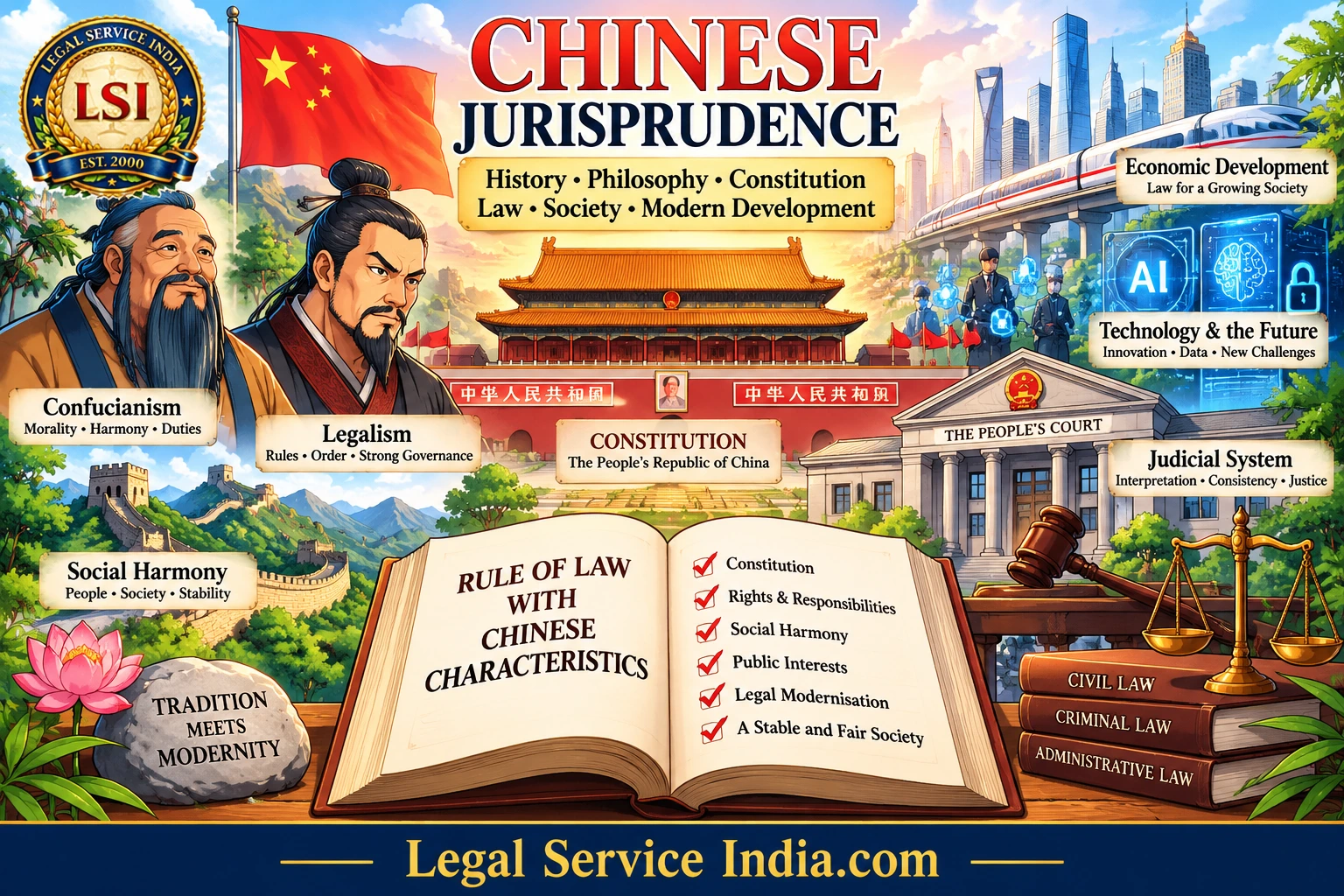
Chinese Jurisprudence: Principles, Characteristics and Development
Introduction
Chinese legal thinking has grown from a mix of old Chinese philosophy, socialist ideas, the Constitution, laws, court practice, and China’s big social and economic changes.
Unlike classic Western legal ideas (which focus a lot on individual rights, natural law, court precedents and separation of powers), Chinese legal thought has always cared more about social harmony, public order, morality, duties, group interests, and using law to keep society stable.
Today’s Chinese legal thinking is not only about the old philosophy. Since the People’s Republic of China was founded in 1949, and especially after the reform and opening-up started in the late 1970s, China’s legal system has grown a lot. Modern Chinese legal ideas combine Marxist legal theory with Chinese traditions and newer ideas such as the rule of law, constitutional government, protecting rights, managing the economy, and making courts more professional.
Historical Foundations of Chinese Jurisprudence
Chinese legal ideas come from several important ancient schools of thought.
Confucianism
Confucius taught that people should behave well, care about others, and keep good relationships. He believed society works best when people learn good morals, not just when they are punished. A person was seen as part of family and community, so duties to family, neighbours and society were very important.
Legalism
Thinkers like Han Feizi had a different view. They wanted clear rules, strong government power, rewards and punishments, and good administration. Legalism helped create the idea that law is a useful tool for the government to control society.
How Confucianism and Legalism Worked Together
Chinese history never used only one or the other. In real life, Chinese rulers mixed moral ideas with formal rules. Confucian morals guided how people should treat each other, while laws helped keep public order.
Marxist Foundations of Modern Chinese Jurisprudence
Modern Chinese legal thinking is strongly shaped by Marxist ideas. Law is seen as connected to the economy, society and politics of the country.
Law is not just a set of abstract rules that exist on their own. It is linked to social relations, economic growth and how state power is organised.
Chinese legal theory therefore looks carefully at the links between:
- law and the state
- law and economic development
- law and social stability
- law and public interests
- law and building a socialist society
At the same time, Chinese legal scholars now also study foreign and international legal ideas.
The Constitution and the Legal Order
The Constitution of the People’s Republic of China is the basic foundation of the whole legal system. It sets out the structure of the state, the main government bodies, and the basic rights and duties of citizens.
It says China is a socialist country. All state organs, the army, political parties, social groups, companies and other organisations must follow the Constitution and the law.
A big change in modern Chinese legal thinking is the stronger focus on “governing the country according to law” and building a socialist rule-of-law system.
Rule of Law with Chinese Characteristics
One key idea in today’s Chinese legal thinking is “rule of law with Chinese characteristics”.
China does not simply copy the Western liberal model. Instead, it connects the rule of law to its own Constitution, political system, social goals and development needs.
The rule of law means:
- governing according to law
- respecting legal procedures
- building a complete set of laws
- making legal institutions more professional
- protecting people’s lawful rights
- stopping officials from acting arbitrarily
- making sure laws are properly enforced
So Chinese legal thinking sees law both as a way to protect rights and as a tool for good government.
The Role of the State in Chinese Jurisprudence
The state plays a very important role in Chinese legal thinking.
The state:
- makes and carries out laws
- regulates the economy
- keeps public order
- promotes social development
- protects national interests
- carries out long-term public policies
Because of this, Chinese legal thought pays more attention to the balance between individual rights and group or public interests than theories that put the individual first.
This does not mean individual rights are missing. Rights are simply understood inside the larger framework of the Chinese Constitution and laws.
Individual Rights and Social Responsibilities
Modern Chinese law recognises many civil, political, economic, social and cultural rights. The Constitution talks about equality, personal freedom, property, education, work and other lawful rights.
At the same time, it also stresses duties. Citizens must follow the Constitution and laws and protect national interests and social order.
A special feature of Chinese legal thinking is that rights and responsibilities are seen as connected, not completely separate.
Law as an Instrument of Social Development
Chinese legal thinking strongly sees law as a tool for social development. Law is not only used to settle disputes after they happen. It is also used to guide the economy and society.
This can be seen clearly in areas such as:
- economic regulation
- environmental protection
- technology
- digital governance
- intellectual property
- market rules
- public administration
- social welfare
Law is one of the main ways the state responds to changing economic and social conditions.
Economic Reform and the Development of Chinese Legal Thought
China’s economic reforms that started in the late 1970s greatly changed its legal system.
Building a socialist market economy needed better rules for contracts, companies, property, investment, competition, finance and commercial disputes.
This led to many new civil and commercial laws and more professional lawyers.
The Civil Code of the People’s Republic of China (which came into force in 2021) is a major step. It brought together important areas of private law: personality rights, property, contracts, marriage and family, inheritance and tort liability.
This shows that Chinese legal thinking now gives more importance to legal certainty, private rights, contracts and civil responsibility inside a socialist market economy.
Judicial Institutions and Chinese Jurisprudence
The People’s Courts are China’s judicial organs. The Supreme People’s Court is the highest court.
Chinese courts:
- interpret and apply the law
- settle civil, criminal and administrative disputes
- protect lawful rights
- keep legal order
- help make the application of law more uniform
China does not follow the common-law rule of stare decisis (binding precedents) in the same way as England, Australia or India. However, courts now use guiding cases, judicial interpretations and other official guidance to make decisions more consistent.
Judicial Interpretation
A special feature of the Chinese system is the important role of judicial interpretations, especially those issued by the Supreme People’s Court.
These interpretations help courts understand and apply laws in the same way. They are especially useful when laws are written in general language and need practical explanation.
This makes court decisions more uniform and predictable, even though it is different from judge-made common law.
Criminal Jurisprudence
Chinese criminal law focuses on protecting social order, preventing crime, and safeguarding the lawful interests of people and society.
Modern criminal justice has also developed clearer rules about:
- legality of crimes and punishments
- evidence standards
- procedural safeguards
- judicial supervision
- rights of suspects and defendants
- fair and proportional punishment
The Criminal Law and Criminal Procedure Law are the main legal foundations.
Chinese criminal legal thinking tries to balance public security, social stability, punishing crime and fair procedures.
Administrative Law and Government Accountability
Administrative law has become more important as government work has grown.
Modern Chinese administrative law deals with:
- administrative decisions
- licences
- government regulation
- public administration
- administrative penalties
- state compensation
- court review of administrative actions
The Administrative Litigation Law lets people and organisations challenge certain government actions in court.
This is an important step toward the idea that government power must stay within the law.
The Principle of Social Harmony
A special feature of Chinese legal thinking is the continuing importance of social harmony.
This idea comes from traditional Chinese philosophy and is still important today. Law is expected not only to decide who is right or wrong but also, where possible, to help keep society stable, encourage reconciliation and maintain good relationships.
This explains why China still values:
- mediation
- negotiated settlements
- community dispute resolution
- other alternative ways of solving disputes
Chinese legal practice often mixes formal court decisions with peaceful ways of settling problems.
Tradition and Modernity
Chinese legal thinking mixes traditional culture with modern legal institutions.
Old ideas such as morality, social harmony, family responsibility and collective welfare still influence legal thought. At the same time, modern Chinese law includes many contemporary ideas:
- constitutionalism
- statutory rights
- contractual freedom
- proper court procedures
- legal professionalism
- human rights discussion
- commercial law
- international law
Chinese jurisprudence is therefore a living mix of history, socialist theory and modern legal development.
Technology and the Future of Chinese Jurisprudence
China’s fast technological growth is creating new legal questions. Issues about artificial intelligence, big data, cybersecurity, digital platforms, e-commerce and personal information are becoming more important.
Digital governance shows that Chinese legal thinking is moving beyond traditional criminal, civil and administrative law into complex questions about technology, data, privacy, innovation and state regulation.
The future of Chinese jurisprudence will partly depend on how well it can balance technological innovation with legal certainty, public interests and the protection of lawful rights.
Contemporary Characteristics of Chinese Jurisprudence
The main features of today’s Chinese legal thinking can be summarised like this:
| Characteristic | Meaning |
|---|---|
| Socialist foundation | Law is developed inside China’s socialist constitutional and political system. |
| State-centred governance | The state has a big role in making laws, running administration and regulating society. |
| Rule of law | Government is increasingly expected to work through legal institutions and procedures. |
| Social harmony | Law tries to keep orderly and harmonious social relationships. |
| Collective interests | Public and group interests are given important weight alongside individual rights. |
| Rights and duties | Legal rights come together with constitutional and social responsibilities. |
| Statutory orientation | Written laws are the main formal source of law. |
| Judicial guidance | Judicial interpretations and guiding cases help make the application of law more consistent. |
| Pragmatism | Law is often developed to meet practical social and economic needs. |
| Economic regulation | Law plays a major role in regulating and supporting economic development. |
| Legal modernisation | Chinese law is adding more modern legal concepts and institutions. |
| Technological adaptation | The legal system is creating rules for digital technologies and new forms of social and economic activity. |
Conclusion
Chinese jurisprudence is a living and changing legal tradition. It is shaped by ancient philosophy, socialist legal theory, constitutional principles and modern legal institutions.
Its historical roots lie mainly in Confucianism and Legalism. Its modern form has been deeply influenced by Marxist theory, socialist constitutionalism, and the process of legal reform and economic development.
Its special character is the ongoing effort to combine law, governance, social stability, collective interests, individual rights, economic development and social harmony.
China has built a large body of legislation, more specialised courts, professional legal institutions, and ways to make court decisions more consistent.
Chinese jurisprudence is neither just a continuation of ancient traditions nor a simple copy of Western models. It is a Chinese approach to law that grows from China’s own history, Constitution, political system, economic changes and present social needs.
To understand Chinese jurisprudence, we need to see how tradition and modernity, individual rights and social duties, legal rules and governance, and national development and the rule of law all work together.

