





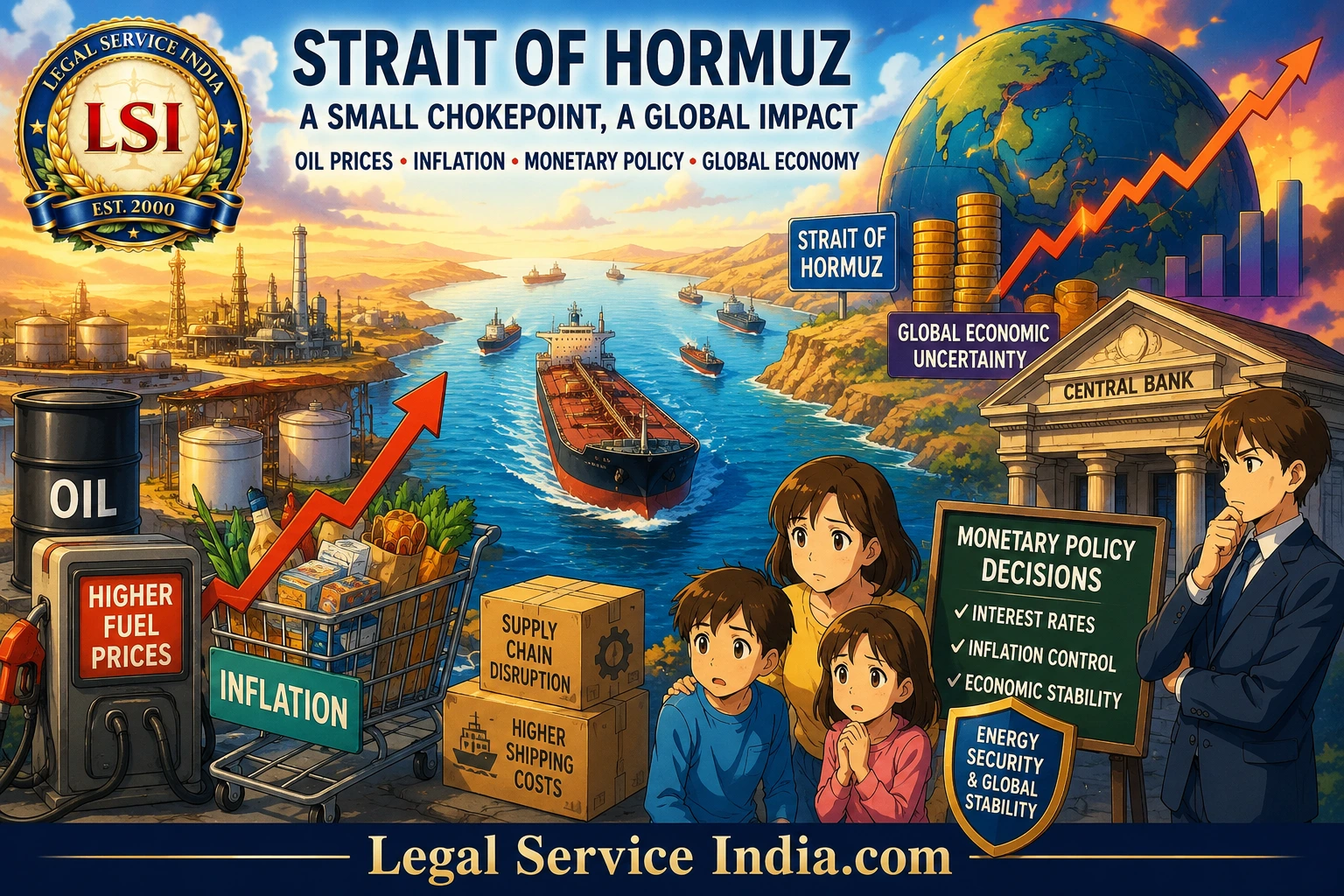
Strait of Hormuz, Inflation, and Global Monetary Policy: Why the World Cannot Ignore a Strategic Chokepoint
By Adv. Tarun Choudhury, Supreme Court Lawyer
The Strait of Hormuz has once again emerged as the focal point of global geopolitical and economic anxiety. While political commentators often view the issue through the lens of military strategy and international diplomacy, economists and financial markets are increasingly treating the Strait’s disruption as a direct threat to inflation stability, monetary policy, and global economic growth.
A recent discussion between geopolitical commentator Mario Nawfal and financial analyst David Lin highlighted an important reality: the closure or disruption of the Strait of Hormuz is no longer merely a regional security concern. It has become a systemic economic risk with implications extending from oil markets and inflation expectations to central-bank decision-making and household borrowing costs worldwide.
The Strategic Importance of the Strait of Hormuz
The Strait of Hormuz is one of the world’s most critical maritime chokepoints. A significant portion of global crude oil and liquefied natural gas (LNG) exports pass through this narrow waterway connecting the Persian Gulf to international markets.
Any prolonged disruption immediately raises concerns about:
- Energy security;
- Global supply chains;
- Shipping costs;
- Inflationary pressures;
- Financial market stability.
Key Risks Associated with Disruption
| Area of Concern | Potential Impact |
|---|---|
| Energy Security | Reduced availability of oil and LNG supplies |
| Global Supply Chains | Delays in transportation and logistics |
| Shipping Costs | Higher freight and insurance expenses |
| Inflationary Pressures | Increased prices of fuel, goods, and services |
| Financial Market Stability | Market volatility and investor uncertainty |
Global Trade and Freedom of Navigation
Historically, freedom of navigation has been regarded as a foundational principle of international trade. The repeated weaponization of strategic waterways raises broader concerns regarding the vulnerability of global commerce to geopolitical conflicts.
Markets Are Not Pricing in a Quick Resolution
One of the most notable observations made during the discussion was that financial markets appear skeptical about any lasting resolution to the crisis.
Despite temporary diplomatic developments and short-lived reopenings of the Strait, bond markets and Federal Reserve expectations have remained largely unchanged. According to the analysis discussed, market participants continue to expect tighter monetary policy and potential future interest-rate hikes rather than a return to lower inflation expectations.
This is a significant signal.
Financial markets often function as real-time aggregators of information. When bond yields remain elevated and traders continue pricing in inflation risks, it suggests that investors believe geopolitical tensions will persist rather than dissipate.
The Inflation Connection
The most immediate economic consequence of a disrupted Strait of Hormuz is energy inflation.
Higher oil prices affect nearly every sector of the economy:
- Transportation costs increase.
- Manufacturing expenses rise.
- Agricultural production becomes more expensive.
- Consumer goods become costlier.
- Supply chains experience additional strain.
Unlike localized economic shocks, energy inflation spreads rapidly throughout the entire economy.
The discussion emphasized that inflation expectations themselves can become self-reinforcing. Once businesses and consumers begin anticipating higher prices, wage demands, pricing strategies, and investment decisions adjust accordingly, making inflation more difficult to control.
How Energy Inflation Impacts the Economy
| Area | Impact of Higher Oil Prices |
|---|---|
| Transportation | Increased fuel and logistics costs |
| Manufacturing | Higher production expenses |
| Agriculture | Rising farming and distribution costs |
| Consumer Goods | More expensive products and services |
| Supply Chains | Additional operational strain |
Central Banks Face a Difficult Choice
The Federal Reserve and other major central banks are already navigating a challenging economic environment.
The conversation highlighted market expectations that interest rates may remain elevated for longer than previously anticipated. Analysts pointed to growing expectations of future rate hikes and continued monetary tightening in response to inflation risks.
This presents policymakers with a dilemma:
Option One: Support Economic Growth
Lower interest rates stimulate borrowing, investment, and consumer spending. Businesses benefit from cheaper financing, and economic growth generally accelerates.
Option Two: Fight Inflation
Higher interest rates suppress demand, reduce borrowing, and help contain inflation. However, they can also slow economic growth and increase recession risks.
The consensus among several economists referenced during the discussion was that inflation currently represents the greater long-term threat. Failure to control inflation can ultimately erode real wages, diminish purchasing power, and create even deeper economic instability.
Policy Options Comparison
| Policy Approach | Potential Benefits | Potential Risks |
|---|---|---|
| Lower Interest Rates | Encourages borrowing and growth | Can worsen inflation |
| Higher Interest Rates | Controls inflation pressures | May slow growth and increase recession risk |
Impact on Ordinary Citizens
Economic discussions often focus on macroeconomic indicators, but the consequences ultimately reach individual households.
A prolonged Strait of Hormuz disruption can translate into:
Higher Mortgage Costs
As bond yields rise, borrowing becomes more expensive. Home loans, refinancing costs, and mortgage renewals become less affordable.
Increased Credit Card Interest
Consumers carrying revolving debt may face higher financing charges.
Rising Fuel Prices
Petrol, diesel, and transportation costs can increase significantly.
Higher Cost of Living
Food prices, utilities, and everyday goods often reflect higher energy costs.
Reduced Business Investment
Companies facing expensive financing may postpone expansion, hiring, and capital expenditure.
The cumulative effect is reduced economic liquidity and slower growth across the broader economy.
Household Economic Consequences
| Economic Area | Potential Effect |
|---|---|
| Mortgages | Higher borrowing costs |
| Credit Cards | Increased interest expenses |
| Fuel | More expensive transportation |
| Living Expenses | Rising prices for essential goods |
| Employment & Investment | Slower hiring and expansion plans |
Beyond Oil: The Semiconductor and Technology Risk
An often-overlooked aspect of the Strait of Hormuz crisis involves industrial gases and semiconductor production.
The discussion noted that Gulf Cooperation Council (GCC) countries supply substantial quantities of helium used in semiconductor manufacturing, particularly for major Asian chip-producing economies such as Taiwan and South Korea. Helium plays a critical role in cooling and fabrication processes.
Consequently, disruptions in regional trade routes could indirectly affect:
- Semiconductor supply chains;
- Electronics manufacturing;
- Artificial intelligence infrastructure;
- Global technology production.
This demonstrates how modern economic interdependence extends far beyond oil markets alone.
The Global Tightening Cycle
The economic effects of a prolonged crisis are not confined to the United States.
The discussion observed that central banks worldwide—including the European Central Bank and the Bank of Japan—have been adjusting monetary policies in response to inflationary pressures.
As inflation expectations rise globally, monetary authorities may:
- Maintain restrictive policies;
- Delay interest-rate cuts;
- Reduce liquidity;
- Tighten credit conditions.
This creates a synchronized global tightening cycle that affects businesses and consumers across continents.
Possible Central Bank Responses
| Policy Response | Objective |
|---|---|
| Maintain Restrictive Policies | Control inflation pressures |
| Delay Interest-Rate Cuts | Prevent inflation resurgence |
| Reduce Liquidity | Limit excess money supply |
| Tighten Credit Conditions | Moderate demand growth |
Geopolitics and Economic Stability
From a legal and policy perspective, the Strait of Hormuz issue highlights the growing overlap between international security and economic governance.
International law recognizes freedom of navigation as a critical principle supporting global trade. However, modern conflicts increasingly demonstrate how strategic chokepoints can be leveraged as instruments of political pressure.
The result is a new era in which geopolitical disputes have immediate and measurable consequences for:
- Inflation;
- Monetary policy;
- Capital markets;
- Consumer welfare.
The economic repercussions are no longer secondary effects—they are central features of modern geopolitical conflict.
Conclusion
The ongoing uncertainty surrounding the Strait of Hormuz serves as a reminder that global economic stability remains deeply intertwined with geopolitical developments.
Financial markets appear unconvinced that lasting peace or stability is imminent. Inflation expectations remain elevated, central banks continue to face difficult policy choices, and consumers worldwide may ultimately bear the cost through higher prices and borrowing expenses.
Whether viewed through the lens of economics, international law, or global security, one conclusion is unmistakable: the Strait of Hormuz is far more than a regional maritime passage. It is a strategic artery of the global economy, and its disruption has consequences that extend into every household, every business, and every financial market across the world.
Key Takeaways: Strait of Hormuz, Inflation, and Global Monetary Policy
The following key insights explain why the Strait of Hormuz remains one of the most important factors influencing global inflation, energy markets, supply chains, and monetary policy decisions.
| Key Topic | Summary |
|---|---|
| Global Energy Security | Nearly one-fifth of the world’s oil and a significant share of LNG exports pass through the Strait of Hormuz. |
| Inflation Risk | Disruptions can increase fuel, transportation, manufacturing, and consumer goods costs worldwide. |
| Financial Markets | Investors continue to price in elevated geopolitical and inflation risks. |
| Monetary Policy | Central banks face challenges balancing inflation control with economic growth. |
| Global Supply Chains | Regional instability can rapidly affect international trade and production networks. |
The Strait of Hormuz Is a Critical Global Economic Lifeline
Nearly one-fifth of the world’s oil and a significant share of LNG exports pass through the Strait of Hormuz, making it one of the most important maritime chokepoints for global energy security.
Disruption Can Trigger Worldwide Inflation
Any blockage or instability in the Strait can drive up crude oil prices, increasing transportation, manufacturing, food production, and consumer goods costs across the globe.
Financial Markets Expect Prolonged Geopolitical Risk
Elevated bond yields and persistent inflation expectations indicate that investors are not anticipating a quick resolution to tensions affecting the Strait of Hormuz.
Energy Inflation Impacts Every Sector of the Economy
Rising fuel costs ripple through supply chains, logistics, agriculture, industry, and retail markets, creating broad-based inflationary pressure.
Central Banks Face a Difficult Policy Dilemma
Institutions such as the Federal Reserve, the European Central Bank, and the Bank of Japan must balance economic growth against the need to control inflation through higher interest rates.
Higher Interest Rates Affect Everyday Consumers
Inflation-driven monetary tightening can result in more expensive mortgages, higher credit card interest rates, reduced business investment, and slower economic growth.
The Crisis Extends Beyond Oil Markets
Gulf nations are major suppliers of helium used in semiconductor manufacturing. Disruptions can therefore impact global chip production, electronics, AI infrastructure, and technology supply chains.
Global Supply Chains Remain Vulnerable to Geopolitical Shocks
The Strait of Hormuz highlights how regional conflicts can quickly evolve into worldwide economic and trade disruptions.
Inflation Expectations Can Become Self-Reinforcing
When businesses and consumers expect prices to rise, wage demands and pricing decisions often accelerate inflation, making it harder for central banks to restore stability.
A Prolonged Crisis Could Delay Interest Rate Cuts Worldwide
Rising energy prices may force central banks to maintain restrictive monetary policies longer than expected, tightening credit conditions globally.
Freedom of Navigation Has Become an Economic Imperative
Beyond international law and maritime security, uninterrupted access through strategic waterways is now essential for global economic stability.
Geopolitics and Monetary Policy Are Increasingly Interconnected
Modern conflicts no longer affect only governments and militaries; they directly influence inflation, interest rates, financial markets, investment decisions, and household finances.
The Strait of Hormuz Is a Systemic Economic Risk, Not Just a Regional Issue
Its stability affects global trade, energy markets, inflation trends, monetary policy decisions, and economic growth across continents.
Quick Summary
- The Strait of Hormuz is vital for global energy security.
- Disruptions can increase inflation worldwide.
- Higher energy costs affect nearly every economic sector.
- Central banks may keep interest rates elevated for longer.
- Global supply chains remain exposed to geopolitical risks.
- Technology and semiconductor industries may also be affected.
- Economic stability increasingly depends on geopolitical stability.
