





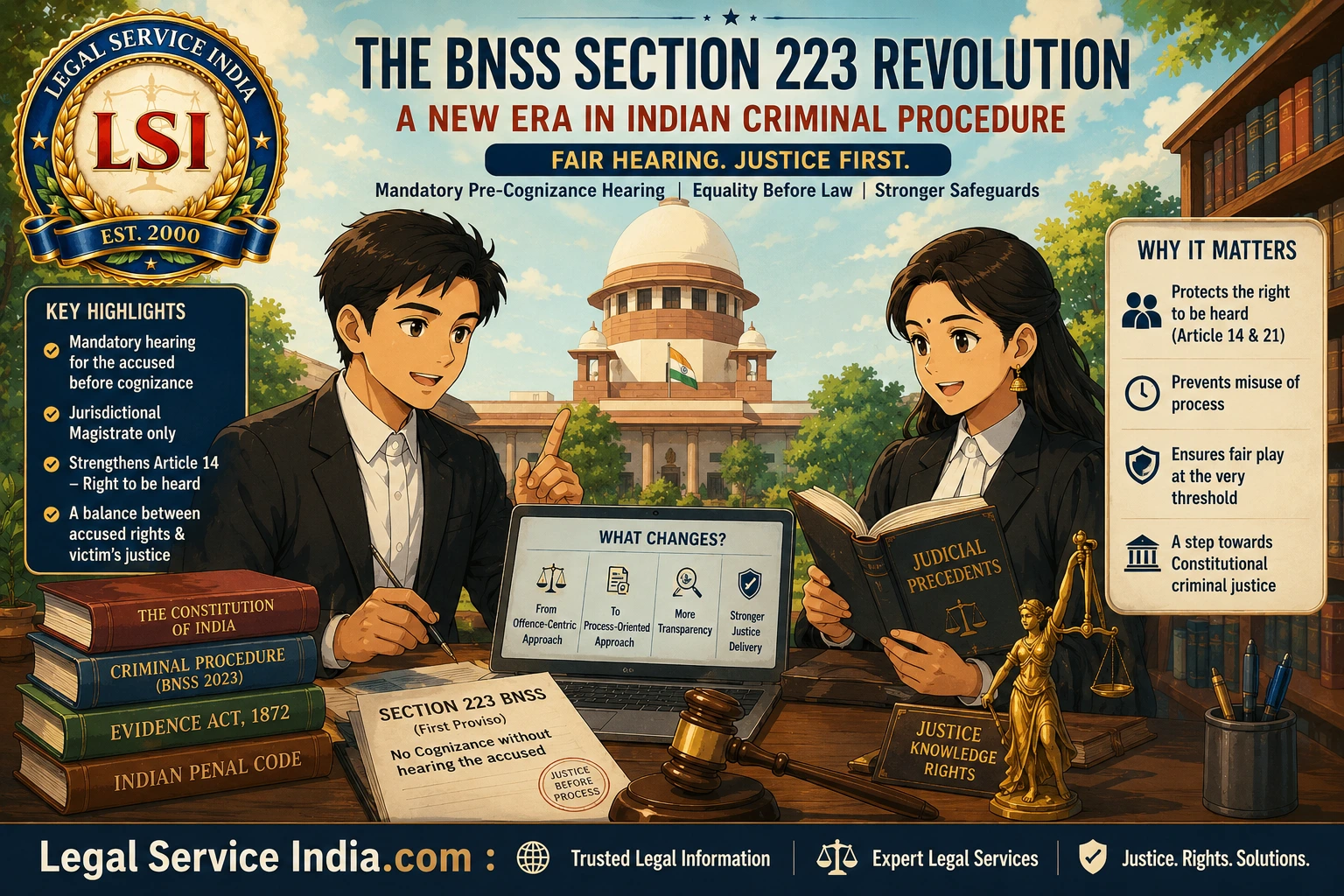
The BNSS Section 223 Revolution: A Fundamental Shift in Indian Criminal Procedure
The Bharatiya Nagarik Suraksha Sanhita (BNSS), 2023, hasn’t just replaced the old Code; it has fundamentally rewritten the opening act of the Indian criminal trial. Through the first proviso to Section 223(1), the legislature has introduced a mandatory hearing for the accused at the pre-cognisance stage. This single procedural shift effectively dismantles a century-old offence-centric philosophy.
What follows is an analysis of this massive shift, from the semantic confusion over the word “while” to the looming constitutional crisis of the “Asymmetric Shield”. By looking at recent fractures in High Court interpretations and the critical 2026 Delhi High Court referral, we have to ask: is Section 223 a genuine safeguard or a self-defeating bottleneck?
The End of the Magistrate’s Monopoly
For over a hundred years, “taking cognisance” was a quiet, almost private act of the judicial mind. Under the CrPC, 1973, the accused was a legal stranger to this stage. They were allowed to watch, but never to speak. This wasn’t a matter of unfairness; it was a matter of utility. The “offence-centric” model ensured that the judicial machinery could identify a crime and set the law in motion without being stalled by the offender before the trial even had a case number.
But the BNSS has thrown those gates open. Section 223(1) and its mandatory proviso have dragged the adversarial process to the very doorstep of the court. What used to be a summary inquiry is now a contested threshold, raising urgent questions about equality under Article 14, the absurdity of notifying “unknown” offenders, and the victim’s right to a speedy trial.
Cognizance: The Judicial State of Mind
In Indian law, “cognisance” is the sine qua non for any criminal trial. Yet, it remains a term of “indefinite import”. It isn’t a formal ceremony; it’s a judicial state of mind.
Key Features of Cognizance
- Judicial Notice: To take cognisance is simply to become judicially aware of an offence.
- The Initiation Point: It marks the exact moment a magistrate applies their mind to a suspected crime with the intent of starting a legal proceeding.
- Focusing on the Crime: Jurisprudentially, the court takes notice of the “offence”, not the “offender”. Once the judge is satisfied a crime occurred, it becomes the court’s duty to find out who did it.
Judicial Principles on Cognizance
| Judicial Principle | Explanation |
|---|---|
| Judicial Notice | The court becomes judicially aware of an alleged offence. |
| Application of Mind | The magistrate applies a judicial mind before initiating criminal proceedings. |
| Offence-Centric Approach | The court first takes cognisance of the offence and subsequently identifies the offender. |
This was settled by foundational precedents like Gopal Marwari v. Emperor (1943) and confirmed by the Constitution Bench in Sarah Mathew v. Institute of Cardiovascular Diseases (2014). The Supreme Court in S.K. Sinha v. Videocon International Ltd (2008) famously noted that cognisance has no “esoteric or mystic significance”—it is just judicial awareness.
The Legacy of the Ex-Parte Threshold
Under Section 200 of the old code, the pre-cognisance stage was strictly between the court and the complainant. The accused had no locus standi. Even if the proposed accused were standing in the courtroom, they couldn’t address the bench or cross-examine witnesses.
Position Under the Old Cr.P.C.
- The precognisance stage involved only the court and the complainant.
- The accused had no locus standi before cognisance was taken.
- The proposed accused could not address the court.
- The proposed accused could not cross-examine witnesses.
- The magistrate considered only the complainant’s material before deciding whether to proceed.
As the 3-judge bench held in Vadilal Panchal v. Dattatraya Dulaji Ghadigaonkar (1960), an accused can only be called to answer once the process has actually been issued. This was reinforced in Chandra Deo Singh v. Prakash Chandra Bose (1964) and Smt. Nagawwa v. Veeranna Shivalingappa Konjalgi (1976), where the court emphasised that a magistrate decides to proceed without ever looking at the potential defence.
Fixing the Jurisdiction Flaw: The Trisuns Chemical Industry Correction
One major, and often overlooked, departure in Section 223(1) BNSS is the insertion of the phrase “A magistrate having jurisdiction”. This was a deliberate fix for a long-standing flaw.
In Trisuns Chemical Industry v. Rajesh Agarwal (1999), the Supreme Court had held that a magistrate taking cognisance didn’t necessarily need the jurisdiction to try the case. Jurists rightly argued that this allowed for “forum shopping” and ignored the local limits defined in Sections 177-188. The BNSS has now aligned cognisance with authority. Only the jurisdictional magistrate where the crime actually happened can take notice of it.
Key Takeaways
- Section 223(1) BNSS introduces the requirement of “a magistrate having jurisdiction”.
- The amendment addresses the jurisdictional concern highlighted after Trisuns Chemical Industry v. Rajesh Agarwal (1999).
- The objective is to prevent forum shopping and reinforce the territorial jurisdiction principles contained in Sections 177-188.
- Only the jurisdictional magistrate, where the alleged offence actually occurred, can take cognisance.
| Aspect | Position Under Earlier Law | Position Under Section 223(1) BNSS |
|---|---|---|
| Magistrate Taking Cognizance | Need not necessarily have territorial jurisdiction | Must be a Magistrate having jurisdiction |
| Primary Concern | Possibility of forum shopping | Jurisdiction aligned with territorial authority |
| Legislative Objective | Not expressly clarified | Ensure cognizance is taken by the competent Magistrate |
The Mandatory Filter: A New Embargo
The first proviso to Section 223(1) is now an absolute embargo. It stipulates that no cognisance can be taken without first giving the proposed accused an opportunity to be heard.
The Supreme Court in Kushal Kumar Agarwal v. Enforcement Directorate (2025) has made it clear: compliance is mandatory. This is designed as a “filter” to kill frivolous or vexatious litigation in the cradle. This safeguard isn’t just for the BNS; the Jammu and Kashmir High Court in Mohd Afzal Beigh v. Noor Hussain (2025) extended it to Section 138 NIA cases, and the Supreme Court in Kushal Kumar Agarwal applied it to the PMLA.
Judicial Recognition of the Mandatory Filter
- The first proviso to Section 223(1) creates a mandatory pre-cognisance hearing.
- Compliance has been held to be compulsory by the Supreme Court.
- The safeguard aims to prevent frivolous and vexatious litigation.
- The principle has also been extended to proceedings beyond the BNS framework.
| Judgment | Principle Recognized |
|---|---|
| Kushal Kumar Agarwal v. Enforcement Directorate (2025) | A precognisance hearing is mandatory. |
| Mohd Afzal Beigh v. Noor Hussain (2025) | Applied the safeguard to Section 138 NIA cases. |
| Kushal Kumar Agarwal | Extended the principle to proceedings under the PMLA. |
A Fractured Judiciary and The Fear of a “Mini-Trial”
Without a clear directive, different high courts have gone in different directions.
The Karnataka HC Drill
In Basanagouda R. Patil (2024), the court mandated that the accused must get the complaint and all statements before the final order on cognisance.
The Kerala HC View
In Suby Antony (2025), the court suggested examining the complainant first and only then hearing the accused if the judge intends to take cognisance.
The Allahabad HC Stance
In Prateek Agarwal (2024), the court quashed a summoning order simply because notice was issued before the pre-summoning evidence was recorded.
Comparative High Court Approaches
| High Court | Case | Approach |
|---|---|---|
| Karnataka High Court | Basanagouda R. Patil (2024) | Complaints and statements must be supplied before the final cognisance order. |
| Kerala High Court | Suby Antony (2025) | The complainant should be examined first before hearing the proposed accused. |
| Allahabad High Court | Prateek Agarwal (2024) | Summoning order quashed because notice preceded pre-summoning evidence. |
Absence of Guidance on Defence Material
There is no guidance on whether the accused can produce documents at this stage. In State of Orissa v. Debendra Nath Padhi (2005), the Supreme Court said an accused can’t even produce documents during the framing of charges. Doing so earlier, at the pre-cognisance stage, is legally inconsistent. It also shifts the burden of proof. At this stage, the court only needs to see if a prima facie case exists. If we allow the accused to mount a full defence now, we turn a summary filter into a “trial before the trial”, stalling justice for years.
Legal Concerns
- No statutory guidance exists on whether defence documents may be produced at the pre-cognisance stage.
- State of Orissa v. Debendra Nath Padhi (2005) restricted reliance on defence documents even at the stage of framing charges.
- Allowing a full defence at the pre-cognisance stage may shift the burden of proof.
- The court is only required to determine whether a prima facie case exists.
- Expanding the inquiry risks converting the statutory safeguard into a “trial before the trial”.
The “While” Conundrum and the Delhi HC Referral
A tiny change in wording, from “taking cognisance” to “while taking cognisance”, might look like a minor edit, but it has sparked a serious debate among legal experts. Many view the addition of “while” as nothing more than “unnecessary surplusage”, a change that adds a layer of confusion to a concept that was once perfectly settled. The real question is timing. Is the examination of the complainant now part of the act of taking cognisance rather than a step that happens after the judge has decided to proceed?
This confusion reached a peak in the recent case of Dr Rita Bakshi v. Seema Bajaj & Anr. (2026), where the Delhi High Court officially flagged the inherent conflict between the new statutory language and long-standing Supreme Court precedents. The Court noted that certain High Courts, including those in Karnataka, Allahabad, and Kerala, along with various coordinate benches, have interpreted the BNSS to mean that the examination of the complainant forms part of the pre-cognisance stage. This suggests that cognisance is only taken after recording pre-summons evidence.
However, this interpretation, the Court said, appears to be at variance with several judicial precedents of the Supreme Court which indicate that cognisance is said to have been taken when the magistrate applies his mind to proceed under Section 200 of the Cr.P.C. and that the examination of the complainant is a step subsequent to such taking of cognisance.
For instance, in Sarah Mathew v. Institute of Cardiovascular Diseases (2014), a Constitution Bench of the Supreme Court held that cognisance is taken when the magistrate applies his judicial mind to the offence with a view to initiating proceedings and that such a stage precedes the commencement of proceedings under the subsequent chapters of the Code (CrPC). The Court observed that the view now adopted by the high courts proceeds on the assumption that cognisance is not taken until after the recording of statements.
Questions Referred to the Larger Bench
To resolve this schism, the Court has referred two critical questions to a larger bench:
- What is the exact stage at which a Magistrate takes “cognizance” under a private complaint, and does the expression “while taking cognizance” in Section 223(1) imply that examination is a step prior to taking judicial notice?
- When must the magistrate issue notice to the accused—immediately upon perusal of the complaint, or after recording statements but before a formal decision on cognisance?
Possible Impact of the Referral
The outcome of this referral will define the “legal identity” of the hearing.
| Possible Interpretation | Legal Consequence |
|---|---|
| Pre-Initiation Filter | The hearing remains an administrative safeguard. |
| Pre-Summoning Inquiry | The hearing becomes a formal part of the judicial record. |
This distinction determines whether these submissions can be used as evidence in future quashing petitions under Section 528 (erstwhile 482 Cr.P.C.).
The “Ghost Accused” and Procedural Paralysis
How do you hear a person you can’t identify? This is the central absurdity of the new mandate. In a hit-and-run or anonymous cyber fraud, the victim often doesn’t know who the offender is.
If the law says you must hear the accused before taking cognisance, but the accused is a “ghost”, the judicial process effectively dies. We risk creating a statutory dead-end for victims of anonymous crimes.
The only solution is a “harmonious construction” with Section 225, allowing for an inquiry to establish identity before the Section 223 hearing is triggered.
Key Legal Concern
- Anonymous offenders make compliance with Section 223 practically impossible.
- The judicial process may reach a statutory dead-end in unidentified offender cases.
- A harmonious construction with Section 225 may be necessary to preserve access to justice.
The “Asymmetric Shield” and Article 14
The BNSS treats the accused differently based on how the case reaches the court. If you are named in a police chargesheet under Section 193, you get no precognisance hearing. But if the same facts are brought via a private complaint, you are suddenly entitled to one.
This feels like “rank discrimination” under Article 14. It fails the two-pronged test of Intelligible Differentia and Rational Nexus. If the goal is to protect people from the “stigma of process”, why is that protection denied to those in police cases, where the threat of arrest is much higher? It is institutionalised procedural inequality.
Article 14 Analysis
| Situation | Pre-Cognizance Hearing |
|---|---|
| Police Chargesheet under Section 193 | No |
| Private Complaint | Yes |
This differential treatment raises questions regarding equality before law and procedural fairness under Article 14 of the Constitution.
The High-Stakes Gamble
Section 223 of the BNSS is a high-stakes jurisprudential gamble. It offers a necessary filter for the innocent, but it threatens to become a bottleneck for the system.
The path forward requires a delicate “reading down” by the judiciary. We must ensure that while the accused is heard, the hearing doesn’t turn into a mini-trial that sacrifices the victim’s right to a speedy trial.
Until the Apex Court provides a unified interpretation, Section 223 remains the most controversial crossroads in Indian criminal reform.
Key Takeaways
- The addition of the word “while” has created a significant interpretational controversy.
- The Delhi High Court has referred fundamental questions regarding the stage of cognisance to a larger bench.
- The decision will determine whether the hearing is merely administrative or forms part of the judicial record.
- Anonymous offender cases expose practical challenges in implementing Section 223.
- The differing treatment of accused persons in police cases and private complaints raises constitutional concerns under Article 14.
- A balanced judicial interpretation is essential to protect both the rights of the accused and the victim’s right to a speedy trial.
Written By: Rayees, an independent legal researcher and writer.
He can be reached at [email protected].

