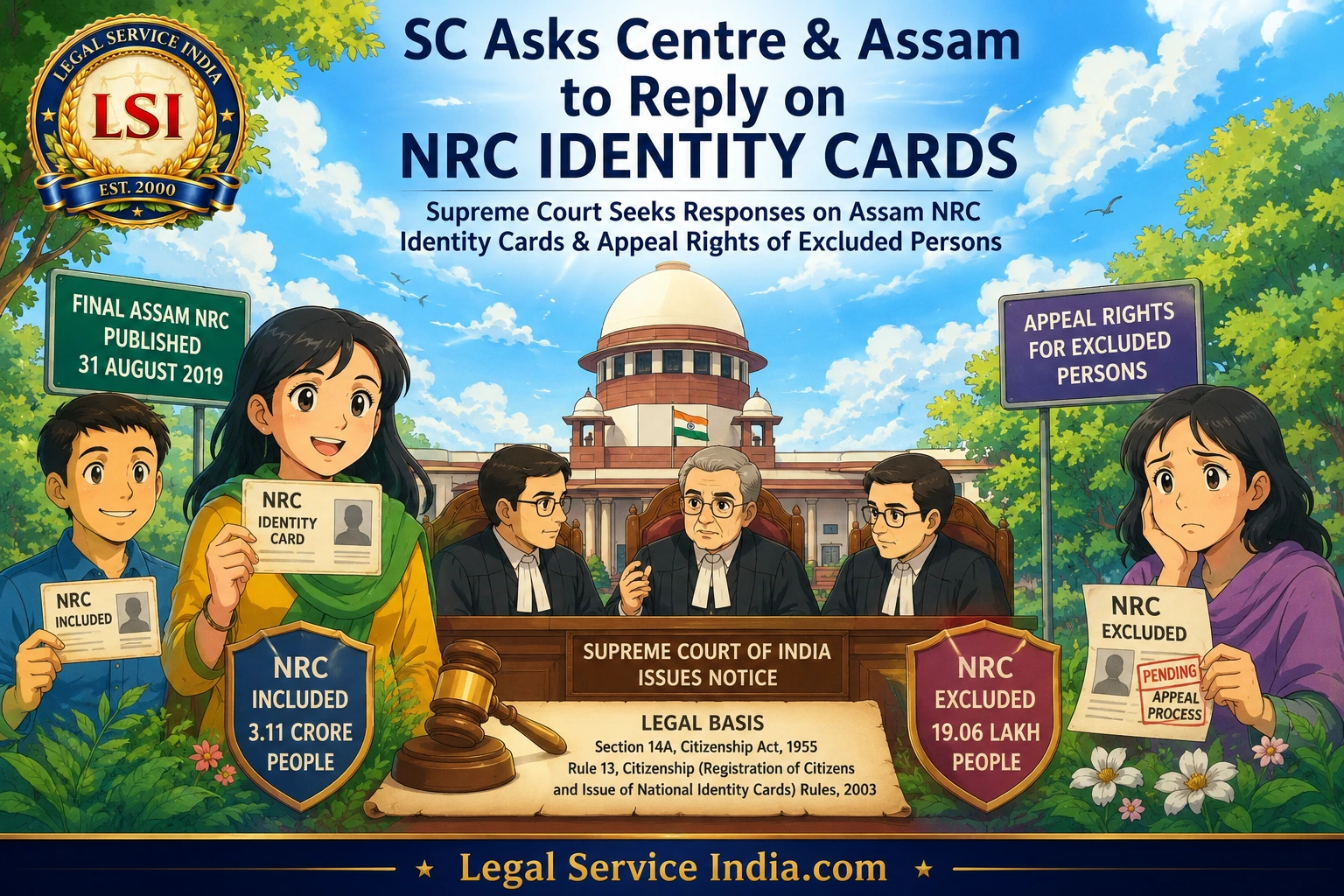
SC Asks Centre & Assam to Reply on NRC Identity Cards: Supreme Court Revives Long-Pending Assam NRC Issues
The Supreme Court has once again stepped into the long-running legal and administrative controversy surrounding the National Register of Citizens (NRC) in Assam.
On July 21, 2026, a three-judge Bench comprising Chief Justice of India Surya Kant and Justices Joymalya Bagchi and Vipul M. Pancholi issued notice to the Centre and other authorities on a petition seeking, among other reliefs, the issuance of national identity cards to persons whose names were included in the final Assam NRC and the commencement of the statutory appeal process for persons whose names were excluded.
The development is legally significant because the final NRC was published nearly seven years ago, on August 31, 2019, after an extraordinary verification exercise conducted under the supervision of the Supreme Court. Yet, important statutory consequences of that exercise remain unresolved.
The latest proceedings therefore raise a fundamental question: Can an exercise intended to determine citizenship be treated as complete when the legal consequences contemplated by the statutory framework have not been implemented?
The Supreme Court has not finally answered that question. It has, however, sought responses from the authorities and tagged the fresh petition with a connected matter already pending before it.
Supreme Court Seeks Response on NRC Identity Cards and Appeals
The petition before the Supreme Court has been filed by the Assam State Jamiat Ulama.
During the hearing, counsel for the petitioner submitted that persons excluded from the NRC continue to suffer because, although the legal framework provides an avenue of appeal, the mechanism has not been operationalised.
The petitioner also sought directions for issuance of national identity cards to those whose names appear in the final NRC.
After hearing the submissions, the Bench ordered:
“Issue notice.”
The matter has been tagged with another pending petition concerning the implementation of the Assam NRC.
The Court has thus opened the door for examination of the unresolved statutory steps surrounding the NRC rather than treating the publication of the final list in 2019 as the end of the matter.
What Is the Assam NRC?
The Assam NRC is not an ordinary electoral or administrative list.
Its history is deeply connected with the Assam Accord and the longstanding question of illegal migration into Assam.
The statutory framework governing citizenship registration in Assam incorporates March 24, 1971, as the relevant cut-off date for determining eligibility under the Assam-specific NRC exercise.
The updated NRC was prepared through an extensive verification process involving legacy data, documentary evidence, and family linkages.
According to figures cited in reports based on the NRC State Coordinator’s records, approximately 3.30 crore applications were submitted.
- Approximately 3.11 crore persons were included in the final NRC;
- Approximately 19.06 lakh applicants were excluded.
| NRC Particular | Figure / Date |
|---|---|
| Applications submitted | Approximately 3.30 crore |
| Persons included | Approximately 3.11 crore |
| Applicants excluded | Approximately 19.06 lakh |
| Final NRC published | August 31, 2019 |
| Relevant cut-off date | March 24, 1971 |
The final NRC was published on August 31, 2019.
The scale of the exercise was unprecedented.
What makes the present Supreme Court proceedings particularly important is that the legal consequences of inclusion and exclusion have not proceeded to their logical conclusion.
Why Are National Identity Cards Important?
The petition relies upon Section 14A of the Citizenship Act, 1955, read with Rule 13 of the Citizenship (Registration of Citizens and Issue of National Identity Cards) Rules, 2003.
Section 14A provides the statutory foundation for compulsory registration of citizens and the maintenance of a National Register of Indian Citizens.
The 2003 Rules contemplate the issuance of national identity cards to registered citizens.
The petitioners therefore contend that once the final NRC identified persons eligible for inclusion, the statutory process should not stop merely with publication of a list.
The argument is essentially one of statutory completion.
If Parliament and the Rules prescribe certain consequences following registration, administrative authorities cannot indefinitely leave those consequences in abeyance without providing a legally sustainable explanation.
This is precisely why the demand for NRC identity cards has assumed importance before the Supreme Court.
Final NRC Published in 2019 — Why Is the Process Still Pending?
From a constitutional perspective, publication of a list and implementation of the consequences flowing from that list are two different things.
The NRC exercise involved enormous administrative resources and judicial supervision.
Yet, according to the petitioners, persons included in the final NRC have not received the national identity cards contemplated under the statutory framework.
At the same time, persons excluded from the NRC have faced a different difficulty.
They have been awaiting the commencement of the mechanism through which they can challenge their exclusion.
This creates a peculiar legal situation.
- A person included in the NRC may not have received the formal identity document contemplated by the Rules.
- A person excluded from the NRC may not have been able to effectively exercise the statutory remedy against exclusion.
Thus, according to the petitioners, both inclusion and exclusion remain without their full legal consequences.
The Indian Express has similarly reported that nearly seven years after publication, the NRC process remains incomplete, with identity cards for included persons and the appeal mechanism for excluded persons still unresolved.
What About the Nearly 19-Lakh People Excluded? From the NRC?
This is perhaps the most sensitive part of the controversy.
Exclusion from the NRC should not automatically be equated with a final judicial determination that an individual is a foreign national.
That distinction is fundamental.
An administrative register and a judicial determination of citizenship status are not necessarily identical legal processes.
The petition before the Supreme Court specifically raises the issue of the appeal mechanism available to persons excluded from the NRC.
The petitioner’s counsel told the court that there is a provision for appeal but that the mechanism has not become operational.
The argument, therefore, is that an individual cannot reasonably be expected to accept exclusion as the final word when the statutory mechanism designed to challenge that exclusion has itself not become functional.
This raises serious questions concerning access to justice.
The Principle of Natural Justice
From the standpoint of constitutional law, the issue has an obvious connection with the principles of natural justice.
Where an administrative process has potentially profound consequences for a person’s legal status and civil rights, the affected person must ordinarily have access to an effective mechanism for challenging an adverse determination.
The principle is not merely procedural formalism.
Citizenship affects an individual’s relationship with the state.
It can have consequences for voting rights, public employment, access to governmental schemes, travel documentation, property-related rights and, most fundamentally, one’s legal status within the country.
Therefore, where exclusion from an official citizenship-related register carries serious consequences, the availability of an effective legal remedy becomes constitutionally significant.
Article 14 and Article 21 Considerations
The controversy also potentially engages Articles 14 and 21 of the Constitution.
Article 14 guarantees equality before the law and equal protection of laws.
Article 21 protects life and personal liberty except according to procedure established by law.
Over several decades, the Supreme Court has repeatedly expanded the meaning of procedural fairness under Article 21.
The larger constitutional question is consequently not merely whether the authorities possess power to maintain a citizenship register.
The more important question is whether the entire process is administered in a manner that is fair, transparent, and non-arbitrary and accompanied by an effective opportunity of legal redress.
That is particularly important when an administrative determination can affect a person’s citizenship status.
The petitioners have argued that failure to complete the statutory steps renders the NRC exercise incomplete and raises concerns under Articles 14 and 21. (Live Law)
The Supreme Court’s Earlier Role In The Assam NRC
The Assam NRC is unusual because the Supreme Court itself exercised extensive supervisory jurisdiction over the preparation of the updated register.
The process involved repeated hearings before the apex court and detailed directions concerning verification, documentation, and timelines.
The final list was ultimately published on August 31, 2019.
The Supreme Court’s involvement makes the present development particularly noteworthy.
The Court is now being asked to examine what happens after the final list has been published.
In other words, the present controversy is not primarily about how the NRC was prepared.
It is about whether the statutory and legal consequences of the completed exercise have been carried through.
What Does Section 14A Of The Citizenship Act Provide?
Section 14A of the Citizenship Act, 1955, is central to the petition.
It provides the statutory basis for compulsory registration of citizens and maintenance of the National Register of Indian Citizens.
The Citizenship Rules, 2003, supplement this framework.
Rule 13 deals with national identity cards.
The petitioners therefore rely upon these provisions to argue that persons included in the final NRC should receive the corresponding national identity documentation.
The issue before the Supreme Court is consequently not simply a demand for a new identity document.
It involves interpretation and implementation of the statutory scheme governing registration of citizens.
NRC Identity Card Is Not the Same as Aadhaar
It is important to distinguish an NRC-related national identity card from Aadhaar.
Aadhaar is primarily an identity document based on demographic and biometric authentication.
It is not, by itself, a conclusive declaration of citizenship.
The NRC, by contrast, arises from the statutory framework dealing specifically with citizenship registration.
Therefore, the demand for NRC identity cards cannot simply be dismissed on the ground that citizens already possess Aadhaar, voter identity cards, PAN cards or other documents.
The legal question is whether the identity document contemplated by the citizenship-registration framework must be issued once the statutory conditions are fulfilled.
That question is now before the Supreme Court.
Why the Supreme Court’s Notice Matters
At this stage, it is important to maintain legal precision.
The Supreme Court has not ordered the Centre to immediately issue NRC identity cards.
Nor has the Court finally declared that the authorities are legally bound to issue such cards without further examination.
What the court has done is to issue notice and seek responses from the relevant authorities.
That is significant because the Court has found the issues raised worthy of judicial examination.
The respondents will now have an opportunity to explain:
- Why national identity cards have not been issued to persons included in the final NRC;
- What is the present legal status of the final NRC
- Why the statutory appeal mechanism for excluded persons has not commenced;
- What steps have been taken by the Union Government and Assam Government
- What is the role of the Registrar General and State NRC Coordinator
- What legal and administrative obstacles remain.
The answers to these questions could determine the future direction of the proceedings.
A Seven-Year Administrative Delay Raises A Serious Legal Question
Ordinarily, courts are reluctant to interfere with complex administrative processes.
But there is a point at which administrative delay itself can become legally significant.
The NRC was not an ordinary departmental exercise.
It involved millions of people and was conducted under judicial supervision.
When such a process culminates in a final list, prolonged failure to implement the consequences of that list inevitably raises questions about the efficacy of the entire statutory scheme.
The Supreme Court will therefore have to balance two competing considerations:
administrative practicality on one hand, and statutory compliance and individual rights on the other.
That balance will be central to the future proceedings.
The Principle: A Remedy Must Be Real, Not Merely Theoretical
One of the strongest legal issues arising from the present controversy concerns the excluded persons.
A statutory right of appeal is meaningful only if the affected person can actually exercise it.
A remedy that exists on paper but cannot practically be invoked for years may raise serious constitutional concerns.
The Supreme Court has repeatedly emphasized in different contexts that access to justice cannot be reduced to a purely theoretical entitlement.
In the NRC context, the issue becomes particularly sensitive because exclusion may have consequences far beyond an ordinary administrative dispute.
The Court may therefore have to examine whether the appellate mechanism has been effectively preserved and whether persons excluded from the final NRC have been provided the documents and procedural avenues necessary to challenge their exclusion.
What Could the Supreme Court Decide?
The present order is only an initial step.
Several possible outcomes remain open.
1. Direction to Issue NRC Identity Cards
The Court could ultimately direct the competent authorities to complete the process of issuing national identity cards to persons included in the final NRC, subject to the applicable statutory framework.
2. Direction to Operationalize the Appeal Mechanism
The Court may require the authorities to commence the statutory process for persons excluded from the NRC.
3. Requirement of Rejection Orders or Reasons
The Court could examine whether excluded persons must receive formal rejection orders or adequate reasons so that they can effectively pursue their remedies.
4. Time-Bound Compliance
Given the extraordinary length of the delay, the Court may consider prescribing timelines for completion of pending statutory steps.
5. Further Clarification of the NRC’s Legal Status
The Court may also have to determine what legal effect the final NRC presently carries and how it interacts with proceedings before Foreigners Tribunals and other statutory authorities.
These are possibilities, not conclusions. The final outcome will depend upon the pleadings and responses of the Union and State authorities.
Why This Case Has Wider Constitutional Significance
The Assam NRC dispute is much larger than the question of an identity card.
It concerns the relationship between citizenship, documentation, administrative power, and constitutional rights.
The case also illustrates a broader principle of constitutional governance:
A state cannot create a legal process and then indefinitely postpone the consequences that the process was designed to produce.
At the same time, the State has an equally legitimate responsibility to ensure that citizenship determination is accurate, lawful, and resistant to fraud.
The constitutional challenge is therefore to reconcile:
- national security;
- protection of genuine citizens;
- prevention of illegal immigration;
- administrative efficiency;
- procedural fairness;
- judicial review; and
- protection of individual rights.
The Supreme Court’s intervention brings all these questions back into focus.
What the Centre and Assam Government Must Now Explain
The notices issued by the Supreme Court effectively place the ball in the respondents’ court.
The Centre and the State authorities will have to explain the present status of the NRC and the reasons for the prolonged delay.
In particular, the Court may expect a clear account of:
- First, whether the final NRC has been formally notified and what legal effect is presently attributed to it.
- Second, whether the national identity cards contemplated under Rule 13 are intended to be issued and, if not, the legal basis for withholding them.
- Third, what mechanism exists for persons excluded from the NRC to challenge their exclusion.
- Fourth, whether rejection orders have been issued to excluded persons.
- Fifth, what steps remain before the appeal process can commence.
- Sixth, whether the authorities propose any time-bound mechanism for completing these statutory obligations.
A detailed affidavit from the government could therefore substantially clarify the future course of the litigation.
An Important Caution: NRC Inclusion Does Not End Every Citizenship Dispute
It would also be legally incorrect to suggest that the present Supreme Court proceedings automatically resolve every question relating to citizenship in Assam.
The NRC is one component of a much larger statutory and constitutional framework.
Questions relating to citizenship can arise under different provisions of the Citizenship Act and before different authorities depending on the facts.
Similarly, exclusion from the NRC should not automatically be portrayed as an irreversible declaration of foreign nationality when the statutory appeal process itself remains a live issue.
The legal position must therefore be assessed case by case.
Conclusion: A Long-Pending Citizenship Process Returns to the Supreme Court
The Supreme Court’s July 21, 2026, proceedings have brought the unfinished business of the Assam NRC back into constitutional focus.
The final NRC was published on August 31, 2019, after an enormous verification exercise. Yet, according to the petitioners, two critical statutory consequences remain unresolved: national identity cards for those included and an effective appeal mechanism for those excluded.
The Supreme Court has now sought responses from the Centre, the Assam Government, and other concerned authorities and has tagged the petition with a connected matter.
For the moment, the Court has not pronounced upon the ultimate merits.
But the significance of the proceedings should not be underestimated.
After years of uncertainty, the apex court is once again being asked to determine whether a citizenship-registration exercise can remain administratively incomplete indefinitely.
From a constitutional perspective, the issue goes to the heart of the rule of law: when the law creates a process affecting fundamental legal status, that process must ultimately lead to a meaningful, transparent and legally reviewable conclusion.
The next stage of the proceedings will therefore be closely watched—not merely in Assam, but across India—because the Supreme Court’s eventual directions may clarify the legal consequences of one of the country’s most consequential citizenship-registration exercises.
Citation
Assam State Jamiat Ulama v. Union of India & Ors., petition concerning implementation of the final Assam NRC, including issuance of national identity cards and commencement of the appeal process for persons excluded from the NRC; Supreme Court proceedings dated 21 July 2026, before Chief Justice Surya Kant, Justice Joymalya Bagchi and Justice Vipul M. Pancholi. The Supreme Court issued notice and tagged the matter with a connected pending petition.
Statutory provisions discussed: Section 14A, Citizenship Act, 1955; Rule 13 and related provisions of the Citizenship (Registration of Citizens and Issue of National Identity Cards) Rules, 2003.
FAQs: Assam NRC Identity Cards Supreme Court Case
1. Why did the Supreme Court ask the Centre and Assam to reply on NRC identity cards?
The SC asks Centre & Assam to reply on NRC identity cards after a petition sought issuance of national identity cards to people included in the final Assam NRC and activation of the appeal process for those excluded. The Supreme Court issued notice to the concerned authorities and sought their response.
2. What is the Assam NRC, and when was the final NRC published?
The Assam NRC (National Register of Citizens) was prepared to identify Indian citizens in Assam under the applicable citizenship framework. The final NRC was published on August 31, 2019. Approximately 3.11 crore people were included, while around 19 lakh applicants were excluded.
3. Will people included in the Assam NRC receive national identity cards?
The petition before the Supreme Court seeks issuance of national identity cards to persons included in the final Assam NRC under the statutory framework. However, the Supreme Court has presently issued notice and has not yet finally directed the government to issue NRC identity cards.
4. What happens to people excluded from the Assam NRC?
Persons excluded from the final NRC are expected to have access to the applicable appeal and legal remedies. The current Supreme Court proceedings specifically raise concerns about the non-operationalization of the appeal mechanism for NRC exclusions. Importantly, NRC exclusion by itself should not automatically be described as a final judicial declaration that a person is a foreign national.
5. What is the significance of the Supreme Court’s latest Assam NRC order?
The Supreme Court’s latest intervention is significant because the final Assam NRC was published in 2019, but important legal consequences reportedly remain unresolved. The Court’s decision to seek responses from the Centre and Assam Government could clarify the status of NRC identity cards, the appeal process for excluded persons, and the implementation of the citizenship-registration framework.
Also Read: File Legal Notice in India: Complete Guide to Drafting, Procedure, Cost & Legal Rights
Key Takeaways: Assam NRC Identity Cards Supreme Court Case
- SC asks Centre & Assam to reply on NRC identity cards after a petition sought national identity cards for people included in the final Assam NRC.
- The Supreme Court issued notice to the Centre, the Assam Government, and other concerned authorities regarding the implementation of the Assam NRC.
- The petition also seeks activation of the appeal process for people excluded from the final Assam NRC.
- The final Assam NRC was published on August 31, 2019, after a large-scale citizenship verification exercise conducted under Supreme Court supervision.
- Around 3.11 crore people were included in the final NRC, while approximately 19 lakh applicants were excluded.
- The legal dispute involves Section 14A of the Citizenship Act, 1955 and the Citizenship (Registration of Citizens and Issue of National Identity Cards) Rules, 2003.
- The petitioners argue that people included in the NRC should receive the national identity cards contemplated under the statutory framework.
- A major issue before the Supreme Court is whether persons excluded from the NRC have been provided with an effective and operational appeal mechanism.
- Exclusion from the NRC should not automatically be treated as a final declaration of foreign nationality, particularly where statutory remedies remain available.
- The case raises important constitutional questions concerning Article 14, Article 21, natural justice, procedural fairness, and access to effective legal remedies.
- The Supreme Court has not yet finally ordered the Centre or Assam Government to issue NRC identity cards. The present proceeding concerns notice and examination of the government’s response.
- The case could potentially result in time-bound directions for NRC identity cards, appeal proceedings, and completion of pending statutory processes.
Summary
The Supreme Court has sought responses from the Centre and Assam Government on a plea concerning NRC identity cards for people included in the final Assam NRC and the appeal mechanism for those excluded. The case raises significant questions about citizenship, statutory compliance, natural justice and constitutional rights.
Need Legal Guidance on NRC, Citizenship, or Supreme Court Matters?
If you or your family member is facing an issue relating to Assam NRC, NRC exclusion, citizenship status, NRC identity cards, appeal proceedings, Foreigners Tribunal proceedings, or other constitutional and Supreme Court matters, seek professional legal guidance.
Adv. Tarun Choudhury
Supreme Court Advocate | 25+ Years of Legal Experience
📞 Call: 9650499965
💬 WhatsApp: 8851978611
Get professional legal guidance on your rights, available remedies, and the appropriate legal course of action.
Important Links
- Lawyers in India
- Copyright Registration in India
- Caveat Filing in Supreme Court of India
- Mutual Consent Divorce in Delhi/NCR : WhatsApp 9650499965