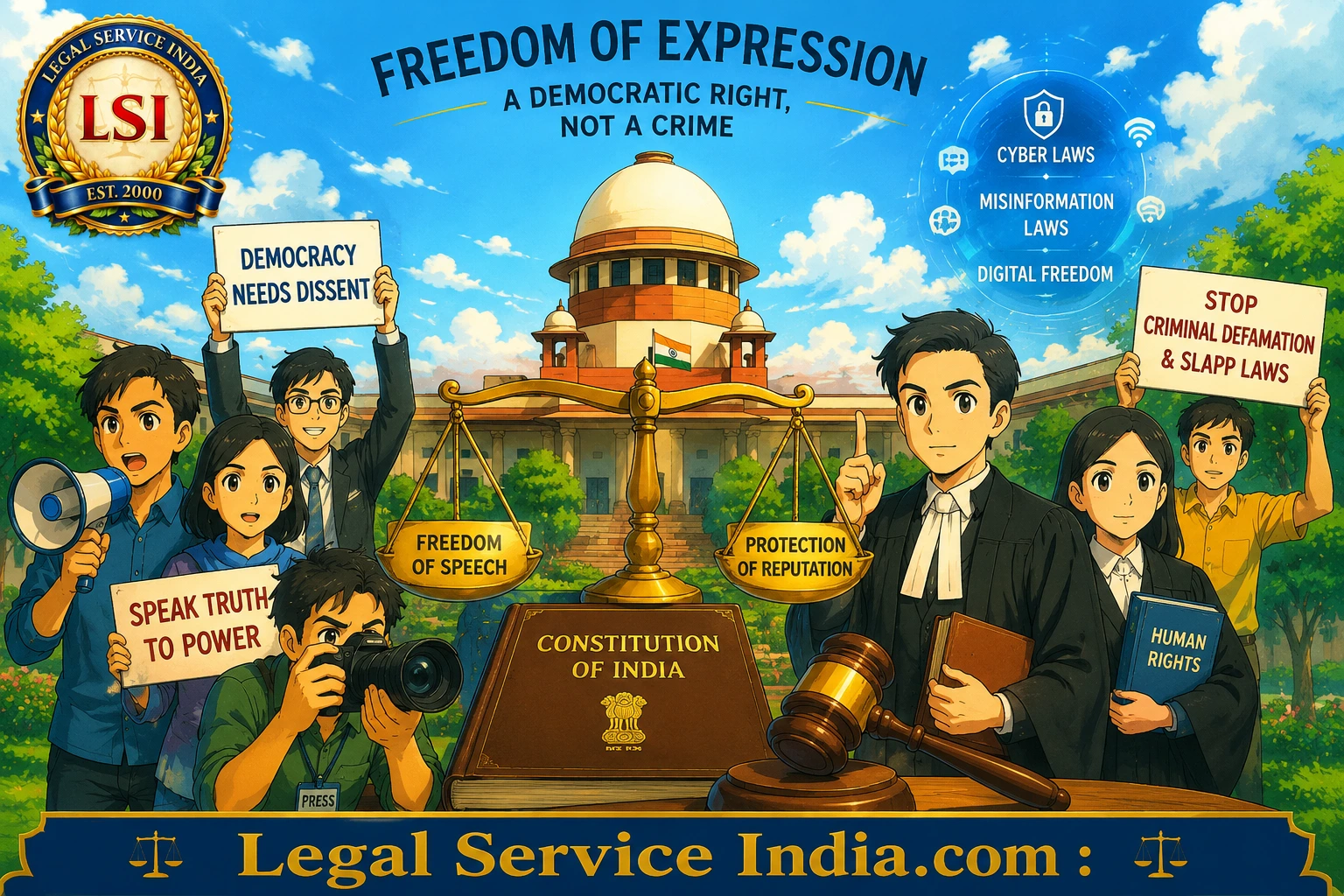
Introduction
Freedom of expression has long been regarded as the cornerstone of every democratic society. It enables citizens to criticise governments, expose corruption, hold public officials accountable, and participate meaningfully in public discourse. Journalists, human rights defenders, lawyers, academics, activists, and ordinary citizens rely upon this freedom to ensure that power remains subject to public scrutiny. Yet, despite widespread constitutional recognition of free speech across the world, governments continue to employ criminal defamation laws as powerful tools to silence criticism rather than protect reputation.
The debate surrounding criminal defamation is no longer confined to legal academia. It has become one of the defining human rights issues of the twenty-first century. Across continents, criminal complaints for defamation are increasingly being filed against investigative journalists, opposition politicians, social activists, bloggers, and whistle-blowers. In many cases, the objective is not to vindicate an individual’s reputation but to intimidate critics into silence through lengthy criminal proceedings, arrests, and the looming threat of imprisonment.
International organisations, constitutional courts, and human rights bodies have therefore questioned whether criminal defamation has any legitimate place in a democratic society where civil remedies are already available to protect reputation. The growing global consensus is that while reputation deserves legal protection, criminal sanctions—particularly imprisonment—are disproportionate and incompatible with modern democratic values.
This article examines the worldwide misuse of criminal defamation laws, the evolving international jurisprudence favouring decriminalisation, and the alarming trend of governments replacing traditional criminal defamation with equally restrictive cybercrime and misinformation laws. It also explores why balancing freedom of expression with protection of reputation has become increasingly complex in the age of digital communication.
Freedom of Expression: The Foundation of Democratic Governance
Freedom of expression is much more than the individual liberty to speak one’s mind. It is the mechanism through which societies expose wrongdoing, demand accountability, and strengthen democratic institutions.
Every democratic constitution recognises that citizens must possess the freedom to question authority without fear of criminal prosecution. Courts across jurisdictions have repeatedly emphasised that criticism of governments, public officials, and public institutions enjoys greater constitutional protection because democracy depends upon informed public debate.
This principle has been recognised in numerous international legal instruments, including:
- Article 19 of the Universal Declaration of Human Rights (UDHR)
- Article 19 of the International Covenant on Civil and Political Rights (ICCPR)
- Regional human rights conventions in Europe, Africa, and the Americas
These instruments acknowledge that freedom of expression includes not merely agreeable opinions but also ideas that may offend, shock, disturb, or embarrass those exercising public authority.
However, freedom of expression has never been absolute. Every legal system recognises certain reasonable restrictions, including protection of national security, public order, privacy, and individual reputation. The challenge lies in ensuring that these restrictions do not become instruments for suppressing legitimate criticism.
Key Principles of Freedom of Expression
| Principle | Explanation |
|---|---|
| Democratic Accountability | Citizens can question governments and public authorities. |
| Public Participation | Encourages informed debate on matters affecting society. |
| Protection of Dissent | Safeguards criticism, even when it is unpopular or uncomfortable. |
| Reasonable Restrictions | Permits limited restrictions relating to national security, public order, privacy, and reputation. |
Defamation: Balancing Reputation and Free Speech
Every individual possesses a legitimate right to protect his or her reputation. False statements capable of lowering a person’s standing within society may cause significant personal and professional harm.
Defamation laws therefore seek to balance two competing constitutional values:
- Protection of individual dignity and reputation; and
- Preservation of free and open public discourse.
Traditionally, legal systems have recognised two distinct approaches:
Civil Defamation
Civil proceedings seek monetary compensation, apologies, corrections, or injunctions. Their primary purpose is restorative rather than punitive.
Criminal Defamation
Criminal defamation treats defamatory speech as an offence against the State. Depending upon the jurisdiction, conviction may result in:
- Imprisonment
- Criminal fines
- Arrest
- Police investigation
- Criminal trial
- Permanent criminal record
It is this criminalisation of speech that has attracted increasing criticism from international human rights organisations.
Civil Defamation vs Criminal Defamation
| Aspect | Civil Defamation | Criminal Defamation |
|---|---|---|
| Nature | Civil wrong | Criminal offence |
| Primary Purpose | Compensation and restoration | Punishment |
| Possible Outcome | Damages, apology, correction, injunction | Imprisonment, fines, criminal record |
| Effect on Free Speech | Generally less restrictive | May create a chilling effect on public debate |
The Global Shift Towards Decriminalisation
During the past two decades, a noticeable global movement has emerged advocating the abolition of criminal defamation laws.
International courts have repeatedly observed that criminal prosecution creates a “chilling effect” on journalism and democratic debate.
Unlike civil litigation, criminal prosecution carries the possibility of arrest, detention, imprisonment, and prolonged criminal trials. Even where conviction ultimately does not occur, the criminal process itself becomes punishment.
Investigative journalists frequently report that merely receiving criminal summons discourages future reporting on corruption, abuse of power, or organised crime.
As a result, several countries have concluded that civil remedies provide sufficient protection for reputation without threatening democratic freedoms.
The international trend increasingly favours replacing criminal sanctions with proportionate civil mechanisms that compensate victims without criminalising speech.
Reasons for the Global Shift
- Protects democratic debate.
- Reduces the chilling effect on journalism.
- Avoids misuse of criminal prosecution.
- Encourages proportionate civil remedies.
- Strengthens constitutional protection of free speech.
The Persistence of Criminal Defamation Across the World
Despite growing international criticism, criminal defamation remains remarkably widespread.
According to international research, approximately 160 UNESCO Member States continue to retain criminal defamation provisions within their legal systems.
This demonstrates that criminal defamation is far from being an obsolete legal doctrine. Instead, it continues to influence the daily work of journalists and media organisations across virtually every continent.
The persistence of these laws becomes particularly concerning because they are often invoked selectively against:
- Investigative journalists
- Political opponents
- Human rights defenders
- Civil society organisations
- Bloggers
- Social media commentators
- Anti-corruption activists
Rather than protecting ordinary citizens from reputational harm, criminal defamation has increasingly become associated with protecting political power.
An Emerging Pattern: Criminal Defamation as a Tool of Suppression
Perhaps the most troubling development is not merely the existence of criminal defamation laws but their strategic misuse.
Powerful political actors frequently initiate criminal proceedings against individuals who publish allegations of corruption, maladministration, abuse of office, or governmental failures.
Even when such cases eventually fail, defendants often endure years of:
- Criminal investigation
- Repeated court appearances
- Legal expenses
- Professional uncertainty
- Psychological stress
- Reputational attacks
The cumulative burden creates a powerful deterrent against future investigative reporting.
Consequently, many journalists choose self-censorship rather than risk criminal prosecution.
This indirect suppression of speech poses a greater threat to democracy than outright censorship because it discourages criticism before publication even occurs.
How Criminal Defamation Is Used to Suppress Dissent
| Practice | Impact on Freedom of Expression |
|---|---|
| Criminal complaints | Create fear of prosecution. |
| Police investigations | Increase pressure on critics. |
| Repeated court appearances | Consume time and financial resources. |
| Threat of imprisonment | Produces a chilling effect on speech |
| Lengthy criminal trials | Discourages investigative journalism |
The Rise of New Laws Restricting Expression
One of the most significant global developments has been the emergence of legislation ostensibly aimed at combating:
- Misinformation
- Disinformation
- Cybercrime
- Online abuse
- Hate speech
- Digital security
While these objectives may appear legitimate, many recently enacted laws employ vague terminology that grants authorities broad discretionary powers.
Since 2016, dozens of countries have enacted or amended legislation containing broadly worded offences capable of criminalising legitimate online expression.
Instead of repealing criminal defamation, some jurisdictions have effectively reintroduced similar restrictions through cybercrime statutes or digital communication laws.
Consequently, journalists may no longer be prosecuted solely for criminal defamation but instead face charges relating to:
- Dissemination of false information
- Online misinformation
- Cyber harassment
- Publication of harmful content
- Offences against public order
Although the terminology has changed, the practical impact on freedom of expression often remains substantially the same.
Criminal Defamation vs. Modern Digital Laws
| Traditional Criminal Defamation | Modern Digital Laws |
|---|---|
| Defamatory statements | Misinformation |
| Damage to reputation | False information |
| Criminal prosecution | Cybercrime prosecution |
| Defamation offences | Digital communication offences |
| Speech restrictions | Online content regulation |
Freedom of Expression in the Digital Era
The internet has fundamentally transformed public discourse.
Unlike traditional newspapers, online communication enables every citizen to become a publisher.
Social media platforms now facilitate instantaneous dissemination of information across national borders.
This technological transformation has generated unprecedented opportunities for democratic participation but has simultaneously complicated defamation law.
Online statements can:
- Spread globally within minutes.
- Remain permanently accessible.
- Reach millions of readers.
- Be shared repeatedly without verification.
Governments increasingly argue that these developments justify stronger legal regulation.
Human rights advocates, however, caution that expanded governmental powers frequently become instruments for suppressing dissent rather than combating genuine misinformation.
The challenge facing modern democracies is therefore not whether online speech should be regulated, but how such regulation can remain consistent with constitutional guarantees of free expression.
Key Challenges in the Digital Era
| Challenge | Impact |
|---|---|
| Instant publication | Information spreads rapidly across borders. |
| Permanent online content | Statements remain accessible indefinitely. |
| Viral sharing | Unverified information may reach millions. |
| Government regulation | May protect society or suppress dissent depending upon implementation. |
Journalists Under Increasing Legal Pressure
International monitoring organisations have documented a disturbing increase in legal actions directed against journalists.
Criminal defamation frequently forms part of broader prosecutions involving multiple offences.
In numerous jurisdictions, journalists face simultaneous accusations of:
- Criminal defamation
- Insulting public officials
- Spreading false information
- Violating cybercrime legislation
- Threatening national security
- Promoting public disorder
Such cumulative charges significantly increase legal risks and intensify pressure upon independent media organisations.
This trend demonstrates that freedom of expression today is challenged not merely by one specific law but by an expanding network of overlapping criminal provisions capable of suppressing legitimate journalism.
Growing Legal Risks for Journalists
| Common Allegation | Potential Consequence |
|---|---|
| Criminal defamation | Criminal prosecution |
| Insulting public officials | Criminal proceedings |
| False information | Investigation and prosecution |
| Cybercrime violations | Additional criminal liability |
| National security allegations | Enhanced legal consequences |
| Public disorder offences | Further criminal charges |
The global debate over criminal defamation reflects a deeper constitutional question: How should democratic societies protect reputation without sacrificing freedom of expression?
While every individual deserves protection against false and malicious allegations, international legal developments increasingly demonstrate that criminal prosecution is neither the most effective nor the most proportionate means of achieving that objective.
Instead, civil remedies, judicial oversight, and narrowly tailored legal standards offer a more balanced approach that safeguards both individual dignity and democratic accountability.
Unfortunately, even as several countries move towards decriminalisation, new cybercrime, misinformation, and digital communication laws threaten to recreate the very restrictions that reform efforts sought to eliminate. The struggle for freedom of expression has therefore entered a new phase—one in which constitutional principles must adapt to the realities of the digital age while ensuring that criticism of those in power is never silenced through fear of criminal prosecution.
Regional Trends in Criminal Defamation Laws – Progress, Regression, and the Continuing Battle for Freedom of Expression
The Uneven Global Journey Towards Decriminalisation
Although the international movement towards decriminalising defamation has gained significant momentum over the last two decades, the pace of reform has been uneven across the world. While some nations have repealed criminal defamation laws in recognition of the primacy of freedom of expression, others have retained, strengthened, or reintroduced such offences through new legislation. The result is a fragmented legal landscape where the protection afforded to journalists and citizens varies dramatically depending upon the jurisdiction.
One of the most striking conclusions emerging from international legal developments is that decriminalisation is neither linear nor irreversible. Several countries that had previously embraced liberal reforms have subsequently enacted cybercrime, fake news, or national security laws that effectively revive restrictions on speech. Consequently, despite constitutional guarantees and international commitments, criminal sanctions continue to cast a long shadow over public discourse in many democracies.
The regional experiences discussed below illustrate how legal reform often reflects the broader political climate of a country. Where democratic institutions remain strong, there has generally been greater willingness to replace criminal penalties with civil remedies. Conversely, in jurisdictions experiencing democratic backsliding, criminal defamation has increasingly become an instrument for silencing dissent rather than protecting reputation.
Regional Overview
| Region | General Trend | Key Observation |
|---|---|---|
| Africa | Encouraging reforms | Growing decriminalisation, but cybercrime laws remain a concern. |
| Arab States | Highly restrictive | Criminal defamation remains deeply entrenched. |
| Asia-Pacific | Mixed progress | Some reforms are offset by stricter online speech laws. |
| Central & Eastern Europe | Mixed | Democratic reforms accompanied by recent regression. |
| Latin America | Progressive | Strong constitutional protection for political speech. |
| Western Europe & North America | Partially reformed | Criminal defamation survives despite democratic traditions. |
Africa: A Region Showing Encouraging Reform Amid Persistent Challenges
Africa has witnessed one of the most encouraging movements towards the decriminalisation of defamation. A turning point came with the landmark judgment of the African Court on Human and Peoples’ Rights in Lohé Issa Konaté v. Burkina Faso (2014), which held that imprisonment for defamation constituted a disproportionate restriction on freedom of expression except in the most exceptional circumstances.
The decision became a catalyst for legislative reform across several African nations. In the years that followed, countries including Ghana, Burkina Faso, Zimbabwe, Kenya, The Gambia, Lesotho, Liberia, and Sierra Leone either abolished criminal defamation entirely or substantially reformed their laws.
These reforms represented an important acknowledgement that democracy flourishes when criticism of public officials is protected rather than criminalised. Governments increasingly recognised that civil remedies are ordinarily sufficient to protect personal reputation without resorting to imprisonment.
However, the broader picture remains mixed. Despite these notable achievements, criminal defamation continues to exist in the overwhelming majority of African countries. In many jurisdictions, governments have simply shifted their focus from traditional defamation laws to prosecutions under cybercrime statutes, anti-terror legislation, fake news laws, or offences relating to national security.
Consequently, although legislative terminology has evolved, journalists continue to face criminal investigations for publishing material that exposes corruption or criticises governmental policies. The legal threat has therefore changed form rather than disappeared altogether.
Key Takeaways
- Landmark judicial reforms encouraged decriminalisation.
- Several countries abolished or substantially reformed criminal defamation laws.
- Cybercrime and national security legislation continue to create restrictions on free speech.
The Arab States: Criminal Defamation Remains Deeply Entrenched
Among all global regions, the Arab world continues to present one of the most restrictive legal environments for freedom of expression.
Unlike several other regions, no Arab state has comprehensively decriminalised defamation. Criminal provisions relating to libel, insult, defamation of public officials, and offences against state institutions remain firmly embedded within national legal systems.
These laws are frequently supplemented by broadly drafted cybercrime legislation that criminalises online criticism of governments, public authorities, or national institutions. Journalists, bloggers, academics, political activists, and human rights defenders often face multiple overlapping criminal charges arising from a single publication.
A common feature within many Arab jurisdictions is the absence of robust legal defences traditionally available in democratic legal systems. Defendants frequently find it difficult to rely upon defences such as truth, fair comment, public interest, or responsible journalism.
As a consequence, criminal defamation operates not merely as a legal remedy for reputational harm but as a mechanism capable of restricting political debate and limiting independent journalism.
Key Takeaways
- No comprehensive regional decriminalisation.
- Cybercrime laws reinforce criminal restrictions.
- Limited legal defences weaken freedom of expression.
Asia-Pacific: Progress Overshadowed by New Restrictions
The Asia-Pacific region illustrates the complex relationship between legal reform and technological change.
Several countries—including New Zealand, Sri Lanka, Timor-Leste, Kyrgyzstan, the Maldives, and others—have abolished criminal defamation or substantially narrowed its application.
These reforms reflected an increasing judicial understanding that imprisonment for speech is fundamentally incompatible with democratic values.
Nevertheless, the broader regional trend remains troubling. Most countries within Asia continue to retain criminal defamation laws, while some have enacted even stricter legislation governing online expression.
One emerging concern is the growing use of lèse-majesté, cybercrime legislation, digital communication laws, and offences concerning false information or public order. These provisions often employ vague statutory language that grants wide discretion to investigative authorities.
The COVID-19 pandemic further accelerated this trend. Several governments introduced emergency laws aimed at combating misinformation relating to public health. While protecting public health was undoubtedly a legitimate objective, concerns quickly emerged that these provisions were also being used against journalists, activists, and citizens who questioned governmental responses to the pandemic.
As digital communication increasingly replaces traditional media, criminal liability for online speech has expanded significantly throughout the region.
Key Takeaways
- Some countries abolished criminal defamation.
- Digital communication laws have expanded criminal liability.
- COVID-19 emergency legislation intensified restrictions on online speech.
Central and Eastern Europe: Reform Accompanied by Democratic Regression
Central and Eastern Europe has experienced both substantial progress and worrying regression.
Many countries—including Estonia, Georgia, Armenia, Ukraine, Romania, Montenegro, and others—abolished criminal defamation during broader democratic reforms undertaken after political transition.
These reforms aligned domestic legal systems more closely with European human rights standards, particularly the jurisprudence of the European Court of Human Rights, which has consistently emphasised the importance of protecting political speech.
However, recent years have witnessed a reversal in certain jurisdictions.
Several states have either strengthened criminal defamation provisions or expanded their application to online communication. Others have considered legislative proposals seeking harsher penalties for defamatory publications, particularly where criticism is directed towards public authorities.
Although not every proposal has ultimately become law, these developments reveal a broader trend of democratic backsliding in parts of Europe.
The resurgence of criminal sanctions demonstrates that legal reform is never permanent. Constitutional safeguards require continual judicial vigilance if freedom of expression is to remain protected.
Latin America: Strong Constitutional Protection for Public Debate
Latin America represents one of the most progressive regions concerning protection of political speech.
Over several decades, constitutional courts and regional human rights institutions increasingly recognised that democratic accountability depends upon allowing robust criticism of public officials.
Many countries repealed desacato laws—special offences criminalising insults against public officials—which had historically been used to shield governments from public scrutiny. Others abolished criminal defamation in matters involving public interest or significantly limited its application.
These reforms reflected an important constitutional principle: individuals exercising public power should tolerate a greater degree of criticism than private citizens because their actions directly affect society.
Despite these encouraging developments, challenges remain.
Criminal defamation continues to exist in many Latin American jurisdictions. Even where specific offences protecting public officials have been repealed, politicians increasingly initiate criminal or civil proceedings in their personal capacity, alleging injury to honour or reputation.
In addition, concerns have emerged regarding new legislative proposals targeting online expression, digital publications, and social media communications.
Thus, while Latin America has made significant progress, the struggle to preserve free expression remains ongoing.
Western Europe and North America: Criminal Defamation Survives Despite Democratic Traditions
Perhaps surprisingly, criminal defamation has not entirely disappeared even within mature democracies.
Although countries such as the United Kingdom, Ireland, Norway, Cyprus, and Malta have repealed criminal defamation, numerous European jurisdictions continue to retain such offences within their criminal codes.
In several civil law countries, imprisonment technically remains available, although prosecutions occur less frequently than in other regions.
Some legal systems also provide enhanced protection for public officials, heads of state, or national institutions by imposing harsher penalties for defamatory statements directed towards them.
The practical use of criminal defamation may therefore be limited, but its continued existence raises concerns because dormant laws may be revived during periods of political instability.
Moreover, recent legislative responses to online hate speech and cyber abuse have expanded governmental authority over digital communication, generating fresh debates regarding the appropriate balance between protecting vulnerable communities and preserving freedom of expression.
The COVID-19 Pandemic: A New Justification for Restricting Speech
The global pandemic presented governments with unprecedented challenges in combating misinformation and protecting public health.
However, emergency legislation introduced during this period also revealed how rapidly exceptional circumstances can justify broader restrictions upon free expression.
Across numerous jurisdictions, authorities relied upon offences relating to false information, public alarm, insult of public officials, damage to the image of government, and other broadly framed criminal provisions to investigate or prosecute journalists and activists questioning official responses to COVID-19.
Although combating dangerous misinformation was undoubtedly a legitimate objective, critics argued that some governments conflated legitimate criticism with malicious falsehoods, thereby chilling public debate precisely when transparency was most essential.
The pandemic therefore demonstrated how emergency powers, if insufficiently defined or judicially supervised, may become long-term restrictions upon constitutional freedoms.
Criminal Defamation May Lie Dormant—But It Still Threatens Free Speech
One misconception often advanced in defence of criminal defamation laws is that they are rarely enforced and therefore pose little practical danger.
International legal experts reject this reasoning.
Even where prosecutions occur infrequently, the mere existence of criminal sanctions creates uncertainty among journalists, editors, publishers, and citizens.
The possibility of arrest or prosecution encourages self-censorship, particularly where reporting concerns politically influential individuals.
Dormant criminal statutes also remain available for future governments that may choose to enforce them more aggressively during periods of political tension.
Thus, legal reform requires not merely non-enforcement but complete repeal where criminal sanctions are no longer justified.
Comparative Analysis
| Issue | General Global Trend |
|---|---|
| Criminal Defamation | Mixed progress towards repeal. |
| Cybercrime Laws | Increasingly used to regulate online speech. |
| Protection of Political Speech | Stronger in democratic jurisdictions. |
| COVID-19 Legislation | Expanded governmental control over expression. |
| Future Risk | Dormant criminal laws remain available for future misuse. |
Conclusion
Regional experiences clearly demonstrate that the future of criminal defamation remains deeply contested. While many jurisdictions have embraced decriminalisation as an essential safeguard for democratic governance, others continue to rely upon criminal law to regulate speech or have substituted traditional defamation offences with cybercrime, misinformation, and national security laws that produce similar chilling effects.
The comparative experience across Africa, the Arab world, Asia-Pacific, Europe, and Latin America reveals a common lesson: legal reform cannot be measured solely by the repeal of criminal defamation statutes. Genuine protection of freedom of expression requires that governments refrain from recreating the same restrictions under different legislative labels.
Civil Defamation, SLAPP Suits, Forum Shopping, and Freedom of Expression in the Digital Age
The New Face of Censorship: When Civil Litigation Becomes a Weapon
For many years, advocates of legal reform believed that replacing criminal defamation with civil remedies would provide an appropriate balance between protecting individual reputation and safeguarding freedom of expression. Civil litigation was viewed as a less intrusive alternative because it focused on compensating victims rather than punishing speakers through imprisonment.
However, experience across numerous jurisdictions has revealed that civil defamation proceedings themselves can become powerful instruments of censorship when they are abused by wealthy individuals, multinational corporations, political leaders, or influential institutions. In several countries that have formally abolished criminal defamation, an equally troubling trend has emerged—the strategic use of civil litigation to silence criticism, intimidate journalists, and discourage investigative reporting.
This evolution demonstrates that the true threat to freedom of expression lies not merely in the label attached to a legal proceeding but in how the legal system is manipulated to suppress public debate.
The Growing Misuse of Civil Defamation
Civil defamation undoubtedly serves a legitimate purpose. Every individual has the right to seek redress when false statements cause genuine injury to reputation. A carefully designed civil justice system can provide effective remedies such as damages, apologies, corrections, or injunctions without resorting to criminal sanctions.
Unfortunately, the practical application of civil defamation laws has often departed from this ideal.
Across many jurisdictions, powerful claimants increasingly file civil suits not because they expect to prove reputational harm but because litigation itself imposes enormous financial, emotional, and professional burdens upon defendants. The legal process becomes the punishment.
Investigative journalists frequently spend years defending civil actions while simultaneously bearing substantial legal costs, repeated court appearances, reputational uncertainty, and disruption to their professional work. Even where they ultimately succeed in court, the litigation may already have achieved its intended purpose—discouraging future investigations into corruption or abuse of power.
International surveys indicate that civil defamation actions now outnumber criminal prosecutions in several regions, making them one of the most significant contemporary threats to media freedom.
Excessive Damages and the Chilling Effect on Journalism
One of the principal concerns associated with civil defamation is the award of disproportionate monetary compensation.
Unlike criminal sanctions, which threaten imprisonment, civil proceedings often expose defendants to enormous financial liability. Courts in some jurisdictions have awarded damages so substantial that they threaten the very existence of newspapers, digital media platforms, and independent journalists.
Such awards produce what constitutional scholars describe as a “chilling effect”.
The danger is not limited to the individual defendant. Editors, publishers, and media organisations observing such cases often adopt increasingly cautious editorial policies, choosing not to publish stories involving politically influential individuals or large corporations.
The result is widespread self-censorship.
Journalists may avoid reporting on corruption, environmental damage, corporate misconduct, organised crime, or governmental failures—not because their reporting lacks credibility, but because defending even a successful lawsuit may prove financially devastating.
This indirect suppression of speech can ultimately prove more damaging than direct censorship because it discourages public interest journalism before publication occurs.
Strategic Lawsuits Against Public Participation (SLAPPs): Litigation as Intimidation
Among the most alarming developments in contemporary freedom of expression jurisprudence is the emergence of Strategic Lawsuits Against Public Participation, commonly known as SLAPPs.
Unlike ordinary defamation actions, SLAPP suits are not principally designed to obtain compensation or vindicate reputation.
Their real purpose is to intimidate.
Typically, a powerful plaintiff—whether a government official, political leader, multinational corporation, influential businessperson, or wealthy individual—initiates legal proceedings against journalists, activists, academics, environmental campaigners, whistle-blowers, or civil society organisations who have spoken on matters of public interest.
The objective is rarely to win the case on its merits.
Instead, SLAPP Litigation Seeks To:
- burden defendants with enormous legal expenses;
- consume their time and professional resources;
- create psychological pressure;
- discourage future criticism;
- deter others from reporting similar issues.
Even where the claim ultimately fails, the prolonged litigation itself achieves the plaintiff’s strategic objective.
Who Becomes the Target of SLAPP Litigation?
Although journalists remain the primary targets, the scope of SLAPP litigation has expanded considerably.
Today, such proceedings are increasingly directed against:
- investigative reporters;
- environmental activists;
- human rights defenders;
- anti-corruption campaigners;
- academics;
- scientists;
- consumer rights organisations;
- lawyers;
- bloggers;
- social media commentators;
- local community groups.
These individuals frequently engage in speech concerning matters of undeniable public importance, including:
- environmental degradation;
- public health;
- corruption;
- election integrity;
- corporate accountability;
- consumer protection;
- misuse of public funds;
- abuse of governmental authority.
The misuse of defamation law in such circumstances threatens not merely individual speakers but democratic accountability itself.
Forum Shopping: Choosing the Most Favourable Court
The digital era has introduced another sophisticated legal strategy known as forum shopping, sometimes referred to as libel tourism.
Modern communications transcend national boundaries. A single online publication may become accessible simultaneously across dozens of jurisdictions.
Powerful plaintiffs exploit this reality by filing proceedings in courts perceived to offer the most favourable legal environment.
The Selected Jurisdiction May Provide:
- higher monetary damages;
- plaintiff-friendly procedural rules;
- weaker protections for journalists;
- greater litigation costs for defendants;
- broader definitions of defamatory speech.
In some instances, plaintiffs deliberately institute proceedings in foreign jurisdictions having only a minimal connection with the alleged publication.
The intention is straightforward.
Defending litigation in another country requires substantial financial resources, specialist legal representation, international travel, and familiarity with foreign procedural law.
Many defendants simply cannot afford such litigation and therefore withdraw publications or agree to settlements irrespective of the merits of the case.
International legal experts have therefore recognised forum shopping as one of the principal mechanisms through which freedom of expression is undermined in the digital age.
Landmark International Judicial Responses to SLAPP Litigation
Courts across several jurisdictions have gradually recognised the dangers posed by abusive litigation.
| Jurisdiction | Key Development |
|---|---|
| United Kingdom | Steel and Morris v. United Kingdom (McLibel case) recognised that prolonged defamation litigation and unequal financial resources could violate freedom of expression under Article 10 of the European Convention on Human Rights. |
| United States | Several states enacted anti-SLAPP legislation allowing courts to dismiss frivolous actions at an early stage while protecting First Amendment rights. |
| Australia | Australian courts recognised misuse of defamation litigation involving environmental activism. |
| Canada | Several provinces enacted anti-SLAPP legislation permitting expedited dismissal of abusive claims and awarding costs against abusive litigants. |
United Kingdom – Steel and Morris v. United Kingdom
One of the best-known examples is Steel and Morris v. United Kingdom, popularly referred to as the McLibel case.
The litigation arose after two environmental activists distributed pamphlets criticising McDonald’s environmental and labour practices. The corporation initiated extensive defamation proceedings against individuals possessing extremely limited financial resources.
The European Court of Human Rights ultimately concluded that the imbalance between the parties, combined with the absence of adequate legal aid and the disproportionate financial consequences, violated the activists’ right to freedom of expression under Article 10 of the European Convention on Human Rights.
The decision remains one of the most influential judicial recognitions of how prolonged defamation litigation can itself infringe fundamental rights.
United States: Constitutional Protection Against SLAPPs
The United States has been among the pioneers in recognising abusive litigation directed against public participation.
American constitutional jurisprudence links anti-SLAPP protections directly to the First Amendment guarantee of free speech.
Several states have enacted dedicated anti-SLAPP legislation enabling courts to dismiss frivolous actions at an early stage before defendants incur extensive legal costs.
The underlying constitutional philosophy is straightforward:
Individuals should never be deterred from participating in democratic debate merely because influential persons possess greater financial resources.
Australia and Canada: Judicial Recognition of Abuse
Australian courts similarly confronted the misuse of defamation litigation in cases involving environmental activism, where major corporations instituted proceedings against numerous activists opposing large-scale industrial projects.
Canadian courts have likewise acknowledged that meritless litigation designed primarily to intimidate public participation constitutes an abuse of judicial process.
Several Canadian provinces have subsequently enacted anti-SLAPP legislation permitting expedited dismissal of such claims while awarding costs against abusive litigants.
These reforms represent an important recognition that courts must protect not only individual litigants but also the democratic function of public debate.
Freedom of Expression in the Digital Era
The internet has transformed both communication and defamation law.
Unlike traditional newspapers, digital platforms allow billions of individuals to publish opinions instantaneously before global audiences.
Information now spreads across continents within seconds.
Articles remain permanently searchable.
Content is replicated through reposts, hyperlinks, screenshots, and algorithmic recommendations.
While this unprecedented connectivity has strengthened democratic participation, it has simultaneously created complex legal questions.
New Legal Challenges Created by Online Speech
Digital communication raises numerous issues that traditional defamation law never anticipated.
For example:
- Can a person be liable merely for sharing another person’s article?
- Are social media platforms responsible for defamatory comments posted by users?
- Should search engines be liable because their algorithms display allegedly defamatory material?
- Does maintaining archived news reports amount to continuing publication years after the original event?
- Can satirical content, memes, or parody constitute actionable defamation?
Courts around the world continue to grapple with these difficult questions.
The challenge lies in developing legal principles that protect reputation without undermining the openness and accessibility that define the internet.
Platform Liability and Online Intermediaries
A particularly controversial issue concerns the liability of internet intermediaries such as:
- social media platforms;
- discussion forums;
- search engines;
- hosting providers;
- digital news portals.
International human rights advocates generally argue that intermediaries should not automatically be held liable for content generated by third parties.
Requiring platforms to monitor every user-generated post before publication would be technologically impractical and would encourage excessive censorship.
Instead, removal of allegedly defamatory material should ordinarily occur only pursuant to an independent judicial determination rather than unilateral governmental orders.
Such safeguards help ensure that restrictions upon speech remain lawful, proportionate, and subject to judicial oversight.
Digital Technology Has Increased the Complexity of Defamation Law
The digital revolution has not diminished the importance of protecting reputation.
Rather, it has complicated the legal balancing exercise.
False statements now travel faster than ever before.
At the same time, governments possess greater technological capacity to regulate online speech.
Courts therefore face an increasingly delicate constitutional task: protecting individuals against genuine reputational harm while ensuring that digital technologies do not become instruments for suppressing legitimate public criticism.
The future of freedom of expression will depend largely upon whether legal systems can adapt to these technological realities without sacrificing the democratic values they were designed to protect.
The evolution of defamation law demonstrates that the repeal of criminal sanctions, although essential, is not by itself sufficient to guarantee freedom of expression. Around the world, civil defamation suits, Strategic Lawsuits Against Public Participation (SLAPPs), and forum shopping have emerged as sophisticated methods of silencing critics through financial pressure and prolonged litigation rather than imprisonment.
At the same time, the digital age has fundamentally altered the nature of communication. Social media, search engines, online archives, and internet intermediaries have created legal questions that traditional defamation principles were never designed to address. The challenge before courts and legislatures is to develop modern legal frameworks that preserve robust public debate while providing proportionate protection for individual reputation.
Gender, Judicial Reform, and the Future of Defamation Law in the Digital Era
Gender and Defamation: An Often Overlooked Dimension
The global debate on criminal and civil defamation has largely centred on journalists, media organisations, and political dissent. However, an equally important yet frequently overlooked aspect is the gendered impact of defamation laws and online abuse. Women journalists, editors, human rights defenders, lawyers, academics, and activists increasingly face coordinated campaigns of harassment that extend beyond professional criticism into deeply personal attacks designed to damage their credibility and silence their voices.
Unlike traditional forms of defamation, these attacks are often accompanied by misogynistic abuse, threats of violence, doxxing, fabricated allegations, and orchestrated disinformation campaigns spread through social media platforms. Such conduct seeks not merely to question the accuracy of a report but to undermine the professional legitimacy and personal dignity of women participating in public life.
International studies have shown that women journalists are disproportionately targeted through online harassment while performing their professional duties. Many of these attacks are coordinated and are intended to intimidate them into abandoning investigative reporting or public commentary.
The consequence is not merely personal distress. It represents a serious threat to media diversity and democratic discourse because it discourages women from participating fully in public debate.
Key Observations
| Issue | Impact |
|---|---|
| Online harassment | Targets women journalists and public figures disproportionately. |
| Coordinated abuse | Seeks to silence professional voices through intimidation. |
| Democratic impact | Discourages women from participating in public discourse. |
Online Harassment Is Not Always Defamation
One of the important observations emerging from international legal discourse is that not every instance of online abuse should be addressed through defamation proceedings.
Many online attacks consist of:
- gender-based harassment;
- sexual intimidation;
- abusive trolling;
- coordinated disinformation campaigns;
- threats of physical violence;
- publication of private information.
While these acts undoubtedly violate the dignity of victims, they often require legal responses different from traditional defamation law.
For example, cyberstalking, criminal intimidation, privacy violations, identity theft, or digital harassment legislation may provide more appropriate remedies than defamation suits.
This distinction is important because expanding defamation law to address every form of online abuse risks creating overly broad restrictions upon legitimate speech.
Instead, lawmakers must develop specialised legal frameworks capable of addressing gender-based digital violence while preserving freedom of expression.
Defamation vs. Other Forms of Digital Abuse
| Type of Conduct | Typical Legal Response |
|---|---|
| False defamatory statements | Defamation law |
| Cyberstalking | Cybercrime legislation |
| Criminal intimidation | Criminal law |
| Identity theft | Cybercrime legislation |
| Privacy violations | Privacy and data protection laws |
| Gender-based digital harassment | Specialised digital abuse laws |
The Need for Better Institutional Support
The legal system alone cannot adequately protect journalists from abusive litigation or coordinated online harassment.
Media organisations also bear significant responsibility.
Many journalists continue to report that when they inform employers about legal threats or online abuse, institutional responses remain inadequate.
Effective support requires:
- immediate legal assistance;
- psychological counselling;
- cybersecurity protection;
- editorial backing;
- financial support during litigation;
- workplace policies addressing online abuse.
Such institutional measures enable journalists to continue investigating matters of public interest without fearing professional isolation.
Protecting freedom of expression therefore demands not only legal reform but also stronger institutional commitment from employers, professional associations, and media organisations.
Essential Institutional Support Framework
| Support Area | Purpose |
|---|---|
| Legal assistance | Respond quickly to legal threats and litigation. |
| Psychological counselling | Support journalists facing sustained harassment. |
| Cybersecurity protection | Reduce risks from digital attacks and data breaches. |
| Editorial backing | Ensure institutional confidence in public-interest reporting. |
| Financial support | Assist journalists during lengthy legal proceedings. |
| Workplace policies | Create structured responses to online abuse. |
Recommendations for Governments
The international legal community increasingly agrees that governments must fundamentally reconsider the role of criminal defamation within modern democratic societies.
The first and most significant recommendation is the complete repeal of criminal defamation laws. Reputation can ordinarily be protected through civil remedies without exposing individuals to imprisonment or criminal prosecution.
Governments should also review legislation dealing with:
- cybercrime;
- fake news;
- terrorism;
- national security;
- public health emergencies;
- hate speech.
Although such legislation may pursue legitimate objectives, vague or overly broad provisions can easily be misused to suppress legitimate criticism.
Accordingly, every restriction upon speech must satisfy well-established constitutional principles of legality, necessity, and proportionality.
Government Reform Priorities
| Area | Recommended Approach |
|---|---|
| Criminal Defamation | Complete repeal and reliance on civil remedies. |
| Cybercrime Laws | Review provisions to prevent misuse against free speech. |
| Fake News Laws | Ensure narrowly tailored provisions. |
| National Security Laws | Apply constitutional safeguards. |
| Public Health Laws | Avoid restrictions exceeding necessity. |
| Hate Speech Laws | Maintain proportionality and legality. |
Reforming Civil Defamation Laws
Repealing criminal defamation is only the first step.
Civil defamation law must also reflect modern constitutional values.
International experts recommend several important safeguards.
No Special Protection for Public Officials
Public officials exercise governmental power and therefore must tolerate a greater degree of public criticism than private individuals.
Governments and state institutions should not enjoy privileged legal protection merely because criticism causes political embarrassment.
In democratic societies, public accountability necessarily involves vigorous scrutiny of those holding public office.
Key Principle
| Principle | Purpose |
|---|---|
| Greater Tolerance for Criticism | Supports democratic accountability. |
| No Special Protection | Prevents misuse of defamation law. |
| Public Scrutiny | Promotes transparency in governance. |
Recognising Strong Legal Defences
A fair defamation system must recognise robust defences protecting legitimate journalism.
These include:
- truth;
- honest opinion;
- fair comment;
- responsible publication;
- public interest reporting;
- innocent dissemination;
- fair and accurate reporting of official proceedings.
Where reporting concerns issues of public importance, courts should avoid imposing liability unless clear evidence of reckless or malicious falsehood exists.
Moreover, the burden of proving falsity should ordinarily rest upon the claimant rather than the defendant in matters involving public interest.
Major Defences in Civil Defamation
| Defence | Purpose |
|---|---|
| Truth | Protects accurate reporting. |
| Honest Opinion | Safeguards genuine opinions. |
| Fair Comment | Encourages public debate. |
| Responsible Publication | Protects responsible journalism. |
| Public Interest Reporting | Encourages reporting on important issues. |
| Innocent Dissemination | Protects intermediaries acting without knowledge. |
| Fair and Accurate Reporting | Protects reporting of official proceedings. |
Proportionate Remedies
International human rights standards strongly discourage excessive monetary awards.
The objective of civil defamation should be restoration—not punishment.
Courts should therefore prefer remedies such as:
- publication of corrections;
- apologies;
- right of reply;
- clarifications;
- limited compensation genuinely reflecting proven harm.
Financial awards should never be so severe that they bankrupt journalists, publishers, or media organisations.
Similarly, courts should consider whether voluntary corrections have already addressed the alleged harm before awarding damages.
Such an approach better reconciles protection of reputation with preservation of free expression.
Preferred Civil Remedies
| Remedy | Objective |
|---|---|
| Publication of Corrections | Restore factual accuracy. |
| Apologies. | Repair reputational harm. |
| Right of Reply | Provide an opportunity to respond. |
| Clarifications | Correct misunderstandings. |
| Limited Compensation | Reflect actual proven harm rather than punishment. |
Protection of Journalistic Sources
Confidential sources remain indispensable to investigative journalism.
Many important public interest investigations—including corruption, financial fraud, environmental violations, corporate misconduct, and abuse of public office—depend entirely upon whistle-blowers willing to provide information confidentially.
International standards therefore emphasise that journalists should not ordinarily be compelled to disclose confidential sources merely because defamation proceedings have been initiated.
Weakening source protection would discourage whistle-blowers from exposing wrongdoing and thereby undermine investigative journalism itself.
Importance of Confidential Sources
| Aspect | Importance |
|---|---|
| Confidential Sources | Essential for investigative journalism. |
| Whistle-blowers | Expose corruption and misconduct. |
| Source Protection | Encourages disclosure of information in the public interest. |
| Disclosure of Sources | Should not ordinarily be compelled during defamation proceedings. |
Protecting Against SLAPPs and Forum Shopping
One of the strongest recommendations emerging from comparative international experience concerns protection against abusive litigation.
Governments are increasingly encouraged to adopt dedicated anti-SLAPP legislation.
Such laws typically include:
- early judicial dismissal of manifestly abusive proceedings;
- recovery of legal costs by successful defendants;
- financial penalties against claimants abusing judicial process;
- safeguards against forum shopping;
- expedited judicial procedures.
These mechanisms discourage litigation intended solely to intimidate public participation while preserving genuine defamation claims involving actual reputational harm.
The recent legislative initiatives undertaken within the European Union illustrate this evolving international consensus.
Key Features of Anti-SLAPP Laws
| Feature | Purpose |
|---|---|
| Early Judicial Dismissal | Prevents abusive litigation from progressing. |
| Recovery of Legal Costs | Protects successful defendants from financial hardship. |
| Financial Penalties | Discourages misuse of judicial processes. |
| Forum Shopping Safeguards | Prevents strategic choice of favourable jurisdictions. |
| Expedited Procedures | Ensures quick disposal of abusive claims. |
The Role of Internet Service Providers
The rapid expansion of digital communication has fundamentally altered the responsibilities of internet intermediaries.
Social media platforms, search engines, hosting providers, and online news portals increasingly face demands to remove allegedly defamatory content.
International legal standards recommend a balanced approach.
Internet intermediaries should generally enjoy immunity for third-party content unless they fail to comply with lawful judicial orders directing removal.
Requiring platforms to proactively monitor every publication would inevitably encourage excessive censorship and undermine the open nature of the internet.
Instead, restrictions upon online content should ordinarily follow independent judicial scrutiny rather than unilateral executive action.
Balanced Approach for Internet Intermediaries
| Issue | Recommended Approach |
|---|---|
| Third-Party Content | General immunity unless lawful judicial orders are ignored. |
| Content Removal | Follow judicial orders rather than executive directions. |
| Platform Monitoring | Avoid mandatory proactive monitoring. |
| Freedom of Expression | Prevent excessive censorship while protecting lawful rights. |
The Responsibility of Judges and Prosecutors
Judicial independence occupies a central place in protecting freedom of expression.
Judges and prosecutors must ensure that domestic defamation laws are interpreted consistently with international human rights principles.
This requires careful consideration of:
- proportionality;
- public interest;
- democratic accountability;
- necessity of restrictions;
- constitutional protection of political speech.
Courts should remain alert to attempts by influential litigants to misuse legal proceedings as instruments of intimidation rather than genuine mechanisms for protecting reputation.
A vigilant judiciary remains the strongest institutional safeguard against abuse of defamation law.
Judicial Principles in Defamation Cases
| Principle | Role |
|---|---|
| Proportionality | Ensures restrictions on speech remain justified. |
| Public Interest | Protects reporting on matters affecting society. |
| Democratic Accountability | Promotes scrutiny of public authorities. |
| Necessity | Limits restrictions to what is genuinely required. |
| Political Speech | Receives strong constitutional protection. |
Civil Society and Strategic Litigation
Meaningful legal reform rarely occurs through legislation alone.
Civil society organisations, bar associations, journalist unions, academic institutions, and international human rights organisations play an essential role in promoting constitutional freedoms.
Strategic litigation before constitutional courts and international tribunals has already produced landmark judgements advancing freedom of expression across multiple jurisdictions.
Equally important is the filing of amicus curiae briefs that assist courts by presenting comparative constitutional principles and international human rights standards.
Public advocacy also remains essential.
Well-informed public debate encourages governments to repeal outdated criminal provisions and discourages legislative backsliding through newly enacted cybercrime or misinformation laws.
Role of Civil Society in Defamation Law Reform
| Stakeholder | Role |
|---|---|
| Civil Society Organisations | Promote constitutional freedoms and advocate legal reform. |
| Bar Associations | Support strategic litigation and legal advocacy. |
| Journalist Unions | Protect press freedom and defend journalists. |
| Academic Institutions | Develop comparative constitutional scholarship. |
| Human Rights Organisations | Advance international human rights standards. |
| Public Advocacy | Encourage informed debate and legislative reform. |
The Future of Defamation Law
The digital age presents unprecedented challenges.
Artificial intelligence, algorithmic content distribution, anonymous online publication, cross-border communication, and rapidly evolving social media platforms have transformed the nature of public discourse.
Future legal reform must therefore move beyond traditional distinctions between criminal and civil defamation.
Instead, modern legal systems should pursue three interconnected objectives:
- Protect genuine reputational interests through fair and proportionate civil remedies.
- Safeguard robust public debate, investigative journalism, and criticism of public officials.
- Develop specialised legal responses to emerging forms of online harassment, coordinated disinformation, and digital abuse without undermining constitutional guarantees of freedom of expression.
Achieving this balance will require continuous judicial innovation, legislative restraint, and adherence to internationally recognised human rights principles.
Three Core Objectives of Future Defamation Law
| Objective | Purpose |
|---|---|
| Protect Reputation | Ensure fair and proportionate civil remedies. |
| Safeguard Free Expression | Protect journalism, public debate, and criticism of public officials. |
| Address Digital Abuse | Develop specialised responses to online harassment and coordinated disinformation. |
Conclusion
The global experience demonstrates that criminal defamation is increasingly viewed as an anachronistic restriction on democratic freedom. Although many jurisdictions have moved towards decriminalisation, the persistence of criminal sanctions, the rise of abusive civil litigation, Strategic Lawsuits Against Public Participation (SLAPPs), forum shopping, and expansive cybercrime legislation reveal that the struggle for freedom of expression is far from over.
The central lesson emerging from comparative constitutional law is that reputation and free speech are not mutually exclusive values. Both deserve protection. However, the means adopted to safeguard reputation must never become instruments for suppressing legitimate criticism, investigative journalism, or democratic accountability.
As technology continues to reshape communication, legislatures and courts must remain committed to ensuring that legal systems protect truth-seeking, transparency, and public participation rather than fear and silence. A democratic society flourishes when citizens are free to question those in power, expose wrongdoing, and participate in public discourse without the constant threat of punitive litigation.
Ultimately, the future of defamation law lies not in criminalising speech but in strengthening constitutional institutions that respect both human dignity and the fundamental right to freedom of expression.
Key Takeaways
| Area | Key Principle |
|---|---|
| Criminal Defamation | Increasingly viewed as incompatible with democratic values. |
| Civil Remedies | Should remain fair, proportionate, and restorative. |
| Freedom of Expression | Must be protected alongside reputation. |
| Digital Era | Requires specialised legal responses to emerging online harms. |
| Future Reform | Should strengthen constitutional institutions, transparency, and democratic accountability. |
h2 id=”key-takeaways-misuse-criminal-defamation-laws-future-free-speech” >Key Takeaways: The Misuse of Criminal Defamation Laws and the Future of Free Speech
The following key takeaways summarise the evolving global debate on criminal defamation, freedom of expression, and the need to balance reputational rights with democratic accountability.
| Topic | Key Takeaway |
|---|---|
| Criminal Defamation | Criminal defamation remains a global concern, with many countries still allowing imprisonment or criminal prosecution for defamatory speech, despite growing international calls for its abolition. |
| Freedom of Expression | Freedom of expression is a cornerstone of democracy, and criminal defamation laws are increasingly criticised for creating a chilling effect on journalists, whistle-blowers, activists, and ordinary citizens. |
| Global Reform | The global trend is shifting towards decriminalisation, as several nations have repealed criminal defamation laws in favour of proportionate civil remedies that better balance reputation and free speech. |
| Emerging Legal Risks | Many governments are replacing traditional criminal defamation laws with cybercrime, fake news, misinformation, and national security legislation, raising fresh concerns about indirect restrictions on freedom of expression. |
Criminal Defamation and Global Free Speech Trends
- Criminal defamation remains a global concern, with many countries still allowing imprisonment or criminal prosecution for defamatory speech, despite growing international calls for its abolition.
- Freedom of expression is a cornerstone of democracy, and criminal defamation laws are increasingly criticised for creating a chilling effect on journalists, whistle-blowers, activists, and ordinary citizens.
- The global trend is shifting towards decriminalisation, as several nations have repealed criminal defamation laws in favour of proportionate civil remedies that better balance reputation and free speech.
- Many governments are replacing traditional criminal defamation laws with cybercrime, fake news, misinformation, and national security legislation, raising fresh concerns about indirect restrictions on freedom of expression.
Civil Defamation, SLAPPs and Forum Shopping
- Civil defamation lawsuits can also be misused, particularly through excessive damages and prolonged litigation that financially and psychologically burden journalists and media organisations.
- Strategic Lawsuits Against Public Participation (SLAPPs) have emerged as a significant threat to investigative journalism by using legal proceedings to intimidate critics rather than genuinely protect reputation.
- Forum shopping (or libel tourism) allows powerful litigants to file defamation cases in jurisdictions most favourable to them, increasing litigation costs and discouraging public interest reporting.
Digital Defamation and Online Freedom of Expression
- The digital age has transformed defamation law, creating complex legal questions about social media, online archives, internet intermediaries, search engines, anonymous speech, and cross-border publications.
- Women journalists face unique challenges, including coordinated online harassment, disinformation campaigns, and gender-based abuse that often extend beyond traditional defamation.
International Human Rights and Defamation Reform
- International human rights standards increasingly favour civil remedies over criminal sanctions, encouraging corrections, apologies, rights of reply, and proportionate compensation instead of imprisonment.
- Public officials should tolerate greater scrutiny than private individuals, as open criticism of those exercising public power is essential for democratic accountability and transparent governance.
- Strong legal defences—such as truth, fair comment, honest opinion, public interest reporting, and responsible journalism—are essential safeguards against misuse of defamation laws.
Legal Reforms and the Role of the Judiciary
- Governments should enact anti-SLAPP legislation to prevent abusive litigation intended to silence journalists, activists, academics, and civil society organisations.
- Internet platforms should not automatically be liable for third-party content, and content removal should ordinarily occur through independent judicial oversight rather than executive orders.
- Judges play a critical constitutional role in ensuring that defamation laws are interpreted consistently with international human rights principles and the constitutional guarantee of freedom of expression.
- Civil society, media organisations, bar associations, and strategic litigation continue to drive global reforms, encouraging the repeal of outdated criminal defamation laws and resisting legislative backsliding.
The Future of Defamation Law
- The future of defamation law lies in balancing reputation with free speech, ensuring that legal systems protect genuine reputational interests without suppressing investigative journalism, public criticism, or democratic participation.
- Ultimately, democratic societies flourish when citizens can speak truth to power without fear of criminal prosecution or abusive litigation, making freedom of expression an indispensable pillar of constitutional governance.
Important Links
Important Links:
- Lawyers in India
- Copyright Registration in India
- Caveat Filing in Supreme Court of India
- Mutual Consent Divorce in Delhi Delhi NCR:NCR: WhatsApp 9650499965