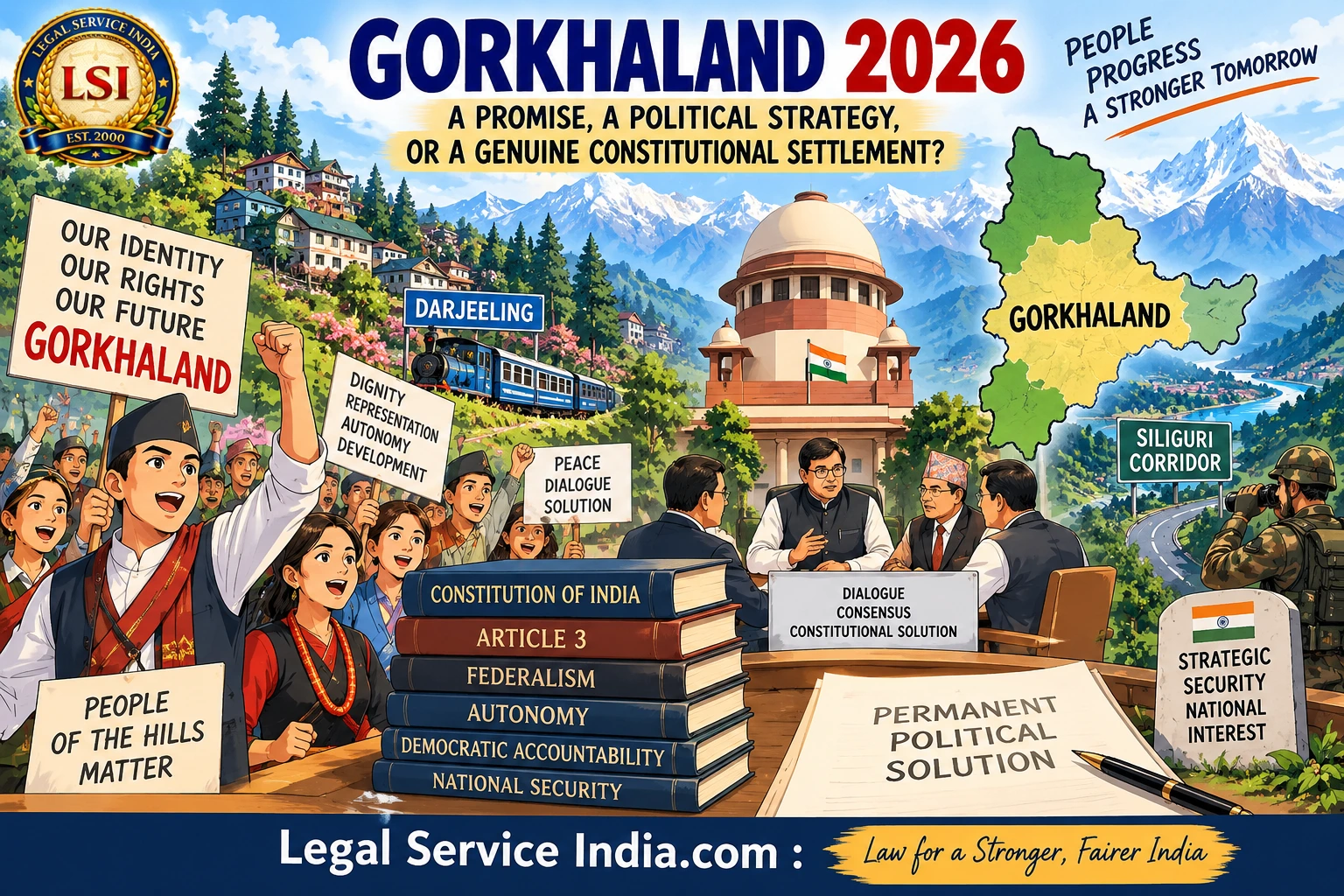
Gorkhaland: A Promise, a Political Strategy, or a Genuine Constitutional Settlement?
Introduction
For decades, Gorkhaland has remained one of India’s most persistent and emotionally charged demands for political recognition. For many people in the Darjeeling Hills, Terai and Dooars, the demand represents far more than the creation of another state. It is connected with identity, dignity, political representation, cultural protection, land rights and greater control over local affairs.
Yet the central question today is no longer simply whether Gorkhaland should exist.
The more important question is whether successive political promises have moved the region closer to a permanent constitutional settlement or whether the Gorkhaland question has become an electoral issue that remains deliberately unresolved.
That question deserves a serious legal and constitutional examination, particularly after the Centre’s August 2026 decision to establish another high-level mechanism for a proposed permanent political solution.
The present article therefore examines the issue not as partisan political commentary but through the lens of constitutional law, federalism, national security, democratic accountability and the interests of the people of the Hills.
Gorkhaland Is More Than an Election Slogan
The historical demand for Gorkhaland cannot fairly be dismissed as an electoral slogan.
The region has witnessed repeated agitations, including major movements during 1986–88, 2007–11 and 2017. The creation of administrative arrangements such as the Darjeeling Gorkha Hill Council and later the Gorkhaland Territorial Administration did not finally settle the underlying political question.
The distinction is important.
An administrative arrangement can provide local governance. A political settlement, however, must address the deeper question of constitutional authority, representation, financial powers, territory, identity and permanence.
The experience of the past decades demonstrates that changing the name of an institution does not necessarily resolve the grievance that produced the demand for that institution.
From Gorkhaland to a “Permanent Political Solution”
One of the most significant developments in the political discourse has been the gradual movement from the specific demand for Gorkhaland towards the broader expression “Permanent Political Solution” (PPS).
There is nothing legally objectionable about negotiating an alternative to full statehood. Indeed, a constitutional settlement could potentially address several concerns simultaneously.
But the phrase creates a fundamental legal problem if it remains undefined.
What Exactly Is a Permanent Political Solution?
Does it mean:
- a separate state;
- a Union Territory;
- enhanced territorial autonomy;
- a strengthened autonomous council;
- special constitutional protections;
- greater legislative and financial powers;
- or an entirely new constitutional arrangement?
The concern is not merely semantic.
A constitutional democracy cannot permanently govern a politically sensitive region through an undefined promise. Citizens are entitled to know the legal nature, powers, territory, financial structure and constitutional basis of the proposed arrangement.
The criticism is particularly relevant because the term ‘PPS’ has historically been interpreted differently by political stakeholders. Contemporary reporting has noted that the expression remained undefined and was interpreted by many in the Hills as potentially referring to Gorkhaland.
The 2021 Talks Were Important — But Dialogue Is Not Settlement
In October 2021, the Union Home Ministry formally initiated tripartite discussions involving Gorkha representatives, the Government of West Bengal and the Centre.
The meeting was chaired by the Union Home Minister, and the Ministry announced that another round would follow.
This was undoubtedly significant.
For the first time in years, the political question received a formal Centre–State–Gorkha dialogue mechanism.
But there is a crucial distinction:
| Process | Outcome |
|---|---|
| Dialogue | A process |
| Constitutional settlement | An outcome |
The democratic test therefore cannot be how many meetings have taken place.
It must be:
What legally enforceable result emerged from those meetings?
That distinction should remain central to any objective assessment of the Gorkhaland issue.
The 2026 Development Is Significant — But It Is Still a Process
The August 22, 2026 meeting at Sukna represents a more consequential development.
The Centre announced the formation of a committee under interlocutor Pankaj Kumar Singh to work out the modalities and details of a proposed permanent political solution within the Constitution. The meeting involved the Union Government, the West Bengal Government and representatives of the Hills.
This is undoubtedly more substantial than another political speech.
There is now an identifiable institutional mechanism tasked with preparing the framework of a proposed settlement.
But legally, an important caution remains necessary.
- A committee is not a constitutional settlement.
- A recommendation is not legislation.
- An announcement is not an enforceable right.
- And a political assurance is not the same as a constitutional guarantee.
The real test will begin when the government places the actual proposal before the public.
Also Read: Can America Reform the Supreme Court? Latest 5–4 Ruling Reignites Term Limits Debate
The Constitutional Route to Gorkhaland Is Not Legally Impossible
One of the most important misconceptions surrounding Gorkhaland concerns the constitutional power to create a new state.
Article 3 of the Constitution expressly empowers Parliament to form a new State by separating territory from an existing State or by combining territories in the manner specified by the Constitution. It also permits alteration of state boundaries and areas.
Therefore, from a purely constitutional perspective, the creation of Gorkhaland is not an impossibility.
The real difficulty is political, administrative, territorial and strategic.
Under Article 3, a bill affecting the area, boundaries or name of a state requires the president’s recommendation and must be referred to the concerned state legislature for expressing its views.
The State Legislature’s views form part of the constitutional process, although the Constitution does not make the State Legislature the ultimate decision-maker on whether Parliament can reorganise the State.
This distinction matters.
The debate should therefore not be reduced to the claim that Gorkhaland is constitutionally impossible.
The correct question is:
What constitutional arrangement best reconciles the aspirations of the Gorkha people with territorial integrity, federal interests, administrative viability and national security?
The Siliguri Corridor Makes the Question Unusually Sensitive
Any serious examination of Gorkhaland must confront the Siliguri Corridor.
The corridor is the principal land link connecting mainland India with the Northeast. The government has repeatedly described its strategic importance, including its connection with international borders and national security.
This does not mean that Gorkhaland is inherently incompatible with national security.
That conclusion would go far beyond the available constitutional evidence.
But it does mean that any territorial reorganisation in the region must address strategic concerns with exceptional care.
Key Security and Governance Questions
A credible proposal must answer:
- Who will control strategically important infrastructure?
- How will defence logistics be protected?
- Who will coordinate border security?
- How will intelligence and counter-infiltration operations function?
- How will roads, railways and communications be protected?
- How will cross-border issues involving Nepal, Bhutan and Bangladesh be managed?
- How will demographic and land-related concerns be addressed?
These are not arguments against Gorkha identity.
They are questions that any responsible constitutional settlement must answer.
Indeed, on August 22, 2026, the Union Home Minister separately reviewed the security of the Siliguri Corridor, including infrastructure, demographic change, border affairs and illegal immigration.
That timing demonstrates how closely the political and security dimensions of the region are connected.
The Real Legal Problem: What Powers Will the New Arrangement Have?
If the proposed permanent political solution is intended to succeed where earlier arrangements failed, it must go beyond administrative symbolism.
The people should be told precisely:
| Area | Question |
|---|---|
| Legislative Powers | What laws can the proposed institution make? |
| Executive Authority | Which subjects will be administered locally? |
| Financial Autonomy | What revenues will it control? Will it have predictable and constitutionally protected financial resources? |
| Land Rights | Who will control land acquisition, transfer and development? |
| Cultural Protection | What safeguards will protect language, culture and community identity? |
| Political Representation | How will the political voice of the region be protected at the state and union levels? |
| Administrative Accountability | Who will supervise the institution, and what mechanisms will exist to prevent administrative failure? |
| Constitutional Permanence | Can the arrangement be altered by an ordinary executive decision, or will it receive statutory or constitutional protection? |
These questions are far more important than the label attached to the arrangement.
The Election-Time Promise Problem
There is also a democratic accountability issue that cannot simply be ignored.
The Gorkhaland question has repeatedly featured prominently during elections. Political parties have used expressions such as “permanent solution”, “constitutional solution” and “justice for Gorkhas” to mobilise public expectations.
That creates a legitimate democratic obligation.
If voters are told that a solution is imminent, they are entitled to ask:
What exactly is the proposed solution?
If they are told that negotiations are progressing, they are entitled to ask:
What has been agreed?
If another committee is constituted, they are entitled to ask:
What is its mandate, deadline and legal consequence?
A government cannot reasonably expect perpetual public patience without measurable progress.
Also Read: SGB Tax Crisis 2026: Can Sovereign Gold Bond Investors Demand Grandfathering and Legal Protection?
Who Benefits From an Unresolved Gorkhaland Question?
This may be the most uncomfortable question of all.
For ordinary citizens, prolonged political uncertainty can have real costs:
- employment uncertainty;
- inadequate infrastructure;
- pressure on land and resources;
- concerns over political representation;
- disruption caused by agitation;
- economic vulnerability;
- tourism instability;
- and continuing uncertainty over the region’s political future.
Political organisations, however, can sometimes derive bargaining power from an unresolved identity question.
The danger is therefore a cycle:
Demand → Promise → Election → Committee → Delay → Renewed Promise → Election.
If that cycle continues indefinitely, the phrase “Permanent Political Solution” risks becoming the opposite of what it promises.
It could produce permanent political suspense rather than permanent political settlement.
What Should the Centre and Political Leadership Do Now?
The present moment provides an opportunity to end ambiguity.
The committee should ideally publish a transparent framework addressing at least ten questions:
- Constitutional basis — What constitutional or statutory mechanism is proposed?
- Territorial scope — Which areas are included?
- Governance structure — Who will exercise executive authority?
- Legislative powers — What subjects will be within local jurisdiction?
- Financial powers — What revenue and budgetary mechanisms will exist?
- Land protection — What safeguards will apply?
- Cultural rights — What protections will be guaranteed?
- Security architecture — How will national-security interests be protected?
- Inter-governmental relations — How will the arrangement interact with West Bengal and the Union?
- Implementation timeline — When will the promised settlement become legally operational?
Without these details, the public cannot properly evaluate whether the proposal is genuinely permanent.
Gorkhaland Deserves a Constitutional Answer
The people demanding Gorkhaland have a legitimate democratic right to express their political aspirations.
At the same time, the Union Government has a legitimate constitutional responsibility to protect India’s territorial integrity, national security and federal balance.
These objectives need not necessarily be contradictory.
A sophisticated constitutional settlement should attempt to reconcile them.
The real failure would be to continue substituting slogans for legal substance.
- If statehood is considered feasible, the government should explain the constitutional route.
- If statehood is not considered feasible, it should explain why.
- If an alternative structure is proposed, its powers should be published.
- And if the government genuinely believes that the present process will produce a permanent political solution, it should provide a clear roadmap towards implementation.
Conclusion: Gorkhaland Must Move From Promise to Law
The Gorkhaland question has survived for decades because the underlying political aspirations have never disappeared.
The current 2026 process is important. The establishment of a committee to work towards a constitutional permanent political solution is more meaningful than another election speech, and the Centre’s renewed engagement represents a significant institutional development.
But history demands caution.
Darjeeling and the wider Gorkha political question have already witnessed multiple agreements, administrative structures, negotiations and promises.
The next arrangement must therefore be judged differently.
Not by its name.
Not by the number of meetings held.
Not by election speeches.
But by the actual legal powers it creates.
The people of the Hills deserve to know what their political future will look like, what constitutional protection they will receive, how their identity will be safeguarded, and how national security will be preserved.
Ultimately, the success or failure of the present process will be determined by one document:
the final legal and constitutional settlement.
Until that document exists, Gorkhaland remains a political aspiration, and the Permanent Political Solution remains a proposal in progress.
After decades of agitation, promises and political uncertainty, the people deserve more than another assurance.
They deserve a settlement that can withstand politics, elections and changes of government.
That is what “permanent” should mean.
Need Legal Guidance on Constitutional and Political Issues?
Complex constitutional questions require careful legal analysis, not political assumptions. If you need professional guidance on constitutional law, political rights, federal issues, state reorganisation, or public law matters, consult an experienced Supreme Court lawyer.
Adv. Tarun Choudhury
Supreme Court Advocate | 25+ Years of Legal Experience
- 📞 Call: 9650499965
- 💬 WhatsApp: 8851978611
For professional legal consultation and guidance, get in touch today.
Frequently Asked Questions
1. What is the Gorkhaland demand, and why is it important?
The Gorkhaland demand seeks greater political recognition and self-governance for the Gorkha people, particularly in the Darjeeling Hills and adjoining areas. It is closely associated with concerns about identity, political representation, cultural protection, land rights and regional development.
2. Is Gorkhaland constitutionally possible under Indian law?
Yes. Gorkhaland is not constitutionally impossible. Article 3 of the Constitution of India gives Parliament the power to create a new state, alter state boundaries or change state areas, subject to the constitutional procedure. The practical question involves political, administrative, territorial and national-security considerations.
3. What is the permanent political solution for Gorkhaland?
The Permanent Political Solution (PPS) for Gorkhaland refers to a proposed constitutional or legal arrangement intended to address the region’s long-standing political demands. Its precise structure, territory, legislative powers, financial authority and constitutional safeguards must be clearly defined before it can be considered a genuinely permanent settlement.
4. How does the Siliguri Corridor affect the Gorkhaland issue?
The Siliguri Corridor is strategically important because it provides the principal land connection between mainland India and the Northeast. Any proposed Gorkhaland arrangement involving strategically sensitive territory must therefore address defence logistics, border security, infrastructure, connectivity and national-security concerns.
5. What should a permanent Gorkhaland settlement include?
A credible permanent Gorkhaland political settlement should clearly specify its constitutional basis, territorial jurisdiction, legislative and executive powers, financial autonomy, land protections, cultural safeguards, political representation and national-security arrangements. Most importantly, it should contain a clear and legally implementable timeline rather than another open-ended political promise.
Key Takeaways: Gorkhaland and the Permanent Political Solution
- Gorkhaland is more than an electoral slogan: the demand is deeply connected with Gorkha identity, political representation, cultural protection, land rights, dignity and regional self-governance.
- A permanent political solution must have legal substance: a committee, political announcement or election promise is not the same as a binding constitutional or statutory settlement.
- Gorkhaland is constitutionally possible: Article 3 of the Constitution of India gives Parliament the power to create new states and alter existing state boundaries, subject to the constitutional procedure.
- The 2026 Gorkhaland process is significant but unfinished: The Centre’s renewed institutional mechanism for a permanent political solution represents progress, but the ultimate test will be the actual legal framework produced.
- The Siliguri Corridor is a critical consideration: any restructuring involving the Darjeeling, Terai or Dooars region must address national security, defence logistics, border management, infrastructure and Northeast connectivity.
- Administrative autonomy is not necessarily a permanent political settlement: Earlier arrangements such as the DGHC and GTA demonstrate that creating an administrative institution alone may not resolve the underlying political aspirations.
- The meaning of “Permanent Political Solution” must be clarified: citizens should know whether the proposal involves statehood, Union Territory status, enhanced autonomy, constitutional safeguards or another governance model.
- Gorkhaland requires transparency and accountability: Any final proposal should clearly specify territory, legislative powers, financial autonomy, land rights, cultural protections, political representation and security safeguards.
- Election promises should be measured against outcomes: The Gorkhaland debate should move away from repeated assurances and towards measurable constitutional, legislative and administrative results.
- The ultimate test is implementation: After decades of agitation and political commitments, the people of the Hills deserve a durable Gorkhaland settlement or clearly defined constitutional alternative—not another cycle of promises, committees and delays.
Summary
The Gorkhaland issue remains unresolved despite decades of political movements, administrative arrangements and negotiations. The current Permanent Political Solution process could represent an important opportunity, but its credibility will depend on a clearly defined constitutional framework, territorial and financial powers, protection of Gorkha identity, and safeguards for national security and the strategically important Siliguri Corridor.
The decisive question is no longer how many promises have been made, but whether a legally enforceable and genuinely permanent settlement is ultimately implemented.