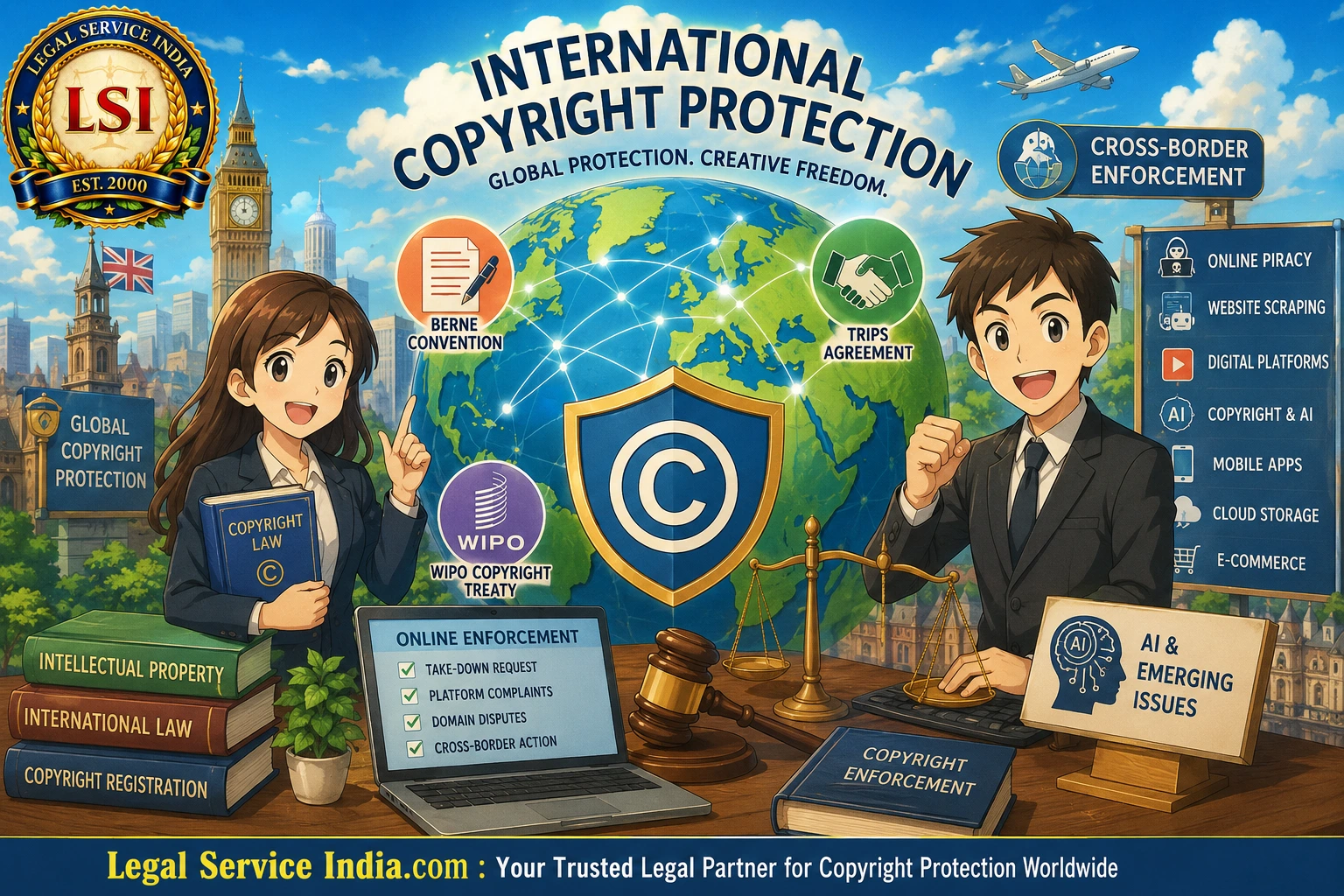
International Copyright Protection
Copyright infringement is no longer confined within national borders. A book published in India can be copied in another country within minutes. A software application developed in Bengaluru may be pirated across multiple jurisdictions. A YouTube video uploaded in Delhi can be downloaded, edited, and monetised anywhere in the world.
Consequently, copyright owners must understand not only Indian copyright law but also the international legal framework governing cross-border protection and digital enforcement.
This concluding part discusses international copyright protection, online enforcement mechanisms, emerging legal issues, and practical recommendations for protecting intellectual property in an increasingly interconnected digital world.
International Copyright Protection
Copyright is territorial in nature, meaning that enforcement generally takes place under the laws of the country where protection is sought.
However, several international treaties significantly simplify protection across national boundaries.
India is a member of important international copyright agreements, including:
- Berne Convention for the Protection of Literary and Artistic Works.
- Agreement on Trade-Related Aspects of Intellectual Property Rights (TRIPS).
- Universal Copyright Convention (where applicable).
- WIPO Copyright Treaty (subject to India’s commitments).
These international frameworks ensure that Indian creators receive copyright protection in numerous countries without having to register separately in each jurisdiction, subject to the domestic laws of those countries.
Bernie Convention
The Berne Convention is one of the most important international copyright treaties.
Its fundamental principles include:
| Principle | Description |
|---|---|
| Automatic Protection | Copyright generally arises automatically without mandatory registration. |
| National Treatment | Member countries generally provide foreign authors with the same protection that they extend to their own nationals. |
| Minimum Standards | The Convention establishes minimum standards for copyright protection, while allowing member countries to provide stronger protection if they choose. |
TRIPS Agreement
The TRIPS Agreement integrates intellectual property protection into the international trading system.
It requires member countries of the World Trade Organization to provide effective enforcement mechanisms for intellectual property rights, including copyright.
TRIPS also emphasises:
- civil remedies;
- criminal remedies in appropriate cases;
- border measures;
- effective judicial enforcement.
Copyright and Cross-Border Online Infringement
The internet has transformed copyright disputes.
Examples include:
- Websites hosted outside India.
- Foreign piracy portals.
- Cross-border streaming platforms.
- International software piracy.
- Online marketplaces.
- Cloud storage services.
Although legal action may become more complex in such situations, copyright owners are not without remedies.
Possible enforcement measures include:
- platform complaint mechanisms;
- take-down requests;
- injunctions against intermediaries where legally permissible;
- proceedings in the appropriate jurisdiction;
- customs measures in suitable cases.
Copyright Protection on Online Platforms
Most major digital platforms have copyright complaint procedures.
These commonly include:
- YouTube.
- Facebook.
- Instagram.
- LinkedIn.
- X (formerly Twitter).
- GitHub.
- App stores.
- E-commerce marketplaces.
- Website hosting providers.
A prompt and well-documented complaint often results in removal of infringing content without immediate court intervention.
Website Scraping and Automated Content Theft
Many businesses now face automated copying through bots and web scraping tools.
Common targets include:
- Blogs.
- Product descriptions.
- Legal articles.
- Research reports.
- News content.
- Educational material.
- FAQs.
Website owners should:
- monitor duplicate content;
- preserve server logs where available;
- maintain publication records;
- issue prompt take-down notices;
- Seek legal advice if commercial exploitation continues.
Copyright and Search Engines
Search engines may index infringing material hosted by third parties.
Where infringing content appears in search results, copyright owners should consider:
- requesting removal from the relevant hosting platform;
- using platform-specific complaint mechanisms;
- seeking legal advice regarding further remedies if necessary.
Prompt action often limits the visibility of infringing material.
Copyright and Domain Names
Copyright disputes sometimes overlap with domain name issues.
Examples include:
- websites copying copyrighted content;
- fake educational portals;
- counterfeit product websites;
- fraudulent publishing platforms.
Although domain name disputes are often addressed through specialised procedures, copyright claims may also arise where original content has been reproduced without permission.
Copyright and Mobile Applications
Modern mobile applications contain multiple copyright-protected components.
These include:
- source code;
- graphics;
- icons;
- user interface elements;
- animations;
- databases;
- instructional material.
Developers should maintain comprehensive records of development, version history, contributor agreements, and licensing arrangements.
Copyright and Databases
Original databases involving sufficient skill, judgement, and creativity may qualify for copyright protection.
Examples include:
- legal databases;
- educational repositories;
- research compilations;
- business directories;
- digital archives.
Mere facts are generally not protected, but the original selection or arrangement of those facts may attract copyright protection.
Copyright in Government Publications
Government publications may be subject to special statutory provisions.
Persons intending to reproduce official publications should verify whether permission is required or whether any statutory exception applies.
Copyright and Open-Source Software
Many software developers use open-source components.
However, open-source does not mean “free from legal obligations”.
Developers should carefully review:
- licence terms;
- attribution requirements;
- modification obligations;
- distribution conditions;
- compatibility with proprietary software.
Failure to comply with licence conditions may expose businesses to legal risks.
Copyright and Cloud Computing
Cloud-based storage has introduced new evidentiary and enforcement issues.
Important considerations include:
- preservation of digital evidence;
- server locations;
- access logs;
- electronic records;
- user permissions;
- contractual obligations.
Businesses should implement clear internal policies governing cloud-based intellectual property management.
Copyright and Digital Evidence Management
Proper digital evidence management is often decisive in modern copyright litigation.
Creators should preserve:
- original source files;
- metadata;
- timestamps;
- version history;
- cloud backups;
- publication logs;
- server records (where available);
- communication records.
Maintaining these records from the outset is far easier than reconstructing them after litigation begins.
Future Challenges in Copyright Law
The coming decade is likely to witness significant developments in copyright jurisprudence.
Key issues expected to receive greater judicial attention include:
- Artificial Intelligence.
- Deepfake technology.
- Voice cloning.
- Machine learning datasets.
- Automated content generation.
- Metaverse assets.
- Virtual reality content.
- Digital avatars.
- AI-assisted music composition.
- AI-generated software.
- Blockchain licensing.
- Digital authentication technologies.
Courts and legislatures will continue to balance technological innovation with the rights of creators.
Best Practices for Copyright Owners
To reduce the risk of infringement and strengthen future enforcement, copyright owners should:
- Create and retain original source material.
- Register commercially significant works wherever appropriate.
- Use clear copyright notices.
- Execute written agreements with employees, freelancers, and collaborators.
- Preserve publication and licensing records.
- Monitor online platforms for unauthorised use.
- Respond promptly to suspected infringement.
- Conduct periodic intellectual property audits.
- Seek legal advice before commencing litigation or licensing valuable works.
Comprehensive Copyright Enforcement Checklist
Before initiating legal proceedings, ensure that you have:
| Checklist |
|---|
| ✔ Identified the copyrighted work. |
| ✔ Established ownership. |
| ✔ Collected supporting documents. |
| ✔ Preserved electronic evidence. |
| ✔ Identified all infringing parties. |
| ✔ Assessed jurisdiction. |
| ✔ Considered interim relief. |
| ✔ Evaluated settlement possibilities. |
| ✔ Estimated financial losses. |
| ✔ Consulted an experienced intellectual property lawyer. |
Conclusion
Copyright law protects the intellectual effort, creativity, and commercial investment of authors, artists, software developers, filmmakers, photographers, educators, businesses, and countless other creators. In today’s digital environment, where copying can occur instantaneously and across borders, understanding the legal framework is essential.
Effective copyright enforcement requires far more than discovering infringement. It demands careful documentation, preservation of evidence, strategic planning, timely legal advice, and appropriate use of both civil and criminal remedies. By adopting proactive intellectual property management practices and responding promptly to unauthorised use, creators and organisations can safeguard the long-term value of their creative works.
Supreme Court & High Court Case Law Analysis, Litigation Strategy, Emerging Jurisprudence and Practice Guide
A successful copyright infringement case depends not only on the Copyright Act, 1957, but also on the interpretation of the Act by the Supreme Court of India and various High Courts. Judicial precedents explain important concepts such as originality, substantial similarity, fair dealing, interim injunctions, ownership, jurisdiction, damages, and digital copyright infringement.
This chapter analyses the leading judicial principles that every copyright lawyer, author, software developer, publisher, filmmaker, photographer, business owner, and content creator should understand before commencing litigation.
Judicial Principles That Govern Copyright Litigation
Indian courts generally examine the following issues while deciding a copyright infringement suit:
- Whether copyright subsists in the work.
- Whether the plaintiff owns the copyright.
- Whether the defendant copied the work.
- Whether the copied portion is substantial.
- Whether any statutory defence applies.
- Whether damages have been proved.
- Whether interim protection is justified.
- Whether the plaintiff has approached the court without undue delay.
Each copyright dispute ultimately depends on its own facts and evidence.
Quick Overview of Key Judicial Considerations
| Judicial Question | Purpose in Copyright Litigation |
|---|---|
| Whether copyright subsists in the work | Determines whether legal protection exists. |
| Whether the plaintiff owns the copyright | Establishes the plaintiff’s legal standing. |
| Whether the defendant copied the work | Examines whether copying has occurred. |
| Whether the copied portion is substantial | Assesses the materiality of the alleged copying. |
| Whether any statutory defence applies | Considers exceptions such as fair dealing. |
| Whether damages have been proved | Determines entitlement to monetary relief. |
| Whether interim protection is justified | Considers urgent relief before trial. |
| Whether the plaintiff has approached the court without undue delay | Assesses whether delay affects equitable relief. |
Landmark Supreme Court Decisions
The following landmark judgements have significantly shaped Indian copyright jurisprudence and continue to guide courts, lawyers, authors, publishers, software developers, and businesses in copyright infringement litigation.
1. R.G. Anand v. Deluxe Films (1978) 4 SCC 118
Facts
The plaintiff alleged that a Hindi film copied his stage play.
Principle Established
The Supreme Court held that:
- Copyright protects expression, not ideas.
- Similar ideas alone do not constitute infringement.
- The plaintiff must prove substantial copying.
- Coincidental similarity is insufficient.
- The overall impression created upon an ordinary viewer is relevant.
Practical Impact
This remains the leading authority on determining whether infringement has occurred.
Whenever a client claims:
“Someone copied my idea.”
The first legal question should be:
Was the expression copied or merely the idea?
| Key Principle | Legal Significance |
|---|---|
| Expression is protected. | Ideas alone are not protected by copyright. |
| Substantial copying | The plaintiff must establish substantial reproduction. |
| Ordinary viewer test | The overall impression created on an ordinary viewer is relevant. |
2. Eastern Book Company v. D.B. Modak (2008) 1 SCC 1
This judgement fundamentally changed the law relating to originality.
Supreme Court Held
The Court rejected the traditional “sweat of the brow” doctrine.
Instead, copyright requires:
- skill,
- judgement,
- intellectual effort,
- a minimum degree of creativity.
Practical Importance
This judgement is particularly relevant for:
- databases,
- legal publications,
- compilations,
- educational material,
- AI-assisted content.
| Originality Requirement | Meaning |
|---|---|
| Skill | Application of professional ability. |
| Judgement | Exercise of intellectual discretion. |
| Intellectual Effort | Independent mental labour. |
| Minimum Creativity | Some creative input is essential. |
3. Indian Performing Rights Society Ltd. v. Sanjay Dalia (2015)
Issue
Territorial jurisdiction under Section 62.
Supreme Court Held
The additional jurisdiction granted to copyright owners should not be misused.
Where both the plaintiff and the cause of action are located at the same place, litigation should ordinarily be instituted there.
Importance
This decision continues to govern jurisdictional objections in copyright litigation.
| Issue | Court’s View |
|---|---|
| Territorial Jurisdiction | Section 62 should not be used to create unnecessary forum shopping. |
4. Midas Hygiene Industries Pvt. Ltd. v. Sudhir Bhatia
Although primarily a trademark decision, courts frequently rely upon it in copyright matters.
Principle
- Where infringement is prima facie established, injunctions should ordinarily follow.
- Delay alone does not necessarily defeat the plaintiff’s claim.
| Principle | Application in Copyright Cases |
|---|---|
| Prima facie infringement | Courts generally favour granting injunctions. |
| Delay | Delay alone does not automatically bar relief. |
5. Civic Chandran v. Ammini Amma
The Kerala High Court discussed parody and fair dealing.
The judgement recognised that every reproduction does not amount to infringement.
The context, purpose and nature of the use must be carefully examined.
This decision is frequently discussed in relation to parody, criticism and artistic freedom.
| Topic | Judicial Observation |
|---|---|
| Parody | May fall within permissible use depending upon context. |
| Fair Dealing | Requires examination of purpose, context and nature of use. |
| Artistic Freedom | Not every reproduction amounts to infringement. |
High Court Decisions on Digital Copyright
Indian High Courts have increasingly dealt with disputes involving:
- websites,
- online piracy,
- software,
- streaming,
- social media,
- online marketplaces,
- educational platforms.
Common judicial approaches include:
- granting dynamic injunctions against piracy websites;
- directing internet intermediaries to comply with lawful orders;
- appointing Local Commissioners;
- preserving digital evidence;
- directing removal of infringing content.
The growing body of digital copyright jurisprudence reflects the increasing importance of online intellectual property protection.
Digital Copyright Disputes at a Glance
| Common Dispute | Judicial Response |
|---|---|
| Website Piracy | Dynamic injunctions and blocking orders. |
| Online Platforms | Directions to intermediaries for compliance. |
| Digital Evidence | Preservation through Local Commissioners. |
| Infringing Content | Removal and take-down directions. |
Dynamic Injunctions
Traditional injunctions often proved ineffective against piracy websites because operators simply shifted to new domain names.
To address this issue, Indian courts have increasingly granted dynamic injunctions, enabling rights-holders to seek extension of existing orders against mirror, redirect, or alphanumeric websites that substantially facilitate the same infringing activity, subject to judicial supervision.
Dynamic injunctions have become an important enforcement tool in large-scale online piracy cases.
Why Dynamic Injunctions Are Important
| Problem | Solution Provided by Courts |
|---|---|
| Mirror Websites | Extension of existing injunction orders. |
| Redirect Domains | Covered through dynamic injunctions. |
| Changing Domain Names | Judicial supervision for additional blocking. |
John Doe (Ashok Kumar) Orders
In cases involving unidentified infringers, courts may grant John Doe (also known as Ashok Kumar) orders.
These orders permit action against unknown persons involved in copyright infringement until their identities become known.
John Doe’s orders are frequently used in:
- movie piracy,
- sports broadcasting,
- software piracy,
- digital content protection.
Common Use of John Doe Orders
| Industry | Typical Purpose |
|---|---|
| Films | Prevent movie piracy before release. |
| Sports | Protect broadcasting rights. |
| Software | Prevent unauthorised copying. |
| Digital Content | Restrict unknown online infringers. |
Role of Local Commissioners
Indian courts regularly appoint local commissioners in copyright disputes.
Their functions may include:
- inspecting premises;
- preparing inventories;
- preserving evidence;
- seizing infringing material where authorised;
- photographing articles;
- recording electronic evidence;
- submitting reports to the court.
Local commission reports often become valuable evidence during trial.
Functions of Local Commissioners
| Function | Purpose |
|---|---|
| Inspection | Examine the premises. |
| Inventory | Record infringing material. |
| Evidence Preservation | Protect digital and physical evidence. |
| Photography | Document infringing articles. |
| Electronic Evidence | Capture digital records. |
| Report Submission | Assist the court during trial. |
Interim Relief Strategy
Experienced copyright litigators carefully decide which interim remedies should accompany the suit.
Possible reliefs include:
| Interim Relief | Purpose |
|---|---|
| Temporary Injunction | Stop ongoing infringement. |
| Ex Parte Injunction | Urgent protection before notice where justified |
| Anton Piller Order | Preserve evidence. |
| Mareva Injunction | Prevent disposal of assets. |
| Local Commissioner | Secure evidence |
| Discovery | Obtain relevant documents. |
| Inspection | Examine infringing material. |
Not every case requires every remedy.
The litigation strategy depends upon the facts.
Choosing the Right Interim Remedy
- Select remedies based on urgency.
- Preserve evidence wherever necessary.
- Prevent continuing infringement.
- Protect assets when recovery may become difficult.
- Tailor interim relief to the facts of each case.
Commercial Courts and Copyright Litigation
Many copyright disputes involving commercial exploitation are now heard before commercial courts established under the Commercial Courts Act, 2015, provided the dispute satisfies the statutory requirements.
Commercial courts generally aim to provide:
- specialised adjudication;
- structured case management;
- expedited timelines where feasible;
- efficient handling of commercial intellectual property disputes.
Advantages of Commercial Courts
| Feature | Benefit |
|---|---|
| Specialised Adjudication | Experienced handling of commercial IP disputes. |
| Structured Case Management | Better procedural efficiency. |
| Expedited Timelines | Faster disposal where feasible. |
| Commercial Expertise | Improved management of intellectual property litigation. |
Copyright and Artificial Intelligence Litigation
AI is expected to generate some of the most significant copyright disputes of the coming decade.
Likely issues include:
- ownership of AI-assisted works;
- AI training datasets;
- machine learning models;
- AI-generated music;
- AI-generated books;
- AI-generated software;
- AI-created artwork;
- synthetic voice generation.
Indian courts are likely to develop jurisprudence in these areas as suitable cases arise.
Key AI Copyright Issues
| Emerging Issue | Potential Legal Question |
|---|---|
| AI-assisted works | Ownership and authorship. |
| Training datasets | Use of copyrighted material for AI training. |
| Machine learning models | Scope of copyright protection. |
| AI-generated music | Ownership and licensing. |
| AI-generated books | Originality and copyright subsistence. |
| AI-generated software | Protection of AI-created code. |
| AI-created artwork | Authorship and infringement issues. |
| Synthetic voice generation | Rights relating to voice cloning and copyright. |
Cross-Examination in Copyright Cases
Cross-examination often determines the outcome of litigation.
Typical Questions for the Plaintiff
- When was the work created?
- How do you prove originality?
- Who authored the work?
- Has the work been licensed?
- When did you discover infringement?
Typical Questions for the Defendant
- Did you access the plaintiff’s work?
- How was your work created?
- Who prepared it?
- Were licences obtained?
- What profits were earned?
Preparation for cross-examination is therefore critical.
| Witness | Focus of Cross-Examination |
|---|---|
| Plaintiff | Originality, ownership, licensing and discovery of infringement. |
| Defendant | Access to the work, creation process, licences and profits. |
Settlement Strategy
Litigation should not always be viewed as the only solution.
Settlement may be appropriate where:
- Infringement has ceased;
- damages can be quantified;
- Future licensing is possible;
- Business relationships can be preserved.
Settlement agreements should clearly address:
- admissions (if any);
- removal of infringing material;
- payment terms;
- future use;
- confidentiality;
- dispute resolution.
Essential Elements of a Settlement Agreement
| Clause | Purpose |
|---|---|
| Admissions (if any) | Clarify liability where agreed. |
| Removal of infringing material | Prevent further infringement. |
| Payment terms | Specify financial obligations. |
| Future use | Regulate subsequent exploitation. |
| Confidentiality | Protect commercial information. |
| Dispute resolution | Provide a mechanism for future disputes. |
Copyright Compliance Programme for Businesses
A proactive compliance programme can significantly reduce litigation risk.
Recommended measures include:
- ✔ Register commercially valuable works.
- ✔ Execute assignment agreements.
- ✔ Maintain copyright registers.
- ✔ Review third-party licences.
- ✔ Conduct periodic audits.
- ✔ Train employees.
- ✔ Preserve digital evidence.
- ✔ Implement AI governance policies.
- ✔ Monitor online infringement.
- ✔ Seek legal review before publication.
| Compliance Measure | Benefit |
|---|---|
| Copyright Registration | Strengthens ownership documentation. |
| Assignment Agreements | Clarifies ownership. |
| Periodic Audits | Identifies legal risks early. |
| Employee Training | Promotes copyright compliance. |
| AI Governance | Addresses emerging AI-related risks. |
| Online Monitoring | Detects infringement promptly. |
Top 25 Practical Tips for Copyright Owners
- Create original work.
- Keep dated drafts.
- Preserve source files.
- Register valuable works.
- Execute written agreements.
- Maintain version history.
- Preserve metadata.
- Use copyright notices.
- Monitor the internet.
- Archive websites.
- Preserve screenshots.
- Save publication records.
- Issue legal notices promptly.
- Consider take-down procedures.
- Avoid unnecessary delay.
- Quantify losses.
- Maintain licensing records.
- Review employee agreements.
- Secure freelancer assignments.
- Maintain financial records.
- Avoid public allegations without evidence.
- Seek interim relief where necessary.
- Keep litigation documents organised.
- Consider settlement where appropriate.
- Consult an experienced intellectual property lawyer at an early stage.
Professional Insights
Copyright law is ultimately about protecting human creativity. Whether the work is a novel, software application, photograph, architectural drawing, film, website, educational course, AI-assisted project, or musical composition, the legal principles remain the same: originality deserves protection, and unauthorised commercial exploitation should be addressed through lawful remedies.
The most successful copyright owners are those who adopt a proactive approach by documenting ownership, preserving evidence, monitoring misuse, and taking timely legal action. Equally, businesses should invest in compliance systems and well-drafted agreements to minimise future disputes.
As digital technology continues to evolve, copyright law will remain a dynamic and expanding field. Staying informed about legislative developments and judicial precedents will help creators and organisations protect one of their most valuable assets—their intellectual property.
Disclaimer
This guide is intended solely for educational and informational purposes. It provides a general overview of copyright law in India and does not constitute legal advice. Every copyright dispute depends upon its own facts, contractual arrangements, and applicable law. Readers should obtain professional legal advice before taking or refraining from any legal action.
Contact for Copyright Registration & Copyright Infringement Litigation
Adv. Tarun Choudhury
Supreme Court Advocate | Advocate-on-Record, Supreme Court of India | 25+ Years of Legal Experience
Professional Services
- Copyright Registration
- Copyright Infringement Litigation
- Civil & Criminal Copyright Proceedings
- Commercial Court Litigation
- Copyright Licensing & Assignment
- Website Content Theft Cases
- Software & Source Code Disputes
- AI & Digital Content Advisory
- Copyright Compliance Audits
- Intellectual Property Portfolio Management
- Emergency Injunctions & Interim Relief
Contact
- 📞 Call: 9891244487
- 💬 WhatsApp: 9891244487
Protect your creativity before it is copied, exploited, or commercially misused. Whether you are an author, software developer, business owner, educator, filmmaker, photographer, publisher, or digital creator, timely legal advice can help you safeguard your intellectual property and enforce your rights effectively. Contact Adv. Tarun Choudhury for comprehensive copyright registration, licensing, advisory, and infringement litigation services across India.
Important Links
Important Links:
- Lawyers in India
- Copyright Registration in India
- Caveat Filing in Supreme Court of India
- Mutual Consent Divorce in Delhi/NCR : WhatsApp 9650499965