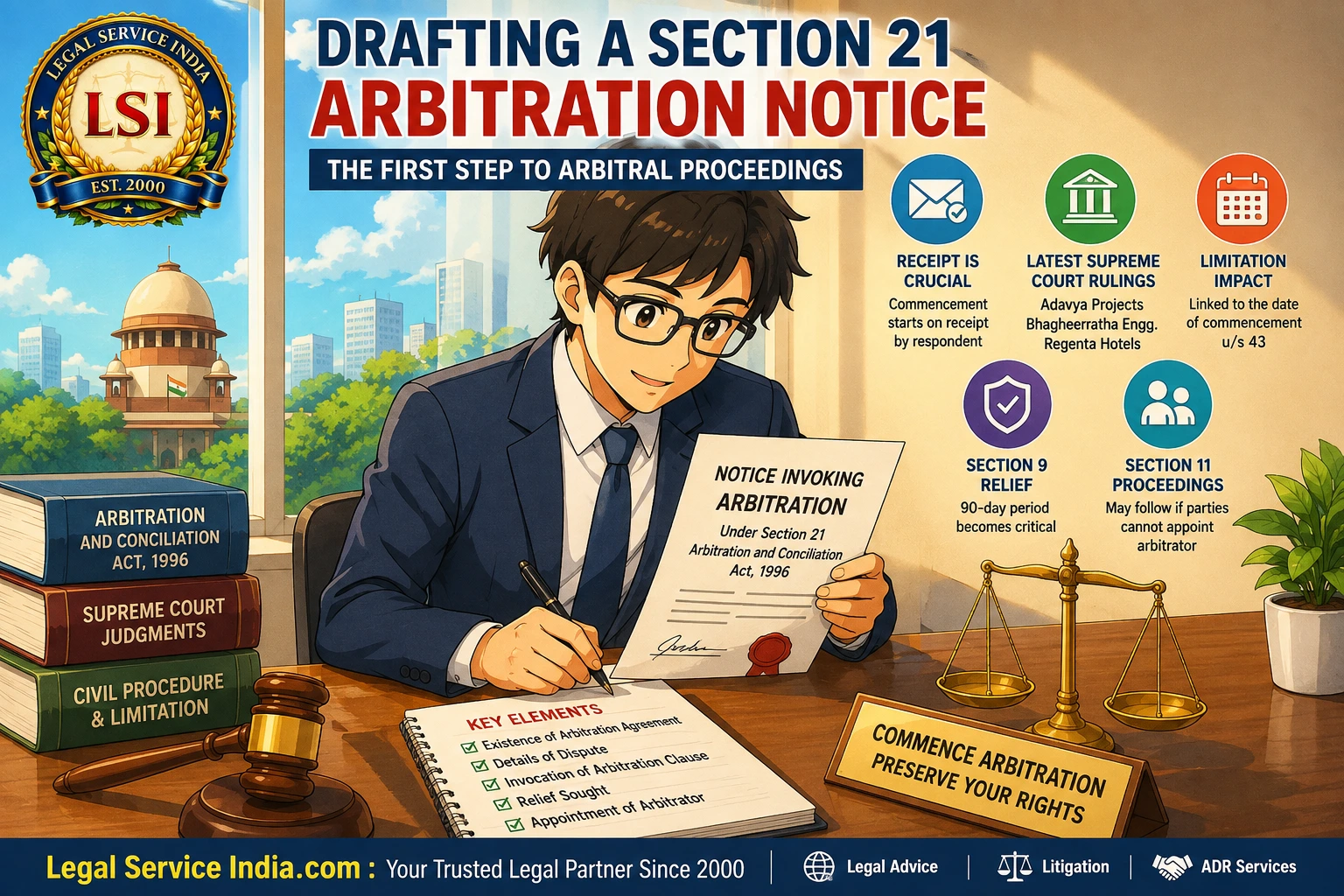
How to Draft a Notice Invoking Arbitration Under Section 21 of the Arbitration and Conciliation Act, 1996
Introduction
A notice invoking arbitration under Section 21 of the Arbitration and Conciliation Act, 1996 is not merely another legal demand notice. It is a strategically important document that can determine the commencement date of arbitral proceedings, affect limitation, trigger the contractual mechanism for appointment of arbitrators and become relevant in subsequent proceedings under Section 11.
Section 21 provides that, unless the parties have agreed otherwise, arbitral proceedings concerning a particular dispute commence when the respondent receives a request for that dispute to be referred to arbitration. Thus, the date of receipt, rather than merely the date of drafting or dispatch, assumes central importance.
Recent Supreme Court decisions, particularly Adavya Projects Pvt. Ltd. v. Vishal Structurals Pvt. Ltd., M/s Bhagheeratha Engineering Ltd. v. State of Kerala and Regenta Hotels Pvt. Ltd. v. Hotel Grand Centre Point, have significantly clarified the legal function of a Section 21 notice.
What Is a Notice Invoking Arbitration Under Section 21?
A notice invoking arbitration is a formal communication by which one party informs the other that:
- an arbitration agreement exists;
- a particular dispute has arisen; and
- the issuing party is invoking the arbitration agreement and seeking reference of the dispute to arbitration.
Section 21 does not prescribe a particular statutory format. Its central function is to identify the point at which arbitral proceedings are deemed to commence, subject to any different agreement between the parties.
A demand for payment is therefore not necessarily a Section 21 notice. If arbitration is intended, the communication should unmistakably state that the arbitration clause is being invoked.
Why the Date of Receipt Is Critical
The most important drafting and procedural point is this:
For Section 21, the legally significant event is ordinarily receipt of the request by the respondent.
This has consequences for limitation under Section 43 because Section 43(2) links commencement of arbitration to the date contemplated by Section 21. The date of invocation may also be relevant to determining the law applicable to the arbitral proceedings.
Therefore, a claimant should preserve reliable evidence showing:
- when the notice was dispatched;
- the mode of service;
- the address used;
- delivery confirmation;
- acknowledgement;
- email transmission and delivery records; and
- any subsequent response from the respondent.
Section 9 Interim Relief: An Important 90-Day Issue
The importance of receipt becomes particularly clear where interim protection has been granted under Section 9.
In Regenta Hotels Pvt. Ltd. v. Hotel Grand Centre Point, the Supreme Court held that for the purpose of Section 9(2), arbitral proceedings commence when the respondent receives the request contemplated by Section 21. The Court rejected the proposition that commencement occurs only when a Section 11 application is filed.
Consequently, where a party has obtained interim protection under Section 9 before commencement of arbitration, the claimant must pay close attention to the statutory period within which the arbitral proceedings must be commenced.
What Has the Supreme Court Clarified in 2025–2026?
1. Adavya Projects: Section 21 and Arbitral Jurisdiction Are Different Questions
In Adavya Projects Pvt. Ltd. v. Vishal Structurals Pvt. Ltd., 2025 INSC 507, the Supreme Court explained that a Section 21 notice serves important procedural purposes, particularly fixing the commencement date and facilitating limitation analysis.
However, the source of the tribunal’s jurisdiction is the arbitration agreement, not the notice itself. The Court held that failure to serve a Section 21 notice on a particular person does not automatically prevent that person from being impleaded where that person’s consent to the arbitration agreement otherwise establishes jurisdiction.
2. Bhagheeratha Engineering: Section 21 Is Procedural, Not Jurisdictional
The position was further clarified in M/s Bhagheeratha Engineering Ltd. v. State of Kerala, 2026 INSC 4.
The Supreme Court held that Section 21 is concerned with the commencement of arbitral proceedings and limitation. Failure to issue a Section 21 notice is not necessarily fatal where the claim is otherwise valid and arbitrable. The Court also emphasised the distinction between Section 21 and Section 23: the former concerns commencement, while the latter governs the claimant’s statement of claim and the issues and reliefs placed before the tribunal.
This distinction is crucial.
A Section 21 notice should be treated as essential litigation hygiene even though its omission does not necessarily extinguish an otherwise valid claim.
3. Unistar Metals: A Useful 2026 Practical Illustration
In Unistar Metals Pvt. Ltd. v. GE Power Ltd., decided by the Bombay High Court on 14 July 2026, the respondent challenged the invocation notice because it did not strictly correspond with the contractual mechanism for constitution of a three-member tribunal.
The Court, relying upon the Supreme Court’s recent jurisprudence, held that the notice’s primary function is time-related and that an objection concerning the precise number of arbitrators proposed did not, in the circumstances, defeat the invocation. The Court ultimately proceeded with appointment after the agreed mechanism had failed.
The practical lesson is that substantial clarity and compliance matter, but every imperfection in a Section 21 notice will not automatically invalidate the arbitral process.
Essential Contents of a Section 21 Arbitration Notice
A professionally drafted notice invoking arbitration under Section 21 should ordinarily contain the following.
| Part | What the Notice Should Address |
|---|---|
| 1. Correct Identification of the Parties | Complete legal names and relevant addresses, including registered office, contractual notice address, email address, authorised representative, and designated officer for legal notices. |
| 2. Identify the Contract | Date of agreement, nature of contract, parties, amendments or supplementary agreements, and relevant contractual provisions. |
| 3. Identify the Arbitration Agreement | Arbitration clause by clause number and provisions concerning appointment of arbitrators, number of arbitrators, seat, venue, institutional arbitration, governing rules, or pre-arbitration procedures. |
| 4. Clearly Identify the Dispute | Relevant contractual obligation, material events, alleged breach, dates of material events, and the dispute that has arisen. |
| 5. Quantify the Claim Where Possible | Presently ascertainable amount and its broad basis, together with interest and other consequential reliefs where legally sustainable. |
| 6. Follow the Contractual Appointment Mechanism | The actual contractual mechanism and applicable institutional rules. |
| 7. Check Pre-Arbitration Conditions | Negotiation, mediation, conciliation, reference to an engineer or adjudicator, escalation to senior management, or any other condition precedent. |
| 8. Correctly State Seat and Venue | The contractually specified seat and the distinction between seat and venue. |
| 9. State the Consequence of Non-Compliance | The right to pursue appropriate relief under Section 11, subject to the contract and applicable law. |
1. Correct Identification of the Parties
Mention the complete legal names and relevant addresses of the claimant and respondent.
Check the contract for:
- registered office;
- contractual notice address;
- email address;
- authorised representative; and
- designated officer for legal notices.
2. Identify the Contract
State:
- date of agreement;
- nature of contract;
- parties;
- amendments or supplementary agreements; and
- relevant contractual provisions.
3. Identify the Arbitration Agreement
Clearly identify the arbitration clause by clause number.
It is advisable to reproduce the clause accurately, particularly where it contains provisions concerning:
- appointment of arbitrators;
- number of arbitrators;
- seat;
- venue;
- institutional arbitration;
- governing rules; or
- pre-arbitration procedures.
The notice should expressly state that the arbitration agreement is being invoked.
4. Clearly Identify the Dispute
Explain briefly:
- the relevant contractual obligation;
- the material events;
- the alleged breach;
- the dates of the material events; and
- the dispute that has arisen.
The notice should be sufficiently specific to identify the dispute, but it need not become a lengthy statement of claim.
5. Quantify the Claim Where Possible
Where the claim is monetary, state the presently ascertainable amount and its broad basis.
If final quantification is not possible, say so expressly and identify the presently ascertainable component, together with interest and other consequential reliefs where legally sustainable.
6. Follow the Contractual Appointment Mechanism
This is an area where practitioners must exercise particular care.
Do not automatically nominate a sole arbitrator when the agreement provides for three arbitrators, and do not assume unilateral appointment powers that the contract does not confer.
Follow the actual contractual mechanism and applicable institutional rules.
7. Check Pre-Arbitration Conditions
Before issuing the notice, examine whether the contract requires:
- negotiation;
- mediation;
- conciliation;
- reference to an engineer or adjudicator;
- escalation to senior management; or
- any other condition precedent.
A Section 21 notice should not be drafted in isolation from the dispute-resolution clause as a whole.
8. Correctly State Seat and Venue
Do not use “seat” and “venue” interchangeably.
If the contract specifies the seat, reproduce it accurately. The distinction can affect the supervisory jurisdiction of courts and the forum for applications under the Arbitration Act.
9. State the Consequence of Non-Compliance
Where the appointment mechanism fails, the notice should make clear that the claimant reserves the right to pursue appropriate relief under Section 11, subject to the contract and applicable law.
Model Structure of a Section 21 Notice
A practical structure is:
Notice Invoking Arbitration Under Section 21 of the Arbitration and Conciliation Act, 1996
Subject: Invocation of arbitration under Clause ___ of Agreement dated ___
- Authority and representation
- Identification of the parties
- Contract and relevant provisions
- Arbitration agreement
- Contractual obligations
- Facts constituting the dispute
- Nature and approximate value of claims
- Express invocation of arbitration
- Appointment/nominations according to the contractual mechanism
- Seat, venue and applicable institutional rules
- Period for response
- Consequences of failure to comply
- Reservation of rights
A suitable invocation paragraph may state:
“Our Client hereby invokes the arbitration agreement contained in Clause ___ of the Agreement dated ___ and calls upon you to refer the disputes and differences arising between the parties to arbitration in accordance with the said agreement and the Arbitration and Conciliation Act, 1996.”
The language should always be adapted to the actual contract.
Can Additional Claims Be Raised After the Section 21 Notice?
Yes, subject to limitation, arbitrability, the arbitration agreement and the applicable procedural framework.
The Supreme Court has clarified that the disputes mentioned in a Section 21 notice do not necessarily constitute an exhaustive ceiling on the tribunal’s jurisdiction. In Adavya Projects and Bhagheeratha Engineering, the Court distinguished the procedural function of Section 21 from the claimant’s substantive pleading obligations under Section 23.
Therefore, the notice should be specific enough to identify the dispute but not drafted on the mistaken assumption that every future pleading must be exhaustively pleaded at the invocation stage.
At the same time, a newly introduced claim may have a separate limitation issue. A lawyer should therefore conduct a limitation analysis claim-by-claim rather than rely upon the original invocation date indiscriminately.
Common Mistakes to Avoid
Mistake 1: Sending Only a Demand Notice
A demand for money is not automatically an arbitration invocation.
Mistake 2: Not Identifying the Arbitration Clause
The respondent should be able to identify exactly which arbitration agreement is being invoked.
Mistake 3: Treating Dispatch as Receipt
Preserve evidence of actual delivery or receipt because Section 21 ordinarily anchors commencement to receipt.
Mistake 4: Ignoring the Contractual Appointment Procedure
An improperly structured nomination may unnecessarily generate a Section 11 dispute.
Mistake 5: Ignoring Pre-Arbitration Steps
Failure to examine escalation or dispute-resolution conditions can create avoidable procedural objections.
Mistake 6: Overloading the Notice
A Section 21 notice should not become a substitute for the statement of claim.
Mistake 7: Ignoring Limitation
Negotiations and correspondence should never be assumed automatically to extend limitation.
Mistake 8: Poor Proof of Service
A strong notice without reliable proof of receipt can create an unnecessary evidentiary dispute.
Practical Checklist Before Sending the Notice
Before issuing a notice invoking arbitration under Section 21, verify:
- Correct parties and addresses
- Correct contract and amendments
- Exact arbitration clause
- Scope of arbitrable disputes
- Contractual pre-arbitration conditions
- Material dates
- Limitation for every significant claim
- Approximate claim value
- Correct arbitrator appointment mechanism
- Arbitrator eligibility and disclosure requirements
- Seat and venue
- Institutional rules, if applicable
- Contractual notice clause
- Permitted modes of service
- Proof of delivery
- Any existing Section 9 order
- Applicable Section 9(2) deadline
- Consequences of failure to appoint
- Potential Section 11 proceedings
- Reservation of additional claims, interest and costs
Frequently Asked Questions
Is a Section 21 Notice Mandatory?
The current position requires nuance. Adavya Projects described the notice as mandatory for its statutory function, while Bhagheeratha Engineering clarified that Section 21 is procedural rather than jurisdictional and that omission does not necessarily defeat an otherwise valid and arbitrable claim.
As a matter of professional practice, the safer course is to issue the notice.
When Does Arbitration Commence?
Ordinarily, arbitral proceedings commence when the respondent receives the request to refer the particular dispute to arbitration, unless the parties have agreed upon a different trigger.
Is Dispatch Enough?
Ordinarily, no. The statutory mechanism focuses on receipt.
Must the Entire Claim Be Included?
No. The dispute should be adequately identified, but the Section 21 notice is not the statement of claim.
Can the Respondent Raise Counterclaims Later?
A counterclaim falling within the arbitration agreement is not automatically barred merely because it was not contained in the original invocation notice. Limitation and the procedural rules remain relevant.
Conclusion
A notice invoking arbitration under Section 21 may be short, but its legal consequences can be substantial. It can establish the commencement date for arbitration, affect limitation, become important for Section 9 compliance, initiate the contractual appointment mechanism and provide the foundation for subsequent proceedings under Section 11.
The recent Supreme Court jurisprudence has made the position more sophisticated, not less important. Adavya Projects distinguishes the notice from the source of arbitral jurisdiction, while Bhagheeratha Engineering makes clear that Section 21 is procedural rather than jurisdictional. Regenta Hotels demonstrates the practical importance of receipt where Section 9 interim protection is involved.
The safest drafting approach remains straightforward:
Identify the parties. Identify the contract. Identify the arbitration agreement. Identify the dispute. Clearly invoke arbitration. Follow the agreed appointment mechanism. Check pre-arbitration conditions. Calculate limitation. Serve the notice properly. Preserve proof of receipt.
The fact that a defective or omitted notice may not always destroy an arbitration is not a reason to draft casually. On the contrary, the recent jurisprudence makes careful drafting even more valuable because the precise date, content, service and contractual context of the notice can affect several subsequent procedural questions.
Legal Note: This article is intended for general legal information and educational purposes. The application of Section 21 depends upon the arbitration agreement, contractual dispute-resolution mechanism, facts of the dispute, limitation, applicable institutional rules and the latest judicial decisions. Professional legal advice should be obtained before issuing or responding to an arbitration notice.
Key Authorities
- Adavya Projects Pvt. Ltd. v. Vishal Structurals Pvt. Ltd., 2025 INSC 507.
- ASF Buildtech Pvt. Ltd. v. Shapoorji Pallonji & Co. Pvt. Ltd., 2025 INSC 616.
- M/s Bhagheeratha Engineering Ltd. v. State of Kerala, 2026 INSC 4.
- Regenta Hotels Pvt. Ltd. v. Hotel Grand Centre Point, 2026 INSC 32.
- Unistar Metals Pvt. Ltd. v. GE Power Ltd., Bombay High Court, 14 July 2026.
- Alupro Building Systems Pvt. Ltd. v. Ozone Overseas Pvt. Ltd., 2017 SCC OnLine Del 7228.
- Arbitration and Conciliation Act, 1996 — Sections 3, 9, 11, 21, 23 and 43.
Frequently Asked Questions
1. What Is a Notice Invoking Arbitration Under Section 21 of the Arbitration and Conciliation Act, 1996?
A notice invoking arbitration under Section 21 of the Arbitration and Conciliation Act, 1996 is a formal communication by which a party informs the other party that an arbitration agreement exists, a specific dispute has arisen, and the party is invoking the arbitration clause to refer the dispute to arbitration. The notice should clearly identify the arbitration agreement and expressly state that arbitration is being invoked.
2. When Does Arbitration Commence After a Section 21 Arbitration Notice Is Issued?
Ordinarily, arbitral proceedings commence when the respondent receives the request to refer the dispute to arbitration, unless the parties have agreed upon a different commencement mechanism. Therefore, the date of receipt of a Section 21 notice is generally more important than the date on which the notice was drafted or dispatched.
3. Is a Section 21 Notice Mandatory for Commencing Arbitration in India?
The legal position requires some nuance. Recent Supreme Court decisions have distinguished the procedural function of Section 21 from the jurisdictional foundation of arbitration. Although failure to issue a Section 21 notice does not necessarily defeat an otherwise valid and arbitrable claim, issuing a properly drafted notice invoking arbitration under Section 21 remains the safer professional practice.
4. What Should a Section 21 Notice Invoking Arbitration Contain?
A properly drafted Section 21 arbitration notice should identify the parties, contract and arbitration agreement; clearly state the dispute and alleged breach; quantify the claim where possible; follow the contractual arbitrator appointment mechanism; comply with pre-arbitration conditions; correctly identify the seat and venue; and state the consequences of failure to comply. It should also preserve the claimant’s rights regarding additional claims, interest and costs.
5. Is Dispatch of a Section 21 Arbitration Notice Sufficient, or Is Proof of Receipt Required?
Ordinarily, dispatch alone is not sufficient because Section 21 focuses on receipt of the request by the respondent. Parties should therefore preserve reliable evidence of service, including delivery confirmations, acknowledgements, email transmission and delivery records, and subsequent correspondence. Proof of receipt can be particularly important for limitation and for complying with the statutory requirements relating to Section 9 interim relief.
Key Takeaways
- A notice invoking arbitration under Section 21 of the Arbitration and Conciliation Act, 1996 is a formal request to refer a specific dispute to arbitration and should clearly state that the arbitration agreement is being invoked.
- Receipt of the Section 21 arbitration notice is ordinarily the critical date for commencement of arbitral proceedings, rather than merely the date of drafting or dispatch.
- The date of receipt can have important consequences for limitation under Section 43 and, in appropriate cases, compliance with the requirements relating to Section 9 interim relief.
- A Section 21 notice should identify the parties, contract, arbitration clause, dispute, alleged breach, claim amount, appointment mechanism, seat, venue and applicable institutional rules, wherever relevant.
- The notice should comply with any pre-arbitration conditions, such as negotiation, mediation, conciliation, adjudication, escalation clauses or other contractual dispute-resolution steps.
- A Section 21 notice is not the same as a demand notice. If arbitration is intended, the communication should expressly invoke the arbitration agreement.
- Dispatch alone is ordinarily not enough. Parties should preserve documentary evidence proving delivery or receipt, including acknowledgements, email delivery records and subsequent responses.
- Recent Supreme Court decisions, including Adavya Projects, Bhagheeratha Engineering and Regenta Hotels, have clarified that Section 21 primarily performs an important procedural and time-related function, while the arbitration agreement remains the source of arbitral jurisdiction.
- The failure to issue a Section 21 notice does not necessarily extinguish an otherwise valid and arbitrable claim, but issuing a properly drafted notice remains the safer professional practice.
- A Section 21 notice does not need to contain the entire statement of claim. The dispute should be identified with sufficient clarity, while detailed pleadings and reliefs can be developed at the appropriate procedural stage.
- Additional claims may potentially be raised later, but each claim must be examined independently for limitation, arbitrability and the scope of the arbitration agreement.
- Practitioners should carefully follow the contractual mechanism for appointment of arbitrators. Incorrectly nominating a sole arbitrator or disregarding an agreed three-member tribunal mechanism can create avoidable procedural disputes.
- The distinction between the seat and venue of arbitration should be accurately reflected in the notice because it may affect the supervisory jurisdiction of courts and subsequent proceedings under the Arbitration and Conciliation Act, 1996.
- Where interim protection has been obtained under Section 9, the claimant should pay particular attention to the applicable time limit for commencing arbitral proceedings after the Section 21 notice is received.
- Best practice: Before sending a Section 21 arbitration notice, verify the arbitration clause, contractual notice requirements, pre-arbitration conditions, limitation periods, claim details, arbitrator appointment procedure, seat and venue, mode of service and proof of receipt.
In Short
Identify the parties, contract, arbitration agreement and dispute; expressly invoke arbitration; follow the agreed appointment procedure; comply with pre-arbitration conditions; protect limitation; serve the notice properly; and preserve proof of receipt.
Need Legal Assistance With Arbitration?
Get professional legal guidance from an experienced Supreme Court Advocate.
Adv. Tarun Choudhury
Supreme Court Advocate | 25+ Years of Legal Experience
Whether you need assistance with a Section 21 notice invoking arbitration, arbitration proceedings, arbitrator appointment, Section 9 interim relief, Section 11 proceedings, or other arbitration-related matters, seek professional legal advice tailored to your case.
📞 Call: 9650499965
💬 WhatsApp: 8851978611
For confidential legal consultation and assistance, contact Adv. Tarun Choudhury today.