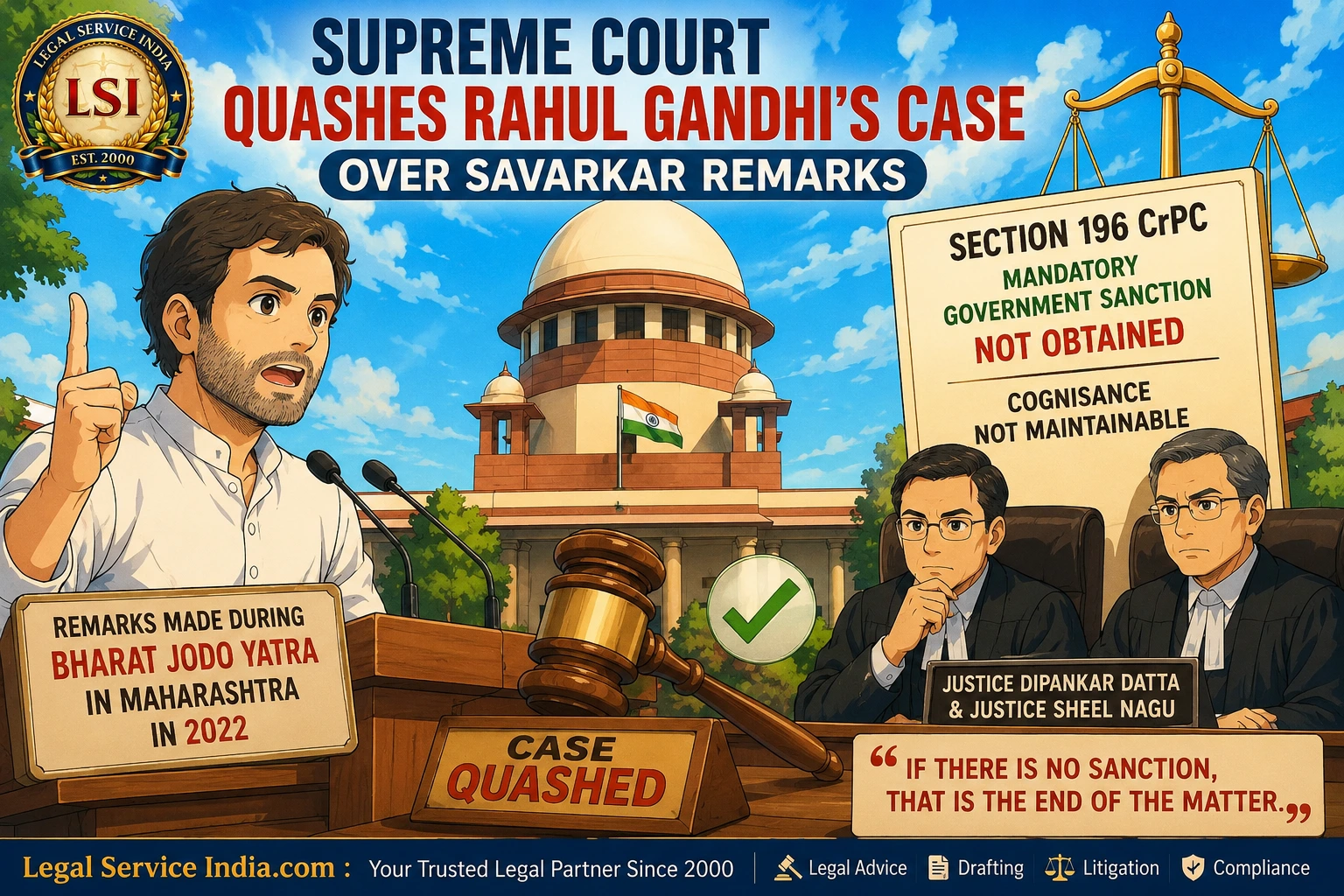
Supreme Court Quashes Rahul Gandhi’s Criminal Defamation Case Over Savarkar Remarks: Sanction Under Section 196 CrPC Was Mandatory
Introduction
In a significant ruling concerning free speech, criminal prosecution of political speech, and the statutory safeguards governing offences affecting public order, the Supreme Court has quashed the criminal proceedings against Congress leader and Leader of Opposition in the Lok Sabha, Rahul Gandhi, arising out of his remarks concerning Vinayak Damodar Savarkar.
The Supreme Court, comprising Justice Dipankar Datta and Justice Sheel Nagu, on 14 August 2026, set aside the criminal complaint and the orders passed by the Lucknow Magistrate after finding that the mandatory governmental sanction required before taking cognisance of the alleged offences had not been obtained. The proceedings arose principally under Sections 153-A and 505 of the Indian Penal Code, provisions concerning promotion of enmity and statements capable of causing public mischief.
The case is Rahul Gandhi v. State of U.P. & Anr., SLP (Crl.) No. 6196/2025, order dated 14 August 2026.
The importance of the decision goes beyond the political controversy surrounding Savarkar. At its heart lies a fundamental principle of criminal procedure: where Parliament has expressly imposed a statutory condition precedent for taking cognisance of certain offences, a criminal court cannot bypass that requirement.
Background of the Rahul Gandhi–Savarkar Case
The proceedings originated from remarks allegedly made by Rahul Gandhi concerning Savarkar during the Bharat Jodo Yatra in Maharashtra in 2022.
A complaint was subsequently instituted by advocate Nripendra Pandey, alleging that Gandhi’s statements were defamatory and were intended to promote hatred, enmity and disharmony in society.
The complaint ultimately resulted in proceedings under, among other provisions, Sections 153-A and 505 IPC.
The Lucknow Magistrate summoned Rahul Gandhi in December 2024. Gandhi challenged the proceedings before the Allahabad High Court, but the High Court declined to interfere, observing that an alternative statutory remedy was available before the Sessions Court.
Gandhi thereafter approached the Supreme Court.
The controversy consequently moved from the realm of political speech into the constitutional and procedural domain of criminal law.
What Did the Supreme Court Decide?
The decisive issue before the Supreme Court was not whether Rahul Gandhi’s remarks about Savarkar were defamatory, historically correct or politically justified.
The immediate question was much narrower but legally fundamental:
Could the magistrate take cognisance of the alleged offences under Section 153-A IPC without the previous sanction contemplated by Section 196 CrPC?
The answer was no.
During the hearing, the Bench specifically asked whether the requisite sanction had been granted. The State’s position was that there was no such sanction.
The Court also examined the affidavit filed by the State of Uttar Pradesh and found that it contained no disclosure that the requisite sanction had been granted.
The Supreme Court therefore held that the proceedings could not legally continue and quashed the complaint and the magistrate’s orders.
The essential reasoning can be understood from the Court’s observation:
“If there is no sanction, that is the end of the matter.”
The Bench accordingly brought the proceedings to an end rather than remanding the matter to the Magistrate.
The Legal Importance of Section 196 CrPC
Section 196 of the Code of Criminal Procedure, 1973, contains an important procedural safeguard.
In relation to specified offences, including offences falling within Chapter VI of the IPC, a court cannot take cognisance unless the statutory requirement concerning previous governmental sanction has been satisfied.
Section 153-A IPC falls within this framework.
The provision is significant because prosecution for offences involving alleged promotion of enmity between groups can have serious consequences for political speech, public debate and democratic discourse.
Parliament has therefore required an additional level of governmental scrutiny before the criminal process is set in motion.
This is not a mere technical formality.
It is a condition precedent to cognisance.
The Supreme Court’s decision in the Rahul Gandhi case therefore reinforces an important proposition:
A criminal court cannot assume jurisdiction in disregard of an express statutory condition imposed by Parliament.
Sanction Is Not the Same as Permission to Prosecute on the Merits
A common misunderstanding in politically sensitive criminal cases is to treat a sanction requirement as an assessment of whether the accused is guilty or innocent.
That is not its function.
Sanction does not mean that the government has determined that the accused committed the offence.
Nor does absence of sanction necessarily amount to a judicial declaration that the impugned speech was lawful.
The sanction requirement operates at the threshold of criminal cognisance.
In other words, the Court’s decision in the present case should not be misunderstood as a pronouncement that every statement attributed to Rahul Gandhi concerning Savarkar was legally protected speech.
The Supreme Court disposed of the case because the prosecution had failed to satisfy the mandatory procedural requirement necessary for cognisance of the relevant offences.
That distinction is crucial.
Why the Requirement of Sanction Matters
Criminal law gives the state extraordinary powers.
Once criminal proceedings commence, an accused may be required to obtain bail, appear before courts, engage lawyers, respond to evidence and face the possibility of conviction.
For offences involving speech and alleged communal disharmony, the consequences can be particularly significant.
The sanction requirement therefore acts as a legislative filter.
It ensures that allegations involving offences such as Section 153-A IPC are not converted into criminal prosecutions without the statutory authority contemplated by Parliament.
This principle is particularly important in cases involving political speeches.
Political speech frequently involves criticism, historical interpretation, strong language and disagreement with political opponents.
Not every controversial statement can automatically become a criminal prosecution.
The criminal law must operate within the boundaries prescribed by statute.
The Supreme Court’s Earlier Intervention
The present order must also be understood against the backdrop of the Supreme Court’s earlier intervention in the case.
When the matter reached the Supreme Court in 2025, the Court stayed the proceedings. During the hearing, Justice Dipankar Datta had expressed strong disapproval of the remarks attributed to Gandhi concerning Savarkar and questioned the manner in which a freedom fighter had been described.
The Court had also indicated that irresponsible remarks concerning freedom fighters should not be repeated.
This makes the latest order legally interesting.
The Court’s earlier observations concerning the propriety of the remarks and its later decision concerning the statutory sanction address two entirely different questions.
The first concerns the Court’s disapproval of the language allegedly used.
The second concerns whether criminal proceedings could legally continue.
The latter ultimately determined the fate of the case.
Why the Supreme Court Did Not Decide the Merits of the Alleged Defamation
The expression “criminal defamation case” is being widely used to describe the proceedings, but legally the case involved more than conventional defamation under Section 499 IPC.
The complaint included allegations under Sections 153-A and 505 IPC, provisions dealing with promotion of enmity and statements conducive to public mischief.
The Supreme Court’s order, therefore, should not be interpreted as a finding that the remarks did or did not constitute defamation on merits.
The Court did not undertake a full trial of:
- whether the statements were factually correct;
- whether they were defamatory;
- whether they were made with the requisite intention;
- whether they promoted enmity;
- whether they were protected political speech; or
- whether the ingredients of Section 153-A or Section 505 were otherwise satisfied.
The proceedings failed at the threshold because the statutory sanction required for cognisance had not been established.
That is an important distinction for lawyers, journalists and commentators reporting the judgement.
Section 153-A IPC and the Protection of Public Order
Section 153-A is not intended to punish every offensive or unpleasant statement.
The Supreme Court has repeatedly emphasised that the provision concerns the promotion of enmity, hatred or ill-will between specified groups and requires careful examination of the statutory ingredients.
In Manzar Sayeed Khan v. State of Maharashtra (2007) 5 SCC 1, the Supreme Court emphasised that the alleged offending material must be examined as a whole and that the intention behind the expression must be assessed in its context.
The Court has similarly recognised in Balwant Singh v. State of Punjab (1995) 3 SCC 214 that criminal restrictions on speech must be connected with the statutory requirements concerning public disorder and incitement.
These authorities demonstrate why criminal prosecution for speech cannot rest merely upon the fact that somebody found the statement offensive.
The prosecution must satisfy the ingredients of the particular offence.
Freedom of Speech and Political Debate
Article 19(1)(a) of the Constitution guarantees freedom of speech and expression, subject to the reasonable restrictions specified under Article 19(2).
Defamation and public-order concerns can legitimately justify restrictions.
But the constitutional protection does not disappear merely because the speaker is a politician or because the subject is controversial.
Equally, Article 19(1)(a) does not give politicians an unrestricted licence to make statements capable of attracting a valid criminal offence.
The proper approach is therefore one of constitutional balance.
The State must protect public order and the dignity of individuals, while the criminal courts must ensure that statutory offences are not invoked mechanically against political expression.
The present judgement is particularly relevant in that context because the Supreme Court did not enter into a broad constitutional ruling on Rahul Gandhi’s speech. Instead, it enforced the procedural discipline prescribed by Parliament.
The Significance of a “Condition Precedent”
From a practitioner’s perspective, perhaps the most important aspect of the ruling is the distinction between a procedural irregularity and a jurisdictional defect.
Where sanction is merely an administrative formality after valid cognisance, the consequences may be different depending upon the statutory scheme.
But where the statute makes prior sanction a condition before the court can take cognisance, the absence of that sanction strikes at the very foundation of the proceedings.
That is why the Supreme Court rejected the suggestion that the matter could simply be remanded to the magistrate for continuation.
The basic principle is straightforward:
A court cannot cure at a later stage what the statute requires to exist before cognisance is taken.
This principle has significance far beyond the Rahul Gandhi case.
Political Cases and Criminal Procedure
The judgement is also a reminder that criminal procedure does not change merely because the accused is a prominent political personality.
The same statutory requirements apply whether the accused is:
- a sitting politician;
- a former minister;
- a public activist;
- a journalist;
- a political commentator; or
- an ordinary citizen.
Indeed, politically sensitive prosecutions demand particularly careful adherence to procedure because criminal law can otherwise become entangled with political controversy.
The Supreme Court’s approach reinforces the idea that political importance cannot substitute for statutory compliance.
A Procedural Victory, Not a Judicial Endorsement of the Remarks
It would be legally inaccurate to describe the judgement simply as the Supreme Court declaring Rahul Gandhi’s Savarkar remarks lawful.
That is not what the Court decided.
Nor would it be accurate to describe the judgement as a judicial finding that Savarkar was defamed.
The Court decided a procedural issue that was fatal to the prosecution as instituted.
The distinction is important because the Supreme Court’s earlier oral observations had expressed disapproval of the remarks. The final order, however, was based on the absence of the legally required sanction.
Thus, the correct legal characterisation is:
The Supreme Court quashed the criminal proceedings because the mandatory sanction required for cognisance of the relevant offences had not been obtained.
What Happens After the Supreme Court’s Order?
The immediate consequence is that the complaint and the magistrate’s orders challenged before the Supreme Court stand quashed.
The judgement therefore provides Rahul Gandhi substantial relief from the criminal proceedings arising out of this particular complaint.
Reports of the order indicate that the Supreme Court’s decision was founded on the absence of sanction disclosed in the state’s affidavit.
The broader legal significance is that any future attempt to prosecute for offences requiring prior sanction must comply with the statutory procedure.
Difference Between This Case and Ordinary Criminal Defamation
It is worth emphasising that ordinary criminal defamation under the IPC follows a different statutory route.
Section 499 IPC defined defamation, while Section 500 provided the punishment.
The present proceedings, however, were substantially concerned with allegations under Sections 153-A and 505 IPC, making the requirement under Section 196 CrPC central to the Supreme Court’s decision.
Therefore, the judgement should not be cited for the proposition that every criminal defamation complaint requires governmental sanction.
That would be an overstatement.
The legal requirement depends upon the particular offence with which the accused is charged and the statutory provision governing cognisance of that offence.
This distinction is essential for accurate legal reporting.
Broader Implications for Criminal Prosecution of Political Speech
The judgement carries at least five broader implications.
1. Statutory Safeguards Must Be Respected
Government authorities and criminal courts must comply with mandatory preconditions before criminal proceedings are instituted or cognisance is taken.
2. Political Speech Cannot Be Criminalised Casually
Controversial speech must be tested against the precise ingredients of the offence alleged.
3. Procedural Safeguards Protect Everyone
Sanction provisions are not privileges granted to politicians. They are statutory safeguards applicable according to the legislative framework.
4. Quashing Does Not Necessarily Determine Factual Truth
Where proceedings are quashed on a threshold procedural ground, the Court may not be deciding the underlying factual controversy.
5. Criminal Procedure Has Constitutional Significance
Procedural safeguards are not merely technical obstacles. They protect personal liberty and ensure that coercive state power operates according to law.
Rahul Gandhi Case and the Rule of Law
The most important lesson from the judgement is perhaps a simple one: criminal law must follow the law.
In politically charged cases, public debate can easily become dominated by questions of ideology, historical interpretation and political allegiance.
Courts, however, must ultimately answer legal questions.
- Was the offence one for which previous sanction was required?
- Was that sanction obtained?
- Could the magistrate lawfully take cognisance without it?
The answer to the decisive question was clear.
The required sanction had not been obtained.
Consequently, the prosecution could not be sustained.
Conclusion
The Supreme Court quashes Rahul Gandhi’s criminal defamation case over Savarkar remarks, which is a significant development not merely because of the political identity of the accused, but because it reaffirms an enduring principle of criminal jurisprudence: where the statute makes prior sanction a condition for cognisance, the criminal court cannot bypass that condition.
The Supreme Court’s decision in Rahul Gandhi v. State of U.P. & Anr., SLP (Crl.) No. 6196/2025, order dated 14 August 2026, brought the proceedings to an end after finding that the requisite sanction from the Uttar Pradesh Government had not been obtained or disclosed.
The ruling should, however, be understood accurately. It is not a declaration on the historical controversy surrounding Savarkar, nor a final judicial endorsement of Rahul Gandhi’s remarks. It is a decision enforcing the statutory requirement governing criminal cognisance.
For the criminal justice system, that distinction is fundamental.
A prosecution, however politically significant, cannot stand on allegations alone. The State must prosecute in accordance with the procedure established by law, and the court must exercise jurisdiction within the limits prescribed by Parliament.
That is ultimately the rule-of-law message emerging from this latest Supreme Court intervention.
Case Citation
Rahul Gandhi v. State of U.P. & Anr.
Supreme Court of India
SLP (Crl.) No. 6196/2025
Order dated: 14 August 2026
Coram: Justice Dipankar Datta and Justice Sheel Nagu
Key issue: Absence of mandatory sanction under Section 196 CrPC for cognisance of offences under Section 153-A IPC.
Note: This article is based on the Supreme Court order and contemporaneous legal reporting available as of 15 August 2026. The official Supreme Court database provides access to its judgements and orders.
Need Legal Advice on a Supreme Court Matter?
Adv. Tarun Choudhury
Supreme Court Advocate | 25+ Years of Legal Experience
Get professional legal guidance on Supreme Court matters, criminal law, constitutional issues, defamation cases, writ petitions, appeals and other complex legal disputes.
📞 Call: 9650499965
💬 WhatsApp: 8851978611
For confidential legal consultation and professional assistance, contact Adv. Tarun Choudhury today.
FAQs
1. Why Did the Supreme Court Quash Rahul Gandhi’s Criminal Defamation Case Over Savarkar Remarks?
The Supreme Court quashed Rahul Gandhi’s criminal defamation case over Savarkar remarks because the mandatory governmental sanction required under Section 196 of the CrPC for taking cognisance of offences such as Section 153-A IPC had not been obtained.
2. What Did the Supreme Court Hold in Rahul Gandhi’s Savarkar Remarks Case?
The Supreme Court held that a criminal court cannot take cognisance of offences covered by Section 196 CrPC without the required prior government sanction. Since the requisite sanction was absent, the proceedings against Rahul Gandhi were quashed.
3. Which Case Did the Supreme Court Quash Against Rahul Gandhi?
The case was Rahul Gandhi v. State of Uttar Pradesh & Anr., SLP (Crl.) No. 6196/2025, concerning remarks allegedly made by Rahul Gandhi about Vinayak Damodar Savarkar during the Bharat Jodo Yatra. The Supreme Court passed its order on 14 August 2026.
4. Does the Supreme Court Judgement Mean That Rahul Gandhi’s Savarkar Remarks Were Legally Justified?
No. The Supreme Court’s decision was primarily based on the absence of mandatory sanction under Section 196 CrPC. The Court did not conduct a full trial or finally determine whether the remarks were defamatory, historically accurate or otherwise protected speech.
5. What Is the Significance of the Rahul Gandhi Savarkar Case for Criminal Prosecution of Political Speech?
The judgement reinforces that mandatory procedural safeguards under criminal law must be strictly followed, particularly when prosecution concerns political speech and offences such as Section 153-A IPC. The decision demonstrates that criminal proceedings cannot continue where a statutory condition precedent, such as prior government sanction, has not been fulfilled.
Key Takeaways
- The Supreme Court quashes Rahul Gandhi’s criminal defamation case over Savarkar remarks after finding that the mandatory governmental sanction required before taking cognisance of the relevant offences was absent.
- The Supreme Court held that Section 196 CrPC requires prior government sanction for taking cognisance of specified offences, including proceedings involving Section 153-A IPC.
- The case arose from Rahul Gandhi’s alleged remarks about Vinayak Damodar Savarkar made during the Bharat Jodo Yatra in 2022.
- The Supreme Court’s decision was based on a procedural and jurisdictional requirement, rather than a final determination that Rahul Gandhi’s remarks were legally justified.
- The judgement reinforces the principle that criminal courts cannot bypass mandatory statutory conditions before taking cognisance of an offence.
- The Court’s ruling highlights the importance of procedural safeguards in politically sensitive criminal cases, particularly those involving political speech and alleged hate speech.
- The judgement does not amount to a judicial endorsement of Rahul Gandhi’s Savarkar remarks and does not finally decide the historical or factual controversy surrounding the statements.
- The decision demonstrates that absence of mandatory sanction can be fatal to criminal proceedings when sanction is expressly required by law.
- The case is Rahul Gandhi v. State of U.P. & Anr., SLP (Crl.) No. 6196/2025, decided by the Supreme Court on 14 August 2026.
- Key legal principle: Criminal prosecution, regardless of the political status of the accused, must comply strictly with the procedure established by law and mandatory statutory safeguards.