





Abstract
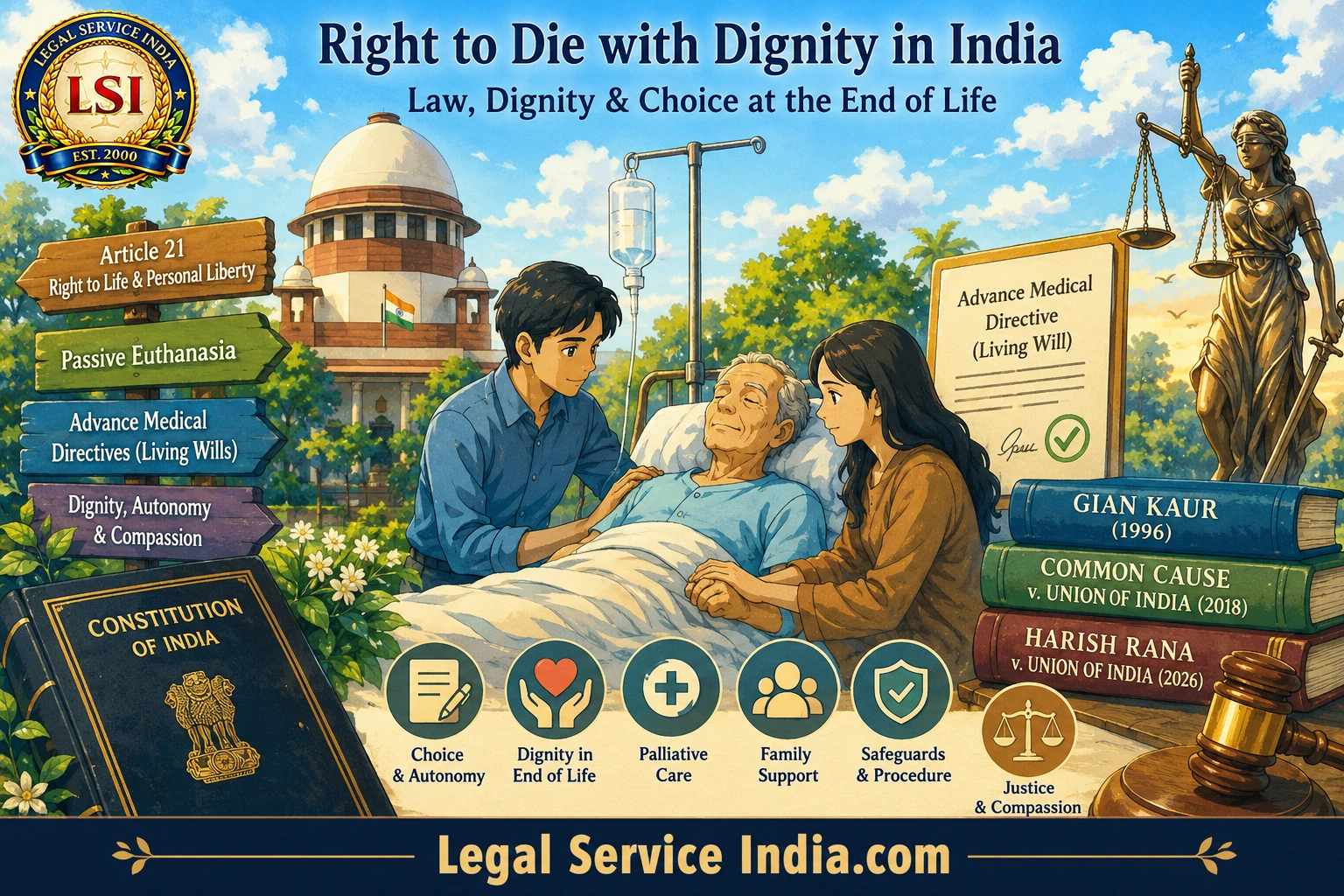
The “choice to leave,” a conceptual spectrum encompassing the competent refusal of life-sustaining treatment, the execution of advance directives, and the contentious pursuit of assisted dying, represents the ultimate intersection of constitutional liberty and state responsibility. This article examines the legal and ethical evolution of the “right to die with dignity” in India, tracing the judicial trajectory from P. Rathinam v. Union of India (1994), through Gian Kaur v. State of Punjab (1996), to the landmark Common Cause v. Union of India (2018) decision.
The study focuses on the recognition of passive euthanasia and Advance Medical Directives (Living Wills) as facets of Article 21 and on the continuing implementation challenges surrounding end-of-life decisions. It also considers the Supreme Court’s March 2026 decision in Harish Rana v. Union of India, particularly its treatment of Clinically Assisted Nutrition and Hydration (CANH) as medical treatment capable of withdrawal where the legal and medical requirements are satisfied.
The article argues that recognition of a constitutional right is meaningful only when supported by workable procedures, adequate palliative care, and safeguards for vulnerable persons. It proposes stronger institutional mechanisms, accessible advance-directive registration, and a statutory framework balancing individual autonomy with protection against coercion and abuse.
Introduction
The “choice to leave” represents one of the most difficult questions at the intersection of constitutional liberty, medical ethics, and state responsibility. At its core, the debate concerns liberty, dignity, personal autonomy, and the state’s duty to protect vulnerable persons. In India, the issue is closely connected with Article 21 of the Constitution, which protects life and personal liberty.
The judicial understanding of Article 21 has evolved significantly. The decision in Gian Kaur v. State of Punjab (1996) rejected the proposition that the right to life ordinarily includes a general right to die, while recognizing the importance of a dignified end of life. Later, Common Cause v. Union of India (2018) gave constitutional recognition to the right to die with dignity in the context of end-of-life medical decisions and validated Advance Medical Directives.
The continuing challenge is implementation. A constitutional right must be capable of being exercised through clear, accessible, and reliable procedures. The Supreme Court’s subsequent modification of the Common Cause framework and its decision in Harish Rana v. Union of India in March 2026 demonstrate the continuing effort to reconcile dignity, medical judgment, family interests, and institutional safeguards.
Research Methodology
This study adopts a doctrinal and analytical research methodology. It examines constitutional provisions, statutes, judicial decisions, and the development of legal principles concerning passive euthanasia and advance medical directives.
The research focuses on two principal questions: first, how the judicial understanding of “life” under Article 21 has developed from an emphasis on preservation of life toward recognition of dignity and autonomy at the end of life; and second, whether procedural safeguards adequately bridge the gap between recognition of the right in law and its practical accessibility.
The scope is confined primarily to passive euthanasia and advance medical directives within the Indian legal system. Active euthanasia and physician-assisted suicide are not treated as the subject of the study, except where a brief distinction is necessary.
The Philosophical Evolution of Article 21
The jurisprudence may broadly be understood through two competing ideas: the sanctity of life and the quality of life.
In Gian Kaur (1996), the Supreme Court adopted a life-centric approach and rejected a general constitutional right to terminate life. At the same time, the judgment recognized that the concept of a dignified life may extend to a dignified process of dying.
Common Cause (2018) marked a major constitutional development. The Supreme Court recognized that the right to live with dignity under Article 21 includes, in appropriate end-of-life circumstances, the right to refuse medical treatment and to avoid the prolongation of a life that has irreversibly lost meaningful quality. The Court also recognized Advance Medical Directives as an expression of individual autonomy.
The development therefore does not create an unrestricted right to death. Rather, it recognizes a limited right concerning end-of-life medical treatment, subject to safeguards designed to ensure that the decision is informed, voluntary, and legally compliant.
Harish Rana v. Union of India (2026): From Survival to Dignity
The Supreme Court’s decision in Harish Rana v. Union of India, delivered on 11 March 2026, represents an important practical development in the jurisprudence of passive euthanasia. The case concerned a patient who had remained in an irreversible vegetative state for many years. The Court considered whether Clinically Assisted Nutrition and Hydration (CANH) constituted medical treatment that could lawfully be withdrawn under the framework developed in Common Cause.
The Supreme Court treated CANH as medical treatment and considered the question through the principle of the best interests of the patient. The decision demonstrates that end-of-life jurisprudence cannot be reduced to the question of whether a patient is technically receiving mechanical ventilation. Instead, the legal inquiry may extend to other forms of technologically mediated medical intervention where the relevant medical and legal conditions are satisfied.
The judgment is significant because it demonstrates the practical application of principles that had previously been recognized constitutionally. It also highlights the importance of medical consensus, procedural safeguards, family consultation, and judicial oversight in decisions concerning withdrawal of treatment.
The Continuing Implementation Gap
The recognition of the right to die with dignity does not, by itself, resolve the practical difficulties faced by patients, families, and hospitals. Advance directives must be properly authenticated and verified, medical opinions must be obtained, and the applicable institutional and legal procedures must be followed.
The complexity of these procedures creates an important policy question: how can the legal system protect vulnerable persons without making a constitutionally recognized right practically inaccessible? The answer requires a balance between safeguards and efficiency.
Greater awareness of advance medical directives, accessible systems for their registration and verification, clear hospital protocols, and adequate palliative-care infrastructure can help reduce uncertainty while maintaining necessary protections.
Constitutional and Legal Framework
Article 21 forms the constitutional foundation of the right to life and personal liberty. The jurisprudence of Gian Kaur and Common Cause demonstrates the distinction between an unrestricted claim to terminate life and the limited recognition of dignity in end-of-life medical decision-making.
The Mental Healthcare Act, 2017, and the Bharatiya Nyaya Sanhita, 2023, also form part of the broader legal context concerning state responses to mental health crises and conduct connected with public authority. These provisions should be interpreted carefully and distinctly from the passive-euthanasia framework, which concerns withdrawal or withholding of medical treatment in appropriate end-of-life circumstances.
The central constitutional question remains one of balancing individual autonomy with the state’s protective responsibility. Any future statutory framework should preserve informed choice while preventing coercion, exploitation, and decisions based merely on economic or social vulnerability.
Key Judicial Precedents
| Case | Year / Citation | Key Significance |
|---|---|---|
| P.Rathinam v. Union of India | 1994 | An earlier Supreme Court decision that adopted a broader interpretation of the relationship between Article 21 and the right to die; it was subsequently overruled by Gian Kaur. |
| Gian Kaur v. State of Punjab | (1996) 2 SCC 648 | Rejected a general constitutional right to die while recognizing the significance of a dignified end of life. |
| Aruna Ramachandra Shanbaug v. Union of India | (2011) 4 SCC 454 | An important decision concerning passive euthanasia and judicial safeguards. |
| Common Cause v. Union of India | (2018) 5 SCC 1 | Recognized the right to die with dignity in the context of end-of-life medical treatment and recognized Advance Medical Directives. |
| Harish Rana v. Union of India | 2026 INSC 222 | Addressed withdrawal of CANH and the application of the passive-euthanasia framework to a patient in an irreversible vegetative state. |
Roadmap for Reform
- First, palliative care should be made more widely accessible so that end-of-life decisions are not driven by the absence of adequate medical and supportive care.
- Second, India should develop reliable systems for registering, verifying, and accessing Advance Medical Directives, including appropriate digital infrastructure.
- Third, a clear statutory framework should consolidate the principles governing end-of-life medical decisions while preserving safeguards for persons who may be vulnerable to coercion or abuse.
- Finally, healthcare professionals, patients, and families should receive clearer guidance about the legal status of advance medical directives and the procedures applicable to withdrawal or withholding of treatment.
Conclusion
India’s jurisprudential journey toward recognising a right to die with dignity marks a significant development in constitutional law. The movement from Gian Kaur to Common Cause and, more recently, Harish Rana demonstrates an increasing emphasis on dignity, autonomy and patient-centred end-of-life decision-making.
At the same time, the existence of a constitutional right does not eliminate the need for safeguards. The legal system must ensure that decisions are informed, voluntary, and medically justified, while protecting vulnerable persons from coercion or exploitation.
The future of end-of-life law in India therefore lies in achieving a careful balance: preserving the sanctity of life while recognising that dignity, autonomy, and compassionate medical care remain important components of Article 21 until the very end.
References and Bibliography
- Constitution of India, 1950, Article 21.
- P. Rathinam v. Union of India, (1994).
- Gian Kaur v. State of Punjab, (1996) 2 SCC 648.
- Aruna Ramachandra Shanbaug v. Union of India, (2011) 4 SCC 454.
- Common Cause v. Union of India, (2018) 5 SCC 1.
- Harish Rana v. Union of India, 2026 INSC 222.
- Mental Healthcare Act, 2017.
- Bharatiya Nyaya Sanhita, 2023.
- Law Commission of India, Report No. 241, Passive Euthanasia – A Relook (2012).
Written By: Dhruvi Chauhan

