





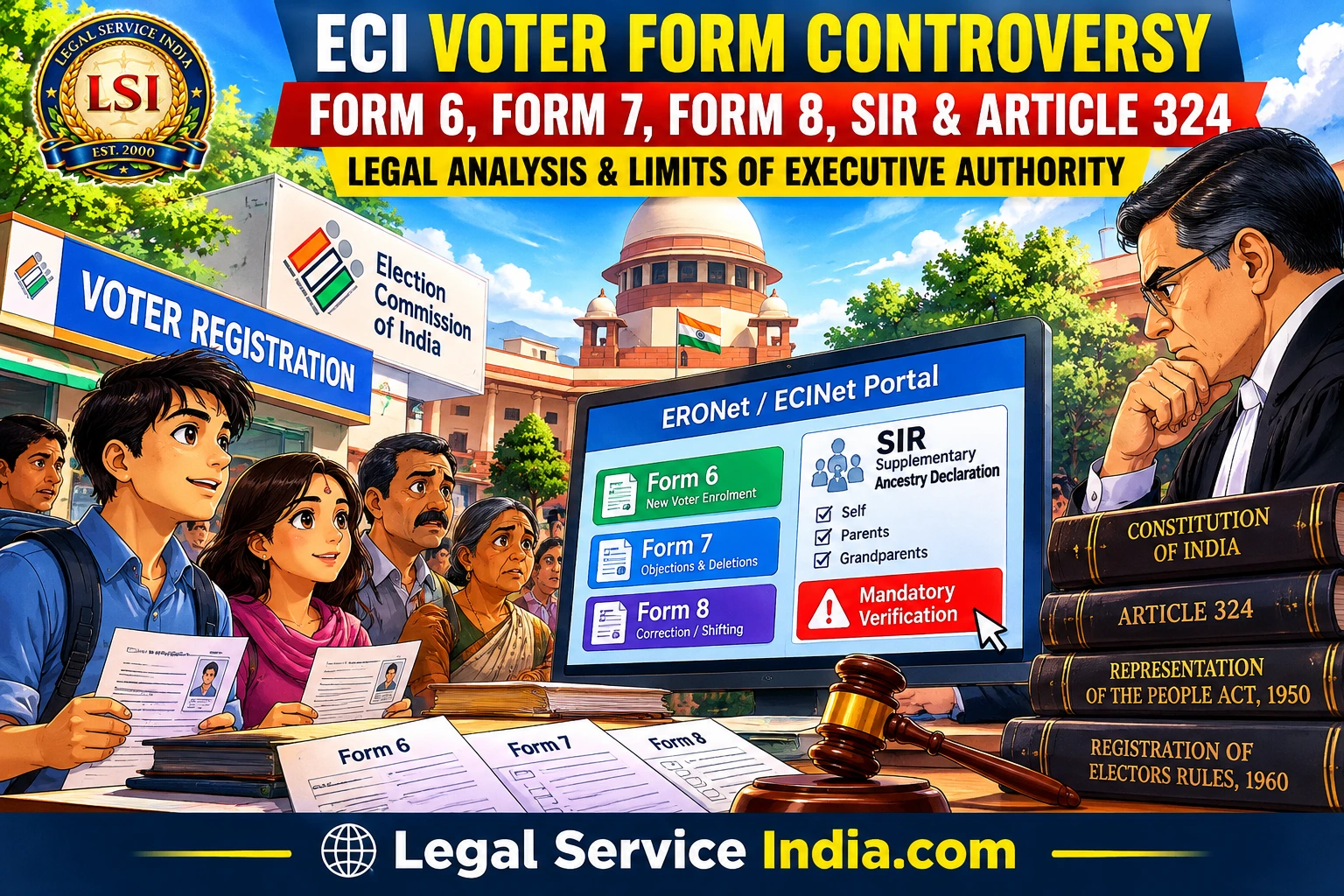
The ECI Voter Form Controversy: Forms 6, 7, and 8, SIR Declaration, and the Limits of Executive Authority
Abstract
The integrity of the electoral roll is the foundational bedrock of representative democracy. In India, voter registration, deletion, and correction are governed by statutory provisions under the Representation of the People Act, 1950 (RPA 1950) and the Registration of Electors Rules, 1960. However, the implementation of the Election Commission of India’s (ECI) Special Intensive Revision (SIR) exercise has triggered a national legal debate regarding executive authority and delegated legislation.
At the heart of this controversy is the legal character of statutory forms—specifically Form 6 (inclusion of new voters), Form 7 (objections and deletions), and Form 8 (corrections and shifting of residence)—and whether the ECI can unilaterally alter these forms or append mandatory digital declarations without formal statutory amendments. This paper presents a doctrinal analysis of the ECI voter form controversy. It deconstructs the legal validity of ancestry declarations appended to Form 6, evaluates the limits of the Commission’s residual administrative authority under Article 324 of the Constitution, and proposes legal safeguards to balance administrative efficiency with constitutional legality.
Statutory Rule-Making Scheme
| Statutory Framework | Authority / Requirement |
|---|---|
| Representation of the People Act, 1950 (Section 28) | Rule-Making Authority: Central Government (in consultation with ECI) Statutory Requirement: Official Gazette Notification & Parliamentary Laying Procedure (Section 28(3)) |
Registration of Electors Rules, 1960
| Form | Relevant Rules | Primary Function |
|---|---|---|
| Form 6 | Rules 13(1) & 26 | New Voter Enrolment |
| Form 7 | Rule 13(2) | Objections & Deletions |
| Form 8 | Rules 13(3) & 26 | Shifting/Correction |
Administrative & Digital Implementation
ERONet / ECINet Portal Architecture
- Mandatory Digital “Supplementary Ancestry Declaration” (Annexure D)
- Soft-coded mandatory gate enforcing legacy roll matching before statutory Form 6 submission can complete.
The Statutory Triad: Understanding Forms 6, 7, and 8 under the 1960 Rules
To evaluate the ongoing constitutional challenge, one must examine the distinct statutory mandates assigned to the core voter registration forms under the Registration of Electors Rules, 1960:
1. Form 6 (Application for Inclusion of Name in Electoral Roll)
Statutory Authority: Governed by Rules 13(1) and 26 of the 1960 Rules.
CEO Bihar
Scope & Function: Form 6 is the primary statutory vehicle through which a citizen exercises their right under Section 19 of the RPA 1950 to be enrolled as an elector. It requires proof of age (qualifying date) and ordinary residence within the assembly constituency.
Evidentiary Threshold: Under the statutory scheme, an applicant must attach self-attested documents confirming date of birth and residence. The Electoral Registration Officer (ERO) or Assistant ERO (AERO) is empowered under Rule 19 to conduct localized inquiries if doubts arise.
Voter – Election Commission of India
2. Form 7 (Application for Objection / Deletion of Name)
Statutory Authority: Governed by Rule 13(2) of the 1960 Rules.
Scope & Function: Form 7 functions as an adversarial procedure allowing an existing elector to object to an improper inclusion or seek the removal of an entry on grounds of death, permanent shifting, or statutory disqualification under Section 16 of the RPA 1950.
Procedural Safeguards: To prevent weaponized or bad-faith deletions, Rule 20 mandates that no name shall be struck off without issuing a notice to the affected individual and providing a reasonable opportunity to be heard (principles of natural justice).
3. Form 8 (Application for Correction of Particulars / Shifting of Residence)
Statutory Authority: Governed by Rules 13(3) and 26 of the 1960 Rules.
Voter – Election Commission of India
Scope & Function: Form 8 is reserved exclusively for citizens who are already registered electors in the electoral database. It covers internal shifting within or between constituencies, corrections of typographical errors, and issuance of replacement Electoral Photo Identity Cards (EPIC).
CEO Bihar
Systemic Role: Proper processing of Form 8 is essential to maintain roll accuracy without creating duplicate EPIC profiles across different state constituencies.
The SIR Declaration Controversy & The Rule-Making Power
Deconstructing the Form 6 Controversy: Mandatory Ancestry Declarations
During the Special Intensive Revision (SIR) exercises, the Election Commission deployed software modifications across its online application portals (ERONet and ECINet). When an applicant sought to submit Form 6 digitally, the application interface presented a non-bypassable digital gateway (commonly designated in field orders as Annexure D or Supplementary Declaration).
This declaration compelled applicants to match themselves, their parents, or their grandparents to historical electoral rolls generated during prior intensive revisions (e.g., 2002 or 2005 intensive revisions).
Comparative Doctrinal & Practical Matrix
| Feature | Statutory Form 6 (1960 Rules) | SIR Supplementary Portal Gate (Annexure D) |
|---|---|---|
| Primary Authority | Sec 28, RPA 1950; Central Govt Gazette | Executive Circulars & ECI Administrative Directions |
| Parliamentary Oversight | Mandatory: Subject to Section 28(3) scrutiny | None: Bypasses legislative review |
| Required Proofs | DOB + Proof of Ordinary Residence | Historical Electoral Ancestry (20–25 year link) |
| Verification Mechanism | Post-submission field verification by BLO/ERO | Pre-submission digital block (Code-level gate) |
The doctrinal invalidity of this procedure stems from two distinct administrative defects:
A. Violation of Delegated Rule-Making Procedures under Section 28
Under Section 28(1) of the RPA 1950, the power to frame rules for the preparation and revision of electoral rolls resides with the Central Government, which acts in consultation with the ECI.
Furthermore, Section 28(3) imposes a mandatory parliamentary control mechanism:
“Every rule made under this Act shall be laid, as soon as may be after it is made, before each House of Parliament…”
Because the statutory forms (Forms 6, 7, and 8) are embedded within the Schedule of the Registration of Electors Rules, 1960, any alteration to the eligibility conditions or documentary mandates requires a formal Official Gazette Notification issued by the Ministry of Law and Justice, followed by parliamentary laying. Introducing substantive documentation hurdles via executive orders or software code updates bypasses this legislative architecture.
B. The Architecture of “Code as Law” and Exclusionary Gates
In modern administrative law, software architecture often functions as an implicit regulator. By soft-coding the ancestral lookup fields as mandatory inputs within the ERONet portal, the ECI created a conditional barrier. An applicant who was unable to locate their grandfather’s 2002 electoral entry could not proceed to generate an application reference number.
While the ECI maintained that the supplementary declaration was a distinct verification questionnaire under its special revision powers rather than an amendment to Form 6 itself, the technical integration yielded an identical legal result: it transformed an unconditional statutory right to apply into a conditional privilege.
Everyday Citizen Context: The Operational Disconnect
To understand the real-world impact of these administrative mechanics, consider three common scenarios where procedural changes affect ordinary citizens:
Scenario 1: The First-Time Young Elector
Statutory Expectation: A 19-year-old college student presents a birth certificate and a college hostel residence certificate to enroll via Form 6.
Administrative Reality under SIR Gate: The digital interface refuses to accept the application without an EPIC number or electoral roll entry of the applicant’s parents or grandparents from an earlier revision drive. If the family migrated across states or lacks old paper records, the student is digitally locked out before an ERO can assess their credentials.
Scenario 2: The Interstate Urban Migrant
Statutory Expectation: A worker relocating from a rural district to an industrial center submits Form 8 to transfer their residential address.
Administrative Reality under SIR Gate: System logic errors on the portal reject Form 8 transfers between distinct states, prompting the system to instruct the user to file a “fresh” Form 6. Consequently, an established voter is misclassified as a brand-new applicant and subjected to ancestral verification checks.
Judicial Scrutiny, Recommendations & Endnotes
Judicial Standards: Article 324 and the Limits of Plenary Authority
The Election Commission has historically defended administrative innovations by invoking its plenary powers under Article 324 of the Constitution and Section 21(3) of the RPA 1950 (which permits the Commission to order a special revision “in such manner as it may think fit”).
However, judicial precedent establishes clear boundaries regarding where executive discretion ends and statutory law begins:
Constitutional Boundaries of Article 324
| Judgment | Principle |
|---|---|
| Mohinder Singh Gill (1978) | Article 324 acts as a “reservoir of power” ONLY where statutory law is silent. It CANNOT override express statutory rules. |
| A.C. Jose (1984) | Plenary power operates ONLY in interstices. It CANNOT override or supplement notified statutory rules. |
The Doctrine of Interstitial Operation (A.C. Jose v. Sivan Pillai, 1984)
The Supreme Court established that when Parliament has enacted specific statutory rules (e.g., the Registration of Electors Rules, 1960), the ECI cannot invoke Article 324 to issue administrative instructions that add inconsistent or onerous burdens to those rules. Executive power operates interstitially—filling gaps where the law is silent—but cannot supplant statutory text.
The Rational Nexus & Non-Exclusion Principle
In reviewing SIR portal challenges, the Supreme Court emphasized that administrative procedures must satisfy the test of proportionality. While purging invalid or fraudulent entries is a legitimate statutory objective, requiring decades-old genealogical tracking creates an arbitrary evidentiary burden that disproportionately disenfranchises mobile, landless, and marginalized populations.
Institutional Collegiality and Internal Decision-Making
Judicial examination of internal Commission file notings revealed significant institutional disagreement. Dissenting records noted that introducing fundamental changes to registration forms without formal statutory amendments or full multi-member Commission consensus undermined internal governance norms.
Recommendations for Electoral Roll Governance
To align electoral administration with constitutional standards, the following legal reforms should be implemented:
| No. | Proposed Reform | Recommended Action |
|---|---|---|
| 1 | Formal Rule Amendments (Sec 28 RPA 1950) | Any modification to voter eligibility declarations or registration requirements must be enacted by amending the Registration of Electors Rules, 1960 through Official Gazette notifications—never software code. |
| 2 | Uncoupling Digital Portals from Statutory Submission Rights | The ERONet/ECINet platform must permit unconditional submission of Form 6. Any supplementary ancestral inquiries must function as non-fatal, post-submission verification requests handled by the ERO. |
| 3 | Automated System Logic Corrections for Form 8 | Software architecture must be re-engineered to process inter-constituency address shifts seamlessly on Form 8, preventing voters from being incorrectly routed into fresh Form 6 filings. |
| 4 | Procedural Safeguards Against Arbitrary Deletions (Form 7) | EROs must enforce mandatory field verification and written notice hearings under Rule 20 before striking off any elector during revision drives. |
Conclusion: Reconciling Administrative Efficiency with Constitutional Legality
The controversy surrounding Form 6 and the Special Intensive Revision highlights a key tension in modern governance: balancing digital efficiency with statutory legality. While the Election Commission’s mandate to maintain an accurate electoral roll is essential to free and fair elections, administrative convenience cannot supersede legislative procedures.
By strictly adhering to the statutory rule-making framework under Section 28 of the Representation of the People Act, 1950, and respecting the boundaries of delegated legislation, India’s electoral framework can maintain procedural due process, prevent arbitrary disenfranchisement, and reinforce public trust in democratic institutions.
Endnotes & Legal Citations
- Representation of the People Act, 1950, §§ 16, 19, 21(3), 28, No. 43, Acts of Parliament, 1950 (India).
- Registration of Electors Rules, 1960, Rules 13, 19, 20, 26; Schedule Forms 6, 7, 8 (India).
- Constitution of India, 1950, Arts. 324, 325, 326.
- Mohinder Singh Gill v. Chief Election Commissioner, (1978) 1 SCC 405 (Establishing that Article 324 is subject to statutory law).
- A.C. Jose v. Sivan Pillai, (1984) 2 SCC 656 (Defining strict limits on executive instructions overriding statutory rules).
- Union of India v. Association for Democratic Reforms, (2002) 5 SCC 294 (Delineating executive gaps versus legislative provisions).
- Election Commission of India, Orders and Directives on Special Intensive Revision (SIR) and ERONet Operations, ECI Directives (2025–2026).
- Supreme Court of India, Orders on Judicial Review of Electoral Roll Modification Portals, W.P. (C) 2026.
