





Abstract
The 73rd Constitutional Amendment was made to empower the local government bodies and increase women’s representation in Panchayati Raj Institutions. But in many cases the elected woman Sarpanches are not able to govern the village due to the dominance of their husbands or any other male members in the family, a phenomenon known as Sarpanch Patriarchy or Sarpanch Pati.
So, the research is conducted to study the suggestions of this particular type of patriarchy and its significance in the constitutional governance of the country. The research further aims to analyze the social and political causes behind the dominance of men over empowered women Sarpanches and analyse if the current legal framework is sufficient to deal with this type of proxy governance.
The method adopted is a doctrinal research approach based on the analysis of the relevant legislations and case laws, governmental reports, and research publications. The research paper tries to establish that only reservation for women in Panchayati Raj Institutions is not enough, women must be given with enough resources to take decisions on their own without depending on their husbands, father, or sons as heads of the family or society.
The research makes many suggestions for consideration to ensure political empowerment and constitutional governance in the state, starting from increasing awareness about their rights between the people to strict punishment for those misusing their positions as Sarpanches. Finally, the research concludes by highlighting the importance of making sure that every citizen of the country is governed justly and constitutionally.
Introduction
Local self-government occupies a distinctive place in India’s constitutional design. Article 40 directs the State to organise village panchayats and endow them with the powers needed to function as units of self-government,¹ and the Constitution (Seventy-third Amendment) Act 1992 converted that aspiration into an enforceable framework by inserting Part IX.² Its most transformative feature is gender-based reservation: not less than one-third of seats, and of the offices of chairperson at every tier, must be reserved for women.³ Many States have gone further and provide for fifty per cent reservation, Bihar leading the way in 2006.⁴
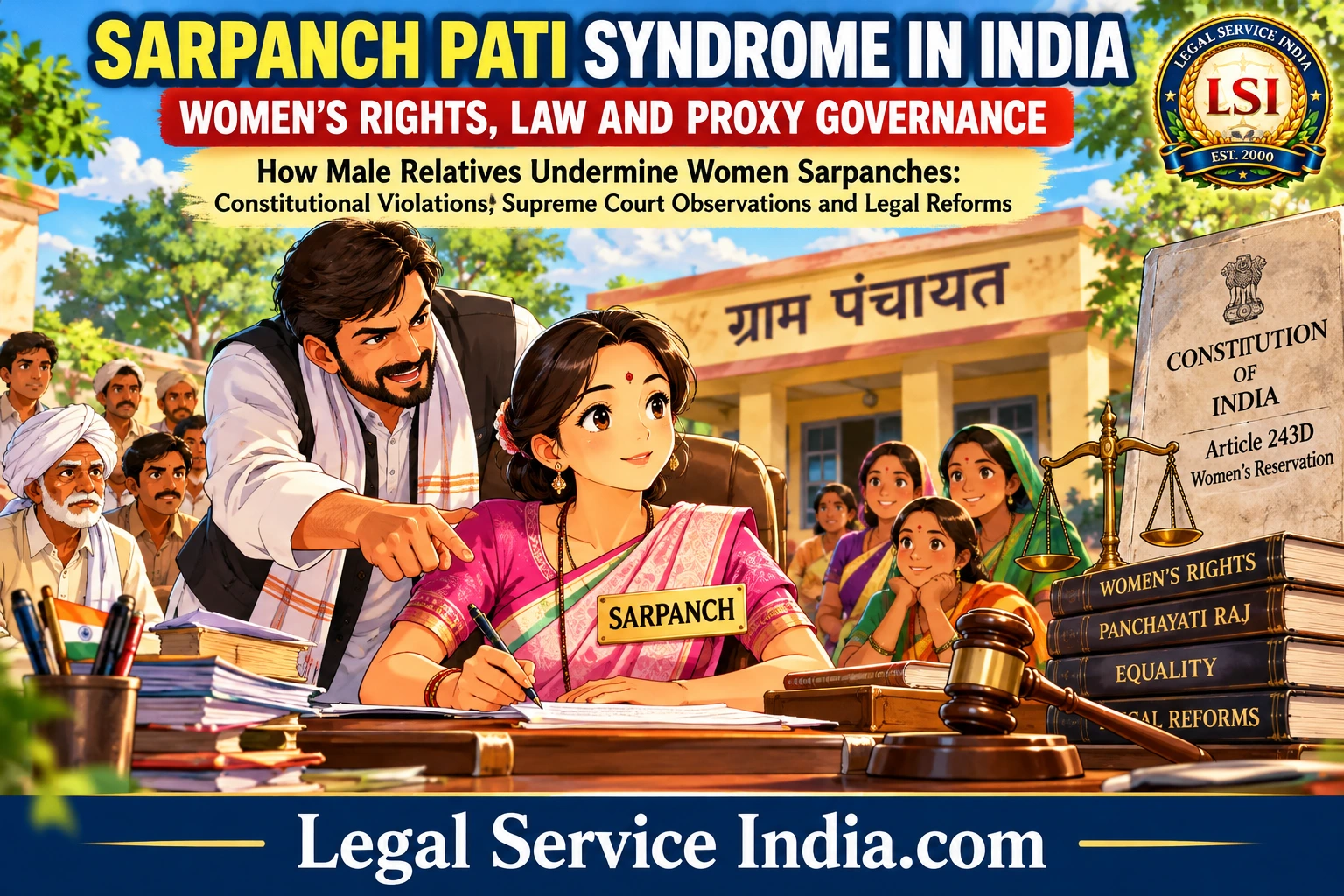
The numerical results are striking. Women are now estimated to account for roughly 46 per cent of elected representatives in local governance bodies.⁵ Yet a paradox accompanies this progress. In numerous villages the woman who holds the title performs a largely ceremonial role, while her husband, father-in-law, brother or son attends meetings, signs papers, deals with officials and takes the decisions. The practice is known as sarpanchpati and, depending on the region and the title of the office, as pradhan-pati, mukhiya-pati or sarpanch-devar.
This article asks what the law can and cannot do about the gap between formal and substantive representation. It argues that sarpanchpati is not merely a social custom but a constitutional wrong: it hollows out the reservation guaranteed by Article 243D, offends the guarantees of equality and dignity, and is incompatible with the fiduciary nature of public office. At the same time, the legal response is underdeveloped, because no central statute names the practice and the sanctions available under State legislation were not designed with proxy governance in mind.
1. Research Problem / Research Question
The research problem lies in the distance between formal and substantive representation. Reservation guarantees that a woman occupies a chairperson’s office; it does not, by itself, guarantee that she exercises it. Where a male relative controls decisions, the elected woman is reduced to a signatory, the electorate’s choice is displaced by an unelected private individual, and the constitutional purpose of Article 243D is defeated. The law, meanwhile, appears to say little about the problem directly.
The Central Research Question
The central research question is: does the existing constitutional, statutory and judicial framework in India adequately prohibit and remedy the proxy exercise of reserved panchayat offices by male relatives, and if not, what legal reforms are required?
Sub-Questions
Three sub-questions follow.
- First, does sarpanchpati violate the Constitution or merely frustrate its spirit?
- Second, what statutory tools do State panchayat laws offer to address it?
- Third, how have the courts and other institutions responded, and with what effect?
2. Objectives of the Study
The study pursues the following objectives:
- to define sarpanchpati and identify its principal forms and causes;
- to assess its compatibility with Article 243D and with the constitutional guarantees of equality and dignity;
- to examine the statutory framework governing the powers, duties and removal of panchayat chairpersons;
- to analyse judicial and institutional responses, including decisions of the Supreme Court and recent action by the Ministry of Panchayati Raj and the National Human Rights Commission; and
- to propose legally workable reforms.
3. Research Methodology
This study follows the doctrinal method of legal research. It proceeds by identifying, analysing and synthesising authoritative legal sources to determine what the law is and what it ought to be.⁶ The primary sources are Part IX of the Constitution, the related fundamental rights and duties, State panchayat legislation, and decisions of the Supreme Court. The secondary sources comprise the report of the Ministry of Panchayati Raj’s expert committee, the proceedings of the National Human Rights Commission, scholarly literature and reputable news reports. Citations follow the OSCOLA style.
The study has three limitations. It is not empirical, and so does not claim to measure how widespread the practice is. It does not survey the panchayat statutes of every State exhaustively, and statements about State law are therefore made at a general level. And because recent developments are reported chiefly through news sources and official releases, those accounts should be checked against primary documents as these become available.
⁶ Terry Hutchinson and Nigel Duncan, ‘Defining and Describing What We Do: Doctrinal Legal Research’ (2012) 17 Deakin Law Review 83.
4. Main Discussion and Legal Analysis
4.1 Concept and Manifestations
Sarpanchpati describes a situation in which a man linked to an elected woman by marriage or kinship exercises the real authority of her office. Proxy takes several forms. In its mildest form, the woman formally decides, but only as her husband directs. More commonly, he attends panchayat and Gram Sabha meetings in her place, receives official communications, and negotiates with block-level officials. At the extreme, her signature is obtained without her understanding the document, or she is kept entirely out of public view. Official literature widely recognises the practice as a distortion of the reservation scheme.⁷
The practice is not confined to gram panchayats. The National Human Rights Commission (NHRC) has noted that proxy representation operates in urban local bodies as well, and not only through male relatives but also through selfappointed liaison personnel.⁸
4.2 Causes
Several mutually reinforcing factors sustain the practice. Patriarchal norms treat public authority as a male domain and expect women to defer to male family members, and in some regions customs of seclusion restrict women’s mobility. Limited literacy, little exposure to administrative procedure and inadequate training leave many first-time office-holders dependent on informal guidance, which male relatives are eager to give.
Political economy also plays a part. Article 243D(3) provides that reserved seats may be allotted by rotation to different constituencies,⁹ so a seat reserved in one term may be open to all in the next. A male leader who loses his seat to reservation therefore has an incentive to field his wife or another female relative as a placeholder and retain control until the seat is released. Finally, hostility to women’s authority is sometimes openly expressed, as the Supreme Court recognised in a recent case discussed below, where villagers were found unable to accept that an elected woman would decide matters on their behalf.
4.3 Constitutional Analysis
Reservation for women is a special provision of the kind that Article 15(3) permits,¹⁰ and its constitutional purpose is substantive equality. Hanna Pitkin’s classic distinction between descriptive representation, where representatives resemble those they represent, and substantive representation, where they act for them,¹¹ helps to locate the injury. Reservation delivers the first. Sarpanchpati intercepts the second, because the person who acts is not the person elected.
A purposive reading of Article 243D supports this view. The Constitution reserves the offices of chairperson, and the powers of those offices are vested by law in the incumbent. A reading that treats the reservation as satisfied once a woman takes the oath, while allowing someone else to wield the authority, would reduce a constitutional guarantee to a formality. The better view is that the reservation carries an implied requirement that the woman actually hold and exercise the office.
Other guarantees point the same way. A woman who is elected but prevented from governing is denied equality of opportunity in public life under Article 14, and her dignity, which is integral to the right to life under Article 21, is compromised when she is treated as an instrument of her family’s ambitions. Article 51A(e) further casts a duty on every citizen to renounce practices derogatory to the dignity of women.¹² India’s obligation under Article 7 of the Convention on the Elimination of All Forms of Discrimination against Women to ensure women’s equal participation in public life reinforces the point,¹³ and the Supreme Court has held that such international norms may be read into domestic guarantees where domestic law is silent.¹⁴
4.4 Delegation, Fiduciary Duty and Accountability
Administrative law offers a second line of analysis. Powers conferred by statute on a named authority must be exercised by that authority, and a delegate cannot sub-delegate unless the statute allows it, a principle captured in the maxim delegatus non potest delegare.¹⁵ State panchayat statutes vest powers in the sarpanch or pradhan by designation and ordinarily permit delegation, if at all, only to defined functionaries such as the deputy chairperson. A private individual who is neither elected, nor sworn in, nor appointed under the statute has no legal authority to exercise those powers. Decisions taken by him, or at his dictation, are exposed to challenge as taken without jurisdiction or in abdication of the statutory duty to apply one’s own mind.
The practice also dissolves accountability. The proxy takes no oath of office, cannot be voted out through a no-confidence motion, and faces none of the disqualification provisions that bind the elected holder, yet he shapes decisions on public funds and schemes. The voter’s choice, the foundation of representative democracy, is displaced by the choice of the family.
The stakes are not abstract. A well-known study of village councils in West Bengal and Rajasthan found that women leaders invested differently from men, favouring public goods such as drinking water that women themselves identified as priorities.¹⁶ To the extent that proxy leadership silences the woman’s voice, such benefits are lost.
5. Relevant Statutory and Judicial Analysis
5.1 Constitutional and Statutory Framework
Part IX supplies the structure. Article 243B provides for the constitution of panchayats at the village, intermediate and district levels, Article 243D provides for reservation, and Article 243G empowers State legislatures to endow panchayats with powers and responsibilities for economic development and social justice.¹⁷ The detailed rules on the powers, duties, conduct and removal of chairpersons are left to State legislation, such as the Bihar Panchayati Raj Act 2006 and the corresponding statutes of other States.
Two features of this framework deserve attention. First, neither Part IX nor, as far as the sources consulted show, State legislation names or defines proxy governance as a distinct wrong. Second, the removal and disqualification provisions in State panchayat laws are generally directed at the office-holder’s own misconduct, such as abuse of position, neglect of duty or financial irregularity. They are poorly suited to proxy cases, where the woman often participates only under social pressure. Proceeding against her would penalise the very person the reservation exists to protect, while the male relative, the real beneficiary, remains outside the reach of the statute.
17 Constitution of India 1950, arts 243B, 243D and 243G.
5.2 Judicial Approach to Reservation
The Supreme Court has affirmed the constitutional importance of reserving chairperson offices in panchayats. In Bhanumati v State of Uttar Pradesh, it upheld the validity of such reservation, recognising it as a tool for empowerment.¹⁸ The difficulty of gender-sensitive scrutiny appears in Rajbala v State of Haryana, where the Court upheld educational qualifications for contesting panchayat elections despite the argument that they would disproportionately exclude women and marginalised groups, treating education as a rational qualification for effective governance.¹⁹ The decision shows that a woman’s capacity to exercise office is shaped by structural conditions, such as education, which the law itself can affect.
5.3 Judicial Responses to Sarpanchpati
In 2023, a non-governmental organisation, the Mundona Rural Development Foundation, approached the Supreme Court seeking directions against the practice. Although the order is reported to have deprecated sarpanchpati, the Court declined to issue directions, treating the remedy as lying in the policy domain and leaving the petitioner to approach the Union government.²⁰ The episode illustrates both the judiciary’s awareness of the problem and its reluctance to craft a remedy where the statutes are silent.
A different facet of the problem emerged in Manisha Ravindra Panpatil v State of Maharashtra. An elected woman sarpanch in Jalgaon district had been removed on allegations connected with her residence with her mother-in-law in premises said to be an encroachment. The Supreme Court set aside the removal as ‘highly disproportionate’, criticised the absence of proper verification, observed that the case reflected the villagers’ inability to accept a woman’s authority, and called on the authorities to sensitise themselves and create a congenial atmosphere for women in office.²¹ The case does not concern proxy rule, but it carries a lesson for reform: sanctions against proxy governance must be proportionate and procedurally fair, or they will themselves become instruments for removing women from office.
5.4 Executive and Commission Responses
The executive has begun to treat sarpanchpati as a governance problem. The Ministry of Panchayati Raj has issued advisories against the practice, and its expert committee headed by Sushil Kumar recommended exemplary penalties for proven cases of proxy leadership in order to deter interference by male relatives.²² In 2025, after a complaint, the NHRC issued conditional summons to senior officials of 32 States and Union Territories, describing proxy representation as defeating the constitutional mandate and seeking their responses on the practice.²³ These interventions are significant, but they are hortatory: advisories and recommendations do not create enforceable rights or duties.
22 ‘Report on “Sarpanch Pati” Proxy Practice’ (n 5); Ministry of Panchayati Raj (n 7).
23 ‘NHRC Initiates Action’ (n 8).
6. Findings / Observations
- Sarpanchpati is constitutionally objectionable. It defeats the purpose of Article 243D, offends Articles 14 and 21, and displaces the electoral mandate.
- The legal framework addresses it only indirectly. Part IX is silent and, as far as the sources consulted show, State laws do not specifically define or sanction proxy governance.
- Existing removal and disqualification mechanisms are aimed at the misconduct of the elected woman. They are ill-suited to proxy cases and risk penalising the victim.
- The Supreme Court has recognised the problem and the discrimination faced by women sarpanches, but has so far treated the creation of a remedy as a matter for executive and legislative policy.
- Rotation of reserved offices and entrenched social norms are key drivers, so legal sanctions alone cannot succeed without institutional and political reform.
- Sanctions must be calibrated. Panpatil shows that administrative power over women office-holders can itself be misused.
- Executive and commission initiatives are important but non-binding, and reliable data on complaints appears limited.
7. Conclusion and Suggestions
Sarpanchpati reveals that representation can be present in form and absent in substance. The promise of Article 243D is not that a woman’s name appear on the ballot, but that she governs. The law, as it stands, protects that promise only indirectly. The following suggestions aim at a response that is firm against proxy rule yet fair to the women whom reservation is meant to serve.
References and Reform Recommendations
- Statutory recognition. State legislatures should amend their panchayat laws, or the Union should circulate a model provision, to define the proxy exercise of reserved offices and declare it unlawful.
- Graded and fair sanctions. Penalties should be proportionate, beginning with warnings,counsellingcounselling and training, and escalating to fines for repeated interference. They should target the person who interferes and the officials who knowingly deal with a proxy, rather than the elected woman, and any proceeding should observe natural justice, consistent with the proportionality stressed in Panpatil.
- Safeguards for personal exercise. Women office-holders should take the oath in person and in public, sign official records personally and preside over meetings, and officials should be directed to decline to deal with nonmembers acting on a chairperson’s behalf. Audio-visual recording of Gram Sabha proceedings could assist verification, subject to privacy safeguards.
- Capacity building. Induction training should be mandatory after every election, supported by women’s peer networks and legal literacy programmes.
- Rotation reform. States should consider longer rotation cycles for reserved offices, so that women have time to build independent political careers and male leaders have less incentive to field placeholders.
- Accessible grievance redress. A confidential complaint channel, for instance through the district panchayat officer or a State-level ombudsman, should protect complainants from retaliation.
- Data and extension. States should collect and publish data on complaints, and similar safeguards should extend to urban local bodies and to the legislative seats to be reserved for women under the Constitution (One Hundred and Sixth Amendment) Act 2023, lest the phenomenon migrate.²⁴
- Law cannot by itself transform social attitudes, but it can remove the incentives and the impunity that sustain proxy rule. A framework that names the wrong, sanctions it fairly and supports women in office would bring local selfgovernment closer to its constitutional promise.
24 Constitution (One Hundred and Sixth Amendment) Act 2023.
8. Bibliography
Cases
- Bhanumati v State of Uttar Pradesh (2010) 12 SCC 1
- Manisha Ravindra Panpatil v State of Maharashtra 2024 INSC 761
- Mundona Rural Development Foundation v Union of India WP (C) 615/2023 (SC, 2023)
- Rajbala v State of Haryana (2016) 2 SCC 445
- Sahni Silk Mills (P) Ltd v Employees’ State Insurance Corporation (1994) 5 SCC 346
- Vishaka v State of Rajasthan (1997) 6 SCC 241
Legislation and Constitutional Provisions
- Bihar Panchayati Raj Act 2006
- Constitution of India 1950
- Constitution (Seventy-third Amendment) Act 1992
- Constitution (One Hundred and Sixth Amendment) Act 2023
International Instruments
- Convention on the Elimination of All Forms of Discrimination against Women (adopted 18 December 1979, entered into force 3 September 1981) 1249 UNTS 13
Books and Journal Articles
- Chattopadhyay R and Duflo E, ‘Women as Policy Makers: Evidence from a Randomized Policy Experiment in India’ (2004) 72 Econometrica 1409
- Hutchinson T and Duncan N, ‘Defining and Describing What We Do: Doctrinal Legal Research’ (2012) 17 Deakin Law Review 83
- Pitkin HF, The Concept of Representation (University of California Press 1967)
Reports and Online Sources
- Ministry of Panchayati Raj, Transforming Women’s Representation and Roles in Panchayati Raj Systems and Institutions: Eliminating Efforts for Proxy Participation (Report of the Committee headed by Sushil Kumar, 2025)
- ‘NHRC Initiates Action Against “Proxy Governance” in Women-Reserved Local Bodies; Issues Summons to Senior Officials of 32 States & UTs’ Verdictum (2025) https://www.verdictum.in/news/nhrc-conditionalsummonsstatesuts-curb-practice-proxy-representation-of-sarpanch-pati1601312 accessed 6 October 2026
- ‘Report on “Sarpanch Pati” Proxy Practice in Local Bodies, NHRC Directs States’ The Tribune (2025) https://www.tribuneindia.com/news/india/reportonsarpanch-pati-proxy-practice-in-local-bodies-nhrc-directs-states accessed 6 October 2026
End-Notes
- Constitution of India 1950, art 40.
- Constitution (Seventy-third Amendment) Act 1992, inserting pt IX (arts 243–243O) into the Constitution of India 1950.
- Constitution of India 1950, art 243D(3)–(4).
- Bihar Panchayati Raj Act 2006.
- ‘Report on “Sarpanch Pati” Proxy Practice in Local Bodies, NHRC Directs States’ The Tribune (2025) https://www.tribuneindia.com/news/india/report-on-sarpanch-pati-proxy-practiceinlocal-bodies-nhrc-directs-states accessed 6 October 2026.
- Ministry of Panchayati Raj, Transforming Women’s Representation and Roles in Panchayati Raj Systems and Institutions: Eliminating Efforts for Proxy Participation (Report of the Committee headed by Sushil Kumar, 2025).
- ‘NHRC Initiates Action Against “Proxy Governance” in Women-Reserved Local Bodies; Issues Summons to Senior Officials of 32 States & UTs’ Verdictum (2025) https://www.verdictum.in/news/nhrc-conditional-summons-statesuts-curb-practiceproxyrepresentation-of-sarpanch-pati-1601312 accessed 6 October 2026.
- Constitution of India 1950, art 243D(3).
- Constitution of India 1950, art 15(3).
- Hanna Fenichel Pitkin, The Concept of Representation (University of California Press 1967).
- Constitution of India 1950, arts 14, 21 and 51A(e).
- Convention on the Elimination of All Forms of Discrimination against Women (adopted 18 December 1979, entered into force 3 September 1981) 1249 UNTS 13, art 7.
- Vishaka v State of Rajasthan (1997) 6 SCC 241.
- Sahni Silk Mills (P) Ltd v Employees’ State Insurance Corporation (1994) 5 SCC 346.
- Raghabendra Chattopadhyay and Esther Duflo, ‘Women as Policy Makers: Evidence from a Randomized Policy Experiment in India’ (2004) 72 Econometrica 1409.
- Bhanumati v State of Uttar Pradesh (2010) 12 SCC 1.
- Rajbala v State of Haryana (2016) 2 SCC 445.
- Mundona Rural Development Foundation v Union of India WP (C) 615/2023 (SC, 2023).
- Manisha Ravindra Panpatil v State of Maharashtra 2024 INSC 761 (SC, 27 September 2024).
Written By: Anamika Dhaker – B.A.L.L.B student

