





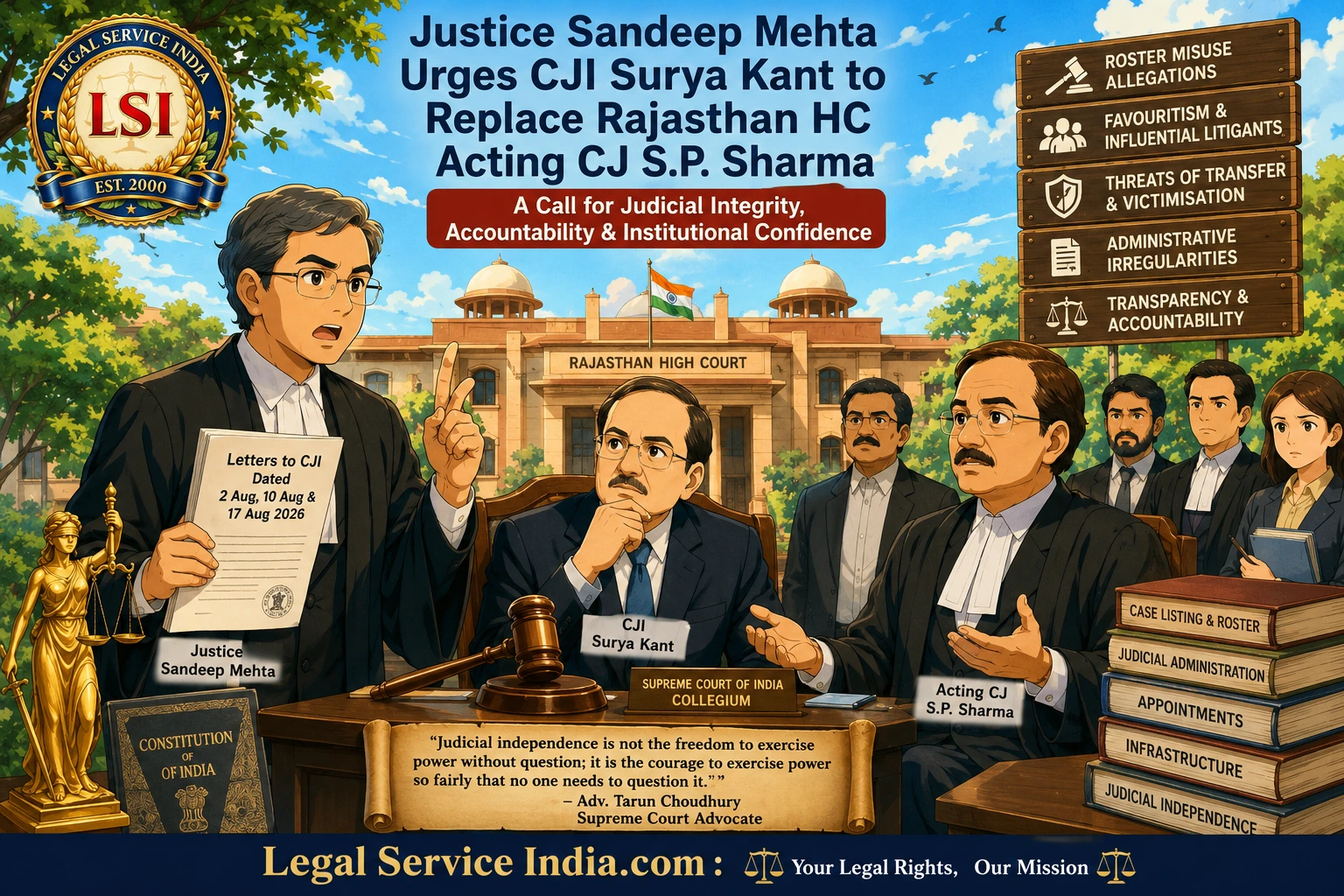
Justice Sandeep Mehta Urges CJI Surya Kant to Replace Rajasthan HC Acting CJ S.P. Sharma: What the Controversy Means for Judicial Administration
“Judicial independence is not the freedom to exercise power without question; it is the courage to exercise power so fairly that no one needs to question it. When the judiciary itself raises a question about its own functioning, the institution must listen—not to protect individuals, but to protect public faith in justice.” — Adv. Tarun Choudhury
Supreme Court Advocate
An Extraordinary Development in the Rajasthan High Court
The Indian higher judiciary has witnessed an unusually serious institutional development. Supreme Court Judge Justice Sandeep Mehta has written a series of letters to Chief Justice of India Justice Surya Kant, urging the immediate appointment of a regular Chief Justice from another High Court to head the Rajasthan High Court and seeking the transfer of its Acting Chief Justice, Justice Sanjeev Prakash Sharma, out of Rajasthan.
The matter is significant not because it is an ordinary judicial disagreement between two judges. It concerns allegations about the functioning of a High Court at the administrative level, including alleged misuse of roster powers, favouritism, threats of transfer, maladministration and questionable administrative decisions.
According to reports, Justice Mehta made these concerns known through letters dated 2 August, 10 August and 17 August 2026. The letters reportedly contain strong observations concerning the functioning of Justice Sharma as Acting Chief Justice.
At the outset, one legal distinction is essential: this is not a reported Supreme Court judgment against Justice Sharma. The development presently concerns communications by a sitting Supreme Court judge to the CJI and the Collegium. The allegations reported in those communications have not, on the material presently available, been adjudicated by a court or established through a judicial finding. That distinction must be maintained if the matter is to be discussed responsibly.
What Justice Sandeep Mehta Has Asked the CJI to Do
Justice Mehta has reportedly urged CJI Surya Kant to appoint a Chief Justice from another High Court to the Rajasthan High Court and transfer Justice S.P. Sharma away from Rajasthan.
His concern appears to go beyond the question of who should occupy the office of Chief Justice. The central issue raised is whether the continuing exercise of extensive administrative powers by an Acting Chief Justice, in the face of the complaints described in the letters, is in the best interest of the institution.
Justice Mehta reportedly expressed the view that continued inaction was against the interest of the institution and urged the Supreme Court Collegium to consider the matter urgently.
Why These Letters Are So Significant
In my view, the most important aspect of this controversy is not any individual allegation. It is the fact that a sitting Supreme Court judge, who himself served in the Rajasthan High Court, has directly raised concerns about the functioning of the Acting Chief Justice before the Chief Justice of India.
Such correspondence between members of the higher judiciary is ordinarily institutional and confidential. When portions of such communications become public, the issue naturally acquires substantial public importance because judicial independence depends not merely upon the independence of individual judges but also upon the credibility of the institution as a whole.
The office of a Chief Justice of a High Court carries responsibilities substantially wider than deciding individual cases. The Chief Justice controls, subject to applicable rules and established conventions, the constitution of benches, allocation of judicial work, roster arrangements and significant administrative functions.
Consequently, allegations concerning the exercise of these powers are institutionally serious even before one reaches the question of whether the allegations are ultimately proved.
Allegations Concerning Roster and Case Listing
One of the most sensitive issues raised by Justice Mehta reportedly concerns the alleged movement of cases from other benches to the bench of the Acting Chief Justice without adequate justification.
This goes directly to the constitutional importance of the master of the roster.
The Chief Justice of a High Court enjoys an important administrative position in determining the distribution of judicial work. But that power is not intended to become a mechanism for selecting a particular bench for a particular matter according to the identity of the litigant, lawyer or expected outcome.
The roster system exists precisely because institutional justice requires predictable allocation of judicial work. If cases are shifted selectively, the perception of justice can be damaged even where the ultimate judicial order is legally correct.
Justice Mehta reportedly referred to instances where matters were allegedly withdrawn from other benches and placed before Justice Sharma’s court. He also referred to specific litigation concerning land in Udaipur and another matter involving a substantial delay in filing a special appeal.
These allegations, however, should be treated as allegations unless and until an appropriate institutional process establishes the underlying facts.
The Alleged 457-Day Delay Controversy
Justice Mehta’s 10 August communication reportedly referred to a matter in which a delay of 457 days was condoned at the first hearing and interim relief was granted.
The controversy, as reported, is not simply about condonation of delay. Courts routinely have power to condone delay where sufficient cause is established. The institutional question is whether the matter was placed before the appropriate bench, whether the procedural route adopted was legally correct, whether the delay was properly considered and whether any external or irrelevant considerations influenced the exercise of judicial power.
Those are fundamentally different questions from the mere fact that delay was condoned.
A lawyer’s professional association with a judge before appointment, by itself, cannot establish bias or corruption. Equally, if a pattern of circumstances creates a reasonable institutional apprehension of preferential treatment, the matter deserves examination through appropriate mechanisms.
Concerns About Favouritism and Influential Litigants
The reports also refer to Justice Mehta’s allegations that certain lawyers and influential parties received favourable treatment through administrative or judicial processes.
This is perhaps the most damaging category of allegation that can be made against any judicial institution because the strength of the justice system ultimately rests on one simple public belief:
That the rich and powerful stand before the same court as the ordinary citizen.
If a litigant believes that money, influence or professional proximity can affect the listing of a case, confidence in the institution begins to erode. And once confidence disappears, even correct judgments may be viewed with suspicion.
For that reason, the judiciary must be particularly careful not only to avoid actual favouritism but also to avoid administrative practices that reasonably create such a perception.
Allegations of Threats and Victimisation
Another particularly serious aspect concerns allegations that judges were threatened with adverse administrative consequences, including transfers.
The independence of a High Court judge is not merely freedom from interference by the executive or legislature. It also includes the ability of a judge to decide cases without fear that an administrative superior will punish him or her for an unpopular judicial view.
According to reports, Justice Mehta stated that several Rajasthan High Court judges had expressed anguish about the alleged conduct of the Acting Chief Justice and alleged threats of transfer. He also referred to allegations concerning the treatment of the wife of a serving High Court judge, who is stated to be a senior officer in the district judiciary.
These allegations are particularly sensitive because the relationship between the High Court and subordinate judiciary must be based on institutional discipline, but never on fear.
The Jodhpur Court Building Controversy
Justice Mehta also reportedly raised concerns about the handling of a newly constructed court building at Jodhpur.
According to the reports, the building contained approximately 40 courtrooms and was stated to have been operationally complete for around a year. Justice Mehta alleged that its inauguration was held up and that changes to the infrastructure were subsequently ordered, even though courts in the judgeship were functioning from rented premises.
The issue may appear administrative, but it has a direct connection with access to justice.
Courthouse infrastructure is not merely a matter of aesthetics. Adequate courtrooms, judicial chambers, litigant facilities, lawyers’ facilities, record rooms and technological infrastructure directly affect the speed and quality of adjudication.
Where thousands of litigants and lawyers depend upon the court system, administrative decisions concerning infrastructure must ordinarily be guided by institutional necessity rather than personal preference.
Permanent Lok Adalat Appointments and Allegations of Nepotism
A separate complaint dated 25 July 2026 has also reportedly become relevant to the controversy. It allegedly raised questions concerning appointments to Permanent Lok Adalats in Rajasthan and suggested that some appointees had personal or familial connections with persons associated with Justice Sharma.
The complaint reportedly included allegations concerning an appointment connected with Jaipur Metro and other appointments involving persons alleged to be close to the Acting Chief Justice.
Again, these are allegations contained in a complaint and should not be presented as established facts.
Nevertheless, appointments to legal institutions must satisfy an exceptionally high standard of transparency. Where a decision-maker is alleged to have appointed relatives, friends or persons having close personal associations, the proper response is not to assume guilt but to ensure that the process can withstand independent scrutiny.
The History of Justice S.P. Sharma and the Collegium Question
Justice Sanjeev Prakash Sharma was appointed a judge of the Rajasthan High Court in November 2016 and was subsequently transferred to the Patna High Court in 2022.
Reports state that when Justice Sharma sought repatriation to Rajasthan on health grounds, the Supreme Court Collegium in March 2023 did not accept the request and instead recommended his transfer to the Punjab and Haryana High Court.
A later Collegium decision in 2025 permitted his return to Rajasthan. He subsequently became Acting Chief Justice of the Rajasthan High Court in September 2025.
Justice Mehta’s letters reportedly question why Justice Sharma was subsequently permitted to return to Rajasthan despite what Justice Mehta describes as concerns reflected in the earlier Collegium process.
This is an important institutional question, but it should not be misunderstood. A previous Collegium decision concerning transfer does not automatically amount to a finding of misconduct. Collegium resolutions may contain considerations that are not public, and the reasons for judicial transfers are often not equivalent to disciplinary findings.
The Timing of the Controversy Is Also Important
There is another important factor: Justice Sharma is reportedly due to retire on 26 September 2026.
That means the controversy has emerged immediately before his scheduled retirement.
Justice Mehta has reportedly referred to the concern that Justice Sharma has been exercising the powers of Acting Chief Justice for more than ten months and has also questioned what he described as attempts to secure his continuation or confirmation as Chief Justice.
The proximity to retirement makes the matter unusual. Any decision by the Collegium now would have to consider not merely the immediate administrative question but also the continuity of the Rajasthan High Court after September 2026.
Why the Office of Acting Chief Justice Matters
An Acting Chief Justice is not a ceremonial position.
The person occupying that office exercises important administrative authority. The Chief Justice decides or influences the distribution of cases, constitution of benches, administrative committees and numerous matters affecting the functioning of the High Court.
Therefore, prolonged uncertainty concerning the permanent leadership of a High Court can itself become an institutional concern.
A High Court should have leadership capable of commanding confidence across different constituencies: judges, lawyers, subordinate courts, registry officials, litigants and the public.
The question is consequently not simply whether Justice Sharma should continue. The larger question is whether the Rajasthan High Court has institutional leadership that inspires confidence in all sections of the judiciary and Bar.
The Master of the Roster: Power With Responsibility
From the perspective of a practising lawyer, one principle deserves emphasis: the power of roster allocation is one of the most sensitive administrative powers within a High Court.
A litigant ordinarily has no control over which bench hears his case. The lawyer has no right to demand a particular bench merely because he believes that bench will be favourable.
Precisely for that reason, the roster must be administered with institutional neutrality.
The moment litigants begin believing that cases can be moved from one bench to another because of the identity of a lawyer, litigant or subject matter, the legitimacy of the system is placed under unnecessary pressure.
The Chief Justice therefore has to act not only fairly but in a manner that is visibly fair.
Judicial Independence Also Requires Internal Accountability
There is sometimes a misconception that judicial independence means that judges should not be questioned.
That is not the constitutional position.
Judicial independence and judicial accountability are complementary principles.
A judge must be protected from improper external pressure. But that protection cannot become immunity from legitimate institutional scrutiny.
The higher judiciary has developed its own mechanisms for addressing concerns involving judges. The Supreme Court Collegium has an important role in transfers and appointments, while serious allegations of misconduct may engage other institutional and constitutional mechanisms depending upon their nature.
The answer to allegations against a judge cannot be trial by media. Nor can it be automatic dismissal of the allegations simply because the person concerned occupies high constitutional office.
The correct response is institutional examination, fairness to the judge concerned and protection of the credibility of the judiciary.
What Should Happen Next?
In my considered view, the immediate requirement is not a public confrontation between judges. It is a fair, confidential and institutionally credible examination of the allegations.
At least five things should follow.
- The allegations should be independently verified. Every specific allegation should be examined against the relevant orders, roster records, administrative files and appointment records.
- Justice Sharma should have an opportunity to respond. Serious allegations require procedural fairness. The person against whom allegations are made cannot be condemned merely because another constitutional authority has made them.
- The Collegium should examine the institutional implications. The question should include the welfare and credibility of the entire Rajasthan High Court.
- Roster administration should remain transparent and principled. Case allocation should be capable of objective explanation whenever serious concerns arise.
- A regular Chief Justice should be appointed without avoidable delay. Leadership of a High Court should not remain uncertain when the institutional need for stable leadership is apparent.
The Larger Constitutional Question
The controversy ultimately raises a question much larger than the personalities involved.
Who protects the institution when allegations arise within the institution itself?
When an ordinary litigant complains about a judge, the legal system provides procedures and institutional channels. But when a sitting Supreme Court judge raises concerns about the functioning of a High Court’s Acting Chief Justice, the matter becomes qualitatively different.
It is then the responsibility of the senior judicial leadership to ensure two things simultaneously:
- First, no judge is unfairly condemned.
- Second, no legitimate institutional concern is ignored.
Both principles are essential. Ignoring allegations can damage public confidence; acting on unverified allegations without due process can equally damage judicial independence.
Why the Public Should Pay Attention
For an ordinary citizen, a controversy involving High Court judges may appear remote. It is not.
Every property dispute, criminal appeal, service matter, constitutional challenge, bail application, commercial dispute and writ petition ultimately depends upon public confidence in the courts.
If people believe that the judicial system is governed by objective legal principles, they accept even an adverse judgment more readily.
But if people begin believing that access to justice depends upon influence, connections or wealth, the damage extends far beyond one case.
That is why allegations concerning judicial administration deserve serious attention, but they also deserve responsible reporting.
My Legal Assessment
As a lawyer who has spent more than two decades dealing with the courts, I would regard this episode as an institutional warning signal rather than merely a personal dispute between judges.
The reported allegations are serious enough to warrant examination. At the same time, the allegations must not be converted into conclusions before Justice Sharma has been given an opportunity to answer them and the competent institutional authorities have evaluated the evidence.
The credibility of the judiciary will ultimately depend upon how the system responds.
If the allegations are unfounded, the institutional process should establish that clearly.
If some allegations are substantiated, appropriate corrective action must follow.
And if the controversy demonstrates weaknesses in roster administration, judicial appointments or internal accountability, those weaknesses should be addressed irrespective of the individuals involved.
Conclusion
The development in which Justice Sandeep Mehta urges CJI Surya Kant to replace Rajasthan HC Acting CJ S.P. Sharma is undoubtedly one of the most significant judicial-administration stories emerging from India on 26 August 2026.
But it is important to describe the matter accurately. There is, as of now, no reported Supreme Court judgment adjudicating the allegations against Justice Sharma. What exists publicly is a series of communications by Justice Mehta raising serious institutional concerns and seeking intervention by the CJI and the Collegium.
The allegations include purported roster manipulation, favouritism, administrative irregularities, alleged threats of transfer, treatment of members of the subordinate judiciary and questions surrounding certain appointments. These allegations require scrutiny, but they remain allegations unless and until established through an appropriate process.
The real test now is not merely what decision is taken regarding one Acting Chief Justice. The real test is whether the Indian judiciary can demonstrate that institutional integrity, procedural fairness and public confidence are placed above individual personalities.
That is the standard expected from the highest constitutional court of the country.
And, ultimately, that is the standard upon which public faith in the judiciary rests.
Citation and Source Note
Primary reported development: Justice Sandeep Mehta’s letters dated 2 August, 10 August and 17 August 2026, as reported by Bar & Bench and subsequently covered by other legal-news organisations.
Important legal qualification: The present controversy should not be described as a “Supreme Court judgment” against Justice S.P. Sharma. The publicly reported material concerns letters/communications and allegations seeking institutional intervention. No final judicial determination of the allegations has been identified in the sources reviewed for this article.
Suggested citation for publication: Justice Sandeep Mehta’s letters to CJI Surya Kant regarding the functioning of Rajasthan High Court Acting Chief Justice S.P. Sharma, dated 2, 10 and 17 August 2026,
Need Legal Advice on a High Court or Supreme Court Matter?
If you are facing a legal dispute, judicial administration issue, High Court matter, Supreme Court case, appeal, writ petition, or any other serious legal concern, professional legal guidance can make a significant difference.
| Advocate | Adv. Tarun Choudhury |
|---|---|
| Experience | Supreme Court Advocate | 25+ Years of Legal Experience |
| Call | 9891244487 |
| 9650499965 |
Get professional legal guidance for your matter. Contact Adv. Tarun Choudhury today.
